REVIEW 3 major objections 5 minor 79 references
Fully characterized linear magnetoelectric response of 2D monolayers from high-throughput first-principles calculations
T0 review · 3 major / 5 minor · reviewed 2026-08-07 · deepseek-v4-flash
Pith's one-line read The paper claims that, among 4,784 screened monolayers, 124 should show a linear magnetoelectric response, with the antiferromagnet Mn2SI2 reaching about 580 ps/m—two orders of magnitude above Cr2O3 and comparable to the strongest bulk…
desk verdict Useful high-throughput screen with honest limitations; the Mn2SI2 number is conditional on a collinear ground state that the authors themselves flag. read the letter →
The pith
A machine-rendered reading of the paper's core claim, the machinery that carries it, and where it could break.
The reading
What carries the argument
The load-bearing object is the four-channel decomposition of the static linear magnetoelectric tensor, $\alpha = \alpha_{\mathrm{LM,S}} + \alpha_{\mathrm{CI,S}} + \alpha_{\mathrm{LM,L}} + \alpha_{\mathrm{CI,L}}$. Here LM and CI denote lattice-mediated (field-induced atomic displacements) and clamped-ion (electronic response at fixed nuclei) contributions, while S and L denote the spin and orbital magnetization channels. Each term is computed separately with density functional theory: LM terms from finite-difference response of spin and orbital moments to an applied electric field, CI spin from the Berry-phase polarization response to a magnetic field, and CI orbital from a perturbation-theory expression for field-induced changes in orbital moments. The decomposition is what lets the paper attribute the total response and demonstrate that no single channel is reliably dominant.
What would settle it
Measure the zero-field magnetic structure of Mn2SI2 below its ordering temperature with neutron or resonant x-ray scattering: a non-collinear or helical order would force the static linear magnetoelectric tensor to vanish, directly contradicting the 580 ps/m prediction. Short of that, recomputing the Mn2SI2 tensor with stricter SCF convergence and Hubbard U corrections—which the authors note can appreciably change Cr2O3—would test whether the giant lattice-mediated spin term is numerically robust.
Extended reading notes
Core claim
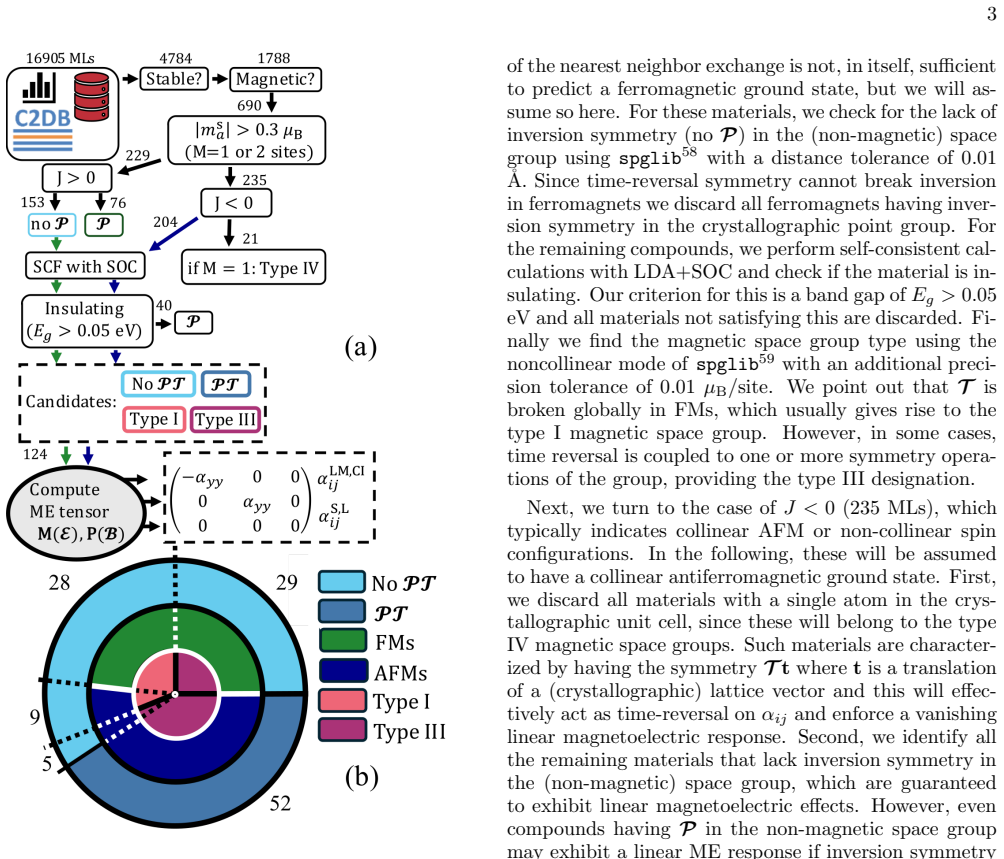
On the paper's own terms, the central discovery is that linear magnetoelectricity is widespread among two-dimensional magnets: of 4,784 stable monolayers screened, 57 ferromagnetic and 67 antiferromagnetic compounds are identified whose full static linear magnetoelectric tensor is nonzero and can be decomposed into spin, orbital, lattice-mediated, and clamped-ion parts. The strongest single component belongs to the antiferromagnet Mn2SI2, whose lattice-mediated spin term alone gives about $599\times10^{-3}$ attoseconds in two dimensions and, converted to a bulk value with a typical van der Waals gap, about 580 ps/m—two orders of magnitude above Cr2O3 and comparable to the largest response measured in TbPO4. The paper further claims that all four channels matter: in TaO2 the spin and clamped-ion channels combine with opposite sign to nearly cancel the large lattice-mediated orbital term, while in MnWSeTe3 the clamped-ion spin term dominates, and across the dataset only 21% of materials are governed by the lattice-mediated spin channel.
Load-bearing premise
The load-bearing premise is that every candidate's magnetic ground state is the collinear ferromagnetic or antiferromagnetic order implied by the sign of the nearest-neighbor exchange parameter; if a true ground state is non-collinear or helical, the predicted tensor, including Mn2SI2's 580 ps/m, is not valid.
Editorial extensions
If this is right
- If the screening is right, 124 monolayers become candidate linear magnetoelectrics, several of them already known as exfoliable van der Waals compounds, so the predicted tensors can be tested in few-layer devices.
- Antiferromagnetic order appears to produce systematically larger responses than ferromagnetic order, so future materials searches should focus on antiferromagnets with broken inversion or PT symmetry.
- Single-channel approximations are unsafe: because the four contributions carry independent signs, the total response can be much smaller or much larger than any individual term.
- A confirmed Mn2SI2 response would place a single monolayer on par with the strongest bulk magnetoelectrics, suggesting voltage-controlled magnetism is achievable at the two-dimensional limit.
- Antimagnetoelectric entries mean that some tensor components vanish by site-level cancellation, so experiments probing a particular component must distinguish local from global response.
Reading between the lines
- My inference beyond the paper: a supercell search for non-collinear order across the 124 candidates would probably shrink the list, because the screening's collinear assumption is exactly where helical ground states would force the linear magnetoelectric tensor to zero.
- My inference: the 580 ps/m figure depends on assuming a roughly 10 Å total layer period; real stacking, sliding, or twisting of the monolayer would shift the converted bulk value by tens of percent, and inversion-restoring stackings would remove the effect.
- My inference beyond the paper: because the reported screening finds no correlation with phonon softness, band gap, or exchange parameters, local site symmetry and magnetic anisotropy likely control the response; a dedicated site-symmetry analysis over this dataset could identify the controlling descriptor.
- My inference: the antimagnetoelectric orbital response, stronger than previously noted, could be probed with atomic-scale magnetoelectric measurements, providing a direct test of the hidden-response picture.
Editorial analysis
A structured set of objections, weighed in public.
Referee Report
Summary. The paper screens 4784 dynamically stable monolayers from C2DB and identifies 124 (57 FM, 67 AFM) monolayers for which the linear magnetoelectric tensor is symmetry-allowed. For each candidate, DFT (GPAW, LDA+SOC) is used to compute four contributions to the static linear ME tensor: lattice-mediated spin, lattice-mediated orbital, clamped-ion spin, and clamped-ion orbital. The authors report that AFMs generally have larger responses than FMs, that all four contributions can be individually important and sometimes cancel, and they highlight AFM Mn2SI2 as having the largest response, approximately 580 ps/m after conversion to a 3D value using an assumed van der Waals gap. They also search for antimagnetoelectric tensor entries using site-resolved moments and present several examples. The paper is explicit about multiple limitations, including the assumption of collinear magnetic order, unreliable clamped-ion spin fits in some cases, and the omission of +U and temperature effects.
Significance. If the quantitative claims survive scrutiny, this would be one of the largest ab initio datasets of fully decomposed linear ME tensors in 2D materials, and the Mn2SI2 prediction would identify a candidate with a response an order of magnitude larger than Cr2O3 and comparable to the best bulk TbPO4 values. The methodological strengths are substantial: the workflow is clearly described, the code stack (GPAW, ASE, spglib) is open, the results include fit-quality statistics (93% of nonzero fits with R² > 0.8; most coefficients with <1% fit error), and the method is benchmarked against Cr2O3 in the authors' previous work. The decomposition into spin/orbital and lattice/clamped-ion channels is physically useful, and the local-moment analysis of antimagnetoelectricity goes beyond a simple tensor listing. The central caveat is that every predicted tensor is computed under the assumed collinear FM or AFM order inferred from the sign of the nearest-neighbor exchange J, and the authors themselves concede that non-collinear or helical ground states could invalidate the predicted response, including the Mn2SI2 headline value.
major comments (3)
- [Sec. II and Sec. VII] The screening protocol assigns a collinear FM or AFM ground state to every candidate from the sign of the C2DB nearest-neighbor exchange parameter, with the text explicitly stating "we will assume so here" for J>0 and assuming collinear AFM for J<0. Section VII then concedes that some cases exhibit large moment canting, that the true ground state may have a nonzero supercell ordering vector, and that helical or spiral order may impose a vanishing linear α. Because the magnetic point group and hence every predicted tensor component (including the headline Mn2SI2 value of approximately 580 ps/m) depends on this collinear assumption, the central quantitative claim is conditional on an unverified ground-state magnetic structure. Please add explicit verification for at least the strongest candidates (e.g., spin-spiral total-energy scans or supercell relaxations), or rephrase the headline and dataset claims so that they are explicitly contingent on the assumed collinear order.
- [Sec. III.D and Sec. IV] The manuscript states that for αCI,S "we sometimes find that the fits are not reliable, which prevents us from making a decisive prediction for that contribution" and that the sign of the undetermined component is unknown. Since Sec. IV reports that CI,S is the principal contribution in 40% of the monolayers, this unreliability affects the total α for a nontrivial subset of the 124 materials and is not merely a completeness footnote. Please quantify how many of the 124 compounds (and which components) have unreliable CI,S fits, report how the uncertainty is propagated into αmax, and mark those entries as incomplete in the Supplemental Material; otherwise the phrase "fully characterized" overstates what is delivered.
- [Sec. V] For Mn2SI2, the fitted linear term is extracted from data that the text itself describes as exhibiting "a cubic dependence of M^S_z on Ez", and the 2D-to-3D conversion uses an assumed interlayer gap h_vdW = 4 Å. The quoted uncertainty of ±20 × 10^-3 as is the fitting error only; it does not include the uncertainty in the magnetic ground state or in h_vdW. Please state the sensitivity of α3D_zx to h_vdW and to the inclusion of higher-order terms, or present the headline value as a range rather than a single number.
minor comments (5)
- [Sec. I] The word "high-througput" in the opening paragraph should be "high-throughput."
- [Sec. V] The sentence "yields αLM,S zx − 599.0 × 10^-3 attoseconds" appears to be missing an equals sign and should read "= −599.0 × 10^-3 attoseconds."
- [Table I] In the Co2Br4Sb4O6 row, the symmetry matrix lists αxx in the (x,z) position; this appears to be a typo for αxz.
- [Fig. 4 caption] The caption contains the typo "persepective" and should read "perspective."
- [Sec. III.B and Sec. III.C] The text says that for PT-symmetric magnets the second-order tensors β and ~β vanish, but the fits to Eqs. (4) and (5) nominally include third-order κ terms; please clarify which higher-order terms are actually retained in the fits shown in Figs. 3–6.
Circularity Check
No significant circularity: the ME tensor components are computed from independent DFT response calculations and benchmarked against external results, with no fitted parameter renamed as a prediction.
full rationale
The derivation chain is self-contained: the four contributions to the linear magnetoelectric tensor are obtained by separate first-principles response calculations (finite-difference magnetization and polarization responses to applied E and B fields, plus a perturbation-theory expression for the clamped-ion orbital term), and the total alpha is formed by adding these independently computed terms. No component of the final tensor is used as input to any of these fits, and no fitted parameter is renamed as a prediction. The methodology cites the authors' previous work (Ref. 38) for technical details and for a benchmark against Cr2O3, but that benchmark is external validation rather than a load-bearing self-citation, so it does not create circularity. The screening assumption that J<0 implies collinear antiferromagnetic order (Sec. II) is an input assumption based on the C2DB exchange parameters; it is not derived from the target ME tensors, and the paper explicitly acknowledges in Sec. VII that non-collinear ground states could invalidate the tensors. That is a validity caveat, not a circular step. The conversion from 2D to 3D response using an assumed van der Waals gap is a unit-scale conversion, not a fitted prediction. Overall, the central quantitative claim for Mn2SI2 follows from the computed lattice-mediated spin contribution, and the comparison to Cr2O3 and TbPO4 uses literature values. No circularity is exhibited.
Assumptions & free parameters
free parameters (5)
- van der Waals interlayer gap h_vdW =
4 Angstrom (assumed)
- Zeroing tolerance epsilon =
10^-5 attoseconds
- Magnetic atom threshold =
3 mu_B within PAW sphere
- Band-gap criterion =
E_g > 0.05 eV
- Davidson SCF iteration count =
2, re-run with 5 if R2 < 0.8
assumptions (5)
- domain assumption The collinear FM/AFM spin state inferred from the sign of the C2DB exchange constant J is the true magnetic ground state for every candidate.
- domain assumption LDA+SOC DFT with the stated convergence settings predicts accurate band gaps, moments, and ME responses.
- standard math The linear ME tensor is the sum of the four independent contributions of Eq. (2), obtained from polynomial fits to field-dependent responses.
- domain assumption The local magnetic moments obtained from PAW-sphere integrations provide a meaningful definition of site-resolved anti-ME responses.
- domain assumption A 4 Angstrom van der Waals gap added to the computed monolayer thickness gives a representative bulk conversion for Mn2SI2.
Cite this review
Pith. "Pith review of Fully characterized linear magnetoelectric response of 2D monolayers from high-throughput first-principles calculations." pith.science (2026). https://pith.science/paper/5OZY6MID
@misc{pith2026250601515,
  author       = {Pith},
  title        = {Pith review of: Fully characterized linear magnetoelectric response of 2D monolayers from high-throughput first-principles calculations},
  year         = {2026},
  howpublished = {\url{https://pith.science/paper/5OZY6MID}},
  note         = {Machine review of arXiv:2506.01515}
}
abstract
We screen 4784 stable monolayers from the Computational 2D Materials Database (C2DB) and identify 57 ferromagnetic (FM) and 67 antiferromagnetic (AFM) compounds that should exhibit linear magnetoelectric (ME) effects. Using density functional theory, we compute contributions from the spin and orbital angular momentum as well as lattice-mediated and clamped-ion analogs to fully characterize the linear ME tensor in the static limit. We observe a general trend that AFM ordering gives rise to a larger ME response compared to FM ordered monolayers. Using a typical van der Waals interlayer distance, we find that AFM $\mathrm{Mn}_2\mathrm{SI}_2$ exhibits the strongest component of linear ME response, providing approximately 580 ps/m. This is two orders of magnitude greater than in prototypical $\mathrm{Cr}_2\mathrm{O}_3$ but comparable to the largest ME response measured in bulk $\mathrm{TbPO}_4$ (280-740 ps/m). We also search for antimagnetoelectricity and find a number of FM and AFM compounds with antiferroic tensor entries. By demonstration of select examples and analysis of our full data set, we argue that inclusion of all contributions (spin, orbital, lattice-mediated and clamped-ion) is of crucial importance for reliable predictions of the total ME response.
Figures


Figures from the paper (4 more)


Reference graph
Works this paper leans on
-
[1]
author author A. Jain , author S. Ping Ong , author G. Hautier , author W. Chen , author W. D. \ Richards , author S. Dacek , author S. Cholia , author D. Gunter , author D. Skinner , author G. Ceder , \ and\ author K. A. \ Persson ,\ @noop journal journal APL Mater. \ volume 1 ,\ eid 011002 ( year 2013 ) NoStop
work page 2013
-
[2]
author author J. E. \ Saal , author S. Kirklin , author M. Aykol , author B. Meredig , \ and\ author C. Wolverton ,\ @noop journal journal JOM \ volume 65 ,\ eid 11 ( year 2013 ) NoStop
work page 2013
-
[3]
author author M. N. \ Gjerding , author A. Taghizadeh , author A. Rasmussen , author S. Ali , author F. Bertoldo , author T. Deilmann , author N. R. \ Knosgaard , author M. Kruse , author A. H. \ Larsen , author S. Manti , author T. G. \ Pedersen , author U. Petralanda , author T. Skovhus , author M. K. \ Svendsen , author J. J. \ Mortensen , author T. Ol...
work page 2021
-
[4]
\ Rivera ,\ @noop journal journal Euro
author author J.-P. \ Rivera ,\ @noop journal journal Euro. Phys. J. B \ volume 71 ,\ pages 299 ( year 1994 ) NoStop
work page 1994
-
[5]
author author W. S. \ Weiglhofer \ and\ author A. Lakhtakia ,\ @noop title Introduction to Complex Mediums for Optics and Electromagnetics \ ( publisher SPIE Press ,\ year 2003 )\ pp.\ pages 167--174 NoStop
work page 2003
-
[6]
author author M. Fiebig , author T. Lottermoser , author D. Meier , \ and\ author M. Trassin ,\ @noop journal journal Nature Reviews Materials \ volume 1 ( year 2016 ) NoStop
work page 2016
-
[7]
author author N. A. \ Spaldin \ and\ author R. Ramesh ,\ @noop journal journal Nature Materials \ volume 18 ,\ pages 203 ( year 2019 ) NoStop
work page 2019
-
[8]
author author S. Fusil , author V. Garcia , author A. Barth\' e l\' e my , \ and\ author M. Bibes ,\ @noop journal journal Ann. Rev. Mater. Res. \ volume 44 ,\ pages 91 ( year 2016 ) NoStop
work page 2016
Show all 79 references
-
[9]
Manipatruni , author D
author author S. Manipatruni , author D. E. \ Nikonov , author C.-C. \ Lin , author T. A. \ Gosavi , author H. Liu , author B. Prasad , author Y.-L. \ Huang , author E. Bonturim , author R. Ramesh , \ and\ author I. A. \ Young ,\ @noop journal journal Nature \ volume 565 ,\ pa...
2019
-
[10]
Huang , author X
author author X. Huang , author X. Chen , author Y. Li , author J. Mangeri , author H. Zhang , author M. Ramesh , author H. Taghinejad , author P. Meisenheimer , author L. Caretta , author S. Susarla , author R. Jain , author C. Klewe , author T. Wang , author R. Chen , author...
2024
-
[11]
Schwierz ,\ @noop journal journal Nat
author author F. Schwierz ,\ @noop journal journal Nat. Nanotech. \ volume 5 ,\ pages 487 ( year 2010 ) NoStop
2010
-
[12]
author author A. C. \ Ferrari , author F. Bonaccorso , author V. Fal'ko , author K. S. \ Novoselov , author S. Roche , author P. B ggild , author S. Borini , author F. H. L. \ Koppens , author V. Palermo , author N. Pugno , author J. A. \ Garrido , author R. Sorda , author A. ...
2015
-
[13]
author author K. S. \ Novoselov , author A. Mishchenko , author A. Carvalho , \ and\ author A. H. \ Castro Neto ,\ @noop journal journal Science \ volume 353 ,\ eid 6298 ( year 2016 ) NoStop
2016
-
[14]
Jiang , author J
author author S. Jiang , author J. Shan , \ and\ author K. F. \ Mak ,\ @noop journal journal Nat. Mater. \ volume 17 ,\ pages 406 ( year 2018 ) NoStop
2018
-
[15]
Kurumaji , author S
author author T. Kurumaji , author S. Seki , author S. Ishiwata , author H. Murakawa , author Y. Kaneko , \ and\ author Y. Tokura ,\ @noop journal journal Phys. Rev. B \ volume 87 ,\ eid 014429 ( year 2013 ) NoStop
2013
-
[16]
author author S. Y. \ Kim , author T. Y. \ Kim , author L. J. \ Sandilands , author S. Sinn , author M.-C. \ Lee , author J. Son , author S. Lee , author K.-Y. \ Choi , author W. Kim , author B.-G. \ Park , author C. Jeon , author H.-D. \ Kim , author C.-H. \ Park , author J.-...
2018
-
[17]
Song , author C
author author Q. Song , author C. A. \ Occhialini , author E. Erge c en , author B. Ilyas , author D. Amoroso , author P. Barone , author J. Kapeghian , author K. Watanabe , author T. Taniguchi , author A. S. \ Botana , author S. Picozzi , author N. Gedik , \ and\ author R. Co...
2022
-
[18]
O zer , author Y. Shemerliuk , author M. Rosloval , author E. Vinokuroval , author L. T. \ Corredor , author L. Veyrat , author A. U. B. \ Wolter , author L. Hozoi , author B. B\
author author S. Selter , author K. K. \ Bestha , author P. Bhattacharyya , author B. \" O zer , author Y. Shemerliuk , author M. Rosloval , author E. Vinokuroval , author L. T. \ Corredor , author L. Veyrat , author A. U. B. \ Wolter , author L. Hozoi , author B. B\" u chner ...
2023
-
[19]
Wang , author Z
author author X. Wang , author Z. Shang , author C. Zhang , author J. Kang , author T. Liu , author X. Wang , author S. Chen , author H. Liu , author W. Tang , author Y.-J. \ Zeng , author J. Guo , author Z. Cheng , author L. Liu , author D. Pan , author S. Tong , author B. Wu...
2023
-
[20]
Aoki , author Y
author author S. Aoki , author Y. Dong , author Z. Wang , author X. S. W. \ Huang , author Y. M. \ Itahashi , author N. Ogawa , author T. Ideue , \ and\ author Y. Iwasa ,\ @noop journal journal Adv. Mater \ volume 36 ,\ eid 2312781 ( year 2023 ) NoStop
2023
-
[21]
author author F. Y. \ Gao , author X. Peng , author X. Cheng , author E. V. \ Bostr\" o m , author D. S. \ Kim , author R. K. \ Jain , author D. Vishnu , author K. Raju , author R. Sankar , author S.-F. \ Lee , author M. A. \ Sentef , author T. Kurumaji , author X. Li , author...
2024
-
[22]
\ Zhang , author G
author author K.-X. \ Zhang , author G. Park , author Y. Lee , author B. Hyun Kim , \ and\ author J.-G. \ Park ,\ @noop journal journal npj Quantum Mater. \ volume 10 ,\ eid 6 ( year 2025 ) NoStop
2025
-
[23]
Watanabe \ and\ author Y
author author H. Watanabe \ and\ author Y. Yanase ,\ @noop journal journal Phys. Rev. B \ volume 98 ,\ eid 245129 ( year 2018 ) NoStop
2018
-
[24]
Vaknin , author J
author author D. Vaknin , author J. L. \ Zaretsky , author J.-P. \ Rivera , \ and\ author H. Schmid ,\ @noop journal journal Physical Review Letters \ volume 92 ,\ eid 20 ( year 2004 ) NoStop
2004
-
[25]
Mufti , author G
author author N. Mufti , author G. R. \ Blake , author M. Mostovoy , author S. Riyadi , author A. A. \ Nugroho , \ and\ author T. T. M. \ Palstra ,\ @noop journal journal Physical Review B \ volume 83 ,\ eid 104416 ( year 2011 ) NoStop
2011
-
[26]
Saha , author S
author author R. Saha , author S. Ghara , author E. Suard , author D. H. \ Jang , author K. H. \ Kim , author N. V. \ Ter-Oganessian , \ and\ author A. Sundaresan ,\ @noop journal journal Phys. Rev. B \ volume 94 ,\ eid 014428 ( year 2016 ) NoStop
2016
-
[27]
Ghara , author N
author author S. Ghara , author N. V. \ Ter-Oganessian , \ and\ author A. Sundaresan ,\ @noop journal journal Phys. Rev. B \ volume 95 ,\ eid 094404 ( year 2017 ) NoStop
2017
-
[28]
Yanda , author N
author author P. Yanda , author N. V. \ Ter-Oganessian , \ and\ author A. Sundaresan ,\ @noop journal journal Phys. Rev. B \ volume 100 ,\ eid 104417 ( year 2019 ) NoStop
2019
-
[29]
Liu , author Y
author author C. Liu , author Y. Luo , author D. Hong , author S. S. L. \ Zhang , author H. Saglam , author Y. Li , author Y. Lin , author B. Fisher , author J. E. \ Pearson , author J. S. \ Jiang , author H. Zhou , \ and\ author A. Bhattacharya ,\ @noop journal journal Sci. A...
2021
-
[30]
Shahee , author K
author author A. Shahee , author K. Yoo , author B. Koteswararao , author N. V. \ Ter-Oganessian , \ and\ author K. H. \ Kim ,\ @noop journal journal Front. Mater. \ volume 10 ,\ eid 1179651 ( year 2023 ) NoStop
2023
-
[31]
Fogh , author B
author author E. Fogh , author B. Klemke , author M. Reehuis , author P. Bourges , author C. Niedermayer , author S. Holm-Dahlin , author O. Zaharko , author J. Schefer , author A. B. \ Kristensen , author M. K. \ S rensen , author S. Paeckel , author K. S. \ Pedersen , author...
2023
-
[32]
Fogh , author B
author author E. Fogh , author B. Klemke , author A. Pages , author J. Li , author D. Vaknin , author H. M. \ R nnow , author N. B. \ Christensen , \ and\ author R. Toft-Petersen ,\ @noop journal journal Physica B \ volume 648 ,\ eid 414380 ( year 2023 b ) NoStop
2023
-
[33]
Du , author X
author author K. Du , author X. Xu , author C. Won , author K. Wang , author S. A. \ Crooker , author S. Rangan , author R. Bartynski , \ and\ author S.-W. \ Cheong ,\ @noop journal journal npj Quantum Materials \ volume 8 ,\ eid 17 ( year 2023 ) NoStop
2023
-
[34]
\' I \ n iguez ,\ @noop journal journal Phys
author author J. \' I \ n iguez ,\ @noop journal journal Phys. Rev. Lett. \ volume 101 ,\ eid 117201 ( year 2008 ) NoStop
2008
-
[35]
Bousquet , author N
author author E. Bousquet , author N. A. \ Spaldin , \ and\ author K. T. \ Delaney ,\ @noop journal journal Phys. Rev. Lett. \ volume 106 ,\ eid 107202 ( year 2011 ) NoStop
2011
-
[36]
Malashevich , author S
author author A. Malashevich , author S. Coh , author I. Souza , \ and\ author D. Vanderbilt ,\ @noop journal journal Phys. Rev. B \ volume 86 ,\ eid 094430 ( year 2012 ) NoStop
2012
-
[37]
Ricci \ and\ author E
author author F. Ricci \ and\ author E. Bousquet ,\ @noop journal journal Phys. Rev. Lett. \ volume 116 ,\ eid 227601 ( year 2016 ) NoStop
2016
-
[38]
Mangeri , author M
author author J. Mangeri , author M. Ovesen , \ and\ author T. Olsen ,\ @noop journal journal Phys. Rev. B \ volume 109 ,\ eid 214404 ( year 2024 ) NoStop
2024
-
[39]
author author I. E. \ Dzyaloshinskii ,\ @noop journal journal J. Exptl. Theoret. Phys. (U.S.S.R.) \ volume 37 ,\ pages 881 ( year 1959 ) NoStop
1959
-
[40]
author author I. E. \ Dzyaloshinskii ,\ @noop journal journal JETP \ volume 10 ,\ eid 628 ( year 1960 ) NoStop
1960
-
[41]
Bousquet , author E
author author E. Bousquet , author E. Leli\' e vre-Berna , author N. Qureshi , author J.-R. \ Soh , author N. A. \ Spaldin , author A. Urru , author X. H. \ Verbeek , \ and\ author S. F. \ Weber ,\ @noop journal journal J. Phys.: Condens. Matter \ volume 36 ,\ eid 155701 ( yea...
2024
-
[42]
author author B. B. \ Krichevtsov , author V. V. \ Pavlov , author R. V. \ Pisarev , \ and\ author V. N. \ Gridnev ,\ @noop journal journal J. Phys.: Condens. Matter \ volume 5 ,\ eid 8233 ( year 1993 ) NoStop
1993
-
[43]
author author B. B. \ Krichevtsov , author V. V. \ Pavlov , author R. V. \ Pisarev , \ and\ author V. N. \ Gridnev ,\ @noop journal journal Phys. Rev. Lett. \ volume 76 ,\ eid 4628 ( year 1996 ) NoStop
1996
-
[44]
Caretta , author N
author author P. Caretta , author N. Papinutto , author C. B. \ Azzoni , author M. C. \ Mozzati , \ and\ author E. Pavarini ,\ @noop journal journal Phys. Rev. B \ volume 66 ,\ eid 094420 ( year 2002 ) NoStop
2002
-
[45]
Hugonin , author M
author author Z. Hugonin , author M. Johnsson , author S. Lidin , author D. Wulferding , author P. Lemmens , \ and\ author R. K. \ Kremer ,\ @noop journal journal J. Sol. Stat. Chem. \ volume 10 ,\ eid 181 ( year 2008 ) NoStop
2008
-
[46]
Baithi , author N
author author M. Baithi , author N. T. \ Dang , author T. A. \ Tran , author P. Fix , author D. H. \ Luong , author K. P. \ Dhakal , author D. Yoon , author A. V. \ Rutkauskas , author S. E. \ Kichanov , author I. Y. \ Zel , author J. Kim , author N. J. \ Borys , author D. P. ...
2023
-
[47]
Peng , author X
author author Y. Peng , author X. Cheng , author P. Gu , author F. Wang , author J. Yang , author M. Xue , author W. Yang , author C. Wang , author S. Liu , author K. Watanabe , author T. Taniguchi , author Y. Ye , \ and\ author J. Yang ,\ @noop journal journal Adv. Func. Mate...
2020
-
[48]
Lai , author Z
author author Y. Lai , author Z. Song , author Y. Wan , author M. Xue , author C. Wang , author Y. Ye , author L. Dai , author Z. Zhang , author W. Yang , author H. Dua , \ and\ author J. Yang ,\ @noop journal journal Nanoscale \ volume 11 ,\ pages 5163 ( year 2019 ) NoStop
2019
-
[49]
author author I. V. \ Chernoukhov , author A. V. \ Bogach , author K. A. \ Cherednichenko , author R. A. \ Gashigullin , author A. V. \ Shevelkov , \ and\ author V. Y. \ Verchenko ,\ @noop journal journal Molecules \ volume 29 ,\ eid 2026 ( year 2024 ) NoStop
2026
-
[50]
Lu , author Z
author author S. Lu , author Z. He , author Y. Pan , author Z. Guo , author Y. Yang , author F. Wu , author Y. Song , author Z. Li , author Z. Liu , author Z. Liu , author D. Shen , author L. Chen , author Y. Ma , author S. Tang , \ and\ author X. Xie ,\ @noop journal journal ...
2024
-
[51]
\ Rivera ,\ @noop journal journal Eur
author author J.-P. \ Rivera ,\ @noop journal journal Eur. Phys. J. B \ volume 71 ,\ eid 299 ( year 2009 ) NoStop
2009
-
[52]
author author C. P. \ Grams , author M. Gr\" u ninger , \ and\ author J. Hemberger ,\ @noop journal journal Phys. Rev. B \ volume 110 ,\ eid L041106 ( year 2024 ) NoStop
2024
-
[53]
author author X. H. \ Verbeek , author A. Urru , \ and\ author N. A. \ Spaldin ,\ @noop journal journal Phys. Rev. Res. \ volume 5 ,\ eid L042018 ( year 2023 ) NoStop
2023
-
[54]
a kkinen , author J. Fojt , author J. Kangsabanik , author J. Sødequist , author J. Lehtom\
author author J. J. \ Mortensen , author A. H. \ Larsen , author M. Kuisma , author A. V. \ Ivanov , author A. Taghizadeh , author A. Peterson , author A. Haldar , author A. O. \ Dohn , author C. Schäfer , author E. O. \ J\' o nsson , author E. D. \ Hermes , author F. A. \ Nil...
2024
-
[55]
author author A. H. \ Larsen , author J. J. \ Mortensen , author J. Blomqvist , author I. E. \ Castelli , author R. Christensen , author M. Du ak , author J. Friis , author P. C. \ Jennings , author P. B. \ Jensen , author J. Kermode , author J. R. \ Kitchen , author E. L. \ K...
2017
-
[56]
author author P. E. \ Bl\" o chl ,\ @noop journal journal Phys. Rev. B \ volume 50 ,\ pages 17953 ( year 1994 ) NoStop
1994
-
[57]
Torelli , author K
author author D. Torelli , author K. S. \ Thygesen , \ and\ author T. Olsen ,\ @noop journal journal 2D Mater \ volume 6 ,\ eid 045018 ( year 2019 ) NoStop
2019
-
[58]
Togo \ and\ author I
author author A. Togo \ and\ author I. Tanaka ,\ @noop title Spglib : a software library for crystal symmetry search , \ howpublished https://github.com/spglib/spglib ( year 2018 ),\ http://arxiv.org/abs/arXiv:1808.01590 arXiv:1808.01590 NoStop
2018 arXiv
-
[59]
Shinohara , author A
author author K. Shinohara , author A. Togo , \ and\ author I. Tanaka ,\ @noop journal journal Acta Cryst. \ ,\ eid A79 ( year 2023 ) NoStop
2023
-
[60]
Wu , author D
author author X. Wu , author D. Vanderbilt , \ and\ author D. R. \ Hamann ,\ @noop journal journal Phys. Rev. B \ volume 72 ,\ eid 035105 ( year 2005 ) NoStop
2005
-
[61]
Ovesen \ and\ author T
author author M. Ovesen \ and\ author T. Olsen ,\ @noop journal journal 2D Mater. \ volume 11 ,\ eid 045010 ( year 2024 ) NoStop
2024
-
[62]
author author E. R. \ Davidson ,\ @noop journal journal J. Comput. Phys. \ volume 17 ,\ pages 87 ( year 1975 ) NoStop
1975
-
[63]
author author R. D. \ King-Smith \ and\ author D. Vanderbilt ,\ @noop journal journal Phys. Rev. B \ volume 47 ,\ eid 1651(R) ( year 1993 ) NoStop
1993
-
[64]
Resta ,\ @noop journal journal Rev
author author R. Resta ,\ @noop journal journal Rev. Mod. Phys. \ volume 66 ,\ eid 899 ( year 1994 ) NoStop
1994
-
[65]
Thonhauser , author D
author author T. Thonhauser , author D. Ceresoli , author D. Vanderbilt , \ and\ author R. Resta ,\ @noop journal journal Phys. Rev. Lett. \ volume 95 ,\ eid 137205 ( year 2005 ) NoStop
2005
-
[66]
Resta ,\ @noop journal journal J
author author R. Resta ,\ @noop journal journal J. Phys.: Condes. Matter \ volume 22 ,\ eid 123201 ( year 2010 ) NoStop
2010
-
[67]
Souza , author J
author author I. Souza , author J. \' I \ n iguez , \ and\ author D. Vanderbilt ,\ @noop journal journal Phys. Rev. Lett. \ volume 89 ,\ eid 117602 ( year 2002 ) NoStop
2002
-
[68]
author author A. M. \ Essin , author A. M. \ Turner , author J. E. \ Moore , \ and\ author D. Vanderbilt ,\ @noop journal journal Phys. Rev. B \ volume 81 ,\ eid 205104 ( year 2010 ) NoStop
2010
-
[69]
author author S. V. \ Gallego , author J. Etxebarria , author L. Elcoro , author E. S. \ Tasci , \ and\ author J. M. \ Perez-Mato ,\ @noop journal journal Acta Cryst. \ volume A75 ,\ pages 438 ( year 2019 ) NoStop
2019
-
[70]
Momma \ and\ author F
author author K. Momma \ and\ author F. Izumi ,\ @noop journal journal J. Appl. Crystallogr. \ volume 44 ,\ pages 1272 ( year 2011 ) NoStop
2011
-
[71]
Matsuoka , author H.-S
author author T. Matsuoka , author H.-S. \ Kim , author S. Samana , author J. Musfeldt , \ and\ author D. Mandrus ,\ @noop journal journal Front. Mater. \ volume 11 ,\ eid 1362744 ( year 2024 ) NoStop
2024
-
[72]
u rich , address Z\
author author X. H. \ Verbeek ,\ title Hidden order, magnetoelectricity, and complex magnetism in corundum structure transition metal oxides ,\ @noop type Phd thesis ,\ school ETH Z\" u rich , address Z\" u rich, Switzerland ( year 2024 ),\ note available at https://www.resear...
2024
-
[73]
Pakdel , author A
author author S. Pakdel , author A. Rasmussen , author A. Taghizadeh , author M. Kruse , author T. Olsen , \ and\ author K. S. \ Thygesen ,\ @noop journal journal Nat. Commun. \ volume 15 ,\ eid 932 ( year 2024 ) NoStop
2024
-
[74]
Lei , author B
author author C. Lei , author B. L. \ Chittari , author K. Nomura , author N. Banerjee , author J. Jung , \ and\ author A. H. \ MacDonald ,\ @noop journal journal Nano Lett. \ volume 21 ,\ eid 5 ( year 2021 ) NoStop
2021
-
[75]
Liu , author A
author author X. Liu , author A. P. \ Pyatakov , \ and\ author W. Ren ,\ @noop journal journal Phys. Rev. Lett. \ volume 125 ,\ eid 247601 ( year 2020 ) NoStop
2020
-
[76]
Sødequist \ and\ author T
author author J. Sødequist \ and\ author T. Olsen ,\ @noop journal journal npj Comp. Mater. \ volume 10 ,\ eid 170 ( year 2024 ) NoStop
2024
-
[77]
Mangeri , author V
author author J. Mangeri , author V. R. \ Pavizhakumari , \ and\ author T. Olsen ,\ @noop journal journal 2D Mater. \ volume 12 ,\ eid 035004 ( year 2025 ) NoStop
2025
-
[78]
Ruff , author S
author author E. Ruff , author S. Widmann , author P. Lunkenheimer , author V. Tsurkan , author S. Bor\' a cs , author I. K\' e zsm\' a rki , \ and\ author A. Loidl ,\ @noop journal journal Sci. Adv. \ volume 1 ,\ eid 10 ( year 2015 ) NoStop
2015
-
[79]
Mostovoy , author A
author author M. Mostovoy , author A. Scaramucci , author N. A. \ Spaldin , \ and\ author K. T. \ Delaney ,\ @noop journal journal Phys. Rev. Lett. \ volume 105 ,\ eid 087202 ( year 2010 ) NoStop
2010
Reviewed August 7, 2026 · model on record in the stance chip above.
Discussion (0). Sign in to comment.