REVIEW 3 major objections 6 minor 31 references
hqQUBO: A Hybrid-querying Quantum Optimization Model Validated with 16-qubits on an Ion Trap Quantum Computer for Life Science Applications
T0 review · 3 major / 6 minor · reviewed 2026-08-07 · deepseek-v4-flash
Pith's one-line read A hybrid query encoding reduces multiple sequence alignment to a QUBO that needs only $O(NL)$ qubits, and a 16-qubit ion-trap experiment returns optimal alignments.
desk verdict A promising encoding and a genuine 16-qubit demo, but the printed QUBO constraint is mathematically wrong as written, so the central MSA claim is not yet supported. read the letter →
The pith
A machine-rendered reading of the paper's core claim, the machinery that carries it, and where it could break.
The reading
What carries the argument
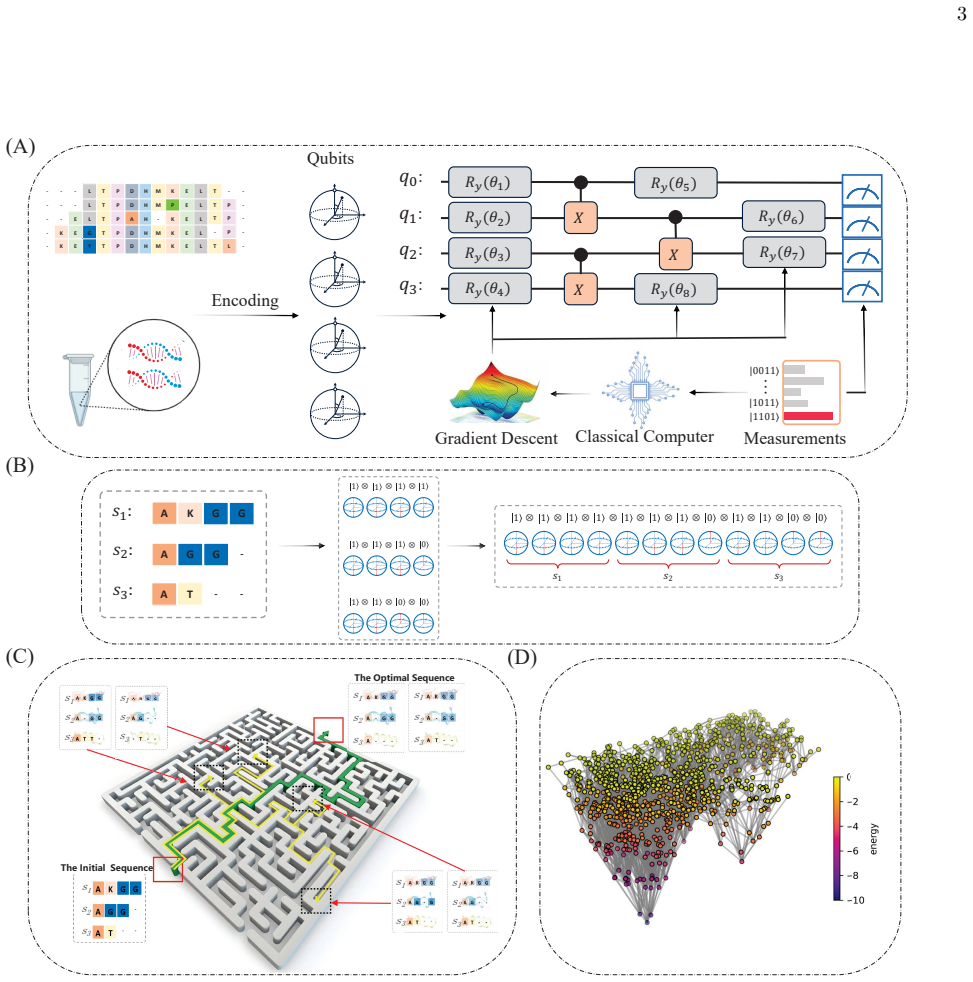
The load-bearing object is the Hybrid Query Encoding (HQE) together with the score function of Eq. (8). In HQE, each sequence of maximal length $L$ is represented by $L$ qubits, with $|1\rangle$ marking an occupied column and $|0\rangle$ a gap; the query function $f_i(k)$ converts the count of preceding 1s into the letter index of the original sequence, which allows the classical computer to evaluate the pair-similarity weights $w^{(i,j)}_{f_i(k),f_j(k)}$ for any sampled bitstring. The quadratic penalty with $p=1.5$ enforces letter-count conservation. Around this core sit two numerical devices: a hardware-efficient ansatz (HEA) with modest entanglement layers, chosen over deeper QAOA circuits, and a two-stage CVaR loss that first optimizes a tail ratio $r<1$ and then switches to $r=1$, reducing iterations and local-minima trapping. The machinery converts MSA into a variational quantum eigensolver problem whose Hamiltonian is diagonal in the computational basis, with eigenvalues given by $L(x;p)$.
What would settle it
Run a small alignment (such as the 16-qubit instance) on a simulator, enumerate all bitstrings that satisfy the letter-count constraint, and compute the ground state of Eq. (8) exactly; then verify that it equals the known optimal alignment and that the variational histogram's top state matches it. Also record on the ion-trap device the fraction of the 2000 shots that satisfy the letter-count constraint; a non-negligible infeasible fraction would falsify the penalty's adequacy.
Extended reading notes
Core claim
The paper's central discovery is that the sum-of-pairs score of an alignment can be evaluated exactly through a classical query function $f_i(k)$ defined on the qubit bitstring, which maps each 1 to the index of the corresponding letter in the original sequence by counting preceding 1s, and maps 0s and excess 1s to a dummy index. Substituting this query into the SP-score yields the hybrid loss $L(x;p)$ of Eq. (8), whose ground state corresponds to the optimal alignment. Because the encoding is positional rather than one-hot, the required qubits fall to $O(NL)$. On a 37-qubit ion-trap quantum computer, 2000-shot measurements of the variational state reproduce the optimal alignment with significant probability at 8, 12, and 16 qubits, and the experimental time per iteration grows polynomially, while a noisy classical simulation grows exponentially, placing a crossover around 22 qubits. The authors state that this is the largest digital simulation on a trapped-ion quantum computer for a life-science problem at the time of writing.
Load-bearing premise
The entire model assumes that the query mapping $f_i(k)$ together with the penalty term $p=1.5$ computes the exact SP-score and keeps every sampled bitstring feasible; if that mapping is wrong for longer sequences or the penalty fails to exclude letter-count violations, the reported optimal states may not be valid alignments.
Editorial extensions
If this is right
- If the encoding is sound, the qubit footprint for aligning $N$ sequences of maximal length $L$ drops from $O(N^2 L)$ to $O(NL)$, making NISQ-era devices viable for small-to-medium MSA instances.
- The projected cost crossover near 22 qubits implies that for alignment problems requiring more than that many qubits, the ion-trap variational routine could beat noisy classical simulation in wall-clock time per iteration, though total iteration counts must still be included.
- The pattern of offloading a reversible classical query (letter identity from run-length counts) to the classical processor generalizes to other combinatorial costs defined on bitstrings, such as assembly or folding constraints that can be written as functions of cumulative counts.
- The two-stage CVaR schedule—warm-up with a tail loss, then full loss—offers a concrete way to stabilize VQE convergence in noisy settings, applicable beyond MSA.
Reading between the lines
- A natural next test, not performed in the paper, is to scale the same encoding to longer sequences and measure the fraction of sampled bitstrings that satisfy the letter-count constraint; if the penalty does not fully suppress infeasible strings, the optimal-state peaks could be contaminated by invalid alignments.
- The crossover estimate is a rough extrapolation that excludes the number of iterations needed for convergence; a fair practical benchmark would compare total time-to-solution against classical progressive aligners rather than noisy GPU simulations.
- The HQE trick may carry over to profile or structural alignment, where any scoring function computable from positions can be queried classically; this suggests a wider family of hybrid-query QUBO encodings for bioinformatics problems.
Editorial analysis
A structured set of objections, weighed in public.
Referee Report
Summary. The paper proposes hqQUBO, a hybrid query-based QUBO formulation of multiple sequence alignment (MSA), in which N sequences of maximum length L are encoded as N*L binary variables and the SP score is evaluated classically through a query function f_i(k). The objective is optimized with a hardware-efficient ansatz and a two-stage CVaR loss, first on CPU/GPU simulators and then on the 37-qubit ion-trap device HYQ-A37 for 8, 12, and 16 qubits. The authors report that the 20-qubit simulated instance reaches the known optimal alignment, that the hardware runs produce feasible optimal states with high probability in 2000 shots, and that per-iteration time on the quantum device grows polynomially while their noisy classical simulation grows exponentially, yielding an estimated crossover near 22 qubits.
Significance. If the constraint formulation is corrected and the reported optima are re-verified, this is a useful proof of principle: it demonstrates a query-based binary encoding for small MSA instances, studies the role of entanglement layers and a two-stage CVaR scheme, and validates the approach on a real trapped-ion device up to 16 qubits without error mitigation. The experimental comparison among noiseless simulation, noisy simulation, and hardware is valuable and the authors are appropriately cautious about the qualitative nature of the time-crossover estimate. The main technical contribution is the encoding itself, but the paper currently overstates what is established: there is no comparison with classical MSA solvers, no benchmark of 'state of the art' performance, and no public code or data, so the central claims are not yet reproducible.
major comments (3)
- [hqQUBO Formalism, Eqs. (5)-(8)] The passage from Eq. (5) to Eq. (6) is not an equivalence: the single equation sum_i(sum_k x_i,k - l_i) = 0 allows compensating deviations, e.g., for N=2 with l1=l2=2, a bitstring with three 1s in sequence 1 and one 1 in sequence 2 satisfies the summed equation while violating both per-sequence constraints. Because Eq. (4) maps a third (or later) 1 in a sequence to the dummy index -1, and because a missing trailing letter can be score-neutral when an all-gap column pairs with score 0, such invalid bitstrings are not penalized by the quadratic term in Eq. (8). The ground state of L(x;p) can therefore be an invalid 'alignment' with energy no higher than a true MSA. This is load-bearing: the central claim that hqQUBO encodes MSA requires the per-sequence penalty p * sum_i (sum_k x_i,k - l_i)^2, not p * (sum_i(sumi x_i,k - l_i))^2. The paper reports feasible states in the 20-qubit example and in the hardware runs, but since no code is supplied it is impossible to tell whether the implementation used the printed or the corrected penalty. The authors should fix the objective and rerun or re-verify all reported optima with the corrected constraint.
- [Results, 'Experimental Results on HYQ-A37' and Fig. 5] The time-efficiency comparison in Fig. 5 compares per-iteration wall-clock time of the variational algorithm on HYQ-A37 with per-iteration time of a classical simulation of the same quantum algorithm. It does not compare against any classical MSA solver (e.g., Clustal Omega, MAFFT, T-Coffee, or exact dynamic programming), so the abstract's 'state of the art performance' and the crossover estimate 'around 22 qubits' are not supported. Moreover, the crossover extrapolation uses only four points (4, 8, 12, 16 qubits), omits the number of iterations needed for convergence, and the text itself concedes that it is 'purely qualitative'. These claims should be removed or replaced by a benchmark against established classical MSA methods with fixed problem instances and time-to-solution.
- [Methods, 'Hybrid Query Encoding'] The stated scaling n = O(NL) is a property of the chosen presence/absence binary encoding, not a result about the computational complexity of solving the MSA. The classical complexity quoted in the Introduction, O(L^N) (the text appears to print 'O(L N )'), refers to the size of the search space for exact SP-score alignment; the per-iteration cost of a variational loop and the number of iterations to convergence are not accounted for. The paper should distinguish encoding width from time-to-solution complexity, and the phrase 'quantum resources significantly reduced to O(NL)' should be rephrased accordingly.
minor comments (6)
- [Abstract and main text] The spelling of the method name is inconsistent: 'hyQUBO' appears in the abstract and 'hqQUBO' elsewhere; please unify.
- [Introduction and Methods] The complexity expression for classical MSA is ambiguous as printed ('O(L N )'); it should be typeset unambiguously as O(L^N) or O(NL^N) depending on the intended reference.
- [Code and data availability] The Code Availability section gives a placeholder URL ('https://github.com') and reference [29] points to 'www.GitHub.xxx.com'; without an actual repository and data, the experiments in Figs. 3-5 cannot be reproduced.
- [Throughout] There are several typos and grammatical slips, including 'minimas' for 'minima', 'sing-qubit' for 'single-qubit', 'Acccording' for 'According', and 'advantage' for 'advantages'; these should be corrected in a final pass.
- [Fig. 2 caption] The statement that QAOA reaches a depth of 4486 layers in the 12-qubit example is not derived in the text; please explain how this number is obtained or remove it.
- [Abstract and Discussion] The claim that this is 'the largest-scale implementation of digital simulation using up to 16 qubits on a trapped-ion quantum computer for life science problem' is presented without a citation or a documented survey; it should be substantiated with a comparison list or removed.
Circularity Check
No significant circularity: the hqQUBO score is a direct encoding of the SP-score, and the resource and crossover claims are either definitional or explicitly labeled qualitative extrapolations.
full rationale
The paper's central derivation—mapping MSA to a QUBO—is self-contained. Equations (1)–(3) define the SP-score and the weight-matrix dictionary; Eq. (4) gives f_i(k), a deterministic decoding of the bitstring, not a fitted parameter. Eq. (8) is therefore the exact SP-score (plus penalty) for any bitstring, and the reported optimal states are validated by explicit alignment, not by construction. The O(NL) resource count follows directly from the size of the hybrid-query encoding, not from a fitted model. The two-stage CVaR and entanglement comparisons are numerical benchmarks on the same tasks, which is standard for optimization demonstrations and does not constitute a prediction forced by a fit. The 22-qubit crossover is a fitted extrapolation of measured per-iteration times, and the paper explicitly labels it "purely qualitative rather than exact" (Results, Fig. 5); an extrapolation is not a circularity. A separate correctness concern—Eq. (6) replaces the per-sequence constraints sum_k x_{i,k}=l_i by the weaker total-count condition sum_i(sum_k x_{i,k}-l_i)=0—weakens the claim that the printed objective enforces letter conservation, but this is a flaw in the constraint encoding, not a circular reduction of the conclusion to the input. No load-bearing self-citations are present. Hence no circular step is identified.
Assumptions & free parameters
free parameters (4)
- penalty parameter p =
1.5
- CVaR ratio r =
0.8 for 12- and 16-qubit experiments
- number of entanglement layers =
2
- time-scaling fit parameters =
crossover at ~22 qubits
assumptions (4)
- domain assumption SP-score is the objective for MSA and the similarity dictionary T provides correct pairwise scores.
- ad hoc to paper The binary presence/absence encoding with query mapping f_i(k) preserves sequence order and computes SP-score exactly for feasible bitstrings.
- domain assumption The hardware-efficient ansatz with two entanglement layers has sufficient expressibility to represent low-energy MSA states for the tested instances.
- domain assumption The per-iteration time comparison between quantum execution and classical simulation of the quantum circuit is a meaningful proxy for solving MSA.
Cite this review
Pith. "Pith review of hqQUBO: A Hybrid-querying Quantum Optimization Model Validated with 16-qubits on an Ion Trap Quantum Computer for Life Science Applications." pith.science (2026). https://pith.science/paper/WH3PUAWL
@misc{pith2026250601559,
  author       = {Pith},
  title        = {Pith review of: hqQUBO: A Hybrid-querying Quantum Optimization Model Validated with 16-qubits on an Ion Trap Quantum Computer for Life Science Applications},
  year         = {2026},
  howpublished = {\url{https://pith.science/paper/WH3PUAWL}},
  note         = {Machine review of arXiv:2506.01559}
}
abstract
AlphaFold has achieved groundbreaking advancements in protein structure prediction, exerting profound influence across biology, medicine, and drug discovery. However, its reliance on multiple sequence alignment (MSA) is inherently time-consuming due to the NP-hard nature of constructing MSAs. Quantum computing emerges as a promising alternative, compared to classical computers, offering the potentials for exponential speedup and improved accuracy on such complex optimization challenges. This work bridges the gap between quantum computing and MSA task efficiently and successfully, where we compared classical and quantum computational scaling as the number of qubits increases, and assessed the role of quantum entanglement in model performance. Furthermore, we proposed an innovative hybrid query encoding approach hyQUBO to avoid redundancy, and thereby the quantum resources significantly reduced to a scaling of $\mathcal{O}(NL)$. Additionally, coupling of VQE and the quenched CVaR scheme was utilized to enhance the robustness and convergence. The integration of multiple strategies facilitates the robust deployment of the quantum algorithm from idealized simulators (on CPU and GPU) to real-world, noisy quantum devices (HYQ-A37). To the best of our knowledge, our work represented the largest-scale implementation of digital simulation using up to 16 qubits on a trapped-ion quantum computer for life science problem, which achieved state of the art performance in both simulation and experimental results. Our work paves the way towards large-scale simulations of life science tasks on real quantum processors.
Figures


Figures from the paper (4 more)


Reference graph
Works this paper leans on
-
[21]
Multi-sequence alignment using the Quantum Approximate Optimization Algorithm
Sebastian Yde Madsen, Frederik Kofoed Marqversen, Stig Elkjær Rasmussen, and Nikolaj Thomas Zin- ner. Multi-sequence alignment using the quantum approximate optimization algorithm.arXiv preprint arXiv:2308.12103, 2023
work page Pith review arXiv 2023
-
[1]
Highly accurate protein structure prediction with alphafold.nature, 596(7873):583–589, 2021
John Jumper, Richard Evans, Alexander Pritzel, Tim Green, Michael Figurnov, Olaf Ronneberger, Kathryn Tunyasuvunakool, Russ Bates, Augustin ˇZ ´ ıdek, Anna Potapenko, et al. Highly accurate protein structure prediction with alphafold.nature, 596(7873):583–589, 2021
work page 2021
-
[2]
Hannah K Wayment-Steele, Adedolapo Ojoawo, Re- nee Otten, Julia M Apitz, Warintra Pitsawong, Marc H¨ omberger, Sergey Ovchinnikov, Lucy Colwell, and Dorothee Kern. Predicting multiple conformations via sequence clustering and alphafold2.Nature, 625(7996):832–839, 2024
work page 2024
-
[3]
A gen- eral method applicable to the search for similarities in the amino acid sequence of two proteins.Journal of molecular biology, 48(3):443–453, 1970
Saul B Needleman and Christian D Wunsch. A gen- eral method applicable to the search for similarities in the amino acid sequence of two proteins.Journal of molecular biology, 48(3):443–453, 1970
1970
-
[4]
Lusheng Wang and Tao Jiang. On the complexity of 12 multiple sequence alignment.Journal of computational biology, 1(4):337–348, 1994
work page 1994
-
[5]
Florence Corpet. Multiple sequence alignment with hierarchical clustering.Nucleic acids research, 16(22):10881–10890, 1988
work page 1988
-
[6]
C´ edric Notredame, Desmond G Higgins, and Jaap Heringa. T-coffee: A novel method for fast and accu- rate multiple sequence alignment.Journal of molecular biology, 302(1):205–217, 2000
work page 2000
-
[7]
Robert D Finn, Jody Clements, and Sean R Eddy. Hm- mer web server: interactive sequence similarity search- ing.Nucleic acids research, 39(suppl 2):W29–W37, 2011
work page 2011
Show all 31 references
-
[8]
A site- resolved two-dimensional quantum simulator with hun- dreds of trapped ions.Nature, pages 1–6, 2024
S-A Guo, Y-K Wu, J Ye, L Zhang, W-Q Lian, R Yao, Y Wang, R-Y Yan, Y-J Yi, Y-L Xu, et al. A site- resolved two-dimensional quantum simulator with hun- dreds of trapped ions.Nature, pages 1–6, 2024
2024
-
[9]
Quantum supremacy using a programmable supercon- ducting processor.Nature, 574(7779):505–510, 2019
Frank Arute, Kunal Arya, Ryan Babbush, Dave Bacon, Joseph C Bardin, Rami Barends, Rupak Biswas, Sergio Boixo, Fernando GSL Brandao, David A Buell, et al. Quantum supremacy using a programmable supercon- ducting processor.Nature, 574(7779):505–510, 2019
2019
-
[10]
Quan- tum computational advantage using photons.Science, 370(6523):1460–1463, 2020
Han-Sen Zhong, Hui Wang, Yu-Hao Deng, Ming-Cheng Chen, Li-Chao Peng, Yi-Han Luo, Jian Qin, Dian Wu, Xing Ding, Yi Hu, Peng Hu, Xiao-Yan Yang, Wei- Jun Zhang, Hao Li, Yuxuan Li, Xiao Jiang, Lin Gan, Guangwen Yang, Lixing You, Zhen Wang, Li Li, Nai- Le Liu, Chao-Yang Lu, and Jia...
2020
-
[11]
Quantum error correction below the sur- face code threshold.arXiv preprint arXiv:2408.13687, 2024
Rajeev Acharya, Laleh Aghababaie-Beni, Igor Aleiner, Trond I Andersen, Markus Ansmann, Frank Arute, Ku- nal Arya, Abraham Asfaw, Nikita Astrakhantsev, Juan Atalaya, et al. Quantum error correction below the sur- face code threshold.arXiv preprint arXiv:2408.13687, 2024
2024 arXiv
-
[12]
Genome assembly using quantum and quantum-inspired annealing.Scientific Reports, 11(1):13183, 2021
AS Boev, AS Rakitko, SR Usmanov, AN Kobzeva, IV Popov, VV Ilinsky, EO Kiktenko, and AK Fedorov. Genome assembly using quantum and quantum-inspired annealing.Scientific Reports, 11(1):13183, 2021
2021
-
[13]
Finding low-energy conformations of lattice protein models by quantum annealing.Scientific reports, 2(1):1–7, 2012
Alejandro Perdomo-Ortiz, Neil Dickson, Marshall Drew-Brook, Geordie Rose, and Al´ an Aspuru-Guzik. Finding low-energy conformations of lattice protein models by quantum annealing.Scientific reports, 2(1):1–7, 2012
2012
-
[14]
Resource-efficient quantum algorithm for protein folding.npj Quantum Informa- tion, 7(1):38, 2021
Anton Robert, Panagiotis Kl Barkoutsos, Stefan Wo- erner, and Ivano Tavernelli. Resource-efficient quantum algorithm for protein folding.npj Quantum Informa- tion, 7(1):38, 2021
2021
-
[15]
Quantum computational quantification of protein-ligand interactions.Interna- tional Journal of Quantum Chemistry, 122(22):e26975, 2022
Josh JM Kirsopp, Cono Di Paola, David Zsolt Man- rique, Michal Krompiec, Gabriel Greene-Diniz, Wolf- gang Guba, Agnes Meyder, Detlef Wolf, Martin Strahm, and David Mu˜ noz Ramo. Quantum computational quantification of protein-ligand interactions.Interna- tional Journal of Quan...
2022
-
[16]
Encoding molecular docking for quantum com- puters.Journal of Chemical Theory and Computation, 19(24):9018–9024, 2023
Jinyin Zha, Jiaqi Su, Tiange Li, Chongyu Cao, Yin Ma, Hai Wei, Zhiguo Huang, Ling Qian, Kai Wen, and Jian Zhang. Encoding molecular docking for quantum com- puters.Journal of Chemical Theory and Computation, 19(24):9018–9024, 2023
2023
-
[17]
Exploring the advantages of quantum generative adversarial networks in generative chemistry.Journal of Chemical Information and Modeling, 63(11):3307–3318, 2023
Po-Yu Kao, Ya-Chu Yang, Wei-Yin Chiang, Jen-Yueh Hsiao, Yudong Cao, Alex Aliper, Feng Ren, Al´ an Aspuru-Guzik, Alex Zhavoronkov, Min-Hsiu Hsieh, et al. Exploring the advantages of quantum generative adversarial networks in generative chemistry.Journal of Chemical Information ...
2023
-
[18]
Quan- tum computing-enhanced algorithm unveils novel in- hibitors for kras.arXiv preprint arXiv:2402.08210, 2024
Mohammad Ghazi Vakili, Christoph Gorgulla, Ak- shatKumar Nigam, Dmitry Bezrukov, Daniel Varoli, Alex Aliper, Daniil Polykovsky, Krishna M Padman- abha Das, Jamie Snider, Anna Lyakisheva, et al. Quan- tum computing-enhanced algorithm unveils novel in- hibitors for kras.arXiv pr...
2024 arXiv
-
[19]
Quantum bridge analytics i: a tutorial on for- mulating and using qubo models.Annals of Operations Research, 314(1):141–183, 2022
Fred Glover, Gary Kochenberger, Rick Hennig, and Yu Du. Quantum bridge analytics i: a tutorial on for- mulating and using qubo models.Annals of Operations Research, 314(1):141–183, 2022
2022
-
[20]
Quaser: Quantum accelerated de novo dna sequence reconstruc- tion.Plos one, 16(4):e0249850, 2021
Aritra Sarkar, Zaid Al-Ars, and Koen Bertels. Quaser: Quantum accelerated de novo dna sequence reconstruc- tion.Plos one, 16(4):e0249850, 2021
2021
-
[22]
Improv- ing variational quantum optimization using cvar.Quan- tum, 4:256, 2020
Panagiotis Kl Barkoutsos, Giacomo Nannicini, Anton Robert, Ivano Tavernelli, and Stefan Woerner. Improv- ing variational quantum optimization using cvar.Quan- tum, 4:256, 2020
2020
-
[23]
Accurate prediction of protein structures and in- teractions using a three-track neural network.Science, 373(6557):871–876, 2021
Minkyung Baek, Frank DiMaio, Ivan Anishchenko, Jus- tas Dauparas, Sergey Ovchinnikov, Gyu Rie Lee, Jue Wang, Qian Cong, Lisa N Kinch, R Dustin Schaeffer, et al. Accurate prediction of protein structures and in- teractions using a three-track neural network.Science, 373(6557):8...
2021
-
[24]
Evolutionary- scale prediction of atomic-level protein structure with a language model.Science, 379(6637):1123–1130, 2023
Zeming Lin, Halil Akin, Roshan Rao, Brian Hie, Zhongkai Zhu, Wenting Lu, Nikita Smetanin, Robert Verkuil, Ori Kabeli, Yaniv Shmueli, et al. Evolutionary- scale prediction of atomic-level protein structure with a language model.Science, 379(6637):1123–1130, 2023
2023
-
[25]
Encoding patterns for quantum algo- rithms.IET Quantum Communication, 2(4):141–152, 2021
Manuela Weigold, Johanna Barzen, Frank Leymann, and Marie Salm. Encoding patterns for quantum algo- rithms.IET Quantum Communication, 2(4):141–152, 2021
2021
-
[26]
Realizing coherently convertible dual-type qubits with the same ion species.Nature Physics, 18(9):1058–1061, 2022
H-X Yang, J-Y Ma, Y-K Wu, Ye Wang, M-M Cao, W-X Guo, Y-Y Huang, Lu Feng, Z-C Zhou, and L-M Duan. Realizing coherently convertible dual-type qubits with the same ion species.Nature Physics, 18(9):1058–1061, 2022
2022
-
[27]
Scalable hyperfine qubit state detection via electron shelving in the 2 d 5/2 and 2 f 7/2 manifolds in 171 yb+.Physical Review A, 104(1):012606, 2021
CL Edmunds, TR Tan, AR Milne, A Singh, MJ Biercuk, and C Hempel. Scalable hyperfine qubit state detection via electron shelving in the 2 d 5/2 and 2 f 7/2 manifolds in 171 yb+.Physical Review A, 104(1):012606, 2021
2021
-
[28]
q-coding.hyqubit.com
HYQ Quantum Cloud Services:https://www. q-coding.hyqubit.com
-
[29]
Hardware Efficient Algorithm for Multiple Sequence Alignment on HYQ-A37:https://www.GitHub.xxx. com
-
[30]
Quantumnas: Noise-adaptive search for robust quantum circuits
Hanrui Wang, Yongshan Ding, Jiaqi Gu, Zirui Li, Yu- jun Lin, David Z Pan, Frederic T Chong, and Song Han. Quantumnas: Noise-adaptive search for robust quantum circuits. InThe 28th IEEE International Symposium on High-Performance Computer Architec- ture (HPCA-28), 2022
2022
-
[3060]
Both scenarios were solved using a HEA circuit that employed 20 qubits and two layers (see Appendix A for details)
simulation, we designed two scenarios: 1) MSA with a reference sequence, 2) MSA without a reference sequence. Both scenarios were solved using a HEA circuit that employed 20 qubits and two layers (see Appendix A for details). For gradient computation, automatic differentiation...
Reviewed August 7, 2026 · model on record in the stance chip above.
Discussion (0). Sign in to comment.