REVIEW 3 major objections 4 minor 23 references
Latent Space Topology Evolution in Multilayer Perceptrons
T0 review · 3 major / 4 minor · reviewed 2026-08-07 · deepseek-v4-flash
Pith's one-line read This paper claims that a pullback-cover tower over an MLP's latent spaces yields a stable two-parameter topological description of how data are reorganized layer by layer.
desk verdict A coherent Mapper-style framework for MLP layers with a correct stability theorem, but the experimental pipeline computes something not proven close to the theory. read the letter →
The pith
A machine-rendered reading of the paper's core claim, the machinery that carries it, and where it could break.
The reading
What carries the argument
The central object is the pullback cover tower of an MLP: a cover of the output space is chosen, and each preceding cover is defined recursively as the connected components of the preimages of the next cover under the layer function. Maps of covers through layer functions induce simplicial maps between nerve complexes, producing a simplicial tower whose persistent homology is MLP persistence. The load-bearing identity is the stability theorem for pullback cover towers, which transfers eta-interleaving of output covers backward through every pullback and then to nerves and persistence diagrams. The computational workhorse is the layer-wise Cech complex, a clique complex built on the proximity graph of each latent space with edges constrained to pairs that the output cover keeps together; it is meant to approximate the pullback construction without computing preimages.
What would settle it
Train a small MLP on two interlocking rings, construct the true pullback-cover tower for output covers at several scales, and compare its persistence diagrams with the layer-wise Cech complexes at the paper's chosen scales; if the bottleneck distance between them exceeds the cover interleaving parameter, the computational proxy is not the object that the stability theorem protects.
Extended reading notes
Core claim
The central discovery is that a pullback-cover tower over an MLP gives a stable bi-persistence invariant of the network's internal representations. Starting from a cover of the output space, each earlier layer's cover is obtained by pulling the next cover back through the layer function and splitting each preimage into connected components; maps between covers induce simplicial maps between nerve complexes, so the layers form a tower of complexes whose persistent homology is MLP persistence. Restricting to a fixed layer and varying scale gives layer persistence. The stability theorem states that eta-interleaved output cover towers yield eta-interleaved pullback towers, eta-interleaved nerve towers, and persistence diagrams whose bottleneck distance is at most eta, so the descriptors are robust to cover choice. The paper further claims that the resulting barcodes and trajectory graphs reveal when a network has already achieved its classification separation, thereby identifying redundant layers and critical transitions.
Load-bearing premise
The framework's conclusions depend on the layer-wise Cech complexes being a faithful computational stand-in for the pullback-cover nerves; the paper states that this substitution does not alter the theoretical results but gives no interleaving bound or equivalence between the two constructions.
Editorial extensions
If this is right
- Layer persistence and MLP persistence can be computed together, so one can see both the scale at which a topological feature exists and the layer at which it appears, merges, or dies.
- If two analyses use different output covers that are eta-interleaved, their persistence diagrams differ by at most eta, so qualitative conclusions about redundant layers and critical transitions are not artifacts of cover choice.
- When latent classes are linearly separable, there exists a cover whose nerve has two disconnected components, connecting linear separability to a concrete topological signature in the tower.
- Because trajectories merge permanently once they share a cover index, the trajectory graph gives a monotone picture of how clusters coalesce toward classification.
- The layer-wise Cech complexes form a simplicial tower whose skeletons are nested, so MLP persistence can be computed with standard persistent homology algorithms rather than explicit pullback covers.
Reading between the lines
- Editorial inference: the same tower construction could be applied to any differentiable stack of maps with accessible intermediate representations, not only to MLPs with scalar output, so the method may transfer to convolutional or attention-based architectures.
- Editorial inference: the practical value of the stability theorem depends on how tightly the cover actually used in an experiment is interleaved with the cover that would expose the true topology; a natural stress test is to compute the descriptors under several very different output covers on the same trained network and compare the observed spread with the predicted eta.
- Editorial inference: the hand-picked sequence of scales used in the experiments could be automated by choosing scale parameters from the birth-death pairs of layer persistence diagrams, turning the method into a fully self-tuning diagnostic.
Editorial analysis
A structured set of objections, weighed in public.
Referee Report
Summary. The paper introduces a topological data analysis framework for interpreting MLP latent representations. It defines pullback-cover towers over the layer-wise images of a finite dataset, proves a stability theorem for these towers (Theorem 3.9), and proposes a bi-persistence scheme (layer persistence and MLP persistence) together with a combinatorial algorithm (Definition 3.11) and trajectory visualizations. Experiments on a two-concentric-circles toy problem and on cardiotocography data are used to claim that the method identifies redundant layers and critical topological transitions.
Significance. The intended contribution is potentially valuable: a stable, cover-robust topological descriptor for layer-wise representations would be a useful interpretability tool, and Theorem 3.9 is a correct application of known interleaving results for pullback cover towers. The paper also provides code and an intuitive trajectory graph. However, the significance is not established because the theoretical object (pullback-cover nerves) is degenerate for the finite point-cloud setting of Definition 2.1, while all non-trivial experimental results come from an unproven Vietoris-Rips proxy. The trajectory 'purity' claims are also partly enforced by the construction. These gaps affect the central claims of the paper.
major comments (3)
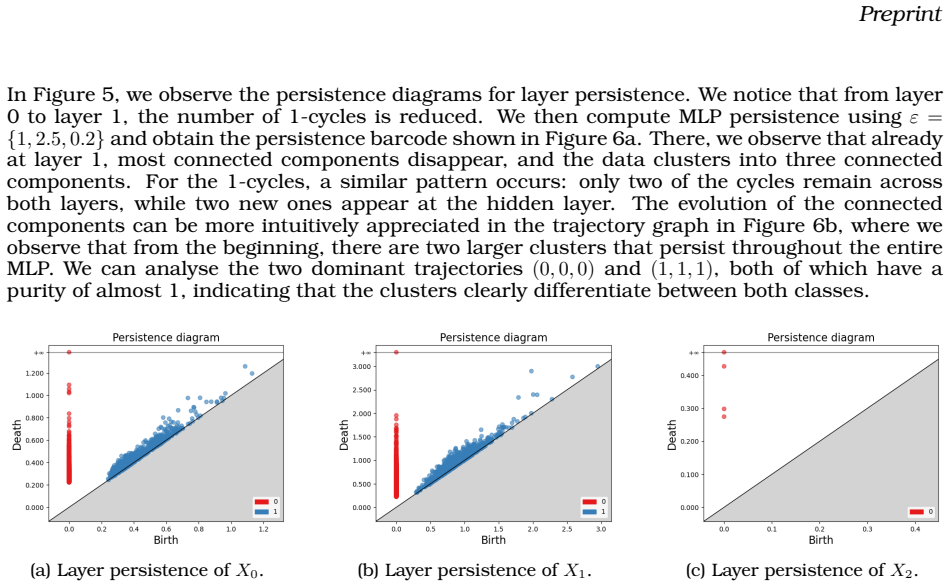
- [Section 3.2.1, Eq. (2)] The theoretical construction is degenerate for the finite point clouds defined in Definition 2.1. Since X is finite, each latent set X_i = F_i(X) is finite and its subspace topology is discrete; hence every connected component of f_i^{-1}(U_alpha) is a singleton, and the pullback covers U^i consist of singleton sets. Their nerves therefore have no edges, so H_p of the pullback-cover tower is zero for all p >= 1. The non-trivial cycles reported in Figures 2, 4, and 6 must come from the Vietoris-Rips complexes of Definition 3.11, not from the pullback-cover tower whose stability is the subject of Theorem 3.9. The statement in Section 4 that using Vietoris-Rips complexes 'does not alter the theoretical results' is unsupported and is contradicted by this discreteness.
- [Section 3.2.4, Definition 3.11] Definition 3.11 is not a well-defined computational proxy for the pullback-cover persistence module. It recursively references the 1-skeleton of K_{i+1}^{epsilon_{i+1}} without specifying a base case at the output layer, and the scale sequence epsilon contains m values while the complexes are indexed by layers 0 through m+1. More importantly, no interleaving, equivalence, or error bound is proved between these layer-wise Cech/VR complexes and the pullback-cover nerves or their homology towers. Section 3.2.3 concedes that the pullback is 'difficult or impossible' and is approximated by clustering, which confirms that the object computed in Section 4 is not the pullback nerve. Consequently, the experimental conclusions about redundant layers and critical topological transitions do not follow from Theorem 3.9.
- [Section 4.1, Figure 4b; Section 4.2, Figure 6b] The trajectory and purity results are at least partly forced by the construction. Definition 3.11 places an edge between u and v only if their images lie in a common element of the output cover U_{m+1}, and in Section 4.1 the cover U_2 is chosen as the two class-connected components (paragraph after Figure 2c). Thus the reported trajectories (1,1,1), (0,0,0), and the statement that 'all nodes in the graph are pure' are consequences of the cover condition, not independent evidence of how the MLP organizes classes. The cardiotocography 'purity of almost 1' claim in Section 4.2 is similarly confounded by this design choice.
minor comments (4)
- [Section 3.1, Proposition 3.1(2)] The proof does not justify the claim that the nerve has exactly two connected components; choosing arbitrarily small balls around each finite point can produce many isolated vertices within a single class, and the proof does not show the balls within each class can be chosen to connect the class into one component.
- [Corollary 3.12] The assertion that the n-skeleton of K_{i-1}^{epsilon_{i-1}} is contained in the n-skeleton of K_i^{epsilon_i} is stated without proof and is unclear because the two complexes have different vertex sets (X_{i-1} and X_i, respectively).
- [Section 4.1, Figure 2c] For the output layer X_2, which is one-dimensional, only H_0 is meaningful, but the text describes 'two connected components that eventually merge at scale 0.21' without explaining how this scale is chosen or how it relates to the output cover U_2 used later.
- [Throughout] There are several minor presentation issues, including the misspelling 'Aknowledgements', the repeated unqualified claim that Vietoris-Rips complexes do not alter theoretical results, and the lack of a precise statement of the base case in Definition 3.11.
Circularity Check
The stability theorem is independent, but the trajectory 'purity' results are enforced by Definition 3.11's output-cover edge condition.
-
self definitional
[Section 3.2.4, Definition 3.11; Section 4.1 Figure 4b; Section 4.2 Figure 6b]
"we define the layer-wise Čech Complex K^{ε_i}_i at layer i as the clique complex of the subgraph of the ε_i-proximity graph of X_i satisfying that (u, v) is an edge if: (u, v) is an edge in the 1-skeleton of K^{ε_{i+1}}_{i+1}, and there exists U ∈ U_{m+1} such that f_{i+1} ◦ · · · ◦f_{m+1}(u) ∈ U and f_{i+1} ◦ · · · ◦f_{m+1}(v) ∈ U. ... We can analyse the two dominant trajectories (0, 0, 0) and (1, 1, 1), both of which have a purity of almost 1, indicating that the clusters clearly differentiate between both classes."
By Definition 3.11, an edge at layer i is only allowed between points whose terminal representations land in the same element U of the output cover U_{m+1}. Connected components of the resulting clique complexes therefore cannot mix points that the output cover separates. In Section 4.1 the output cover is explicitly chosen as 'those two connected components' of X2, which are the two classes; hence every trajectory node is pure by construction. The reported 'purity of almost 1' and the claim that clusters 'clearly differentiate between both classes' restate the edge condition rather than measure a property of the learned representation.
full rationale
The theoretical core is not circular: Theorem 3.9 and Corollaries 3.5–3.8 are derived from the paper's own pullback definition (Eq. 2) plus external results cited from Dey-Wang and Hatcher, with no dependence on the experimental fits or on self-citations. The Section 3.2.4 construction, however, makes the experimental trajectory validation self-referential: connectivity in each layer-wise complex is constrained by membership in a single output-cover set, and the output cover is selected from the output layer's connected components. Thus the class-purity trajectories reported in Sections 4.1 and 4.2 are guaranteed by the construction, not discovered. This is a partial circularity limited to the demonstration; the persistence and stability claims themselves retain independent content. There is no self-citation chain or uniqueness argument importing the main result; the unproven VR-proxy gap is a correctness or validation concern rather than a circularity one.
Assumptions & free parameters
free parameters (3)
- MLP persistence scale parameters (epsilon) =
{0.5, 0.4, 0.2} for toy; {1, 2.5, 0.2} for cardiotocography
- Sparsification threshold for cardiotocography latent points =
0.05 (squared distance)
- Output cover U_{m+1} in the toy example =
two connected components at scale 0.2
assumptions (4)
- domain assumption Every pullback cover satisfies the nerve theorem conditions: all non-empty intersections of cover sets are contractible.
- domain assumption Preimages of open sets under each layer function have finitely many connected components.
- ad hoc to paper The layer-wise Cech complex (Definition 3.11) is a valid approximation of the theoretical pullback-based MLP persistence.
- standard math Layer functions are continuous and datasets are finite point clouds.
Cite this review
Pith. "Pith review of Latent Space Topology Evolution in Multilayer Perceptrons." pith.science (2026). https://pith.science/paper/NMZOM7OG
@misc{pith2026250601569,
  author       = {Pith},
  title        = {Pith review of: Latent Space Topology Evolution in Multilayer Perceptrons},
  year         = {2026},
  howpublished = {\url{https://pith.science/paper/NMZOM7OG}},
  note         = {Machine review of arXiv:2506.01569}
}
read the original abstract
This paper introduces a topological framework for interpreting the internal representations of Multilayer Perceptrons (MLPs). We construct a simplicial tower, a sequence of simplicial complexes connected by simplicial maps, that captures how data topology evolves across network layers. Our approach enables bi-persistence analysis: layer persistence tracks topological features within each layer across scales, while MLP persistence reveals how these features transform through the network. We prove stability theorems for our topological descriptors and establish that linear separability in latent spaces is related to disconnected components in the nerve complexes. To make our framework practical, we develop a combinatorial algorithm for computing MLP persistence and introduce trajectory-based visualisations that track data flow through the network. Experiments on synthetic and real-world medical data demonstrate our method's ability to identify redundant layers, reveal critical topological transitions, and provide interpretable insights into how MLPs progressively organise data for classification.
Figures


Figures from the paper (3 more)


Reference graph
Works this paper leans on
-
[1]
D. Campos and J. Bernardes. Cardiotocography. UCI Machine Learning Repository, 2000. DOI: https://doi.org/10.24432/C51S4N
doi:10.24432/c51s4n 2000
-
[2]
Stability of persistence dia- grams
David Cohen-Steiner, Herbert Edelsbrunner, and John Harer. Stability of persistence dia- grams. Discrete Computational Geometry, 37(1):103–120, December 2006
work page 2006
-
[3]
Dey, Facundo Mémoli, and Yusu Wang
Tamal K. Dey, Facundo Mémoli, and Yusu Wang. Multiscale mapper: topological summa- rization via codomain covers. In Proceedings of the Twenty-Seventh Annual ACM-SIAM Sym- posium on Discrete Algorithms, SODA ’16, page 997–1013, USA, 2016. Society for Industrial and Applied Mathematics
work page 2016
-
[4]
Computational Topology for Data Analysis
Tamal Krishna Dey and Yusu Wang. Computational Topology for Data Analysis. Cambridge University Press, 2022
work page 2022
-
[5]
Computational Topology - an Introduction
Herbert Edelsbrunner and John Harer. Computational Topology - an Introduction. American Mathematical Society, 2010
work page 2010
-
[6]
Elisenda Grigsby and Kathryn Lindsey
J. Elisenda Grigsby and Kathryn Lindsey. On transversality of bent hyperplane arrange- ments and the topological expressiveness of relu neural networks, 2021. 18 Preprint
work page 2021
-
[7]
Algebraic Topology
Allen Hatcher. Algebraic Topology. Cambridge University Press, Cambridge, 2002
2002
-
[8]
Deep, skinny neural networks are not universal approximators, 2018
Jesse Johnson. Deep, skinny neural networks are not universal approximators, 2018
work page 2018
Show all 23 references
-
[9]
Barcodes of towers and a streaming algorithm for persistent homology
Michael Kerber and Hannah Schreiber. Barcodes of towers and a streaming algorithm for persistent homology. Discrete Computational Geometry, 61(4):852–879, October 2018
2018
-
[10]
Topological uncertainty: Monitoring trained neural networks through persistence of activation graphs, 2021
Théo Lacombe, Yuichi Ike, Mathieu Carriere, Frédéric Chazal, Marc Glisse, and Yuhei Umeda. Topological uncertainty: Monitoring trained neural networks through persistence of activation graphs, 2021
2021
-
[11]
Defining neural network architecture through polytope structures of datasets
Sangmin Lee, Abbas Mammadov, and Jong Chul Ye. Defining neural network architecture through polytope structures of datasets. In Ruslan Salakhutdinov, Zico Kolter, Kather- ine Heller, Adrian Weller, Nuria Oliver, Jonathan Scarlett, and Felix Berkenkamp, editors, Proceedings of ...
2024
-
[12]
Data topology-dependent upper bounds of neural network widths, 2023
Sangmin Lee and Jong Chul Ye. Data topology-dependent upper bounds of neural network widths, 2023
2023
-
[13]
A unified approach to interpreting model predictions
Scott M Lundberg and Su-In Lee. A unified approach to interpreting model predictions. In I. Guyon, U. V. Luxburg, S. Bengio, H. Wallach, R. Fergus, S. Vishwanathan, and R. Garnett, editors, Advances in Neural Information Processing Systems 30 , pages 4765–4774. Curran Associat...
2017
-
[14]
A comprehensive review of the mapper algorithm, a topological data analysis technique, and its applications across various fields (2007-2025), 2025
Vine Nwabuisi Madukpe, Bright Chukwuma Ugoala, and Nur Fariha Syaqina Zulkepli. A comprehensive review of the mapper algorithm, a topological data analysis technique, and its applications across various fields (2007-2025), 2025
2007
-
[15]
Layer-Wise Relevance Propagation: An Overview , pages 193–209
Grégoire Montavon, Alexander Binder, Sebastian Lapuschkin, Wojciech Samek, and Klaus- Robert Müller. Layer-Wise Relevance Propagation: An Overview , pages 193–209. Springer International Publishing, Cham, 2019
2019
-
[16]
Topology of deep neural networks
Gregory Naitzat, Andrey Zhitnikov, and Lek-Heng Lim. Topology of deep neural networks. Journal of Machine Learning Research, 21(184):1–40, 2020
2020
-
[17]
Paul T. Pearson. Visualizing clusters in artificial neural networks using morse theory. Ad- vances in Artificial Neural Systems, 2013(1):486363, 2013
2013
-
[18]
why should I trust you?
Marco Tulio Ribeiro, Sameer Singh, and Carlos Guestrin. "why should I trust you?": Ex- plaining the predictions of any classifier. In Proceedings of the 22nd ACM SIGKDD Interna- tional Conference on Knowledge Discovery and Data Mining, San Francisco, CA, USA, August 13-17, 201...
2016
-
[19]
Machine learning explanations with topological data analysis
Nathaniel Saul and Dustin L Arendt. Machine learning explanations with topological data analysis. In VISxAI Workshop, 2018
2018
-
[20]
Topological methods for the analysis of high dimensional data sets and 3d object recognition, 2007
Gurjeet Singh, Facundo Memoli, and Gunnar Carlsson. Topological methods for the analysis of high dimensional data sets and 3d object recognition, 2007
2007
-
[21]
Suresh, B
S. Suresh, B. Das, V. Abrol, and S. Dutta Roy. On characterizing the evolution of embedding space of neural networks using algebraic topology.Pattern Recognition Letters, 179:165–171, 2024
2024
-
[22]
GUDHI User and Reference Manual
The GUDHI Project. GUDHI User and Reference Manual. GUDHI Editorial Board, 2015
2015
-
[23]
Hendrik Jacob van Veen, Nathaniel Saul, David Eargle, and Sam W. Mangham. Kepler mapper: A flexible python implementation of the mapper algorithm. Journal of Open Source Software, 4(42):1315, 2019. 19
2019
Reviewed August 7, 2026 · model on record in the stance chip above.
Discussion (0). Sign in to comment.