REVIEW 1 major objections 5 minor 13 references
Mixture of Experts Provably Detect and Learn the Latent Cluster Structure in Gradient-Based Learning
T0 review · 1 major / 5 minor · reviewed 2026-08-07 · deepseek-v4-flash
Pith's one-line read A mixture-of-experts network provably detects latent clusters in gradient-based regression, recovering both per-cluster and shared single-index signals with sample complexity $\widetilde{O}(d^{k^*-1})$—the same order as learning a single…
desk verdict A serious, extensive theory paper with a genuinely new router-learning mechanism, but the 'provably' in the title is undercut by a load-bearing sign-invariance assumption that is stated, not proven. read the letter →
The pith
A machine-rendered reading of the paper's core claim, the machinery that carries it, and where it could break.
The reading
What carries the argument
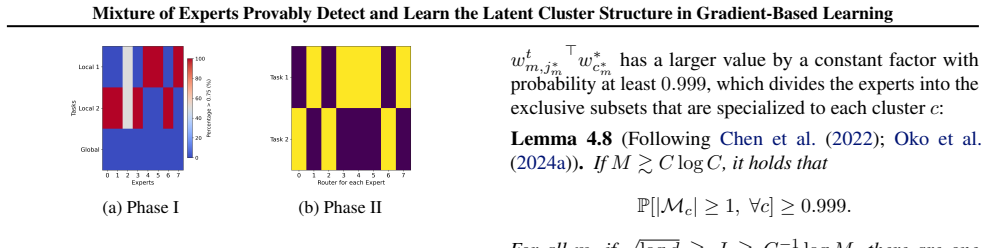
The load-bearing object is the information exponent $k^*$ of a single-index function—the index of the first nonzero coefficient in its Hermite expansion. For a neuron whose alignment with an index $w$ is $\kappa$, spherical gradient flow grows $|\kappa|$ at rate $\sim |\kappa|^{k^*-1}$, so lower exponents are learned first. The paper shows that the shared global index has its gradient contributions canceled across clusters (because $\sum_c s_c=0$ and the neuron's Hermite coefficients across clusters agree up to $d^{-1/2}$), which effectively raises the global index's exponent by one and leaves it trapped at alignment $\widetilde{O}(d^{-1/2})$. The MoE escapes this trap in four phases: Phase I creates expert-specific weak recovery of cluster indices; Phase II trains the softmax router for a single step so that $h_m(x_c)$ is positive for experts $m\in M_c$ and negative otherwise; Phase III reinitializes experts and, using adaptive top-k routing (activation iff $h_m\ge 0$), lets each expert strongly recover both $w_c^*$ and $w_g^*$ without cross-cluster interference; Phase IV fits the second layer by convex ridge regression.
What would settle it
Run Algorithm 1 (or its population gradient flow) on Example 4.1 with $C=2$, $k^*=5$, $d\approx 200$, near-orthogonal feature vectors, and track the vanilla network's alignment $|w^\top w_g^*|$ over $T_1$ steps: if any neuron's alignment exceeds, say, $d^{-1/3}$ (while Theorem 4.3 predicts $\widetilde{O}(d^{-1/2})$), the central claim fails. For the MoE, check the promised complexity: if reaching test error $\varepsilon$ requires a sample size growing faster than $d^{k^*-1}$ (e.g., needing $T_1\gg d^{k^*-1}$ or $n\gg d$ for the router step), Theorem 4.6 fails.
Extended reading notes
Core claim
On the paper's own terms, the central discovery is a separation: for the clustered single-index teacher of Assumption 3.2, a vanilla network cannot recover the shared index $w_g^*$ (Theorem 4.3: $\sup_t |w_{m,j}^\top w_g^*| \lesssim \widetilde{O}(d^{-1/2})$ w.h.p.), whereas the MoE of Section 3.2 trained by the four-phase Algorithm 1 does recover it and reaches $\mathbb{E}_{x_c}[|F_M(x_c;\{\hat a_m\})-f_c^*(x_c)-s_c g^*(x_c)|] \le \varepsilon$ with probability at least $0.99$, with $J=O(\varepsilon^{-1})$ neurons per expert, $T_1=\widetilde{\Theta}(d^{k^*-1})$ exploration steps, one router step with batch $n=\widetilde{\Theta}(d)$, $T_3=\widetilde{\Theta}(d^{k^*-1}\vee d\varepsilon^{-2}\vee \varepsilon^{-3})$ expert steps, and $T_4=\widetilde{\Theta}(\varepsilon^{-2})$ second-layer steps. The total sample complexity $\widetilde{\Theta}(d^{k^*-1})$ matches what a vanilla network needs to learn a single cluster's single-index function, so the MoE pays no extra complexity for detecting the latent organization.
Load-bearing premise
The load-bearing premise is the technical sign-invariance condition in Assumption 3.4: the sign of the leading Hermite coefficient $\alpha_{m,j,i,c}$ of $\sigma_m(\cdot+w_{m,j}^\top v_c+b_{m,j})$ is assumed fixed during training, because the paper states it cannot evaluate higher-order Hermite contributions; the gradient-flow inequalities that drive both the vanilla-failure and MoE-success theorems rely on that sign staying constant, and if it flips their proofs no longer hold.
Editorial extensions
If this is right
- An MoE trained by the four-phase schedule matches the sample complexity of learning one cluster: $n \asymp \widetilde{O}(d^{k^*-1})$, in contrast to the $\widetilde{O}(d^{p^*})$ that kernel ridge regression requires for the same targets.
- A vanilla network with polynomially many neurons cannot recover a shared single-index signal when cluster coefficients sum to zero; its alignment with the shared index stays $\widetilde{O}(d^{-1/2})$ for all time.
- Router learning is cheap: after Phase I weak recovery, one gradient step with a batch of size $n=\widetilde{\Theta}(d)$ already separates the clusters for the expert-training phase.
- Adaptive top-k routing with the threshold $h_m(x)\ge 0$ lets the algorithm avoid both load imbalance and competition among experts assigned to the same cluster.
- The full schedule runs in polynomial time in $d$ and $\varepsilon^{-1}$: $T_3 = \widetilde{\Theta}(d^{k^*-1}\vee d\varepsilon^{-2}\vee \varepsilon^{-3})$ and $T_4=\widetilde{\Theta}(\varepsilon^{-2})$.
Reading between the lines
- Implicit in the paper's argument is that expert diversity at initialization is not a nuisance but a required signal: the router's one-step learning depends on weak-recovery differences among experts, so deliberately initializing experts differently (e.g., from diverse pretrained checkpoints) should shorten Phase I.
- One testable extension: the theory assumes near-orthogonal task indices and cluster vectors orthogonal to them; a natural experiment is to increase the correlation between $w_c^*$ and $w_g^*$ or between clusters and measure where the $\widetilde{O}(d^{-1/2})$ alignment bound breaks.
- The separation result suggests that in multi-task regression, partitioning data by a learned router may replace gradient-interference-reduction heuristics entirely; the paper's zero-sum shared signal is the worst-case configuration for gradient conflict, so success here is a strong benchmark for such methods.
- Because the main theorem requires the sign of the leading Hermite coefficient to be invariant, testing activations whose Hermite coefficients flip sign (e.g., polynomials with higher-degree terms) would reveal whether the phase-wise success is robust outside the stated assumption.
Editorial analysis
A structured set of objections, weighed in public.
Referee Report
Summary. The paper analyzes a two-layer Mixture-of-Experts (MoE) trained by a four-phase SGD algorithm on a clustered single-index regression problem. Each cluster has a local teacher f_c^*(w_c^*^T x) and a shared global teacher s_c g^*(w_g^*^T x) with sum_c s_c = 0, so the global signal cancels across clusters. The authors prove two main claims: (i) a vanilla two-layer network cannot recover w_g^* on a constructed example (Theorem 4.3, under Example 4.1 with k* >= 5), and (ii) the MoE with an exploration phase, a router-learning phase, a second expert-learning phase, and a final ridge-regression layer achieves epsilon error with T1 = Theta~(d^{k*-1}), T3 = Theta~(d^{k*-1} or d epsilon^{-2} or epsilon^{-3}), and T4 = Theta~(epsilon^{-2}) (Theorem 4.6). The proofs use Hermite information-exponent calculations, weak-to-strong recovery, and reuse lemmas from Oko et al. (2024a).
Significance. If the theorems were fully established, this would be a valuable contribution: it would provide one of the first SGD-dynamics analyses of MoE for nonlinear regression, explain router learning through weak recovery of cluster-specific features, and show that MoE can decouple a task whose global signal is canceled by interference. The paper is careful to state its four-phase algorithm and to give a formal comparison with the vanilla network. The strengths include precise theorem statements, a detailed proof skeleton in the appendix, and small synthetic experiments that qualitatively illustrate the claimed phase behavior. However, the central results are conditional on Assumption 3.4, an explicit but unproved sign-invariance condition on Hermite coefficients, and the proof uses that condition exactly where the main differential inequalities must be controlled. The sample-complexity summary in Section 4.2.1 also needs qualification when epsilon is treated as a variable. These issues are fixable within the manuscript's scope, but they are load-bearing for the advertised conclusions.
major comments (1)
- [Assumption 3.4; Lemmas B.5, B.15; Lemmas C.12, C.21-C.26] The abstract and Section 4.1 present the vanilla-failure result as a general claim about vanilla neural networks and SGD, but Theorem 4.3 is proved only for the specific Example 4.1 with k* >= 5, and the theorem statement itself concerns population spherical gradient flow rather than the SGD iterates of Algorithm 1. The comparison is part of the paper's central message, so the claims should be qualified to this example, or the proof should be extended. This does not by itself invalidate Theorem 4.6, but it changes the advertised scope of the negative result.
minor comments (5)
- [Assumption 3.4] The sentence 'we technically assume that the sign the Hermite coefficient' is missing 'of'; please correct the grammar and make the referenced assumption number consistent (the appendix refers to 'Theorem 3.4' where 'Assumption 3.4' is meant).
- [Section 4.2.1, Theorem 4.6] Please clarify the dependence on epsilon when stating the total sample complexity. As written, the sentence 'The total sample complexity is O~(d^{k*-1})' is only true for fixed epsilon; if epsilon is part of the complexity measure, the T3 term Theta~(d epsilon^{-2} or epsilon^{-3}) and T4 = Theta~(epsilon^{-2}) give a strictly larger total.
- [Lemma B.15] The proof says 'additionally assume k* > 4' while Example 4.1 states k* >= 5; please use one consistent condition, since the subsequent inequality uses k* >= 5.
- [Figure 1 caption] The caption of Figure 1(a) is unclear about what is plotted for 'the distribution of the number of w_{m,j} with larger alignment than max_{j,c} w^T_{m,j} w*_c'; please rephrase so the reader can reproduce the experiment.
- [Appendix C.3] In Lemma C.14 and the proof of Lemma C.15, the notation for h_m and the max over m' is easy to confuse; please distinguish the expert index in the router output and the professional expert set more carefully.
Circularity Check
No circular derivation: the MoE success and vanilla-failure theorems are derived from stated assumptions, and the reuse of prior-work lemmas is independent support rather than a self-citation chain.
full rationale
The paper's central claims (Theorem 4.3 and Theorem 4.6) are established by explicit gradient-flow analyses over the vanilla and MoE architectures; the stated sample and runtime complexities are derived from the weak- and strong-recovery times, not fitted from the objects being predicted. No fitted parameter is renamed as a prediction, and no quantity is defined in terms of the conclusion it is used to prove. The load-bearing technical condition is Assumption 3.4, which the paper states explicitly: "we technically assume that the sign the Hermite coefficient α_{m,j,i,c} of σ_m(·+ρ w^t_{m,j}^T v_c + b_{m,j}) is invariant during the optimization since we cannot evaluate the contribution of higher-order Hermite coefficients." This is a genuine limitation and a correctness risk—Lemma B.15 and the Phase III auxiliary sequences in Lemmas C.12 and C.21 rely on this sign remaining fixed—but it is not circular: the theorems are conditional on the assumption, and the assumption is not equivalent to the conclusions it supports. The reuse of lemmas from Oko et al. (2024a), on which one of the present authors appears, is independent evidence: those lemmas are prior published, parameter-free results with stated assumptions that do not include the present target theorems, and the MoE-specific phases (Phase I weak recovery, Phase II router learning, Phase III expert decomposition) are not contained in the cited work. No self-definitional step, fitted-input-as-prediction, imported uniqueness theorem, ansatz smuggled via citation, or renaming of a known result was found.
Assumptions & free parameters
assumptions (7)
- standard math Hermite polynomials form a complete orthonormal basis of L2 under the standard Gaussian, with integration-by-parts and orthogonality rules.
- standard math Bihari-LaSalle and Gronwall inequalities control polynomial-growth recurrences in the alignment dynamics.
- domain assumption Data generation model of Assumption 3.2: cluster inputs x_c=ρ v_c+z, labels y_c=f*_c(w*_c^T x_c)+s_c g*(w*_g^T x_c)+ν, with |β_{c,k*}|=|γ_{k*}| and Σ_c s_c=0.
- domain assumption Task correlation Assumption 3.3: feature vectors w*_i are near-orthogonal and cluster means v_c are orthogonal to all w*_i.
- ad hoc to paper Activation assumption 3.4: student activations are randomized polynomials or ReLU with compatible Hermite coefficient signs, and the sign of α_{m,j,i,c} is invariant during optimization.
- domain assumption Width and number-of-experts conditions: M≳C log C and J≳C^{-1} log M so that every cluster has at least one professional expert after random initialization (Lemma C.2).
- domain assumption Example 4.1 construction: k*≥5, C=2 with s_1=+1, s_2=-1, s_c=0 otherwise, f*_c=β He_{k*}(w*_c^T x), g*=He_{k*}(w*_g^T x), completely orthogonal features.
Cite this review
Pith. "Pith review of Mixture of Experts Provably Detect and Learn the Latent Cluster Structure in Gradient-Based Learning." pith.science (2026). https://pith.science/paper/VAWUZREB
@misc{pith2026250601656,
  author       = {Pith},
  title        = {Pith review of: Mixture of Experts Provably Detect and Learn the Latent Cluster Structure in Gradient-Based Learning},
  year         = {2026},
  howpublished = {\url{https://pith.science/paper/VAWUZREB}},
  note         = {Machine review of arXiv:2506.01656}
}
read the original abstract
Mixture of Experts (MoE), an ensemble of specialized models equipped with a router that dynamically distributes each input to appropriate experts, has achieved successful results in the field of machine learning. However, theoretical understanding of this architecture is falling behind due to its inherent complexity. In this paper, we theoretically study the sample and runtime complexity of MoE following the stochastic gradient descent (SGD) when learning a regression task with an underlying cluster structure of single index models. On the one hand, we prove that a vanilla neural network fails in detecting such a latent organization as it can only process the problem as a whole. This is intrinsically related to the concept of information exponent which is low for each cluster, but increases when we consider the entire task. On the other hand, we show that a MoE succeeds in dividing this problem into easier subproblems by leveraging the ability of each expert to weakly recover the simpler function corresponding to an individual cluster. To the best of our knowledge, this work is among the first to explore the benefits of the MoE framework by examining its SGD dynamics in the context of nonlinear regression.
Figures

Reference graph
Works this paper leans on
-
[1]
We first show that • The Hermite coefficients corresponding to±He k∗ (w∗ g ⊤xc)cancel out (Theorems B.4 and C.8), • For all neurons wm,j, there are some tasks c∈[C] such that the signals of w∗ c grow (Theorem B.7), the set of suchw m,j is defined asC j
-
[2]
For eachjth neuron, the above points imply that there are three types of signals, as shown in Theorems B.9 to B.11: (a)w ∗ c , c∈ Cj: Learnable ( d dt |κt m,j,c|is positive), (b)w ∗ c , c∈[C]\ Cj: Not learnable ( d dt |κt m,j,c|is negative), (c)w ∗ g: Not learnable (the growth rate of the product w⊤ j w∗ g is too small compared to (a) because the Hermite ...
-
[3]
We show that all neurons tend to learn the features (a)w ∗ c , c∈ Cj (Theorem B.12)
-
[4]
In Theorem B.13, we repeat the argument in Theorem B.12 while keeping the condition of Hermite coefficients in Theorems B.4 and B.5 until the products (a) become sufficiently large
-
[5]
We finally show the growth of other products (b),(c) will be blocked (Theorem B.15) once the products corresponding to (a) become too large, additionally assumingk ∗ ≥5 15 Mixture of Experts Provably Detect and Learn the Latent Cluster Structure in Gradient-Based Learning B.1. Characterization of Hermite coefficients Here we will show that the Hermite coe...
-
[7]
P c∈Cj |κt1 m,j,c| ≃d−1/2+1/(2k∗), 2.|κ t1 m,j,c|≲ ˜O(d−1/2)for allc /∈ Cj, 3.|ξ t1 m,j,g|≲ ˜O(d−1/2)forc= 1,2. Proof. Combine the results in Theorem B.9 and Theorem B.11. Theorem B.9 implies the first condition by Gronwall inequality. Theorem B.11 leads to the second and the third conditions becausemax{maxc /∈Cj |κt1 m,j,c|,|ξ t1 m,j,g|} ≤ |ξt1 m,j,g|+P ...
-
[8]
P c∈Cj |κ Pl l′ =1 tl′ m,j,c | ≃d−Al,
-
[9]
Then, there existst l+1 ≲η −1J dAl(k∗−2) such that
P c /∈Cj |κ Pl l′ =1 tl′ m,j,c |+|ξ m,j,g|≲d −1/2 3.|α Pl l′ =1 tl′ m,j,k∗,c −α m,j,k∗ |≲ ˜O(d−1/2). Then, there existst l+1 ≲η −1J dAl(k∗−2) such that
Show all 13 references
-
[10]
P c∈Cj |κ Pl+1 l′ =1 tl′ m,j,c | ≃d−Al+1 whereA l+1 = k∗−2 k∗ Al + 1 2k∗
-
[11]
Proof.Let|κ t m,j,c|≲d − k∗ −2 k∗ Al− 1 2k∗ ,t∈[t l, tl+1]
P c /∈Cj |κ Pl+1 l′ =1 tl′ m,j,c |+|ξ m,j,g|≲d −1/2 3.|α Pl+1 l′ =1 tl′ m,j,k∗,c −α 0 m,j,k∗ |≲ ˜O(wt j ⊤vc)≲ ˜O(d−1/2). Proof.Let|κ t m,j,c|≲d − k∗ −2 k∗ Al− 1 2k∗ ,t∈[t l, tl+1]. Following Theorems B.5 and C.8, we have |wt j ⊤ vc|≲ ˜O(d−1/2) + ˜O(ηJ −1 Z tl+1 tl |κt m,j,c|k∗...
-
[12]
, J,c= 1,2, we have sup t≥0 |ξt m,j,g|≲ ˜O(d−1/2) with high probability
P c∈Cj |κt m,j,c|≳d −1/4−1/(8k∗), 2.|κ t m,j,c|≲ ˜O(d−1/2)for allc /∈ Cj, 3.|ξ t m,j,g|≲ ˜O(d−1/2)forc= 1,2, Finally we have the following theorem by Theorem B.16: 22 Mixture of Experts Provably Detect and Learn the Latent Cluster Structure in Gradient-Based Learning Theorem B...
2024
-
[13]
Thus, κt c,m,j >1−ϵ holds for all t3,3 ≤t≤(T 3,1 −t 3,1) + (T3,2 −t 3,2) +T 3,3 until κt c,m,j >1− ϵ 3 holds
When there exists some time κt c,m,j <1− ϵ 3 for t > t3,3, κt c,m,j ≥1−2a 2 since |κt+1 c,m,j −κ t c,m,j| ≤A1ηe′. Thus, κt c,m,j >1−ϵ holds for all t3,3 ≤t≤(T 3,1 −t 3,1) + (T3,2 −t 3,2) +T 3,3 until κt c,m,j >1− ϵ 3 holds. By recursively applying this step, we obtain the desi...
2022
-
[1262]
Dandi, Y ., Krzakala, F., Loureiro, B., Pesce, L., and Stephan, L
PMLR, 2024. Dandi, Y ., Krzakala, F., Loureiro, B., Pesce, L., and Stephan, L. How two-layer neural networks learn, one (giant) step at a time.Journal of Machine Learning Research, 25 (349):1–65, 2024a. Dandi, Y ., Troiani, E., Arnaboldi, L., Pesce, L., Zdeborova, L., and Krza...
2021 arXiv
Reviewed August 7, 2026 · model on record in the stance chip above.
Discussion (0). Sign in to comment.