REVIEW 3 major objections 5 minor 51 references
Efficient fiber coupling of telecom single-photons from circular Bragg gratings
T0 review · 3 major / 5 minor · reviewed 2026-08-07 · deepseek-v4-flash
Pith's one-line read Direct fiber collection lifts telecom single-photon delivery by a factor of 3.0, while keeping alignment tolerances of a few micrometers.
desk verdict Useful engineering comparison of fiber-based collection for telecom CBG single-photon sources; the 3x claim is an upper bound and the sample-drift concern is real but fixable. read the letter →
The pith
A machine-rendered reading of the paper's core claim, the machinery that carries it, and where it could break.
The reading
What carries the argument
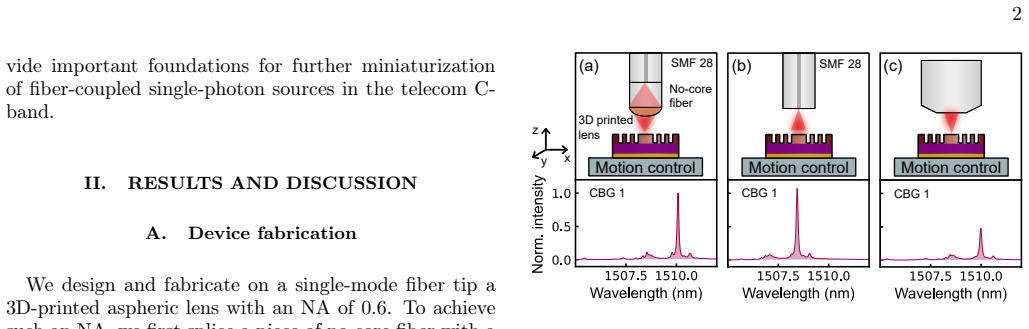
The load-bearing component is an aspheric microlens ($\mathrm{NA}=0.6$) written by two-photon polymerization onto a $550\,\mu$m no-core fiber spliced to a single-mode fiber; this lens both collects the cavity emission and gives enough spatial resolution (about $600\,$nm) to image the sample surface by reflected light, so the same CBG can be located in every configuration. The comparison metric is the end-to-end efficiency $\eta_{\mathrm{end-to-end}} = R/f_{\mathrm{rep}}$ together with the separately determined setup transmission $\eta_{\mathrm{setup}}$, which lets the authors separate picking photons up from transporting them to the detector. For the bare fiber, the relevant mechanism is a Fabry-Pérot cavity formed between the CBG's gold back-reflector and the cleaved fiber facet, which produces the observed distance oscillations and defines the working distance.
What would settle it
Re-measure one CBG in all three configurations during a single cool-down, with spectral monitoring and compensation of the $1.6\,$nm blue shift; if the bare fiber's factor-of-$3.0\pm0.2$ advantage over the objective shrinks or disappears once the same emission line and strain state are restored, the central claim fails.
Extended reading notes
Core claim
Benchmarking the same four CBG devices under three collection geometries, the paper reports that both fiber configurations deliver raw counts at least as high as the objective while exceeding its end-to-end efficiency: with CBG 1, the bare fiber gives $R = 1.33\,\mathrm{MHz}$ and $\eta_{\mathrm{end-to-end}} = 1.8\%$ versus $R = 0.44\,\mathrm{MHz}$ and $0.6\%$ for the objective, a factor of $3.0\pm0.2$ (average $1.8\pm0.7$). The authors attribute the gain to the setup transmission $\eta_{\mathrm{setup}} = (22.1\pm1.7)\%$ for the bare fiber and $(16.1\pm2.3)\%$ for the lensed fiber versus $(3.7\pm0.7)\%$ for the objective, rather than to better photon collection into the first optic. They quantify the spatial budget for a future monolithic source: the lensed fiber has $\mathrm{FWHM}_{XY} = (1.22\pm0.20)\,\mu$m and $\mathrm{FWHM}_{YZ} = (4.56\pm0.70)\,\mu$m, while the bare fiber has $\mathrm{FWHM}_{XY} = (4.90\pm0.34)\,\mu$m and a roughly $10\,\mu$m vertical working plateau whose Fabry-Pérot fringes have 67% contrast, so the bare fiber needs tens of nanometres positioning at a fringe maximum.
Load-bearing premise
The comparison assumes that the same quantum dot, excitation conditions, and emitter brightness are unchanged in all three configurations even though the bare-fiber run showed a $1.6\,$nm spectral blue shift from altered strain; if the dot's brightness shifted, the reported count-rate ratios would measure sample drift, not collection efficiency.
Editorial extensions
If this is right
- Fiber-based collection can outperform a standard microscope-objective setup by up to a factor of $3.0\pm0.2$ in end-to-end efficiency without changing the emitter or cavity.
- The lensed fiber can navigate and resolve the sample surface well enough to find a targeted CBG, which is the precondition for attaching a fiber for plug-and-play operation.
- The bare fiber offers a vertical working range of about $10\,\mu$m before the count rate starts dropping, but its Fabry-Pérot oscillations demand positioning precision of tens of nanometres at a fringe maximum.
- Improving the $42\pm12\%$ inferred fiber in-coupling of the 3D-printed lens, for example by better shape optimization or adjusted no-core length, would likely make the lensed fiber the best of the three configurations.
- Using ultra-high-NA fibers on either fiber arm should improve mode matching from the CBG into the fiber and raise the collection efficiency.
Reading between the lines
- The paper's count-rate ratios are clean only if the emitter stayed equally bright across configurations; a follow-up that stabilizes the dot wavelength against the $1.6\,$nm strain-induced blue shift would test whether part of the $3.0\pm0.2$ gain comes from sample changes rather than collection geometry.
- Because $N$-fold coincidence rates grow steeply with detected counts, a persistent $3\times$ end-to-end improvement would translate into roughly $9\times$ more two-photon and $27\times$ more three-photon coincidence events, making fiber collection especially attractive for multi-photon protocols.
- An anti-reflection coating on the cleaved fiber tip, which the paper mentions only as an option, could remove the need for nanometre positioning by suppressing the Fabry-Pérot oscillations; testing this would separate the bare fiber's large tolerance from its fringe constraint.
- The lensed fiber's collection efficiency was inferred rather than directly measured; a power-through measurement of the lens-to-fiber coupling would turn the estimated $42\pm12\%$ loss into a concrete design target for the microlens.
Editorial analysis
A structured set of objections, weighed in public.
Referee Report
Summary. The paper reports a comparative study of three photon-collection configurations for single-photon sources based on quantum dots in circular Bragg gratings (CBGs) at telecom wavelengths: a fiber with a 3D-printed lens, a cleaved bare SMF-28 fiber, and a free-space microscope objective. For each configuration, the authors characterize the ability to image the sample surface, measure the lateral and vertical spatial tolerance of the fiber-to-CBG coupling, and determine the count rate, collection efficiency, and end-to-end efficiency for four CBGs. The central claim is that the fiber-based configurations improve the end-to-end detected count rate by a factor of up to 3.0±0.2 over the microscope-objective setup because the fiber setups have higher overall transmission, while the spatial alignment tolerances are quantified as FWHM values of a few micrometers in the lateral direction.
Significance. If the central claim is robust, the result is practically valuable: it indicates that compact, mechanically stable fiber-coupled telecom single-photon sources are feasible without a free-space microscope objective. The paper has several strengths: it compares three configurations on multiple devices, provides quantitative FWHM data and compares them with simulations, and explicitly quantifies the setup efficiencies. The spatial-tolerance measurements, in particular, are useful for future monolithic or plug-and-play integration. However, the headline improvement factor is currently undercut by a confounding sample-change issue and by missing uncertainty estimates in the reference measurements, so the quantitative claim needs revision before the significance can be fully trusted.
major comments (3)
- [Section II.A and II.D, Table I] The headline factor of 3.0±0.2 is derived from the bare-fiber count rate of CBG1 (1.33±0.07 MHz) divided by the microscope-objective count rate of the same CBG (0.44 MHz). However, Section II.A states that the bare-fiber configuration was accompanied by a consistent 1.6 nm blue shift attributed to partial detachment of the semiconductor membrane after several cooling cycles, i.e., a physical change of the emitter-cavity system. The assertion that 'the emitter performance remained comparable' is not supported by any control measurement, such as a repeated count-rate or g(2) measurement in a fixed configuration before and after the strain change. Since the largest bare-fiber rate and the smallest objective rate in the table both occur for CBG1, the ratio is particularly sensitive to sample drift. An interleaved or repeated control measurement is needed before the factor can be attributed cleanly to the collection scheme.
- [Table I] Several entries in the microscope-objective column are single measurements without any stated uncertainty (R = 0.44, 0.76, and 0.41 MHz; η_end-to-end = 0.6%, 1.0%, and 0.5%), and some fiber entries also lack uncertainties. The quoted ratio 3.0±0.2 therefore propagates only the standard deviation of the bare-fiber numerator and ignores the uncertainty of the objective denominator. To support the quantitative comparison, repeated measurements for the objective configuration (or an explicit statement that the ratio is a single-point comparison) should be provided.
- [Section II.D] The inferred lensed-fiber in-coupling loss of (42±12)% is based on the assumption that the collection efficiency of the lensed fiber equals that of the microscope objective. The assumption is stated, but the presented η_coll values vary considerably across CBGs (8.9–13.5% for the lensed fiber versus 14.4–31.7% for the objective), so the uncertainty on the inferred loss may be underestimated. This estimate should be presented as explicitly conditional on that assumption, ideally with a sensitivity analysis.
minor comments (5)
- [Throughout] There are several typos that should be corrected, including 'challange' (Introduction), 'labes' (Section II.B), 'agreeement' and 'FWMHXY' (Section II.C), 'compararing' (Section II.D), 'efficienct' (Introduction), and 'contrbiution' (Acknowledgements).
- [Section II.C] The sentence 'In the inset of Fig.3 (a), the first oscillation...' appears to refer to the bare-fiber measurement shown in Fig.4 (a); the cross-reference should be corrected.
- [Section II.C] The phrase 'the distance of the bare fiber to the the sample' contains a duplicated article and should read 'to the sample'.
- [Table I] The statement that four CBGs were measured 'each in the following configurations' is not fully reflected in Table I, since CBG2 lacks a bare-fiber entry (N/A). The text or table should clarify which CBGs were measured in which configuration.
- [Section II.D] The repetition rate f_rep used to compute η_end-to-end from R is not stated for each CBG; providing this value would aid reproducibility of the efficiency numbers in Table I.
Circularity Check
No circularity found: the central efficiency comparison is an experimental measurement, not a derived prediction of its own inputs.
full rationale
The paper's central claims are direct experimental comparisons. The end-to-end efficiency is defined as eta_end-to-end = R/f_rep and the collection efficiency as eta_coll = R/(eta_setup * f_rep), where R is a measured single-photon count rate corrected by g(2)(0), f_rep is the excitation repetition rate, and eta_setup is an independently measured setup transmission. No parameter is fitted to reproduce the headline factor of 3.0 +/- 0.2; that factor is simply the ratio of measured count rates for CBG 1 (1.33 MHz with the bare fiber versus 0.44 MHz with the microscope objective in Table I). The 42% lens in-coupling loss is explicitly an estimate derived from the stated assumption that the collection efficiency of the lensed fiber should equal that of the microscope objective; it is not presented as a prediction or as evidence for the central claim. The spatial FWHM measurements are compared with independent simulations that assume Gaussian propagation from the fiber, and discrepancies are discussed physically. Self-citations appear only for fabrication methods, prior device demonstrations, and simulation approaches (e.g., Refs. [16, 18, 30, 34, 50, 51]); none is used as a load-bearing uniqueness theorem or as an unverified premise that forces a result. The main fragility is experimental rather than circular: the reported 1.6 nm blue shift and the non-simultaneous nature of the comparisons could confound the count-rate ratios, but that is a validity or reproducibility concern, not a circularity of the kind defined here. Therefore the circularity score is 0.
Assumptions & free parameters
assumptions (4)
- domain assumption The QD count rate correction sqrt(1-g2(0)) yields the pure single-photon count rate.
- domain assumption The quantum dot line measured in each configuration is the same emitter with unchanged brightness.
- ad hoc to paper For the lensed fiber, eta_coll equals the microscope objective eta_coll, enabling estimation of the unmeasured fiber in-coupling loss.
- domain assumption The CBG far-field can be approximated as a Gaussian beam with NA_CBG=0.40 for the ray-optics estimate L=MFD/(2*NA_CBG).
Cite this review
Pith. "Pith review of Efficient fiber coupling of telecom single-photons from circular Bragg gratings." pith.science (2026). https://pith.science/paper/5AVCR6ZB
@misc{pith2026250601661,
  author       = {Pith},
  title        = {Pith review of: Efficient fiber coupling of telecom single-photons from circular Bragg gratings},
  year         = {2026},
  howpublished = {\url{https://pith.science/paper/5AVCR6ZB}},
  note         = {Machine review of arXiv:2506.01661}
}
read the original abstract
Deterministic sources of quantum light are becoming increasingly relevant in the development of quantum communication, particularly in deployed fiber networks. Therefore, efficient fiber-coupled sources at telecom wavelength are highly sought after. With this goal in mind, we systematically investigate the fiber coupling performance of quantum dots in optical resonators under three experimental configurations. We quantify coupling efficiency and sensitivity to spatial displacement for single-mode fibers with 3D printed optics on their tip, and benchmark their behavior over a commercial cleaved-cut fiber and a standard optical setup. The reduction of the required optical elements when operating with a lensed or a bare fiber allows for an increased end-to-end efficiency by a factor of up to 3.0 +/- 0.2 over a standard setup. For the perspective of realizing a mechanically stable fiber-coupled source, we precisely quantify the spatial tolerance to fiber-cavity misalignment, observing less than 50 % count rate drop for several micrometers displacement. These results will play a key role in the future development of fiber-coupled sources of quantum light.
Figures


Figures from the paper (1 more)

Reference graph
Works this paper leans on
-
[1]
J. L. O’Brien, A. Furusawa, and J. Vučković, Nature Photonics3, 687 (2009)
work page 2009
-
[2]
Wehner, D
S. Wehner, D. Elkouss, and R. Hanson, Science362, eaam9288 (2018)
2018
-
[3]
T. Heindel, J.-H. Kim, N. Gregersen, A. Rastelli, and S. Reitzenstein, Advances in Optics and Photonics15, 613 (2023)
work page 2023
-
[4]
D. A. Vajner, L. Rickert, T. Gao, K. Kaymazlar, and T. Heindel, Advanced Quantum Technologies5, 2100116 (2022)
work page 2022
-
[5]
P. Michler and S. L. Portalupi,Semiconductor Quantum Light Sources: Fundamentals, Technologies and Devices (Walter de Gruyter GmbH & Co KG, 2024)
work page 2024
-
[6]
P. Senellart, G. Solomon, and A. White, Nature nan- otechnology12, 1026 (2017)
work page 2017
-
[7]
N. Somaschi, V. Giesz, L. De Santis, J. Loredo, M. P. Almeida, G. Hornecker, S. L. Portalupi, T. Grange, C. Anton, J. Demory,et al., Nature Photonics10, 340 (2016)
work page 2016
-
[8]
N. Tomm, A. Javadi, N. O. Antoniadis, D. Najer, M. C. Löbl, A. R. Korsch, R. Schott, S. R. Valentin, A. D. Wieck, A. Ludwig,et al., Nature Nanotechnology16, 399 (2021)
work page 2021
Show all 51 references
-
[9]
Ding, Y.-P
X. Ding, Y.-P. Guo, M.-C. Xu, R.-Z. Liu, G.-Y. Zou, J.- Y. Zhao, Z.-X. Ge, Q.-H. Zhang, H.-L. Liu, L.-J. Wang, et al., Nature Photonics19, 387 (2025)
2025
-
[10]
Schweickert, K
L. Schweickert, K. D. Jöns, K. D. Zeuner, S. F. Covre da Silva, H. Huang, T. Lettner, M. Reindl, J. Zichi, R. Trotta, A. Rastelli, and V. Zwiller, Applied Physics Letters112, 093106 (2018)
2018
-
[11]
Hanschke, K
L. Hanschke, K. A. Fischer, S. Appel, D. Lukin, J. Wierzbowski, S. Sun, R. Trivedi, J. Vučković, J. J. Finley, and K. Müller, npj Quantum Information4, 43 (2018)
2018
-
[12]
Barnes, G
W. Barnes, G. Björk, J. Gérard, P. Jonsson, J. Wasey, P. Worthing, and V. Zwiller, The European Physi- cal Journal D-Atomic, Molecular, Optical and Plasma Physics18, 197 (2002)
2002
-
[13]
Sapienza, M
L. Sapienza, M. Davanço, A. Badolato, and K. Srini- vasan, Nature communications6, 7833 (2015)
2015
-
[14]
J. Liu, R. Su, Y. Wei, B. Yao, S. F. C. d. Silva, Y. Yu, J. Iles-Smith, K. Srinivasan, A. Rastelli, J. Li,et al., Nature nanotechnology14, 586 (2019)
2019
-
[15]
H. Wang, H. Hu, T.-H. Chung, J. Qin, X. Yang, J.-P. Li, R.-Z. Liu, H.-S. Zhong, Y.-M. He, X. Ding, Y.-H. Deng, Q. Dai, Y.-H. Huo, S. Höfling, C.-Y. Lu, and J.-W. Pan, Phys. Rev. Lett.122, 113602 (2019)
2019
-
[16]
Nawrath, R
C. Nawrath, R. Joos, S. Kolatschek, S. Bauer, P. Pruy, F. Hornung, J. Fischer, J. Huang, P. Vijayan, R. Sittig, M. Jetter, S. L. Portalupi, and P. Michler, Advanced Quantum Technologies6, 2300111 (2023)
2023
-
[17]
Y. Yu, S. Liu, C.-M. Lee, P. Michler, S. Reitzenstein, K. Srinivasan, E. Waks, and J. Liu, Nature Nanotech- nology18, 1389 (2023)
2023
-
[18]
R. Joos, S. Bauer, C. Rupp, S. Kolatschek, W. Fischer, C. Nawrath, P. Vijayan, R. Sittig, M. Jetter, S. L. Por- talupi, and P. Michler, Nano Letters24, 8626 (2024)
2024
-
[19]
Holewa, D
P. Holewa, D. A. Vajner, E. Zięba-Ostój, M. Wasiluk, B. Gaál, A. Sakanas, M. Burakowski, P. Mrowiński, B. Krajnik, M. Xiong,et al., Nature Communications 15, 3358 (2024)
2024
-
[20]
C. L. Phillips, A. J. Brash, M. Godsland, N. J. Martin, A. Foster, A. Tomlinson, R. Dost, N. Babazadeh, E. M. Sala, L. Wilson,et al., Scientific Reports14, 4450 (2024). 8
2024
-
[21]
Maisch, J
J. Maisch, J. Grammel, N. Tran, M. Jetter, S. L. Por- talupi, D. Hunger, and P. Michler, Phys. Rev. B110, 165301 (2024)
2024
-
[22]
Neuwirth, F
J. Neuwirth, F. B. Basset, M. B. Rota, E. Roccia, C. Schimpf, K. D. Jöns, A. Rastelli, and R. Trotta, Ma- terials for Quantum Technology1, 043001 (2021)
2021
-
[23]
Thomas and P
S. Thomas and P. Senellart, Nature Nanotechnology16, 367 (2021)
2021
-
[24]
Bremer, K
L. Bremer, K. Weber, S. Fischbach, S. Thiele, M. Schmidt, A. Kaganskiy, S. Rodt, A. Herkommer, M. Sartison, S. L. Portalupi, P. Michler, H. Giessen, and S. Reitzenstein, APL Photonics5, 106101 (2020)
2020
-
[25]
Rickert, T
L. Rickert, T. Kupko, S. Rodt, S. Reitzenstein, and T. Heindel, Opt. Express27, 36824 (2019)
2019
-
[26]
Rickert, K
L. Rickert, K. Żołnacz, D. A. Vajner, M. von Hel- versen, S. Rodt, S. Reitzenstein, H. Liu, S. Li, H. Ni, P. Wyborski, G. Sęk, A. Musiał, Z. Niu, and T. Heindel, Nanophotonics (2025)
2025
-
[27]
Rickert, F
L. Rickert, F. Schröder, T. Gao, C. Schneider, S. Höfling, and T. Heindel, Applied Physics Letters119, 131104 (2021)
2021
-
[28]
Schlehahn, S
A. Schlehahn, S. Fischbach, R. Schmidt, A. Kaganskiy, A. Strittmatter, S. Rodt, T. Heindel, and S. Reitzen- stein, Scientific reports8, 1340 (2018)
2018
-
[29]
T. Gao, L. Rickert, F. Urban, J. Große, N. Srocka, S. Rodt, A. Musiał, K. Żołnacz, P. Mergo, K. Dybka, W. Urbańczyk, G. S¸ ek, S. Burger, S. Reitzenstein, and T. Heindel, Applied Physics Reviews9, 011412 (2022)
2022
-
[30]
Ruchka, S
P. Ruchka, S. Hammer, M. Rockenhäuser, R. Albrecht, J. Drozella, S. Thiele, H. Giessen, and T. Langen, Quan- tum Science and Technology7, 045011 (2022)
2022
-
[31]
K. Y. K. Yamaguchi, K. Y. K. Yujobo, and T. K. T. Kaizu, Japanese journal of applied physics39, L1245 (2000)
2000
-
[32]
Sittig, C
R. Sittig, C. Nawrath, S. Kolatschek, S. Bauer, R. Sch- aber, J. Huang, P. Vijayan, P. Pruy, S. L. Portalupi, M. Jetter, and P. Michler, Nanophotonics11, 1109 (2022)
2022
-
[33]
E. S. Semenova, R. Hostein, G. Patriarche, O. Mau- guin, L. Largeau, I. Robert-Philip, A. Beveratos, and A. Lemaître, Journal of Applied Physics103, 103533 (2008)
2008
-
[34]
Kolatschek, C
S. Kolatschek, C. Nawrath, S. Bauer, J. Huang, J. Fis- cher, R.Sittig, M.Jetter, S.L.Portalupi, andP.Michler, Nano Letters21, 7740 (2021)
2021
-
[35]
J. Wang, F. Sciarrino, A. Laing, and M. G. Thompson, Nature Photonics14, 273 (2020)
2020
-
[36]
N. C. Harris, D. Grassani, A. Simbula, M. Pant, M. Galli, T. Baehr-Jones, M. Hochberg, D. Englund, D. Bajoni, and C. Galland, Phys. Rev. X4, 041047 (2014)
2014
-
[37]
Goyvaerts, S
J. Goyvaerts, S. Kumari, S. Uvin, J. Zhang, R. Baets, A. Gocalinska, E. Pelucchi, B. Corbett, and G. Roelkens, Opt. Express28, 21275 (2020)
2020
-
[38]
Schwartz, E
M. Schwartz, E. Schmidt, U. Rengstl, F. Hornung, S. Hepp, S. L. Portalupi, K. Llin, M. Jetter, M. Siegel, and P. Michler, Nano Letters18, 6892 (2018)
2018
-
[39]
S. Hepp, F. Hornung, S. Bauer, E. Hesselmeier, X. Yuan, M. Jetter, S. L. Portalupi, A. Rastelli, and P. Michler, Applied Physics Letters117, 254002 (2020)
2020
-
[40]
Hornung, U
F. Hornung, U. Pfister, S. Bauer, D. R. Cyrlyson’s, D. Wang, P. Vijayan, A. J. Garcia Jr, S. F. Covre da Silva, M. Jetter, S. L. Portalupi,et al., Nano Letters24, 1184 (2024)
2024
-
[41]
K. J. Vahala, Nature424, 839 (2003)
2003
-
[42]
Schwab, K
J. Schwab, K. Weber, J. Drozella, C. Jimenez, A. Herkommer, L. Bremer, S. Reitzenstein, and H. Giessen, Opt. Express30, 32292 (2022)
2022
-
[43]
Cox,Optical imaging techniques in cell biology(CRC Press, 2006)
G. Cox,Optical imaging techniques in cell biology(CRC Press, 2006)
2006
-
[44]
Nwaneshiudu, C
A. Nwaneshiudu, C. Kuschal, F. H. Sakamoto, R. Rox Anderson, K. Schwarzenberger, and R. C. Young, Jour- nal of Investigative Dermatology132, 1 (2012)
2012
-
[45]
Ristok, P
S. Ristok, P. Flad, and H. Giessen, Opt. Mater. Express 12, 2063 (2022)
2022
-
[46]
C.-M. Lee, M. A. Buyukkaya, S. Harper, S. Aghaeimei- bodi, C. J. K. Richardson, and E. Waks, Nano Letters 21, 323 (2021)
2021
-
[47]
Y. Zhao, L. Wang, L. Siegle, and H. Giessen, Current Directions in Biomedical Engineering10, 694 (2024)
2024
-
[48]
B. Gaál, M. A. Jacobsen, L. Vannucci, J. Claudon, J.-M. Gérard, and N. Gregersen, Applied Physics Letters121, 170501 (2022)
2022
-
[49]
Rickert, F
L. Rickert, F. Betz, M. Plock, S. Burger, and T. Heindel, Optics Express31, 14750 (2023)
2023
-
[50]
Sartison, K
M. Sartison, K. Weber, S. Thiele, L. Bremer, S. Fis- chbach, T. Herzog, S. Kolatschek, M. Jetter, S. Reitzen- stein, A. Herkommer, P. Michler, S. L. Portalupi, and H. Giessen, Light: Advanced Manufacturing2, 1 (2021)
2021
-
[51]
Weber, S
K. Weber, S. Thiele, M. Hentschel, A. Herkommer, and H. Giessen, Advanced Quantum Technologies7, 2400135 (2024)
2024
Reviewed August 7, 2026 · model on record in the stance chip above.
Discussion (0). Sign in to comment.