REVIEW 3 major objections 4 minor 16 references
A New 5 bit/2D-symbol Modulation Format for Relative Intensity Noise-dominated IM-DD Systems
T0 review · 3 major / 4 minor · reviewed 2026-08-07 · deepseek-v4-flash
Pith's one-line read This paper proposes a 32-point two-dimensional constellation, selected from the $6\times 6$ PAM-6 grid, that achieves the lowest symbol error rate among its symmetric 32-point subsets under relative-intensity-noise-dominated IM-DD…
desk verdict Solid, useful constellation-design paper; the 0.94 dB gain is real, but the global optimality claim rests on an unproven symmetry reduction. read the letter →
The pith
A machine-rendered reading of the paper's core claim, the machinery that carries it, and where it could break.
The reading
What carries the argument
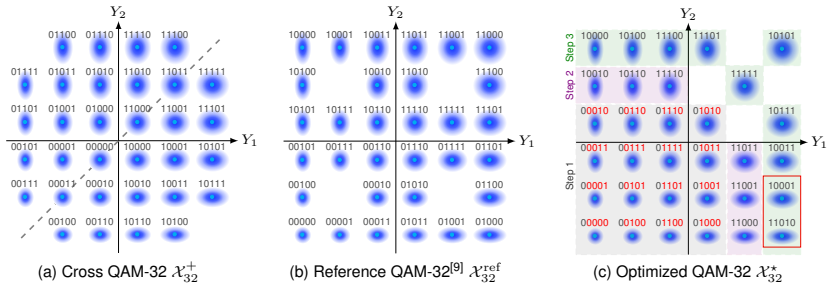
The engine of the design is the memoryless IM-DD channel model $Y = X + Z\sqrt{\sigma_{\mathrm{th}}^2 + (X+\beta)^2\sigma_{\mathrm{rin}}^2}$, in which the total noise variance depends on the transmitted symbol, so RIN makes high-amplitude symbols noisier. The optimization problem is (8): minimize SER over the 58,905 subsets $X_{32}\subset X_{36}$, reduced to 345 candidates by restricting to constellations invariant under the diagonal symmetry of the RIN noise distribution. The winning constellation $\mathcal{X}^\star_{32}$ removes four symbols in the first quadrant, where the sum of the two noise variances is largest. The labeling is a three-step heuristic: a Gray-coded 16-point square base, a new most-significant bit, and a search over $10!$ labelings of the remaining points minimizing average Hamming distance between nearest neighbors.
What would settle it
Re-run the search without the diagonal-symmetry restriction, over all 58,905 subsets of QAM-36 using the same ML detection rule, or evaluate a concrete asymmetric candidate that removes two high-noise symbols from each of two quadrants rather than four from one quadrant, at RIN = $-141$ dB/Hz and high OMA, and compare its SER with $\mathcal{X}^\star_{32}$; if any asymmetric subset has lower SER, the claimed optimality of $\mathcal{X}^\star_{32}$ is refuted.
Extended reading notes
Core claim
The central claim is that the constellation $\mathcal{X}^\star_{32}$, found by minimizing symbol error rate over all 32-point subsets of QAM-36 that are symmetric about the $Y_2=Y_1$ diagonal, is the SER-minimizing 32-point subset for the RIN-dominated IM-DD channel. Unlike cross QAM-32, which drops the four corners, $\mathcal{X}^\star_{32}$ removes four points from the first quadrant, where the signal-dependent RIN noise is largest, and is therefore not symmetric about its origin. In the OMA region where RIN dominates, $\mathcal{X}^\star_{32}$ improves SNR by 0.94 dB over cross QAM-32, while the reference constellation of [9] improves by 0.71 dB over the same baseline; the corresponding SER and BER floors are also reduced. The paper argues that its heuristic labeling makes the BER approach $\mathrm{SER}/5$ asymptotically, the Gray-label limit for 32 points, although two nearest-neighbor pairs have Hamming distance 3.
Load-bearing premise
The load-bearing premise is that the globally best 32-point subset of QAM-36 is symmetric about the diagonal noise axis; the exhaustive search only examines the 345 symmetric candidates, and no proof is given that an asymmetric subset could not have a lower symbol error rate.
Editorial extensions
If this is right
- In a 400 Gb/s-per-lane IM-DD link, replacing cross QAM-32 with $\mathcal{X}^\star_{32}$ gives a 0.94 dB SNR gain in the RIN-limited regime, which can be spent as extra link margin or as a relaxed RIN specification for the laser.
- Because the proposed labeling achieves BER approximately equal to $\mathrm{SER}/5$ at high OMA, forward error correction designed for Gray-coded QAM-32 can be used without extra overhead.
- The optimization method of (8) with the diagonal-symmetry reduction applies directly to other operating points, such as different RIN values or different bias $\beta$, and to other subset sizes.
- The result shows that for signal-dependent noise, the best 2D constellation for a fixed alphabet is not the one that maximizes minimum distance; asymmetric subset selection is beneficial.
Reading between the lines
- If the symmetry restriction is removed, a full search over all 58,905 subsets might find an asymmetric constellation with slightly lower SER; the 0.94 dB gain over cross QAM-32 would likely survive, but the 'lowest-SER' claim would need revision.
- The same subset-selection principle, dropping symbols in the quadrant with largest RIN variance, should carry over to PAM-8 or 2D formats with more bits per symbol, since the scalar noise model becomes even more lopsided at higher amplitudes.
- The labeling is heuristic; a joint constellation-and-labeling optimization, even within the symmetric family, could reduce the Hamming distance of the two exceptional nearest-neighbor pairs and push BER even closer to $\mathrm{SER}/5$.
- Using the SNR definition in (6) as an objective for geometric shaping, with continuous symbol positions instead of a fixed grid subset, may yield gains beyond the 0.94 dB.
Editorial analysis
A structured set of objections, weighed in public.
Referee Report
Summary. Felipe Villenas et al. propose a 32-point 2D constellation X*_32, a subset of the 6x6 QAM-36 grid, for PAM-6 based IM-DD links dominated by relative intensity noise. They formulate a minimum-SER search over all 32-point subsets of QAM-36, reduce the search to the 345 subsets symmetric about the Y1=Y2 diagonal, and report a constellation with four removed points in the first quadrant. For this constellation they design a quasi-Gray binary labeling. They compare the proposed constellation with cross QAM-32 and a reference QAM-32 from [9] via analytic SNR evaluation and Monte Carlo SER/BER simulations, reporting a 0.94 dB SNR gain over cross QAM-32 in the saturation regime and BER that approaches SER/5 asymptotically.
Significance. If the optimality claim can be rigorously established, the paper provides a simple and useful design principle for RIN-limited IM-DD: remove symbols where both coordinates are large positive, thereby reducing the signal-dependent noise variance. The 0.94 dB SNR gain is modest but relevant for short-reach links. The exhaustive search over the 345 symmetric subsets is transparent and reproducible, and the labeling search over 10! candidates for the remaining points is a concrete optimization step. However, the global optimality claim and the asymptotic optimality of the labeling are stronger than the evidence presented. The paper is clearly written and the Monte Carlo methodology is standard.
major comments (3)
- [Optimizing QAM-32 Constellation, Eq. (8)] The paper states in Eq. (8) that X*_32 minimizes SER over all 58,905 subsets of QAM-36, but the actual search only covers the 345 subsets that are invariant under coordinate swap (Y1,Y2)->(Y2,Y1). The noise distribution in Eq. (4) is symmetric in the two coordinates, so any subset and its transposed image have equal SER; however, this does not imply that the set of minimizers contains a symmetric subset. The SER objective is not convex, and mirror-image minimizers could exist as an asymmetric pair without a symmetric representative. Therefore, the claim that X*_32 achieves the lowest SER among all 32-point PAM-6 constellations is not established. The authors should either prove existence of a symmetric minimizer, perform the full search over 58,905 subsets, or explicitly restrict the claim to the symmetric-subset search.
- [Optimizing QAM-32 Constellation] The phrase 'the OMA region of interest' is never defined. The noise variance in Eq. (1) depends on eta through sigma_th^2 = (NEP/eta)^2 B, and OMA = eta(max X - min X), so the SER in (8) depends on OMA. As a consequence, the optimal subset could vary with OMA. Please specify the OMA range used in the optimization and verify that X*_32 is optimal over that range, or state explicitly that the optimization is performed in the asymptotic RIN-dominated limit where sigma_th = 0.
- [Conclusions] The conclusion states that the proposed labeling is 'asymptotically optimal' and that 'any improvements by jointly optimizing the constellation X32 and the labeling will be negligible.' These statements are stronger than the evidence. The labeling section describes a heuristic three-step construction and presents a conjecture, not a proof. I recommend replacing 'asymptotically optimal' with 'approaching the Gray-bound SER/5 in the simulated error-floor region' and removing the claim about negligible improvement from joint optimization.
minor comments (4)
- [Results, Fig. 3(b-c)] The Monte Carlo SER/BER results do not report the number of simulated symbols or confidence intervals. At BER levels around 10^-7, this information is necessary to assess whether the apparent gains are statistically significant; please add it.
- [Optimizing QAM-32 Constellation, Step 2] The description 'The six adjacent points are then labeled' is ambiguous; please state which points are adjacent to the initial 16-point subset and how their labels are chosen.
- [Results, Fig. 3(c)] The horizontal lines are labeled 'SER/5' in the figure and called 'approximated Gray label BER values' in the text; clarify that these lines represent the approximation BER = SER/log2(M).
- [Abstract and Introduction] The abstract uses 'PAM-6' as a 1D modulation, but the transmitted symbols are actually 2D points from a 32-point subset of QAM-36. Consider rephrasing to avoid the impression that the proposal is a 1D constellation.
Circularity Check
No significant circularity: the optimization, SNR analysis, and labeling are computed from the assumed channel model, not from the claimed results.
full rationale
The paper's derivation chain is self-contained. The channel model in Eq. (1) is an assumed input reused from the authors' prior OFC paper [11], not derived from the target result, and no parameter is fitted to the reported SER/BER curves. The constellation search in Eq. (8) minimizes SER under that fixed model, and the 0.94 dB SNR gain is computed from the independent SNR definitions in Eqs. (6)-(7), so the gain is a geometric consequence of the chosen point set rather than an imposed outcome. The bit labeling is obtained by an explicit exhaustive search over Hamming distances, and the BER/SER comparisons are Monte Carlo simulations using the stated decision rule. The only substantive gap is that the search in Eq. (8) is restricted to the 345 diagonal-symmetric subsets without proving that the global minimizer among all 58,905 candidate subsets is symmetric; however, this is a limitation of the optimality claim, not circular reasoning, because the objective is not defined in terms of the claimed optimal constellation. The self-citation to [11] supplies the channel model and simulation parameters, but it is not used to prove the improvement, so it does not raise the circularity score.
Assumptions & free parameters
assumptions (4)
- domain assumption The IM-DD channel is memoryless with output Y = X + Z*sqrt(sigma_th^2 + (X+beta)^2 sigma_rin^2), with Z unit-variance Gaussian.
- ad hoc to paper The optimal constellation can be sought among subsets symmetric about the Y2=Y1 line.
- standard math Equiprobable symbols and maximum-likelihood detection (Eq. 5).
- domain assumption The peak-power constraint is enforced by a bias beta >= |min{X6}|, fixed independently.
Cite this review
Pith. "Pith review of A New 5 bit/2D-symbol Modulation Format for Relative Intensity Noise-dominated IM-DD Systems." pith.science (2026). https://pith.science/paper/QI34N4SX
@misc{pith2026250601761,
  author       = {Pith},
  title        = {Pith review of: A New 5 bit/2D-symbol Modulation Format for Relative Intensity Noise-dominated IM-DD Systems},
  year         = {2026},
  howpublished = {\url{https://pith.science/paper/QI34N4SX}},
  note         = {Machine review of arXiv:2506.01761}
}
read the original abstract
We propose a novel 5-bit/2D-symbol modulation format based on PAM-6 optimized for IM-DD systems dominated by relative intensity noise. The proposed modulation scheme improves SNR by 0.94 dB compared to conventional PAM-6 and achieves near-optimal BER performance.
Figures


Reference graph
Works this paper leans on
-
[9]
PAM-6 coded modula- tion for IM/DD channels with a peak-power constraint
T. Prinz, T. Wiegart, D. Plabst, S. Calabrò, G. Böcherer, N. Stojanovic, and T. Rahman, “PAM-6 coded modula- tion for IM/DD channels with a peak-power constraint”, in 2021 11th International Symposium on Topics in Coding (ISTC), Montreal, Canada, Sep. 2021
work page 2021
-
[1]
Modulation format and digital signal processing for IM-DD optics at post-200G era
D. Che and X. Chen, “Modulation format and digital signal processing for IM-DD optics at post-200G era”, Journal of Lightwave Technology, vol. 42, no. 2, pp. 588– 605, Jan. 2024
work page 2024
-
[2]
800G Pluggable MSA, https://www.800gmsa.com/ , retrieved on 13/08/2024
work page 2024
-
[3]
200 Gbps/lane IM/DD technologies for short reach optical interconnects
X. Pang, O. Ozolins, R. Lin, L. Zhang, A. Udalcovs, L. Xue, R. Schatz, U. Westergren, S. Xiao, W. Hu, G. Ja- cobsen, S. Popov, and J. Chen, “200 Gbps/lane IM/DD technologies for short reach optical interconnects”, Jour- nal of Lightwave Technology, vol. 38, no. 2, pp. 492–503, 2020
work page 2020
-
[4]
4-PAM for high-speed short-range optical communications
K. Szczerba, P . Westbergh, J. Karout, J. S. Gustavsson, Å. Haglund, M. Karlsson, P . A. Andrekson, E. Agrell, and A. Larsson, “4-PAM for high-speed short-range optical communications”, Journal of Optical Communications and Networking, vol. 4, no. 11, pp. 885–894, Oct. 2012
work page 2012
-
[5]
Q. Hu, T. Tannert, M. Grözing, G. Raybon, R. Borkowski, F . Buchali, X. Chen, P . Iannone, G. Rademacher, and R. Ryf, “467 Gbit/s net bitrate IM/DD transmission using 176 GBd PAM-8 enabled by SiGe AMUX with excellent linearity”, in Optical Fiber Communication Conference (OFC), San Diego, USA, Mar. 2024
work page 2024
-
[6]
A. Uchiyama, S. Okuda, T. Tsuji, Y . Hokama, M. Shirao, K. Abe, T. Y amatoya, and Y . Y amauchi, “Demonstration of 155 Gbaud PAM4 and PAM6 EML with narrow high- mesa EA modulator for 400 Gbps per lane transmission”, in Optical Fiber Communications Conference (OFC) , IEEE, San Diego, USA, Mar. 2024
work page 2024
-
[7]
225 Gb/s per lambda IMDD PAM short reach links using only commercial components
J. Wei, C. Prodaniuc, L. Zhang, and N. Stojanovic, “225 Gb/s per lambda IMDD PAM short reach links using only commercial components”, in Opto-Electronics and Communications Conference (OECC), Jeju, Korea, Jul. 2018
work page 2018
Show all 16 references
-
[8]
Comparison of PAM-6 modulations for short-reach fiber- optic links with intensity modulation and direct detec- tion
T. Prinz, T. Wiegart, D. Plabst, T. Rahman, M. S.-B. Hos- sain, N. Stojanovi´c, S. Calabrò, N. Hanik, and G. Kramer, “Comparison of PAM-6 modulations for short-reach fiber- optic links with intensity modulation and direct detec- tion”, in European Conference on Optical Communi...
2022
-
[10]
On the optimality of the binary reflected Gray code
E. Agrell, J. Lassing, E. G. Strom, and T. Ottosson, “On the optimality of the binary reflected Gray code”, IEEE Transactions on Information Theory , vol. 50, no. 12, pp. 3170–3182, Nov. 2004
2004
-
[11]
On Geometric Shaping for 400 Gbps IM-DD Links with Laser Intensity Noise
F . Villenas, K. Wu, Y . C. Gültekin, J. Riani, and A. Al- varado, “On Geometric Shaping for 400 Gbps IM-DD Links with Laser Intensity Noise”, in Optical Fiber Com- munications Conference (OFC), San Francisco, USA, Apr. 2025
2025
-
[12]
PAM-6 generation using 32-QAM con- stellation
L. Chorchos, “PAM-6 generation using 32-QAM con- stellation”, Metro and Data Center Optical Networks and Short-Reach Links II, vol. 10946, pp. 140–149, Feb. 2019
2019
-
[13]
Constellation labeling for linear encoders
R. D. Wesel, X. Liu, J. M. Cioffi, and C. Komninakis, “Constellation labeling for linear encoders”, IEEE Trans- actions on Information Theory, vol. 47, no. 6, pp. 2417– 2431, Sep. 2001
2001
-
[14]
Exper- imental comparison of probabilistic shaping methods for unrepeated fiber transmission
J. Renner, T. Fehenberger, M. P . Y ankov, F . Da Ros, S. Forchhammer, G. Böcherer, and N. Hanik, “Exper- imental comparison of probabilistic shaping methods for unrepeated fiber transmission”, Journal of Lightwave Technology, vol. 35, no. 22, pp. 4871–4879, 2017
2017
-
[15]
Hui, Introduction to fiber-optic communications
R. Hui, Introduction to fiber-optic communications. Aca- demic Press, 2019
2019
-
[16]
Gray coding for multilevel constellations in Gaussian noise
E. Agrell, J. Lassing, E. G. Strom, and T. Ottosson, “Gray coding for multilevel constellations in Gaussian noise”, IEEE Transactions on Information Theory, vol. 53, no. 1, pp. 224–235, Dec. 2006
2006
Reviewed August 7, 2026 · model on record in the stance chip above.
Discussion (0). Sign in to comment.