REVIEW 3 major objections 5 minor 1 cited by
Minimal Pair-Based Evaluation of Code-Switching
T0 review · 3 major / 5 minor · reviewed 2026-08-07 · deepseek-v4-flash
Pith's one-line read A minimal-pair benchmark built from real bilingual sentences and one-word manipulations tests whether language models share bilinguals' code-switching preferences, and finds that larger models agree more often.
desk verdict A genuinely useful code-switching benchmark that is undermined by an overclaimed scaling result and an unexamined token-length confound. read the letter →
The pith
A machine-rendered reading of the paper's core claim, the machinery that carries it, and where it could break.
The reading
What carries the argument
The central object is the minimal pair of code-switched sentences: one naturally occurring sentence paired with a variant created by translating exactly one word next to a switch point into the other language, with the number of switch points held constant between the two members. The construction pipeline combines token-level language identification, sentence segmentation, machine translation, word alignment, and dependency parsing to generate pairs in a language-agnostic way, and it excludes nouns, unaligned material, and non-integrative switches to keep pairs plausible. Evaluation is by accuracy: the proportion of pairs in which a model assigns higher probability to the naturally occurring sentence than to the manipulated variant, with the log-probability margin used as the measure of how large the acceptability difference is.
What would settle it
A reader could audit the assumption directly by running a larger human study on sampled pairs: if for any language pair bilinguals prefer the naturally occurring sentence no more often than chance, the gold standard fails for that pair. The paper already reports 22 German–English pairs in which all three annotators chose the manipulated variant instead, so examining those pairs systematically would show whether the failure is structured, for example when the manipulation fixes a typo in the original.
Extended reading notes
Core claim
The paper's central claim is that the acceptability of code-switching can be operationalised as a choice between two sentences that differ by one word: the sentence a bilingual actually produced and a variant produced by translating a single word adjacent to the switch point into the other language. Under the assumption that observed code-switching is acceptable and that the manipulation lowers acceptability, the naturally occurring sentence is the gold standard. The paper reports that bilinguals choose that sentence consistently across all 11 language pairs, with multi-rater agreement coefficient $\kappa = 0.57$ for German–English and accuracy ranging from about 75 to 88 percent. It then reports that LLM performance scales with size: the largest model tested is significantly better than all smaller models on most language pairs, reaching 74.8 percent accuracy on German–English, and that the probability margin between pair members is larger when the manipulated word belongs to a closed class such as auxiliaries or pronouns. This is presented as the first benchmark that directly measures LLM code-switching acceptability and permits testing of linguistic hypotheses about which word classes are more switchable.
Load-bearing premise
The benchmark's gold standard rests on the assumption that every naturally observed code-switched sentence is acceptable and that translating one word next to the switch point lowers acceptability on average; if many observed sentences are typos, mislabeled, or not genuine code-switching, the labels are wrong.
Editorial extensions
If this is right
- Because human judgments are needed only once to validate how pairs are built, any new automatic system can be evaluated on the benchmark by comparing its sentence probabilities, making code-switching evaluation cheap and repeatable.
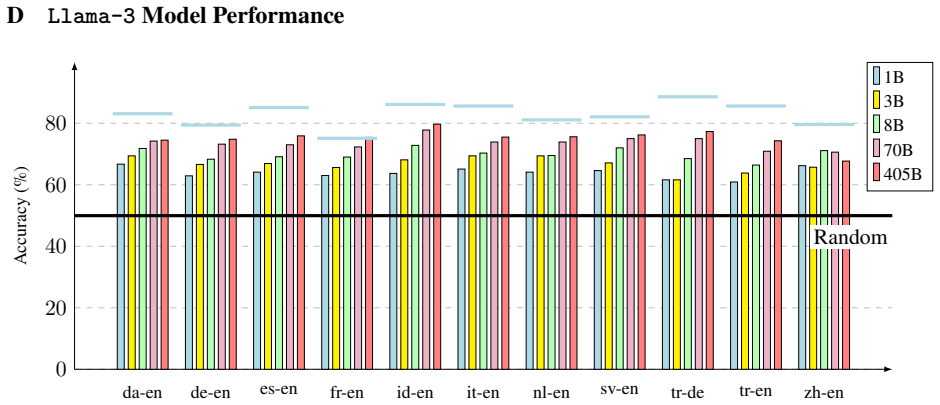
- Accuracy on the benchmark rises with model size within the tested model families, and the largest tested model significantly beats all smaller ones on most language pairs, so the benchmark can track future progress in code-switching modelling.
- The part-of-speech analysis provides direct empirical support for the long-standing claim that closed-class words (auxiliaries, pronouns, determiners) are more switchable than open-class words (verbs, adjectives, adverbs) in almost all language pairs.
- Spoken transcription code-switching is not inherently easier or harder for LLMs than written code-switching: Turkish–German shows the same scaling trend as social-media-derived pairs, whereas the different-script Chinese–English pair shows no improvement with scale.
- Even the best tested model remains below the human agreement ceiling, so current LLMs do not fully capture bilingual code-switching acceptability.
Reading between the lines
- If the scaling trend persists in future base models, the benchmark could act as a canary for whether pretraining corpora contain enough natural code-switched text, in the same way monolingual minimal-pair benchmarks track grammaticality.
- The same one-word-swap intervention could be applied to additional language pairs, including non-Latin-script pairs, to separate the Chinese–English plateau's likely cause (no shared tokens between scripts) from genuine difficulty differences in code-switching modelling.
- The closed-class result would be cleaner if tested after controlling for word frequency, word length, and tokenizer behaviour, since those confounds could create larger margins without a linguistic cause.
- The 22 German–English pairs where all human judges preferred the manipulated sentence form a ready-made audit set for the assumption that the observed sentence is always acceptable; some may be cases where the manipulation accidentally corrected an error.
Editorial analysis
A structured set of objections, weighed in public.
Referee Report
Summary. The paper introduces ACS, a benchmark of minimal pairs for code-switching (CS) acceptability across 11 language pairs. Each pair consists of a naturally occurring CS sentence from social media or spoken corpora and a manipulated variant created by translating one word adjacent to the switch point. The authors validate the benchmark with human judgments, report inter-annotator agreement for German–English, and evaluate several open-weight LLM families using unnormalized sentence probabilities. They report three main findings: humans prefer the observed CS sentence on average; larger LLMs more often assign higher probability to the observed CS sentence; and larger absolute LLM margins occur for closed-class word manipulations, consistent with theoretical claims.
Significance. The ACS benchmark is a potentially valuable resource for CS evaluation: it is publicly released, covers an unusually wide set of language pairs, and avoids the subjectivity of absolute acceptability ratings by using controlled minimal pairs. The human validation experiments, the error analysis on a 100-pair sample, and the use of permutation tests are strengths that make the claims checkable. If the scaling claim can be stated with the proper qualifications and the token-length confound is addressed, the benchmark would be a useful tool for tracking LLM progress on code-switching. The paper is honest about several limitations, including noisy Twitter data, one-participant validation for most language pairs, and uncertainty about training-data leakage.
major comments (3)
- [Abstract and §3.2] The abstract's scaling claim, 'the larger the model, the more consistently it assigns higher probability to the naturally occurring CS sentence than to the variant,' is contradicted by the paper's own results. Section 3.2 reports that for Chinese–English 'there is no improvement with model size (all comparisons have p>0.05)', and the following paragraph states that Llama-3.1 405B is statistically indistinguishable from smaller models for Danish–English, Indonesian–English, Dutch–English, Swedish–English, and Turkish–English. Appendix Table 7 confirms this: for zh-en the 405B accuracy is 67.7% while the 70B model reaches 70.6%, and for da-en the 405B is 74.5% versus 74.2% for 70B. The scaling claim therefore cannot be stated as a general result without specifying the language pairs and model families for which it holds.
- [§3.1, Eq. (1) and footnote 7] The accuracy metric and margin are computed from unnormalized sentence probabilities, and the minimal-pair manipulation changes the token count by construction. The footnote cites Ueda et al. (2024) to justify not normalizing by token count, but that citation addresses a specific normalization method, not whether token-length differences are a confound in this benchmark. Because English words are often tokenized into fewer subword tokens than words in several other languages covered here, the observed CS sentence may systematically be the shorter one. A baseline that simply chooses the shorter sentence, or an analysis conditioned on token-length difference, is needed to establish that the LLM accuracies in Figures 2–4 and the margin analyses in Figures 3 and 5 reflect CS acceptability rather than a token-length preference. This is load-bearing for the scaling claim.
- [§2 and §2.2 (error analysis)] The gold-standard assumption, stated in Section 2 as 'We assume that all observed CS is acceptable' and that the manipulation will on average decrease acceptability, is only partially verified. The error analysis on 100 German–English pairs found that only 76% of genuine CS sentences produced 'fair' pairs, and Section 2.3 reports 22 minimal pairs for which all three human annotators chose the manipulated sentence. The Limitations section also acknowledges that Twitter noise 'can contribute to the acceptability differential,' with the 'belive'/'glauben' example showing that the manipulation can make the variant more correct than the observed sentence. Label noise of this kind can attenuate or distort both human and LLM accuracy, so the paper should either filter out known error cases, report robustness analyses excluding them, or quantify how much the main results depend on pairs whose labels are most uncertain.
minor comments (5)
- [§2.1] The statement that the treated languages 'must be written in Latin script' is inconsistent with the later inclusion of Chinese–English; please clarify that this condition applies only to the Twitter-derived language pairs and that the Chinese–English and Turkish–German data are complements from spoken corpora.
- [§2.3] For the ten language pairs other than German–English, human validation rests on a single participant per pair. The abstract's phrase 'bilinguals consistently prefer' is stronger than the evidence; the paper should state that the single bilingual participant in each pair preferred the observed sentence on average, or provide additional participants for those pairs.
- [Limitations] There is a typo in the Limitations section: 'we also also cannot be sure' should read 'we also cannot be sure.'
- [Figure 4 and Appendix D] The caption 'Horizontal light blue lines represent the accuracy achieved by our participants' is misleading for language pairs with a single participant; consider labeling these lines as 'single-participant accuracy' or 'mean human accuracy' as appropriate.
- [Table 7] The zh-en row of Table 7 shows non-monotonic accuracy across model sizes (66.2, 65.7, 71.1, 70.6, 67.7); since this row is central to the exception to the scaling claim, it should be discussed in the main text rather than only in the appendix.
Circularity Check
No significant circularity: benchmark labels are external observed data and LLM scores are direct measurements, not fitted predictions.
full rationale
The benchmark labels are external observed data (naturally occurring tweets and spoken transcriptions), not outputs of the models under evaluation, and the LLM accuracy and margin scores contain no fitted parameters. The core claims—bilinguals prefer the observed CS sentence and larger LLMs assign it higher probability—are direct measurements against those external labels. The paper's reliance on its own AnE and sat-12-sm tools is supported by separate published evaluations and by an internal error analysis on 100 German–English pairs; these tools affect data construction but do not by themselves force the scaling, human-agreement, or POS-margin results. The 'all observed CS is acceptable' assumption is explicitly stated and is tested against independent human judgments rather than derived from them. The token-length difference footnote acknowledges a potential confound but does not reduce the prediction to the input; it is a validity concern, not circularity. No equation in the paper defines the model output in terms of the labels, and no fitted parameter is renamed as a prediction. The self-citations are present but not load-bearing for the central claims, so the circularity score is low.
Assumptions & free parameters
free parameters (3)
- Noun-exclusion rule at switch points
- Minimum POS group size =
10
- Data filtering thresholds =
6 tokens minimum, 200 characters maximum, Levenshtein distance below 5, under 50 percent unknown words, 1,000 pair cap
assumptions (4)
- domain assumption All observed CS is acceptable
- domain assumption Translating one word at a switch point decreases acceptability on average
- domain assumption Automatic NLP tools are accurate enough
- domain assumption LLM sentence probabilities can be compared across sentences without length normalization
Cite this review
Pith. "Pith review of Minimal Pair-Based Evaluation of Code-Switching." pith.science (2026). https://pith.science/paper/HDTM3GEN
@misc{pith2026250601840,
  author       = {Pith},
  title        = {Pith review of: Minimal Pair-Based Evaluation of Code-Switching},
  year         = {2026},
  howpublished = {\url{https://pith.science/paper/HDTM3GEN}},
  note         = {Machine review of arXiv:2506.01840}
}
read the original abstract
There is a lack of an evaluation methodology that estimates the extent to which large language models (LLMs) use code-switching (CS) in the same way as bilinguals. Existing methods do not have wide language coverage, fail to account for the diverse range of CS phenomena, or do not scale. We propose an intervention based on minimal pairs of CS. Each minimal pair contains one naturally occurring CS sentence and one minimally manipulated variant. We collect up to 1,000 such pairs each for 11 language pairs. Our human experiments show that, for every language pair, bilinguals consistently prefer the naturally occurring CS sentence. Meanwhile our experiments with current LLMs show that the larger the model, the more consistently it assigns higher probability to the naturally occurring CS sentence than to the variant. In accordance with theoretical claims, the largest probability differences arise in those pairs where the manipulated material consisted of closed-class words.
Figures


Figures from the paper (5 more)


Forward citations
Cited by 1 Pith paper
-
Lost in Speech: Benchmarking, Evaluation, and Parsing of Spoken Bilingual Conversational Language Beyond Standard UD Assumptions
A 126-sentence spoken code-switching benchmark, a flexible scoring metric, and an agentic LLM parser are introduced, but the paper's tables contradict its claimed accuracy gains.
Reference graph
Works this paper leans on
-
[1]
For the work here, we do not include these wordlists
One of the problems in our previous corpus was Swiss German sentences, because we decided to include Swiss and Austrian wordlists in the compilation process. For the work here, we do not include these wordlists
-
[2]
Such words are almost never German/English words
We also exclude tweets which contain words with an umlaut but not in the German wordlist. Such words are almost never German/English words
-
[3]
We found many monolingual tweets which arise due to incorrectly identified interlingual homographs and other shared words between the languages. We search for German words in a bilingual dictionary (dict.cc) which have identical corresponding English entries, and vice versa. We remove all such words from their wordlists of each language. A second aspect o...
-
[4]
We only keep tweets with fewer than 50% unknown words. Borrowed words Borrowed words are words of foreign origin used in one language that are fully assimilated and hence considered part of that language. They form a grey area in language change, and for our purposes should not be altered in a minimal pair. We collect lists of borrowed words for each lang...
work page 2022
-
[2018]
InInterspeech, pages 1938–1942
The role of cognate words, pos tags and en- trainment in code-switching. InInterspeech, pages 1938–1942. Igor Sterner. 2024.Multilingual identification of En- glish code-switching. In Proceedings of the Eleventh Workshop on NLP for Similar Languages, Varieties, and Dialects (VarDial 2024), pages 163–173, Mexico City, Mexico. Association for Computational ...
work page 1938
-
[2021]
DaLAJ - a dataset for linguistic acceptability judgments for Swedish: Format, baseline, sharing
DaLAJ - a dataset for linguistic acceptability judgments for Swedish: Format, baseline, sharing. Preprint, arXiv:2105.06681v1. Alex Warstadt, Aaron Mueller, Leshem Choshen, Ethan Wilcox, Chengxu Zhuang, Juan Ciro, Rafael Mos- quera, Bhargavi Paranjabe, Adina Williams, Tal Linzen, and Ryan Cotterell. 2023.Findings of the BabyLM challenge: Sample-efficient ...
work page Pith review arXiv 2023
-
[2024]
ZhoBLiMP: a systematic assessment of lan- guage models with linguistic minimal pairs in chinese. Preprint, arXiv:2411.06096v1. Holy Lovenia, Samuel Cahyawijaya, Genta Winata, Peng Xu, Yan Xu, Zihan Liu, Rita Frieske, Tiezheng Yu, Wenliang Dai, Elham J. Barezi, Qifeng Chen, Xi- aojuan Ma, Bertram Shi, and Pascale Fung. 2022. ASCEND: A spontaneous Chinese-E...
arXiv 2022
-
[2025]
MultiBLiMP 1.0: A massively multilingual benchmark of linguistic minimal pairs. Preprint, arXiv:2504.02768v2. Carina Kauf and Anna Ivanova. 2023.A better way to do masked language model scoring. In Proceed- ings of the 61st Annual Meeting of the Association for Computational Linguistics (Volume 2: Short Pa- pers), pages 925–935, Toronto, Canada. Associati...
arXiv 2023
Reviewed August 7, 2026 · model on record in the stance chip above.
Discussion (0). Sign in to comment.