REVIEW 3 major objections 4 minor 43 references
Proximity-induced Rashba spin-orbit interaction in BaMnO$_\text{3}|$KTaO$_\text{3}$ heterostructure for antiferromagnetic spintronics
T0 review · 3 major / 4 minor · reviewed 2026-08-07 · deepseek-v4-flash
Pith's one-line read A BaMnO3|KTaO3 heterostructure is predicted to combine antiferromagnetism with a sizable Rashba spin splitting, giving antiferromagnetic spintronics a single platform.
desk verdict Solid DFT design study with a new material prediction, but the Rashba-on-BMO mechanism is not actually isolated by the slab control the authors rely on. read the letter →
The pith
A machine-rendered reading of the paper's core claim, the machinery that carries it, and where it could break.
The reading
What carries the argument
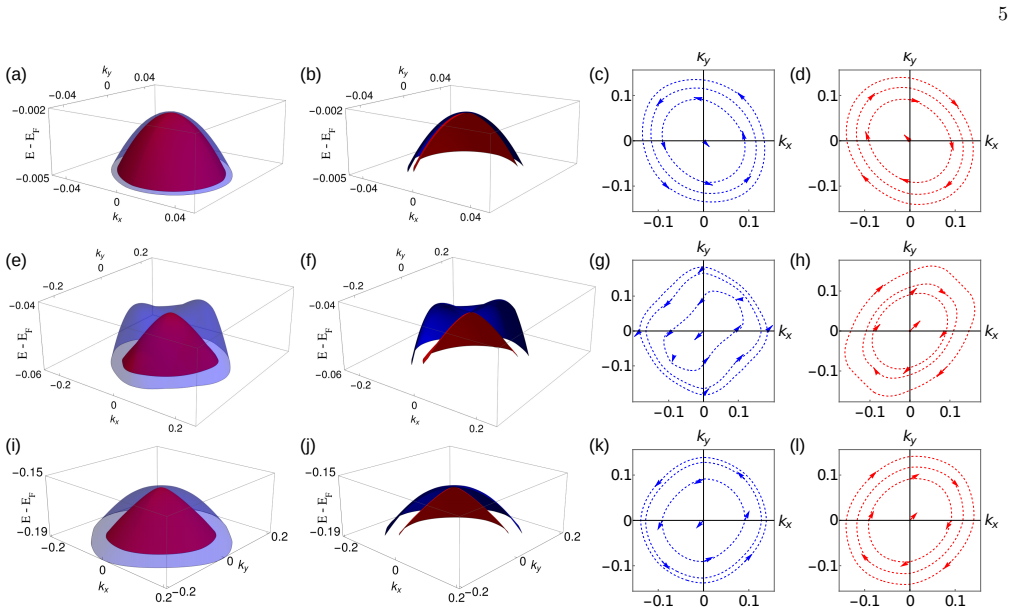
The working object is the inversion-asymmetric $(\text{BaMnO}_3)_2|(\text{KTaO}_3)_3$ superlattice, a polar|nonpolar oxide heterostructure in which alternating charged $(\text{KO})^-$ and $(\text{TaO}_2)^+$ planes in KTO generate an internal electrostatic potential and a compensating charge transfer at the BMO|KTO interfaces. That polar field, combined with the strong intrinsic spin-orbit coupling of Ta-5d electrons, is what the paper argues induces linear Rashba splitting on the Mn-3d-derived bands of the BMO layer. The argument is carried by comparing the heterostructure with inversion-symmetric bulk BMO and with a BMO slab that breaks inversion symmetry but shows no Rashba splitting, then fitting the DFT bands to a two-band Rashba model and inspecting the helical spin textures.
What would settle it
Recompute the same heterostructure with the spin-orbit interaction on Ta atoms switched off; if the BMO valence bands still show the $\sim$0.06–0.11 eV·Å linear splitting, the proximity-induced-SOI explanation is falsified. A complementary experimental check is spin-resolved photoemission on BMO grown on KTO(001), looking for the predicted helical spin texture and extracting the Rashba coefficient for direct comparison.
Extended reading notes
Core claim
The central claim is that placing cubic BaMnO3 next to KTaO3 transfers enough spin-orbit character from the Ta-5d states to the Mn-3d states that the BMO bands near the Fermi level show pronounced, roughly linear Rashba spin splitting while the BMO layer simultaneously retains strong antiferromagnetism. The paper identifies the C-type antiferromagnetic arrangement as lowest in energy, estimates exchange couplings $J_1 = 4.96$ meV and $J_2 = -1.86$ meV, and, from Monte Carlo specific-heat peaks, an ordering temperature of at least 54 K. The Rashba-split valence-band pairs are fitted to a two-band Rashba model with effective masses $-0.49\,m_e$ and $-0.402\,m_e$ and with coefficients 0.063 eV·Å and 0.114 eV·Å. Orbital-character analysis shows Mn-d states dominate the Fermi-level bands, which the authors take as evidence that the spin-orbit interaction is proximity-induced from KTO rather than intrinsic to BMO.
Load-bearing premise
The claim that KTaO3's spin-orbit coupling, rather than the interface electric field alone, causes the BMO band splitting rests on comparing the heterostructure with a freestanding BMO slab; if that slab does not reproduce the heterostructure's field and strain, the splitting could arise from the polar interface alone.
Editorial extensions
If this is right
- Increasing the KTO thickness beyond roughly 10 unit cells should make the interface conducting, creating a two-dimensional electron system at the BMO|KTO interface alongside the antiferromagnetism.
- The fitted linear Rashba coefficients place the BMO valence bands in a range where current-induced spin-orbit torques acting on the C-type antiferromagnetic order become plausible.
- Proximity to KTaO3 offers a route to impart Rashba spin splitting to a magnetic oxide without alloying or chemical doping the magnetic layer.
- BMO|KTO becomes a candidate platform for studying spin-momentum locking and antiferromagnetic order on the same interface.
- The ~54 K ordering temperature gives a concrete baseline for strain or layer-thickness engineering aimed at raising the working temperature.
Reading between the lines
- A decisive control calculation is to delete Ta-5d spin-orbit coupling; if the BMO splitting persists, the active mechanism is the polar interface field rather than proximity to KTO's Ta orbitals.
- Exchanging KTO for an isostructural, nonpolar strong-SOC partner (for example SrIrO3) could separate the roles of polarity and 5d spin-orbit coupling in generating the effect.
- The electrostatic model's thickness threshold suggests a testable growth series: BMO films on KTO(001) with 5, 10, and 20 KTO unit cells should show onset of interface conductivity only after the threshold.
- The same proximity recipe may eventually transfer other KTO interface properties, such as its two-dimensional electron gas, into the magnetic BMO layer, though that is beyond what the paper demonstrates.
Editorial analysis
A structured set of objections, weighed in public.
Referee Report
Summary. The manuscript reports DFT+U+SOC calculations for a (BaMnO3)2|(KTaO3)3 superlattice. It finds a C-type antiferromagnetic ground state for the BMO block, derives exchange constants J1 and J2 by total-energy mapping, estimates a N\'eel temperature of about 54 K by Monte Carlo simulation, and identifies Rashba-like spin splitting in BMO-derived valence bands near the Fermi level, with linear Rashba coefficients of 0.063 and 0.114 eV\cdot\AA. The authors attribute this splitting to proximity-induced spin-orbit interaction from the KTaO3 layer and propose the heterostructure as a platform for antiferromagnetic spintronics.
Significance. If correct, the work would address a real materials challenge by combining strong spin-orbit interaction and antiferromagnetic ordering in one oxide heterostructure. The paper is methodologically transparent: computational parameters are stated (VASP, LSDA+U with specified Ueff values, 450 eV cutoff, 11x11x1 k-mesh), a thick-KTO test calculation is reported, and Monte Carlo finite-size behavior is checked for three lattice sizes. However, the two central quantitative pillars, namely the proximity mechanism for the Rashba splitting and the exchange-based ordering temperature, need significantly stronger support before the conclusions can be accepted. The simulated supercell is also insulating, so the spintronic relevance of the extracted Rashba parameters is not directly demonstrated.
major comments (3)
- [Rashba analysis / Fig. 3] The attribution of the Rashba splitting to proximity-induced SOI from KTO is not established by the control used. The text states that bulk BMO and a BMO slab show no Rashba splitting, while the BMO|KTO heterostructure does (Fig. 3). This control is insufficient: the freestanding BMO slab lacks the polar electrostatic potential that the authors' own model (Eq. (1), Fig. 1(a)) places across the BMO block even before charge transfer. Inversion asymmetry plus an interface electric field plus Mn-3d/O-2p spin-orbit coupling is the standard mechanism for interfacial Rashba splitting, so the observed splitting could be a generic field-induced effect rather than a transfer of Ta-5d spin-orbit character. Figure 3(h) shows Ta dxy weight only at elevated conduction-band energies, not in the fitted valence bands; the statement that this "establishes" a proximity-induced splitting is therefore not supported. A calculation of a BMO slab under an applied electric field, or an explicit quantification of Ta weight in the Rashba-split bands, is needed to isolate the proximity contribution.
- [Tables I and II / Magnetic ordering] The exchange constants in Table II are inconsistent with the DFT magnetic energies in Table I. For a two-neighbor collinear Heisenberg model with J1 out-of-plane and J2 in-plane nearest-neighbor interactions, the energy differences per Mn satisfy the relation E_A - E_C = (E_FM - E_C) + (E_G - E_C). Table I gives 34.5, 33.7, and 57.8 meV, so the relation would require 34.5 meV to equal approximately 91.5 meV, which fails badly. Equivalently, the listed signs J1 = +4.96 meV and J2 = -1.86 meV would make the A-type arrangement (ferromagnetic out-of-plane, antiferromagnetic in-plane) lower in energy than the C-type arrangement, contrary to Table I. Hence the J values cannot be derived from the stated energies, and the 54 K Monte Carlo ordering temperature built on these J values is not supported. The authors should correct the mapping or include additional exchange interactions beyond the two nearest-neighbor paths.
- [Heterostructure model / Results] The quantitative results are obtained for an insulating supercell, not for a conducting spintronic interface. The authors state that the (BMO)2|(KTO)3 supercell has a gap of about 0.65 eV and "does not host a conducting interface desired for antiferromagnetic spintronics." The Rashba coefficients and effective masses are extracted from valence bands of this insulator, and the model-based onset estimate (Eq. (3)) indicates that at least ten unit cells of KTO are required for charge transfer. The test with (BMO)2|(KTO)20 is mentioned only as evidence of a conducting interface, with no analysis of its band structure or Rashba splitting. The generalization of the 2|3 results to a conducting, device-relevant interface is therefore an assumption rather than a demonstrated result.
minor comments (4)
- [Eq. (6)] The notation in Eq. (6) for the second sum is garbled ("k=4X i,k=1"); it should be written as a sum over the four in-plane neighbors of each spin.
- [Control slab calculation] The BMO slab used as the control is not described: its thickness, vacuum spacing, surface termination, relaxation protocol, and computational parameters should be specified so that the reader can assess whether it is an appropriate control for the heterostructure electric field.
- [Monte Carlo details] The spin length S used in Eqs. (4)-(6) and in the Monte Carlo simulation is never stated; since the extracted J values and the resulting ordering temperature depend on this choice, the value of S should be given explicitly.
- [Throughout] There are several typographical and formatting errors, including "isoenegertic" for "isoenergetic," "PA W" for "PAW," and inconsistent rendering of powers such as "10−7 eV" and "10−2 eVÅ−1"; these should be corrected.
Circularity Check
No significant circularity: the DFT-derived magnetic and Rashba descriptors are standard parameter extractions rather than predictions forced by construction.
full rationale
After walking the derivation chain, I find no step in which a predicted quantity is equivalent by construction to its input. The ordering temperature is obtained by mapping four DFT magnetic-configuration energies to a two-parameter Heisenberg model (J1, J2) and then running Metropolis Monte Carlo; while the J values are extracted from the same DFT energies, the 54 K specific-heat peak is an emergent statistical-mechanical output, not a restatement of the energy differences. The Rashba coefficients alpha(1) = 0.063 and 0.114 eV·Å and the effective masses are fit parameters describing the DFT bands; they are reported as characterizations of the computed dispersion rather than as independent predictions, so the 'fitted input called prediction' pattern does not apply. The proximity-induced attribution rests on a computational comparison (bulk BMO and a BMO slab show no splitting, whereas the BMO|KTO heterostructure shows splitting). That comparison may be scientifically debated, because a free-standing BMO slab does not reproduce the full interface polar field, but a questionable control is an evidence and validity concern, not a circular reduction, and the text does not define 'proximity-induced' in terms of the observed result. Self-citations to Refs. [7], [9], and [16] are motivational or methodological; the KTO strong-Rashba premise is supported jointly by those works and by external experimental references [10, 11, 14, 40], so no load-bearing self-citation chain is present. Overall, the paper is a self-contained DFT study with standard parameter extraction and no significant circularity.
Assumptions & free parameters
free parameters (8)
- Ueff for Mn-3d =
3 eV
- Ueff for Ta-5d =
1 eV
- J1 (out-of-plane exchange) =
4.96 meV
- J2 (in-plane exchange) =
-1.86 meV
- Rashba coefficient alpha for second valence band pair =
0.063 eV Å
- Rashba coefficient alpha for third valence band pair =
0.114 eV Å
- effective mass m* for second valence band pair =
-0.49 me
- effective mass m* for third valence band pair =
-0.402 me
assumptions (5)
- domain assumption LSDA+U with Ueff = 3 eV on Mn and 1 eV on Ta provides a sufficiently accurate electronic structure for this heterostructure.
- domain assumption The magnetic ground state can be found among collinear C-, A-, G-type AFM and FM configurations, and a Heisenberg Hamiltonian with only J1 and J2 describes the relevant spin physics.
- domain assumption The simulated ideal superlattice represents a physically realizable coherently strained BMO film on KTO, without octahedral rotations, intermixing, oxygen vacancies, or reconstructed interfaces.
- domain assumption The measured band dispersion can be parameterized by a linear Rashba two-band model with isotropic effective mass.
- ad hoc to paper The electrostatic potential in the superlattice follows a parallel-plate capacitor model with ideal +1/-1 charged planes and a threshold voltage VTh = epsilon_g + Delta.
Cite this review
Pith. "Pith review of Proximity-induced Rashba spin-orbit interaction in BaMnO$_\text{3}|$KTaO$_\text{3}$ heterostructure for antiferromagnetic spintronics." pith.science (2026). https://pith.science/paper/2PIEX5GM
@misc{pith2026250601861,
  author       = {Pith},
  title        = {Pith review of: Proximity-induced Rashba spin-orbit interaction in BaMnO$_\text3|$KTaO$_\text3$ heterostructure for antiferromagnetic spintronics},
  year         = {2026},
  howpublished = {\url{https://pith.science/paper/2PIEX5GM}},
  note         = {Machine review of arXiv:2506.01861}
}
abstract
Antiferromagnetic spintronics, a promising technology for ultra-fast electronic devices, faces several challenges, including the lack of materials simultaneously hosting robust antiferromagnetism and adequate Rashba-like interaction. We design a heterostructure of BaMnO$_3|$KTaO$_3$ with the idea of proximity-inducing strong Rashba spin-orbit interaction from KTaO$_3$ part to BaMnO$_3$ part, where the latter is already a robust antiferromagnet. Within our DFT calculations, the heterostructure reveals BaMnO$_3$ bands near the Fermi level with a significant magnetic moment per Mn atom and a decent ordering temperature. Further, the BaMnO$_3$ bands in the heterostructure exhibit linear Rashba interaction with a sizable Rashba coefficient, owing to its proximity to KTaO$_3$. Our work can motivate future research by demonstrating the road map to proximity-induced Rashba interaction for antiferromagnetic spintronics.
Figures


Figures from the paper (1 more)
Reference graph
Works this paper leans on
-
[1]
Baltz, A
V. Baltz, A. Manchon, M. Tsoi, T. Moriyama, T. Ono, and Y. Tserkovnyak, Antiferromagnetic spintronics, Rev. Mod. Phys. 90, 015005 (2018)
2018
-
[2]
Ohtomo and H
A. Ohtomo and H. Y. Hwang, A high-mobility electron gas at the LaAlO 3/SrTiO3 heterointerface, Nature 427, 423 (2004)
2004
-
[3]
N. Ganguli and P. J. Kelly, Tuning Ferromagnetism at Interfaces between Insulating Perovskite Oxides, Phys. Rev. Lett. 113, 127201 (2014)
work page 2014
-
[4]
J. A. Bert, B. Kalisky, C. Bell, M. Kim, Y. Hikita, H. Y. Hwang, and K. A. Moler, Direct imaging of the coex- istence of ferromagnetism and superconductivity at the LaAlO3/SrTiO3 interface, Nat. Phys. 7, 767 (2011)
work page 2011
-
[5]
L. Li, C. Richter, J. Mannhart, and R. C. Ashoori, Co- 6 existence of magnetic order and two-dimensional super- conductivity at LaAlO3/SrTiO3 interfaces, Nat. Phys. 7, 762 (2011)
work page 2011
- [6]
-
[7]
J. Chakraborty and N. Ganguli, Perovskite oxide hetero- junction for Rashba-Dresselhaus assisted antiferromag- netic spintronics, Phys. Rev. B 102, 214425 (2020)
work page 2020
-
[8]
L. M. Vicente-Arche, J. Br´ ehin, S. Varotto, M. Cosset- Cheneau, S. Mallik, R. Salazar, P. No¨ el, D. C. Vaz, F. Trier, S. Bhattacharya, A. Sander, P. Le F` evre, F. Bertran, G. Saiz, G. M´ enard, N. Bergeal, A. Barth´ el´ emy, H. Li, C. Lin, D. E. Nikonov, I. A. Young, J. E. Rault, L. Vila, J. Attan´ e, and M. Bibes, Spin- Charge Interconversion in KTaO...
work page 2021
Show all 43 references
-
[9]
Kumar and N
V. Kumar and N. Ganguli, Rashba-like spin-orbit inter- action and spin texture at the KTaO 3(001) surface from DFT calculations, Phys. Rev. B 106, 125127 (2022)
2022
-
[10]
KTaO3 (KTO) (001) surface shows a giant Rashba splitting [9, 11–15], although it hosts no magnetism
estimated a weak Rashba coefficient. KTaO3 (KTO) (001) surface shows a giant Rashba splitting [9, 11–15], although it hosts no magnetism. Earlier, we designed and simulated a heterostructure of LaAlO 3|SrIrO3|SrTiO3 to be a suitable platform for antiferromagnetic spintronics [...
2025 arXiv
-
[11]
W. Lin, L. Li, F. Do˘ gan, C. Li, H. Rotella, X. Yu, B. Zhang, Y. Li, W. S. Lew, S. Wang, W. Prellier, S. J. Pennycook, J. Chen, Z. Zhong, A. Manchon, and T. Wu, Interface-based tuning of Rashba spin-orbit interaction in asymmetric oxide heterostructures with 3d electrons, Nat...
2019
-
[12]
Varotto, A
S. Varotto, A. Johansson, B. G¨ obel, L. M. Vicente-Arche, S. Mallik, J. Br´ ehin, R. Salazar, F. Bertran, P. L. F` evre, N. Bergeal, J. Rault, I. Mertig, and M. Bibes, Direct vi- sualization of Rashba-split bands and spin/orbital-charge interconversion at KTaO3 interfaces, Na...
2022
-
[13]
Gupta, H
A. Gupta, H. Silotia, A. Kumari, M. Dumen, S. Goyal, R. Tomar, N. Wadehra, P. Ayyub, and S. Chakraverty, KTaO3−The New Kid on the Spintronics Block, Adv. Mater. 34, 2106481 (2022)
2022
-
[14]
Setvin, M
M. Setvin, M. Reticcioli, F. Poelzleitner, J. Hulva, M. Schmid, L. A. Boatner, C. Franchini, and U. Diebold, Polarity compensation mechanisms on the perovskite sur- face KTaO3(001), Science 359, 572 (2018)
2018
-
[15]
P. Kim, K. T. Kang, G. Go, and J. H. Han, Nature of orbital and spin Rashba coupling in the surface bands of SrTiO3 and KTaO3, Phys. Rev. B 90, 205423 (2014)
2014
-
[16]
S. K. Ojha, S. K. Gogoi, P. Mandal, S. D. Kaushik, J. W. Freeland, M. Jain, and S. Middey, Oxygen vacancy in- duced electronic structure modification of KTaO 3, Phys. Rev. B 103, 085120 (2021)
2021
-
[17]
Ganguli, A
N. Ganguli, A. Singh, V. Kumar, and J. Chakraborty, Mapping Rashba and Dresselhaus spin-orbit interactions to inversion asymmetry in perovskite oxide heterostruc- tures, Phys. Rev. B 111, 064413 (2025)
2025
-
[18]
Marchenko, A
D. Marchenko, A. Varykhalov, M. Scholz, G. Bihlmayer, E. Rashba, A. Rybkin, A. Shikin, and O. Rader, Giant Rashba splitting in graphene due to hybridization with gold, Nat. Commun. 3, 1232 (2012)
2012
-
[19]
S. V. Eremeev, V. N. Men’shov, V. V. Tugushev, P. M. Echenique, and E. V. Chulkov, Magnetic proximity effect at the three-dimensional topological insulator/magnetic insulator interface, Phys. Rev. B 88, 144430 (2013)
2013
-
[20]
Avsar, J
A. Avsar, J. Y. Tan, T. Taychatanapat, J. Balakrish- nan, G. Koon, Y. Yeo, J. Lahiri, A. Carvalho, A. S. Rodin, E. O’Farrell, G. Eda, A. H. Castro Neto, and B. ¨Ozyilmaz, Spin-orbit proximity effect in graphene, Nat. Commun. 5, 4875 (2014)
2014
-
[21]
Z. Qiao, W. Ren, H. Chen, L. Bellaiche, Z. Zhang, A. H. MacDonald, and Q. Niu, Quantum Anomalous Hall Ef- fect in Graphene Proximity Coupled to an Antiferromag- netic Insulator, Phys. Rev. Lett. 112, 116404 (2014)
2014
-
[22]
Katmis, V
F. Katmis, V. Lauter, F. S. Nogueira, B. A. Assaf, M. E. Jamer, P. Wei, B. Satpati, J. W. Freeland, I. Eremin, D. Heiman, P. Jarillo-Herrero, and J. S. Moodera, A high- temperature ferromagnetic topological insulating phase by proximity coupling, Nature 533, 513 (2016)
2016
-
[23]
J. O. Island, X. Cui, C. Lewandowski, J. Y. Khoo, E. M. Spanton, H. Zhou, D. Rhodes, J. C. Hone, T. Taniguchi, K. Watanabe, L. S. Levitov, M. P. Zale- tel, and A. F. Young, Spin-orbit-driven band inversion in bilayer graphene by the van der Waals proximity effect, Nature 571, ...
2019
-
[24]
Tamura and Y
S. Tamura and Y. Tanaka, Theory of the proximity effect in two-dimensional unconventional superconductors with Rashba spin-orbit interaction, Phys. Rev. B 99, 184501 (2019)
2019
-
[25]
Q. Tong, M. Chen, and W. Yao, Magnetic Proximity Ef- fect in a van der Waals Moir´ e Superlattice, Phys. Rev. Applied 12, 024031 (2019)
2019
-
[26]
L´ opez, L
A. L´ opez, L. Colmen´ arez, M. Peralta, F. Mireles, and E. Medina, Proximity-induced spin-orbit effects in graphene on Au, Phys. Rev. B 99, 085411 (2019)
2019
-
[27]
Chamberland, A
B. Chamberland, A. Sleight, and J. Weiher, Preparation and characterization of BaMnO3 and SrMnO3 polytypes, Journal of Solid State Chemistry 1, 506 (1970)
1970
-
[28]
P. S. Dobal, A. Dixit, R. S. Katiyar, Z. Yu, R. Guo, and A. S. Bhalla, Micro-Raman scattering and dielectric in- vestigations of phase transition behavior in the BaTiO 3- BaZrO3 system, J. Appl. Phys. 89, 8085 (2001)
2001
-
[29]
G¨ oko˘ glu and H
G. G¨ oko˘ glu and H. Yıldırım, Electronic structure and surface properties of cubic perovskite oxide BaMnO3, Computational Materials Science 50, 1212 (2011)
2011
-
[30]
Sønden ˚ a, S
R. Sønden ˚ a, S. Stølen, P. Ravindran, T. Grande, and N. L. Allan, Corner- versus face-sharing octahedra in AMnO3 perovskites (A = Ca, Sr, and Ba), Phys. Rev. B 75, 184105 (2007)
2007
-
[31]
J. B. Goodenough and M. Longo, 3.1.7 Data: Crystallographic properties of compounds with per- ovskite or perovskite-related structure, in Landolt- B¨ ornstein - Group III Condensed Matter (Springer- Verlag, Berlin/Heidelberg, 1970) pp. 148–161
1970
-
[32]
Kresse and J
G. Kresse and J. Furthm¨ uller, Efficient iterative schemes for ab initio total-energy calculations using a plane-wave basis set, Phys. Rev. B 54, 11169 (1996)
1996
-
[33]
Kresse and D
G. Kresse and D. Joubert, From ultrasoft pseudopoten- tials to the projector augmented-wave method, Phys. Rev. B 59, 1758 (1999)
1999
-
[34]
D. M. Ceperley and B. J. Alder, Ground State of the Electron Gas by a Stochastic Method, Phys. Rev. Lett. 45, 566 (1980)
1980
-
[35]
J. P. Perdew and A. Zunger, Self-interaction correction to density-functional approximations for many-electron systems, Phys. Rev. B 23, 5048 (1981)
1981
-
[36]
S. L. Dudarev, G. A. Botton, S. Y. Savrasov, C. J. Humphreys, and A. P. Sutton, Electron-energy-loss spec- tra and the structural stability of nickel oxide: An LSDA+U study, Phys. Rev. B 57, 1505 (1998)
1998
-
[37]
P. E. Bl¨ ochl, Projector augmented-wave method, Phys. Rev. B 50, 17953 (1994)
1994
-
[38]
P. E. Bl¨ ochl, O. Jepsen, and O. K. Andersen, Im- proved tetrahedron method for Brillouin-zone integra- 7 tions, Phys. Rev. B 49, 16223 (1994)
1994
-
[39]
We use ϵKTO = 220 ϵ0 [41], ϵ0 being the free-space per- mittivity, ϵBMO = 22 ϵ0 [42], εBMO g = 1 .08 eV [28], ∆ = −0.145 eV, and aKTO = 3 .988 ˚A for the calcula- tions
-
[40]
Momma and F
K. Momma and F. Izumi, VESTA 3 for three-dimensional visualization of crystal, volumetric and morphology data, J. Appl. Cryst. 44, 1272 (2011)
2011
-
[41]
Zhang, X
H. Zhang, X. Yan, X. Zhang, S. Wang, C. Xiong, H. Zhang, S. Qi, J. Zhang, F. Han, N. Wu, B. Liu, Y. Chen, B. Shen, and J. Sun, Unusual Electric and Op- tical Tuning of KTaO3-Based Two-Dimensional Electron Gases with 5d Orbitals, ACS Nano 13, 609 (2019)
2019
-
[42]
M. D. Agrawal and K. V. Rao, Dielectric properties and optical absorption of KTaO 3 single crystals and KTaO3.NaTaO mixed crystals, J. Phys. C: Solid State Phys. 3, 1120 (1970)
1970
-
[43]
Hughes, A
L. Hughes, A. Roy, N. Yadav, C. Downing, M. P. Browne, J. K. Vij, and V. Nicolosi, Dielectric Engineering of Per- ovskite BaMnO3 for the Rapid Heterogeneous Nucleation of Pt Nanoparticles for Catalytic Applications, Advanced Functional Materials 34, 2402103 (2024)
2024
Reviewed August 7, 2026 · model on record in the stance chip above.
Discussion (0). Sign in to comment.