REVIEW 3 major objections 4 minor 84 references
The Electron-Gamma Coincidence Setup DAGOBERT
T0 review · 3 major / 4 minor · reviewed 2026-08-07 · deepseek-v4-flash
Pith's one-line read DAGOBERT@QCLAM establishes that electron-gamma coincidence spectroscopy works for medium-heavy and heavy nuclei, demonstrated with the first (e,e'gamma) measurement on 96Ru up to 15 MeV.
desk verdict A genuinely new (e,e'gamma) capability, well documented and worth refereeing, but the bremsstrahlung subtraction omits the paper's own interference term and the angular distribution lacks error bars. read the letter →
The pith
A machine-rendered reading of the paper's core claim, the machinery that carries it, and where it could break.
The reading
What carries the argument
The load-bearing object is the coincidence setup itself, named DAGOBERT@QCLAM. QCLAM is a large-acceptance magnetic spectrometer (35 msr solid angle, $\pm10\%$ momentum acceptance, $10^{-4}$ relative energy resolution) that momentum-analyzes the scattered electron; DAGOBERT is an array of six $3\times3$ inch LaBr$_3$:Ce scintillators with 0.7 ns intrinsic timing, 2.9% energy resolution at 662 keV, and 0.61% total photopeak efficiency at 1.33 MeV, mounted at backward angles to suppress the forward bremsstrahlung cone. The figure of merit that carries the sensitivity claim is the electro-photo production coincidence resolution $R = (E_i/\Delta E_x)(E_\gamma/\Delta E_\gamma)/\Gamma(T_{\mathrm{coin}})$, the product of electron and photon energy resolutions per coincidence-time resolution; after time-of-flight and amplitude-dependent trigger corrections the coincidence time resolution reaches 1.9 ns FWHM. Two background-subtraction mechanisms carry the physics results: a simulation method that combines a Monte Carlo detector response with the Bethe-Heitler formula (the standard quantum-electrodynamic bremsstrahlung cross section) scaled to the data, and a measurement method that takes background gates above and below an isolated state and averages them. The angular-distribution analysis compares the $2_1^+$ decay with PWBA and with a DWBA calculation that includes Coulomb distortion, giving the theoretical curves the data are tested against.
What would settle it
Take the same $^{96}\mathrm{Ru}$ target at a second beam energy or spectrometer angle and compare the extracted $2_1^+$ angular distribution and $2_3^+$ branching ratios with the first measurement; both PWBA and DWBA predict a specific kinematic dependence of the nuclear contribution and a different suppression of bremsstrahlung, so a systematic shift between kinematical settings would show that the background subtraction is biasing the results.
Extended reading notes
Core claim
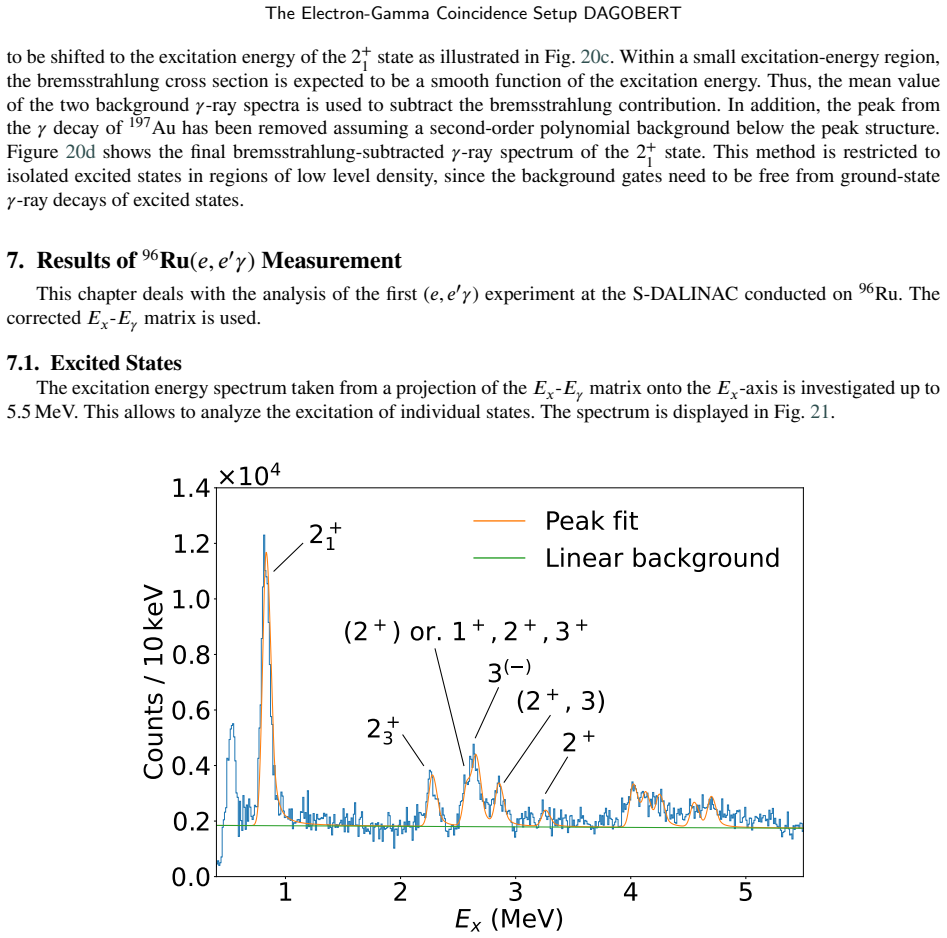
The central claim is that high-resolution electron-gamma coincidence measurements are no longer confined to light nuclei. Combining the QCLAM spectrometer with the DAGOBERT array yields an electro-photo production coincidence resolution of $R = 32.3\ \mathrm{ps}^{-1}$, roughly 60 times the value of the pioneering $^{12}\mathrm{C}$ experiment, and a two-to-three orders of magnitude higher sensitivity to electro-photo production reactions. In the first $A\ge90$ case, $^{96}\mathrm{Ru}(e,e'\gamma)$ at 85 MeV and a scattering angle of 46.3 degrees, the setup resolves eleven excited states below 5.5 MeV, reproduces the predicted quadrupole angular distribution of the $2_1^+$ state, and extracts $2_3^+\to0_1^+$ and $2_3^+\to2_1^+$ branching ratios ($6.1^{+1.1}_{-6.1}\%$ by the simulation method, $6.0^{+2.0}_{-6.0}\%$ by the measurement method, and $90(11)\%$ / $90(10)\%$ for the $2_1^+$ branch) that are compatible with literature. Above the neutron separation threshold, the same matrix shows $\gamma$ decay of $^{95}\mathrm{Ru}$ following $(e,e'n)$, including a 1141 keV transition observed for the first time. The paper concludes that the setup is ready for science production, targeting dipole response and giant-resonance studies.
Load-bearing premise
The results stand on the assumption that the coincident-bremsstrahlung background is correctly described by the subtraction procedures -- the simulation method after the computed Bethe-Heitler matrix is scaled to the data, and the measurement method on the assumption that the background gates beside an isolated state contain no ground-state decays of other excited states.
Editorial extensions
If this is right
- The $(e,e'\gamma)$ reaction can now be used on medium-heavy and heavy stable nuclei; the $^{96}\mathrm{Ru}$ run is the first such experiment for $A\ge90$ and covers excitation energies up to 15 MeV.
- Measured gamma-ray angular distributions can be compared with PWBA and DWBA calculations to test the interference between longitudinal and transverse form factors, as demonstrated for the $2_1^+$ state.
- Branching ratios of weakly populated off-yrast states, such as the mixed-symmetric $2_3^+$ state, can be extracted with either of the two bremsstrahlung-subtraction methods.
- Above the neutron separation threshold, $(e,e'n\gamma)$ data become accessible; three low-lying transitions in $^{95}\mathrm{Ru}$ were resolved, including the 1141 keV transition seen for the first time.
- Planned applications follow directly: studies of the low-energy dipole response and the Pygmy Dipole Resonance, separation of $M1$ and $E1$ strength, and energy-resolved neutron-decay branches of the Isovector Giant Dipole Resonance.
Reading between the lines
- Because the two bremsstrahlung-subtraction methods rest on different assumptions, their agreement on the $2_3^+$ branching ratios is a useful internal check; applying both to states with precisely known ground-state branches would quantify how much of the quoted uncertainty comes from the background model rather than from counting statistics.
- The coincidence condition suppresses the radiative tail, so the same data set could be re-analyzed to map gamma-decay strength versus excitation energy above the neutron threshold, turning the $(e,e'n\gamma)$ events into a decay-strength distribution rather than three resolved lines.
- If the sensitivity transfers to other targets, $(e,e'\gamma)$ experiments on isotopically enriched or otherwise rare stable nuclei become plausible, and the measured rotation of the angular distribution could serve as a longitudinal-transverse form-factor separation for those nuclei.
- The angular-distribution comparison is made in arbitrary units, so the shape is tested but not the absolute cross section; an absolute measurement, possible with the known target thickness and beam current, would probe the intensity predictions of PWBA/DWBA and the overall normalization of the background subtraction.
Editorial analysis
A structured set of objections, weighed in public.
Referee Report
Summary. The paper describes the construction, commissioning, and first physics results of DAGOBERT, a LaBr3:Ce gamma-ray detector array coupled to the QCLAM electron spectrometer at the S-DALINAC. It reports the first (e,e'gamma) experiment on a nucleus with A>=90, namely 96Ru, up to 15 MeV excitation energy. The measured quantities are the angular distribution of the 2_1^+ -> 0_1^+ transition and the gamma-decay branching ratios of the mixed-symmetric 2_3^+ state, together with a first observation of gamma decays in 95Ru populated via (e,e'n gamma). The paper also introduces two methods for subtracting the coincident bremsstrahlung background and quantifies the performance gain via the figure of merit R, which is improved by a factor of about 60 compared to the pioneering Illinois setup.
Significance. If the physics results are reliable, the paper is significant for nuclear structure and for the development of exclusive electron-scattering capabilities. It demonstrates that (e,e'gamma) experiments can be extended to medium-heavy and heavy nuclei, opening the possibility of studying off-yrast states, mixed-symmetry states, and the decay of the pygmy dipole resonance with purely electromagnetic probes. The instrumentation is characterized in detail, including calibrations, timing resolution, and efficiency, and the processed data are made openly available. The paper also has a strength in that the branching ratios are compared with, rather than fitted to, literature values. However, the physics results are more modest than the abstract suggests: the 2_3^+ -> 0_1^+ branch is only an upper limit, and the angular distribution is presented without error bars. The main concern is the treatment of the coherent interference term in the background subtraction, which could bias the extracted branching ratios and the angular distribution.
major comments (3)
- [Sec. 6.6 and Eq. (3)] Eq. (3) states that the total (e,e'gamma) cross section is sigma_nucl + sigma_brems + sigma_inter, with a coherent interference term. The two background subtraction methods in Sec. 6.6.1 and 6.6.2 remove only the incoherent Bethe-Heitler contribution. The simulated matrix in Sec. 6.6.1 is built from Eq. (9) and therefore contains no sigma_inter, while the background gates in Sec. 6.6.2 are placed off resonance, where the nuclear amplitude is suppressed and sigma_inter is negligible. Consequently, the on-resonance residual after subtraction contains sigma_nucl + sigma_inter, not sigma_nucl alone. Since sigma_inter can be as large as 2 sqrt(sigma_nucl sigma_brems) and V_I is proportional to sin(theta)cos(Phi) (Eq. A.4), it is not suppressed at the detector angles used here. For the weak 2_3^+ -> 0_1^+ branch, whose literature branching ratio is only 6.7(8)%, this can produce a relative bias far larger than the quoted uncertainties in Table 7. The same issue affects the 2_1^+ angular distribution in Sec. 7.2: the data have been corrected for sigma_brems only, while the DWBA curve in Eq. (22) includes the full coherent sum sigma_nucl + sigma_brems + sigma_inter. The authors should either include sigma_inter in the background subtraction, perform a coherent fit of the full cross section to the data, or at minimum quantify the size of sigma_inter with the available DWBA formalism and add it as a systematic uncertainty.
- [Sec. 7.2, Fig. 22] The angular distribution of the 2_1^+ -> 0_1^+ decay is presented without any error bars on the six data points, and the data are normalized to the PWBA maximum in arbitrary units. The text claims 'excellent agreement' with PWBA and DWBA, but no chi-square, number of degrees of freedom, or normalization uncertainty is given. In addition, the figure mixes data that have been corrected for incoherent bremsstrahlung with DWBA curves that include coherent bremsstrahlung and interference, so the comparison is not well defined. The authors should specify the exact correction applied to the data, provide statistical and systematic point-by-point uncertainties, and give a quantitative measure of the agreement, ideally with a fit including the interference term.
- [Table 7 and Sec. 7.4] The 2_3^+ -> 0_1^+ branching ratio is reported as 6.1 +1.1/-6.1 and 6.0 +2.0/-6.0 from the two subtraction methods, with the error bars extending to zero. The text in Sec. 7.4 correctly states that only an upper limit can be determined, and the figure shows no clear ground-state peak. However, the abstract and Highlights say that the 'gamma-decay branching ratios of the mixed-symmetric 2_3^+ state were observed', and Table 7 presents these values as central results. This is an overstatement: for the weak branch, only an upper limit is available, and the central values are essentially unconstrained. The authors should clearly mark the 2_3^+ -> 0_1^+ entries as upper limits and adjust the wording of the abstract and Highlights accordingly.
minor comments (4)
- [Sec. 6.6.1] The description of the simulation-based subtraction does not state how the scale factor applied to the simulated bremsstrahlung matrix is determined, which regions of the data are used for the scaling, or how the statistical and systematic uncertainties of this scaling are propagated into the final spectra. This information is needed for reproducibility and for assessing the reliability of the method.
- [Sec. 6.2.1 and Eq. (15)] In the text following Eq. (15), the fit parameters are listed as a, b, c, d, and f, but Eq. (15) contains the parameters c, d, e, and f. The variable e is missing from the list, and the sentence should be corrected.
- [Sec. 7.2, Fig. 23] The conversion between the PWBA angles (theta, Phi) of Fig. 2 and the DWBA angles (theta_k, phi_k) is given in Eqs. (24) and (25), but the figure caption does not clearly state which angle convention the plotted experimental data use. This makes it unnecessarily difficult to compare the two presentations of the same data.
- [Entire manuscript] The paper would benefit from a short table or appendix listing the main systematic uncertainties in the extracted branching ratios and the angular distribution, separate from the statistical uncertainties. Currently, the quoted errors in Table 7 appear to be statistical only, and the text does not discuss systematic contributions from the background subtraction, the relative efficiency, or the normalization.
Circularity Check
No significant circularity: the setup performance, angular distribution, and branching ratios are extracted from data and compared with external literature and theory, not derived from the paper's own assumptions.
full rationale
The paper's central claims—worldwide-unique setup, first (e,e'gamma) measurement of an A>=90 nucleus, and the measured 2+1 angular distribution and 2+3 branching ratios—are supported by directly measured resolutions, calibrated spectra, and coincidence data. The bremsstrahlung background subtraction uses a Bethe-Heitler PWBA simulation scaled to the data and an experiment-based gate method; neither method fits the extracted physics quantities (branching ratios or angular distribution shape) to the literature or to the nuclear PWBA/DWBA calculations. The angular distribution is explicitly normalized to PWBA, so only the shape is compared, a disclosed convention rather than a forced prediction. The 2+3 branching ratios are compared with independent (p,p'gamma) literature values [62] and are shown to be compatible, which is a validation against external data. Although Refs. [43], [52], [62], and [64] involve overlapping authors, they are separate published measurements or theoretical calculations with stated assumptions and do not constitute a self-citation chain that forces the present results. The possible omission of the coherent interference term sigma_inter in the background subtraction (Eq. 3 vs. Sec. 6.6) is a correctness concern about the background model, not a circular reduction of the derivation to its inputs.
Assumptions & free parameters
free parameters (8)
- Bremsstrahlung simulation scale factor =
not quoted (global normalization)
- 197Au peak background polynomial coefficients =
not quoted
- QCLAM energy calibration coefficients a, b, c =
a=10.1(15) keV offset, slope 1.0013(13), c not stated
- QCLAM aberration correction polynomial coefficients a_ij =
not quoted
- LaBr3 rate-correction parameters a,b,c,d,e,f =
Table 4
- Electron line-shape parameters sigma1, sigma2, eta, delta =
36.7(4) keV, 49.7(5) keV, 1.36(2), 1.77(8)
- Time-of-flight and time-walk correction coefficients =
not quoted
- Relative efficiency normalization =
not quoted
assumptions (7)
- domain assumption One-photon exchange dominates electron-nucleus scattering at these momentum transfers
- domain assumption Bethe-Heitler formula with a ground-state charge form factor reduction describes the coincident bremsstrahlung background
- domain assumption The DWBA theory of Ref. [64] is valid for 96Ru(e,e'gamma)
- domain assumption Skyrme SkP HF+RPA transition densities provide realistic nuclear structure input
- domain assumption Known level scheme and branching ratios from literature [62] are correct
- domain assumption GEANT4 detector response simulation is reliable for the LaBr3 detectors
- ad hoc to paper Empirical rate-correction formula for detector 2 (Eq. 15) is valid
Cite this review
Pith. "Pith review of The Electron-Gamma Coincidence Setup DAGOBERT." pith.science (2026). https://pith.science/paper/RFFBLE64
@misc{pith2026250602072,
  author       = {Pith},
  title        = {Pith review of: The Electron-Gamma Coincidence Setup DAGOBERT},
  year         = {2026},
  howpublished = {\url{https://pith.science/paper/RFFBLE64}},
  note         = {Machine review of arXiv:2506.02072}
}
abstract
The QCLAM electron spectrometer at the S-DALINAC electron accelerator at Technische Universit\"at Darmstadt has been extended by the DAGOBERT $\gamma$-detector array consisting of fast timing and high efficiency LaBr$_3$:Ce detectors to perform electron-gamma coincidence measurements. The functionality of the setup and data acquisition system was demonstrated in a commissioning measurement on $^{12}\textrm{C}$ observing the $4.44\,$MeV and $15.11\,$MeV states. A medium-heavy nucleus, $^{96}\textrm{Ru}$, has been studied for the first time up to excitation energies of $15\,$MeV using the $(e,e'\gamma)$ reaction. In particular, the angular distribution of the $2_1^+$ state and the $\gamma$-decay branching ratios of the mixed-symmetric $2_3^+$ state were observed. DAGOBERT@QCLAM is a new and worldwide unique setup for nuclear structure studies of excitation and decay using purely electromagnetic probes, with a significantly improved sensitivity compared to previous experiments.
Figures


Figures from the paper (22 more)








Reference graph
Works this paper leans on
-
[1]
Hofstadter, Electron Scattering and Nuclear Structure, Rev
R. Hofstadter, Electron Scattering and Nuclear Structure, Rev. Mod. Phys. 28 (1956) 214–254
1956
-
[2]
B. Hahn, D. G. Ravenhall, R. Hofstadter, High-Energy Electron Scattering and the Charge Distributions of Selected Nuclei, Phys. Rev. 101 (1956) 1131–1142
1956
-
[3]
Hofstadter, The Electron-Scattering Method and its Application to the Structure of Nuclei and Nucleons, Nobel Lecture (1961)
R. Hofstadter, The Electron-Scattering Method and its Application to the Structure of Nuclei and Nucleons, Nobel Lecture (1961)
1961
-
[4]
T. W. Donnelly, I. Sick, Elastic magnetic electron scattering from nuclei, Rev. Mod. Phys. 56 (1984) 461–566
1984
-
[5]
B. W. Downs, D. G. Ravenhall, D. R. Yennie, Electron Scattering from Nonspherical Nuclei, Phys. Rev. 106 (1957) 1285–1289
work page 1957
-
[6]
M. K. Pal, Electron Scattering by the Quadrupole Charge Distribution of N14, Phys. Rev. 117 (1960) 566–572
work page 1960
-
[7]
J. Goldemberg, R. H. Pratt, Magnetic Electron Scattering from Nuclei, Rev. Mod. Phys. 38 (1966) 311–329
work page 1966
-
[8]
T. A. Griffy, R. J. Qakes, Electron-Proton Coincidence Cross Section forHe3 andH3, Phys. Rev. 135 (1964) B1161–B1167
work page 1964
Show all 84 references
-
[9]
Hofstadter, Structure of Nuclei and Nucleons, Science 136 (1962) 1013–1022
R. Hofstadter, Structure of Nuclei and Nucleons, Science 136 (1962) 1013–1022
1962
-
[10]
W. C. Barber, Inelastic Electron Scattering, Annu. Rev. Nucl. Part. Sci. 12 (1962) 1–42
1962
-
[11]
Pitthan, T
R. Pitthan, T. Walcher, Inelastic electron scattering in the giant resonance region of La, Ce and Pr, Phys. Lett. B 36 (1971) 563–564
1971
-
[12]
Heisenberg, Nuclear transition density determinations from inelastic electron scattering, Adv
J. Heisenberg, Nuclear transition density determinations from inelastic electron scattering, Adv. Nucl. Phys. 12 (1981) 61–133
1981
-
[13]
C. N. Papanicolas, Low energy experiments with continuous electron and photon beams, Nucl. Phys. A 446 (1985) 249–258
1985
-
[14]
C. N. Papanicolas, S. E. Williamson, H. Rothhaas, G. O. Bolme, L. J. Koester, Jr., B. L. Miller, R. A. Miskimen, P. E. Mueller, and L. S. Cardman, (𝑒,𝑒′𝛾) Measurements on the 4.439-MeV State of12C, Phys. Rev. Lett. 54 (1985) 26–29
1985
-
[15]
P. E. Mueller, Separation of the E2 and M1 form factors of the 6.32 MeV state of nitrogen-15 using (e,e’gamma), Ph.D. Thesis, University of Illinois, Illinois, 1993
1993
-
[16]
J.R.Deininger,Nuclearstructureinoxygen-16measuredwith(e,e’gamma)coincidentelectronscattering,Ph.D.Thesis,UniversityofIllinois, Illinois, 1996
1996
-
[17]
Pietralla, The Institute of Nuclear Physics at the TU Darmstadt, Nucl
N. Pietralla, The Institute of Nuclear Physics at the TU Darmstadt, Nucl. Phys. News 28 (2018) 4–11
2018
-
[18]
A.D’Alessio,P.vonNeumann-Cosel,N.Pietralla,M.Singer,V.Werner,TheQClam-SpectrometerattheS-DALINAC,in:J.-E.García-Ramos, M.V.Andrés,J.A.L.Valera,A.M.Moro,F.Pérez-Bernal(Eds.),BasicConceptsinNuclearPhysics:Theory,ExperimentsandApplications, Springer International Publishing, Cham...
2019
-
[19]
Rasmussen, BrilLanCe 380 Scintillation Material, 2004
B. Rasmussen, BrilLanCe 380 Scintillation Material, 2004
2004
-
[20]
Dirac, The quantum theory of the emission and absorption of radiation, Proc
P. Dirac, The quantum theory of the emission and absorption of radiation, Proc. R. Soc. Lond. A 114 (1927) 243–265
1927
-
[21]
de Forest, J
T. de Forest, J. D. Walecka, Electron scattering and nuclear structure, Adv. Phys. 15 (1966) 1–109
1966
-
[22]
Überall, Electron Scattering from Complex Nuclei: Part B, volume 2, Academic Press, New York, 1971
H. Überall, Electron Scattering from Complex Nuclei: Part B, volume 2, Academic Press, New York, 1971
1971
-
[23]
T. Suda, H. Simon, Prospects for electron scattering on unstable, exotic nuclei, Prog. Part. Nucl. Phys. 96 (2017) 1–31
2017
-
[24]
von Neumann-Cosel, C
P. von Neumann-Cosel, C. Rangacharyulu, A. Richter, G. Schrieder, A. Stascheck, S. Strauch, Complete Spectroscopy of an Isobaric Analog Resonance with the(𝑒,𝑒′𝑝)Reaction, Phys. Rev. Lett. 78 (1997) 2924–2927
1997
-
[25]
Diesener, U
H. Diesener, U. Helm, P. von Neumann-Cosel, A. Richter, G. Schrieder, S. Strauch, Isoscalar multipole strength decomposition in40Ca with the(𝑒,𝑒′𝛼0) reaction, Phys. Lett. B 352 (1995) 201–206
1995
-
[26]
Cowley, R
P.vonNeumann-Cosel,H.Diesener,U.Helm,G.Herbert,V.Huck,A.Richter,G.Schrieder,A.Stascheck,A.Stiller,J.Ryckebusch,J.Carter, A. Cowley, R. Fearick, J. Lawrie, S. Mills, R. Newman, J. Pilcher, F. Smit, Z. Vilakazi, D. Whittal, Excitation and decay of electric giant resonances in th...
1994
-
[27]
Strauch, P
S. Strauch, P. von Neumann-Cosel, C. Rangacharyulu, A. Richter, G. Schrieder, K. Schweda, J. Wambach, Giant Resonances in the Doubly Magic Nucleus48Cafrom the(𝑒,𝑒′𝑛)Reaction, Phys. Rev. Lett. 85 (2000) 2913–2916
2000
-
[28]
D. F. Hubbard, M. E. Rose, Nuclear structure effects in bremsstrahlung, Nucl. Phys. 84 (1966) 337–379
1966
-
[29]
H. L. Acker, M. E. Rose, Investigation of Nuclear Effects in Bremsstrahlung, Ann. Phys. 44 (1967) 336–362
1967
-
[30]
Donnelly, Electron scattering and neutrino reactions in nuclei, Prog
T. Donnelly, Electron scattering and neutrino reactions in nuclei, Prog. Part. Nucl. Phys. 13 (1985) 183–236
1985
-
[31]
H.Bethe,W.Heitler, Onthestoppingoffastparticlesandonthecreationofpositiveelectrons, Proc.R.soc.Lond.Ser.A-Contain.Pap.Math. Phys. Character 146 (1934) 83–112
1934
-
[32]
Sonnabend, D
K. Sonnabend, D. Savran, J. Beller, M. A. Büssing, A. Constantinescu, M. Elvers, J. Endres, M. Fritzsche, J. Glorius, J. Hasper, J. Isaak, B. Löher, S. Müller, N. Pietralla, C. Romig, A. Sauerwein, L. Schnorrenberger, C. Wälzlein, A. Zilges, M. Zweidinger, The Darmstadt High-I...
2011
-
[33]
M. G. Meier, Entwicklung und Aufbau der Laser-getriebenen Compton-Rückstreuquelle COBRA für Strahldiagnose am S-DALINAC, Doctoral Thesis, Technische Universität Darmstadt, Darmstadt, 2024
2024
-
[34]
Savran, K
D. Savran, K. Lindenberg, J. Glorius, B.Löher, S. Müller, N. Pietralla, L. Schnorrenberger, V. Simon, K. Sonnabend, C. Wälzlein, M.Elvers, J. Endres, J. Hasper, A. Zilges, The low-energy photon tagger NEPTUN, Nucl. Instrum. Methods Phys. Res. A 613 (2010) 232–239
2010
-
[35]
M. Knirsch, Konzeption, Aufbau und Erprobung eines hochauflösenden QCLAM-Elektronenspektrometers mit großem Raumwinkel und hoher Impulsakzeptanz am Elektronenbeschleuniger S-DALINAC, Doctoral Thesis, Technische Hochschule Darmstadt, Darmstadt, 1991
1991
-
[36]
G. C. Lüttge, Entwicklung und Aufbau eines Magnetsystems für Elektronenstreuung unter180◦ und vollständige Bestimmung der magnetis- chen Dipol- und Quadrupolstärkeverteilung in28Si, Doctoral Thesis, Technische Hochschule Darmstadt, Darmstadt, 1994
1994
-
[37]
Detector system and performance of the electron scattering apparatus, Nucl
D.Schüll,J.Foh,H.-D.Gräf,H.Miska,R.Schneider,E.Spamer,H.Theissen,O.Titze,T.Walcher, Highresolutionelectronscatteringfacility at the Darmstadt linear accelerator (DALINAC): III. Detector system and performance of the electron scattering apparatus, Nucl. Instrum. and Methods 153...
1978
-
[38]
Singer, U
M. Singer, U. Bonnes, A. D’Alessio, M. Hilcker, P. von Neumann-Cosel, N. Pietralla, New data acquisition system of the Lintott magnetic spectrometer at the S-DALINAC, Nucl. Instrum. Methods Phys. Res. A 999 (2021) 165115
2021
-
[39]
Jürgensen, Entwicklung und Aufbau eines Hochenergie-Elektronen-Scrapersystems für den S-DALINAC, Doctoral Thesis, Technische Universität Darmstadt, Darmstadt, 2018
L. Jürgensen, Entwicklung und Aufbau eines Hochenergie-Elektronen-Scrapersystems für den S-DALINAC, Doctoral Thesis, Technische Universität Darmstadt, Darmstadt, 2018. B. Hesbacher, G. Steinhilber, J. Isaak, N. Pietralla et al.:Preprint submitted to Elsevier Page 33 of 35 The ...
2018
-
[40]
K.-D. Hummel, Entwicklung Aufbau und Inbetriebnahme eines Vieldratdriftkammer-Detektorsystems für das QCLAM-Spektrometer am supraleitenden Darmstädter Elektronenbeschleuniger S-DALINAC, Doctoral Thesis, Technische Hochschule Darmstadt, Darmstadt, 1992
1992
-
[41]
F. Neumeyer, Untersuchung magnetischer Kernanregungen in48Ca und 90Zr mit hochauflösender Elektronenstreuung unter 180° am S- DALINAC, Doctoral Thesis, Technische Universität Darmstadt, Darmstadt, 1997
1997
-
[42]
Singer, Entwicklung und Inbetriebnahme eines neuen Datenaufnahmesystems am QCLAM-Spektrometer, Doctoral Thesis, Technische Universität Darmstadt, Darmstadt, 2019
M. Singer, Entwicklung und Inbetriebnahme eines neuen Datenaufnahmesystems am QCLAM-Spektrometer, Doctoral Thesis, Technische Universität Darmstadt, Darmstadt, 2019
2019
-
[43]
Steinhilber, The electron-gamma coincidence setup at the S-DALINAC, Doctoral Thesis, Technische Universität Darmstadt, Darmstadt, 2022
G. Steinhilber, The electron-gamma coincidence setup at the S-DALINAC, Doctoral Thesis, Technische Universität Darmstadt, Darmstadt, 2022
2022
-
[44]
Schneider, M
D. Schneider, M. Arnold, U. Bonnes, A. Brauch, M. Dutine, R. Grewe, L. E. Jürgensen, N. Pietralla, F. Schließmann, G. Steinhilber, Development of an active beam-stabilization system for electrofission experiments at the S-DALINAC, in: Proc. IPAC’24, 15th International Particle...
2024
-
[45]
Saint-Gobain Crystals, Scintillation Products Technical Note - Lanthanum Bromide Scintillation Performance Summary, 2021
2021
-
[46]
B.Löher,D.Savran,E.Fiori,M.Miklavec,N.Pietralla,M.Vencelj, Highcountrate 𝛾-rayspectroscopywithLaBr3:Cescintillationdetectors, Nucl. Instrum. Methods Phys. Res. A 686 (2012) 1–6
2012
-
[47]
Dassault Systémes, CST Studio Suite 2020.00 - release notes, 2019
2020
-
[48]
E. L. Goldwasser, F. E. Mills, A. O. Hanson, Ionization Loss and Straggling of Fast Electrons, Phys. Rev. 88 (1952) 1137–1141
1952
-
[49]
URL:https://web.archive.org/web/ 20201022154112/https://www.gsi.de/work/forschung/experimentelektronik/datenverarbeitung/datenerfassung/ mbs.htm
GSI Helmholzzentrum für Schwerionenforschung GmbH, GSI multi branch system, 22.10.2020. URL:https://web.archive.org/web/ 20201022154112/https://www.gsi.de/work/forschung/experimentelektronik/datenverarbeitung/datenerfassung/ mbs.htm
2020
-
[50]
URL:https://www.struck.de/ sis3316.html
Struck Innovative Systems GmbH, SIS3316 16 channel 125/250 MSPS 14/16-bit Digitizer Family, 2024. URL:https://www.struck.de/ sis3316.html
2024
-
[51]
H. T. Johansson, The UCESB unpacker generator, 2010. URL:http://fy.chalmers.se/~f96hajo/ucesb/
2010
-
[52]
Zamfir, Coulomb excitation of the2+ 𝑚𝑠 state of96Ru in inverse kinematics, Phys
N.Pietralla,C.J.Barton,R.Krücken,C.W.Beausang,M.A.Caprio,R.F.Casten,J.R.Cooper,A.A.Hecht,H.Newman,J.R.Novak,N.V. Zamfir, Coulomb excitation of the2+ 𝑚𝑠 state of96Ru in inverse kinematics, Phys. Rev. C 64 (2001) 031301(R)
2001
-
[53]
Hoyle, On Nuclear Reactions Occuring in Very Hot STARS.I
F. Hoyle, On Nuclear Reactions Occuring in Very Hot STARS.I. the Synthesis of Elements from Carbon to Nickel, Astrophys. J. Suppl. Ser. 1 (1954) 121
1954
-
[54]
J. H. Kelley, J. E. Purcell, C. G. Sheu, Energy levels of light nuclei𝐴=12 , Nucl. Phys. A 968 (2017) 71–253
2017
-
[55]
F.Hofmann,P.vonNeumann-Cosel,F.Neumeyer,C.Rangacharyulu,B.Reitz,A.Richter,G.Schrieder,D.I.Sober,L.W.Fagg,B.A.Brown, Magnetic dipole transitions in32S from electron scattering at 180°, Phys. Rev. C 65 (2002) 024311
2002
-
[56]
Helmer, C
R. Helmer, C. van der Leun, Recommended standards for𝛾-ray energy calibration (1999), Nucl. Instrum. Methods Phys. Res. A 450 (2000) 35–70
1999
-
[57]
M. Wang, G. Audi, A. Wapstra, F. Kondev, M. MacCormick, X. Xu, B. Pfeiffer, The Ame2012 atomic mass evaluation, Chin. Phys. C 36 (2012) 1603
2012
-
[58]
Hesbacher, Kernstrukturuntersuchungen an 96Ru mittels Elektron-Gamma-Koinzidenz-Reaktionen am S-DALINAC, M.Sc
B. Hesbacher, Kernstrukturuntersuchungen an 96Ru mittels Elektron-Gamma-Koinzidenz-Reaktionen am S-DALINAC, M.Sc. Thesis, Technische Universität Darmstadt, Darmstadt, 2023
2023
-
[59]
Allison, K
J. Allison, K. Amako, J. Apostolakis, P. Arce, M. Asai, T. Aso, E. Bagli, A. Bagulya, S. Banerjee, G. Barrand, B. Beck, A. Bogdanov, D. Brandt, J. Brown, H. Burkhardt, P. Canal, D. Cano-Ott, S. Chauvie, K. Cho, G. Cirrone, G. Cooperman, M. Cortés-Giraldo, G. Cosmo, G. Cuttone,...
2016
-
[60]
Allison, K
J. Allison, K. Amako, J. Apostolakis, H. Araujo, P. Arce Dubois, M. Asai, G. Barrand, R. Capra, S. Chauvie, R. Chytracek, G. Cirrone, G. Cooperman, G. Cosmo, G. Cuttone, G. Daquino, M. Donszelmann, M. Dressel, G. Folger, F. Foppiano, J. Generowicz, V. Grichine, S. Guatelli, P....
2006
-
[61]
Boudreau, L
S.Agostinelli,J.Allison,K.Amako,J.Apostolakis,H.Araujo,P.Arce,M.Asai,D.Axen,S.Banerjee,G.Barrand,F.Behner,L.Bellagamba, J. Boudreau, L. Broglia, A. Brunengo, H. Burkhardt, S. Chauvie, J. Chuma, R. Chytracek, G. Cooperman, G. Cosmo, P. Degtyarenko, A. Dell’Acqua, G. Depaola, D....
2003
-
[62]
Mineva, P
A.Hennig,T.Ahn,V.Anagnostatou,A.Blazhev,N.Cooper,V.Derya,M.Elvers,J.Endres,P.Goddard,A.Heinz,R.O.Hughes,G.Ilie,M.N. Mineva, P. Petkov, S. G. Pickstone, N. Pietralla, D. Radeck, T. J. Ross, D. Savran, M. Spieker, V. Werner, A. Zilges, Collective excitations of 96Ru by means of(...
2015
-
[63]
H.Bolotin,D.Kennedy,B.Linard,A.Stuchbery,S.Sie,I.Katayama,H.Sakai, Measuredlifetimesofstatesin197Auandacriticalcomparison with the weak-coupling core-excitation model, Nucl. Phys. A 321 (1979) 231–249
1979
-
[64]
D.H.Jakubassa-Amundsen,V.Y.Ponomarev, Coincidentexcitationandradiativedecayinelectron-nucleuscollisions, Phys.Rev.C95(2017) 024310
2017
-
[65]
Ravenhall, R
D. Ravenhall, R. Schult, J. Wambach, C. Papanicolas, S. Williamson, Coincident electron scattering in distorted wave Born approximation I. The(𝑒,𝑒′𝛾)process, Ann. Phys. 178 (1987) 187–226
1987
-
[66]
Visscher, K
L. Visscher, K. Dyall, Dirac–Fock atomic electronic structure calculations using different nuclear charge distributions, At. Data Nucl. Data Tables 67 (1997) 207–224
1997
-
[67]
Salvat, J
F. Salvat, J. Fernández-Varea, W. Williamson, Accurate numerical solution of the radial Schrödinger and Dirac wave equations, Comput. Phys. Commun. 90 (1995) 151–168
1995
-
[68]
G.Colò,L.Cao,N.VanGiai,L.Capelli, Self-consistentRPAcalculationswithSkyrme-typeinteractions:Theskyrme_rpaprogram, Comput. Phys. Commun. 184 (2013) 142–161
2013
-
[69]
G. Colò, X. Roca-Maza, User guide for the hfbcs-qrpa(v1) code, 2021.arXiv:2102.06562
2021 arXiv
-
[70]
Dobaczewski, H
J. Dobaczewski, H. Flocard, J. Treiner, Hartree-Fock-Bogolyubov description of nuclei near the neutron-drip line, Nucl. Phys. A 422 (1984) 103–139
1984
-
[71]
Klein, A
H. Klein, A. F. Lisetskiy, N. Pietralla, C. Fransen, A. Gade, P. von Brentano, Proton-neutron mixed-symmetry2+ ms and3+ ms states in96Ru, Phys. Rev. C 65 (2002) 044315
2002
-
[72]
Ball, Studies of95Ru and94Ru with the96Ru(𝑝,𝑑) and(𝑝,𝑡) reactions, Nucl
J. Ball, Studies of95Ru and94Ru with the96Ru(𝑝,𝑑) and(𝑝,𝑡) reactions, Nucl. Phys. A 160 (1971) 225–236
1971
-
[73]
Savran, M
D. Savran, M. Babilon, A. M. van den Berg, M. N. Harakeh, J. Hasper, A. Matic, H. J. Wörtche, A. Zilges, Nature of the Pygmy Dipole Resonance in140Ce Studied in(𝛼,𝛼′𝛾) Experiments, Phys. Rev. Lett. 97 (2006) 172502
2006
-
[74]
Pietralla, V
D.Savran,V.Derya,S.Bagchi,J.Endres,M.Harakeh,J.Isaak,N.Kalantar-Nayestanaki,E.Lanza,B.Löher,A.Najafi,S.Pascu,S.Pickstone, N. Pietralla, V. Ponomarev, C. Rigollet, C. Romig, M. Spieker, A. Vitturi, A. Zilges, Multi-messenger investigation of the Pygmy Dipole Resonance in140Ce, ...
2018
-
[75]
Savran, T
D. Savran, T. Aumann, A. Zilges, Experimental studies of the Pygmy Dipole Resonance, Prog. Part. Nucl. Phys. 70 (2013) 210–245
2013
-
[76]
Lanza, L
E. Lanza, L. Pellegri, A. Vitturi, M. Andrés, Theoretical studies of Pygmy Resonances, Prog. Part. Nucl. Phys. 129 (2023) 104006
2023
-
[77]
S. F. Semenko, Sov. J. Nucl. Phys. 34 (1981)
1981
-
[78]
V. O. Nesterenko, A. Repko, J. Kvasil, P.-G. Reinhard, Individual Low-Energy Toroidal Dipole State in24Mg, Phys. Rev. Lett. 120 (2018) 182501
2018
-
[79]
V.O.Nesterenko,A.Repko,J.Kvasil,P.-G.Reinhard, Individualdipoletoroidalstates:Mainfeaturesandsearchinthe (𝑒,𝑒′)reaction, Phys. Rev. C 100 (2019) 064302
2019
-
[80]
Repko, V
A. Repko, V. O. Nesterenko, J. Kvasil, P.-G. Reinhard, Systematics of toroidal dipole modes in Ca, Ni, Zr, and Sn isotopes, Eur. Phys. J. A 55 (2019) 242–257
2019
-
[81]
von Neumann-Cosel, V
P. von Neumann-Cosel, V. O. Nesterenko, I. Brandherm, P. I. Vishnevskiy, P.-G. Reinhard, J. Kvasil, H. Matsubara, A. Repko, A. Richter, M. Scheck, A. Tamii, Candidate Toroidal Electric Dipole Mode in the Spherical Nucleus58Ni, Phys. Rev. Lett. 133 (2024) 232502
2024
-
[82]
Kleemann, N
J. Kleemann, N. Pietralla, U. Friman-Gayer, J. Isaak, O. Papst, K. Prifti, V. Werner, A. D. Ayangeakaa, T. Beck, G. Colò, M. L. Cortés, S. W. Finch, M. Fulghieri, D. Gribble, K. E. Ide, X. K.-H. James, R. V. F. Janssens, S. R. Johnson, P. Koseoglou, Krishichayan, D. Savran, W....
2025
-
[83]
The Electron-Gamma Coincidence Setup DAGOBERT
B. Hesbacher, G. Steinhilber, J. Isaak, N. Pietralla, J. Birkhan, I. Brandherm, M. L. Cortes, D. Jakubassa-Amundsen, I. Jurosevic, P. von Neumann-Cosel, M. Rech, X. Roca-Maza, D. Schneider, Dataset for "The Electron-Gamma Coincidence Setup DAGOBERT" Manuscript ,
-
[2025]
URL:https://doi.org/10.48328/tudatalib-1665. B. Hesbacher, G. Steinhilber, J. Isaak, N. Pietralla et al.:Preprint submitted to Elsevier Page 35 of 35
Reviewed August 7, 2026 · model on record in the stance chip above.
Discussion (0). Sign in to comment.