REVIEW 4 major objections 5 minor 85 references
Evolution of Wormholes under f(R, T) Theory, the Karmarkar Condition and the Casimir Energy
T0 review · 4 major / 5 minor · reviewed 2026-08-07 · deepseek-v4-flash
Pith's one-line read In f(R,T) gravity, one model supports traversable wormholes without exotic matter, while another requires it and the Karmarkar condition does not change that.
desk verdict A competent f(R,T) wormhole scan whose stability test uses GR TOV despite the theory's non-conservation, and whose Karmarkar shape function has a pole at the throat. read the letter →
The pith
A machine-rendered reading of the paper's core claim, the machinery that carries it, and where it could break.
The reading
What carries the argument
The argument is carried by three named objects. The f(R,T) Lagrangians $R - a_1^2/R + a_2 T$ and $R + a_1^2R^2 + a_2T$, drawn from cosmological models of accelerated expansion, determine the field equations whose solutions give $\rho$, $p_r$, and $p_t$. The generalized Tolman-Oppenheimer-Volkoff equation, $dp_r/dr + \delta'(\rho+p_r)/2 + 2(p_r-p_t)/r = 0$, is the stability test that balances gravitational, hydrostatic, and anisotropic forces. The Karmarkar condition, $R_{1414} = (R_{1212}R_{3434}+R_{1224}R_{1334})/R_{2323}$, ties the metric potentials together and yields the generalized shape function. Finally, the Casimir wormhole equation-of-state parameter $w_{\rm casimir} = \frac13(3 - 2(9r+r_0)/(3r+r_0))$ is the comparison target that picks out $\beta=3$.
What would settle it
Evaluate the covariant divergence $\nabla_\mu T^{\mu\nu}$ using Eq. (13) for the anisotropic fluid (14) with $L_m = (p_r + 2p_t)/3$: if the result is nonzero, the TOV equation (36) omits source terms and the derived stability condition is not the equilibrium condition of this theory.
Extended reading notes
Core claim
The central claim is that the gravitational Lagrangian's form decides whether a static, spherically symmetric wormhole needs exotic matter. Starting from the Morris-Thorne metric with redshift $\delta(r)=\delta_0(r_0/r)^\alpha$ and shape $b(r)=b_0(r_0/r)^\beta$, the paper solves the f(R,T) field equations for the two models. In the first model the weak, strong, and null energy conditions all hold (with DEC partially), so no exotic matter appears; in the second one, increasing $\beta$ drives the energy density negative and the conditions fail, so exotic matter is required. Applying the Karmarkar condition to the second model produces the shape function $b(r) = r - r^{2\alpha+3}/(r^{2\alpha+2} + r_0^{2\alpha+2}(r_0 - C))$, but the energy-condition violations persist. The paper then identifies $\beta = 3$ as the case where $w = (p_r + 2p_t)/(3\rho)$ agrees with the Casimir wormhole parameter, concluding that Casimir energy can support the throat while the TOV equation indicates equilibrium.
Load-bearing premise
The stability analysis assumes the standard TOV equilibrium equation applies unchanged in f(R,T) gravity, even though the theory's own equations imply the stress-energy tensor is not conserved; if f(R,T) correction terms belong in the force balance, the equilibrium and Casimir-support conclusions would need revision.
Editorial extensions
If this is right
- For the model $R - a_1^2/R + a_2T$, traversable wormholes can satisfy the null, weak, and strong energy conditions, so this branch of f(R,T) gravity may host wormholes without exotic matter.
- For the model $R + a_1^2R^2 + a_2T$, energy-condition violations persist, so exotic matter remains necessary even after the Karmarkar condition is imposed.
- At $\beta=3$, the wormhole equation of state matches the Casimir wormhole, implying quantum vacuum (Casimir) energy can stabilize the throat in this configuration.
- The TOV force balance holds around the throat for both models in the studied parameter sets, which the paper interprets as static stability.
- Increasing $\beta$ changes the wormhole geometry and, in the second model, turns the energy density negative, linking the shape-parameter evolution to the sign of the matter energy.
Reading between the lines
- Because the paper itself writes $\nabla_\mu T^{\mu\nu} \neq 0$ in f(R,T) gravity, a natural next step is to re-derive the TOV equilibrium with the non-conservation terms; until that is done, the stability conclusion rests on an assumption rather than on the theory's own equations.
- The $\beta=3$ Casimir match suggests a concrete test: compute the renormalized vacuum stress-energy tensor of a quantum field in the $\beta=3$ wormhole geometry and check whether it equals the Casimir form at the throat.
- The generalized Karmarkar shape function could serve as a scan tool across modified-gravity theories: since it isolates the role of the redshift function, inserting it into other gravitational Lagrangians would reveal which theories can avoid exotic matter.
- If the proposed positive-to-negative energy transition near the throat is real, wormhole geometry itself could act as a vacuum-energy source; a search direction would be to look for anomalous lensing or tidal signatures in compact objects whose internal geometry evolves toward $\beta=3$.
Editorial analysis
A structured set of objections, weighed in public.
Referee Report
Summary. The paper investigates static, spherically symmetric traversable wormholes in f(R,T) gravity for two Lagrangians, R - a1^2/R + a2 T and R + a1^2 R^2 + a2 T. For each model and for beta = 1, 2, 3, the authors derive explicit algebraic expressions for the energy density and pressures, plot the energy conditions, and use the standard Tolman-Oppenheimer-Volkoff (TOV) equation to claim hydrostatic stability. They also construct a shape function from the Karmarkar condition, examine whether that condition removes the need for exotic matter, and identify beta = 3 as matching the equation-of-state parameter of a Casimir wormhole, concluding that Casimir energy can support the throat. The main advertised results are that the first model satisfies the WEC, SEC, and NEC without exotic matter, that the second model requires exotic matter, and that the Karmarkar-based analysis does not eliminate that requirement.
Significance. If the claims were correct, the paper would be of moderate interest to the modified-gravity wormhole community: it would provide explicit f(R,T) wormhole solutions with no exotic matter in one model and a possible Casimir-energy stabilization mechanism in another. The manuscript has some positive features: it presents the field equations in detail, gives long analytic expressions for the fluid variables, and explicitly acknowledges in Eq. (16) that the matter stress-energy tensor is not conserved in f(R,T) theory. However, the central claims are currently supported by two invalid or incomplete pieces of analysis: the use of the GR TOV equation despite the non-conservation of T, and a Karmarkar shape function that fails the throat condition. The Casimir conclusion is also a retrospective curve match rather than an independent derivation. As a result, the significance of the paper is not established by the present calculation.
major comments (4)
- [Section 4, Eq. (36)] The stability analysis uses the standard GR TOV equation dp_r/dr + delta'(rho + p_r)/2 + (2/r)(p_r - p_t) = 0 and interprets F_g + F_a + F_h = 0 as hydrostatic equilibrium. In f(R,T) theory, however, Eqs. (13) and (16) give nabla_mu T^{mu nu} = [a_2/(8 pi + a_2)] nabla^nu(L_m - T/2), which is nonzero for the chosen value a_2 = -9 pi. The correct equilibrium condition must contain an extra source term proportional to nabla^r(L_m - T/2). Since the stability verdicts for both models (Figs. 6, 8, 10, 13, 15, 17) and the final claim that beta = 3 is stabilized by Casimir energy all rest on Eq. (36), those conclusions are not supported by the calculation as presented.
- [Section 5, Eq. (44)] The Karmarkar shape function in Eq. (44) does not satisfy the throat condition b(r_0) = r_0. Direct substitution gives b(r_0) = r_0 - r_0/(1 + r_0 - C), which equals r_0 only if r_0/(1 + r_0 - C) = 0, an equation that has no solution for finite C. For the values used in Section 5, r_0 = 1 and C = 2, the denominator r^{2 alpha + 2} + r_0^{2 alpha + 2}(r_0 - C) reduces to r^{2 alpha + 2} - 1 and vanishes at r = r_0, making b(r) singular at the throat. Consequently the energy-condition plots in Figs. 19-21 and the conclusion that the Karmarkar condition does not remove the need for exotic matter are based on an invalid wormhole geometry.
- [Section 6 and Fig. 22] The claimed agreement between beta = 3 and the Casimir equation-of-state parameter is obtained by computing w for beta = 1, 2, 3 and selecting the value that lies closest to w_casimir. The paper does not derive beta = 3 from the condition w = w_casimir, does not provide a quantitative measure of the agreement, and does not specify the radial interval over which the match holds. Moreover, the statement that Casimir energy can stabilize the throat is presented as a stability conclusion, but the only stability analysis in the paper is the invalid TOV analysis of Section 4. The beta = 3 matching therefore does not constitute a demonstration that Casimir energy supports the throat.
- [Section 4, Figs. 5-17] The energy-condition plots for both models and all beta values begin at r/M = 2, whereas the wormhole throat is at r_0 = 1 and the traversability conditions are evaluated at r_0. The claims that the WEC, SEC, and NEC are satisfied for the R - a_1^2/R + a_2 T model are therefore demonstrated only on the interval [2, 3], not on the full wormhole domain r >= r_0. Since the no-exotic-matter conclusion depends on the energy conditions being satisfied throughout the wormhole, the paper should verify the conditions for all r >= r_0 or explicitly restrict the claim to the plotted range.
minor comments (5)
- [Eq. (12) and Eq. (26)] The notation (g_mu nu nabla_mu nabla_nu - nabla_mu nabla_nu) f_R should be written with a box operator, e.g., (g_mu nu Box - nabla_mu nabla_nu) f_R; the current notation is confusing and appears in both field equations.
- [Section 3] The abstract and Section 3 use inconsistent notation for the matter coupling: the abstract writes a_2 g(T) while the field equations are derived for a_2 T. This should be reconciled, since L_m is later chosen as (p_r + 2p_t)/3.
- [Section 5, after Eq. (44)] The expression for Gamma, Gamma = r_0^2 (r_0 - C)/(e^delta alpha^2 b_0^2), introduces b_0 and delta_0 that do not appear in Eq. (44), and the definition of b_0 in this context is unclear.
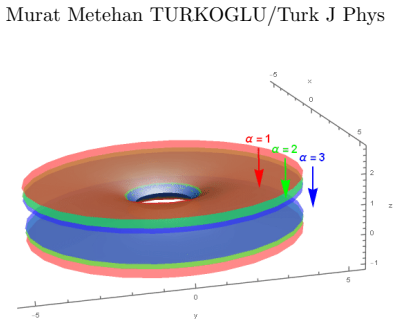
- [Figure captions, Figs. 19-21] The captions for Figs. 19 and 20 state 'alpha = 1' while the titles and text refer to alpha = 1, 2, and 3; the captions should report the alpha value actually used in each figure.
- [Fig. 22 and surrounding text] The text says 'upper part of figure 22' and 'lower part of figure 22' when the figure has left and right panels; this should be corrected. The right panel's y-axis range makes the w_Casimir curve difficult to read, and the claimed overlap with beta = 3 should be shown in a zoomed panel.
Circularity Check
Casimir-support conclusion is obtained by choosing β=3 to match w_Casimir, turning the target equation of state into a selected model parameter.
-
fitted input called prediction
[Section 6 (Conclusion), Casimir analysis following Eq. (45) and Fig. 22]
"As can be seen, the w parameter for R + a2 1R2 + a2T is in strong agreement with the Casimir wormhole parameter wcasimir for a specific value of the β parameter (β = 3). ... Therefore, it can be concluded that specifically for β = 3 the wormhole is supported by Casimir energy around the throat radius."
The shape function in Eq. (4) contains β as a free parameter: b(r) = b0(r0/r)^β. The paper computes the equation-of-state parameter w = (pr + 2pt)/(3ρ) for β = 1, 2, 3 and compares it with w_casimir imported from Garattini’s Eq. (45). The value β = 3 is selected only because this comparison shows agreement; it is not fixed by the field equations or by any independent physical condition. The concluding statement that the β = 3 throat is supported by Casimir energy is therefore a restatement of the selection rule “choose β so that w matches w_casimir” rather than an independent prediction. Had a different target equation of state been chosen, a different β could have been selected; the agreement is an input to the model-selection argument, not an output of the derivation.
full rationale
The energy-condition computations for the two f(R,T) models and the Karmarkar-derived shape function are self-contained: the field equations (15) and (26) are solved with the stated ansatz and plotted, and the Karmarkar condition is applied to obtain a new shape function without reducing to its own output. The load-bearing circularity is confined to the Casimir claim. There, β is a free parameter in the shape function, and the agreement between w(β) and w_Casimir is achieved by choosing β = 3. The subsequent conclusion that the wormhole is supported by Casimir energy is thus equivalent to the selection procedure, not a prediction derived from the theory. I do not score the use of the GR TOV equation as circularity because the issue is a consistency/correctness problem with the non-conservation equation (16), not a reduction of an output to an input. There are no self-citations, so the self-citation load-bearing patterns do not apply.
Assumptions & free parameters
free parameters (8)
- a1 =
9*pi
- a2 =
-9*pi
- beta =
1, 2, 3
- alpha =
1 (and 2,3 in Section 5)
- delta0 =
1
- r0 =
1
- M =
1
- C =
2
assumptions (6)
- domain assumption f(R,T) field equations (Eq. 12) correctly describe wormhole geometry.
- domain assumption Anisotropic perfect fluid energy-momentum tensor (Eq. 14) with Lm=(pr+2pt)/3 represents wormhole matter.
- domain assumption Morris-Thorne metric ansatz with delta=delta0(r0/r)^alpha and b=b0(r0/r)^beta is a valid wormhole geometry.
- domain assumption Karmarkar condition (Eq. 40) is applicable and the derived shape function satisfies wormhole conditions.
- ad hoc to paper Standard GR TOV equation (Eq. 36) is valid in f(R,T) gravity despite non-conservation of T.
- domain assumption Casimir equation of state (Eq. 45) from Garattini can be compared to the model's w=P/rho.
Cite this review
Pith. "Pith review of Evolution of Wormholes under f(R, T) Theory, the Karmarkar Condition and the Casimir Energy." pith.science (2026). https://pith.science/paper/2C4EFWFV
@misc{pith2026250602074,
  author       = {Pith},
  title        = {Pith review of: Evolution of Wormholes under f(R, T) Theory, the Karmarkar Condition and the Casimir Energy},
  year         = {2026},
  howpublished = {\url{https://pith.science/paper/2C4EFWFV}},
  note         = {Machine review of arXiv:2506.02074}
}
abstract
In this study, both the evolution of wormholes (by examining both the energy conditions and using the TOV equations) and the effects of the Karmarkar condition on the solutions obtained under certain specific cases were examined in the light of the $f(R,T)$ gravity theory, using two $f(R,T)$ functions predicted to describe the accelerated expansion of the universe. In this context, for the first time in the literature, a generalized shape function was obtained using the Karmarkar condition. It was observed that solutions of the type $R-a_{1}^2/R+a_{2}g(T)$ satisfy the energy conditions (with the dominant energy condition being partially satisfied), whereas solutions of the type $R+a_{1}^2R^2+a_{2}g(T)$ require the presence of exotic matter. In both cases, stable, static, and traversable wormhole solutions were obtained. By applying the Karmarkar condition to the $R+a_{1}^2R^2+a_{2}g(T)$ type solutions, which violate the energy conditions, the relationship between wormhole geometry and energy conditions was investigated. The study examined whether the Karmarkar condition eliminates the need for exotic matter, and it was found that the solutions do not remove the necessity of exotic matter. Additionally, it was demonstrated that a specific value of the parameter, ${\beta}$, which determines the radial variation of the shape function, could ensure the stability of the wormhole throat with the aid of Casimir energy. In other words, it is considered possible that the geometric evolution of the wormhole throat could trigger the transition from positive energy (baryonic matter) to negative energy (dark matter, dark energy, or other exotic matter) by inducing Casimir forces.
Figures


Figures from the paper (19 more)




Reference graph
Works this paper leans on
-
[1]
Flamm, ”Beitrage zur Einsteinschen Gravitationstheorie,” Phys
L. Flamm, ”Beitrage zur Einsteinschen Gravitationstheorie,” Phys. Z. 17 (1916)
1916
-
[2]
Einstein and N
A. Einstein and N. Rosen, ”Constructing ‘hair’ for the three charge hole,” Phys. Rev48 (1935) 73-77
1935
-
[3]
M. S. Morris and K. S. Thorne, ”Wormholes in spacetime and their use for interstellar travel,” Am. J. Phys 56 (1988)
1988
-
[4]
C. A. Picon, ”On a class of stable, traversable Lorentzian wormholes in classical general relativity,” Phys. Rev. D65 (2002) 104010
2002
-
[5]
Sushkov, ”Wormholes supported by a phantom energy,” Phys
S. Sushkov, ”Wormholes supported by a phantom energy,” Phys. Rev. D71 (2005) 043520
2005
-
[6]
F. S. N. Lobo, ”Phantom energy traversable wormholes,” Phys. Rev. D71 (2005) 084011
work page 2005
-
[7]
O. B. Zaslavskii, ” Exactly solvable model of wormhole supported by phantom energy,” Phys. Rev. D72 (2005) 061303
work page 2005
-
[8]
F. S. N. Lobo, ”Chaplygin traversable wormholes,” Phys. Rev. D73 (2006) 064028
work page 2006
Show all 85 references
-
[9]
Jamil, P
M. Jamil, P. K. F. Kuhfittig, F. Rahaman and S. A. Rakib, ”Wormholes supported by polytropic phantom energy,” Eur. Phys. J. C 67 (2010) 513
2010
-
[10]
Jamil and M
M. Jamil and M. U. Farooq, ”Phantom Wormholes in (2+1)-dimensions,” Int. J. Theor. Phys.49 (2010) 835
2010
-
[11]
Jamil, ”Evolution of a Schwarzschild black hole in phantom-like Chaplygin gas cosmologies,” Int
M. Jamil, ”Evolution of a Schwarzschild black hole in phantom-like Chaplygin gas cosmologies,” Int. J. Theor. Phys. 62 (2009) 609
2009
-
[12]
Cataldo and F
M. Cataldo and F. Orellana, ”Static phantom wormholes of finite size,” Phys. Rev. D96 (2017) 064022
2017
-
[13]
Parsaei and S
F. Parsaei and S. Rastgoo, ”Asymptotically flat wormhole solutions with variable equation-of-state pa- rameter,” Phys. Rev. D99 (2019) 104037. 38 Murat Metehan TURKOGLU/Turk J Phys
2019
-
[14]
P. K. F. Kuhfittig and V. D. Gladney, ”A model for dark energy based on the theory of embedding,” Adv. Stud. Theor. Phys.12 (2018) 233
2018
-
[15]
D. Wang, X. -h. Meng, ”Traversable geometric dark energy wormholes constrained by astrophysical observations,” Eur. Phys. J. C76 (2016) 484
2016
-
[16]
J. L. Bl´ azquez-Salcedo, C. Knoll and E. Radu, ”Traversable wormholes in Einstein-Dirac-Maxwell theory,” Phys. Rev. Lett.126 (2021) 101102
2021
-
[17]
Israel, Nuovo Cim
W. Israel, Nuovo Cim. B144 (1966) 1
1966
-
[18]
Visser, S
M. Visser, S. Kar and N. Dadhich, ”Traversable wormholes with arbitrarily small energy condition viola- tions” Phys. Rev. Lett. 90 (2003) 201102
2003
-
[19]
La Camera, ”Wormhole solutions in the Randall-Sundrum scenario,” Phys
M. La Camera, ”Wormhole solutions in the Randall-Sundrum scenario,” Phys. Lett. B. 27 (2003) 573
2003
-
[20]
F. S. N. Lobo, M. A. Oliveira, ”Wormhole geometries in f(R) modified theories of gravity,” Phys. Rev. D 80 (2009) 104012
2009
-
[21]
Capozziello, T
S. Capozziello, T. Harko, T. S. Koivisto, F. S. N. Lobo, and G. J. Olmo, ”Wormholes supported by hybrid metric-Palatini gravity,” Phys. Rev. D86 (2012) 127504
2012
-
[22]
J. L. Rosa, J. P. S. Lemos and F. S. N. Lobo, ”Wormholes in generalized hybrid metric-Palatini gravity obeying the matter null energy condition everywhere,” Phys. Rev. D98 (2018) 064054
2018
-
[23]
J. L. Rosa and P. M. Kull, ”Non-exotic traversable wormhole solutions in linear f(R,T) gravity,” Eur. Phys. J. C82 (2022) 1154
2022
-
[24]
M. N. Christiansen (Editor), T. K. Rasmussen (Editor), E. Anderson (Contributor), G. Basini (Contrib- utor), S. Capozziello (Contributor) Classical and Quantum Gravity Research, (Nova Science Publishers, 2008)
2008
-
[25]
Garattini and F
R. Garattini and F. S. N. Lobo, ”Self sustained phantom wormholes in semi-classical gravity,” Classical Quantum Gravity 24 (2007) 2401
2007
-
[26]
F. S. N. Lobo, ”General class of wormhole geometries in conformal Weyl gravity,” Classical Quantum Gravity 25 (2008) 175006
2008
-
[27]
Garattini and F
R. Garattini and F. S. N. Lobo, ”Self-sustained traversable wormholes in noncommutative geometry,” Physics Letters B 671 (2009) 146
2009
-
[28]
F. S. N. Lobo and M. A. Oliveira, ”General class of vacuum Brans-Dicke wormholes,” Phys. Rev. D 81 (2010) 067501
2010
-
[29]
Garattini and F
R. Garattini and F. S. N. Lobo, ”Self-sustained wormholes in modified dispersion relations,” Phys. Rev. D 85 (2012) 024043
2012
-
[30]
Myrzakulov, L
R. Myrzakulov, L. Sebastiani, S. Vagnozzi and S. Zerbini, ”Static spherically symmetric solutions in mimetic gravity: rotation curves and wormholes,” Class. Quant. Grav. 33 (2016) 125005
2016
-
[31]
Harko, F
T. Harko, F. S. N. Lobo, M. K. Mak and S. V. Sushkov, ”Modified-gravity wormholes without exotic matter,” Phys. Rev. D87 (2013) 067504
2013
-
[32]
L. A. Anchordoqui, S. .P. Bergliaffa and D. F. Torres, ”Brans-Dicke wormholes in nonvacuum spacetime,” Phys. Rev. D55 (1997) 5226
1997
-
[33]
Bhawal and S
B. Bhawal and S. Kar, ”Lorentzian wormholes in Einstein-Gauss-Bonnet theory,” Phys. Rev. D46 (1992) 2464. 39 Murat Metehan TURKOGLU/Turk J Phys
1992
-
[34]
Oliva and R
J. Oliva and R. Troncoso, ”Static wormholes in vacuum for conformal gravity,” Int. Jour. Mod. Phys. A 24 (2009) 1528-1532
2009
-
[35]
K. A. Bronnikov and S. W. Kim, ”Possible wormholes in a brane world,” Phys. Rev. D67 (2003) 064027
2003
-
[36]
F. S. N. Lobo, ”General class of braneworld wormholes”, Phys. Rev. D75 (2007) 064027
2007
-
[37]
A. G. Agnese and M. La Camera, ”Wormholes in the Brans-Dicke theory of gravitation,” Phys. Rev. D51 (1995) 2011
1995
-
[38]
K. K. Nandi, B. Bhattacharjee, S M. K. Alam and J. Evans, ”Brans-Dicke wormholes in the Jordan and Einstein frames,” Phys. Rev. D57 (1998) 823
1998
-
[39]
De Benedictis and D
A. De Benedictis and D. Horvat, ”On wormhole throats in f (R) gravity theory,” Gen. Relativ. Gravit.44 (2012) 2711
2012
-
[40]
E. F. Eiroa and G. F. Aguirre, ”Thin-shell wormholes with charge in F(R) gravity,” Eur. Phys. J. C76 (2016) 132
2016
-
[41]
S. H. Mazharimousavi and M. Halilsoy, ”Necessary Conditions for Having Wormholes in f(R) Gravity,” Mod. Phys. Lett. A31 (2016) 1650192
2016
-
[42]
Godani and G
N. Godani and G. C. Samanta, ”Traversable Wormholes in f(R) with Constant and Variable Redshift Functions,” New Astron.80 (2020) 101399
2020
-
[43]
Pavlovic and M
P. Pavlovic and M. Sossich, ”Wormholes in viable f(R) modified theories of gravity and Weak Energy Condition,” Eur. Phys. J. C75 (2015) 117
2015
-
[44]
Zubair, R
M. Zubair, R. Saleem, Y. Ahmad and G. Abbas, ”Exact wormholes solutions without exotic matter in f(R,T) gravity,” Int.J.Geom.Meth.Mod.Phys. 16 (2019) 1950046
2019
-
[45]
Zubair, S
M. Zubair, S. Waheed and Y. Ahmad, ”Static Spherically Symmetric Wormholes in f(R,T) Gravity,” Eur. Phys. J. C.76 (2016) 444
2016
-
[46]
N. M. Garcia and F. S. N. Lobo, ”Exact solutions of Brans-Dicke wormholes in the presence of matter,” Modern Physics Letters A.26 (2011) 3067
2011
-
[47]
Papantonopoulos, C
E. Papantonopoulos, C. Vlachos, ”Wormhole solutions in modified Brans-Dicke theory,” Phys. Rev. D.10 (2020) 064025
2020
-
[48]
Chanda, S
A. Chanda, S. Dey and B. C. Paul, ”Study of Gravastars in Rastall Gravity,” JCAP 2021 (2021) 004
2021
-
[49]
Harko, F
T. Harko, F. S. N. Lobo, S. Nojiri and S. D. Odintsov, ”f(R,T) gravity,” Phys. Rev. D.84 (2011) 024020
2011
-
[50]
O. J. Barrientos and F. R. Guillermo, ”Comment on f(R,T),” Phys. Rev. D.90 (2014) 028501
2014
-
[51]
P. .H R. S. Moraes and P. K. Sahoo, ”Modeling wormholes in f(R,T) gravity,” Phys. Rev. D.96 (2017) 044038
2017
-
[52]
A. K. Mishra, U. K. Sharma, V. C. Dubey and A. Pradhan, ”Traversable wormholes in f(R,T) gravity,” Astrophys. Space Sci.365 (2020) 34
2020
-
[53]
Sahoo, P
P. Sahoo, P. H. R. S. Moraes, M. M. Lapola and P. K. Sahoo, ”Traversable wormholes in the traceless f(R,T) gravity,” Int. Journ. Mod. Phys. D30 (2021) 2150100
2021
-
[54]
Saleem and M
R. Saleem and M. I. Aslam, ”Traversable wormholes in f(R,T) gravity with vanishing speed of sound,” Chinese Journal of Physics85 (2023) 741-751
2023
-
[55]
Chandra, S
A. Chandra, S. Dey and B. C. Paul, ”Anisotropic compact objects in f(T) gravity with Finch–Skea geometry,” Eur. Phys. Jour. C.53 (2021) 78. 40 Murat Metehan TURKOGLU/Turk J Phys
2021
-
[56]
J. Wu, G. Li, T. Harko and S. D. Liang, ”Palatini formulation of f(R, T) gravity theory, and its cosmological implications,” Eur. Phys. Jour. C.78 (2018) 430
2018
-
[57]
Harko, ”Thermodynamic interpretation of the generalized gravity models with geometry-matter cou- pling,” Phys
T. Harko, ”Thermodynamic interpretation of the generalized gravity models with geometry-matter cou- pling,” Phys. Rev. D90 (2014) 044067
2014
-
[58]
Bertolami and M
O. Bertolami and M. C. Sequeira, ”Energy conditions and stability in f(R) theories of gravity with nonminimal coupling to matter,” Phys. Rev. D79 (2009) 104010
2009
-
[59]
Capozziello, S
S. Capozziello, S. Nojiri and S. D. Odintsov, ”The role of energy conditions in f(R) cosmology,” Physics Letters B781 (2018) 99-106
2018
-
[60]
C. S. Santos, J. Santos, S. Capozziello and J. S. Alcaniz, ”Strong energy condition and the repulsive character of f(R) gravity,” Gen. Rel. Gravit49 (2017) 50
2017
-
[61]
Zubai and S
M. Zubai and S. Waheed, ”Energy Conditions in f(T) Gravity with Non- Minimal Torsion-Matter Cou- pling,” Eur. Phys. J. Plus137 (2022) 755
2022
-
[62]
Ganiyeva, J
N. Ganiyeva, J. L. Rosa and F. S. N. Lobo ”Wormhole geometries in f R, T2 gravity satisfying the energy conditions,” Contribution to the proceedings of the17th Marcel Grossmann Meeting(2025)
2025
-
[63]
D. Roy, A. Dutta, B. Ghosh and S. Chakraborty, ”Investigating Evolving Wormholes in f (R, T) Gravity,” accepted paper IJMPA(2025)
2025
-
[64]
Yousaf, and H
M. Yousaf, and H. Asad, ”Impact of modified Chaplygin gas on electrically charged thin-shell wormhole models, ”Physics of the Dark Universe48 (2025) 101841
2025
-
[65]
M. Z. Bhatti, M. Yousaf, and Z. Yousaf, ”Construction of thin-shell wormhole models in the geometric representation of f(R,T) gravity, ” New Astronomy106 (2024) 102132
2024
-
[66]
Rastgoo, and F
S. Rastgoo, and F. Parsaei, ”Wormholes in f(R,T) gravity with variable equation of state, ”Nuclear Physics B 1011 (2025) 116797
2025
-
[67]
Chaudhary, S
S. Chaudhary, S. K. Maurya, J. Kumar and S. Kiroriwal, ”Physically viable travsersable wormhole solutions and energy conditions in F(R,T) gravity within R2 formalism via specific form of shape functions, ”Physics of the Dark Universe46 (2024) 101565
2024
-
[68]
J. Lu, M. Xu, J. Guo, and R. Li, ”Investigating the physical properties of traversable wormholes in the modified f(R, T) gravity, ” Gen. Rel. Grav.56 (2024) 37
2024
-
[69]
Tangphati, A
T. Tangphati, A. Banerjee, and A. Pradhan, ”Wormholes and energy conditions in f(R,T) gravity, ” Inter- national Journal of Geometric Methods in Modern Physics21 (2024) 2450109
2024
-
[70]
B. R. Yashwanth, S. K. Narasimhamurthy, and Z. Nekouee, ”Generalized Finslerian Wormhole Models in f(R,T) Gravity, ”Particles 7 (2024) 747-767
2024
-
[71]
Mondal, and F
M. Mondal, and F. Rahaman, ”Possible existence of galactic wormholes in f(R,T) gravity, ” Eur. Phys. J. Plus 139 (2024) 39
2024
-
[72]
Azmat, Q
H. Azmat, Q. Muneer, M. Zubair, E. Gudekli, I. Ahmad, and S. Waheed, ”Class of charged traversable Casimir wormholes in f(R,T) gravity, ” Nuclear Physics B998 (2024) 116396
2024
-
[73]
Chaudhary, S
S. Chaudhary, S. K. Maurya, J. Kumar, and S. Kiroriwal, ”Traversable wormhole solutions with phantom fluid in modified f(R, T) gravity, ” Pramana J. Phys.98 (2024) 139
2024
-
[74]
Zubair, Q
M. Zubair, Q. Muneer and S. Waheed, ”Energy Constraints for Evolving Spherical and Hyperbolic Wormholes in f(R,T) Gravity,” Eur. Phys. J. Plus355 (2015) 361-369. 41 Murat Metehan TURKOGLU/Turk J Phys
2015
-
[75]
Mandal, P
S. Mandal, P. K. Sahoo and J. R. L. Santos, ”Energy conditions in f(Q) gravity,” Phys. Rev. D102 (2020) 024027
2020
-
[76]
Curiel, ”A Primer on Energy Conditions.,” Einstein Studies 13 (2017)
E. Curiel, ”A Primer on Energy Conditions.,” Einstein Studies 13 (2017)
2017
-
[77]
Cattoen, F
C. Cattoen, F. Tristan and M. Visser, ”Gravastars must have anisotropic pressures,” Classical Quantum Gravity 22 (2005) 22
2005
-
[78]
F. S. N. Lobo, F. Parsaei and F. N. Riazi, ”New asymptotically flat phantom wormhole solutions,” Phy. Rev. D87 (2013) 084030
2013
-
[79]
K. R. Karmarkar, Proc. Indian Acad. Sci. A27 (1948) 56
1948
-
[80]
Remo, ”Casimir wormholes,” The European Physical Journal C79 (2019) 11
G. Remo, ”Casimir wormholes,” The European Physical Journal C79 (2019) 11
2019
-
[81]
N. S. Kavya, C. S. Varsha, L. Sudharani, and V. Venkatesha, ”Unifying non-commutative geometry with Casimir energy: A novel f(R) wormhole solution,” Nuclear Physics B1011 (2025) 116794
2025
-
[82]
Sahoo, S
A. Sahoo, S. K. Tripathy, B. Mishra, S. Ray ”Casimir wormhole with GUP correction in extended symmetric teleparallel gravity,” The European Physical Journal C84 (2024) 325
2024
-
[83]
Banerjee, S
A. Banerjee, S. Hansraj, and A. Pradhan, ” Wormholes In f(R,T) Gravity with Casimir Stress Energy,” SSRN, ISSN: 1556-5068 (2023)
2023
-
[84]
Zubair, S
M. Zubair, S. Waheed, M. Farooq, A. H. Alkhakdi, and A. Ali, ” New Casimir wormholes in f(R, T) gravity admitting conformal killing vectors,” The European Physical Journal C138 (2023) 902
2023
-
[85]
A. C. L. Santos, R. V. Maluf, and C. R. Muniz, ”Generating 4-dimensional wormholes with Yang–Mills Casimir sources,” Annals of Physics469 (2024) 169775 42
2024
Reviewed August 7, 2026 · model on record in the stance chip above.
Discussion (0). Sign in to comment.