REVIEW 3 major objections 4 minor 69 references
Descriptive History Representations: Learning Representations by Answering Questions
T0 review · 3 major / 4 minor · reviewed 2026-08-07 · deepseek-v4-flash
Pith's one-line read The paper claims that a representation able to answer every task-relevant question about a history is a sufficient statistic, and that a joint encoder-answerer-decider training loop can learn one.
desk verdict The DHR idea is good and the experiments are promising, but the central theoretical claim (Proposition 1) is false as stated, and the empirical section omits the train/test split, so the paper needs major revision before it is credible. read the letter →
The pith
A machine-rendered reading of the paper's core claim, the machinery that carries it, and where it could break.
The reading
What carries the argument
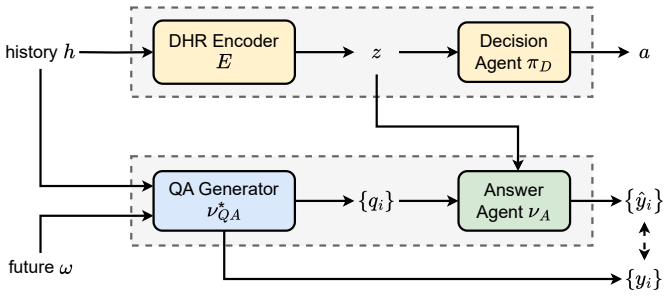
The central object is the QA-space, a tuple $(Q,Y,X,\nu)$ of question space, answer space, context space, and answer function, with histories as contexts. A DHR is the pair $(E,\nu_A)$: an encoder that maps each history to a compact representation and an answer function that reproduces the history's answers to all sufficient questions from the representation alone. The argument for Proposition 1 turns on the set $S_{\mathrm{constr}}(z)$ of question-answer pairs constructible from a representation $z$: the proof defines $g_\pi(z)=F_\pi(S_{\mathrm{constr}}(z))$ and tries to show this set equals the sufficient question-answer set $S_{QA}(h)$ for any history $h$ with $E(h)=z$. The learning machinery is a three-agent actor-critic loop: the encoder is the policy, the answer agent supplies the representation-learning signal through a discriminator trained on QA pairs, and the decision agent receives environment reward.
What would settle it
Train a DHR on MovieLens and search for two distinct histories $h_1,h_2$ with $E(h_1)=E(h_2)=z$ but with different sufficient question sets $Q^*_{h_1}\neq Q^*_{h_2}$, for example one history whose future ratings make a pairwise preference question sufficient and another whose representation cannot answer it. If such a pair exists, $S_{\mathrm{constr}}(z)$ is not equal to $S_{QA}(h_1)$, so the constructed function $g_\pi(z)=F_\pi(S_{\mathrm{constr}}(z))$ need not recover $f_\pi(h_1)$, and Proposition 1 as stated is not established.
Extended reading notes
Core claim
On the paper's own terms, the central discovery is that sufficiency can be defined and achieved through questions rather than through low-level prediction. Given a QA-space $(Q,Y,H,\nu)$ and a set of sufficient questions $Q^*_h$ for each history $h$, a DHR is an embedding $E:H\to Z$ for which there is a compressed answer function $\nu_A:Z\times Q\to\Delta Y$ with $\nu_A(E(h),q)=\nu(h,q)$ for every $q\in Q^*_h$. Proposition 1 then claims that $E$ is an $f$-sufficient statistic: for the value function $f(h;\pi)$ of any policy $\pi$, there is a function $g_\pi$ with $f(h;\pi)=g_\pi(E(h))$. The paper also claims that sufficiency can be learned: the joint objective maximizes expected reward while minimizing an $f$-divergence between the answer agent's distribution and the oracle QA-generator's distribution, solved through a variational discriminator. Empirically, DHRL-trained textual profiles improve pairwise preference accuracy and recommendation reward over the same LLM baselines without DHRL.
Load-bearing premise
The proof of Proposition 1 assumes, without proving it, that any two histories mapped to the same representation share the same set of sufficient questions, so the question-answer pairs answerable from the representation are exactly those of the original history.
Editorial extensions
If this is right
- If Proposition 1 holds, any decision policy that is optimal on raw histories can be replaced by a policy that reads only the DHR, so history compression does not sacrifice decision quality.
- The DHRL objective gives a recipe for learning sufficient statistics without a known state space: generate ground-truth QA pairs from full trajectories in hindsight, then train encoder, answerer, and decisioner jointly by RL plus divergence minimization.
- If the empirical results generalize, a short human-readable textual profile can carry the same decision-relevant information as the full interaction history, which would make interpretability and optimal control compatible.
- The reported gains on MovieLens and Amazon suggest the approach transfers across language-model backbones and across domains with different question types, including ranking and review generation.
Reading between the lines
- The sufficiency guarantee is relative to the chosen QA-space and the function $f$: if the designer's questions omit information that the true objective needs, a DHR can be perfectly sufficient for the question-answering task yet lose reward-relevant information; a natural extension is to test whether LLM-generated question templates cover the information needed for optimal recommendation.
- The proof's Case 2 depends on the assumption that the sufficient-question map $Q^*_h$ is a function of the representation; a counterexample of two histories with the same representation but different sufficient question sets would bound the theorem's scope.
- A strict evaluation would separate the future interactions used to construct training QA pairs from the future interactions used as ground truth, since otherwise the answer agent's accuracy and the recommendation reward could be inflated by label leakage.
- Applied to other POMDPs, the same recipe could produce interpretable state summaries in dialogue or robotics by choosing natural-language questions about intents, obstacles, or predicted trajectories.
Editorial analysis
A structured set of objections, weighed in public.
Referee Report
Summary. The paper introduces Descriptive History Representations (DHRs), embeddings of interaction histories that are claimed to be sufficient statistics because they can reproduce the answer function of a question-answering (QA) space for all ''sufficient questions.'' The authors propose a multi-agent learning framework comprising a representation encoder, an answer agent, a decision policy, and a QA generator, trained with a joint objective that balances reward maximization against an f-divergence between the answer agent's output distribution and a ground-truth QA distribution. Experiments on MovieLens and Amazon recommendation datasets show that LLM-generated textual user profiles trained with the proposed DHRL method improve pairwise preference prediction, recommendation reward, and qualitative profile/review ratings over baselines. The central formal claim is Proposition 1: every DHR is an f-sufficient statistic.
Significance. If the sufficiency claim were correct, the paper would offer a novel and interpretable bridge between representation learning and question answering for partially observable decision making, with a clean theoretical justification and a practical training objective. The empirical setup is ambitious and the reported gains are large; the use of natural-language profiles as representations is a worthwhile direction. However, the central theorem is false as stated, and the experimental evaluation does not report the data split needed to rule out target leakage from QA generation into evaluation. The paper's main contribution is therefore not established, although parts of the empirical methodology may be salvageable.
major comments (3)
- [Appendix E, Proposition 1] The proof of Proposition 1 is invalid. In Case 2 of Appendix E, the authors assume that the set of sufficient questions is a function of the representation, i.e., Q*_h = G(E(h)) for some G, and this assumption is neither implied by Definition 3 nor proven. A concrete counterexample refutes the proposition: let H={h1,h2}, Z={z}, Q={q1,q2}, with Q*_h1={q1}, Q*_h2={q2}, ν(h1,q1)=0, ν(h2,q2)=1, and f_π(h1)=0, f_π(h2)=1. Define ν_A(z,q1)=0 and ν_A(z,q2)=1. Then E(h1)=E(h2)=z satisfies Definition 3 for each history's sufficient questions, but any g_π(z) is a single value and cannot equal both f_π(h1) and f_π(h2). Thus E is not an f-sufficient statistic, and Proposition 1 is false as stated. This is a load-bearing error: the paper's central theoretical contribution, that DHRs are sufficient statistics, does not hold under the given definition.
- [Section 5.1 and Algorithm 1] The experimental evaluation does not describe the train/evaluation split, which is essential given the QA generation procedure. In Algorithm 1, ground-truth question-answer pairs are generated from future realizations ω_t (line 6), and in Section 5.1 the evaluation metrics (prediction accuracy, recommendation reward) are computed against ground-truth future ratings. If the future interactions used for QA training overlap with the future interactions used for evaluation, then the reported 'predictions' may largely reflect fitting to the training targets rather than generalization. The manuscript must specify whether evaluation users, items, or time windows are disjoint from those used to construct the QA pairs; without such a split, the empirical claims are not interpretable.
- [Section 4, OPT 2] Even if Proposition 1 were repaired, the training objective in OPT 2 does not guarantee that the learned encoder E satisfies Definition 3. The objective minimizes an f-divergence between two distributions over (y,h,q); it does not enforce the exact equality ν_A(z,q)=ν(h,q) for every sufficient question q of every history h. The text states that training the answer agent 'ensures E is indeed a DHR,' but no argument or proof connects approximate divergence minimization to the exact condition required by Definition 3. This is a second gap between the formal framework and the proposed method.
minor comments (4)
- [Appendix C, Table 3] The hyperparameter table uses 'DSR Balancing Factor' and the model description refers to a 'DSR discriminator'; these should be 'DHR Balancing Factor' and 'DHR discriminator' for consistency with the main text.
- [Appendix F.2] The prompt text contains a typo: 'if it's a ranking quesiton' should read 'if it's a ranking question.'
- [Section 3.1, Definition 2] The phrase '{(q, ν(x,q))}_{q∈Q*_x} is an f-sufficient statistic' is informal because a statistic is a function of the context x; consider explicitly defining S(x) = {(q, ν(x,q)) : q∈Q*_x} and stating that S is an f-sufficient statistic.
- [Section 5.1, Evaluation Metrics] The 'Review Quality' metric in Table 1 is reported as a win-rate, while 'Profile-History Consistency' is reported on a 1-5 scale; the units and direction of the win-rate should be stated explicitly in the caption or text.
Circularity Check
Proposition 1's proof assumes that the representation determines the sufficient-question set, which is essentially the sufficiency claim to be shown.
-
other
[Appendix E, Proof of Proposition 1, Case 2 (K_constr subset of K_QA)]
"Notice that, if multiple histories h1, h2, . . . map to the same representation z = E_DHR(h1) = E_DHR(h2) = . . ., then the set of sufficient questions is in itself a function of z. That is, Q*_h = G(E_DHR(h)) for some function G : Z 7-> Q mapping representations to sets of questions. If this holds, then for our specific history h, Q*_h = G(E_DHR(h)) = G(z_h)."
To prove that E is f-sufficient, the proof defines g_pi(z) = F_pi(S_constr(z)) and must show S_constr(z_h) = S_QA(h). The inclusion K_constr subset of K_QA is established only by asserting that all histories mapping to the same representation share the same sufficient-question set, Q*_h = G(E(h)). Definition 3 does not imply this: it only requires nu_A(z,q) = nu(h,q) for q in Q*_h, and it says nothing about Q*_h' for a different h' with the same embedding. The asserted condition is exactly the kind of recoverability from the representation that sufficiency requires, so the proof assumes its own conclusion. The conditional is also false in general, so Proposition 1 as stated is not established by the argument given.
full rationale
The paper's training algorithm and empirical comparisons are largely self-contained and do not reduce to a fitted parameter being renamed as a prediction: future interactions are described as used only in hindsight to construct QA pairs, while reported evaluations use held-out items and ground-truth future ratings, so no quoted passage demonstrates that the identical future labels appear in both the QA training targets and the evaluation metric. Self-citations appear only in dataset choice ('consistent with prior work [Tennenholtz et al., 2024a,b]') and are not load-bearing for the DHR sufficiency claim. The central circularity is formal: the proof of Proposition 1, the paper's key theoretical guarantee, requires the unproven and generally false assumption that the set of sufficient questions is a function of the representation. Because this assumption is effectively the sufficiency property to be proved, the theorem's derivation is circular at its load-bearing step. The score reflects this partial but central circularity, not a self-citation chain.
Assumptions & free parameters
free parameters (5)
- lambda (DSR balancing factor) =
0.01
- Profile length (max tokens) =
256
- History length H =
10
- Number of ranking questions K =
5
- f-divergence type =
TV-distance
assumptions (4)
- domain assumption For any history h, there exists a subset of sufficient questions Q*_h whose answers form an f-sufficient statistic.
- ad hoc to paper The set of sufficient questions is a function of the representation: Q*_h = G(E(h)) for some G.
- domain assumption An oracle QA generator provides ground-truth question-answer pairs from the future realization omega.
- domain assumption LLMs (Gemma, Gemini) can serve as encoder, answer, and decision agents with shared parameters and distinct prompts.
invented entities (3)
-
Descriptive History Representation (DHR)
-
QA-space
-
QA generator (nu*_QA)
Cite this review
Pith. "Pith review of Descriptive History Representations: Learning Representations by Answering Questions." pith.science (2026). https://pith.science/paper/CIIO4CWX
@misc{pith2026250602125,
  author       = {Pith},
  title        = {Pith review of: Descriptive History Representations: Learning Representations by Answering Questions},
  year         = {2026},
  howpublished = {\url{https://pith.science/paper/CIIO4CWX}},
  note         = {Machine review of arXiv:2506.02125}
}
read the original abstract
Effective decision making in partially observable environments requires compressing long interaction histories into informative representations. We introduce Descriptive History Representations (DHRs): sufficient statistics characterized by their capacity to answer relevant questions about past interactions and potential future outcomes. DHRs focus on capturing the information necessary to address task-relevant queries, providing a structured way to summarize a history for optimal control. We propose a multi-agent learning framework, involving representation, decision, and question-asking components, optimized using a joint objective that balances reward maximization with the representation's ability to answer informative questions. This yields representations that capture the salient historical details and predictive structures needed for effective decision making. We validate our approach on user modeling tasks with public movie and shopping datasets, generating interpretable textual user profiles which serve as sufficient statistics for predicting preference-driven behavior of users.
Figures


Figures from the paper (1 more)

Reference graph
Works this paper leans on
-
[1]
All Robert Graham items are rated 5/5
Brand Loyalty: • Extremely High Loyalty to Robert Graham: The vast majority (7 out of 10) of rated items are from this brand. All Robert Graham items are rated 5/5. This is the single strongest signal in the data. The user explicitly calls Robert Graham "king". • Open to Other Brands, but with Caution: Purchased items from Lucky 21 (blazer, rated poorly),...
-
[2]
Product Category Preferences: • Men’s Shirts (Dominant): Specifically, long-sleeve button-down shirts are the primary interest. Focus is on dress shirts and slightly more casual shirts (like a refined polo). • Women’s Gifts/Items (Secondary): Purchases include a women’s blazer, earrings, and a robe. Reviews indicate these are likely gifts ("Wife likes"). ...
-
[3]
Style Preferences (Men’s Shirts): • Bold Patterns and Colors: Descriptions of favored items include "geometric pattern," "ombre squares," "pixel patterned," "striped," "floral embroidery." This user is not afraid of visually interesting shirts. • High-Quality Materials: Mentions of "Egyptian cotton," "mercerized pique cotton," "satin stitch," and "925 Ste...
-
[4]
Style Preferences (Gifts/Women’s Items): • Classic/Elegant: The earrings are described as "Bridal Flower Stud" with Cubic Zir- conia, suggesting a classic, somewhat formal style. The robe is a "Soft Micro Fleece Plush Shawl Collar," indicating a preference for comfort and a traditional design. • Less information than men’s
-
[5]
Price Sensitivity: • Value-Oriented, but Willing to Pay for Quality: The user repeatedly mentions "great deal" and compares the price favorably to Nordstrom’s. This suggests a search for good value, but not necessarily the absolute lowest price. They are willing to pay for a Robert Graham shirt, implying a higher price bracket acceptance for favored brand...
-
[6]
Review Style: • Concise and Positive (when satisfied): Uses short phrases like "love it," "Fantastic shirt," "Great shirt." • Value-Focused: Often mentions price and deals in positive reviews. 22 • Direct (when dissatisfied): Simply states "sent back" for the negative review. • Expressive: show appreciation and gratefulness
-
[7]
Purchase Channel: The purchase channel is not described
- [8]
Show all 69 references
-
[9]
More history would be needed
Purchase Frequency: Cannot be determined from this data alone. More history would be needed
-
[10]
#END# #END EXAMPLE ————————————————– ————————————————– The above is just an example, you do not have to follow this template exactly
Inferred Gender and Demographic Most likely Male, purchasing gifts for female. #END# #END EXAMPLE ————————————————– ————————————————– The above is just an example, you do not have to follow this template exactly. You can try different ways to describe the user’s preferences, a...
-
[11]
Title:<item 1 title> Description:<item 1 description> Price:<item 1 price> Review:<item 1 review>
-
[12]
Title:<item 2 title> Description:<item 2 description> Price:<item 2 price> Review:<item 2 review>
-
[13]
Title:<item 3 title> Description:<item 3 description> Price:<item 3 price> Review:<item 3 review>
-
[14]
Title:<item 4 title> Description:<item 4 description> Price:<item 4 price> Review:<item 4 review>
-
[15]
Title:<item 5 title> Description:<item 5 description> Price:<item 5 price> Review:<item 5 review>
-
[16]
Title:<item 6 title> Description:<item 6 description> Price:<item 6 price> Review:<item 6 review>
-
[17]
Title:<item 7 title> Description:<item 7 description> Price:<item 7 price> Review:<item 7 review>
-
[18]
Title:<item 8 title> Description:<item 8 description> Price:<item 8 price> Review:<item 8 review> 23
-
[19]
Title:<item 9 title> Description:<item 9 description> Price:<item 9 price> Review:<item 9 review>
-
[20]
Ignore information that seems irrelevant or not informative
Title:<item 10 title> Description:<item 10 description> Price:<item 10 price> Review:<item 10 review> ————————————————– ————————————————– ————————————————– Write a user profile to describe this user. Ignore information that seems irrelevant or not informative. Limit the profil...
-
[21]
Title:<item 1 title> Description:<item 1 description> Price:<item 1 price>
-
[22]
Title:<item 2 title> Description:<item 2 description> Price:<item 2 price>
-
[23]
Title:<item 3 title> Description:<item 3 description> Price:<item 3 price>
-
[24]
Title:<item 4 title> Description:<item 4 description> Price:<item 4 price>
-
[25]
Title:<item 5 title> Description:<item 5 description> Price:<item 5 price>
-
[26]
User review
Title:<item 6 title> Description:<item 6 description> Price:<item 6 price> ————————————————– ————————————————– Below are a set of 6 questions about the items above: 24 (Q1) Rank the items<id 5>and<id 6>based on the user’s preferences. (Q2) Rank the items<id 6>and<id 2>based on...
-
[27]
Casual, Elegant Fitted Knit Cardigan Sweaters That is Versatile and Made Out of High Quality Material and Luciously Soft
Title: BIADANI Women Button Down Long Sleeve Basic Soft Knit Cardigan Sweater Item Item description: "Casual, Elegant Fitted Knit Cardigan Sweaters That is Versatile and Made Out of High Quality Material and Luciously Soft." Price: $10.01 - $25.80 ————————————————–
-
[28]
U neck style size: S( US 0) Bust:25.19 ¨Waist:24.40 ¨Length:23.62 ¨M(US 2) Bust:26.77 ¨Waist:25.98 ¨Length:24.01 ¨L(US 4) Bust:28.34 ¨Waist:27.55 ¨Length:24.40 ¨XL(US
Title: Moxeay Women Sexy Sleeveless Spaghetti Strap Mini Club Dress Item Item description: "Material: Polyester (soft fabric make you comfortable to wear) Style: Spaghetti strap mini dress Features: U neck/V neck, Sleeveless, Spaghetti strap,Backless, High Waist, Back zipper D...
-
[29]
2.Colors may slightly different due to the lighting and monitor
Bust:31.49 ¨Waist:29.92 ¨Length:24.80 ¨Lace V neck style size: S:Bust 32.28¨,Waist 27.55¨, Length 30.31 ¨M:Bust 33.85¨, Waist 29.13¨, Length 30.70 ¨L:Bust 35.43¨, Waist 30.70¨, Length 31.10 ¨XL:Bust 36.22¨, Waist 31.49¨, Length 31.49Ëmbroidery V neck style: S:Waist 29.92”,Bust...
-
[30]
Title: Miusol Women’s Casual Flare Floral Contrast Evening Party Mini Dress Item description: unknown Price: unknown ————————————————–
-
[31]
The case holds up to 10 business cards securely and snaps shut when not in use
Title: Damask Embossed Metal Business Card Case Item Item description: "This business card case features an embossed gold damask pattern on both sides. The case holds up to 10 business cards securely and snaps shut when not in use. Measures 3.75 ¨x 2.5¨x 0.25¨." Price: $3.95 —...
-
[32]
Comes in different sizes with a spring clasp
Title: Honolulu Jewelry Company Sterling Silver 1mm Box Chain Necklace, 14¨- 36 Item Item description: "Nickel free sterling silver 1mm box chain. Comes in different sizes with a spring clasp. Rhodium finished to pre- vent tarnishing. Made in Italy. Gift box included. From Hon...
-
[33]
(Q2) Rank the items id 3 and id 6 based on the user’s preferences
Title: Milumia Women’s Button up Split Floral Print Flowy Party Maxi Dress Item description: unknown Price: $18.99 - $35.99 ————————————————– (Q1) Rank the items id 2 and id 3 based on the user’s preferences. (Q2) Rank the items id 3 and id 6 based on the user’s preferences. (...
-
[34]
Dont get stuck on the carpet floor.Zumba Carpet Glidersallows you to step, shake, swivel and spin on carpet with ease and reduced risk of injury
Title: Zumba Carpet Gliders for Shoes Item Item description: "Dont get stuck on the carpet floor.Zumba Carpet Glidersallows you to step, shake, swivel and spin on carpet with ease and reduced risk of injury." Price: unknown User Rating: 1.0
-
[35]
Solid 925 sterling silver, teardrops are approx 5/8 x 3/8 inches
Title: Sterling Silver Leverback Earrings Black Pear Teardrop Made with Swarovski Crystals Item Item description: "Black faceted crystal teardrops hang from sterling silver rings and leverback earwires. Solid 925 sterling silver, teardrops are approx 5/8 x 3/8 inches. Made wit...
-
[36]
Title: Wiipu fashion vintage luxurious pink color crystal brand designer statement women necklace(B379) Item Item description: "Material:alloy rhinestone ,crystal Size: necklace ribbon chain is 35cm ,pendant is 17cm*12cm; shipping from China, usually take about 7–15days arriva...
-
[37]
Title: Kooljewelry Sterling Silver Bead and Diamond-Cut Ball Station Necklace (14, 16, 18, 20, 22, 24, 30, or 36 inch) Item description: unknown Price: $25.99 User Rating: 5.0
-
[38]
They understand exactly what customers are looking for– from pampering your feet in cozy softness to keeping you one step ahead of the game." Price: unknown User Rating: 4.0
Title: Dearfoams Women’s Sequin Flat Slipper Item Item description: "Dearfoams is a slipper brand with great awareness. They understand exactly what customers are looking for– from pampering your feet in cozy softness to keeping you one step ahead of the game." Price: unknown ...
-
[39]
Buy with confidence as they are MADE IN THE USA
Title: Women’s Chiffon Beachwear Dress Swimwear Bikini Cover-up Made in The USA Item Item description: "SHORE TRENDZ quality constructed cover-up Chiffon dresses are created with lovely detail. Buy with confidence as they are MADE IN THE USA. These sexy Chiffon dresses have fi...
-
[40]
Brushed terry lining and insole, 10mm high density poly foam insole, with durable, skid resistant, TPR outsole.", "Dearfoams is a slipper brand with great awareness
Title: Dearfoams Women’s Lurex Sweater Knit Ballerina Slipper Item Item description: "This slipper features a cable knit upper with silver lurex, yarn pom embellishment with silver lurex, and elasticized throat line for secure fit. Brushed terry lining and insole, 10mm high de...
-
[41]
It is trend-right footwear that you will reach for in your closet again and again
Title: Nine West Women’s Able Synthetic Platform Pump Item Item description: "Nine West offers a quick edit of the runways – pinpointing the must have looks of the season, and translating what is fun, hip, and of the moment. It is trend-right footwear that you will reach for i...
-
[42]
Title: Annie Shoes Women’s Devine Dress Pump Item description: unknown Price: unknown User Rating: 4.0
-
[43]
Title: TinkSky Wedding Tiara Rhinestones Crystal Bridal Headband Pageant Princess Crown Item description: unknown Price: $8.99 User Rating: 3.0 We want to use the following summary to capture user preference from the above purchase history:
-
[44]
A secondary interest in Sterling Silver jewelry
Brand Affinity:Shows a strong preference for Nine West and Annie Shoes, evidenced by the 5-star ratings. A secondary interest in Sterling Silver jewelry. 2.Style:Appreciates fashionable slippers and pumps; likely enjoys comfortable yet stylish footwear. 3.Price Range:Primarily...
-
[45]
5.Purchase typeMost likely female
Negative Feedback:The low rating of the beachwear dress and the tiara headband suggests a critical eye towards embellishments and potentially lower quality. 5.Purchase typeMost likely female. Does the above summary faithfully capture user preference from their purchase history...
-
[46]
Title: Hangover, The (2009) ————————————————–
2009
-
[47]
Title: Old Boy (2003) ————————————————–
2003
-
[48]
Vengeance (Boksuneun naui geot) (2002) ————————————————–
Title: Sympathy for Mr. Vengeance (Boksuneun naui geot) (2002) ————————————————–
2002
-
[49]
Title: Let the Right One In (Låt den rätte komma in) (2008) ————————————————–
2008
-
[50]
Title: Spanking the Monkey (1994) ————————————————–
1994
-
[51]
(Q2) Rank the movies id 6 and id 5 based on the user’s preferences
Title: Visitor Q (Bizita Q) (2001) ————————————————– (Q1) Rank the movies id 2 and id 6 based on the user’s preferences. (Q2) Rank the movies id 6 and id 5 based on the user’s preferences. (Q3) Rank the movies id 5 and id 1 based on the user’s preferences. (Q4) Rank the movies...
2001
-
[52]
Title: RoboCop (1987) User Rating: 3.5
1987
-
[53]
Title: Chasing Amy (1997) User Rating: 3.5
1997
-
[54]
Title: Grosse Pointe Blank (1997) User Rating: 3.0
1997
-
[55]
Title: Arachnophobia (1990) User Rating: 3.0
1990
-
[56]
Title: Mary Poppins (1964) User Rating: 1.5
1964
-
[57]
Title: Ice Age (2002) User Rating: 2.0
2002
-
[58]
Title: No Country for Old Men (2007) User Rating: 4.0
2007
-
[59]
Title: Wayne’s World (1992) User Rating: 4.5
1992
-
[60]
Title: Bad Boys (1995) User Rating: 2.5
1995
-
[61]
Inseam 32 inches. Fit tip: For accuracy, measure yourself in your undergarments. Give all measurements in inches. If your measurements are between sizes, order the larger size
Title: Planet of the Apes (1968) User Rating: 3.5 We want to use the following summary to capture user preference from the above history: This user enjoys a mix of genres, primarily leaning towards action, comedy, and sci-fi. They demonstrate a preference for films from the 80...
1968
-
[62]
Price:$9.90 User Rating:4.0 5.Title:Vikoros Women Flowy Lace Overlay Adjustable Strap Crop Top Tank Bustier Item description:
Title:Eye Catching Women Leather Bracelet Silver Color Beads Cuff Jewelry with Mag- netic Clasp 7.5¨(Black) Item description:"Another eye catching Urban Jewelry bracelet,silver beads color make a stunning splash along a luxe multi midnight black leather bracelet with magnetic ...
1945
-
[63]
, "The Mitchel Collection
Title:Men Purple Mesh Pocket Shorts Inner Drawstring Avail Size S-5X Item description: unknown Price: unknown User Rating:5.0 4.Title:Breda Men’s 1627-Gold Mitchell Multi Time Zone Watch Item description:"A great-looking timepiece from Breda, this watch utilizes an excellent b...
-
[64]
Title:Camouflage Cap, Color: Orange Camo, Size: One Size Item description: unknown Price: $8.66 User Rating:5.0 8.Title:LRG Men’s Big-Tall Core Collection Nine Camo T-Shirt Item description:The Core Collection Nine Camo Tee is constructed of Jersey featuring a contrasting patt...
-
[65]
They consistently rate items favorably (mostly 5-star) suggesting a generally positive shopping experience and valuing style
Title:Rocawear Men’s Big-Tall Gradient Black Hearts Item description: unknown Price: unknown User Rating:5.0 10.Title:Kangol Men’s Tropic Galaxy Cap Item description:The galaxy is a kangol interpretation of a classic 8-quarter cap" Price:$37.40 User Rating:5.0 User Profile:Thi...
-
[66]
Satisfaction guaranteed Returns accepted
Title:Hollywood Star Fashion Casual Basic Women’s Semi-Crop Camisole Cami Tank Top with Adjustable Straps Item description:“This is a long length Tank top Versatile Basic Spaghetti Strap Satin Trim Stretch Camisole Tank Yoga Everyday Active Adventure Travel Fitted Scoop neckli...
-
[67]
1pcs for each!
Title:MANDI HOME Hot Sale Wedding Fashion 925 Silver Plated Jewelry Set Big Hand Chain Bracelet Necklace Ring Stud Earings Eardrop Water Drops Item description:“1pcs for each!" Price:$6.35 User Rating:2.0 6.Title:Fruit of the Loom Girls’ Cotton Spaghetti Strap Sport Bra Item d...
-
[68]
Title:Mens Colorful Dress Socks Argyle - HSELL Men Multicolored Argyle Pattern Fashionable Fun Crew Socks Item description: unknown Price:$11.99 User Rating:5.0
-
[69]
Star Wars
Title:Marvel Comics Crew Socks Mens Mix Hulk Spiderman, The Avengers Large With Bonus One XWi Wrist Sweatband Item description:“A simply Marvel-ous way to get your man to change socks regularly, each set of socks feature classic artwork from the comics themselves, with full co...
1977
Reviewed August 7, 2026 · model on record in the stance chip above.
Discussion (0). Sign in to comment.