REVIEW 4 major objections 5 minor 26 references
Reflection-Based Memory For Web navigation Agents
T0 review · 4 major / 5 minor · reviewed 2026-08-07 · deepseek-v4-flash
Pith's one-line read ReAP stores short self-reflections from past web navigation runs and retrieves the most relevant ones for a new task, reporting an 11-point overall success gain on WebArena and a 28–29 point gain on tasks the baseline previously failed…
desk verdict Plausible and useful memory design, but the headline transfer gain is statistically fragile and the reporting needs cleaning before the number is taken at face value. read the letter →
The pith
A machine-rendered reading of the paper's core claim, the machinery that carries it, and where it could break.
The reading
What carries the argument
The carrying mechanism is the Reflection-Augmented Planning (ReAP) pipeline: a knowledge base of key-value pairs whose keys are embedded task descriptions and whose values are LLM-generated reflections distilled from past trajectories. Reflections are structured around five questions—what worked (positive reinforcement), site limitations, shortcuts, backtracking or challenges, and feedback for unsuccessful plans. At inference, the current task is embedded, the top-5 reflections by cosine similarity are retrieved, and they are inserted into the agent's prompt before the agent acts. The comparison conditions (one-shot trajectory, summary, reflection) isolate whether concise insights outperform raw trajectories.
What would settle it
Run the same 70 WebArena tasks with the ReAP method multiple times under varied seeds (the paper itself reports that stochastic settings change results) and check whether the 11-point overall gain and the 28–29 point gain on previously failed tasks persist; a complementary test is to evaluate on another benchmark such as Mind2Web, which the paper lists as a limitation.
Extended reading notes
Core claim
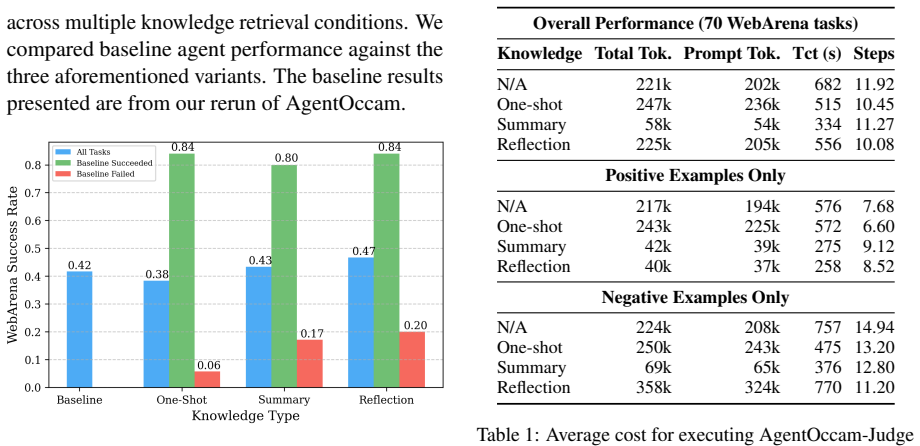
The central claim is that storing key insights—not full trajectories—from past web navigation experiences and retrieving them by semantic similarity to the current task improves an agent's success on both repeated and novel tasks. On WebArena, every tested reflection type beats the baseline, and the best variant (Reflection) improves overall success by 11 points and by 28–29 points on previously failed tasks, while also reducing average steps and token usage. The paper interprets this as evidence that self-reflections transfer across similar-but-distinct web tasks without additional training.
Load-bearing premise
The headline improvement is computed from a single deterministic rollout per task on a held-out set of about 14 tasks, with no confidence intervals or significance test, so the measured 11-point gain could be within normal run-to-run variance of the language model.
Editorial extensions
If this is right
- ReAP raises WebArena success by 11 points overall without any fine-tuning, suggesting reflection memory can substitute for some retraining.
- The largest gains are on previously failed tasks (28–29 points), so the method primarily converts past mistakes into reusable guidance.
- Reflection prompts cut average steps by about 29% and total tokens from 221k to 83k relative to baseline, lowering execution cost.
- Both Summary and Reflection outperform one-shot trajectory injection, indicating that distilled insights are more effective than raw trajectories for in-context transfer.
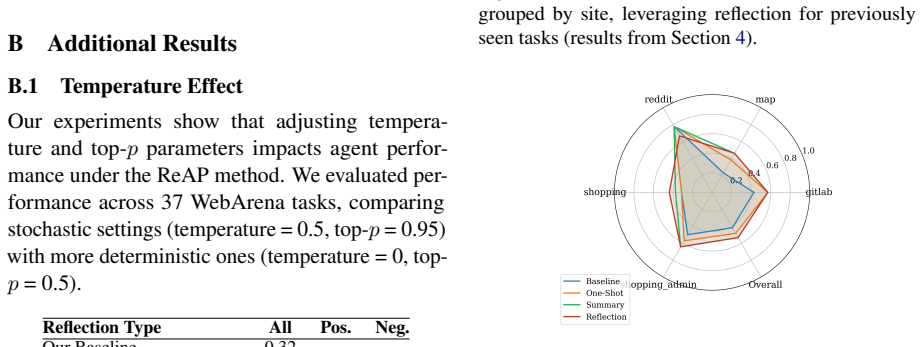
- Site-level results show double-digit gains on most WebArena sites (GitLab, map, shopping, shopping_admin), with Reddit as the only site where performance drops.
Reading between the lines
- If the effect is real, the memory could be updated online after every run, so an agent deployed in production would accumulate a growing set of task-specific lessons at near-zero marginal cost.
- The retrieval step is plausibly the load-bearing component: because reflections are selected by embedding similarity to the new task, the method should transfer to tasks that share workflows but not wording; a natural test would be to compare against random retrieval.
- The paper's deterministic single-run evaluation leaves open whether the 11-point gain is robust; repeated runs or a significance test, which the authors do not report, would settle this.
- The cost savings imply reflection memory might be a more practical adaptation mechanism than fine-tuning for frequently changing websites, since it needs no gradient updates and can be updated in place.
Editorial analysis
A structured set of objections, weighed in public.
Referee Report
Summary. The paper introduces Reflection-Augmented Planning (ReAP), a memory mechanism for web navigation agents that stores short self-reflections from prior trajectories and retrieves the k most relevant reflections for new tasks. The method is tested on WebArena using AgentOccam as the base agent, with three knowledge representations: one-shot trajectories, summaries, and structured web-reflections. The authors report that ReAP improves success rate by 11 points overall and by 28–29 points on tasks that the baseline previously failed, and that these gains transfer to held-out tasks without additional training. The paper also reports reductions in steps and tokens, indicating lower execution cost. The central claim is that simple reflective insights, rather than full trajectories, suffice to improve performance on similar but distinct web navigation tasks.
Significance. If the transfer result were statistically secure, ReAP would be a useful and practical contribution: it is conceptually simple, training-free, and offers a clear memory-augmentation recipe for web agents. The paper's strengths include a concrete algorithm (Algorithm 1), explicit prompt templates in Appendix A, a comparison of three knowledge types, cost analysis, and an honest limitations statement restricting scope to WebArena and a single base agent. However, the central claim currently rests on a very small evaluation with no statistical testing, and the reporting contains ambiguities that prevent the reader from verifying the headline numbers. The contribution is therefore conditionally significant: the idea is promising, but the evidence as presented is not yet at the standard required to establish the 11-point transfer claim.
major comments (4)
- [Section 5.1 / Figure 2] The central transfer claim is not statistically supported. Section 5 describes an 80-20 split of 70 WebArena tasks, so the held-out test set is approximately 14 tasks, with one deterministic rollout per task and no confidence intervals or repeated runs. On 14 binary outcomes, a difference of 11 percentage points corresponds to about 1.5 tasks, and the standard error of the difference in proportions is roughly 18 percentage points. The observed improvement is therefore statistically indistinguishable from zero under the stated protocol, and the subsequent site-level breakdowns in Appendix B.2 compound the small-sample problem.
- [Section 5 / Table 2] The evaluation set for the transfer experiment is unclear. Section 5 states that performance is evaluated on the remaining 20% of tasks, but Table 2 and Figures 2 and 4 are captioned '70 WebArena tasks,' and Table 2's baseline row (221k total tokens, 202k prompt tokens, 682s, 11.92 steps) is identical to Table 1's 70-task baseline row. This suggests either that the same 70-task run was reused for the held-out comparison or that the caption is inaccurate. The authors should clarify whether the success rates in Section 5.1 are computed over 14 tasks, 70 tasks, or some other subset, and should provide the per-task outcome table and task IDs to resolve the ambiguity.
- [Section 5.1 / Method] The causal role of reflection content is not isolated. The comparison is only between the baseline and ReAP with retrieved reflections; there is no control condition that retrieves random, irrelevant, or content-free reflections while keeping the retrieval pipeline and prompt length fixed. Without such a control, the improvement could be attributed to the presence of additional task-related context or to the retrieval mechanism itself rather than to the reflective content. Adding a condition that retrieves unrelated reflections from the same knowledge base would provide a direct test of whether the insight content matters.
- [Abstract / Section 5.1 / Section 5.2 / Conclusion] The headline numbers are internally inconsistent. The abstract reports a 29-point gain on previously failed tasks, while Section 5.1 states a 28-point gain; the conclusion reports a 34.7% step reduction, while Section 5.2 reports 29.1%. These discrepancies matter because the paper's central claims are quantitative, and the reader cannot determine which numbers are authoritative. The authors should reconcile these values and ensure that all abstract, body, and conclusion figures are drawn from the same experiments.
minor comments (5)
- [Appendix B.1 / Table 3] In Table 3, the rows for 'Summary (Stochastic)' and 'Reflect (Stochastic)' are identical (0.36, 0.78, 0.16). This is likely a typo, but it should be corrected or explained, as it casts doubt on the appendix's reliability.
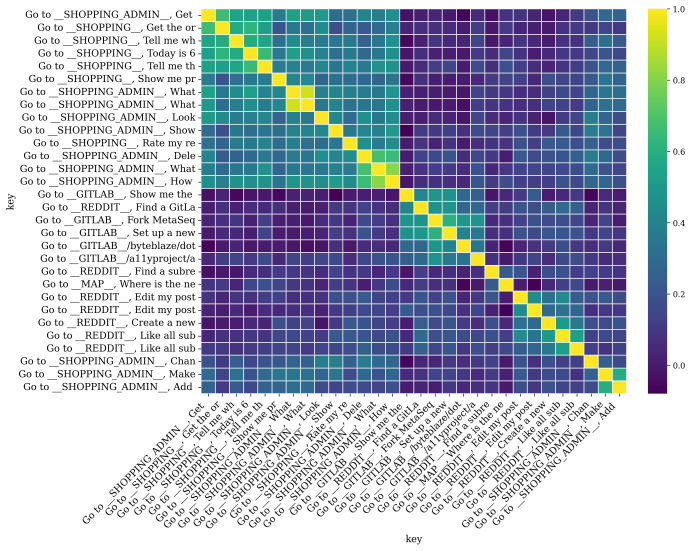
- [Appendix C] The choice of embedding model (gte-Qwen2-7B-instruct) is made by qualitative inspection of t-SNE plots and similarity heatmaps on WebArena tasks, and the temperature/top-p settings are tuned on 37 WebArena tasks in Appendix B.1. This selection on the evaluation benchmark could inflate the reported improvements; the authors should acknowledge this or provide a robustness check on an independent split.
- [Appendix A.1.2] The Web-Reflection prompt contains several typos and grammatical errors, including 'sucessfully accomplished,' 'there unexpected challenged,' and the instruction 'Please do not call the agent an inexperienced -- that is rude.' These do not affect the experimental logic but should be corrected before publication.
- [Section 5 / General] The paper does not provide code, per-task outcomes, or the exact set of held-out task IDs. Sharing these would substantially improve reproducibility and would help reviewers verify the split and the site-level success rates reported in Figure 4.
- [Section 4.1] The success-rate results in Section 4.1 are also based on a single rollout per task for 70 tasks, with no error bars. The claims of '+5 points' and '+20 points' would be more convincing with repeated runs or at least a bootstrap confidence interval.
Circularity Check
No derivational circularity: ReAP's transfer gains are empirical held-out comparisons, not reductions to fitted inputs or self-citation.
full rationale
The paper's pipeline is not circular by construction. Reflections are generated from 80% of WebArena trajectories, stored as key-value pairs keyed by task, and retrieved for the remaining 20% of tasks via cosine similarity; the reported 11-point and 28/29-point gains are measured success-rate differences between the baseline and ReAP in the environment, not quantities defined in terms of each other. No equation in the paper makes the target outcome equal to an input. The hyperparameters (k=5, gte-Qwen2-7B-instruct, temperature 0, top-p 0.5) are selected using WebArena analyses in Appendices B.1 and C, but that is benchmark-specific tuning rather than a fitted parameter being renamed as a prediction; the held-out comparison still has independent empirical content. The only self-citation (Azam et al., 2024, in Related Work) supports the general premise that self-reflection helps web agents, but the paper's own experiments carry that claim, so the citation is not load-bearing. Reporting ambiguities do exist—Figure 2/Table 2 are captioned "70 WebArena tasks" while the text says a 20% held-out split, the baseline cost row in Table 2 duplicates Table 1, and the abstract's 29 points differs from Section 5.1's 28 points—but these are evaluation-validity and consistency concerns, not circular reductions. The Limitation section explicitly acknowledges that evaluation is bounded to WebArena and a single base agent, which is a generalizability limitation rather than evidence of circularity. No specific reduction of a claimed result to its inputs or to a self-citation chain can be exhibited, so the appropriate finding is no significant circularity.
Assumptions & free parameters
free parameters (4)
- k (number of retrieved reflections) =
5
- temperature =
0
- top_p =
0.5
- embedding model =
gte-Qwen2-7B-instruct
assumptions (4)
- domain assumption LLM-generated reflections from trajectories are accurate and useful.
- domain assumption Cosine similarity on task embeddings reliably measures task relevance.
- domain assumption WebArena success rate is a valid proxy for real-world web navigation performance.
- domain assumption Deterministic decoding (temperature 0, top-p 0.5) yields stable and representative agent behavior.
Cite this review
Pith. "Pith review of Reflection-Based Memory For Web navigation Agents." pith.science (2026). https://pith.science/paper/SW53NAMU
@misc{pith2026250602158,
  author       = {Pith},
  title        = {Pith review of: Reflection-Based Memory For Web navigation Agents},
  year         = {2026},
  howpublished = {\url{https://pith.science/paper/SW53NAMU}},
  note         = {Machine review of arXiv:2506.02158}
}
read the original abstract
Web navigation agents have made significant progress, yet current systems operate with no memory of past experiences -- leading to repeated mistakes and an inability to learn from previous interactions. We introduce Reflection-Augment Planning (ReAP), a web navigation system to leverage both successful and failed past experiences using self-reflections. Our method improves baseline results by 11 points overall and 29 points on previously failed tasks. These findings demonstrate that reflections can transfer to different web navigation tasks.
Figures


Figures from the paper (7 more)


Reference graph
Works this paper leans on
-
[1]
URL: " 'urlintro :=
ENTRY address author booktitle chapter edition editor howpublished institution journal key month note number organization pages publisher school series title type volume year eprint doi pubmed url lastchecked label extra.label sort.label short.list INTEGERS output.state before.all mid.sentence after.sentence after.block STRINGS urlintro eprinturl eprintpr...
-
[2]
write newline
" write newline "" before.all 'output.state := FUNCTION n.dashify 't := "" t empty not t #1 #1 substring "-" = t #1 #2 substring "--" = not "--" * t #2 global.max substring 't := t #1 #1 substring "-" = "-" * t #2 global.max substring 't := while if t #1 #1 substring * t #2 global.max substring 't := if while FUNCTION word.in bbl.in capitalize " " * FUNCT...
-
[3]
Deepak Akkil, Ruhana Azam, Tamer Abuelsaad, Prasenjit Dey, Aditya Vempaty, Ashish Jagmohan, and Ravi Kokku. 2025. https://openreview.net/forum?id=7PQnFTbizU Agent-e: From autonomous web navigation to foundational design principles in agentic systems
work page 2025
-
[4]
Shengnan An, Zexiong Ma, Zeqi Lin, Nanning Zheng, Jian-Guang Lou, and Weizhu Chen. 2024. https://doi.org/10.48550/arXiv.2310.20689 Learning From Mistakes Makes LLM Better Reasoner
-
[5]
Ruhana Azam, Tamer Abuelsaad, Aditya Vempaty, and Ashish Jagmohan. 2024. https://doi.org/10.48550/arXiv.2410.00689 Multimodal Auto Validation For Self-Refinement in Web Agents
work page Pith review arXiv doi:10.48550/arxiv.2410.00689 2024
-
[6]
Rae, Erich Elsen, and Laurent Sifre
Sebastian Borgeaud, Arthur Mensch, Jordan Hoffmann, Trevor Cai, Eliza Rutherford, Katie Millican, George van den Driessche, Jean-Baptiste Lespiau, Bogdan Damoc, Aidan Clark, Diego de Las Casas, Aurelia Guy, Jacob Menick, Roman Ring, Tom Hennigan, Saffron Huang, Loren Maggiore, Chris Jones, Albin Cassirer, Andy Brock, Michela Paganini, Geoffrey Irving, Ori...
work page 2022
-
[7]
Xiang Deng, Yu Gu, Boyuan Zheng, Shijie Chen, Samuel Stevens, Boshi Wang, Huan Sun, and Yu Su. 2023. http://arxiv.org/abs/2306.06070 Mind2web: Towards a generalist agent for the web
arXiv 2023
-
[8]
Tao Feng, Pengrui Han, Guanyu Lin, Ge Liu, and Jiaxuan You. 2024. https://openreview.net/forum?id=SkDNQbMQba Thought-retriever: Don t just retrieve raw data, retrieve thoughts
work page 2024
Show all 26 references
- [9]
- [10]
-
[11]
Hongliang He, Wenlin Yao, Kaixin Ma, Wenhao Yu, Yong Dai, Hongming Zhang, Zhenzhong Lan, and Dong Yu. 2024. http://arxiv.org/abs/2401.13919 Webvoyager: Building an end-to-end web agent with large multimodal models
2024 arXiv
-
[12]
u ttler, Mike Lewis, Wen-tau Yih, Tim Rockt \
Patrick Lewis, Ethan Perez, Aleksandra Piktus, Fabio Petroni, Vladimir Karpukhin, Naman Goyal, Heinrich K \"u ttler, Mike Lewis, Wen-tau Yih, Tim Rockt \"a schel, Sebastian Riedel, and Douwe Kiela. 2020. https://proceedings.neurips.cc/paper/2020/file/6b493230205f780e1bc26945df...
2020
-
[13]
Michael Lutz, Arth Bohra, Manvel Saroyan, Artem Harutyunyan, and Giovanni Campagna. 2024. Wilbur: Adaptive in-context learning for robust and accurate web agents. arXiv preprint arXiv:2404.05902
2024 arXiv
- [14]
-
[15]
Shikhar Murty, Hao Zhu, Dzmitry Bahdanau, and Christopher D Manning. 2024. Nnetnav: Unsupervised learning of browser agents through environment interaction in the wild. In Scaling Self-Improving Foundation Models without Human Supervision
2024
- [16]
-
[17]
Tarr, William W
Gabriel Sarch, Lawrence Jang, Michael J. Tarr, William W. Cohen, Kenneth Marino, and Katerina Fragkiadaki. 2025. https://doi.org/10.48550/arXiv.2406.14596 VLM Agents Generate Their Own Memories : Distilling Experience into Embodied Programs of Thought
2025 doi
-
[18]
Junhong Shen, Atishay Jain, Zedian Xiao, Ishan Amlekar, Mouad Hadji, Aaron Podolny, and Ameet Talwalkar. 2024. Scribeagent: Towards specialized web agents using production-scale workflow data. arXiv preprint arXiv:2411.15004
2024 arXiv
- [19]
- [20]
- [21]
- [22]
- [23]
-
[24]
Ke Yang, Yao Liu, Sapana Chaudhary, Rasool Fakoor, Pratik Chaudhari, George Karypis, and Huzefa Rangwala. 2024 a . Agentoccam: A simple yet strong baseline for llm-based web agents. arXiv preprint arXiv:2410.13825
2024 arXiv
- [25]
-
[26]
Shuyan Zhou, Frank F Xu, Hao Zhu, Xuhui Zhou, Robert Lo, Abishek Sridhar, Xianyi Cheng, Yonatan Bisk, Daniel Fried, Uri Alon, et al. 2023. https://webarena.dev Webarena: A realistic web environment for building autonomous agents . arXiv preprint arXiv:2307.13854
2023 arXiv
Reviewed August 7, 2026 · model on record in the stance chip above.
Discussion (0). Sign in to comment.