REVIEW 3 major objections 5 minor 39 references
Demonstrating magnetic field robustness and reducing temporal T1 noise in transmon qubits through magnetic field engineering
T0 review · 3 major / 5 minor · reviewed 2026-08-07 · deepseek-v4-flash
Pith's one-line read Moderate magnetic fields, whether trapped or applied, more than halve temporal T1 fluctuations in Nb/Ta transmon qubits without degrading average coherence.
desk verdict A credible but under-powered experimental report that moderate magnetic fields stabilize T1 in high-coherence Nb/Ta transmons; the effect is plausible and the engineering is solid, but the statistical identification is confounded by separate cooldowns and nonstationary T1 noise. read the letter →
The pith
A machine-rendered reading of the paper's core claim, the machinery that carries it, and where it could break.
The reading
What carries the argument
The experimental machinery is a three-axis Helmholtz coil assembly wound from copper-clad superconducting wire, with fields calibrated in situ by a fluxgate magnetometer; it lets the experimenters apply a known perpendicular field either during cooldown, to trap flux in the capacitor pads, or during T1 measurement at 8 mK. The analysis machinery is Allan deviation analysis, a time-domain statistic that decomposes the T1 time series into white, flicker, and random-walk noise amplitudes. The physical mechanism proposed is threefold: polarization of paramagnetic impurities such as O2, NbO, and TaNb; trapping of non-equilibrium quasiparticles in vortex cores; and saturation of high-frequency two-level-system loss channels.
What would settle it
Run a series of interleaved cooldowns on a single qubit: zero field, 600 mG, zero field, 600 mG, each followed by a 24-hour T1 trace; if the zero-field runs sometimes show MAD as low as the 600 mG runs, the suppression is not magnetic.
Extended reading notes
Core claim
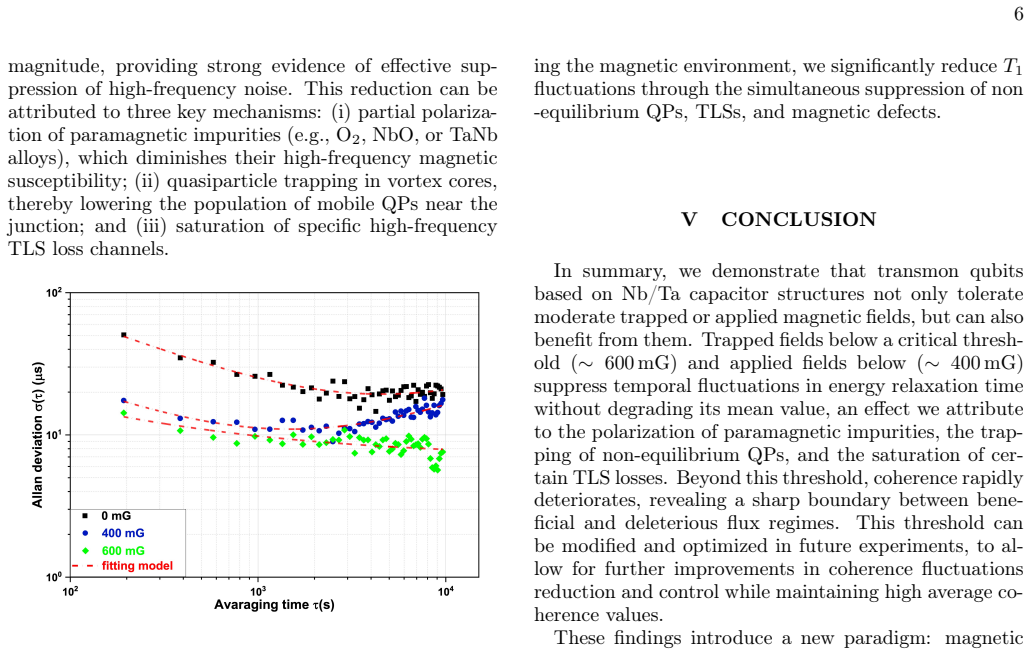
The central discovery is that there is a window of magnetic field strengths in which transmon coherence becomes more stable rather than worse. For a qubit with mean T1 of 142.7 microseconds at zero field, cooling in 600 mG reduced the mean absolute deviation from 10.1 microseconds to 5.2 microseconds while mean T1 stayed at 140.2 microseconds; for a second qubit, MAD fell from 38.0 microseconds to 13.7 microseconds at mean T1 near 291 microseconds. A third qubit cooled in zero field and measured under applied fields of 100 to 400 mG showed the same trend: mean T1 remained around 205 to 218 microseconds while MAD fell from 23.2 microseconds to 10.7 microseconds. Trapped fields of 800 mG and above caused sharp degradation, placing a threshold between 600 and 800 mG. Allan deviation fits show the suppression is largely in the white-noise amplitude n0, which drops by nearly an order of magnitude at 400 to 600 mG.
Load-bearing premise
The results assume that differences in T1 noise between field settings are caused by the field, not by the fact that each setting was measured in a separate cooldown; no zero-field baseline was repeated and no statistical test was applied.
Editorial extensions
If this is right
- Cooldown protocols can be tuned to trap 400 to 600 mG of flux, more than halving T1 fluctuations without recalibrating qubit frequency or average T1.
- Applied static fields up to 400 mG can stabilize a qubit during operation, offering a live knob for noise suppression.
- Allan deviation data indicate the suppression targets white noise, with n0 dropping nearly tenfold, so short-timescale calibration stability should improve.
- Fields above 600 to 800 mG must be avoided; the sharp threshold defines a clear operating window for magnetic field engineering.
- The effect, if reproduced across devices, reduces the recalibration overhead caused by T1 drift in multi-qubit processors.
Reading between the lines
- The mechanism list is not discriminated by this dataset; a testable separation would be to compare perpendicular versus in-plane fields, since paramagnetic polarization should be more isotropic while vortex trapping is direction-sensitive.
- If quasiparticle trapping is the dominant term, the stabilization should weaken when quasiparticle density is independently reduced by normal-metal traps, a prediction the paper does not test.
- The reported MAD reductions imply a direct operational benefit: fewer T1 recalibrations over a 12 to 24 hour experiment, which matters for automating large processors.
- The sharp threshold between 600 and 800 mG suggests material and geometry dependence, so varying pad spacing and junction area could shift the window and make the effect tunable per device.
Editorial analysis
A structured set of objections, weighed in public.
Referee Report
Summary. The manuscript reports measurements on Nb/Ta transmon qubits showing that both magnetic flux trapped during cooldown (up to 600 mG) and static magnetic fields applied during operation (up to 400 mG) reduce the temporal fluctuations of T1, quantified by the mean absolute deviation (MAD), without significantly changing the mean T1 or qubit frequency. Higher fields (800–1000 mG) cause a sharp degradation of T1. The authors support the central claim with box plots for two qubits (q1, q2) under trapped-flux conditions, a third qubit (q3) under applied fields, and an Allan deviation analysis of one qubit (q2). They interpret the stabilization as resulting from paramagnetic impurity polarization, quasiparticle trapping in vortices, and partial saturation of two-level systems.
Significance. The reported effect, if robust, is significant: it challenges the general assumption that magnetic fields are always detrimental to superconducting qubits and could offer a practical route to stabilizing coherence in devices with Nb/Ta capacitor pads. The experiment benefits from a dedicated three-axis Helmholtz coil system with in-situ field monitoring, long-duration T1 tracking (12–24 h), and a quantitative noise analysis via Allan deviation. However, the causal claim that magnetic fields suppress T1 fluctuations is currently identified through comparisons across separate cooldowns and a monotonic field sequence, without statistical tests or repeated zero-field baselines, so the strength of the evidence is not yet commensurate with the breadth of the conclusion.
major comments (3)
- [§III A, Table I] The comparison of T1 fluctuations between B_trapped = 0, 400, and 600 mG is confounded by cooldown-to-cooldown variability, because each trapped-flux condition for q1 and q2 was realized in a separate cooldown and no repeated zero-field baseline was measured. Given the well-documented nonstationarity of T1 fluctuations in superconducting qubits (e.g., Klimov et al., PRL 121:090502, and Carroll et al., npj Quantum Inf 8:132), the reduction in MAD from 38.0 μs to 16.7/13.7 μs for q2 might reflect the specific cooldown rather than the applied field. The authors should provide repeated zero-field cooldowns interleaved with the field conditions, or multiple cooldowns per condition, and report a statistical test (e.g., bootstrap confidence intervals for M and MAD).
- [§III C, Fig. 4] The actively applied field experiment on q3 uses a monotonic field sequence (0 → 100 → 200 → 400 mG) within a single 15-hour run, with no return to zero field. A slow monotonic drift in qubit stability over the course of the run would produce exactly the observed trend of decreasing MAD with field. To support the causal claim, the field sequence should be randomized or interleaved with repeated zero-field segments, allowing the authors to separate a field effect from time-dependent environmental drift.
- [§IV, Table II and Fig. 5] The Allan deviation analysis is presented as strong evidence ('n0 drops by nearly an order of magnitude'), but the fitted noise amplitudes n0, n1, n2 are extracted from a single 24-hour run per field condition and no uncertainties or goodness-of-fit metrics are given. Without confidence intervals on these fitted parameters, the claimed suppression of white noise amplitude is not statistically supported. At minimum, the authors should report fit uncertainties and, ideally, repeat measurements or apply a bootstrap over the measured T1 time series.
minor comments (5)
- [Eq. (1)] The expression N = B × A / Φ0 does not specify whether A is the projected area of the superconducting film or the total surface area; please clarify the definition used for estimating vortex number.
- [Table I] The table lists M and MAD without any measure of uncertainty or number of T1 samples; adding the standard error or the number of measurements would help the reader judge the stability of the reported values.
- [§III, opening paragraph] The statement 'No correlation was observed between the magnetic field and qubit frequency shift or dephasing parameters' is made without supporting data; providing a plot or the numerical limits would make this claim verifiable.
- [§IV] The Allan deviation formula uses τ but the text does not define the range of averaging times over which the fit was performed; please specify the τ values or the fitting window.
- [Various] There are minor formatting inconsistencies, such as 'FIG. 1a' versus 'FIG. 1a' and the use of 'T1' with and without a subscript; a careful copyedit would improve readability.
Circularity Check
No circularity: the central claim is a direct empirical comparison of measured T1 statistics; fitted Allan-deviation amplitudes are characterizations, not predictions.
full rationale
This is an experimental measurement paper. The central claim—that trapped flux up to 600 mG and applied fields up to 400 mG reduce temporal T1 fluctuations—is supported by directly measured mean (M) and mean absolute deviation (MAD) values under different field conditions (Table I and Fig. 4). No equation in the paper defines the suppressed fluctuation amplitude in terms of the field or in terms of the fitted noise amplitudes; the Allan deviation model in Section IV is fitted to the measured time traces after the fact and is used as a characterization, not as a predictor of the suppression. The field-dependent noise amplitudes in Table II are outputs of fits to the same data, not inputs that force the reported reductions. Self-citations such as [18] and [23] provide device context and prior SRF-cavity loss measurements, but they are not used to define or derive the qubit fluctuation result, and the qubit conclusion does not reduce to those citations. The potential confound of comparing separate cooldowns without repeated zero-field baselines is a legitimate experimental-design concern about causal identification, but it is not a circularity: the reported MAD values are independently measured quantities and the claim does not collapse into its inputs by definition or by fitting. Therefore, no significant circularity is present, and the score is 0.
Assumptions & free parameters
free parameters (3)
- Allan deviation white noise amplitude n0 =
8.47e5 (0 mG), 1.01e5 (400 mG), 0.95e5 (600 mG) for q2
- Allan deviation flicker noise amplitude n1 =
2.61e-2 (0 mG), 2.60e-2 (400 mG), 0.42e-2 (600 mG)
- Allan deviation random walk noise amplitude n2 =
3.01e-3 (0 mG), 2.95e-3 (400 mG), 0.49e-3 (600 mG)
assumptions (4)
- domain assumption T1 fluctuations are dominated by TLSs, non-equilibrium quasiparticles, and paramagnetic impurity noise.
- domain assumption A field applied during cooldown from 15 K to 3 K is trapped in the superconducting structure with density N = B*A/Phi0.
- domain assumption The Helmholtz coil system produces a uniform, well-calibrated field at the qubit location with negligible heating at base temperature.
- domain assumption Zero-field T1 statistics are stable baselines, and cooldown-to-cooldown variation is small enough to compare MAD values across separate runs.
Cite this review
Pith. "Pith review of Demonstrating magnetic field robustness and reducing temporal T1 noise in transmon qubits through magnetic field engineering." pith.science (2026). https://pith.science/paper/MZKBZPA7
@misc{pith2026250602187,
  author       = {Pith},
  title        = {Pith review of: Demonstrating magnetic field robustness and reducing temporal T1 noise in transmon qubits through magnetic field engineering},
  year         = {2026},
  howpublished = {\url{https://pith.science/paper/MZKBZPA7}},
  note         = {Machine review of arXiv:2506.02187}
}
read the original abstract
The coherence of superconducting transmon qubits is often disrupted by fluctuations in the energy relaxation time (T1), limiting their performance for quantum computing. While background magnetic fields can be harmful to superconducting devices, we demonstrate that both trapped magnetic flux and externally applied static magnetic fields can suppress temporal fluctuations in T1 without significantly degrading its average value or qubit frequency. Using a three-axis Helmholtz coil system, we applied calibrated magnetic fields perpendicular to the qubit plane during cooldown and operation. Remarkably, transmon qubits based on tantalum-capped niobium (Nb/Ta) capacitive pads and aluminum-based Josephson junctions (JJs) maintained T1 lifetimes near 300 {\mu}s even when cooled in fields as high as 600 mG. Both trapped flux up to 600 mG and applied fields up to 400 mG reduced T1 fluctuations by more than a factor of two, while higher field strengths caused rapid coherence degradation. We attribute this stabilization to the polarization of paramagnetic impurities, the role of trapped flux as a sink for non-equilibrium quasiparticles (QPs), and partial saturation of fluctuating two-level systems (TLSs). These findings challenge the conventional view that magnetic fields are inherently detrimental and introduce a strategy for mitigating noise in superconducting qubits, offering a practical path toward more stable and scalable quantum systems.
Figures


Figures from the paper (2 more)

Reference graph
Works this paper leans on
- [1]
-
[2]
M. Kjaergaard, M.E. Schwartz, J. Braumüller, P. Krantz, J.I.J. Wang, S. Gustavsson, and W.D. Oliver. Supercon- ducting qubits: Current state of play.Annual Review of Condensed Matter Physics, 11:369–395, 2020
work page 2020
-
[3]
I. Siddiqi. Engineering high-coherence superconducting qubits. Nature Reviews Materials, 6(10):875–891, 2021
work page 2021
- [4]
-
[5]
J.J. Burnett, J. Sagar, O.W. Kennedy, P.A. Warburton, and J.C. Fenton. Decoherence benchmarking of super- conductingqubits. npj QuantumInformation, 5:54, 2019. 7
work page 2019
- [6]
-
[7]
J.H. Béjanin, C.T. Earnest, A.S. Sharafeldin, and M. Mariantoni. Interacting defects generate stochastic fluctuations in superconducting qubits.Physical Review B, 103(17):174103, 2021
work page 2021
-
[8]
D. Yoo, R. McDermott, and M.G. Vavilov. Fluctuations of t1 and correlated errors in superconducting qubits.npj Quantum Information, 9:85, 2023
work page 2023
Show all 39 references
-
[9]
Müller, J.H
C. Müller, J.H. Cole, and J. Lisenfeld. Interacting two-level defects as sources of fluctuating high-frequency noise in superconducting circuits. Physical Review B, 92(3):035442, 2015
2015
-
[10]
Abdisatarov, D
B. Abdisatarov, D. Bafia, A. Murthy, G. Eremeev, H.E. Elsayed-Ali, J. Lee, A. Netepenko, C.P. Carlos, S. Leith, G. Rosaz, A. Romanenko, and A. Grassellino. Direct measurement of microwave loss in nb films for super- conducting qubits. Applied Physics Letters, 125:124002, 2024
2024
-
[11]
Bafia, A
D. Bafia, A. Murthy, A. Grassellino, and A. Roma- nenko. Oxygen vacancies in niobium pentoxide as a source of two-level system losses in superconducting nio- bium. Physical Review Applied, 2023
2023
-
[12]
J.S. Oh, R. Zaman, A. Murthy, M. Bal, F. Crisa, S. Zhu, C.G. Torres-Castanedo, C.J. Kopas, J.Y. Mutus, D. Jing, J. Zasadzinski, A. Grassellino, A. Romanenko, M.C. Her- sam, M.J. Bedzyk, B.C. Zhou, and L. Zhou. Structure and formation mechanisms in tantalum and niobium ox- ides...
2024
-
[13]
Catelani, S.E
G. Catelani, S.E. Nigg, S.M. Girvin, R.J. Schoelkopf, and L.I. Glazman. Decoherence of superconducting qubits caused by quasiparticle tunneling. Physical Review B, 86(18):184514, 2012
2012
-
[14]
Aumentado, G
J. Aumentado, G. Catelani, K. Serniak, M.H. Devoret, and R.J. Schoelkopf. Quasiparticle poisoning in su- perconducting quantum computers. Physical Review Letters, 130(14):140502, 2023
2023
-
[15]
Kumar, S
P. Kumar, S. Sendelbach, D. Hover, A. Sears, L. Maurer, S.T. Merkel, E.J. Pritchett, F.K. Wilhelm, and R. Mc- Dermott. Origin and suppression of 1/f magnetic flux noise. Physical Review Applied, 6(4):041001, 2016
2016
-
[16]
Szczęśniak and S
D. Szczęśniak and S. Kais. Magnetic flux noise in superconducting qubits and the gap states continuum. Scientific Reports, 11(1):13428, 2021
2021
-
[17]
D. A. Rower, N. Earnest, D. Hover, S. Sendelbach, and R. McDermott. Evolution of 1/ f flux noise in super- conducting qubits with weak magnetic fields. Physical Review Letters, 130(22):220602, 2023
2023
-
[18]
M. Bal, A. Murthy, S. Zhu, F. Crisa, X. You, Z. Huang, T. Roy, J. Lee, D. van Zanten, R. Pilipenko, et al. Sys- tematic improvements in transmon qubit coherence en- abled by niobium surface encapsulation. npj Quantum Information, 10(1):43, 2024
2024
-
[19]
S. Aull, O. Kugeler, and J. Knobloch. Trapped magnetic flux in superconducting niobium samples. Physical Review Special Topics - Accelerators and Beams, 15:062001, 2012
2012
-
[20]
Calatroni and R
S. Calatroni and R. Vaglio. Simple model for the rf field amplitude dependence of the trapped flux sensitivity in superconducting rf cavities. Phys. Rev. Accel. Beams, 22(2):022001, Feb 2019
2019
-
[21]
Romanenko, A
A. Romanenko, A. Grassellino, A.C. Crawford, D.A. Ser- gatskov, and O. Melnychuk. Ultra-high quality factors in superconducting niobium cavities in ambient magnetic fields up to 190 mg. Applied Physics Letters, 105(23), 2014
2014
-
[22]
Posen, M
S. Posen, M. Checchin, A.C. Crawford, A. Grassellino, M. Martinello, O. Melnychuk, A. Romanenko, D.A. Ser- gatskov, and Y. Trenikhina. Efficient expulsion of mag- netic flux in superconducting radiofrequency cavities for high q applications.Journal of Applied Physics, 119(21), 2016
2016
-
[23]
Bafia, B
D. Bafia, B. Abdisatarov, R. Pilipenko, Y. Lu, G. Ere- meev, A. Romanenko, and A. Grassellino. Quantifying trapped magnetic vortex losses in niobium resonators at mktemperatures. arXivpreprintarXiv:2503.14616, 2025
2025
-
[24]
D. Lee, J. L. DuBois, and V. Lordi. Identification of local sources of paramagnetic noise in superconduct- ing qubit devices fabricated onα-al2o3 substrates using density-functional calculations.Physical Review Letters, 112(1):017001, 2014
2014
-
[25]
Sendelbach, D
S. Sendelbach, D. Hover, M. Mück, and R. McDer- mott. Magnetism in squids at millikelvin temperatures. Physical Review Letters, 100(22):227006, 2008
2008
-
[26]
R. J. Cava, B. Batlogg, K. Kiyono, H. Takagi, J. J. Kra- jewski, W. F. Peck, and L. W. Rupp. Electrical and mag- netic properties of nb2o5−δ crystallographic shear struc- tures. Physical Review B, 44(13):6973–6977, 1991
1991
-
[27]
P. G. Pritchard and J. Rondinelli. Suppressed param- agnetism in amorphous ta2o5−x oxides and its link to superconducting qubit performance. Physical Review Materials, 8(4):044802, 2024
2024
-
[28]
C. Wang, Y. Gao, I.M. Pop, U. Vool, and M.H. Devoret. Measurement and control of quasiparticle dynamics in a superconducting qubit.Nature Communications, 5:5836, 2014
2014
-
[29]
Schneider, T
A. Schneider, T. Wolz, and M. Pfirrmann. Trans- mon qubit in a magnetic field: Evolution of coherence and transition frequency. Physical Review Research, 1(2):023003, 2019
2019
-
[30]
Song, T.W
C. Song, T.W. Heitmann, M.P. DeFeo, K. Yu, R. Mc- Dermott, M. Neeley, J.M. Martinis, and B.L.T. Plourde. Microwave response of vortices in superconducting thin films of re and al. Physical Review B, 79(17):174512, 2009
2009
-
[31]
Vorticesinnormalpartofproximitysystem
V.G.Kogan. Vorticesinnormalpartofproximitysystem. Phys. Rev. B, 91(18):180505, May 2015
2015
-
[32]
Catelani, J
G. Catelani, J. Koch, L. Frunzio, R.J. Schoelkopf, M.H. Devoret, and L.I. Glazman. Quasiparticle relaxation of superconducting qubits in the presence of flux.Physical Review Letters, 106(7):077002, Feb 2011
2011
-
[33]
Paik, D.I
H. Paik, D.I. Schuster, L.S. Bishop, G. Kirchmair, G. Catelani, A.P. Sears, B.R. Johnson, M.J. Reagor, L. Frunzio, L.I. Glazman, S.M. Girvin, M.H. De- voret, and R.J. Schoelkopf. Observation of high coher- ence in josephson junction qubits measured in a three- dimensional circ...
2011
-
[34]
M.J. Reagor. Superconducting cavities for circuit quan- tum electrodynamics. In Proceedings Title Placeholder, 2016
2016
-
[35]
D.W. Allan. Statistics of atomic frequency standards. Proceedings of the IEEE, 54(2):221–230, 1966
1966
-
[36]
IEEE standard specification format guide and test procedure for single-axis interferometric fiber optic gyros
IEEE. IEEE standard specification format guide and test procedure for single-axis interferometric fiber optic gyros. 8 IEEE Std 952-1997, 1998. pp. 1–84
1997
-
[37]
Yang, X.Y
X.X. Yang, X.Y. Yang, L.L. Guo, L. Du, P. Duan, Z.L. Jia, H.O. Li, and G.P. Guo. Locating two-level sys- tems in a superconducting xmon qubit.Applied Sciences, 13(11):6672, 2023
2023
-
[38]
Abdurakhimov, I
L.V. Abdurakhimov, I. Mahboob, H. Toida, K. Kakuyanagi, Y. Matsuzaki, and S. Saito. Iden- tification of different types of high-frequency defects in superconducting qubits. PRX Quantum, 3(4):040332, Dec 2022
2022
-
[39]
Carroll, S
M. Carroll, S. Rosenblatt, P. Jurcevic, et al. Dynamics of superconducting qubit relaxation times.npj Quantum Information, 8(1):132, 2022
2022
Reviewed August 7, 2026 · model on record in the stance chip above.
Discussion (0). Sign in to comment.