REVIEW 4 major objections 5 minor 52 references
First-Principles and Machine Learning Investigation of the Structural and Optoelectronic Properties of Dodecaphenylyne: A Novel Carbon Allotrope
T0 review · 4 major / 5 minor · reviewed 2026-08-07 · deepseek-v4-flash
Pith's one-line read Dodecaphenylyne is predicted to be a stable, semiconducting carbon allotrope with direction-dependent optoelectronic properties.
desk verdict DP is a genuinely new 2D carbon allotrope with solid structural and electronic characterization, but the headline electron mobility does not reproduce from the paper's own equation—about 25x off—so the 'much higher than other 2D materials' claim needs a recheck. read the letter →
The pith
A machine-rendered reading of the paper's core claim, the machinery that carries it, and where it could break.
The reading
What carries the argument
The central object is the DP lattice itself: an orthorhombic carbon sheet (space group PMMM, $a = 3.92$ Å, $b = 3.85$ Å, thickness about 4.61 Å) that interconnects four-, six-, and twelve-membered rings, merging the biphenylene motif with linear acetylenic linkages. Its mixed sp2/sp carbon hybridization and bond lengths from 1.22 to 1.56 Å drive the reported electronic anisotropy, directional stiffness, and optical dichroism. The calculations carry the argument through density-functional and hybrid-functional electronic structure, a machine-learned interatomic potential trained on ab initio molecular dynamics for phonon and fracture simulations, deformation-potential theory for carrier mobilities, and Bethe-Salpeter excitonic calculations with a 2D Coulomb cutoff for optical spectra.
What would settle it
Run a systematic search over 2D carbon allotropes at the same DFT level and compare formation energies relative to graphene and other known phases; if any candidate lies below $-7.98$ eV/atom, DP is not the thermodynamically preferred carbon sheet claimed here.
Extended reading notes
Core claim
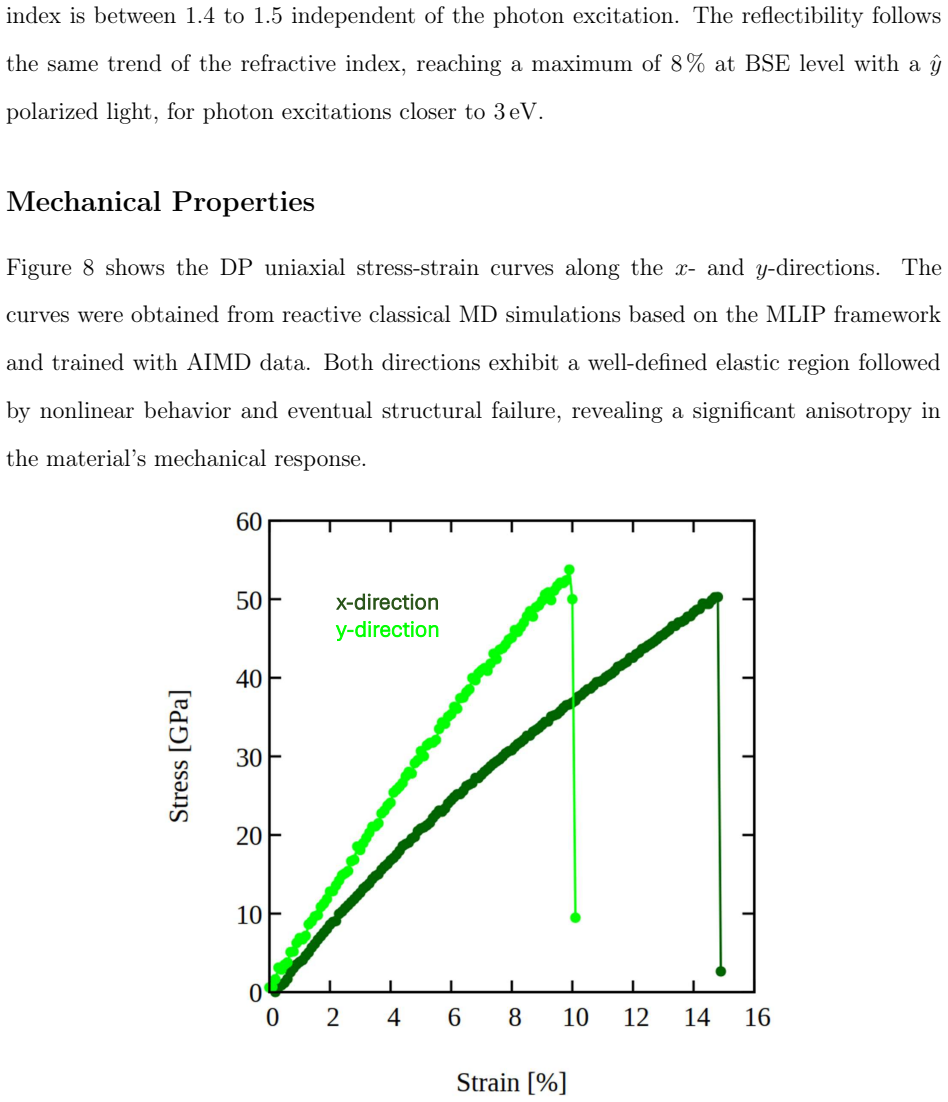
The paper claims that dodecaphenylyne is a thermodynamically and dynamically stable 2D carbon allotrope: formation energy $-7.98$ eV/atom, no imaginary phonon modes, and an intact structure after 5 ps at 1000 K. It is an indirect semiconductor with an HSE06 gap near $1.73$ eV, predicted electron mobility up to $30.6 \times 10^4$ cm$^2$/V$\cdot$s along $x$ and hole mobility $8.4 \times 10^4$ cm$^2$/V$\cdot$s, Young's moduli of 469 GPa along $x$ and 600 GPa along $y$, and strongly anisotropic optical absorption with an exciton binding energy of 779 meV.
Load-bearing premise
The stability argument assumes that the specific hand-built DP geometry is representative of the lowest-energy arrangement, because no global search over carbon networks was performed.
Editorial extensions
If this is right
- DP's indirect gap near 1.73 eV falls in the range often targeted for photovoltaic absorbers, so it could serve as a carbon-only active layer if synthesized.
- The very high predicted electron mobility along x, $30.6 \times 10^4$ cm$^2$/V$\cdot$s, would make DP competitive with or better than several known 2D semiconductors for fast transistors.
- The large exciton binding energy of 779 meV means optical absorption is dominated by strongly bound electron-hole pairs, shifting absorption to lower photon energies.
- The anisotropic Young's moduli and fracture behavior suggest DP would deform and fail differently along its two in-plane axes, useful for direction-engineered mechanical applications.
- Phonon and AIMD results indicate the sheet remains intact at 1000 K, pointing to thermal stability under device operating conditions.
Reading between the lines
- A systematic search over 2D carbon allotropes at the same DFT level would determine whether DP is the ground-state phase or merely a metastable local minimum; the paper itself does not report such a search.
- Varying the length of the acetylenic linkers between biphenylene units could interpolate between DP and graphyne-like networks, and the same DFT/ML workflow could map how gap and mobility shift with spacer length.
- If the reported 779 meV exciton binding energy is correct, photovoltaic efficiency in DP would be limited by strong exciton recombination unless the material is engineered into heterostructures or sensitized; that consequence is not developed in the paper.
- Field-effect transistor measurements on a synthesized sample would test the predicted $30.6 \times 10^4$ cm$^2$/V$\cdot$s electron mobility directly, since deformation-potential estimates carry several approximations.
Editorial analysis
A structured set of objections, weighed in public.
Referee Report
Summary. The manuscript proposes a new 2D carbon allotrope, dodecaphenylyne (DP), and characterizes its structural, thermodynamic, mechanical, electronic, and optical properties using DFT (PBE and HSE06), phonon calculations (DFPT and MTP), AIMD, deformation-potential mobility theory, BSE optical calculations, and MLIP-based classical MD. The authors report a formation energy of -7.98 eV/atom, absence of imaginary phonon modes, stability up to 1000 K, Young's moduli of 469 and 600 GPa, an indirect HSE06 gap of about 1.73 eV, anisotropic carrier mobilities up to 30.6 x 10^4 cm^2/V.s for electrons, and anisotropic optical absorption. The structural, phonon, and electronic characterization is mostly standard and internally consistent, but the carrier mobility numbers are not reproducible from Eq. (2) and Table 1, and the stability claim lacks a reference state and comparison.
Significance. If the properties hold, DP would be a new semiconducting 2D carbon allotrope with strongly anisotropic electronic, mechanical, and optical responses, which is of interest for optoelectronic and photonic applications. The paper's strengths are the explicit structural data provided as a CIF, the use of standard DFT settings, the agreement between DFPT and MTP phonon dispersions, and the HSE06 gap that supports the semiconducting assignment. However, the headline carrier mobility and the thermodynamic stability claim are the central selling points, and both currently rest on insufficiently supported numbers: the mobilities do not follow from the stated formula, and the formation energy is quoted without a reference state or benchmark. The manuscript would be a useful contribution if these load-bearing points are corrected and documented.
major comments (4)
- [Effective Mass and Carrier Mobility (Eq. (2), Table 1)] The four mobility values in Table 1 do not follow from Eq. (2) with the tabulated inputs under any consistent unit convention. For example, converting C2D to J/m^2, m* to kg, and E1 to J gives an x-electron mobility of about 7.9 x 10^8 cm^2/V.s, roughly 2600 times the tabulated 3.06 x 10^5 cm^2/V.s, and the discrepancy is direction-dependent (the y-hole ratio is about 900). The paper does not state which effective mass (m*_i or m_d) enters Eq. (2) or the unit convention for C2D, and no uncertainty is given for E1. The headline comparison of DP mobilities with other 2D materials is therefore not supported by the paper's own data.
- [Structural Properties (formation energy paragraph)] The claim of high thermodynamic stability based on a formation energy of -7.98 eV/atom is not self-contained: no reference state for the formation energy is defined, and no comparison is made with graphene or the biphenylene network at the same computational settings. The statement that the value is 'comparable to many other theoretically predicted and stable 2D carbon allotropes' is not backed by specific numbers. Because the discovery claim rests on stability, the formation energy should be recomputed and reported relative to an explicit reference (e.g., isolated atoms or graphene) and benchmarked against known allotropes under identical conditions.
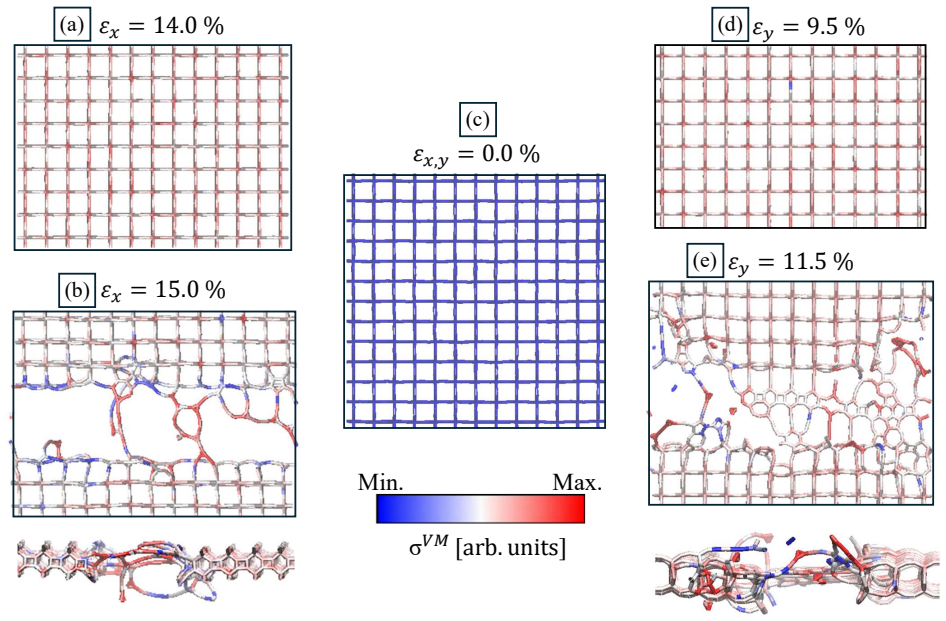
- [Methodology and Mechanical Properties (MLIP)] The mechanical results (Young's moduli, stress-strain curves, fracture) are obtained entirely from the trained MTP, but the manuscript does not validate this potential against direct DFT calculations for the properties it is used to predict. The training data are described as AIMD on relaxed and strained supercells, yet the effective stress-strain behavior up to 15% strain and the fracture mechanisms are inferred from this potential without a quantified DFT-MTP comparison for elastic constants or stress-strain curves. The transferability of the MTP to the fracture regime is an assumption that needs to be supported, for example by DFT calculations at representative strains.
- [Excitonic and Optical Properties (BSE basis)] The BSE calculation uses only the three highest valence bands and the lowest conduction band, which limits the excitonic spectrum to a very small energy window. The text asserts this basis is sufficient for the solar range, but the strong absorption response appears at energies above 3 eV in Fig. 7(a), and the claimed exciton binding energy of 779 meV and the red shift of the absorption edge depend on the completeness of the basis. A convergence test with respect to the number of occupied and unoccupied bands should be reported before drawing conclusions about the magnitude of excitonic effects.
minor comments (5)
- [Abstract and Conclusions] The notation '30.6 x 10^4 cm^2/V.s' is used throughout; for readability, consider writing 3.06 x 10^5 cm^2/V.s or stating that the table unit is 10^4 cm^2/V.s consistently.
- [Effective Mass and Carrier Mobility] Equation (2) defines the mobility, but the symbol e is not identified; please define e as the elementary charge. Also clarify the role of the average effective mass m_d in Table 1, since it is not used in Eq. (2).
- [Excitonic and Optical Properties] The term 'reflectibility' in the text and in Figure 7(c) should be 'reflectivity'.
- [Figure 1 caption] The caption describes panels (a), (b), and (c) in a way that does not match the figure description in the main text; please align the panel labels.
- [Mechanical Properties] The ultimate tensile stress values (51.4 GPa and 52.9 GPa) are quoted without specifying whether these are engineering or true stresses; please clarify.
Circularity Check
No significant circularity: the central structural, electronic, and optical claims are self-contained first-principles outputs; the headline mobility is a deterministic function of fitted inputs (with an internal arithmetic inconsistency), which is a correctness concern rather than a by-construction reduction.
full rationale
The derivation chain for DP is largely self-contained first-principles work. The structure is hand-constructed from biphenylenic and acetylenic motifs (a design choice, not a circular step), and the stability, electronic, and optical claims are direct DFT outputs: formation energy -7.98 eV/atom, no imaginary DFPT phonons, HSE06 gap 1.73 eV, AIMD integrity at 1000 K, and BSE exciton binding energy 779 meV. The machine-learned MTP phonon dispersion is cross-validated internally against DFPT, so the machine-learning agreement is a consistency check rather than a borrowed conclusion. Self-citations (refs 11, 12, 38, 40) support methodology context and literature comparisons but are not load-bearing: they do not supply any of the paper's computed values. Two caveats are flagged and weighed. First, the headline carrier mobility (30.6 x 10^4 cm2/V.s for x-electrons) is not an independent observable: Eq. (2) evaluates a deterministic formula of the fitted effective masses, C2D, and deformation potentials in Table 1, so the superlative claim 'much higher than the observed for other 2D materials' is a restatement of the anomalously small fitted E1 = 0.024 eV; worse, a unit-consistent SI evaluation of Eq. (2) with Table 1 gives about 7.9 x 10^6 cm2/V.s for that entry, roughly 25 times the quoted value, so the abstract number is not reproducible from the paper's own equations and data. That is an internal-consistency/correctness problem, not a circularity, because the fitted parameters were not fit to any mobility data. Second, the MTP is explicitly trained on AIMD data of DP itself, so the MLIP-derived Young's moduli (469.1 and 600.4 GPa) and stress-strain curves are surrogate interpolations of this material's own DFT data rather than independent predictions, although the potential is independently benchmarked against DFPT for phonons. Because the central stability and semiconducting claims rest on first-principles DFT without any fitted parameter renamed as a prediction, the circularity score is low; the two caveats belong to correctness and surrogate-model scope, not to a by-construction reduction.
Assumptions & free parameters
free parameters (4)
- Deformation potential constants E1 =
0.024, -0.118, -0.113, -0.032 eV
- Carrier effective masses m* =
0.857, 0.737, 1.105, 2.94 m0
- In-plane stiffness C2D =
14.62 and 19.90 eV/A2
- Moment tensor potential parameters =
not provided
assumptions (6)
- domain assumption DFT-PBE and HSE06 exchange-correlation functionals accurately describe DP energetics, phonons, and band structure.
- domain assumption Deformation potential (Bardeen-Shockley) theory describes electron and hole transport in DP.
- ad hoc to paper A 5 ps AIMD run at 1000 K is sufficient to demonstrate thermal stability.
- ad hoc to paper The hand-built DP geometry is the relevant ground state; no lower-energy carbon phase exists.
- ad hoc to paper The trained MTP is transferable to strain and fracture regimes.
- domain assumption BSE with three valence bands, one conduction band, and 2D Coulomb truncation captures the relevant optical response.
invented entities (1)
-
Dodecaphenylyne (DP) monolayer
independent evidence
Cite this review
Pith. "Pith review of First-Principles and Machine Learning Investigation of the Structural and Optoelectronic Properties of Dodecaphenylyne: A Novel Carbon Allotrope." pith.science (2026). https://pith.science/paper/46PYPTIH
@misc{pith2026250602218,
  author       = {Pith},
  title        = {Pith review of: First-Principles and Machine Learning Investigation of the Structural and Optoelectronic Properties of Dodecaphenylyne: A Novel Carbon Allotrope},
  year         = {2026},
  howpublished = {\url{https://pith.science/paper/46PYPTIH}},
  note         = {Machine review of arXiv:2506.02218}
}
abstract
We report the computational discovery and characterization of Dodecaphenylyne (DP), a novel carbon allotrope with a distinctive geometric arrangement. DP structural, thermodynamic, mechanical, electronic, and optical properties were evaluated using density functional theory and a machine learning interatomic potential trained explicitly for this material. The formation energy of -7.98 eV/atom indicates high thermodynamic stability, further supported by the absence of imaginary phonon modes and the preservation of structural integrity up to 1000 K in ab initio molecular dynamics simulations. Mechanical analysis reveals high in-plane stiffness with directional dependence: Young's modulus values of 469.09 GPa and 600.41 GPa along the x and y directions, respectively. Electronic band structure and projected density of states analyses confirm the DP semiconducting character. Calculations of carrier mobility using the deformation potential theory reveal pronounced anisotropy, with maximum values reaching up to $30.6 \times 10^4$ cm$^2$/V$\cdot$s (electrons, e) and $8.4 \times 10^4$ cm$^2$/V$\cdot$s (holes, h), much higher than the observed for other 2D materials. DP also exhibits anisotropic optical absorption in the visible and ultraviolet spectrum, highlighting its potential for optoelectronic applications.
Figures


Figures from the paper (6 more)


Reference graph
Works this paper leans on
-
[1]
Novoselov, K. S.; Geim, A. K.; Morozov, S. V.; Jiang, D.-e.; Zhang, Y.; Dubonos, S. V.; Grigorieva, I. V.; Firsov, A. A. Electric field effect in atomically thin carbon films. science 2004, 306, 666--669
work page 2004
-
[2]
Geim, A. K.; Novoselov, K. S. The rise of graphene. Nature materials 2007, 6, 183--191
work page 2007
-
[3]
Castro Neto, A. H.; Guinea, F.; Peres, N. M.; Novoselov, K. S.; Geim, A. K. The electronic properties of graphene. Reviews of modern physics 2009, 81, 109--162
work page 2009
-
[4]
Schwierz, F. Graphene transistors. Nature nanotechnology 2010, 5, 487--496
work page 2010
-
[5]
Enyashin, A. N.; Ivanovskii, A. L. Graphene allotropes. physica status solidi (b) 2011, 248, 1879--1883
work page 2011
-
[6]
Hirsch, A. The era of carbon allotropes. Nature materials 2010, 9, 868--871
work page 2010
-
[7]
Desyatkin, V. G.; Martin, W. B.; Aliev, A. E.; Chapman, N. E.; Fonseca, A. F.; Galv \ a o, D. S.; Miller, E. R.; Stone, K. H.; Wang, Z.; Zakhidov, D. et al. Scalable synthesis and characterization of multilayer -graphyne, new carbon crystals with a small direct band gap. Journal of the American Chemical Society 2022, 144, 17999--18008
work page 2022
-
[8]
Aliev, A. E.; Guo, Y.; Fonseca, A. F.; Razal, J. M.; Wang, Z.; Galv \ a o, D. S.; Bolding, C. M.; Chapman-Wilson, N. E.; Desyatkin, V. G.; Leisen, J. E. et al. A planar-sheet nongraphitic zero-bandgap sp2 carbon phase made by the low-temperature reaction of -graphyne. Proceedings of the National Academy of Sciences 2025, 122, e2413194122
work page 2025
Show all 52 references
-
[9]
Graphdiyne: synthesis, properties, and applications
Gao, X.; Liu, H.; Wang, D.; Zhang, J. Graphdiyne: synthesis, properties, and applications. Chemical Society Reviews 2019, 48, 908--936
2019
-
[10]
Wang, Z.; Zhou, X.-F.; Zhang, X.; Zhu, Q.; Dong, H.; Zhao, M.; Oganov, A. R. Phagraphene: a low-energy graphene allotrope composed of 5--6--7 carbon rings with distorted dirac cones. Nano letters 2015, 15, 6182--6186
2015
-
[11]
A.; Abreu, A
Lima, K. A.; Abreu, A. V.; Silva, A. M.; Ribeiro, L. A. First-principles and machine learning insights into the design of DOTT-carbon and its lithium-ion storage capacity. Journal of Materials Chemistry A 2025,
2025
-
[12]
A.; de Mendonça, F
Lima, K.; da Silva , D.; Nze, G. A.; de Mendonça, F. L.; Pereira, M.; Ribeiro, L. Structural, electronic, and Li-ion adsorption properties of PolyPyGY explored by first-principles and machine learning simulations: A new multi-ringed 2D carbon allotrope. Journal of Energy Stora...
2025
-
[13]
M.; Lin, S.; Chen, Z.; Choi, W.; Kim, Y.-M.; Yun, E.; Baek, E
Liu, X.; Cho, S. M.; Lin, S.; Chen, Z.; Choi, W.; Kim, Y.-M.; Yun, E.; Baek, E. H.; Ryu, D. H.; Lee, H. Constructing two-dimensional holey graphyne with unusual annulative -extension. Matter 2022, 5, 2306--2318
2022
-
[14]
P.; da Cunha, W
J \'u nior, M. P.; da Cunha, W. F.; Giozza, W. F.; de Sousa Junior, R. T.; Junior, L. R. Irida-graphene: A new 2d carbon allotrope. FlatChem 2023, 37, 100469
2023
-
[15]
W.; Krej c \' , O.; Dimosthenous, S.; Kachel, S
Fan, Q.; Yan, L.; Tripp, M. W.; Krej c \' , O.; Dimosthenous, S.; Kachel, S. R.; Chen, M.; Foster, A. S.; Koert, U.; Liljeroth, P. et al. Biphenylene network: A nonbenzenoid carbon allotrope. Science 2021, 372, 852--856
2021
-
[16]
Ab initio molecular dynamics for liquid metals
Kresse, G.; Hafner, J. Ab initio molecular dynamics for liquid metals. Physical review B 1993, 47, 558
1993
-
[17]
Efficiency of ab-initio total energy calculations for metals and semiconductors using a plane-wave basis set
Kresse, G.; Furthm \"u ller, J. Efficiency of ab-initio total energy calculations for metals and semiconductors using a plane-wave basis set. Computational materials science 1996, 6, 15--50
1996
-
[18]
P.; Burke, K.; Ernzerhof, M
Perdew, J. P.; Burke, K.; Ernzerhof, M. Generalized gradient approximation made simple. Physical review letters 1996, 77, 3865
1996
-
[19]
E.; Ernzerhof, M
Heyd, J.; Scuseria, G. E.; Ernzerhof, M. Hybrid functionals based on a screened Coulomb potential. The Journal of chemical physics 2003, 118, 8207--8215
2003
-
[20]
Phonons and related crystal properties from density-functional perturbation theory
Baroni, S.; De Gironcoli, S.; Dal Corso, A.; Giannozzi, P. Phonons and related crystal properties from density-functional perturbation theory. Reviews of modern Physics 2001, 73, 515
2001
-
[21]
First principles phonon calculations in materials science
Togo, A.; Tanaka, I. First principles phonon calculations in materials science. Scripta Materialia 2015, 108, 1--5
2015
-
[22]
A unified formulation of the constant temperature molecular dynamics methods
Nos \'e , S. A unified formulation of the constant temperature molecular dynamics methods. The Journal of chemical physics 1984, 81, 511--519
1984
-
[23]
A.; Yates, J
Mostofi, A. A.; Yates, J. R.; Lee, Y.-S.; Souza, I.; Vanderbilt, D.; Marzari, N. wannier90: A tool for obtaining maximally-localised Wannier functions. Comp. Phys. Commun. 2008, 178, 685 -- 699
2008
-
[24]
E.; Bethe, H
Salpeter, E. E.; Bethe, H. A. A Relativistic Equation for Bound-State Problems. Phys. Rev. 1951, 84, 1232--1242
1951
-
[25]
A.; Varsano, D.; Marini, A.; Gross, E
Rozzi, C. A.; Varsano, D.; Marini, A.; Gross, E. K. U.; Rubio, A. Exact Coulomb cutoff technique for supercell calculations. Physical Review B 2006, 73
2006
-
[26]
C.; Silveira, J
Dias, A. C.; Silveira, J. F.; Qu, F. WanTiBEXOS: A Wannier based Tight Binding code for electronic band structure, excitonic and optoelectronic properties of solids. Computer Physics Communications 2023, 285, 108636
2023
-
[27]
Fast parallel algorithms for short-range molecular dynamics
Plimpton, S. Fast parallel algorithms for short-range molecular dynamics. Journal of computational physics 1995, 117, 1--19
1995
-
[28]
V.; Podryabinkin, E
Shapeev, A. V.; Podryabinkin, E. V.; Gubaev, K.; Tasn \'a di, F.; Abrikosov, I. A. Elinvar effect in -Ti simulated by on-the-fly trained moment tensor potential. New Journal of Physics 2020, 22, 113005
2020
-
[29]
S.; Gubaev, K.; Podryabinkin, E
Novikov, I. S.; Gubaev, K.; Podryabinkin, E. V.; Shapeev, A. V. The MLIP package: moment tensor potentials with MPI and active learning. Machine Learning: Science and Technology 2020, 2, 025002
2020
-
[30]
V.; Shapeev, A
Podryabinkin, E. V.; Shapeev, A. V. Active learning of linearly parametrized interatomic potentials. Computational Materials Science 2017, 140, 171--180
2017
-
[31]
Machine Learning in Modeling and Simulation: Methods and Applications; Springer, 2023; pp 427--451
Mortazavi, B. Machine Learning in Modeling and Simulation: Methods and Applications; Springer, 2023; pp 427--451
2023
-
[32]
Mortazavi, B.; Zhuang, X.; Rabczuk, T.; Shapeev, A. V. Atomistic modeling of the mechanical properties: the rise of machine learning interatomic potentials. Materials Horizons 2023, 10, 1956--1968
2023
-
[33]
Exploring the structural stability, thermal and mechanical properties of nanoporous carbon nitride nanosheets using a transferrable machine learning interatomic potential
Mortazavi, B.; Rabczuk, T.; Zhuang, X. Exploring the structural stability, thermal and mechanical properties of nanoporous carbon nitride nanosheets using a transferrable machine learning interatomic potential. Machine Learning for Computational Science and Engineering 2025, 1, 5
2025
-
[34]
V.; Novikov, I
Mortazavi, B.; Podryabinkin, E. V.; Novikov, I. S.; Roche, S.; Rabczuk, T.; Zhuang, X.; Shapeev, A. V. Efficient machine-learning based interatomic potentialsfor exploring thermal conductivity in two-dimensional materials. Journal of Physics: Materials 2020, 3, 02LT02
2020
-
[35]
Electronic, thermal and mechanical properties of carbon and boron nitride holey graphyne monolayers
Mortazavi, B. Electronic, thermal and mechanical properties of carbon and boron nitride holey graphyne monolayers. Materials 2023, 16, 6642
2023
-
[36]
Goldene: An Anisotropic Metallic Monolayer with Remarkable Stability and Rigidity and Low Lattice Thermal Conductivity
Mortazavi, B. Goldene: An Anisotropic Metallic Monolayer with Remarkable Stability and Rigidity and Low Lattice Thermal Conductivity. Materials 2024, 17, 2653
2024
-
[37]
Mortazavi, B.; Shapeev, A. V. Anisotropic mechanical response, high negative thermal expansion, and outstanding dynamical stability of biphenylene monolayer revealed by machine-learning interatomic potentials. FlatChem 2022, 32, 100347
2022
-
[38]
A.; Alves, R
Lima, K. A.; Alves, R. A.; da Silva, D. A.; Mendon c a, F. L.; Pereira, M. L.; Ribeiro, L. A. TH-graphyne: a new porous bidimensional carbon allotrope. Physical Chemistry Chemical Physics 2024,
2024
-
[39]
Competition for graphene: graphynes with direction-dependent dirac cones
Malko, D.; Neiss, C.; Vines, F.; G \"o rling, A. Competition for graphene: graphynes with direction-dependent dirac cones. Physical review letters 2012, 108, 086804
2012
-
[40]
D.; Piotrowski, M
Cavalheiro Dias, A.; Almeida Cornelio, C. D.; Piotrowski, M. J.; Ribeiro Junior, L. A.; de Oliveira Bastos, C. M.; Caldeira Rego, C. R.; Guedes-Sobrinho, D. Can 2D Carbon Allotropes Be Used as Photovoltaic Absorbers in Solar Harvesting Devices? ACS Applied Energy Materials 202...
2024
-
[41]
M.; Bj \"o rk, J
Niu, K.; Fan, Q.; Chi, L.; Rosen, J.; Gottfried, J. M.; Bj \"o rk, J. Unveiling the formation mechanism of the biphenylene network. Nanoscale Horizons 2023, 8, 368--376
2023
-
[42]
Enhanced carrier mobility in anisotropic two-dimensional tetrahex-carbon through strain engineering
Peng, X.; Wei, Q.; Yang, G. Enhanced carrier mobility in anisotropic two-dimensional tetrahex-carbon through strain engineering. Carbon 2020, 165, 37--44
2020
-
[43]
Two-dimensional carbon allotrope with remarkable electron mobility and tunable band gap under uniaxial strain engineering
Liu, H.; Yang, Y.; Xing, M.; Fan, Q. Two-dimensional carbon allotrope with remarkable electron mobility and tunable band gap under uniaxial strain engineering. Results in Physics 2024, 58, 107435
2024
-
[44]
High-mobility transport anisotropy and linear dichroism in few-layer black phosphorus
Qiao, J.; Kong, X.; Hu, Z.-X.; Yang, F.; Ji, W. High-mobility transport anisotropy and linear dichroism in few-layer black phosphorus. Nature communications 2014, 5, 4475
2014
-
[45]
Single-layer MoS2 transistors
Radisavljevic, B.; Radenovic, A.; Brivio, J.; Giacometti, V.; Kis, A. Single-layer MoS2 transistors. Nature nanotechnology 2011, 6, 147--150
2011
-
[46]
C.; Bragan c a, H.; de Mendon c a, J
Dias, A. C.; Bragan c a, H.; de Mendon c a, J. P. A.; Da Silva, J. L. F. Excitonic Effects on Two-Dimensional Transition-Metal Dichalcogenide Monolayers: Impact on Solar Cell Efficiency. ACS Applied Energy Materials 2021, 4, 3265–3278
2021
-
[47]
A.; Dias, A
Moujaes, E. A.; Dias, A. C. On the excitonic effects of the 1T and 1OT phases of PdS2, PdSe2, and PdSSe monolayers. Journal of Physics and Chemistry of Solids 2023, 182, 111573
2023
-
[48]
R.; Besse, R.; Piotrowski, M
Guassi, M. R.; Besse, R.; Piotrowski, M. J.; C. R\^ego, C. R.; Guedes-Sobrinho, D.; da Rosa, A. L.; Cavalheiro Dias, A. Unveiling excitons in two-dimensional -pnictogens. Scientific Reports 2024, 14
2024
-
[49]
D.; Pereira Júnior, M
Aparicio-Huacarpuma, B. D.; Pereira Júnior, M. L.; Piotrowski, M. J.; Rêgo, C. R. C.; Guedes-Sobrinho, D.; Ribeiro , Jr., L. A.; Cavalheiro Dias, A. Enhanced solar harvesting efficiency in nanostructured MXene monolayers based on Scandium and Yttrium. Nanoscale 2025, --
2025
-
[50]
Scarpa, F.; Adhikari, S.; Phani, A. S. Effective elastic mechanical properties of single layer graphene sheets. Nanotechnology 2009, 20, 065709
2009
-
[51]
Estimation of Young’s modulus of graphene by Raman spectroscopy
Lee, J.-U.; Yoon, D.; Cheong, H. Estimation of Young’s modulus of graphene by Raman spectroscopy. Nano letters 2012, 12, 4444--4448
2012
-
[52]
!1A Qa
Felix, L. C.; Tromer, R. M.; Autreto, P. A.; Ribeiro Junior, L. A.; Galvao, D. S. On the mechanical properties and thermal stability of a recently synthesized monolayer amorphous carbon. The Journal of Physical Chemistry C 2020, 124, 14855--14860 mcitethebibliography main_acd....
2020
Reviewed August 7, 2026 · model on record in the stance chip above.
Discussion (0). Sign in to comment.