REVIEW 4 major objections 6 minor 63 references
Stability of a cluster-disrupted mean-motion resonance (chain) in HR 8799 and PDS 70
T0 review · 4 major / 6 minor · reviewed 2026-08-07 · deepseek-v4-flash
Pith's one-line read This paper argues that HR 8799 must have been born in an 8:4:2:1 mean-motion resonance chain and kept it: all 50 randomized non-resonant copies dissolve in about 0.3 Myr, far less than the system's 20-50 Myr age.
desk verdict The paired-cluster experiment is clean and the qualitative result is plausible, but the exponential survival fit is contradicted by the authors' own survivors, so the 'negligible probability' claim does not hold. read the letter →
The pith
A machine-rendered reading of the paper's core claim, the machinery that carries it, and where it could break.
The reading
What carries the argument
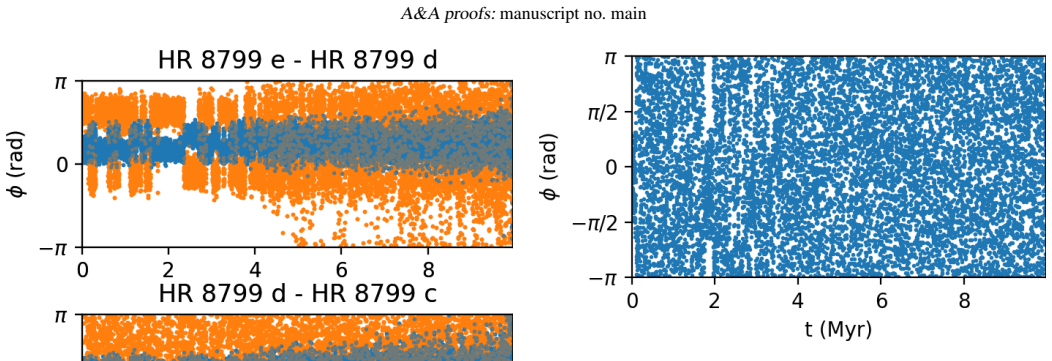
The argument is carried by the mean-motion resonance chain and its diagnostic angle. For HR 8799, the chain is present when the four-body resonance angle $\varphi_{4\mathrm{BR}} = \lambda_e - 2\lambda_d - \lambda_c + 2\lambda_b$ librates, and similarly the 2-body angles librate for PDS 70. The authors generate resonant initial conditions by convergent migration, then make non-resonant copies by randomizing each planet's mean anomaly. Simulations are run both in isolation and inside a simulated birth cluster; the cluster is evolved once with the Lonely Planets two-stage method, and the recorded stellar encounter history is replayed identically onto every planetary system. Because the only difference between the ensembles is the resonance state, the comparison isolates the protective effect of the chain; survival is then fit to an exponential decay to extrapolate expected survival fractions at the systems' present ages.
What would settle it
Re-integrate the 50 non-resonant HR 8799 initial conditions with a higher-order symplectic integrator and a smaller time step (for instance, an 8th-order scheme with step 0.005) and check that the planar isolated runs stay planar. If a substantial fraction survive past 1 Myr or reach the 10 Myr cutoff, then the 0.3 Myr dissolution times—and with them the conclusion that HR 8799 must be resonant—would rest on numerical error rather than dynamics.
Extended reading notes
Core claim
The paper's central claim is that HR 8799 could only have survived to its present age if its four planets are in an 8:4:2:1 mean-motion resonance chain, and that this chain was present at birth and preserved through stellar flybys. The evidence is a control-group comparison: resonant initial conditions, built by convergent migration and verified by librating resonance angles, remain stable for 10 Myr in isolation and in 41 of 50 cluster-perturbed runs; 50 non-resonant copies with the same orbits but randomized mean anomalies all dissolve, with median lifetimes of 0.303±0.042 Myr isolated and 0.300±0.043 Myr perturbed. Modeling dissolution as an exponential decay yields 5-σ confidence intervals for the expected survival fraction at 20-50 Myr that top out near $10^{-6}$ to $10^{-15}$ for the non-resonant configurations, which the authors call a negligible probability. PDS 70's non-resonant copies dissolve in about 1.2 Myr while the resonant copy survives 10 Myr, but the error bars overlap, so the authors conclude only that PDS 70 was probably born in resonance.
Load-bearing premise
The load-bearing premise is that the non-resonant control runs are physically faithful; the authors themselves report spurious out-of-plane inclination growth in the isolated planar runs (Figure D.1c), which they attribute to chaotic growth of numerical errors, and if that error also shortens the non-resonant dissolution times the central conclusion is weakened.
Editorial extensions
If this is right
- HR 8799's formation must have proceeded via convergent migration that built the 8:4:2:1 chain outside-in, with no later event strong enough to break it.
- Wide-orbit multi-planet systems at ages of tens of Myr should be strongly biased toward resonant architectures; any survey finding a non-resonant analogue should re-examine either its ages or its orbits.
- Typical star-cluster encounters do not destroy resonance chains: 41 of 50 perturbed resonant HR 8799 copies survive 10 Myr, so chains can survive the birth environment.
- A broken resonance chain can be temporarily stabilized by external perturbations: non-resonant HR 8799 systems survive about 173% longer when perturbed by cluster stars than in isolation.
- Packing stability criteria (Gladman, Chambers, Smith-Lissauer) should be extended to include the resonance state, since resonant and non-resonant systems with identical masses and spacings have vastly different lifetimes.
Reading between the lines
- A testable population-level prediction follows: future direct-imaging surveys of old, wide-orbit multi-planet systems should find an overabundance of near-2:1 period ratios, because non-resonant systems would have dissolved long before being observed.
- The numerical-error caveat suggests the non-resonant dissolution times may be lower bounds; if better-controlled integrations lengthen them, the 'must be resonant' conclusion would weaken, making the control group's numerical quality the decisive question.
- The 173% stabilization of broken chains might reflect encounters pushing the planets into wider, metastable orbits; mapping which encounter parameters trigger this effect could turn the statistical trend into a predictive model for which packed systems survive in clusters.
- For PDS 70, the overlapping confidence intervals mean the resonance question remains open; high-precision astrometry over the next decade that measures libration of the two planets' 2:1 angle could settle it directly.
Editorial analysis
A structured set of objections, weighed in public.
Referee Report
Summary. The paper uses N-body simulations within the Lonely Planets/AMUSE framework to compare the stability of resonant and non-resonant initial conditions for the HR 8799 and PDS 70 planetary systems, both in isolation and while perturbed by a model star cluster. The resonant HR 8799 and PDS 70 systems remain stable over the 10 Myr simulation window, while most non-resonant copies dissolve on sub-Myr timescales. On the basis of an exponential fit to dissolution times and an extrapolation to the systems' ages, the paper concludes in Section 5 that HR 8799 'must have a mean-motion resonance chain' and that a non-resonant HR 8799 had negligible probability of surviving to 20-50 Myr, with a weaker 'probably' claim for PDS 70.
Significance. If the central claim could be established, it would be an important constraint on the formation and survival of HR 8799, indicating that the apparent 8:4:2:1 chain is not merely a possible interpretation of the current orbits but a necessary condition for the system's existence. The simulation design has real strengths: assigning identical cluster interaction histories to resonant and non-resonant copies enables a clean paired comparison, and the release of data, initial conditions, and scripts on Zenodo is exemplary for reproducibility. The observation that some broken MMR chains survive longer under stellar flybys (Appendix C) is also novel and interesting. However, the quantitative 'negligible probability' claim rests on a statistical model that is contradicted by the paper's own data, and the admitted numerical error in the isolated non-resonant HR 8799 runs affects the control group that underpins the main conclusion.
major comments (4)
- [Section 4, Table 1] The exponential model is internally contradicted by the calibration data. For the perturbed non-resonant HR 8799 sample, lambda = 2.31 +/- 0.33 Myr^-1 implies a per-system probability of surviving to the 10 Myr cutoff of e^-23.1 ~ 1e-10, yet Section 3.2.1 reports 2 of 50 systems surviving to that cutoff; the probability of two or more survivors under the fitted model is of order 1e-18. Likewise, in the isolated sample one system dissolves at 9.97 Myr, whereas the expected maximum of 50 draws from Exp(lambda = 2.29) is approximately 1.7 Myr. The model is therefore rejected by the very data used to calibrate it, and the 5-sigma upper bounds of 1.3e-6 at 20 Myr and 2.1e-15 at 50 Myr in Table 1 are not supported. A nonparametric one-sided 95% upper bound from 2/50 survivors at 10 Myr is about 0.12, orders of magnitude larger. Please replace the exponential extrapolation with a survival model that fits the observed tail (e.g., a censored likelihood, a mixture model, or a Kaplan-Meier estimate) and re-evaluate the 'negligible' wording accordingly.
- [Section 4, Eqs. (3)-(7)] The estimator in Eq. (3) uses only the dissolved systems and does not include the likelihood contribution of systems that survive to the cutoff Tc; Eq. (6) corrects for truncation of the observed dissolution times but not for right-censoring of the survivors. For Type-I censored exponential data the MLE is lambda = d / (sum t_i + (n-d) Tc), which for the perturbed HR 8799 sample (d = 48, sum t_i ~ 20.8 Myr, Tc = 10 Myr, n = 50) gives lambda ~ 1.18 Myr^-1 instead of the reported 2.31 Myr^-1. Ignoring censoring inflates lambda and deflates the survival fractions in Table 1. Please use a censored-data estimator and discuss the sensitivity of the conclusions to the exponential assumption.
- [Appendix D.1, Figure D.1c] The caption states that isolated planar non-resonant HR 8799 systems develop out-of-plane motion 'as a result of chaotic growth of numerical errors.' This is an explicit admission that the control-group integrations are not numerically converged. If integration error also spuriously excites eccentricities or semi-major axes, the reported dissolution times for the isolated non-resonant systems could be artificially short, biasing the comparison in favor of the resonant systems. Please add convergence tests (e.g., varying the Symple timestep parameter, or re-integrating a subset with a different symplectic or higher-order method) and show that the dissolution-time distribution is unchanged. An acknowledgement that the error exists is not sufficient to establish that it does not affect the main result.
- [Section 5 and Section 2.1] The conclusion that HR 8799 'must have a mean-motion resonance chain' is broader than what the simulations test. The non-resonant initial conditions are generated by randomizing the mean anomalies of the resonant chain while keeping the same semi-major axes and eccentricities (Table A.1). Because Section 1 notes that the orbital parameters are poorly constrained, other non-resonant architectures consistent with the observations could in principle be stable and are not explored. The simulations support a conditional statement, namely that the specific non-resonant configurations derived from the resonant chain are highly unstable, but not a universal 'must.' Please reformulate the conclusion to make the dependence on the assumed architecture explicit and, if feasible, sample a wider region of the observationally allowed parameter space.
minor comments (6)
- [Abstract and Section 5] The abstract's 'almost possible' should be 'almost certainly possible' to match the conclusions bullet, and the quoted dissolution times of 0.303 +/- 0.042 Myr and 1.26 +/- 0.25 Myr should be labeled as median lifetimes from the exponential fit rather than mean dissolution times.
- [Section 4, Eq. (7)] The notation sigma_l/u = |lambda - Delta lambda_l/u| is not fully defined; please specify how Delta lambda_l/u is computed from the chi-squared bounds.
- [Section 5 vs Section 4] The statement that PDS 70 was 'probably' born in MMR is inconsistent with Section 4's conclusion that the three confidence intervals in Table 1 are statistically indistinguishable and that 'we cannot with confidence claim anything' about the presence of MMR; please align the wording.
- [Figure 3 caption] The caption's 'All sets of systems display distinct behaviour' is later qualified by the statement that the isolated and perturbed resonant curves do not have a statistically significant difference; please harmonize the caption with the quantitative result.
- [Section 2.3] The sentence 'if the runs is a perturbed run' contains a subject-verb agreement error; 'runs' should be 'run.'
- [Appendix B] The notation 'j - o_i : j MMR' is introduced without defining j and o_i; please define the resonance order and the period ratio before Eq. (B.1).
Circularity Check
No significant circularity: the resonance-required conclusion derives from self-contained N-body integrations checked against external stability criteria; the exponential extrapolation behind the 'negligible' survival probability is a model-selection risk, not an input-output equivalence.
full rationale
The central claim (Section 5: 'The planetary system HR 8799 must have a mean-motion resonance chain for the system to have survived in its current state to its present age of 20 Myr to 50 Myr') is an empirical inference from N-body outputs, not a tautology. Resonant initial conditions are formed by convergent migration into a resonance chain verified by independent resonance angles (Appendix B, Eqs. B.1-B.5), and non-resonant controls are generated by randomising mean anomalies (Appendix A); survival fractions in Figures 3 and 6 are simulation products, and the non-resonant instability is corroborated by external, non-author criteria (Gladman 1993; Chambers et al. 1996; Smith & Lissauer 2009). Self-citations (Huang & Ormel 2021 for resonance-angle definitions; Portegies Zwart and co-workers for AMUSE, Ph4, SeBa, Lonely Planets) are methodological and non-load-bearing; no author-invented uniqueness theorem is invoked, and the exponential decay model of Section 4 is an explicitly stated ansatz, not a result smuggled in by citation. The claim is therefore not equivalent to its inputs. The fragile quantitative link is correctness-related, not circular: Table 1's 'negligible' fractions are extrapolations f_s(T0)=e^{-λT0} of that exponential ansatz, yet Section 3.2.1 reports that two of 50 perturbed non-resonant HR 8799 systems survive to the 10 Myr cutoff, which f_s(10 Myr)=e^{-23.1} under λ=2.31 makes effectively impossible, so the exponential model is strained by the calibration data; separately, the Figure D.1c caption flags 'chaotic growth of numerical errors' producing out-of-plane inclination in planar isolated runs, a possible bias on the non-resonant dissolution times that feed the fit. Those are model-selection and numerical-integrity risks affecting the strength of the conclusion, not reductions of the conclusion to its own inputs.
Assumptions & free parameters
free parameters (4)
- Neighbor count k =
6
- Cluster Plummer radius =
0.7 pc
- Symple timestep parameter =
0.01
- Resonant IC migration parameters =
not reported in paper
assumptions (5)
- standard math Newtonian point-mass gravity and symplectic integration in Symple and Ph4 provide a faithful model of the dynamics.
- domain assumption The Solar birth cluster analog (Plummer sphere with 0.7 pc radius, 5000 stars, Kroupa IMF) represents the birth environment of HR 8799 and PDS 70.
- domain assumption Randomizing the mean anomalies of the resonant initial conditions yields representative non-resonant configurations consistent with observed orbital elements.
- domain assumption The planetary systems do not back-react on the cluster, so the interaction history can be recorded once and replayed.
- domain assumption The host star masses are set exactly to the HR 8799 and PDS 70 masses before the cluster simulation, which only negligibly affects the cluster initial mass function.
Cite this review
Pith. "Pith review of Stability of a cluster-disrupted mean-motion resonance (chain) in HR 8799 and PDS 70." pith.science (2026). https://pith.science/paper/BDTRBBM7
@misc{pith2026250602253,
  author       = {Pith},
  title        = {Pith review of: Stability of a cluster-disrupted mean-motion resonance (chain) in HR 8799 and PDS 70},
  year         = {2026},
  howpublished = {\url{https://pith.science/paper/BDTRBBM7}},
  note         = {Machine review of arXiv:2506.02253}
}
abstract
HR~8799 is a planetary system with four planets potentially in a mean-motion resonance chain. It is unclear from the observations if they are in mean-motion resonance. Similarly, PDS~70 has two observed planets also potentially in mean-motion resonance. We simulate HR~8799 and PDS~70 under external perturbations to study their responds if in resonance or mean-motion resonance. We integrate the equations of motion for HR~8799 and PDS~70 starting with either in resonance or in mean-motion resonance and study their in isolation and in a star cluster. In the star cluster, we take the effects of passing stars into account. The dynamics of the star cluster is resolved using the Lonely Planets module in AMUSE. HR~8799 and PDS~70 in mean-motion resonance are stable, whereas in non-resonance they dissolve in $0.303\pm0.042$Myr and $1.26\pm0.25$Myr, respectively. In a cluster, the non-resonant HR~8799 is slightly more stable than in isolation, but still dissolves in $0.300\pm0.043$Myr, whereas the resonant planetary system remains stable for at least $0.71$Myr. In contrast, a non-resonant PDS~70 system is approximately equally stable in a cluster compared to isolation, and dissolves in $1.03\pm0.20$Myr, whereas the resonant PDS~70 system remains stable for at least $0.83$Myr. Considering the more stable solutions of mean-motion resonance for HR~8799, we argue that the planetary system was born in mean-motion resonance and that the mean-motion resonance was preserved. If HR~8799 was not born in resonance, the probability that it survived until the present day is negligible. Similarly, we argue that PDS~70 was probably born in mean-motion resonance and that its state was preserved. We also find that it is almost possible for planetary systems with a broken mean-motion resonance chain to survive longer in a perturbing cluster environment compared to isolation.
Figures


Figures from the paper (6 more)


Reference graph
Works this paper leans on
-
[1]
, " * write output.state after.block = add.period write newline
ENTRY address archiveprefix author booktitle chapter edition editor howpublished institution eprint journal key month note number organization pages publisher school series title type volume year label extra.label sort.label short.list INTEGERS output.state before.all mid.sentence after.sentence after.block FUNCTION init.state.consts #0 'before.all := #1 ...
-
[2]
write newline
" write newline "" before.all 'output.state := FUNCTION n.dashify 't := "" t empty not t #1 #1 substring "-" = t #1 #2 substring "--" = not "--" * t #2 global.max substring 't := t #1 #1 substring "-" = "-" * t #2 global.max substring 't := while if t #1 #1 substring * t #2 global.max substring 't := if while FUNCTION word.in bbl.in " " * FUNCTION format....
-
[3]
2015, The Astrophysical Journal Supplement Series, 216, 29
Bovy, J. 2015, The Astrophysical Journal Supplement Series, 216, 29
2015
-
[4]
Burgasser, A. J. & Mamajek, E. E. 2017, The Astrophysical Journal, 845, 110
2017
-
[5]
Cai, M. X., Kouwenhoven, M. B. N., Portegies Zwart, S. F., & Spurzem, R. 2017, Monthly Notices of the Royal Astronomical Society, 470, 4337
work page 2017
-
[6]
Chambers, J. E., Wetherill, G. W., & Boss, A. P. 1996, ICARUS, 119, 261
work page 1996
-
[7]
Charalambous, C., Cuello, N., & Petrovich, C. 2025
work page 2025
-
[8]
Clement, M. S., Kaib, N. A., Raymond, S. N., Chambers, J. E., & Walsh, K. J. 2019, Icarus, 321, 778
work page 2019
Show all 63 references
-
[9]
2013, Python and HDF5 (O'Reilly)
Collette, A. 2013, Python and HDF5 (O'Reilly)
2013
-
[10]
& Hodges, J
Fix, E. & Hodges, J. 1951
1951
-
[11]
M., et al
Gillon, M., Jehin, E., Lederer, S. M., et al. 2016, Nature 2016 533:7602, 533, 221
2016
-
[12]
H., Demory, B
Gillon, M., Triaud, A. H., Demory, B. O., et al. 2017, Nature 2017 542:7642, 542, 456
2017
-
[13]
1993, Icarus, 106, 247
Gladman, B. 1993, Icarus, 106, 247
1993
-
[14]
Gontcharov , G. A. 2006, Astronomy Letters, 32, 759
2006
-
[15]
& Migaszewski , C
Go \'z dziewski , K. & Migaszewski , C. 2020, , 902, L40
2020
-
[16]
C., Lega , E., & Morbidelli , A
Griveaud , P., Crida , A., Petit , A. C., Lega , E., & Morbidelli , A. 2024, , 688, A202
2024
-
[17]
Y., Bohn, A
Haffert, S. Y., Bohn, A. J., de Boer, J., et al. 2019, Nature Astronomy, 3, 749
2019
-
[18]
R., Millman, K
Harris, C. R., Millman, K. J., van der Walt, S. J., et al. 2020, Nature, 585, 357
2020
-
[19]
& Ormel, C
Huang, S. & Ormel, C. W. 2021, Monthly Notices of the Royal Astronomical Society, 511, 3814
2021
-
[20]
& Ormel , C
Huang , S. & Ormel , C. W. 2022, , 511, 3814
2022
-
[21]
Hunter, J. D. 2007, Computing in Science & Engineering, 9, 90
2007
-
[22]
& Bahcall, J
Hut, P. & Bahcall, J. N. 1983, The Astrophysical Journal, 268, 319
1983
-
[23]
E., Isella , A., et al
Izidoro , A., Schlichting , H. E., Isella , A., et al. 2022, , 939, L19
2022
-
[24]
Karim, M. T. & Mamajek, E. E. 2016, Mon. Not. R. Astron. Soc, 000, 1
2016
-
[25]
Keppler, M., Benisty, M., Müller, A., et al. 2018
2018
-
[26]
2002, Science, 295, 82
Kroupa, P. 2002, Science, 295, 82
2002
-
[27]
1799, Traité de Mécanique Céleste
Laplace, P.-S. 1799, Traité de Mécanique Céleste
-
[28]
1824, Exposition du Système du Monde (cinquième édition)
Laplace, P.-S. 1824, Exposition du Système du Monde (cinquième édition)
-
[29]
2024, arXiv e-prints, arXiv:2408.10206
Li , R., Chiang , E., Choksi , N., & Dai , F. 2024, arXiv e-prints, arXiv:2408.10206
2024 arXiv
- [30]
-
[31]
2017, Nature Astronomy 2017 1:6, 1, 1
Luger, R., Sestovic, M., Kruse, E., et al. 2017, Nature Astronomy 2017 1:6, 1, 1
2017
-
[32]
P., Leleu, A., et al
Luque, R., Osborn, H. P., Leleu, A., et al. 2023, Nature 2023 623:7989, 623, 932
2023
-
[33]
G., Ragozzine, D., Fabrycky, D
MacDonald, M. G., Ragozzine, D., Fabrycky, D. C., et al. 2016, The Astronomical Journal
2016
-
[34]
1991, Icarus, 94, 399
Malhotra, R. 1991, Icarus, 94, 399
1991
-
[35]
2008, Science, 322, 1348
Marois, C., Macintosh, B., Barman, T., et al. 2008, Science, 322, 1348
2008
-
[36]
M., Macintosh, B., & Barman, T
Marois, C., Zuckerman, B., Konopacky, Q. M., Macintosh, B., & Barman, T. 2010, Nature, 468, 1080
2010
-
[37]
Miller, R. H. 1964, The Astrophysical Journal
1964
-
[38]
Müller, A., Keppler, M., Henning, T., et al. 2018
2018
-
[39]
& Morbidelli, A
Nesvorný, D. & Morbidelli, A. 2012, AJ, 144, 117
2012
-
[40]
I., van Elteren, A., de Vries, N., et al
Pelupessy, F. I., van Elteren, A., de Vries, N., et al. 2013, Astronomy and Astrophysics, 557, A84
2013
-
[41]
Plummer, H. C. 1911, Monthly Notices of the Royal Astronomical Society, 71, 460
1911
-
[42]
2019, A&A, 622, 69
Portegies Zwart, S. 2019, A&A, 622, 69
2019
-
[43]
& McMillan, S
Portegies Zwart, S. & McMillan, S. 2018, araa
2018
-
[44]
2008, New Astronomy, 14, 369
Portegies Zwart, S., McMillan, S., Harfst, S., Groen, D., & Fujii, M. 2008, New Astronomy, 14, 369
2008
-
[45]
2023, AMUSE: the Astrophysical Multipurpose Software Environment
Portegies Zwart, S., van Elteren, A., Pelupessy, I., et al. 2023, AMUSE: the Astrophysical Multipurpose Software Environment
2023
-
[46]
F., McMillan, S
Portegies Zwart, S. F., McMillan, S. L., van Elteren, A., Pelupessy, F. I., & de Vries, N. 2013, Computer Physics Communications, 184, 456
2013
-
[47]
Portegies Zwart, S. F. & Verbunt, F. 1996, A&A, 309, 179
1996
-
[48]
Prusti, T., Bruijne, J. H. D., Brown, A. G., et al. 2016, Astronomy and Astrophysics, 595, 14
2016
-
[49]
J., Menten, K
Reid, M. J., Menten, K. M., Brunthaler, A., et al. 2014, The Astrophysical Journal, 783, 130
2014
-
[50]
& Liu, S
Rein, H. & Liu, S. F. 2012, Astronomy and Astrophysics, 537, A128
2012
-
[51]
& Tamayo, D
Rein, H. & Tamayo, D. 2015, Monthly Notices of the Royal Astronomical Society, 452, 376
2015
-
[52]
2009, Introduction to Probability and Statistics for Engineers and Scientists (Academic Press)
Ross, S. 2009, Introduction to Probability and Statistics for Engineers and Scientists (Academic Press)
2009
-
[53]
Sepulveda, A. G. & Bowler, B. P. 2022, The Astronomical Journal, 163, 52
2022
-
[54]
Smith, A. W. & Lissauer, J. J. 2009, Icarus, 201, 381
2009
-
[55]
2017, , 840, L19
Tamayo , D., Rein , H., Petrovich , C., & Murray , N. 2017, , 840, L19
2017
-
[56]
S., & Agol , E
Teyssandier , J., Libert , A. S., & Agol , E. 2022, , 658, A170
2022
-
[57]
2012, Astronomy and Astrophysics, 546, A70
Toonen, S., Nelemans, G., & Portegies Zwart, S. 2012, Astronomy and Astrophysics, 546, A70
2012
-
[58]
Vallenari, A., Brown, A. G. A., Prusti, T., et al. 2023, Astronomy & Astrophysics, 674, A1
2023
-
[59]
& Drake, F
Van Rossum, G. & Drake, F. L. 2009, Python 3 Reference Manual (Scotts Valley, CA: CreateSpace)
2009
-
[60]
Vink, J. S. 2008, New Astronomy Reviews, 52, 419
2008
-
[61]
E., et al
Virtanen, P., Gommers, R., Oliphant, T. E., et al. 2020, Nature Methods, 17, 261
2020
-
[62]
J., Vigan, A., Lacour, S., et al
Wang, J. J., Vigan, A., Lacour, S., et al. 2021
2021
-
[63]
K., Batygin, K., & Adams, F
Zink, J. K., Batygin, K., & Adams, F. C. 2020, The Astronomical Journal, 160, 232
2020
Reviewed August 7, 2026 · model on record in the stance chip above.
Discussion (0). Sign in to comment.