REVIEW 3 major objections 6 minor 40 references
Enabling Probabilistic Learning on Manifolds through Double Diffusion Maps
T0 review · 3 major / 6 minor · reviewed 2026-08-07 · deepseek-v4-flash
Pith's one-line read The paper claims that extending Probabilistic Learning on Manifolds with Double Diffusion Maps and Geometric Harmonics, and solving a full-order stochastic differential equation in the latent space, produces statistically consistent…
desk verdict The synthesis is new and clean, but the paper's headline claim about low-data generalization is not tested; it needs quantitative evidence and baselines before it can be believed. read the letter →
The pith
A machine-rendered reading of the paper's core claim, the machinery that carries it, and where it could break.
The reading
What carries the argument
The central object is the Double Diffusion Maps latent harmonics basis $\Psi$, obtained by running a second diffusion map on the leading non-harmonic diffusion coordinates $g_\alpha$ with the kernel $k^\star_\epsilon(g_\alpha^{(i)},g_\alpha^{(j)}) = \exp(-\|g_\alpha^{(i)}-g_\alpha^{(j)}\|^2/2\epsilon^2)$. This basis supports Geometric Harmonics, a spectral interpolation scheme that projects any function $h$ defined on the data onto the latent harmonics, $P_\delta h = \sum_{j=1}^m \langle h,\psi_j\rangle \psi_j$, and evaluates it at a new latent point through the out-of-sample extension $\Psi_j(g^{\mathrm{new}}_\alpha)=\sigma_j^{-1}\sum_{i=1}^m k^\star_\epsilon(g^{\mathrm{new}}_\alpha,g^{(i)}_\alpha)\psi_j(g^{(i)}_\alpha)$. The reconstructed map $GH^{-1}:[g_m]\to[\psi]\to[x_d]$ carries generated latent samples back to the ambient space, so the full-order stochastic differential equation can be solved in the low-dimensional latent space while the generated samples still land on the learned manifold.
What would settle it
Take a dataset whose manifold is intentionally chosen so that a discarded diffusion coordinate is not a function of the retained ones, such as an independent extra mode with small variance, and compute the leave-one-out Geometric Harmonics reconstruction error for that coordinate from the retained latent coordinates; if the normalized error does not shrink toward zero as the sample size grows, the functional-dependence premise fails, and generated samples will inherit that error. A second check is to sample from the full-order ISDE in the latent space, lift the samples, and compare the empirical distribution of the lifted samples against the training distribution on a held-out test set.
Extended reading notes
Core claim
On the paper's own terms, the central discovery is that the small-data failure of PLoM, where the diffusion-map basis dimension approaches the sample size and generalization is lost, can be removed by learning the inverse map explicitly. The method first applies Diffusion Maps to find the leading non-harmonic coordinates of the data manifold, then applies a second Diffusion Map on those coordinates to build a latent harmonics basis, and uses Geometric Harmonics to extend functions from the latent space back to the ambient space. A full-order ISDE is solved directly in the latent space, with the estimated density of the latent coordinates as its invariant measure, and each generated latent sample is lifted through the Geometric Harmonics interpolant to produce a new high-dimensional realization. The paper reports that this procedure retains the global structure of polynomial test data and reproduces both ensemble-averaged fields and extreme outlier realizations for detonation-wave simulations.
Load-bearing premise
The method assumes that every diffusion-map direction that is discarded is exactly determined by the retained coordinates, so that Geometric Harmonics can reconstruct those discarded directions from any new latent point; if that functional dependence is only approximate, the lifting step injects error into every generated sample.
Editorial extensions
If this is right
- The method supplies a smooth inverse map from latent coordinates to the observation space, so generated samples can be visualized and evaluated directly as physical fields rather than only as abstract reduced coordinates.
- Solving the full-order ISDE in the latent space preserves the full dynamical complexity of the system instead of projecting the dynamics onto a truncated diffusion basis.
- In low-data settings the method should avoid the overfitting plateau where the diffusion-map basis dimension approaches the sample size, because the latent space stays low-dimensional and discarded directions are reconstructed rather than discarded.
- The framework applies to datasets whose features are uncorrelated but still lie on a low-dimensional manifold, where linear reduction such as principal component analysis fails.
- The reported reproduction of both ensemble-averaged behavior and extreme outlier realizations indicates the method can support uncertainty quantification on costly simulations.
Reading between the lines
- Because the latent harmonics basis is constructed from the data itself, the method offers a nonparametric alternative to autoencoder-based generators for manifold-supported distributions, with no neural-network training; this is a natural consequence of the construction that the paper does not spell out.
- The Geometric Harmonics reconstruction error of the discarded coordinates could serve as a diagnostic for choosing the latent dimension, complementing the residual-based criterion used in the paper.
- One could test the low-data advantage directly by running the proposed method and the original PLoM on the same datasets while progressively reducing the sample size, and comparing the distribution of lifted samples against a held-out reference; the paper's two examples suggest but do not report such a comparison.
- The same latent-space SDE plus Geometric Harmonics lifting could be adapted to conditional generation by augmenting the latent variables with conditioning parameters, an extension the authors leave for future work.
Editorial analysis
A structured set of objections, weighed in public.
Referee Report
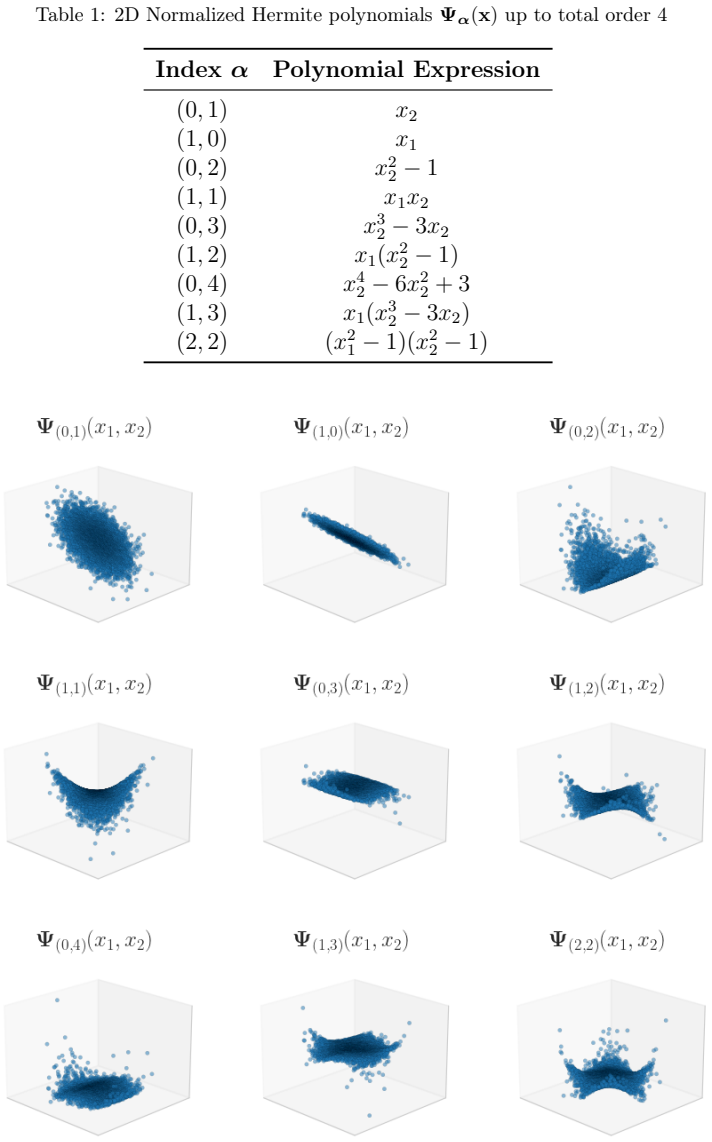
Summary. The paper proposes GH-PLoM, an extension of Probabilistic Learning on Manifolds (PLoM) that combines Double Diffusion Maps with Geometric Harmonics (GH) and solves a full-order Itô stochastic differential equation (ISDE) directly in a diffusion-map latent space. The method first embeds high-dimensional data into a low-dimensional manifold using diffusion maps, constructs a latent harmonic basis via a second diffusion-map step, estimates a kernel density on the latent coordinates, generates new latent samples from a full-order ISDE, and lifts them back to the ambient space using the GH inverse map. The authors claim that this hybrid approach retains the geometric expressiveness of PLoM while improving sample quality and generalization in low-data regimes. The paper includes two numerical studies: one based on two-dimensional Hermite polynomial functions (N = 10,000) and one based on detonation-wave simulations in a rotating detonation engine (N = 897). The reported results are primarily visual, showing that generated samples resemble training data in terms of mean fields and representative realizations.
Significance. The conceptual integration of Double Diffusion Maps and Geometric Harmonics into PLoM is a sensible and potentially valuable direction: it addresses a real limitation of the original method, namely the absence of a principled inverse map from the diffusion-map latent space back to the ambient data space. The proposed framework is clearly described, and the two test problems are nontrivial, particularly the rotating detonation engine example with high-dimensional input vectors. If the central claim of improved generalization in low-data regimes were properly supported, this would be a useful contribution to generative modeling on manifolds. However, as presented, the evidence does not substantiate that claim: the experiments do not operate in the small-data regime the paper motivates, no comparison with the original PLoM or other generative baselines is provided, and no quantitative sample-quality or lifting-error metrics are reported. The paper's contribution is therefore currently an interesting algorithmic proposal with preliminary visual demonstrations rather than a validated method.
major comments (3)
- [Section 6 and Section 7] The paper's central claim, stated in the introduction and conclusion, is that GH-PLoM improves sample quality and generalization in low-data regimes. This claim is not supported by the experiments. The Hermite example uses N = 10,000 samples and the RDE example uses N = 897, both of which are moderate-to-large relative to the intrinsic dimensions of the respective manifolds (roughly 1-2 for Hermite and 3 for RDE). The motivating regime described in Section 3 is when the number of diffusion-map basis vectors approaches N in 'extreme small-data settings', and neither experiment approaches that regime. Moreover, there is no comparison against the original PLoM or any other generative baseline, and no quantitative sample-quality metric (such as MMD, energy distance, coverage, or covariance bias) is reported; Figures 8, 14, 15, and 16 are visual only. To support the central claim, the authors should add experiments with small N (e.g., N comparable to the diffusion-map truncation dimension), compare against the original PLoM and a standard baseline, and report quantitative metrics of sample quality and generalization.
- [Section 5 and Algorithm 2] The accuracy of the Geometric Harmonics inverse map GH^{-1} for out-of-sample latent points generated by the ISDE is never quantified, yet it is load-bearing for the method. The only quantitative GH check, Figure 7, evaluates reconstruction on points from the training distribution (train and test splits of the observed data cloud), not on latent coordinates produced by the full-order ISDE. Because the kernel density estimate in Eq. (5) has unbounded support on R^nu, the ISDE can generate latent points that lie outside the convex hull of the training latent coordinates; for such points, the Nyström extension and GH interpolation error is uncontrolled and generally grows with distance from the training data. This is precisely the failure mode that matters in the low-data regime the paper claims to enable, where KDE bandwidths are larger and the diffusion-map eigenvectors are noisier. The authors should measure GH reconstruction error on actual ISDE-generated latent points, for both in-distribution and extrapolation cases, and report how this error scales with N and with distance from the training cloud.
- [Section 4, first paragraph] The key assumption underlying Double Diffusion Maps as used here is that the discarded diffusion-map eigenvectors are 'functionally dependent' on the retained non-harmonic coordinates and can therefore be reconstructed through the latent harmonics Psi. This assumption is asserted in the first paragraph of Section 4 without supporting evidence or error analysis. Since every generated ambient sample is obtained by lifting through this reconstructed inverse map, the accuracy of this functional dependence is load-bearing: if it holds only approximately, the approximation error propagates into all generated samples. The manuscript should either provide a theoretical bound on the reconstruction error, quantify it empirically on held-out and ISDE-generated points, or explicitly state the conditions under which the assumption is valid and acknowledge the resulting limitation.
minor comments (6)
- [Throughout] There are several unresolved '[REF]' placeholders in the text (e.g., in the introduction and in the caption of Figure 9). These must be completed before the manuscript can be considered publication-ready.
- [Section 2, equations] Equation numbering is inconsistent: Eq. (9) appears twice (once for the mean identity and once for the product-form density), and Eq. (10) is used for both the ISDE and the covariance identity. Please renumber all equations.
- [Table 2] Table 2 contains a typo: 'Psi_{0,2)' is missing the closing subscript parenthesis; it should be 'Psi_{(0,2)}'.
- [Section 6.1, Figure 8] The text states that 'the noise has vanished since we are taking the expectation over 100 generated with PLoM realizations'. Averaging over realizations removes stochastic noise by construction, so this observation does not demonstrate that individual generated samples are statistically consistent or noise-free; the authors should clarify what claim is being made.
- [Section 6.2, Figure 16] The caption of Figure 16 refers to an 'augmented dataset' while the text describes a 'reconstructed image'; please unify the terminology to avoid confusion between generated samples and reconstructed training samples.
- [Section 3, challenges] When discussing limitations of the original PLoM in small-data settings, the authors should cite the specific prior extensions that already address small-data regimes (e.g., Refs. [26], [35], and [36]) rather than only the original PLoM paper, so that the claimed novelty relative to those extensions is made explicit.
Circularity Check
No central circularity: GH-PLoM composes independently published methods, but Figure 16 validates the GH inverse map on a training outlier, an in-sample reconstruction presented as an accuracy check.
-
fitted input called prediction
[Section 6.2, Figure 16 and surrounding text]
"we identify the point that lies farthest from the rest in the reduced latent space. This outlier, which represents an extreme combustion scenario in the reduced representation, is then mapped back to the physical space ... computed both via the original training dataset (top) and the reconstructed image using our approach (bottom). This indicates a very accurate reproduction even for outlier samples."
The 'extreme' point is a training sample: it is chosen by distance in the diffusion-map embedding computed from the 897 training snapshots. The GH inverse map is an interpolant constructed from all training points through Eqs. (33)-(35), so lifting that point back to ambient space is an in-sample evaluation at an interpolation node. It is therefore forced to be close by construction and cannot by itself support the claimed out-of-sample generalization of GH^{-1} to ISDE-generated latent points.
full rationale
The paper's core pipeline is not circular: it composes independently published components (PLoM ISDE sampling, Double Diffusion Maps from [32], Geometric Harmonics from [33], and the harmonic-selection criterion of [34]) rather than deriving a result from its own conclusion. The GH inverse map is a standard spectral interpolation method fit to the training latent coordinates, and applying it to new latent samples is a legitimate predictive step, provided its out-of-sample error is controlled. The central low-data generalization claim is not strongly evidenced (N=10,000 and N=897 are not extreme small-data settings, no comparison against original PLoM or other generative baselines, and no quantitative sample-quality metric is reported), but lack of evidence is a correctness concern, not circularity. The one self-referential element is the Figure 16 validation, where an outlier from the training set is reconstructed through an interpolant that includes that same point; this is in-sample and cannot demonstrate generalization to new latent draws. Because this validation artifact is not the mathematical derivation itself, the overall circularity score is low rather than severe.
Assumptions & free parameters
free parameters (6)
- Diffusion maps kernel bandwidth ε (Hermite example) =
15 times the median pairwise distance
- Diffusion maps kernel bandwidth ε (RDE example) =
0.2 times the median pairwise distance
- Number of non-harmonic diffusion coordinates m =
2 for Hermite data, 3 for RDE data
- Geometric Harmonics spectral threshold δ =
not reported
- ISDE solver parameters (f0, time step, horizon M0, n_MC) =
not reported
- Added noise level in Hermite dataset =
not reported
assumptions (4)
- domain assumption The data lie on or near a low-dimensional manifold embedded in the high-dimensional ambient space.
- ad hoc to paper The discarded diffusion-map eigenvectors are functionally dependent on the retained non-harmonic coordinates, so latent harmonics Ψ can reconstruct them.
- domain assumption The Gaussian KDE in diffusion-map coordinates, together with the full-order ISDE, has the estimated density as its invariant measure.
- domain assumption Geometric Harmonics interpolation remains accurate for new latent points generated by the ISDE, including points away from the training latent coordinates.
Cite this review
Pith. "Pith review of Enabling Probabilistic Learning on Manifolds through Double Diffusion Maps." pith.science (2026). https://pith.science/paper/5XCVX5BV
@misc{pith2026250602254,
  author       = {Pith},
  title        = {Pith review of: Enabling Probabilistic Learning on Manifolds through Double Diffusion Maps},
  year         = {2026},
  howpublished = {\url{https://pith.science/paper/5XCVX5BV}},
  note         = {Machine review of arXiv:2506.02254}
}
read the original abstract
We present a generative learning framework for probabilistic sampling based on an extension of the Probabilistic Learning on Manifolds (PLoM) approach, which is designed to generate statistically consistent realizations of a random vector in a finite-dimensional Euclidean space, informed by a limited (yet representative) set of observations. In its original form, PLoM constructs a reduced-order probabilistic model by combining three main components: (a) kernel density estimation to approximate the underlying probability measure, (b) Diffusion Maps to uncover the intrinsic low-dimensional manifold structure, and (c) a reduced-order Ito Stochastic Differential Equation (ISDE) to sample from the learned distribution. A key challenge arises, however, when the number of available data points N is small and the dimensionality of the diffusion-map basis approaches N, resulting in overfitting and loss of generalization. To overcome this limitation, we propose an enabling extension that implements a synthesis of Double Diffusion Maps -- a technique capable of capturing multiscale geometric features of the data -- with Geometric Harmonics (GH), a nonparametric reconstruction method that allows smooth nonlinear interpolation in high-dimensional ambient spaces. This approach enables us to solve a full-order ISDE directly in the latent space, preserving the full dynamical complexity of the system, while leveraging its reduced geometric representation. The effectiveness and robustness of the proposed method are illustrated through two numerical studies: one based on data generated from two-dimensional Hermite polynomial functions and another based on high-fidelity simulations of a detonation wave in a reactive flow.
Figures


Figures from the paper (11 more)


Reference graph
Works this paper leans on
-
[1]
ER Crabtree, JM Bello-Rivas, and IG Kevrekidis. Micro-macro consistency in multiscale modeling: Score-based model assisted sampling of fast/slow dynamical systems.Chaos: An Interdisciplinary Journal of Nonlinear Science, 34(5), 2024
work page 2024
-
[2]
Han Gao, Sebastian Kaltenbach, and Petros Koumoutsakos. Generative learning of the solution of parametric partial differential equations using guided diffusion models and virtual observations.Computer Methods in Applied Mechanics and Engineering, 435:117654, 2025
2025
-
[3]
Han Gao, Sebastian Kaltenbach, and Petros Koumoutsakos. Generative learning for forecasting the dynamics of complex systems.arXiv preprint arXiv:2402.17157, 2024
arXiv 2024
-
[4]
Generative Learning for Slow Manifolds and Bifurcation Diagrams
Ellis R Crabtree, Dimitris G Giovanis, Nikolaos Evangelou, Juan M Bello-Rivas, and Ioannis G Kevrekidis. Generative learning for slow manifolds and bifurcation diagrams. arXiv preprint arXiv:2504.20375, 2025. 25
work page Pith review arXiv 2025
-
[5]
Generative Learning of Densities on Manifolds
Dimitris G Giovanis, Ellis Crabtree, Roger G Ghanem, and Ioannis G Kevrekidis. Generative learning of densities on manifolds.arXiv preprint arXiv:2503.03963, 2025
work page Pith review arXiv 2025
-
[6]
Highly accurate protein structure prediction with alphafold.nature, 596(7873):583– 589, 2021
John Jumper, Richard Evans, Alexander Pritzel, Tim Green, Michael Figurnov, Olaf Ronneberger, Kathryn Tunyasuvunakool, Russ Bates, Augustin Žídek, Anna Potapenko, et al. Highly accurate protein structure prediction with alphafold.nature, 596(7873):583– 589, 2021
work page 2021
-
[7]
Rongguang Wang, Vishnu Bashyam, Zhijian Yang, Fanyang Yu, Vasiliki Tassopoulou, Sai Spandana Chintapalli, Ioanna Skampardoni, Lasya P Sreepada, Dushyant Sahoo, KonstantinaNikita, etal. Applicationsofgenerativeadversarialnetworksinneuroimaging and clinical neuroscience.Neuroimage, 269:119898, 2023
work page 2023
-
[8]
Luke de Oliveira, Michela Paganini, and Benjamin Nachman. Learning particle physics by example: location-aware generative adversarial networks for physics synthesis.Computing and Software for Big Science, 1(1):4, 2017
work page 2017
Show all 40 references
-
[9]
Generative adversarial networks (gan) based efficient sampling of chemical composition space for inverse design of inorganic materials.npj Computational Materials, 6(1):84, 2020
Yabo Dan, Yong Zhao, Xiang Li, Shaobo Li, Ming Hu, and Jianjun Hu. Generative adversarial networks (gan) based efficient sampling of chemical composition space for inverse design of inorganic materials.npj Computational Materials, 6(1):84, 2020
2020
-
[10]
Producing realistic climate data with generative adversarial networks
Camille Besombes, Olivier Pannekoucke, Corentin Lapeyre, Benjamin Sanderson, and Olivier Thual. Producing realistic climate data with generative adversarial networks. Nonlinear Processes in Geophysics, 28(3):347–370, 2021
2021
-
[11]
Auto-encoding variational bayes.arXiv preprint arXiv:1312.6114, 2013
Diederik P Kingma. Auto-encoding variational bayes.arXiv preprint arXiv:1312.6114, 2013
2013 arXiv
-
[12]
Stochastic backpropa- gation and approximate inference in deep generative models
Danilo Jimenez Rezende, Shakir Mohamed, and Daan Wierstra. Stochastic backpropa- gation and approximate inference in deep generative models. InInternational conference on machine learning, pages 1278–1286. PMLR, 2014
2014
-
[13]
The neural autoregressive distribution estimator
Hugo Larochelle and Iain Murray. The neural autoregressive distribution estimator. InProceedings of the fourteenth international conference on artificial intelligence and statistics, pages 29–37. JMLR Workshop and Conference Proceedings, 2011
2011
-
[14]
Normalizing flows for probabilistic modeling and inference
George Papamakarios, Eric Nalisnick, Danilo Jimenez Rezende, Shakir Mohamed, and Balaji Lakshminarayanan. Normalizing flows for probabilistic modeling and inference. Journal of Machine Learning Research, 22(57):1–64, 2021
2021
-
[15]
Generative adversarial networks
Ian Goodfellow, Jean Pouget-Abadie, Mehdi Mirza, Bing Xu, David Warde-Farley, Sherjil Ozair, Aaron Courville, and Yoshua Bengio. Generative adversarial networks. Communications of the ACM, 63(11):139–144, 2020
2020
-
[16]
Conditional generative adversarial nets.arXiv preprint arXiv:1411.1784, 2014
Mehdi Mirza. Conditional generative adversarial nets.arXiv preprint arXiv:1411.1784, 2014. 26
2014 arXiv
-
[17]
Score-based generative modeling through stochastic differential equations
Yang Song, Jascha Sohl-Dickstein, Diederik P Kingma, Abhishek Kumar, Stefano Ermon, and Ben Poole. Score-based generative modeling through stochastic differential equations. arXiv preprint arXiv:2011.13456, 2020
2011 arXiv
-
[18]
Generative modeling by estimating gradients of the data distribution.Advances in neural information processing systems, 32, 2019
Yang Song and Stefano Ermon. Generative modeling by estimating gradients of the data distribution.Advances in neural information processing systems, 32, 2019
2019
-
[19]
Denoising diffusion probabilistic models
Jonathan Ho, Ajay Jain, and Pieter Abbeel. Denoising diffusion probabilistic models. Advances in neural information processing systems, 33:6840–6851, 2020
2020
-
[20]
Improved techniques for training score-based generative models.Advances in neural information processing systems, 33:12438–12448, 2020
Yang Song and Stefano Ermon. Improved techniques for training score-based generative models.Advances in neural information processing systems, 33:12438–12448, 2020
2020
-
[21]
Diffwave: A versatile diffusion model for audio synthesis.arXiv preprint arXiv:2009.09761, 2020
Zhifeng Kong, Wei Ping, Jiaji Huang, Kexin Zhao, and Bryan Catanzaro. Diffwave: A versatile diffusion model for audio synthesis.arXiv preprint arXiv:2009.09761, 2020
2009 arXiv
-
[22]
Permutation invariant graph generation via score-based generative modeling
Chenhao Niu, Yang Song, Jiaming Song, Shengjia Zhao, Aditya Grover, and Stefano Ermon. Permutation invariant graph generation via score-based generative modeling. InInternational Conference on Artificial Intelligence and Statistics, pages 4474–4484. PMLR, 2020
2020
-
[23]
Broadly applicable and accurate protein design by integrating structure prediction networks and diffusion generative models.BioRxiv, pages 2022–12, 2022
Joseph L Watson, David Juergens, Nathaniel R Bennett, Brian L Trippe, Jason Yim, Helen E Eisenach, Woody Ahern, Andrew J Borst, Robert J Ragotte, Lukas F Milles, et al. Broadly applicable and accurate protein design by integrating structure prediction networks and diffusion ge...
2022
-
[24]
Data-driven probability concentration and sampling on manifold.Journal of Computational Physics, 321:242–258, 2016
Christian Soize and Roger Ghanem. Data-driven probability concentration and sampling on manifold.Journal of Computational Physics, 321:242–258, 2016
2016
-
[25]
Entropy-based closure for probabilistic learning on manifolds.Journal of Computational Physics, 388:518–533, 2019
Christian Soize, Roger Ghanem, Cosmin Safta, Xun Huan, Zachary P Vane, J Oefelein, Guilhem Lacaze, Habib N Najm, Qi Tang, and X Chen. Entropy-based closure for probabilistic learning on manifolds.Journal of Computational Physics, 388:518–533, 2019
2019
-
[26]
Christian Soize and Roger Ghanem. Probabilistic learning on manifolds constrained by nonlinear partial differential equations for small datasets.Computer Methods in Applied Mechanics and Engineering, 380:113777, 2021
2021
-
[27]
Probabilistic learning on manifolds (plom) with partition.International Journal for Numerical Methods in Engineering, 123(1):268–290, 2022
Christian Soize and Roger Ghanem. Probabilistic learning on manifolds (plom) with partition.International Journal for Numerical Methods in Engineering, 123(1):268–290, 2022
2022
-
[28]
Testing the manifold hypothesis.Journal of the American Mathematical Society, 29(4):983–1049, 2016
Charles Fefferman, Sanjoy Mitter, and Hariharan Narayanan. Testing the manifold hypothesis.Journal of the American Mathematical Society, 29(4):983–1049, 2016
2016
-
[29]
The isomap algorithm and topological stability.Science, 295(5552):7–7, 2002
Mukund Balasubramanian and Eric L Schwartz. The isomap algorithm and topological stability.Science, 295(5552):7–7, 2002. 27
2002
-
[30]
Nonlinear dimensionality reduction by locally linear embedding.science, 290(5500):2323–2326, 2000
Sam T Roweis and Lawrence K Saul. Nonlinear dimensionality reduction by locally linear embedding.science, 290(5500):2323–2326, 2000
2000
-
[31]
Diffusionmaps
RRCoifmanandSLafon. Diffusionmaps. Applied and Computational Harmonic Analysis, 21(1):5–30, 2006
2006
-
[32]
Double diffusion maps and their latent harmonics for scientific computations in latent space.Journal of Computational Physics, 485:112072, 2023
Nikolaos Evangelou, Felix Dietrich, Eliodoro Chiavazzo, Daniel Lehmberg, Marina Meila, and Ioannis G Kevrekidis. Double diffusion maps and their latent harmonics for scientific computations in latent space.Journal of Computational Physics, 485:112072, 2023
2023
-
[33]
Geometric harmonics: a novel tool for multiscale out-of- sample extension of empirical functions.Applied and Computational Harmonic Analysis, 21(1):31–52, 2006
RR Coifman and S Lafon. Geometric harmonics: a novel tool for multiscale out-of- sample extension of empirical functions.Applied and Computational Harmonic Analysis, 21(1):31–52, 2006
2006
-
[34]
Parsimonious representation of nonlinear dynamical systems through manifold learning: A chemotaxis case study.Applied and Computational Harmonic Analysis, 44(3):759–773, 2018
Carmeline J Dsilva, Ronen Talmon, Ronald R Coifman, and Ioannis G Kevrekidis. Parsimonious representation of nonlinear dynamical systems through manifold learning: A chemotaxis case study.Applied and Computational Harmonic Analysis, 44(3):759–773, 2018
2018
-
[35]
Transient anisotropic kernel for probabilistic learning on manifolds.Computer Methods in Applied Mechanics and Engineering, 432 B, 2024
Christian Soize and Roger Ghanem. Transient anisotropic kernel for probabilistic learning on manifolds.Computer Methods in Applied Mechanics and Engineering, 432 B, 2024
2024
-
[36]
Sampling of bayesian posteriors with a non-gaussian probabilistic learning on manifolds from a small dataset
Christian Soize, Roger G Ghanem, and Christophe Desceliers. Sampling of bayesian posteriors with a non-gaussian probabilistic learning on manifolds from a small dataset. Statistics and Computing, 30(5):1433–1457, 2020
2020
-
[37]
Physics-constrained non-gaussian probabilistic learning on manifolds.International Journal for Numerical Methods in Engineering, 121(1):110–145, 2020
Christian Soize and Roger Ghanem. Physics-constrained non-gaussian probabilistic learning on manifolds.International Journal for Numerical Methods in Engineering, 121(1):110–145, 2020
2020
-
[38]
Christian Soize and Roger Ghanem. Probabilistic-learning-based stochastic surrogate model from small incomplete datasets for nonlinear dynamical systems.Computer Methods in Applied Mechanics and Engineering, 418:116498, 2024
2024
-
[39]
Probabilistic nonconvex constrained optimization with fixed number of function evaluations.International Journal for Numerical Methods in Engineering, 113(4):719–741, 2018
Roger Ghanem and Christian Soize. Probabilistic nonconvex constrained optimization with fixed number of function evaluations.International Journal for Numerical Methods in Engineering, 113(4):719–741, 2018
2018
-
[40]
Uncertainty quantification and flow dynamics in rotating detonation engines.arXiv preprint arXiv:2505.02378, 2025
Vinay Kumar, Zheming Gou, and Roger Ghanem. Uncertainty quantification and flow dynamics in rotating detonation engines.arXiv preprint arXiv:2505.02378, 2025. 28
2025 arXiv
Reviewed August 7, 2026 · model on record in the stance chip above.
Discussion (0). Sign in to comment.