REVIEW 4 major objections 5 minor 30 references
TransAct V2: Lifelong User Action Sequence Modeling on Pinterest Recommendation
T0 review · 4 major / 5 minor · reviewed 2026-08-07 · deepseek-v4-flash
Pith's one-line read The paper claims that combining a lifelong user action sequence with an auxiliary next-action loss improves a production CTR ranking model.
desk verdict Solid industrial serving paper with a plausible leakage flaw in the NAL design that should force authors to re-verify the ablation before acceptance. read the letter →
The pith
A machine-rendered reading of the paper's core claim, the machinery that carries it, and where it could break.
The reading
What carries the argument
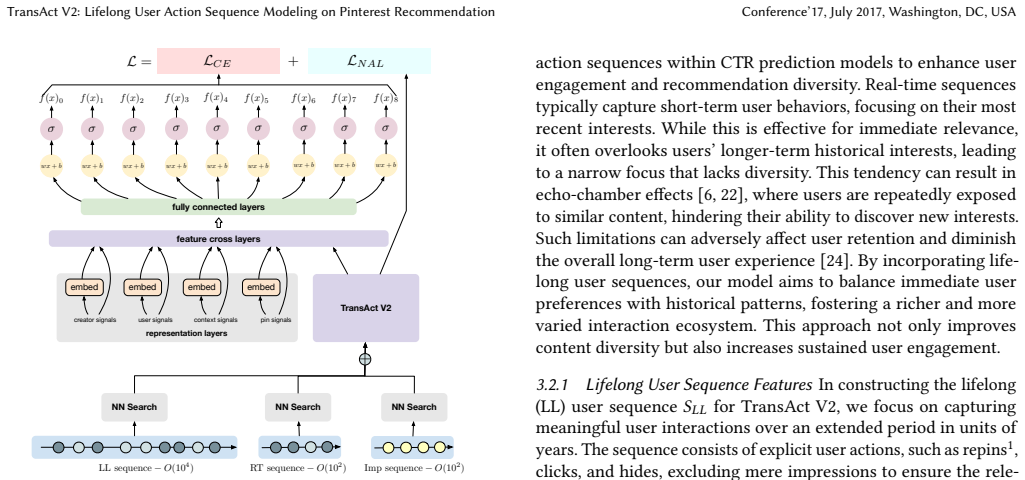
The load-bearing object is the TransAct V2 encoder: a two-layer, single-head transformer over a concatenated sequence $S_{\mathrm{all}} = \mathrm{NN}(S_{LL},c) \oplus S_{RT}[:r] \oplus \mathrm{NN}(S_{RT}[r:],c) \oplus \mathrm{NN}(S_{imp},c)$, where each NN is a dot-product nearest-neighbor search between the candidate pin embedding and token embeddings. A causal mask makes each position $\mathbf{u}(t)$ a representation of the user's history up to $t$, which feeds both the multi-head CTR loss and the next-action loss $L_{NAL}$, a sampled-softmax contrastive loss over positive next-action pins and impression-based negatives. The serving machinery (logging only NN features at request time, then recomputing the NN search on-device from the full lifelong sequence at serving time) is what makes $O(10^4)$-token sequences tractable.
What would settle it
Recompute the offline HIT@3 comparison using the serving path's real-time on-device NN search over the full lifelong sequence instead of the logged NN features; if the +13.31% repin gain and the -11.25% hide reduction disappear or reverse, the train-serve alignment assumption fails.
Extended reading notes
Core claim
On its own terms, the paper reports one main discovery: in a live CTR ranking model, combining a lifelong user sequence (up to $10^4$ explicit actions over about two years) with a short real-time sequence and an impression-based next-action loss outperforms the previous real-time-only transformer model. The mechanism is that the candidate pin anchors three nearest-neighbor searches (lifelong, real-time, impressions), and the concatenated, causally masked sequence is encoded by a two-layer transformer; a sampled-softmax next-action head trained on the same sequence pushes the encoder to represent what the user will do next, with impressions the user saw but did not engage as hard negatives. The reported numbers are HIT@3/repin +13.31%, HIT@3/hide -11.25% offline and +6.35% Homefeed repin volume, -12.80% Homefeed hide volume online, with increases in impression diversity and time spent. The paper further claims these gains are achievable at production latency through request-level de-duplication, fused GPU kernels, and a pinned-memory arena.
Load-bearing premise
The load-bearing premise is that the nearest-neighbor features logged at training time are equivalent, for ranking purposes, to the nearest-neighbor features computed live from the user's full lifelong sequence at serving time.
Editorial extensions
If this is right
- Long-horizon user history becomes usable in pointwise CTR without transferring the full sequence per candidate; only nearest-neighbor tokens cross the network.
- Auxiliary next-action training with impression negatives can reduce negative feedback such as hides, rather than only boosting positive engagement.
- The same candidate-anchored NN search plus auxiliary next-action loss should transfer to other feed-style ranking systems with long user histories.
- Serving optimizations such as deduplicated request features, fused sequence kernels, and pinned-memory batching generalize to other transformer-based CTR models, not just lifelong-sequence ones.
Reading between the lines
- One implicit consequence is that the next-action head's learned user embedding could be reused outside scoring, for example as a query for candidate retrieval or as an input to diversity re-ranking; the paper only uses it through the concatenated sequence.
- The train-serve NN consistency assumption implies a testable monitoring signal: track the overlap and dot-product agreement between logged NN features and live NN features for the same request, and use that divergence as a drift alarm.
- If impression negatives are the key to hide reduction, then other negative-signal sources such as dwell time or explicit not-interested feedback should be testable in the same NAL framework and might push hide metrics further.
Editorial analysis
A structured set of objections, weighed in public.
Referee Report
Summary. The paper describes TransAct V2, a production CTR ranking model for Pinterest Homefeed that combines a real-time action sequence, a lifelong action sequence of order 10^4 tokens, and an impression sequence in a two-layer causal transformer encoder. The model adds a next-action auxiliary loss (NAL), implemented with sampled softmax, and a set of serving optimizations: logged NN features for training, on-device NN search at serving, a fused Triton transformer kernel (SKUT), request-level de-duplication, and a pinned-memory arena. Offline and online A/B experiments report large relative gains over a TransAct (RT sequence) baseline, including +13.31% HIT@3/repin, -11.25% HIT@3/hide, and online +6.35% repin volume and -12.80% hide volume. Ablations cover NAL negative-sample selection, NAL loss type and weight, transformer hyperparameters, and serving latency components.
Significance. If the empirical claims hold, the paper has substantial practical significance: it demonstrates that a pointwise CTR model can consume lifelong user sequences with acceptable serving cost and that an auxiliary next-action loss can improve engagement and reduce negative feedback at production scale. The serving-engineering content is a genuine strength, with concrete latency and memory measurements, explicit ablations, and a final deployed system. The paper does not release code or data, and several load-bearing empirical claims currently rest on point estimates and on two alignment assumptions that are not tested: the NAL causal-mask construction may leak future actions, and the logged-versus-serving NN features are asserted to be consistent without measurement. Credit is due for the detailed serving ablation study and for explicitly flagging one statistically insignificant cell, but the lack of uncertainty quantification for the headline numbers is a limitation.
major comments (4)
- [§3.3.2 and Eq. (2)] The claim that the causal mask prevents information leakage is not established by the construction. In Eq. (2), S_all = NN(S_LL,c) ⊕ S_RT[:r] ⊕ NN(S_RT[r:],c) ⊕ NN(S_Imp,c) is a block concatenation, and the paper does not state that the blocks or the NN-retrieved tokens are sorted by timestamp. S_LL is defined over the past two years of explicit actions and is not stated to exclude the recent actions contained in S_RT; hence the positive sample p_u(t+1), which is drawn from S_RT[:r], can also be selected into the first block NN(S_LL,c). Because the LL block occupies positions before S_RT[:r], the causal mask permits u(t) to attend to that future action, making the NAL objective partially solvable by copying the label rather than by forecasting. This directly affects the attribution in Tables 2 and 4. The authors should sort the concatenated sequence by timestamp, or mask according to action timestamps, and rerun the NAL ablations; if the gains persist, the sorted-sequence results should be reported.
- [§3.4.1] The training/serving alignment of NN features is asserted but not demonstrated. Training consumes NN features logged at request time, presumably from a deployed snapshot of the sequence and candidate set, while serving performs a fresh on-device NN search over the current full LL sequence. Embedder drift, sequence staleness, and candidate-set differences can change the top-K items, and the paper gives no bound or measurement of that skew. Since the online gains in Table 3 depend on transfer of the offline behavior, the authors should add a quantitative consistency check, such as replaying logged candidates through the serving path and reporting NN feature overlap, or specifying staleness and embedder-versioning limits.
- [Tables 2–4 and Table 3] The empirical headline claims are point estimates without confidence intervals. Only one cell (Table 2, BST hide) is flagged as statistically insignificant, and no p-value or confidence interval is given for the +13.31% repin, -11.25% hide, or the online +6.35% repin and -12.80% hide. Given 1.5%-traffic online buckets and the large offline dataset, the authors should report significance measures for every metric, such as bootstrap confidence intervals or delta-method intervals, and for the online metrics they should include experiment duration and bucket count.
- [§4.2.2] The closest lifelong-sequence baseline, TWIN v2, is excluded with the explanation that it relies on expensive offline inference. This may be practically necessary, but without a comparison or a description of what a feasible adaptation would require, the statement that TransAct V2 outperforms existing methods is not fully supported. The authors should either add an offline comparison against a reasonable approximation of TWIN v2 or restrict the superiority claim to the evaluated baselines.
minor comments (5)
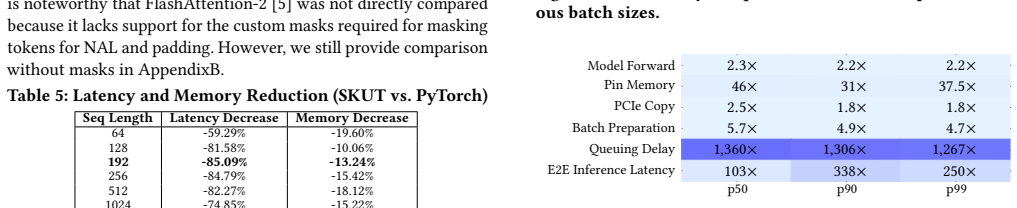
- [Figure 9] The reported 103x, 338x, and 250x end-to-end latency improvements should be reconciled with the 75–85% reductions shown in Figures 7 and 8; specify the exact baseline decomposition, since queuing-delay improvements can dominate and make the headline factor sensitive to batch-traffic assumptions.
- [Eq. (5) and §3.3.1] Please specify how many negative samples N are used and whether the negatives are shared across positive positions; also define p_u(t+1) when the next action in S_RT is not a positive engagement, since Section 3.3.1 states that only positive tokens from S_RT[:r] are used as positives.
- [Table 2] All entries appear to be relative deltas, but no absolute baseline values are given; without base rates, the reader cannot judge whether 13.31% is a change from 0.01 to 0.0113 or from 0.1 to 0.113, so absolute HIT@3 numbers should be reported alongside the deltas.
- [§3.2.1] The quantization scale of 0.65 is described as normalizing the input distribution, but no empirical distribution or reconstruction-error measurement is provided; please add a sentence describing the data used to choose this value and its effect on downstream metrics.
- [Appendix A, Table 6] The NAL loss weight w_NAL = 0.01 is selected by tuning; state explicitly whether this weight was selected on the same evaluation set reported in Table 4, and if so, note the risk of selection bias.
Circularity Check
No significant circularity: all central claims are empirical, with ablations and online A/B tests; self-citations are provenance, not load-bearing reductions.
full rationale
This paper does not present a derivation chain; it reports an industrial system and evaluates it empirically. The three contributions are the lifelong sequence, the Next Action Loss (NAL), and serving optimizations, and each is supported by measurements rather than by definitional equivalence. NAL as defined in Equations (5)-(7) is a trained auxiliary objective, not a fitted parameter that is later renamed as a prediction; its effect on ranking is measured by HIT@3 in Table 2 and Table 4 and by online metrics in Table 3. The comparison between TransAct V2 and TransAct (RT sequence) is an ablation that tests the contribution of the lifelong sequence, and the NAL negative-sampling comparison in Table 4 is an ablation, not a forced consequence of the loss definition. Hyperparameter and loss-weight choices in Tables 6 and 7 are standard model selection on the same offline metric, which does not make the headline result circular. The self-citations, notably TransAct [25] and PinnerFormer [13], are used as design provenance and baseline references, not as load-bearing justifications that the present model must work because the authors previously asserted it. No uniqueness theorem is imported from the authors' prior work, and no ansatz is smuggled in via citation. The potential concern that the S_all construction in Equation (2) may not be chronologically sorted is a label-leakage/correctness risk, not circularity: even if future labels could be attended to through the LL block, that would make NAL easier by information leakage, not because the claimed prediction reduces to the training target by construction. Thus the paper is self-contained as an empirical systems paper, and no circular step is identifiable.
Assumptions & free parameters
free parameters (4)
- NAL loss weight w_NAL =
0.01
- PinSage embedding quantization scale =
0.65
- Transformer hyperparameters (sequence length, layers, FFN dim, model dim) =
192, 2, 32, 64
- NN search top-K and recent-actions keep count r =
unspecified, final |S_all| = 192
assumptions (5)
- domain assumption PinSage embedding dot product is a valid similarity measure for retrieving relevant user actions for a candidate pin.
- domain assumption Impression-based negative samples (pins viewed but not engaged) represent low user interest.
- domain assumption Training on logged NN features transfers to on-device NN search at serving time.
- domain assumption Offline HIT@3 metrics correlate with the online engagement metrics used for A/B evaluation.
- standard math Sampled softmax is an appropriate contrastive objective for the next-action prediction task.
Cite this review
Pith. "Pith review of TransAct V2: Lifelong User Action Sequence Modeling on Pinterest Recommendation." pith.science (2026). https://pith.science/paper/PCEBSND6
@misc{pith2026250602267,
  author       = {Pith},
  title        = {Pith review of: TransAct V2: Lifelong User Action Sequence Modeling on Pinterest Recommendation},
  year         = {2026},
  howpublished = {\url{https://pith.science/paper/PCEBSND6}},
  note         = {Machine review of arXiv:2506.02267}
}
read the original abstract
Modeling user action sequences has become a popular focus in industrial recommendation system research, particularly for Click-Through Rate (CTR) prediction tasks. However, industry-scale CTR models often rely on short user sequences, limiting their ability to capture long-term behavior. Additionally, these models typically lack an integrated action-prediction task within a point-wise ranking framework, reducing their predictive power. They also rarely address the infrastructure challenges involved in efficiently serving large-scale sequential models. In this paper, we introduce TransAct V2, a production model for Pinterest's Homefeed ranking system, featuring three key innovations: (1) leveraging very long user sequences to improve CTR predictions, (2) integrating a Next Action Loss function for enhanced user action forecasting, and (3) employing scalable, low-latency deployment solutions tailored to handle the computational demands of extended user action sequences.
Figures


Figures from the paper (5 more)


Reference graph
Works this paper leans on
-
[1]
Fedor Borisyuk, Mingzhou Zhou, Qingquan Song, Siyu Zhu, Birjodh Tiwana, Ganesh Parameswaran, Siddharth Dangi, Lars Hertel, Qiang Charles Xiao, Xi- aochen Hou, Yunbo Ouyang, Aman Gupta, Sheallika Singh, Dan Liu, Hailing Cheng, Lei Le, Jonathan Hung, Sathiya Keerthi, Ruoyan Wang, Fengyu Zhang, Mohit Kothari, Chen Zhu, Daqi Sun, Yun Dai, Xun Luan, Sirou Zhu,...
arXiv 2024
-
[3]
Qiwei Chen, Huan Zhao, Wei Li, Pipei Huang, and Wenwu Ou. 2019. Be- havior Sequence Transformer for E-Commerce Recommendation in Alibaba. InProceedings of the 1st International Workshop on Deep Learning Practice for High-Dimensional Sparse Data(Anchorage, Alaska)(DLP-KDD ’19). Asso- ciation for Computing Machinery, New York, NY, USA, Article 12, 4 pages. ...
-
[4]
Heng-Tze Cheng, Levent Koc, Jeremiah Harmsen, Tal Shaked, Tushar Chandra, Hrishi Aradhye, Glen Anderson, Greg Corrado, Wei Chai, Mustafa Ispir, et al
-
[5]
Tri Dao. 2023. FlashAttention-2: Faster Attention with Better Parallelism and Work Partitioning. arXiv:2307.08691 [cs.LG] https://arxiv.org/abs/2307.08691
arXiv 2023
-
[7]
Lars Hertel, Neil Daftary, Fedor Borisyuk, Aman Gupta, and Rahul Mazumder
-
[8]
Pin-Lun Hsu, Yun Dai, Vignesh Kothapalli, Qingquan Song, Shao Tang, Siyu Zhu, Steven Shimizu, Shivam Sahni, Haowen Ning, and Yanning Chen. 2025. Liger Kernel: Efficient Triton Kernels for LLM Training. arXiv:2410.10989 [cs.LG] https://arxiv.org/abs/2410.10989
arXiv 2025
-
[10]
Wang-Cheng Kang and Julian McAuley. 2018. Self-attentive sequential recom- mendation. In2018 IEEE international conference on data mining (ICDM). IEEE, 197–206
2018
-
[11]
Siddarth Malreddy, Matthew Lawhon, Usha Amrutha Nookala, Aditya Mantha, and Dhruvil Deven Badani. 2024. Improving feature interactions at Pinterest under industry constraints.arXiv preprint arXiv:2412.01985(2024)
work page Pith review arXiv 2024
Show all 30 references
-
[12]
Vinh Nguyen, Michael Carilli, Sukru Burc Eryilmaz, Vartika Singh, Michelle Lin, Natalia Gimelshein, Alban Desmaison, and Edward Yang. 2021. Accelerating PyTorch with CUDA Graphs. (2021). https://pytorch.org/blog/accelerating- pytorch-with-cuda-graphs/
2021
-
[13]
Nikil Pancha, Andrew Zhai, Jure Leskovec, and Charles Rosenberg. 2022. Pinner- Former: Sequence Modeling for User Representation at Pinterest. InProceedings of the 28th ACM SIGKDD Conference on Knowledge Discovery and Data Mining (Washington DC, USA)(KDD ’22). Association for ...
2022
-
[14]
Qi Pi, Xiaoqiang Zhu, Guorui Zhou, Yujing Zhang, Zhe Wang, Lejian Ren, Ying Fan, and Kun Gai. 2020. Search-based User Interest Modeling with Lifelong Sequential Behavior Data for Click-Through Rate Prediction.Proceedings of the 29th ACM International Conference on Information ...
2020
-
[15]
Pinterest. 2024. Third Quarter 2024 Earnings Conference Call. (2024). https: //investor.pinterestinc.com/news-and-events/events-and-presentations/event- details/2024/Third-Quarter-2024-Earnings-Conference-Call/default.aspx
2024
-
[16]
Jiarui Qin, Weinan Zhang, Xin Wu, Jiarui Jin, Yuchen Fang, and Yong Yu. 2020. User Behavior Retrieval for Click-Through Rate Prediction. InProceedings of the 43rd International ACM SIGIR Conference on Research and Development in Information Retrieval (SIGIR ’20). ACM, 2347–235...
2020
-
[17]
Rabe and Charles Staats
Markus N. Rabe and Charles Staats. 2022. Self-attention Does Not Need𝑂(𝑛 2) Memory. arXiv:2112.05682 [cs.LG] https://arxiv.org/abs/2112.05682
2022 arXiv
-
[18]
Zihua Si, Lin Guan, Zhongxiang Sun, Xiaoxue Zang, Jing Lu, Yiqun Hui, Xingchao Cao, Zeyu Yang, Yichen Zheng, Dewei Leng, Kai Zheng, Chenbin Zhang, Yanan Niu, Yang Song, and Kun Gai. 2024. TWIN V2: Scaling Ultra-Long User Behavior Sequence Modeling for Enhanced CTR Prediction a...
2024
-
[19]
Fei Sun, Jun Liu, Jian Wu, Changhua Pei, Xiao Lin, Wenwu Ou, and Peng Jiang
-
[20]
Philippe Tillet. 2021. Introducing Triton: Open-source GPU programming for neural networks. (2021). https://openai.com/index/triton/
2021
-
[21]
Philippe Tillet, H. T. Kung, and David Cox. 2019. Triton: an intermediate lan- guage and compiler for tiled neural network computations. InProceedings of the 3rd ACM SIGPLAN International Workshop on Machine Learning and Program- ming Languages(Phoenix, AZ, USA)(MAPL 2019). As...
2019
-
[22]
Chi, and Minmin Chen
Yuyan Wang, Cheenar Banerjee, Samer Chucri, Fabio Soldo, Sriraj Badam, Ed H. Chi, and Minmin Chen. 2024. Beyond Item Dissimilarities: Diversifying by Intent in Recommender Systems. arXiv:2405.12327 [cs.IR] https://arxiv.org/abs/2405. 12327
2024 arXiv
-
[23]
Erik Wijmans, Brody Huval, Alexander Hertzberg, Vladlen Koltun, and Philipp Krähenbühl. 2024. Cut Your Losses in Large-Vocabulary Language Models. arXiv:2411.09009 [cs.LG] https://arxiv.org/abs/2411.09009
2024 arXiv
-
[24]
Chi, and Jennifer Gillenwater
Mark Wilhelm, Ajith Ramanathan, Alexander Bonomo, Sagar Jain, Ed H. Chi, and Jennifer Gillenwater. 2018. Practical Diversified Recommendations on YouTube with Determinantal Point Processes. InProceedings of the 27th ACM International Conference on Information and Knowledge Man...
2018
-
[25]
Xue Xia, Pong Eksombatchai, Nikil Pancha, Dhruvil Deven Badani, Po-Wei Wang, Neng Gu, Saurabh Vishwas Joshi, Nazanin Farahpour, Zhiyuan Zhang, and An- drew Zhai. 2023. TransAct: Transformer-based Realtime User Action Model for Recommendation at Pinterest. InProceedings of the ...
2023
-
[26]
Jiajing Xu, Andrew Zhai, and Charles Rosenberg. 2022. Rethinking Personalized Ranking at Pinterest: An End-to-End Approach. InProceedings of the 16th ACM Conference on Recommender Systems(Seattle, WA, USA)(RecSys ’22). Association for Computing Machinery, New York, NY, USA, 50...
2022
-
[27]
Rengan Xu, Junjie Yang, Yifan Xu, Hong Li, Xing Liu, Devashish Shankar, Haoci Zhang, Meng Liu, Boyang Li, Yuxi Hu, Mingwei Tang, Zehua Zhang, Tunhou Zhang, Dai Li, Sijia Chen, Gian-Paolo Musumeci, Jiaqi Zhai, Bill Zhu, Hong Yan, and Srihari Reddy. 2024. Enhancing Performance a...
2024
-
[28]
Jing Yan, Liu Jiang, Jianfei Cui, Zhichen Zhao, Xingyan Bin, Feng Zhang, and Zuotao Liu. 2024. Trinity: Syncretizing Multi-/Long-tail/Long-term Interests All in One. arXiv:2402.02842 [cs.IR] https://arxiv.org/abs/2402.02842
2024 arXiv
-
[29]
Hamilton, and Jure Leskovec
Rex Ying, Ruining He, Kaifeng Chen, Pong Eksombatchai, William L. Hamilton, and Jure Leskovec. 2018. Graph Convolutional Neural Networks for Web-Scale Recommender Systems. InProceedings of the 24th ACM SIGKDD International Conference on Knowledge Discovery and Data Mining(Lond...
2018
-
[30]
Jiaqi Zhai, Lucy Liao, Xing Liu, Yueming Wang, Rui Li, Xuan Cao, Leon Gao, Zhao- jie Gong, Fangda Gu, Michael He, Yinghai Lu, and Yu Shi. 2024. Actions Speak Louder than Words: Trillion-Parameter Sequential Transducers for Generative Recommendations. arXiv:2402.17152 [cs.LG] h...
2024 arXiv
-
[2016]
InProceedings of the 1st workshop on deep learning for recommender systems
Wide & deep learning for recommender systems. InProceedings of the 1st workshop on deep learning for recommender systems. 7–10
-
[2019]
arXiv:1904.06690 http://arxiv.org/abs/1904.06690
BERT4Rec: Sequential Recommendation with Bidirectional Encoder Rep- resentations from Transformer.CoRRabs/1904.06690 (2019). arXiv:1904.06690 http://arxiv.org/abs/1904.06690
2019 arXiv
-
[2024]
arXiv:2412.06924 [cs.LG] https://arxiv.org/abs/2412
Efficient user history modeling with amortized inference for deep learning recommendation models. arXiv:2412.06924 [cs.LG] https://arxiv.org/abs/2412. 06924
Reviewed August 7, 2026 · model on record in the stance chip above.
Discussion (0). Sign in to comment.