Greedy recursion parameter selection for one-way spatial integration of hyperbolic equations
Pith reviewed 2026-05-19 11:30 UTC · model grok-4.3
The pith
A greedy algorithm automatically selects recursion parameters for one-way hyperbolic wave equations, yielding faster convergence at lower cost.
A machine-rendered reading of the paper's core claim, the machinery that carries it, and where it could break.
Core claim
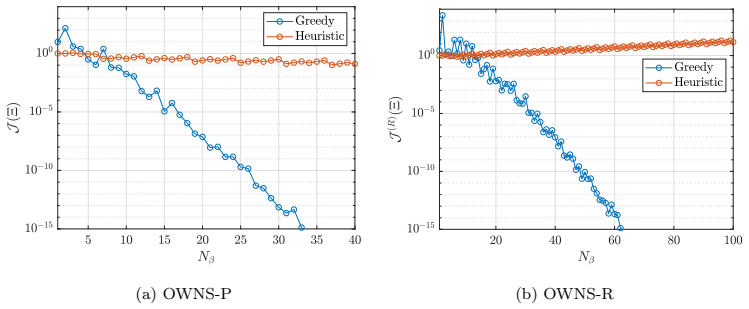
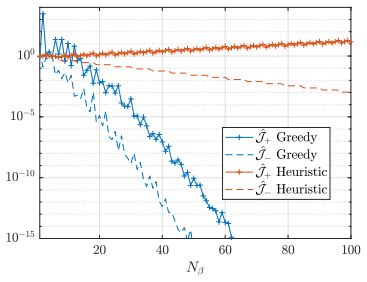
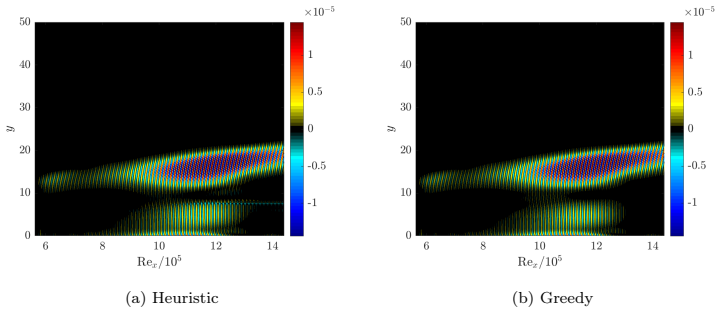
The greedy algorithm iteratively selects each new recursion parameter to minimize the error of the resulting one-way operator relative to a reference solution, which produces faster error reduction than heuristic choices and therefore lowers the total number of operations needed to reach a target accuracy in linear and nonlinear boundary-layer simulations.
What carries the argument
The greedy recursion parameter selection procedure, which at each iteration adds the parameter value that most reduces the discrepancy between the one-way operator and a reference two-way solution.
If this is right
- The method applies directly to any system of linear first-order hyperbolic equations.
- The projection-based one-way method converges faster and more stably than the recursive variant.
- Fewer recursion parameters suffice for a given accuracy, producing a net reduction in computational cost.
- Manual trial-and-error tuning of parameters is replaced by an automatic procedure.
Where Pith is reading between the lines
- The same greedy selection logic could be tested on other numerical filters used in wave propagation problems.
- When the unidirectional assumption is only approximate, the method could be paired with an error monitor that switches back to the full system if needed.
- Extending the tests to three-dimensional or more complex geometries would clarify how broadly the cost savings hold.
Load-bearing premise
Wave propagation must remain sufficiently unidirectional so that the recursive filter can remove left-going waves without introducing large errors into the retained right-going solution.
What would settle it
Apply the greedy method to a hyperbolic system with strong bidirectional propagation and check whether the one-way solution deviates substantially from the full two-way reference; large deviations would show the accuracy claim fails.
Figures



read the original abstract
Solutions to hyperbolic systems comprise waves propagating at finite speeds. When wave propagation is predominantly unidirectional, one-way wave equations can be used to evolve only the right-going solution by removing support for left-going waves. The One-Way Navier-Stokes (OWNS) approach, which was originally developed for systems of first-order hyperbolic equations, constructs one-way approximations to the linearized Navier-Stokes equations using a recursive filter to remove left-going waves. The computational cost scales with the number of recursion parameters, which must be carefully chosen to ensure accuracy and stability of the resulting one-way equation. Previous work has chosen parameters based on heuristic estimates of key eigenvalues, which requires trial-and-error tuning while also yielding slow error convergence. We propose a greedy algorithm for automatic parameter selection, which we show yields faster convergence and a net decrease in computational cost for linear and nonlinear disturbance evolution in boundary-layer flows. We review the OWNS projection (OWNS-P) and recursive (OWNS-R) methods, comparing their convergence properties, and show through our numerical analysis and experiments that OWNS-P yields superior convergence and stability properties. Although we demonstrate the method for Navier-Stokes equations, we perform our analyses on systems of linear first-order hyperbolic equations and emphasize that the greedy algorithm is applicable to such systems.
Editorial analysis
A structured set of objections, weighed in public.
Referee Report
Summary. The paper introduces a greedy algorithm for automatic selection of recursion parameters in one-way spatial integration methods for hyperbolic systems, focusing on the OWNS-P (projection) and OWNS-R (recursive) approaches originally developed for the linearized Navier-Stokes equations. It reviews the construction of one-way approximations that remove left-going waves, performs analysis on linear first-order hyperbolic systems, and demonstrates through numerical experiments that the greedy selection yields faster error convergence and lower net computational cost than heuristic eigenvalue-based tuning for both linear and nonlinear boundary-layer disturbance evolution. The manuscript also compares OWNS-P and OWNS-R, concluding that OWNS-P exhibits superior convergence and stability.
Significance. If the empirical results and comparisons hold, the work provides a reproducible, algorithmic procedure that reduces manual tuning in one-way wave models, which are widely used in aeroacoustics and hydrodynamic stability. The explicit demonstration of cost savings on both linear hyperbolic systems and nonlinear Navier-Stokes cases, together with the side-by-side evaluation of OWNS-P versus OWNS-R, strengthens the practical utility of one-way approximations for unidirectional wave propagation problems.
major comments (2)
- [§4.3] §4.3 (greedy algorithm description): the termination criterion and the precise definition of the local error indicator used to rank candidate recursion parameters are not stated with sufficient formality; without an explicit pseudocode or mathematical statement of the selection loop, it is difficult to assess reproducibility or to verify that the reported convergence improvement is independent of implementation details.
- [§6.2, Table 2] §6.2 and Table 2 (nonlinear boundary-layer experiments): the net computational-cost reduction is asserted after including the greedy search overhead, yet the table reports only the integration cost per time step; a breakdown showing the one-time search cost amortized over the number of runs performed would be required to substantiate the 'net decrease' claim for typical usage patterns.
minor comments (3)
- [§2.1] §2.1: the notation distinguishing the recursion parameters from the eigenvalues of the spatial operator is introduced without a consolidated symbol table; adding such a table would improve readability.
- [Figure 5] Figure 5 caption: the line styles for OWNS-P and OWNS-R are not described, making it hard to match curves to the two methods without consulting the main text.
- [References] Reference list: the citation to the original OWNS papers is present, but more recent works on one-way approximations for nonlinear systems (post-2020) are absent; a brief update would place the contribution in current context.
Simulated Author's Rebuttal
We thank the referee for the careful reading of our manuscript and the constructive comments. We address each major comment below and have revised the manuscript to incorporate the suggested improvements for clarity and completeness.
read point-by-point responses
-
Referee: [§4.3] §4.3 (greedy algorithm description): the termination criterion and the precise definition of the local error indicator used to rank candidate recursion parameters are not stated with sufficient formality; without an explicit pseudocode or mathematical statement of the selection loop, it is difficult to assess reproducibility or to verify that the reported convergence improvement is independent of implementation details.
Authors: We agree that the description in §4.3 would benefit from greater formality to support reproducibility. In the revised manuscript we will add an explicit mathematical definition of the local error indicator, the procedure for ranking candidate recursion parameters, and the termination criterion for the selection loop. We will also include pseudocode for the full greedy algorithm. revision: yes
-
Referee: [§6.2, Table 2] §6.2 and Table 2 (nonlinear boundary-layer experiments): the net computational-cost reduction is asserted after including the greedy search overhead, yet the table reports only the integration cost per time step; a breakdown showing the one-time search cost amortized over the number of runs performed would be required to substantiate the 'net decrease' claim for typical usage patterns.
Authors: We acknowledge that Table 2 reports only the per-step integration costs. To substantiate the net-cost claim, the revised manuscript will include an explicit breakdown of the one-time greedy-search overhead together with amortization over representative numbers of runs and simulation lengths typical of boundary-layer studies. revision: yes
Circularity Check
No significant circularity detected
full rationale
The paper introduces a greedy algorithm for selecting recursion parameters in one-way spatial integration of hyperbolic systems. This is an algorithmic procedure driven by an external error indicator rather than any fitted quantity that is then re-used as a prediction. The reported improvements in convergence and cost are measured directly from numerical experiments on both linear first-order hyperbolic systems and nonlinear boundary-layer flows. The unidirectionality premise is stated as the standard modeling assumption for one-way equations and is not derived from the algorithm itself. No self-definitional steps, fitted-input predictions, or load-bearing self-citation chains appear in the derivation; the central claims remain independent of the parameter-selection procedure.
Axiom & Free-Parameter Ledger
free parameters (1)
- number of recursion parameters
axioms (1)
- domain assumption Wave propagation is predominantly unidirectional
Reference graph
Works this paper leans on
-
[1]
D. Lee, A. D. Pierce, E.-C. Shang, Parabolic equation development in the twentieth century, Journal of Computational Acoustics 08 (04) (2000) 527–637. doi:10.1142/S0218396X00000388
-
[2]
L. N. Trefethen, L. Halpern, Well-posedness of one-way wave equa- tions and absorbing boundary conditions, Mathematics of Computation 47 (176) (1986) 421–435
work page 1986
-
[3]
L. Halpern, L. N. Trefethen, Wide-angle one-way wave equations, The Journal of the Acoustical Society of America 84 (4) (1988) 1397–1404. doi:10.1121/1.396586
-
[4]
J. F. Claerbout, Fundamentals of geophysical data processing with ap- plications to petroleum prospecting. [Textbook], McGraw-Hill Book Co., Inc.,New York, 1976. 44
work page 1976
-
[5]
J. F. Claerbout, Imaging the earth’s interior, Blackwell Scientific Pub.,Palo Alto, CA, 1985
work page 1985
-
[6]
M. D. Collins, Applications and time-domain solution of higher-order parabolic equations in underwater acoustics, The Journal of the Acous- tical Society of America 86 (3) (1989) 1097–1102. doi:10.1121/1.398101
-
[7]
F. B. Jensen, W. A. Kuperman, M. B. Porter, H. Schmidt, J. F. Bar- tram, Computational ocean acoustics, The Journal of the Acoustical Society of America 97 (5) (1995) 3213–3213. doi:10.1121/1.411832
-
[8]
M. N. Guddati, Arbitrarily wide-angle wave equations for complex me- dia, Computer Methods in Applied Mechanics and Engineering 195 (1) (2006) 65–93. doi:10.1016/j.cma.2005.01.006
-
[9]
A. Towne, T. Colonius, One-way spatial integration of hyperbolic equations, Journal of Computational Physics 300 (2015) 844–861. doi:https://doi.org/10.1016/j.jcp.2015.08.015
-
[10]
R.J.Briggs, Electron-streaminteractionwithplasmas, MITPress, 1964, Ch. 2, pp. 32–33
work page 1964
- [11]
-
[12]
doi:10.1016/S0021-9991(03)00005-6
-
[13]
T. Hagstrom, T. Warburton, A new auxiliary variable formulation of high-order local radiation boundary conditions: corner compatibility conditions and extensions to first-order systems, Wave Motion 39 (4) (2004) 327–338, new computational methods for wave propagation. doi:10.1016/j.wavemoti.2003.12.007
-
[14]
A. Towne, G. Rigas, O. Kamal, E. Pickering, T. Colonius, Efficient global resolvent analysis via the one-way navier–stokes equations, Jour- nal of Fluid Mechanics 948 (2022) A9. doi:10.1017/jfm.2022.647
-
[15]
O. Kamal, G. Rigas, M. T. Lakebrink, T. Colonius, Application of the One-Way Navier-Stokes (OWNS) equations to hypersonic boundary lay- ers, in: AIAA AVIATION 2020 FORUM, 2020. doi:10.2514/6.2020- 2986. 45
-
[16]
O. Kamal, G. Rigas, M. Lakebrink, T. Colonius, Input/output analysis of hypersonic boundary layers using the one-way navier- stokes (owns) equations, in: AIAA AVIATION 2021 FORUM, 2021. doi:10.2514/6.2021-2827
-
[17]
O. Kamal, G. Rigas, M. T. Lakebrink, T. Colonius, Input/output analy- sis of a mach-6 cooled-wall hypersonic boundary layer using the one-way navier-stokes(owns)equations, in: AIAAAVIATION2022Forum, 2022. doi:10.2514/6.2022-3556
-
[18]
G. Rigas, T. Colonius, M. Beyar, Stability of wall-bounded fows using one-way spatial integration of Navier-Stokes equations, in: 55th AIAA Aerospace Sciences Meeting, 2017. doi:10.2514/6.2017-1881
-
[19]
M. K. Sleeman, T. Colonius, M. T. Lakebrink, Boundary-layer stability analysis using the Nonlinear One-Way Navier–Stokes Approach, AIAA J. 0 (0) (2025) 1–15. doi:10.2514/1.J064909
-
[20]
F. P. Bertolotti, T. Herbert, P. R. Spalart, Linear and nonlinear stability of the blasius boundary layer, Journal of Fluid Mechanics 242 (1992) 441–474. doi:10.1017/S0022112092002453
-
[21]
Herbert, Parabolized stability equations, Annual Review of Fluid Mechanics 29 (1) (1997) 245–283
T. Herbert, Parabolized stability equations, Annual Review of Fluid Mechanics 29 (1) (1997) 245–283. doi:10.1146/annurev.fluid.29.1.245
-
[22]
M. Zhu, A. Towne, Recursive one-way navier-stokes equations with pse-like cost, Journal of Computational Physics 473 (2023) 111744. doi:10.1016/j.jcp.2022.111744
-
[23]
C. Rudel, S. Pernet, J.-P. Brazier, Numerical factorization of propaga- tion operator for hyperbolic equations and application to one-way, true amplitude one-way equations and bremmer series, Journal of Scientific Computing 93 (09 2022). doi:10.1007/s10915-022-01985-7
-
[24]
H.-O. Kreiss, Initial boundary value problems for hyperbolic systems, Communications on Pure and Applied Mathematics 23 (3) (1970) 277–
work page 1970
-
[25]
doi:https://doi.org/10.1002/cpa.3160230304
-
[26]
R. L. Higdon, Initial-boundary value problems for linear hyperbolic sys- tems, SIAM Review 28 (2) (1986) 177–217. 46
work page 1986
-
[27]
A. Towne, Advancements in Jet Turbulence and Noise Modeling: Ac- curate One-Way Solutions and Empirical Evaluation of the Nonlinear Forcing of Wavepackets, Ph.D. thesis, California Institute of Technol- ogy (Jan. 2016)
work page 2016
-
[28]
K. W. Thompson, Time dependent boundary conditions for hyper- bolic systems, Journal of Computational Physics 68 (1) (1987) 1–24. doi:10.1016/0021-9991(87)90041-6
-
[29]
R. D. Joslin, C. L. Streett, C. L. Chang, Spatial direct numerical simula- tion of boundary-layer transition mechanisms: Validation of PSE theory, Theoretical and Computational Fluid Dynamics 4 (6) (1993) 271–288. doi:10.1007/BF00418777
-
[30]
Y. Ma, X. Zhong, Receptivity of a supersonic boundary layer over a flat plate. part 1. wave structures and interactions, Journal of Fluid Mechanics 488 (2003) 31–78. doi:10.1017/S0022112003004786
-
[31]
O. Kamal, Optimal receptivity and the generalization of the One-Way Navier-Stokes (OWNS) Equations to complex high-speed boundary lay- ers and jets, Ph.D. thesis, California Institute of Technology (Jan. 2023)
work page 2023
-
[32]
J. Van Ingen, A. R. C. F. M. Sub-Committee, V. Technische Hogeschool Delft, A Suggested Semi-empirical Method for the Calcu- lation of the Boundary Layer Transition Region, ARC-19337, TH Delft, Delft, 1956
work page 1956
- [33]
discussion (0)
Sign in with ORCID, Apple, or X to comment. Anyone can read and Pith papers without signing in.