REVIEW 4 major objections 6 minor 54 references
Generalized Category Discovery via Reciprocal Learning and Class-Wise Distribution Regularization
T0 review · 4 major / 6 minor · reviewed 2026-08-07 · deepseek-v4-flash
Pith's one-line read Adding an auxiliary base-class branch and a class-wise distribution loss improves generalized category discovery.
desk verdict A strong, honest empirical GCD paper: RLF plus CDR gives a real plug-in gain, with a sloppy but salvageable theorem proof and missing error bars. read the letter →
The pith
A machine-rendered reading of the paper's core claim, the machinery that carries it, and where it could break.
The reading
What carries the argument
The load-bearing objects are the AUX token and the CDR loss. The AUX token is a single trainable parameter inserted before the last block of the ViT; its output is dedicated to a base-only classifier, giving the model a specialist module for known classes. The reciprocal loop consists of a pseudo-base filter (the main branch selects samples it predicts as base) and cross-branch distillation, with KL divergence weighted by the auxiliary branch's maximum probability. The CDR loss computes, for each category k, a class-wise expected distribution m_k over the mini-batch and maximizes the inner product between the two augmented views' distributions, which the authors prove equals one only when both views agree and are one-hot; the loss thus drives predictions toward confident, view-consistent distributions and treats every class equally, counteracting the base-class bias introduced by the reciprocal loop.
What would settle it
On CUB200, replace the pseudo-base filter with a random subset of equal size during training; if all-class accuracy does not drop well below the reported 70.0, the reciprocal filter is not the mechanism behind the gain. A complementary check: measure the auxiliary branch's base pseudo-label accuracy in the first 50 epochs; if it is not higher than the main branch's, distillation is not supplying more reliable labels.
Extended reading notes
Core claim
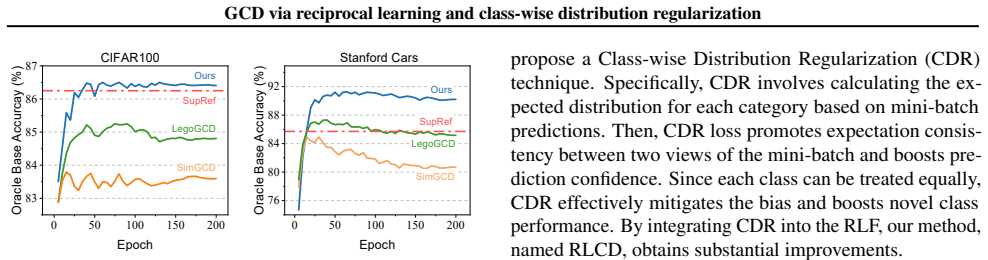
The central discovery is that the bottleneck in current GCD models is unreliable soft labels from self-supervision, which hurt base-class discrimination. RLCD addresses this with a Reciprocal Learning Framework: a trainable AUX token is inserted before the final transformer block; its output feeds a base-only classifier, while the CLS token continues to feed the all-class classifier. During training, the main branch filters samples it predicts as base classes and sends them to the auxiliary branch; the auxiliary branch, in turn, distills its base-class distribution back to the main branch, weighted by the auxiliary confidence. This creates a virtuous cycle because the auxiliary branch specializes in base classes and provides more accurate soft labels than the main branch's own self-supervision. On top of this, Class-wise Distribution Regularization (CDR), which enforces consistency between class-wise expected predictive distributions of two augmented views, increases prediction confidence and mitigates a learned bias toward base classes, improving novel-class accuracy. After training only the main branch is kept, so the extra cost during inference is negligible.
Load-bearing premise
The reciprocal loop only helps if the main branch's pseudo-base filter is accurate enough that most samples it sends to the auxiliary branch are genuinely base-class samples; if early misrouting sends many novel samples in, the auxiliary branch will amplify that bias.
Editorial extensions
If this is right
- Base-class discrimination in GCD can be improved without extra inference cost, because at test time only the main branch and its all-class classifier are used.
- The gap between supervised-only base accuracy and GCD base accuracy can be closed or even inverted, with RLCD reporting oracle base accuracy above the supervised reference on CIFAR100 and Stanford Cars.
- Class-wise distribution regularization is a label-free consistency loss, so it can be applied to any branch and should transfer to other semi-supervised or open-world clustering settings.
- RLCD remains effective when the number of classes is estimated rather than given, and when the labeled fraction is small, as shown by 10% labels on CUB200, suggesting the mechanism does not depend on exact supervision.
- Removing either the auxiliary branch or the distillation step drops base accuracy substantially, so the reciprocal loop is a genuinely load-bearing component rather than a side effect of extra parameters.
Reading between the lines
- We infer that the same reciprocal structure could apply to other token-based classifiers, such as multi-modal encoders, where a dedicated known-class token might guard against open-world drift.
- We infer that the fixed CDR weight likely needs rescaling with batch size and class imbalance, and a batch-size-adaptive beta would be a natural testable variant.
- We infer that the larger gains observed at 10% labeled data indicate the method acts as a form of self-distillation that is most valuable under scarce supervision.
- We infer that because the paper removes InfoNCE alongside adding RLF and CDR, the isolated contribution of each change is not fully separated; a two-by-two ablation of InfoNCE removal and RLF+CDR would test whether the reciprocal loop alone drives the improvement.
Editorial analysis
A structured set of objections, weighed in public.
Referee Report
Summary. The paper proposes RLCD, a parametric generalized category discovery method combining a Reciprocal Learning Framework (RLF) and Class-wise Distribution Regularization (CDR). RLF inserts an AUX token and a base-only classifier into a ViT; the main branch filters pseudo-base samples for the auxiliary branch, whose soft labels are distilled back into the main branch. CDR computes class-wise expected distributions from two views of a mini-batch and encourages consistency and confidence. The authors introduce an Oracle Base accuracy metric, report state-of-the-art results on seven GCD benchmarks with both DINO and DINOv2 backbones, and provide ablations, hyper-parameter sensitivity, robustness analyses, and an appendix with theoretical support.
Significance. If the empirical claims hold, RLCD is a useful contribution: the AUX-token reciprocal design is simple, adds negligible inference cost, and the reported gains on fine-grained benchmarks (3.6% average improvement over prior methods on DINO) are practically meaningful. The paper also ships code, defines a new evaluation metric (OB) that directly targets base-class discrimination, and provides extensive comparisons and ablations. The main weaknesses are that the theoretical justification for CDR (Theorem 3.2) is incorrect as stated, and a key design choice (removing InfoNCE) is not ablated in isolation, so the attribution of gains to the proposed components is not fully established.
major comments (4)
- [Section 3.3, Theorem 3.2 and Appendix A] The proof of Theorem 3.2 is invalid. From the Cauchy-Schwarz equality one obtains a = b, but the subsequent step "sum_i a_i^2 <= sum_i a_i = 1 implies a_i in {0,1}" is incorrect: the inequality holds for every probability vector and does not force equality, so it does not imply one-hotness. Moreover, the claimed one-hot optimum is unreachable for the quantity defined in Eq. (7): m_k is a convex combination of per-sample distributions p_i weighted by p_i^(k), so m_k can be one-hot only if every sample with positive p_i^(k) has all its probability mass on class k, which cannot hold for all k simultaneously in a batch containing multiple classes. This is load-bearing because the paper uses Theorem 3.2 to claim that CDR 'increases prediction confidence' and converges to one-hot distributions. The theorem should either be corrected to a valid statement (e.g., an inequality relating L_CDR to a proper scoring rule or to the variance of predictions) or removed and replaced by empirical evidence.
- [Section 3.1 and Table 3] The removal of the InfoNCE loss is described as a deliberate choice ('we chose to remove InfoNCE in our approach'), but no ablation isolates this change. Since SimGCD's objective includes InfoNCE, and the paper argues that InfoNCE 'conflicts with the SupCon loss and impairs feature discrimination,' the reported gains over SimGCD could be substantially due to this removal rather than to RLF or CDR. Please add an ablation that runs the full RLCD pipeline with and without InfoNCE, and ideally also runs a SimGCD baseline with InfoNCE removed, so the contribution of each component is identifiable.
- [Tables 1, 2 and all experimental tables] No standard deviations or multiple seeds are reported. Some improvements are small relative to likely run-to-run variation (e.g., CIFAR10 with DINOv2: 99.0 vs 99.0; several fine-grained numbers), and the claim of 'consistently outperforming' all methods would be strengthened by reporting means and standard deviations over at least three seeds. This is particularly important because GCD training involves stochastic pseudo-label filters and entropy regularization.
- [Section 3.2 and Table 4] The reciprocal learning mechanism assumes that the main branch's pseudo-base filter is reliable enough that feeding filtered pseudo-base samples to the auxiliary branch creates a 'virtuous cycle.' Table 4 reports final pseudo-label accuracy of the AUX branch, but it does not measure the precision of the filter during training, especially in the early epochs when many novel samples may be misrouted into the base set. Please report the precision and recall of the pseudo-base filter as a function of training epoch, or include an upper-bound ablation that uses the ground-truth base mask instead of the pseudo-base filter, to quantify how much performance depends on filter quality.
minor comments (6)
- [Equation (9)] The total CDR loss L_CDR is used in Eq. (9) but never explicitly defined. Please specify whether it is the sum or the mean of L_CDR^(k) over classes, since this affects the effective gradient scale and the interpretation of the hyper-parameter beta.
- [Equation (5)] The notation max(p_aux_b,i) should be clarified: it is the maximum over base-class probabilities of the auxiliary branch for sample i. Please also state explicitly that the maximum is taken over the base-class output dimension.
- [Appendix D, Table 8] The comparison of parameter counts removes the projector in RLCD while SimGCD and LegoGCD keep it. This is a fair design choice, but the text should note that the projector removal is an additional difference from SimGCD, not a consequence of the proposed AUX token, so readers can separate its effect from the proposed components.
- [Introduction and Appendix G] There are two typos: 'Semantic Shit Benchmark' should be 'Semantic Shift Benchmark,' and 'GCP' in Appendix G should be 'GPC.'
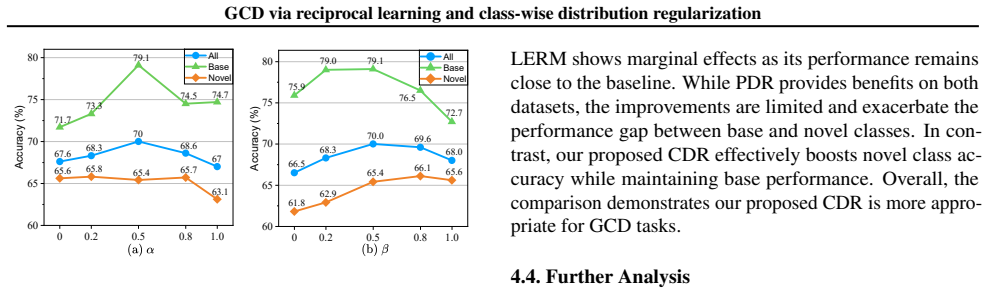
- [Figure 6] The hyper-parameter sensitivity plots report All/Base/Novel accuracy for alpha and beta but do not include error bars or repeated runs, so the apparent flatness or peaks may not be significant. Adding multiple seeds would make the recommended default (alpha=beta=0.5) more convincing.
- [Appendix C] The supervised cross-entropy (SupCE) loss curves are presented as evidence of reduced label noise, but the plot reports only the training loss, not label accuracy. Reporting the pseudo-label accuracy of the main branch over time (or the fraction of samples whose soft label agrees with the ground-truth base label) would more directly support the claim.
Circularity Check
No significant circularity: central results are benchmarked against external baselines and do not reduce to fitted inputs or self-citations.
full rationale
The paper's central claims are empirical: RLCD is compared with external GCD baselines on seven datasets (Tables 1-2), and ablations (Table 3) attribute the gains to specific loss components. The RLF pseudo-base filter/distillation loop in Eqs. (5)-(6) is a self-training mechanism whose behavior depends on the trained network and data, not a quantity that equals its output by construction: the auxiliary branch's soft labels are detached and weighted by max(p_aux_b,i), and Table 4 independently verifies pseudo-label accuracy. The CDR loss in Eqs. (7)-(8) uses class-wise expected distributions from two views; no parameter is fitted to a subset and then reported as a prediction, and the claimed confidence effect is separately monitored in Fig. 4. Theorem 3.1 and the definition of m_k are explicitly credited to Zhang et al. (2024), an external source. The proof of Theorem 3.2 in Appendix A is mathematically flawed: from sum a_i^2 <= sum a_i = 1 one cannot conclude that a is one-hot. However, that is a correctness concern, not circularity, because Eq. (8) is not defined in terms of the novel-class improvements it is said to produce. The only self-citations are Zhao et al. 2023b and 2024 in Appendix J's future-work paragraph on continual GCD; they are not load-bearing for any main result. No step in the derivation reduces by the paper's own equations to its input, so no circularity is found.
Assumptions & free parameters
free parameters (3)
- alpha (distillation strength) =
0.5
- beta (CDR weight) =
0.5
- lambda (SimGCD balance weight) =
0.35
assumptions (6)
- ad hoc to paper The pseudo-base filter based on the main branch's all-class predictions is reliable enough for cross-branch distillation to help.
- ad hoc to paper Removing the InfoNCE loss improves feature discrimination relative to SimGCD.
- domain assumption The class-wise expected distribution m_k from LERM is a useful regularizer for GCD.
- domain assumption The pretrained DINO/DINOv2 backbone provides a strong feature initialization for GCD.
- domain assumption The total number of classes |Y_u| is known in advance.
- standard math Cauchy-Schwarz inequality and the probabilistic interpretation of m_k as a distribution.
invented entities (1)
-
AUX token and the auxiliary base-class classification branch
Cite this review
Pith. "Pith review of Generalized Category Discovery via Reciprocal Learning and Class-Wise Distribution Regularization." pith.science (2026). https://pith.science/paper/3FBGASSN
@misc{pith2026250602334,
  author       = {Pith},
  title        = {Pith review of: Generalized Category Discovery via Reciprocal Learning and Class-Wise Distribution Regularization},
  year         = {2026},
  howpublished = {\url{https://pith.science/paper/3FBGASSN}},
  note         = {Machine review of arXiv:2506.02334}
}
read the original abstract
Generalized Category Discovery (GCD) aims to identify unlabeled samples by leveraging the base knowledge from labeled ones, where the unlabeled set consists of both base and novel classes. Since clustering methods are time-consuming at inference, parametric-based approaches have become more popular. However, recent parametric-based methods suffer from inferior base discrimination due to unreliable self-supervision. To address this issue, we propose a Reciprocal Learning Framework (RLF) that introduces an auxiliary branch devoted to base classification. During training, the main branch filters the pseudo-base samples to the auxiliary branch. In response, the auxiliary branch provides more reliable soft labels for the main branch, leading to a virtuous cycle. Furthermore, we introduce Class-wise Distribution Regularization (CDR) to mitigate the learning bias towards base classes. CDR essentially increases the prediction confidence of the unlabeled data and boosts the novel class performance. Combined with both components, our proposed method, RLCD, achieves superior performance in all classes with negligible extra computation. Comprehensive experiments across seven GCD datasets validate its superiority. Our codes are available at https://github.com/APORduo/RLCD.
Figures


Figures from the paper (8 more)




Reference graph
Works this paper leans on
-
[1]
write newline
" write newline "" before.all 'output.state := FUNCTION n.dashify 't := "" t empty not t #1 #1 substring "-" = t #1 #2 substring "--" = not "--" * t #2 global.max substring 't := t #1 #1 substring "-" = "-" * t #2 global.max substring 't := while if t #1 #1 substring * t #2 global.max substring 't := if while FUNCTION format.date year duplicate empty "emp...
-
[2]
Open-world semi-supervised learning
Cao, K., Brbic, M., and Leskovec, J. Open-world semi-supervised learning. In International Conference on Learning Representations, 2022
work page 2022
-
[3]
Solving the catastrophic forgetting problem in generalized category discovery
Cao, X., Zheng, X., Wang, G., Yu, W., Shen, Y., Li, K., Lu, Y., and Tian, Y. Solving the catastrophic forgetting problem in generalized category discovery. In Proceedings of the IEEE/CVF Conference on Computer Vision and Pattern Recognition, pp.\ 16880--16889, 2024
work page 2024
-
[4]
Emerging properties in self-supervised vision transformers
Caron, M., Touvron, H., Misra, I., J \'e gou, H., Mairal, J., Bojanowski, P., and Joulin, A. Emerging properties in self-supervised vision transformers. In Proceedings of the IEEE/CVF international conference on computer vision, pp.\ 9650--9660, 2021
2021
-
[5]
Debiased self-training for semi-supervised learning
Chen, B., Jiang, J., Wang, X., Wan, P., Wang, J., and Long, M. Debiased self-training for semi-supervised learning. Advances in Neural Information Processing Systems, 35: 0 32424--32437, 2022
work page 2022
-
[6]
Contrastive mean-shift learning for generalized category discovery
Choi, S., Kang, D., and Cho, M. Contrastive mean-shift learning for generalized category discovery. In Proceedings of the IEEE/CVF Conference on Computer Vision and Pattern Recognition, pp.\ 23094--23104, 2024
work page 2024
-
[7]
Imagenet: A large-scale hierarchical image database
Deng, J., Dong, W., Socher, R., Li, L.-J., Li, K., and Fei-Fei, L. Imagenet: A large-scale hierarchical image database. In 2009 IEEE Conference on Computer Vision and Pattern Recognition, pp.\ 248--255. IEEE, 2009
work page 2009
-
[8]
An image is worth 16x16 words: Transformers for image recognition at scale
Dosovitskiy, A. An image is worth 16x16 words: Transformers for image recognition at scale. In International Conference on Learning Representations, 2021
work page 2021
Show all 54 references
-
[9]
A unified objective for novel class discovery
Fini, E., Sangineto, E., Lathuili \`e re, S., Zhong, Z., Nabi, M., and Ricci, E. A unified objective for novel class discovery. In Proceedings of the IEEE/CVF International Conference on Computer Vision, 2021
2021
-
[10]
and Bengio, Y
Grandvalet, Y. and Bengio, Y. Semi-supervised learning by entropy minimization. In Advances in neural information processing systems, 2004
2004
-
[11]
Class-relation knowledge distillation for novel class discovery
Gu, P., Zhang, C., Xu, R., and He, X. Class-relation knowledge distillation for novel class discovery. In Proceedings of the IEEE/CVF International Conference on Computer Vision (ICCV), 2023
2023
-
[12]
Learning to discover novel visual categories via deep transfer clustering
Han, K., Vedaldi, A., and Zisserman, A. Learning to discover novel visual categories via deep transfer clustering. In Proceedings of the IEEE/CVF International Conference on Computer Vision, pp.\ 8401--8409, 2019
2019
-
[13]
Automatically discovering and learning new visual categories with ranking statistics
Han, K., Rebuffi, S.-A., Ehrhardt, S., Vedaldi, A., and Zisserman, A. Automatically discovering and learning new visual categories with ranking statistics. In International Conference on Learning Representations, 2020
2020
-
[14]
Autonovel: Automatically discovering and learning novel visual categories
Han, K., Rebuffi, S.-A., Ehrhardt, S., Vedaldi, A., and Zisserman, A. Autonovel: Automatically discovering and learning novel visual categories. IEEE Transactions on Pattern Analysis and Machine Intelligence, 44 0 (10): 0 6767--6781, 2021
2021
-
[15]
Hao, S., Han, K., and Wong, K.-Y. K. Ci PR : An efficient framework with cross-instance positive relations for generalized category discovery. Transactions on Machine Learning Research, 2024. ISSN 2835-8856. URL https://openreview.net/forum?id=1fNcpcdr1o
2024
-
[16]
Deep residual learning for image recognition
He, K., Zhang, X., Ren, S., and Sun, J. Deep residual learning for image recognition. In Proceedings of the IEEE conference on computer vision and pattern recognition, pp.\ 770--778, 2016
2016
-
[17]
Mask r-cnn
He, K., Gkioxari, G., Doll \'a r, P., and Girshick, R. Mask r-cnn. In Proceedings of the IEEE international conference on computer vision, pp.\ 2961--2969, 2017
2017
-
[18]
Minimum class confusion for versatile domain adaptation
Jin, Y., Wang, X., Long, M., and Wang, J. Minimum class confusion for versatile domain adaptation. In Computer Vision--ECCV 2020: 16th European Conference, Glasgow, UK, August 23--28, 2020, Proceedings, Part XXI 16, pp.\ 464--480. Springer, 2020
2020
-
[19]
Supervised contrastive learning
Khosla, P., Teterwak, P., Wang, C., Sarna, A., Tian, Y., Isola, P., Maschinot, A., Liu, C., and Krishnan, D. Supervised contrastive learning. Advances in neural information processing systems, 33: 0 18661--18673, 2020
2020
-
[20]
Conmatch: Semi-supervised learning with confidence-guided consistency regularization
Kim, J., Min, Y., Kim, D., Lee, G., Seo, J., Ryoo, K., and Kim, S. Conmatch: Semi-supervised learning with confidence-guided consistency regularization. In European Conference on Computer Vision, pp.\ 674--690. Springer, 2022
2022
-
[21]
3d object representations for fine-grained categorization
Krause, J., Stark, M., Deng, J., and Fei-Fei, L. 3d object representations for fine-grained categorization. In Proceedings of the IEEE international conference on computer vision workshops, pp.\ 554--561, 2013
2013
-
[22]
Learning multiple layers of features from tiny images
Krizhevsky, A., Hinton, G., et al. Learning multiple layers of features from tiny images. 2009
2009
-
[23]
Kuhn, H. W. The hungarian method for the assignment problem. Naval research logistics quarterly, 2 0 (1-2): 0 83--97, 1955
1955
-
[24]
Lee, D.-H. et al. Pseudo-label: The simple and efficient semi-supervised learning method for deep neural networks. In Workshop on challenges in representation learning, ICML. Atlanta, 2013
2013
-
[25]
Flipped classroom: Aligning teacher attention with student in generalized category discovery
Lin, H., An, W., Wang, J., Chen, Y., Tian, F., Wang, M., Wang, Q., Dai, G., and Wang, J. Flipped classroom: Aligning teacher attention with student in generalized category discovery. In Advances in Neural Information Processing Systems, volume 37, pp.\ 60897--60935, 2024
2024
-
[26]
Happy: A debiased learning framework for continual generalized category discovery
Ma, S., Zhu, F., Zhong, Z., Liu, W., Zhang, X.-Y., and Liu, C.-L. Happy: A debiased learning framework for continual generalized category discovery. In Advances in Neural Information Processing Systems, volume 37, pp.\ 50850--50875, 2024 a
2024
-
[27]
Active generalized category discovery
Ma, S., Zhu, F., Zhong, Z., Zhang, X.-Y., and Liu, C.-L. Active generalized category discovery. In Proceedings of the IEEE/CVF conference on computer vision and pattern recognition, pp.\ 16890--16900, 2024 b
2024
-
[28]
Some methods for classification and analysis of multivariate observations
Macqueen, J. Some methods for classification and analysis of multivariate observations. In Proceedings of 5-th Berkeley Symposium on Mathematical Statistics and Probability/University of California Press, 1967
1967
-
[29]
Fine-grained visual classification of aircraft
Maji, S., Rahtu, E., Kannala, J., Blaschko, M., and Vedaldi, A. Fine-grained visual classification of aircraft. arXiv preprint arXiv:1306.5151, 2013
2013 arXiv
-
[30]
Oord, A. v. d., Li, Y., and Vinyals, O. Representation learning with contrastive predictive coding. arXiv preprint arXiv:1807.03748, 2018
2018 arXiv
-
[31]
DINO v2: Learning robust visual features without supervision
Oquab, M., Darcet, T., Moutakanni, T., Vo, H., Szafraniec, M., Khalidov, V., Fernandez, P., Haziza, D., Massa, F., El-Nouby, A., et al. DINO v2: Learning robust visual features without supervision. Transactions on Machine Learning Research, 2024. ISSN 2835-8856
2024
-
[32]
Dynamic conceptional contrastive learning for generalized category discovery
Pu, N., Zhong, Z., and Sebe, N. Dynamic conceptional contrastive learning for generalized category discovery. In Proceedings of the IEEE/CVF conference on computer vision and pattern recognition, pp.\ 7579--7588, 2023
2023
-
[33]
Learn to categorize or categorize to learn? self-coding for generalized category discovery
Rastegar, S., Doughty, H., and Snoek, C. Learn to categorize or categorize to learn? self-coding for generalized category discovery. Advances in Neural Information Processing Systems, 36, 2024
2024
-
[34]
A., Cubuk, E
Sohn, K., Berthelot, D., Carlini, N., Zhang, Z., Zhang, H., Raffel, C. A., Cubuk, E. D., Kurakin, A., and Li, C.-L. Fixmatch: Simplifying semi-supervised learning with consistency and confidence. Advances in neural information processing systems, 33: 0 596--608, 2020
2020
-
[35]
C., Liu, Y., Ambrose, B., Tulig, M., and Belongie, S
Tan, K. C., Liu, Y., Ambrose, B., Tulig, M., and Belongie, S. The herbarium challenge 2019 dataset. arXiv preprint arXiv:1906.05372, 2019
2019 arXiv
-
[36]
and Valpola, H
Tarvainen, A. and Valpola, H. Mean teachers are better role models: Weight-averaged consistency targets improve semi-supervised deep learning results. Advances in neural information processing systems, 30, 2017
2017
-
[37]
Contrastive multiview coding
Tian, Y., Krishnan, D., and Isola, P. Contrastive multiview coding. In Computer Vision--ECCV 2020: 16th European Conference, Glasgow, UK, August 23--28, 2020, Proceedings, Part XI 16, pp.\ 776--794. Springer, 2020
2020
-
[38]
and Hinton, G
Van der Maaten, L. and Hinton, G. Visualizing data using t-sne. Journal of machine learning research, 9 0 (11), 2008
2008
-
[39]
N., Kaiser, ., and Polosukhin, I
Vaswani, A., Shazeer, N., Parmar, N., Uszkoreit, J., Jones, L., Gomez, A. N., Kaiser, ., and Polosukhin, I. Attention is all you need. In Advances in neural information processing systems, 2017
2017
-
[40]
Open-set recognition: A good closed-set classifier is all you need? In International Conference on Learning Representations, 2022 a
Vaze, S., Han, K., Vedaldi, A., and Zisserman, A. Open-set recognition: A good closed-set classifier is all you need? In International Conference on Learning Representations, 2022 a
2022
-
[41]
Generalized category discovery
Vaze, S., Han, K., Vedaldi, A., and Zisserman, A. Generalized category discovery. In Proceedings of the IEEE/CVF Conference on Computer Vision and Pattern Recognition, pp.\ 7492--7501, 2022 b
2022
-
[42]
No representation rules them all in category discovery
Vaze, S., Vedaldi, A., and Zisserman, A. No representation rules them all in category discovery. In Advances in Neural Information Processing Systems, volume 36, 2024
2024
-
[43]
The caltech-ucsd birds-200-2011 dataset
Wah, C., Branson, S., Welinder, P., Perona, P., and Belongie, S. The caltech-ucsd birds-200-2011 dataset. 2011
2011
-
[44]
Sptnet: An efficient alternative framework for generalized category discovery with spatial prompt tuning
Wang, H., Vaze, S., and Han, K. Sptnet: An efficient alternative framework for generalized category discovery with spatial prompt tuning. In International Conference on Learning Representations, 2024
2024
-
[45]
Hilo: A learning framework for generalized category discovery robust to domain shifts
Wang, H., Vaze, S., and Han, K. Hilo: A learning framework for generalized category discovery robust to domain shifts. In International Conference on Learning Representations, 2025
2025
-
[46]
Parametric classification for generalized category discovery: A baseline study
Wen, X., Zhao, B., and Qi, X. Parametric classification for generalized category discovery: A baseline study. In Proceedings of the IEEE/CVF International Conference on Computer Vision, pp.\ 16590--16600, 2023
2023
-
[47]
Unsupervised data augmentation for consistency training
Xie, Q., Dai, Z., Hovy, E., Luong, T., and Le, Q. Unsupervised data augmentation for consistency training. Advances in neural information processing systems, 33: 0 6256--6268, 2020
2020
-
[48]
Rethinking guidance information to utilize unlabeled samples: A label encoding perspective
Zhang, Y., Yao, Y., Chen, S., Jin, P., Zhang, Y., Jin, J., and Lu, J. Rethinking guidance information to utilize unlabeled samples: A label encoding perspective. In Proceedings of the 41th International Conference on Machine Learning, 2024
2024
-
[49]
Learning semi-supervised gaussian mixture models for generalized category discovery
Zhao, B., Wen, X., and Han, K. Learning semi-supervised gaussian mixture models for generalized category discovery. In Proceedings of the IEEE/CVF International Conference on Computer Vision, pp.\ 16623--16633, 2023 a
2023
-
[50]
Few-shot class-incremental learning via class-aware bilateral distillation
Zhao, L., Lu, J., Xu, Y., Cheng, Z., Guo, D., Niu, Y., and Fang, X. Few-shot class-incremental learning via class-aware bilateral distillation. In Proceedings of the IEEE/CVF conference on computer vision and pattern recognition, pp.\ 11838--11847, 2023 b
2023
-
[51]
Safe: Slow and fast parameter-efficient tuning for continual learning with pre-trained models
Zhao, L., Zhang, X., Yan, K., Ding, S., and Huang, W. Safe: Slow and fast parameter-efficient tuning for continual learning with pre-trained models. In Advances in Neural Information Processing Systems, 2024
2024
-
[52]
Simmatch: Semi-supervised learning with similarity matching
Zheng, M., You, S., Huang, L., Wang, F., Qian, C., and Xu, C. Simmatch: Semi-supervised learning with similarity matching. In Proceedings of the IEEE/CVF Conference on Computer Vision and Pattern Recognition, pp.\ 14471--14481, 2022
2022
-
[53]
Neighborhood contrastive learning for novel class discovery
Zhong, Z., Fini, E., Roy, S., Luo, Z., Ricci, E., and Sebe, N. Neighborhood contrastive learning for novel class discovery. In Proceedings of the IEEE/CVF conference on computer vision and pattern recognition, pp.\ 10867--10875, 2021
2021
-
[54]
Openmix: Exploring outlier samples for misclassification detection
Zhu, F., Cheng, Z., Zhang, X.-Y., and Liu, C.-L. Openmix: Exploring outlier samples for misclassification detection. In Proceedings of the IEEE/CVF Conference on Computer Vision and Pattern Recognition, pp.\ 12074--12083, 2023
2023
Reviewed August 7, 2026 · model on record in the stance chip above.
Discussion (0). Sign in to comment.