REVIEW 4 major objections 6 minor 1 cited by
Truth over Tricks: Measuring and Mitigating Shortcut Learning in Misinformation Detection
T0 review · 4 major / 6 minor · reviewed 2026-08-07 · deepseek-v4-flash
Pith's one-line read Misinformation detectors trained on static benchmarks do not learn authenticity: they learn spurious correlations with surface cues, and LLM rewriting of a text can cut their accuracy by up to 92 percent; retraining on LLM-paraphrased…
desk verdict Large, useful shortcut-injection benchmark, but the headline degradation numbers only appear under deliberately anti-correlated retraining, not on standard-trained detectors. read the letter →
The pith
A machine-rendered reading of the paper's core claim, the machinery that carries it, and where it could break.
The reading
What carries the argument
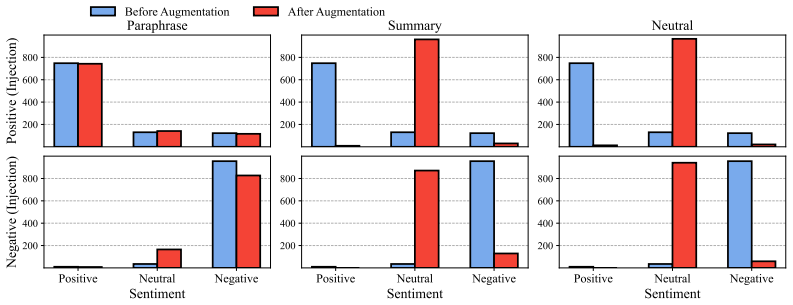
The load-bearing object is a taxonomy: intrinsic shortcut induction, which splits a benchmark so the joint distribution of the label and an indicator (sentiment, style, topic, or perplexity) is reversed between training/validation and test, and extrinsic shortcut injection, which uses Meta-Llama-3-8B-Instruct prompts to rewrite both real and fake texts with explicit attributes (sentiment, tone, word choice) or implicit author attributes (age, gender). The second load-bearing object is SMF, an LLM-augmented data augmentation framework whose three variants—Paraphrase, Summary (keep only fact-relevant content), and Neutral (overwrite a shortcut factor with a neutral alternative)—are applied to text before both training and inference. These objects carry the argument because the extrinsic injection constructs the failure mode, the intrinsic splits demonstrate that the failure exists naturally in existing benchmarks, and SMF supplies the claimed cure.
What would settle it
Train a detector on a standard split, then evaluate it on test texts rewritten by a rule-based, non-LLM paraphrasing engine that changes surface wording while provably introducing no label-correlated sentiment, topic, or style cue; if accuracy stays near the original level, the LLM-rewrite drop is not generic distribution shift, but if it also falls to near chance, the shortcut explanation is not needed to explain the Vanilla results.
Extended reading notes
Core claim
On the paper's own terms, the central discovery is that trainable content-based misinformation detectors do not learn to assess whether a claim is true; they learn correlations between the label and shortcut features, so when an LLM rewrites content with a different sentiment, tone, or word choice, accuracy collapses even though the underlying truth label is unchanged. The evidence includes average accuracy drops of about 80 percent, and up to 92 percent, for BERT, DeBERTa, and three debiasing detectors under explicit injection, plus transfer results showing that a detector trained on sentiment-injected data improves on the SST-2 and MTEB sentiment tasks without ever seeing sentiment labels. LLM-based detectors prompted in a zero-shot fashion are less accurate overall but largely immune to the same injections. The paper further claims that rewriting training and test texts with SMF—paraphrase, factual summarization, or sentiment-neutralization—removes enough shortcut signal to substantially recover accuracy, with improvements up to 838.4 percent on the most damaging attacks.
Load-bearing premise
The paper's diagnosis assumes that the large accuracy drop under the Vanilla LLM rewrite (for example, BERT falling from 78.1 to 17.3) is caused by the detector latching onto shortcut cues, but the Vanilla prompt injects no explicit shortcut, so ordinary sensitivity to a changed writing style could in principle produce the same drop without any specific spurious cue being learned.
Editorial extensions
If this is right
- A detector's high accuracy on a static benchmark should not be read as evidence that it detects misinformation; the same architecture collapses to near chance when the surface form of the text changes.
- LLM-based prompting detectors, though weaker on standard benchmarks, are the more robust option against rewrite-based attacks, which argues for hybrid designs that combine LLM judgment with trainable components.
- Data-centric augmentation using SMF is a viable complement to debiasing model architectures, and combining debiasing methods with SMF yields the strongest robustness under explicit injection.
- Detectors trained under shortcut-inducing conditions acquire transferable ability on unrelated tasks such as sentiment classification, so shortcut reliance can be diagnosed by probing which auxiliary skills a model gained during training.
- The two new factual misinformation datasets, NQ-Misinfo and Streaming-Misinfo, provide a way to test whether a detector uses factual knowledge, and current detectors perform only slightly above chance on them.
Reading between the lines
- If the shortcut diagnosis transfers, the same evaluation design could be applied to other content-classification tasks such as hate speech, spam, and stance detection, where LLM rewriting is equally cheap and would likely reveal similar fragility.
- The success of the Summary variant suggests that training models on concise, fact-only versions of claims could serve as a general robustness regularizer, independent of the specific attack type used at evaluation time.
- A testable extension is to apply SMF at inference time only, without retraining, since the framework rewrites text before both training and inference; the paper does not separate these two effects, so it is unknown whether rewriting alone can protect a deployed detector.
- Because the implicit age and gender injections fail to move detectors, the practical threat model is narrower than 'any LLM rewrite': only attacks that shift an explicit, learnable surface attribute are dangerous, and future adversarial prompts that succeed at implicit author impersonation could close that gap.
Editorial analysis
A structured set of objections, weighed in public.
Referee Report
Summary. The paper introduces TruthOverTricks, a two-part evaluation paradigm for shortcut learning in misinformation detection: intrinsic shortcut induction (sentiment, style, topic, perplexity) and extrinsic shortcut injection (Vanilla, Explicit, and Implicit LLM-based rewriting). It evaluates seven detectors across 16 datasets, including two new QA-derived factual misinformation benchmarks (NQ-Misinfo, Streaming-Misinfo), reports that trainable detectors suffer large accuracy drops under the constructed shortcut settings, and proposes SMF, an LLM-based data augmentation framework (Paraphrase, Summary, Neutral variants) that improves accuracy under these settings. The paper also includes human evaluations of injection fidelity and a public release of resources.
Significance. If the claims were accepted as stated, the paper would provide a broad evaluation paradigm and a data-centric mitigation for an important but under-measured failure mode. The manuscript has genuine strengths: a large benchmark coverage (16 datasets, 7 detectors), explicit prompts for six injection strategies, human and automated checks that the injected rewrites preserve authenticity, external sentiment-transfer experiments as evidence of shortcut acquisition, and publicly released resources. However, the central diagnostic claim is currently overstated: the main degradation results are produced by retraining detectors on deliberately anti-correlated splits, not by exposing standard-trained detectors to rewritten inputs, and the paper's own control experiments (Tables 20–21) show only minor performance changes under standard training. Several quantitative claims also rest on very small test sets and best-of-five reporting without variance estimates. The framework and datasets are valuable, but the interpretation needs to be reframed and the evidence needs to be reported with appropriate qualifications.
major comments (4)
- [Abstract; §3.2; Appendix J.2; Tables 20–21] The central claim that existing detectors 'suffer severe performance degradation when exposed to' shortcuts is not supported as stated. The large drops in Table 2 are obtained by retraining each trainable detector on training/validation splits where the injected attribute e is perfectly correlated with the label y, then testing on the reversed correlation (Appendix J.2). Appendix F.3, Tables 20–21, shows that when the same detectors are trained on the original data and evaluated on the rewritten test sets, performance changes are minor (e.g., BERT on D01 goes from 74.6 Original to 79.4 Vanilla; DEBERTA on D01 goes from 68.3 to 59.3). The paper should either rephrase the claim as 'detectors suffer severe degradation when retrained under deliberately induced anti-correlated splits' or add standard-trained evaluations to support the broad statement that existing detectors fail on rewritten inputs.
- [Table 9; Table 1; Table 14] Several intrinsic shortcut cells have extremely small test sets, making the reported accuracies unstable. For example, Celeberty Style has 2 test instances, COCO Style has 2 test instances, and RumourEval Sentiment has 9 test instances. Appendix H states that experiments were run five times and the best performance is reported, but no standard deviations or error bars are given. This makes it impossible to assess whether the per-dataset drops and occasional improvements in Table 1 and Table 14 are meaningful. The manuscript should report variance across runs or restrict per-cell conclusions to cells with sufficiently large test sets.
- [§2.1; Appendix C] The 'intrinsic shortcut induction' protocol constructs training/test splits that are anti-correlated by design, so it measures susceptibility to an induced spurious correlation rather than demonstrating that shortcuts 'naturally emerge within existing benchmarks.' The distribution plots (Figure 5, Table 13) show similar marginal distributions, but the experimental protocol forces the joint distribution to differ between training and test. The manuscript should separate the claim that datasets contain potential shortcut cues (supported by the distribution analyses) from the claim that standard-trained detectors already rely on those cues (which the current protocol does not test).
- [§4.2; Table 3] The mitigation results are reported as relative percentages over a near-zero baseline, which is misleading. For example, BERT under Vanilla goes from 17.3 to 38.8 with Paraphrase (123.7% relative), and under Word Choice from 7.0 to 63.4 (800.5% relative), but absolute accuracy remains low and several augmented cells stay near or below chance (e.g., DEBERTA Vanilla with Paraphrase 30.2; BERT Sentiment with Paraphrase 14.7). The claim that SMF 'consistently enhances robustness across 16 benchmarks' should be qualified with per-dataset absolute performance, and statistical significance across the five runs should be reported.
minor comments (6)
- [Figure 8; §3.2] The caption says 'before and after training under the Sentiment injection attack,' but the text refers to 'after shortcut-based training' and the figure shows accuracy on SST-2 and MTEB; please clarify that the evaluation is on external sentiment datasets, not on the misinformation test set.
- [Appendix B; Table 8] The two new datasets are constructed by converting QA pairs into declarative sentences and using CoEdIT to fix grammar; please report how many instances were discarded due to grammar-correction failure or other filtering, since this could affect the dataset's representativeness.
- [Appendix J.2] The notation '∥e∥' for the number of attribute values is nonstandard; consider using '|e|' or explicitly stating 'the number of possible attribute values.'
- [Table 7; Appendix H] The hyperparameter table does not include training epochs, early stopping criteria, or validation selection details; adding these would improve reproducibility.
- [§2.2; Table 5] The Vanilla strategy is described as 'altering prompt formats,' but the three Vanilla prompts (rewriting, paraphrase, open-ended) change the text substantially, not merely the format; the wording should be adjusted.
- [References] The entries for Tianchi, Kaggle1, and Kaggle2 contain only links with no formal citation information; please provide complete citations or dataset documentation references.
Circularity Check
No significant circularity: the paper's central claims rest on controlled stress-test experiments with external validation, and the self-citations are contextual rather than load-bearing.
full rationale
The paper's main empirical claims are measurements under an explicitly constructed evaluation protocol, not predictions derived from the protocol's inputs. The intrinsic and extrinsic shortcut settings deliberately create training/test splits in which a chosen attribute e is correlated with the label y in training and anti-correlated in test (Section 2.1 and Appendix C). Downstream accuracy drops under this protocol are a designed stress test for shortcut reliance, not a self-fulfilling derivation: the paper does not claim to predict the drops from the construction; it observes them empirically. The interpretation that detectors rely on shortcuts is further supported by independent evidence such as the transfer of sentiment-injection-trained detectors to external sentiment classification datasets (Figure 8) and the control experiments in Appendix F.3 (Tables 20-21) showing that the same detectors under standard training do not severely degrade on rewritten inputs. The proposed SMF mitigation is evaluated on the same injected shortcut data, but its mechanism (removing the injected attribute) is the intended intervention, and the paper also verifies removal via similarity and distribution analyses (Appendix K.1); this is a designed mitigation experiment rather than a circular validation. The few self-citations (e.g., Refs. [56] and [59], which share authors with this paper) are used for background context about LLM-based attacks and cross-domain generalization struggles, not as the sole justification for the paper's central claims. No load-bearing argument reduces to a self-citation, no fitted parameter is renamed as a prediction, and no uniqueness theorem is imported from the authors' prior work. The paper's limitations—such as the inability to cover all shortcut types and the possibility that vanilla rewriting induces generic distribution shift rather than shortcut learning—are correctness/interpretation concerns, not circularity concerns.
Assumptions & free parameters
free parameters (5)
- Perplexity split threshold =
Top 50% versus bottom 50%
- Topic group binarization =
First 4 of 8 topic classes vs last 4
- Sentiment binarization =
Negative versus positive; neutral excluded
- Style binarization =
Subjective versus neutral
- Dataset sampling cap =
1,000 instances per dataset
assumptions (4)
- domain assumption The external indicator classifiers for sentiment, style, and topic accurately label the shortcut factor e for every instance.
- domain assumption LLM rewriting preserves authenticity across all 16 datasets and all injection and mitigation strategies.
- domain assumption A feature e whose marginal distribution is similar across real and fake instances is not causally informative for authenticity, so reliance on it is a shortcut.
- domain assumption The 14 selected benchmarks plus NQ-Misinfo and Streaming-Misinfo, and the 7 selected detectors, are representative of misinformation detection practice.
Cite this review
Pith. "Pith review of Truth over Tricks: Measuring and Mitigating Shortcut Learning in Misinformation Detection." pith.science (2026). https://pith.science/paper/U2DYL3EJ
@misc{pith2026250602350,
  author       = {Pith},
  title        = {Pith review of: Truth over Tricks: Measuring and Mitigating Shortcut Learning in Misinformation Detection},
  year         = {2026},
  howpublished = {\url{https://pith.science/paper/U2DYL3EJ}},
  note         = {Machine review of arXiv:2506.02350}
}
read the original abstract
Misinformation detection models often rely on superficial cues (i.e., \emph{shortcuts}) that correlate with misinformation in training data but fail to generalize to the diverse and evolving nature of real-world misinformation. This issue is exacerbated by large language models (LLMs), which can easily generate convincing misinformation through simple prompts. We introduce TruthOverTricks, a unified evaluation paradigm for measuring shortcut learning in misinformation detection. TruthOverTricks categorizes shortcut behaviors into intrinsic shortcut induction and extrinsic shortcut injection, and evaluates seven representative detectors across 14 popular benchmarks, along with two new factual misinformation datasets, NQ-Misinfo and Streaming-Misinfo. Empirical results reveal that existing detectors suffer severe performance degradation when exposed to both naturally occurring and adversarially crafted shortcuts. To address this, we propose SMF, an LLM-augmented data augmentation framework that mitigates shortcut reliance through paraphrasing, factual summarization, and sentiment normalization. SMF consistently enhances robustness across 16 benchmarks, encouraging models to rely on deeper semantic understanding rather than shortcut cues. To promote the development of misinformation detectors, we have published the resources publicly at https://github.com/whr000001/TruthOverTricks.
Figures


Figures from the paper (9 more)


Forward citations
Cited by 1 Pith paper
-
Beyond the Crowd: LLM-Augmented Community Notes for Governing Health Misinformation
CrowdNotes+ combines LLM note augmentation and automation with a three-stage evaluation to outperform human contributors on correctness, helpfulness, and evidence utility for health misinformation notes.
Reference graph
Works this paper leans on
-
[1]
Out of one, many: Using language models to simulate human samples
Lisa P Argyle, Ethan C Busby, Nancy Fulda, Joshua R Gubler, Christopher Rytting, and David Wingate. Out of one, many: Using language models to simulate human samples. Political Analysis, 31(3):337–351, 2023
2023
-
[2]
Guangsheng Bao, Yanbin Zhao, Zhiyang Teng, Linyi Yang, and Yue Zhang. Fast-detectgpt: Efficient zero-shot detection of machine-generated text via conditional probability curvature. In The Twelfth International Conference on Learning Representations, ICLR 2024, Vienna, Austria, May 7-11, 2024. OpenReview.net, 2024
work page 2024
-
[3]
Fakingrecipe: Detecting fake news on short video platforms from the perspective of creative process
Yuyan Bu, Qiang Sheng, Juan Cao, Peng Qi, Danding Wang, and Jintao Li. Fakingrecipe: Detecting fake news on short video platforms from the perspective of creative process. In Proceedings of the 32nd ACM International Conference on Multimedia , pages 1351–1360, 2024
work page 2024
-
[4]
Automatically identifying fake news in popular twitter threads
Cody Buntain and Jennifer Golbeck. Automatically identifying fake news in popular twitter threads. In 2017 IEEE international conference on smart cloud (smartCloud), pages 208–215. IEEE, 2017
work page 2017
-
[5]
Canyu Chen and Kai Shu. Can llm-generated misinformation be detected? In The Twelfth International Conference on Learning Representations, ICLR 2024, Vienna, Austria, May 7-11,
work page 2024
-
[6]
Complex claim verification with evidence retrieved in the wild
Jifan Chen, Grace Kim, Aniruddh Sriram, Greg Durrett, and Eunsol Choi. Complex claim verification with evidence retrieved in the wild. In Proceedings of the 2024 Conference of the North American Chapter of the Association for Computational Linguistics: Human Language Technologies (Volume 1: Long Papers), pages 3569–3587, 2024
work page 2024
-
[7]
Fine-grained analysis of propaganda in news article
Giovanni Da San Martino, Seunghak Yu, Alberto Barrón-Cedeño, Rostislav Petrov, and Preslav Nakov. Fine-grained analysis of propaganda in news article. In Proceedings of the 2019 Conference on Empirical Methods in Natural Language Processing and the 9th International Joint Conference on Natural Language Processing (EMNLP-IJCNLP), pages 5636–5646, 2019
work page 2019
-
[8]
Semeval-2017 task 8: Rumoureval: Determining rumour veracity and support for rumours
Leon Derczynski, Kalina Bontcheva, Maria Liakata, Rob Procter, Geraldine Wong Sak Hoi, and Arkaitz Zubiaga. Semeval-2017 task 8: Rumoureval: Determining rumour veracity and support for rumours. In Proceedings of the 11th International Workshop on Semantic Evaluation (SemEval-2017), pages 69–76, 2017
work page 2017
Show all 71 references
-
[9]
Bert: Pre-training of deep bidirectional transformers for language understanding
Jacob Devlin, Ming-Wei Chang, Kenton Lee, and Kristina Toutanova. Bert: Pre-training of deep bidirectional transformers for language understanding. In Proceedings of the 2019 conference of the North American chapter of the association for computational linguistics: human langu...
2019
-
[10]
Unveiling implicit deceptive patterns in multi-modal fake news via neuro-symbolic reasoning
Yiqi Dong, Dongxiao He, Xiaobao Wang, Youzhu Jin, Meng Ge, Carl Yang, and Di Jin. Unveiling implicit deceptive patterns in multi-modal fake news via neuro-symbolic reasoning. In Proceedings of the AAAI Conference on Artificial Intelligence, volume 38, pages 8354–8362, 2024
2024
-
[11]
Debiasing graph neural networks via learning disentangled causal substructure
Shaohua Fan, Xiao Wang, Yanhu Mo, Chuan Shi, and Jian Tang. Debiasing graph neural networks via learning disentangled causal substructure. Advances in Neural Information Processing Systems, 35:24934–24946, 2022
2022
-
[12]
Shortcut learning in deep neural networks
Robert Geirhos, Jörn-Henrik Jacobsen, Claudio Michaelis, Richard Zemel, Wieland Brendel, Matthias Bethge, and Felix A Wichmann. Shortcut learning in deep neural networks. Nature Machine Intelligence, 2(11):665–673, 2020
2020
-
[13]
Heterogeneous graph reasoning for fact checking over texts and tables
Haisong Gong, Weizhi Xu, Shu Wu, Qiang Liu, and Liang Wang. Heterogeneous graph reasoning for fact checking over texts and tables. In Proceedings of the AAAI Conference on Artificial Intelligence, volume 38, pages 100–108, 2024
2024
-
[14]
The llama 3 herd of models
Aaron Grattafiori, Abhimanyu Dubey, Abhinav Jauhri, Abhinav Pandey, Abhishek Kadian, Ahmad Al-Dahle, Aiesha Letman, Akhil Mathur, Alan Schelten, Alex Vaughan, et al. The llama 3 herd of models. arXiv preprint arXiv:2407.21783, 2024. 10
2024 arXiv
-
[15]
Public wisdom matters! discourse-aware hyperbolic fourier co-attention for social text classification.Advances in Neural Information Processing Systems, 35:9417–9431, 2022
Karish Grover, SM Angara, Md Shad Akhtar, and Tanmoy Chakraborty. Public wisdom matters! discourse-aware hyperbolic fourier co-attention for social text classification.Advances in Neural Information Processing Systems, 35:9417–9431, 2022
2022
-
[16]
Language models hallucinate, but may excel at fact verification
Jian Guan, Jesse Dodge, David Wadden, Minlie Huang, and Hao Peng. Language models hallucinate, but may excel at fact verification. In Proceedings of the 2024 Conference of the North American Chapter of the Association for Computational Linguistics: Human Language Technologies ...
2024
-
[17]
On calibration of modern neural networks
Chuan Guo, Geoff Pleiss, Yu Sun, and Kilian Q Weinberger. On calibration of modern neural networks. In International conference on machine learning, pages 1321–1330. PMLR, 2017
2017
-
[18]
Applying automatic text summarization for fake news detection
Philipp Hartl and Udo Kruschwitz. Applying automatic text summarization for fake news detection. In Proceedings of the Thirteenth Language Resources and Evaluation Conference, pages 2702–2713, 2022
2022
-
[19]
Anti-vax: a novel twitter dataset for covid-19 vaccine misinformation detection
Kadhim Hayawi, Sakib Shahriar, Mohamed Adel Serhani, Ikbal Taleb, and Sujith Samuel Mathew. Anti-vax: a novel twitter dataset for covid-19 vaccine misinformation detection. Public health, 203:23–30, 2022
2022
-
[20]
Deberta: decoding-enhanced bert with disentangled attention
Pengcheng He, Xiaodong Liu, Jianfeng Gao, and Weizhu Chen. Deberta: decoding-enhanced bert with disentangled attention. In 9th International Conference on Learning Representations, ICLR 2021, Virtual Event, Austria, May 3-7, 2021. OpenReview.net, 2021
2021
-
[21]
Bad actor, good advisor: Exploring the role of large language models in fake news detection
Beizhe Hu, Qiang Sheng, Juan Cao, Yuhui Shi, Yang Li, Danding Wang, and Peng Qi. Bad actor, good advisor: Exploring the role of large language models in fake news detection. In Proceedings of the AAAI Conference on Artificial Intelligence, volume 38, pages 22105–22113, 2024
2024
-
[22]
A survey on hallucination in large language models: Principles, taxonomy, challenges, and open questions
Lei Huang, Weijiang Yu, Weitao Ma, Weihong Zhong, Zhangyin Feng, Haotian Wang, Qiang- long Chen, Weihua Peng, Xiaocheng Feng, Bing Qin, et al. A survey on hallucination in large language models: Principles, taxonomy, challenges, and open questions. ACM Transactions on Informat...
2025
-
[23]
Fake news classification based on subjective language
Caio Libanio Melo Jeronimo, Leandro Balby Marinho, Claudio EC Campelo, Adriano Veloso, and Allan Sales da Costa Melo. Fake news classification based on subjective language. In Proceedings of the 21st International Conference on Information Integration and Web-based Application...
2019
-
[24]
Mistral 7b
Albert Q Jiang, Alexandre Sablayrolles, Arthur Mensch, Chris Bamford, Devendra Singh Chaplot, Diego de las Casas, Florian Bressand, Gianna Lengyel, Guillaume Lample, Lucile Saulnier, et al. Mistral 7b. arXiv preprint arXiv:2310.06825, 2023
-
[25]
Hale, and Rada Mihalcea
Ashkan Kazemi, Zehua Li, Verónica Pérez-Rosas, Scott A. Hale, and Rada Mihalcea. Matching tweets with applicable fact-checks across languages. In Amitava Das, Tanmay Chakraborty, Asif Ekbal, and Amit P. Sheth, editors, Proceedings of the Workshop on Multi-Modal Fake News and H...
2022
-
[26]
Natural questions: a benchmark for question answering research
Tom Kwiatkowski, Jennimaria Palomaki, Olivia Redfield, Michael Collins, Ankur Parikh, Chris Alberti, Danielle Epstein, Illia Polosukhin, Jacob Devlin, Kenton Lee, et al. Natural questions: a benchmark for question answering research. Transactions of the Association for Computa...
2019
-
[27]
Coco: an annotated twitter dataset of covid-19 conspiracy theories
Johannes Langguth, Daniel Thilo Schroeder, Petra Filkuková, Stefan Brenner, Jesper Phillips, and Konstantin Pogorelov. Coco: an annotated twitter dataset of covid-19 conspiracy theories. Journal of Computational Social Science, 6(2):443–484, 2023
2023
-
[28]
Autobencher: Towards declarative benchmark construction
Xiang Lisa Li, Farzaan Kaiyom, Evan Zheran Liu, Yifan Mai, Percy Liang, and Tatsunori Hashimoto. Autobencher: Towards declarative benchmark construction. In The Thirteenth International Conference on Learning Representations, 2025. 11
2025
-
[29]
Mcfend: A multi-source benchmark dataset for chinese fake news detection
Yupeng Li, Haorui He, Jin Bai, and Dacheng Wen. Mcfend: A multi-source benchmark dataset for chinese fake news detection. In Proceedings of the ACM Web Conference 2024 , pages 4018–4027, 2024
2024
-
[30]
Cfever: A chinese fact extraction and verification dataset
Ying-Jia Lin, Chun-Yi Lin, Chia-Jen Yeh, Yi-Ting Li, Yun-Yu Hu, Chih-Hao Hsu, Mei-Feng Lee, and Hung-Yu Kao. Cfever: A chinese fact extraction and verification dataset. In Proceedings of the AAAI Conference on Artificial Intelligence, volume 38, pages 18626–18634, 2024
2024
-
[31]
Stream- ingqa: A benchmark for adaptation to new knowledge over time in question answering models
Adam Liska, Tomas Kocisky, Elena Gribovskaya, Tayfun Terzi, Eren Sezener, Devang Agrawal, Cyprien De Masson D’Autume, Tim Scholtes, Manzil Zaheer, Susannah Young, et al. Stream- ingqa: A benchmark for adaptation to new knowledge over time in question answering models. In Inter...
2022
-
[32]
Infini- gram: Scaling unbounded n-gram language models to a trillion tokens
Jiacheng Liu, Sewon Min, Luke Zettlemoyer, Yejin Choi, and Hannaneh Hajishirzi. Infini- gram: Scaling unbounded n-gram language models to a trillion tokens. arXiv preprint arXiv:2401.17377, 2024
2024 arXiv
-
[33]
Mmfakebench: A mixed-source multimodal misinformation detection benchmark for lvlms
Xuannan Liu, Zekun Li, Peipei Li, Shuhan Xia, Xing Cui, Linzhi Huang, Huaibo Huang, Weihong Deng, and Zhaofeng He. Mmfakebench: A mixed-source multimodal misinformation detection benchmark for lvlms. arXiv preprint arXiv:2406.08772, 2024
2024 arXiv
-
[34]
Raemollm: Retrieval augmented llms for cross-domain misinformation detection using in-context learning based on emotional information
Zhiwei Liu, Kailai Yang, Qianqian Xie, Christine de Kock, Sophia Ananiadou, and Eduard Hovy. Raemollm: Retrieval augmented llms for cross-domain misinformation detection using in-context learning based on emotional information. arXiv preprint arXiv:2406.11093, 2024
2024
-
[35]
Fighting fire with fire: The dual role of llms in crafting and detecting elusive disinformation
Jason Lucas, Adaku Uchendu, Michiharu Yamashita, Jooyoung Lee, Shaurya Rohatgi, and Dongwon Lee. Fighting fire with fire: The dual role of llms in crafting and detecting elusive disinformation. In Proceedings of the 2023 Conference on Empirical Methods in Natural Language Proc...
2023
-
[36]
Rumor detection on twitter with tree-structured recursive neural networks
Jing Ma, Wei Gao, and Kam-Fai Wong. Rumor detection on twitter with tree-structured recursive neural networks. In Proceedings of the 56th Annual Meeting of the Association for Computational Linguistics (Volume 1: Long Papers), pages 1980–1989, 2018
1980
-
[37]
A survey on bias and fairness in machine learning
Ninareh Mehrabi, Fred Morstatter, Nripsuta Saxena, Kristina Lerman, and Aram Galstyan. A survey on bias and fairness in machine learning. ACM computing surveys (CSUR), 54(6):1–35, 2021
2021
-
[38]
Detectgpt: Zero-shot machine-generated text detection using probability curvature
Eric Mitchell, Yoonho Lee, Alexander Khazatsky, Christopher D Manning, and Chelsea Finn. Detectgpt: Zero-shot machine-generated text detection using probability curvature. In Interna- tional Conference on Machine Learning, pages 24950–24962. PMLR, 2023
2023
-
[39]
Mteb: Massive text embedding benchmark
Niklas Muennighoff, Nouamane Tazi, Loic Magne, and Nils Reimers. Mteb: Massive text embedding benchmark. In Proceedings of the 17th Conference of the European Chapter of the Association for Computational Linguistics, pages 2014–2037, 2023
2014
-
[40]
Training language models to follow instructions with human feedback
Long Ouyang, Jeffrey Wu, Xu Jiang, Diogo Almeida, Carroll Wainwright, Pamela Mishkin, Chong Zhang, Sandhini Agarwal, Katarina Slama, Alex Ray, et al. Training language models to follow instructions with human feedback. Advances in neural information processing systems, 35:2773...
2022
-
[41]
Enhancing society- undermining disinformation detection through fine-grained sentiment analysis pre-finetuning
Tsung-Hsuan Pan, Chung-Chi Chen, Hen-Hsen Huang, and Hsin-Hsi Chen. Enhancing society- undermining disinformation detection through fine-grained sentiment analysis pre-finetuning. In Findings of the Association for Computational Linguistics: EACL 2024, pages 1371–1377, 2024
2024
-
[42]
On the risk of misinformation pollution with large language models
Yikang Pan, Liangming Pan, Wenhu Chen, Preslav Nakov, Min-Yen Kan, and William Wang. On the risk of misinformation pollution with large language models. In Findings of the Association for Computational Linguistics: EMNLP 2023, pages 1389–1403, 2023
2023
-
[43]
Automatic detection of fake news
Verónica Pérez-Rosas, Bennett Kleinberg, Alexandra Lefevre, and Rada Mihalcea. Automatic detection of fake news. In Proceedings of the 27th International Conference on Computational Linguistics, pages 3391–3401, 2018. 12
2018
-
[44]
Gpt-generated text detection: Benchmark dataset and tensor-based detection method
Zubair Qazi, William Shiao, and Evangelos E Papalexakis. Gpt-generated text detection: Benchmark dataset and tensor-based detection method. In Companion Proceedings of the ACM on Web Conference 2024, pages 842–846, 2024
2024
-
[45]
Language models are unsupervised multitask learners
Alec Radford, Jeffrey Wu, Rewon Child, David Luan, Dario Amodei, Ilya Sutskever, et al. Language models are unsupervised multitask learners. OpenAI blog, 1(8):9, 2019
2019
-
[46]
Coedit: Text editing by task- specific instruction tuning
Vipul Raheja, Dhruv Kumar, Ryan Koo, and Dongyeop Kang. Coedit: Text editing by task- specific instruction tuning. In Findings of the Association for Computational Linguistics: EMNLP 2023, pages 5274–5291, 2023
2023
-
[47]
A domain adaptive graph learning framework to early detection of emergent healthcare misin- formation on social media
Lanyu Shang, Yang Zhang, Zhenrui Yue, YeonJung Choi, Huimin Zeng, and Dong Wang. A domain adaptive graph learning framework to early detection of emergent healthcare misin- formation on social media. In Proceedings of the International AAAI Conference on Web and Social Media, ...
2024
-
[48]
Zoom out and observe: News environment perception for fake news detection
Qiang Sheng, Juan Cao, Xueyao Zhang, Rundong Li, Danding Wang, and Yongchun Zhu. Zoom out and observe: News environment perception for fake news detection. In Proceedings of the 60th Annual Meeting of the Association for Computational Linguistics (Volume 1: Long Papers), pages...
2022
-
[49]
Causality guided disentanglement for cross-platform hate speech detection
Paras Sheth, Raha Moraffah, Tharindu S Kumarage, Aman Chadha, and Huan Liu. Causality guided disentanglement for cross-platform hate speech detection. In Proceedings of the 17th ACM International Conference on Web Search and Data Mining, pages 626–635, 2024
2024
-
[50]
Fakenewsnet: A data repository with news content, social context, and spatiotemporal information for studying fake news on social media
Kai Shu, Deepak Mahudeswaran, Suhang Wang, Dongwon Lee, and Huan Liu. Fakenewsnet: A data repository with news content, social context, and spatiotemporal information for studying fake news on social media. Big data, 8(3):171–188, 2020
2020
-
[51]
Embracing domain differences in fake news: Cross-domain fake news detection using multi-modal data
Amila Silva, Ling Luo, Shanika Karunasekera, and Christopher Leckie. Embracing domain differences in fake news: Cross-domain fake news detection using multi-modal data. In Proceedings of the AAAI conference on artificial intelligence, volume 35, pages 557–565, 2021
2021
-
[52]
Recursive deep models for semantic compositionality over a sentiment treebank
Richard Socher, Alex Perelygin, Jean Wu, Jason Chuang, Christopher D Manning, Andrew Y Ng, and Christopher Potts. Recursive deep models for semantic compositionality over a sentiment treebank. In Proceedings of the 2013 conference on empirical methods in natural language proce...
2013
-
[53]
Fake news detectors are biased against texts generated by large language models
Jinyan Su, Terry Yue Zhuo, Jonibek Mansurov, Di Wang, and Preslav Nakov. Fake news detectors are biased against texts generated by large language models. arXiv preprint arXiv:2309.08674, 2023
2023 arXiv
-
[54]
Hg-sl: Jointly learning of global and local user spreading behavior for fake news early detection
Ling Sun, Yuan Rao, Yuqian Lan, Bingcan Xia, and Yangyang Li. Hg-sl: Jointly learning of global and local user spreading behavior for fake news early detection. In Proceedings of the AAAI Conference on Artificial Intelligence, volume 37, pages 5248–5256, 2023
2023
-
[55]
Deepfake video detection via facial action dependencies estimation
Lingfeng Tan, Yunhong Wang, Junfu Wang, Liang Yang, Xunxun Chen, and Yuanfang Guo. Deepfake video detection via facial action dependencies estimation. In Proceedings of the AAAI Conference on Artificial Intelligence, volume 37, pages 5276–5284, 2023
2023
-
[56]
On the risk of evidence pollution for malicious social text detection in the era of llms
Herun Wan, Minnan Luo, Zhixiong Su, Guang Dai, and Xiang Zhao. On the risk of evidence pollution for malicious social text detection in the era of llms. arXiv preprint arXiv:2410.12600, 2024
2024 arXiv
-
[57]
Explainable fake news detection with large language model via defense among competing wisdom
Bo Wang, Jing Ma, Hongzhan Lin, Zhiwei Yang, Ruichao Yang, Yuan Tian, and Yi Chang. Explainable fake news detection with large language model via defense among competing wisdom. In Proceedings of the ACM on Web Conference 2024, pages 2452–2463, 2024
2024
-
[58]
Fake news in sheep’s clothing: Robust fake news detection against llm-empowered style attacks
Jiaying Wu, Jiafeng Guo, and Bryan Hooi. Fake news in sheep’s clothing: Robust fake news detection against llm-empowered style attacks. In Proceedings of the 30th ACM SIGKDD conference on knowledge discovery and data mining, pages 3367–3378, 2024. 13
2024
-
[59]
Probing spurious correlations in popular event-based rumor detection benchmarks
Jiaying Wu and Bryan Hooi. Probing spurious correlations in popular event-based rumor detection benchmarks. In Machine Learning and Knowledge Discovery in Databases - European Conference, ECML PKDD 2022, Grenoble, France, September 19-23, 2022, Proceedings, Part II, pages 274–...
2022
-
[60]
Msynfd: Multi-hop syntax aware fake news detection
Liang Xiao, Qi Zhang, Chongyang Shi, Shoujin Wang, Usman Naseem, and Liang Hu. Msynfd: Multi-hop syntax aware fake news detection. In Proceedings of the ACM on Web Conference 2024, pages 4128–4137, 2024
2024
-
[61]
Harnessing network effect for fake news mitigation: Selecting debunkers via self-imitation learning
Xiaofei Xu, Ke Deng, Michael Dann, and Xiuzhen Zhang. Harnessing network effect for fake news mitigation: Selecting debunkers via self-imitation learning. In Proceedings of the AAAI Conference on Artificial Intelligence, volume 38, pages 22447–22456, 2024
2024
-
[62]
Wsdms: Debunk fake news via weakly supervised detection of misinforming sentences with contextualized social wisdom
Ruichao Yang, Wei Gao, Jing Ma, Hongzhan Lin, and Zhiwei Yang. Wsdms: Debunk fake news via weakly supervised detection of misinforming sentences with contextualized social wisdom. In Proceedings of the 2023 Conference on Empirical Methods in Natural Language Processing, pages ...
2023
-
[63]
Llm-enhanced multiple instance learning for joint rumor and stance detection with social context information
Ruichao Yang, Jing Ma, Wei Gao, and Hongzhan Lin. Llm-enhanced multiple instance learning for joint rumor and stance detection with social context information. ACM Transactions on Intelligent Systems and Technology, 2025
2025
-
[64]
Gamc: an unsupervised method for fake news detection using graph autoencoder with masking
Shu Yin, Peican Zhu, Lianwei Wu, Chao Gao, and Zhen Wang. Gamc: an unsupervised method for fake news detection using graph autoencoder with masking. In Proceedings of the AAAI Conference on Artificial Intelligence, volume 38, pages 347–355, 2024
2024
-
[65]
Contrastive domain adaptation for early misinformation detection: A case study on covid-19
Zhenrui Yue, Huimin Zeng, Ziyi Kou, Lanyu Shang, and Dong Wang. Contrastive domain adaptation for early misinformation detection: A case study on covid-19. In Proceedings of the 31st ACM international conference on information & knowledge management , pages 2423–2433, 2022
2022
-
[66]
Escnet: Entity-enhanced and stance checking network for multi-modal fact-checking
Fanrui Zhang, Jiawei Liu, Jingyi Xie, Qiang Zhang, Yongchao Xu, and Zheng-Jun Zha. Escnet: Entity-enhanced and stance checking network for multi-modal fact-checking. In Proceedings of the ACM on Web Conference 2024, pages 2429–2440, 2024
2024
-
[67]
Reinforced adaptive knowledge learning for multimodal fake news detection
Litian Zhang, Xiaoming Zhang, Ziyi Zhou, Feiran Huang, and Chaozhuo Li. Reinforced adaptive knowledge learning for multimodal fake news detection. In Proceedings of the AAAI Conference on Artificial Intelligence, volume 38, pages 16777–16785, 2024
2024
-
[68]
Mining dual emotion for fake news detection
Xueyao Zhang, Juan Cao, Xirong Li, Qiang Sheng, Lei Zhong, and Kai Shu. Mining dual emotion for fake news detection. In Proceedings of the web conference 2021, pages 3465–3476, 2021
2021
-
[69]
A survey of fake news: Fundamental theories, detection methods, and opportunities
Xinyi Zhou and Reza Zafarani. A survey of fake news: Fundamental theories, detection methods, and opportunities. ACM Comput. Surv., 53(5), September 2020
2020
-
[70]
When”, “Where
Yongchun Zhu, Qiang Sheng, Juan Cao, Shuokai Li, Danding Wang, and Fuzhen Zhuang. Generalizing to the future: Mitigating entity bias in fake news detection. In Proceedings of the 45th International ACM SIGIR Conference on Research and Development in Information Retrieval, page...
2022
-
[2024]
OpenReview.net, 2024
2024
Reviewed August 7, 2026 · model on record in the stance chip above.
Discussion (0). Sign in to comment.