REVIEW 5 major objections 6 minor 21 references
ViTNF: Leveraging Neural Fields to Boost Vision Transformers in Generalized Category Discovery
T0 review · 5 major / 6 minor · reviewed 2026-08-07 · deepseek-v4-flash
Pith's one-line read The paper argues that replacing the vision transformer's MLP classifier head with a neural-field classifier, trained only on support samples and without meta-training or fine-tuning, is enough to beat prior methods in generalized category…
desk verdict The neural-field head idea is worth a look, but the SOTA claim rests on comparing a 10-class 10-shot subset to standard 100-class GCD baselines, so the headline numbers are not credible. read the letter →
The pith
A machine-rendered reading of the paper's core claim, the machinery that carries it, and where it could break.
The reading
What carries the argument
The load-bearing object is the static neural field function $u(z)=\phi(\int_\Omega \omega_\sigma(z-z')\phi(s(z))\,dz')$, discretized as the activation of a single neuron by its distance-weighted response to a query. The interaction kernel $\omega_\sigma$ is a Mexican-hat difference of Gaussians whose excitatory radius the paper derives as $r_e = 3\sqrt{\ln(3)/2}\,\sigma$; a hypersphere-packing argument sets $\sigma \le 1$ and guides dimensionality reduction. Classification is then a spatial-activation question: two coupled fields encode support features and category labels, and an adaptive search shrinks $\sigma$ when several categories fire, expands it when none fire, and declares a new category when the maximal scale still activates nothing. This mechanism replaces learned weights and error back-propagation with fixed distance-based connections, which is what lets the head be trained on support samples alone.
What would settle it
Re-run the published GCD baselines (simGCD, PromptCAL, GPC, µGCD, AGCD) under the paper's exact protocol: same pre-trained ViT-B/16 features, same 5-old-class/5-new-class random split, same 10 labeled samples per old class, and report Old/New/All. If those baselines match or exceed ViTNF's numbers, or if ViTNF's all-class accuracy drops sharply when evaluated on the standard GCD splits (for example, 80 labeled old classes and 20 unlabeled new classes on CIFAR-100), the state-of-the-art claim is falsified.
Extended reading notes
Core claim
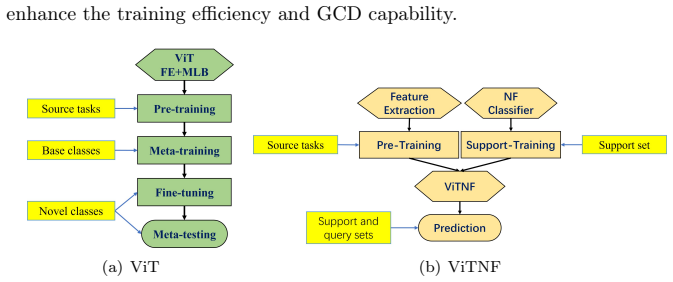
The paper's central claim is that ViTNF, a vision transformer whose MLP head is replaced by a neural-field-based (NF) classifier, achieves state-of-the-art generalized category discovery accuracy. The NF classifier stores each support sample's feature vector as a neuron in an elementary field, stores category labels as neurons in a high-level field, and connects them with fixed binary weights; a query activates nearby elementary neurons through a difference-of-Gaussians lateral interaction, and the high-level field reveals which category, if any, is firing. At the maximal interaction scale, a query that activates no high-level neuron is declared a new category and gets a pseudo-label, and adding a category never rewires existing connections, so the paper argues there is no catastrophic forgetting. The paper reports all-class accuracies of 98.6% on CIFAR-100, 99.2% on ImageNet-100, 94.1% on CUB-200, and 90.3% on Stanford Cars, with gains of 19 points on new classes and 16 points on all classes over published baselines.
Load-bearing premise
The reported comparisons assume that evaluating on 10 randomly chosen classes (5 old with 10 labeled samples each, 5 new) produces numbers comparable to published baselines that were benchmarked under the standard GCD protocol; if the easier 10-class task explains most of the gap, the superiority claim collapses.
Editorial extensions
If this is right
- The three-stage ViT recipe (pre-train, meta-train, fine-tune) becomes two stages: pre-train the feature extractor once, then fit the NF head on the support set, cutting training cost and sample demand.
- New categories can be discovered during inference by adding an elementary neuron, a high-level neuron, and a binary cross-field connection, leaving all existing connections untouched and avoiding catastrophic forgetting.
- Because no activation at $\sigma=1$ triggers a new category, the model does not need a pre-specified number of categories.
- Reported accuracies put ViTNF at 98.6% (CIFAR-100), 99.2% (ImageNet-100), 94.1% (CUB-200), and 90.3% (Stanford Cars) all-class, with 19-point and 16-point gains over published baselines on new and all classes.
- The head's behavior is metric-dependent: Euclidean distance gives the best results while cosine distance collapses new-class accuracy to 33.6–53.2% in the ablation study.
Reading between the lines
- An editor's inference: the 19%/16% margin is measured against baselines run under the standard GCD protocol, while ViTNF is evaluated on a 10-class subset (5 old, 5 new); a same-protocol rerun of the baselines could materially shrink the gap.
- An editor's inference: the NF head is in effect a non-parametric nearest-activation classifier built on frozen features, so its reported accuracy is an upper bound on feature quality; weaker or less separable backbones would likely erode the gains.
- An editor's inference: the same head swap could be tested on other frozen feature extractors, including CNN-based ones, as a cheap post-hoc few-shot and open-world upgrade that the paper does not explore.
- An editor's inference: the 'no activation means new category' rule depends on the single maximal scale $\sigma=1$; on tasks with many more classes, a calibration set may be needed to set the threshold and avoid over- or under-discovery of new categories.
Editorial analysis
A structured set of objections, weighed in public.
Referee Report
Summary. The paper proposes ViTNF, which replaces the MLP classification head of a vision transformer with a neural-field-based classifier. It defines a static neural field function (Eq. 3) as a surrogate for the dynamical neural field of Eq. (1), constructs an elementary field over support-sample features and a high-level field over class labels, and introduces an algorithm for prediction and new-class detection. The claimed contributions are a simplified training procedure (pre-trained feature extractor plus a head trained only on support samples, with no meta-training or fine-tuning) and state-of-the-art GCD accuracy, with reported All-class accuracies of 98.6% on CIFAR-100, 99.2% on ImageNet-100, 94.1% on CUB-200, and 90.3% on Stanford Cars. The experiments, however, use a non-standard 10-class, 10-shot protocol (5 old + 5 new classes) while comparing against baselines reported under the standard GCD protocol.
Significance. If the results were obtained under a protocol comparable to the baselines, the method would be an interesting departure from conventional fine-tuning: replacing a learned head with a non-parametric neural-field memory is simple and, as argued in Section 4.3, supports adding new categories without retraining. The paper's emphasis on decoupling feature extraction from classifier training is a legitimate research direction. That said, the significance is currently not established: the evaluation protocol mismatch makes the headline improvements untestable, the theoretical grounding of Eq. (3) is asserted rather than derived, and hyperparameters are selected on the evaluation data. The paper does not provide code or splits, so the reported standard deviations cannot be checked independently.
major comments (5)
- [Section 5.1, Tables 2-3] The evaluation protocol is not comparable to the baselines. Section 5.1 defines old classes as five randomly selected classes with 10 shots per class and new classes as another five classes, i.e., a 10-way task with 50 labeled support samples and four-dimensional Laplacian-eigenmap features. The baseline numbers in Tables 2-3 are from the standard GCD protocol, e.g., CIFAR-100 with 80 old classes and 50% of the training samples labeled, and ImageNet-100 evaluated over all 100 classes. Because the baselines are not re-run on the 10-class subset, the abstract's claims of '+19% in new and +16% in all classes' and the statement that ViTNF 'surpasses existing state-of-the-art methods' are unsupported. The central claim of the paper therefore rests on a protocol mismatch.
- [Section 4.2, Eq. (3)] The static neural field function is introduced with the statement that 'the solution with a finite excitatory region can be approximate by the convolution on the input function s(z,t) interaction kernel ωσ(·)', but no derivation, numerical verification, or citation is provided. Since Eq. (3) is the foundation of the elementary and high-level fields in Eqs. (5)-(6), this asserted approximation is load-bearing. The further claim that Eq. (3) 'will not generate the ill-posed ∞-solution' is also not proved; it is stated without argument.
- [Section 4.4, Tables 6-7] The derivation of the upper bound σ ≤ 1 relies on Propositions 1-2, which in turn rely on Assumptions 1-3. The text itself calls these assumptions 'not strict restrictions in practical applications,' so the bound is not a rigorous guarantee. Moreover, Proposition 2 only computes the zero-crossing of the DoG kernel; it does not establish that this radius is the correct classification threshold for the feature distributions. The ablations in Tables 6-7 then show that increasing the upper bound of σ reduces accuracy, but those ablations use the same evaluation data that motivated the choice, so they do not independently validate the theory. The 'prediction' is confirmed by the data used to select the parameter.
- [Section 5.1, Proposition 3] The paper states that with 10 categories, four dimensions are reserved 'according to Proposition 3.' Proposition 3 says that an n-dimensional hypersphere of radius 3 contains at least 2n+1 separable unit hyperspheres. For n=4, 2n+1=9, which is less than 10. The stated justification is therefore internally inconsistent: either five dimensions are required by the proposition, or the proposition does not apply to this setting.
- [Section 5.3] The hyperparameters λ=0.4, T=4, num=s/2, σ=1, and the reduced dimension are selected by maximizing accuracy on the evaluation data that is also used for the final reported numbers in Tables 2-3. No held-out validation or nested selection procedure is described. Consequently, the reported accuracies are in-sample estimates and the differences between configurations may be overstated; the small standard deviations do not address this selection bias.
minor comments (6)
- [Section 1] The introduction states that the method is validated in '5-way 1-shot and 5-way 5-shot tasks,' but Section 5.1 uses 5-way 10-shot plus 5 new classes. The statement is inconsistent with the actual experiments.
- [Section 5.2] The paragraph after Table 3 says 'The experimental results in Table 3 demonstrate that ViTNF achieves state-of-the-art performance across all three benchmark datasets,' but Table 3 reports CUB-200 and Stanford Cars; the CIFAR-10/100 and ImageNet-100 results are in Table 2.
- [Section 2.1] The sentence describing SORL ('Spectral open-world representation learning (SORL) provides a graph-theoretical framework...') appears twice verbatim in the same section; one occurrence should be removed.
- [Section 5.1] 'Average results over 600 epochs' is unclear. The authors should specify whether these are random trials, seeds, or evaluation passes, and describe the random class-selection procedure so the results are reproducible.
- [Tables 2-3] The table captions contain typographical errors ('accuarcy', 'CIF AR-10', 'CIF AR-100') that should be corrected.
- [Equations (3)-(6), Algorithm 1] The symbol s is overloaded: it denotes an external input in Eqs. (3)-(4), the number of categories in Algorithm 1, and part of the notation in Proposition 2. Please disambiguate these uses.
Circularity Check
SOTA claim is not an independent derivation: reported accuracies are selected on the same evaluation data and compared against a different, harder protocol.
-
fitted input called prediction
[Section 5.3, Tables 4-9; final results in Tables 2-3]
"The ablation studies reveal critical insights into the performance of ViTNF under varying configurations of the parameter num (proportional to sample size) and distance metrics (Euclidean, Cosine, Mahalanobis). The results demonstrate that ViTNF achieves optimal performance when using num = s/2 with the Euclidean (Euc) metric, establishing it as the most robust and effective configuration. ... To verify the rationality in this strategy, we allow the σ to increase by σ/λ for 0, 1, 4, and 9 times and compare the results..."
The final Tables 2-3 accuracies are obtained with exactly the configuration (num=s/2, Euclidean distance, λ=0.4, σ upper bound fixed at 1) that Section 5.3 selects by maximizing accuracy on the same evaluation sets. Thus the reported 'state-of-the-art' numbers are not predictions of an independent procedure; they are the optimum of a search over the reported metric. The claimed 19%/16% improvement is therefore forced by the selection, not derived from the NF classifier alone.
-
other
[Section 5.1 'Datasets and experimental setting'; Tables 2-3]
"We use a typical sample selection setting for GCD as follows: • Old classes: following 5-way 10-shot setting, that is, randomly select five categories for meta-testing, 10 samples per class to form the support set, and group the rest samples to the test set. • New classes: randomly select another five categories besides the old ones."
The baselines in Tables 2-3 are not re-run under this protocol; they are cited from the standard GCD benchmark (e.g., Vaze et al.'s 80/20 class split with 50% labeled data). The easy 10-class, 10-shot-per-old-class task with only five new classes makes high accuracy nearly guaranteed by task construction. Therefore the SOTA comparison is not a metric of the method's discovery ability; the claimed advantage is built into the evaluation design rather than obtained from the neural-field derivation.
full rationale
The method's internal derivation (static field equations, activation rules) is self-contained and not circular: Eqs. (5)-(6) define a kernel-like classifier whose weights are set by support labels, and Propositions 1-3 are ordinary geometric facts (though Proposition 3 is misapplied for 10 categories in 4 dimensions). No load-bearing self-citation appears; all references are external. However, the paper's central comparative claim is not an independent prediction. The final accuracies in Tables 2-3 are the configurations selected in Section 5.3 by maximizing accuracy on the same evaluation sets (num=s/2, Euc, λ=0.4, σ upper bound=1), so the reported 'state-of-the-art' numbers are the optimum of a search, not a validation. Moreover, the baselines are taken from the standard GCD protocol while ViTNF is tested on a 10-class, 10-shot subset, making the comparison invalid as evidence for the claimed 19%/16% gains. These issues are evaluation-circularity rather than derivation-circularity.
Assumptions & free parameters
free parameters (5)
- Interaction scale upper bound sigma=1 =
1.0
- Iteration ratio lambda =
0.4
- Terminal iteration number T =
4
- New-class threshold num > s/2 =
s/2
- Reserved feature dimension =
4
assumptions (3)
- domain assumption Assumptions 1-3: same-category samples are symmetric, categories share a similar distribution scale, and categories are separable in feature space.
- domain assumption Standardized features lie mostly inside a radius-3 Euclidean hypersphere after ignoring extreme outliers.
- ad hoc to paper The static neural field function (Eq. 3) approximates the dynamical neural field steady state by convolution with the interaction kernel.
invented entities (2)
-
Elementary static neural field
independent evidence
-
High-level static neural field
independent evidence
Cite this review
Pith. "Pith review of ViTNF: Leveraging Neural Fields to Boost Vision Transformers in Generalized Category Discovery." pith.science (2026). https://pith.science/paper/EXHA6ORZ
@misc{pith2026250602367,
  author       = {Pith},
  title        = {Pith review of: ViTNF: Leveraging Neural Fields to Boost Vision Transformers in Generalized Category Discovery},
  year         = {2026},
  howpublished = {\url{https://pith.science/paper/EXHA6ORZ}},
  note         = {Machine review of arXiv:2506.02367}
}
read the original abstract
Generalized category discovery (GCD) is a highly popular task in open-world recognition, aiming to identify unknown class samples using known class data. By leveraging pre-training, meta-training, and fine-tuning, ViT achieves excellent few-shot learning capabilities. Its MLP head is a feedforward network, trained synchronously with the entire network in the same process, increasing the training cost and difficulty without fully leveraging the power of the feature extractor. This paper proposes a new architecture by replacing the MLP head with a neural field-based one. We first present a new static neural field function to describe the activity distribution of the neural field and then use two static neural field functions to build an efficient few-shot classifier. This neural field-based (NF) classifier consists of two coupled static neural fields. It stores the feature information of support samples by its elementary field, the known categories by its high-level field, and the category information of support samples by its cross-field connections. We replace the MLP head with the proposed NF classifier, resulting in a novel architecture ViTNF, and simplify the three-stage training mode by pre-training the feature extractor on source tasks and training the NF classifier with support samples in meta-testing separately, significantly reducing ViT's demand for training samples and the difficulty of model training. To enhance the model's capability in identifying new categories, we provide an effective algorithm to determine the lateral interaction scale of the elementary field. Experimental results demonstrate that our model surpasses existing state-of-the-art methods on CIFAR-100, ImageNet-100, CUB-200, and Standard Cars, achieving dramatic accuracy improvements of 19\% and 16\% in new and all classes, respectively, indicating a notable advantage in GCD.
Figures


Reference graph
Works this paper leans on
-
[1]
k-means++: the advantages of careful seeding
David Arthur and Sergei Vassilvitskii. k-means++: the advantages of careful seeding. InProceedings of the Eighteenth Annual ACM-SIAM Symposium on Discrete Algorithms, SODA ’07, page 1027–1035, USA, 2007. Society for Industrial and Applied Mathematics
work page 2007
-
[2]
Richard P. Brent. An algorithm with guaranteed convergence for finding a zero of a function.Comput. J., 14:422–425, 1971
work page 1971
-
[3]
Yuri Burda, Harri Edwards, Deepak Pathak, Amos Storkey, Trevor Darrell, and Alexei A. Efros. Large-scale study of curiosity-driven learning. InICLR, 2019
work page 2019
-
[4]
Open-world semi-supervised learning, 2021
Kaidi Cao, Maria Brbic, and Jure Leskovec. Open-world semi-supervised learning, 2021
work page 2021
-
[5]
On the relationship between self-attention and convolutional layers
Jean-Baptiste Cordonnier, Andreas Loukas, and Martin Jaggi. On the relationship between self-attention and convolutional layers. In8th Interna- tional Conference on Learning Representations, ICLR 2020, Addis Ababa, Ethiopia, April 26-30, 2020. OpenReview.net, 2020
work page 2020
-
[6]
Ima- genet: A large-scale hierarchical image database
Jia Deng, Wei Dong, Richard Socher, Li-Jia Li, Kai Li, and Li Fei-Fei. Ima- genet: A large-scale hierarchical image database. In2009 IEEE Conference on Computer Vision and Pattern Recognition, pages 248–255, 2009
work page 2009
-
[7]
An image is worth 16x16 words: Transformers for image recognition at scale
Alexey Dosovitskiy, Lucas Beyer, Alexander Kolesnikov, Dirk Weissenborn, Xiaohua Zhai, Thomas Unterthiner, Mostafa Dehghani, Matthias Minderer, Georg Heigold, Sylvain Gelly, Jakob Uszkoreit, and Neil Houlsby. An image is worth 16x16 words: Transformers for image recognition at scale. In International Conference on Learning Representations, 2021. 20
work page 2021
-
[8]
3d object representations for fine-grained categorization
Jonathan Krause, Michael Stark, Jia Deng, and Li Fei-Fei. 3d object representations for fine-grained categorization. In2013 IEEE International Conference on Computer Vision Workshops, pages 554–561, 2013
work page 2013
Show all 21 references
-
[9]
Learning multiple layers of features from tiny images
Alex Krizhevsky. Learning multiple layers of features from tiny images. University of Toronto, 05 2012
2012
-
[10]
Active generalized category discovery
Shijie Ma, Fei Zhu, Zhun Zhong, Xu-Yao Zhang, and Cheng-Lin Liu. Active generalized category discovery. InProceedings of the IEEE/CVF Conference on Computer Vision and Pattern Recognition (CVPR), pages 16890–16900, June 2024
2024
-
[11]
A review of deep learning in image recognition
Myeongsuk Pak and Sanghoon Kim. A review of deep learning in image recognition. In2017 4th International Conference on Computer Applications and Information Processing Technology (CAIPT), pages 1–3, 2017
2017
-
[12]
Dynamic conceptional contrastive learning for generalized category discovery.2023 IEEE/CVF Conference on Computer Vision and Pattern Recognition (CVPR), pages 7579–7588, 2023
Nan Pu, Zhun Zhong, and Niculae Sebe. Dynamic conceptional contrastive learning for generalized category discovery.2023 IEEE/CVF Conference on Computer Vision and Pattern Recognition (CVPR), pages 7579–7588, 2023
2023
-
[13]
Openldn: Learning to discover novel classes for open-world semi-supervised learning
Mamshad Nayeem Rizve, Navid Kardan, Salman Khan, Fahad Shah- baz Khan, and Mubarak Shah. Openldn: Learning to discover novel classes for open-world semi-supervised learning. In Shai Avidan, Gabriel Brostow, Moustapha Cissé, Giovanni Maria Farinella, and Tal Hassner, editors,Co...
2022
-
[14]
A graph-theoretic framework for understanding open-world semi-supervised learning
Yiyou Sun, Zhenmei Shi, and Yixuan Li. A graph-theoretic framework for understanding open-world semi-supervised learning. InProceedings of the 37th International Conference on Neural Information Processing Systems, NIPS ’23, Red Hook, NY, USA, 2023. Curran Associates Inc
2023
-
[15]
Attention is all you need
Ashish Vaswani, Noam Shazeer, Niki Parmar, Jakob Uszkoreit, Llion Jones, Aidan N Gomez, Ł ukasz Kaiser, and Illia Polosukhin. Attention is all you need. In I. Guyon, U. Von Luxburg, S. Bengio, H. Wallach, R. Fergus, S. Vishwanathan, and R. Garnett, editors,Advances in Neural I...
2017
-
[16]
Generalized category discovery
Sagar Vaze, Kai Hant, Andrea Vedaldi, and Andrew Zisserman. Generalized category discovery. In2022 IEEE/CVF Conference on Computer Vision and Pattern Recognition (CVPR), pages 7482–7491, 2022
2022
-
[17]
No representation rules them all in category discovery
Sagar Vaze, Andrea Vedaldi, and Andrew Zisserman. No representation rules them all in category discovery. InThirty-seventh Conference on Neural Information Processing Systems, 2023
2023
-
[18]
C. Wah, S. Branson, P. Welinder, P. Perona, and S. Belongie. The caltech- ucsd birds-200-2011 dataset. Technical Report CNS-TR-2011-001, California Institute of Technology, 2011. 21
2011
-
[19]
Parametric classification for generalized category discovery: A baseline study.2023 IEEE/CVF International Conference on Computer Vision (ICCV), pages 16544–16554, 2022
Xin Wen, Bingchen Zhao, and Xiaojuan Qi. Parametric classification for generalized category discovery: A baseline study.2023 IEEE/CVF International Conference on Computer Vision (ICCV), pages 16544–16554, 2022
2023
-
[20]
Khan, Zhiqiang Shen, Muzammal Naseer, Guangyi Chen, and Fahad Shahbaz Khan
Sheng Zhang, Salman H. Khan, Zhiqiang Shen, Muzammal Naseer, Guangyi Chen, and Fahad Shahbaz Khan. Promptcal: Contrastive affinity learning via auxiliary prompts for generalized novel category discovery. InCVPR, pages 3479–3488, 2023
2023
-
[21]
Learning semi-supervised gaussian mixture models for generalized category discovery
Bingchen Zhao, Xin Wen, and Kai Han. Learning semi-supervised gaussian mixture models for generalized category discovery. In2023 IEEE/CVF International Conference on Computer Vision (ICCV), pages 16577–16587, 2023. 22
2023
Reviewed August 7, 2026 · model on record in the stance chip above.
Discussion (0). Sign in to comment.