REVIEW 5 major objections 8 minor 63 references
The Devil is in the Darkness: Diffusion-Based Nighttime Dehazing Anchored in Brightness Perception
T0 review · 5 major / 8 minor · reviewed 2026-08-07 · deepseek-v4-flash
Pith's one-line read A brightness-aware diffusion model dehazes night scenes and restores daytime lighting in one pass.
desk verdict Genuinely novel synthesis pipeline, but the paper's core brightness-mapping claim rests on no-reference IQA and unvalidated synthetic constants; deserves peer review with major-revision expectations. read the letter →
The pith
A machine-rendered reading of the paper's core claim, the machinery that carries it, and where it could break.
The reading
What carries the argument
The paper's central mechanism is a two-part pipeline. First, data synthesis converts real daytime images into hazy night images: depth estimation and sky segmentation produce a non-uniform illumination mask $\hat{S}$, sky and distant regions are darkened (Eqs. 2--4), and simulated point/cone light sources with an attenuation map are added through Eqs. 5--6 inside the severe degradation model. Second, lighting reconstruction fine-tunes a pre-trained one-step diffusion model with LoRA, while a brightness perception network $\Phi$ predicts a brightness map $\hat{M}$ from the encoder's first-layer features; this map modulates the first skip connection (Eq. 9) and is trained with the brightness-mean loss $L_M$, together with pixel-wise, adversarial, and diffusion losses.
What would settle it
Take real scenes photographed at night and again in daytime with fixed camera pose and exposure (or a calibrated reference), train DiffND on the synthetic pipeline alone, and compare region-wise brightness of the output with the real daytime image; if the mean absolute brightness error is no better than a global gamma correction, the claimed non-uniform mapping is not doing the work.
Extended reading notes
Core claim
On its own terms, the paper establishes that the bottleneck in nighttime dehazing with brightness mapping is not network capacity but the combination of training data and lighting prior. It shows that training the proposed diffusion model on existing daytime-label datasets (UNREAL-NH, NHR/NHM/NHC-Daytime) still produces dark or over-bright results, and training existing dehazing networks on the new synthetic dataset damages content; only DiffND, with both the depth/sky-guided non-uniform brightness synthesis and the brightness perception network, yields outputs whose brightness is close to real daytime images on the RWNH test set. The central discovery is that non-uniform, depth-aware synthesis plus a diffusion prior is sufficient to learn night-to-day brightness mapping without aligned real night/day pairs.
Load-bearing premise
The load-bearing premise is that the hand-set non-uniform brightness mapping (Eqs. 2--4) and simulated light distortions (Eqs. 5--6) reproduce the brightness and haze statistics of real night scenes closely enough that a model trained only on synthetic pairs from Places365 generalizes to real RWNH images, a transfer the paper assumes rather than validates with aligned real night/day pairs.
Editorial extensions
If this is right
- A model trained only on synthetic night/day pairs derived from Places365 generalizes to real-world RWNH images without paired real data.
- Existing NDBM datasets (UNREAL-NH and the NH-series) are insufficient for the task because their global brightness adjustments do not match real night scenes.
- The same fine-tuned model can produce dehazed nighttime results by switching the text prompt from 'a clear daytime image' to 'a dark nighttime image' while preserving scene content.
- Both the depth/sky-guided non-uniform brightness adjustment and the brightness perception network contribute to the reported quality; removing either lowers visual or quantitative performance.
Reading between the lines
- We infer that the depth/sky-guided synthesis recipe could transfer to other day-to-night translation problems, such as low-light enhancement or nighttime detection, wherever aligned pairs are hard to obtain.
- We infer that collecting a small set of aligned real night/day images would let a future study test whether the learned brightness mapping is physically consistent, rather than only visually plausible.
- We infer that the fixed synthesis hyperparameters (for example $\alpha=4$, $\varphi_1=2$, $\varphi_2=1.5$) may need re-tuning for scenes without blue sky, since the training data were selected for blue-sky daytime images.
Editorial analysis
A structured set of objections, weighed in public.
Referee Report
Summary. This paper proposes DiffND, a framework for the nighttime-dehazing-and-brightness-mapping task (NDBM), i.e., converting hazy nighttime images into clear daytime-equivalent images. The framework has two parts. First, a data synthesis pipeline (Sec. 3.1) starts from real daytime images from Places365 and produces synthetic hazy night images via a depth- and sky-guided non-uniform brightness mapping (Eqs. 2-4) plus simulated point/cone light sources with an attenuation model (Eqs. 5-6). Second, a restoration model (Sec. 3.2) fine-tunes a one-step pre-trained diffusion model with LoRA, conditioned on a fixed 'a clear daytime image' prompt, and adds a brightness perception network Phi whose predicted brightness map modulates the first-level skip connection; Phi is supervised toward the mean brightness of the daytime label (Eqs. 8-10). Training uses 1,546 synthetic image pairs; the model is evaluated on 440 real images from the RWNH set using ten no-reference IQA metrics, cross-validations (training their model on existing datasets and existing models on their dataset), and ablations. The paper claims that DiffND achieves superior haze removal and night-to-day brightness mapping and that both the dataset and the model are necessary for the favorable results.
Significance. The NDBM task is genuinely under-addressed, and the paper's two-part recipe -- depth/sky-guided non-uniform brightness synthesis and a one-step diffusion model with a brightness prior -- is a plausible and timely direction. The paper has real strengths: it evaluates on a real-world test set (RWNH) instead of synthetic benchmarks only; it runs cross-validation in both directions (their model on existing datasets, existing models on their dataset, Tables 2-3); and most of the pipeline is specified concretely enough to implement. The main weaknesses concern the evidence for the central claim: the synthetic-to-real transfer of the hand-set brightness mapping (Eqs. 2-6) is never validated against real night/day statistics; the quantitative case rests entirely on no-reference quality metrics with single runs and no error bars, significance tests, or human study; and the ablation for the headline brightness perception component Phi is reported in an uninterpretable aggregated form. These issues are fixable without changing the method's scope, but they currently prevent me from accepting the paper's performance claims at face value.
major comments (5)
- [Sec. 3.1 (Eqs. 2-6); Sec. 4.1-4.2] The central claim -- faithful night-to-day brightness mapping on real images -- rests on an unvalidated synthetic-to-real transfer. The synthesis constants (alpha=4, phi1=2, phi2=1.5, rho, theta=0.98, mu=0.85, xi1=1, xi2=3, xi3=1.8) are set by hand in Sec. 4.1 with no sensitivity analysis, and the abstract's assertion that the pipeline ensures 'brightness consistency between synthetic and real-world scenes' is never verified directly: there are no aligned real night/day pairs, no distributional comparison of synthesized night images against RWNH or other real night statistics, and the only real-world evidence is no-reference IQA (Table 1) plus mean-brightness plots of the final outputs (Fig. 7), which cannot detect systematic mapping errors such as a consistent global offset or a wrong sky/non-sky brightness ratio. I recommend adding (i) a per-region brightness comparison (mean, standard deviation, sky/non-sky ratio) between synthetic night images and real night images, (ii) a sensitivity analysis over the synthesis constants, and (iii) if feasible, a test on real aligned day/night pairs.
- [Sec. 4.2 (Table 1); Sec. 4.4] The quantitative evidence for superiority consists of ten no-reference IQA metrics on a single evaluation of 440 real RWNH images: no error bars, no significance tests, and no human evaluation are reported. Several of these metrics (MUSIQ, MANIQA, DBCNN, TOPIQ) are generic naturalness/quality scores uncalibrated for the NDBM task, so high scores do not establish that the output lighting matches the true daytime appearance of the scene. In addition, no simple baseline (e.g., a dehazing model followed by gamma correction, or a standard low-light enhancement method) is included, so the contribution of the generative brightness mapping itself is not isolated. I recommend reporting multi-run variance, adding a perceptual user study on brightness fidelity, and adding such baselines.
- [Sec. 4.3 (Tables 2-3)] The cross-validation narrative overstates the tabulated results. In Table 3, Fourmer trained on the proposed dataset exceeds Ours on TOPIQ (0.449 vs 0.443), TReS (64.665 vs 61.050), and DBCNN (0.427 vs 0.414); in Table 2, SD-UNREAL-NH exceeds Ours on TReS (68.299 vs 61.050), MUSIQ (52.881 vs 51.098), and DBCNN (0.426 vs 0.414). The text nevertheless concludes that existing models 'cannot achieve effective dehazing ability in terms of quantitative metrics' and that the proposed data and model 'must be used together.' With single runs and margins this small, the conclusion is not supported by the printed numbers; please report variance and reconcile the text with the tables.
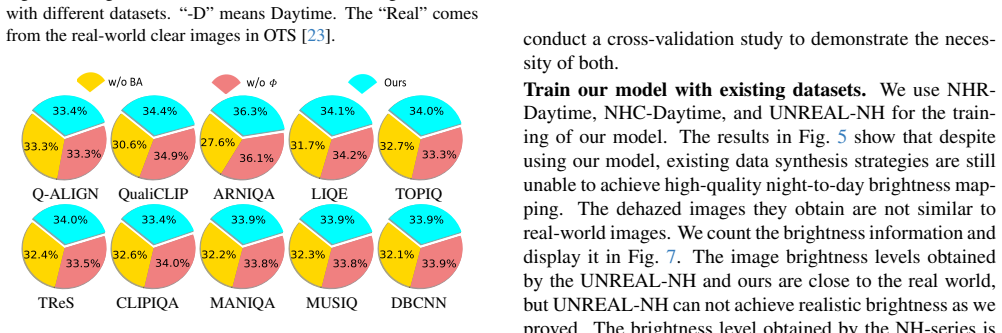
- [Sec. 4.4 (Fig. 8)] The ablation of the two methodological centerpieces -- the non-uniform brightness adjustment (BA) and the brightness perception network Phi -- is reported only as a percentage derived from summing metrics across three settings, an aggregation that is not defined and cannot be checked against raw values; the individual metric values for the ablations are not given. The text further concedes that adding Phi only 'maintains' the quantitative evaluation performance, so the necessity of Phi -- a headline contribution ('anchored in brightness perception') -- rests on visual inspection alone. Please provide a standard ablation table with the ten metrics for each setting, and add targeted evidence for Phi (e.g., accuracy of the predicted brightness map against the daytime label's brightness map).
- [Sec. 3.2 (Eqs. 8-10)] Phi is described as able to 'identify non-uniform brightness in nighttime hazy images,' but its only direct supervision L_M (Eq. 10) compares the mean of the predicted brightness map with the scalar mean brightness of the daytime label; the spatial structure of the predicted map is not directly supervised. The spatial modulation in Eq. (9) can in principle be shaped indirectly by the pixel-wise loss L_pc (Eq. 11), but as written the claimed non-uniform-brightness perception capability is not a direct consequence of L_M. Please either define M as a per-pixel map (if that is intended), visualize what Phi learns, or add per-pixel supervision.
minor comments (8)
- [Sec. 3.1] The prose states that the mask is 'split by the area where depth g(i,j) is larger than the threshold theta,' but Eqs. (2) and (3) use the condition 1-g(i,j) >= theta (i.e., g(i,j) <= 0.02 for theta = 0.98); please align the text with the equations.
- [Sec. 3.1] The sentence describing the sky brightness normalization ('the brightness of the sky area is adjusted to make the mean value close to the preset level mu') is not formalized in any equation; with mu = 0.85, the synthesis pipeline cannot be exactly reproduced from the text as written.
- [Tables 2 and 3] Several entries are typeset with numerals running together (e.g., '59.6300.4380.276' in Table 2, '52.8810.426' in the same table, and '64.6650.345' in Table 3); please regenerate the tables with proper numeric spacing.
- [Figs. 7, 11, 12, 13] The captions and in-figure legends of Figures 7, 11, 12, and 13 contain garbled unicode sequences (e.g., '/uni0000002b/uni00000044/...'), and Figure 2's rendered equations inside the diagram are partially unreadable; please regenerate the figures before resubmission.
- [Sec. 4.1] The dataset is a stated contribution but is not released, and no download link, sample, or detailed split (beyond the counts 1,546 training and 440 test images) is provided, which limits reproducibility of the reported experiments.
- [Sec. 4.1] There is a typo in 'Places365 datadset' (should be 'dataset'); reference [2] is labeled 'IEEE WAVC' but should be 'IEEE WACV'.
- [Sec. 4.2 (Table 1, Fig. 4)] The 'state-of-the-art dehazing model [8]' used to produce the comparison rows is never named in the main text; identifying it as SFSNiD (as in Fig. 4 and Table 3) would make Table 1 easier to interpret.
- [Sec. 4.4 (Fig. 13)] The claim that prompt-based brightness changes preserve scene content is supported only by visual inspection; a quantitative content-consistency measure (e.g., LPIPS or SSIM between the daytime- and nighttime-prompt outputs) would make the claim checkable.
Circularity Check
No significant circularity: DiffND is trained on synthetic night/day pairs and evaluated on an external real-world benchmark; the claimed “predictions” are not constructed from the fitted brightness constants.
full rationale
The derivation chain is self-contained. The data synthesis pipeline (Eqs. 1–6) starts from real daytime images y_d^r and constructs synthetic hazy nighttime images x_s^n using hand-set non-uniform brightness mapping (Eqs. 2–4, with α=4, φ_1=2, φ_2=1.5, ρ, and ϑ=0.98) and simulated distortion (Eqs. 5–6, with ξ_1=1, ξ_2=3, ξ_3=1.8). These constants are chosen a priori and are not fitted to the model’s own outputs or to the RWNH test set. The network is trained on these synthetic pairs with a pixel-wise reconstruction loss (Eq. 11) against the original real daytime labels, and the brightness supervision M in Eq. 10 is the mean brightness of the target daytime label, not a quantity derived from the model’s output; hence there is no self-definitional or fitted-input-called-prediction step. Real-world evaluation on RWNH (Fig. 1, Fig. 4, Table 1) is an external benchmark, and the no-reference IQA metrics are external tools, not functions of the synthesis constants. The self-citations to prior work ([8], [15], [30], [58]) are used for baseline implementations, comparison methods, or reusable modules such as Γ_z and pixel-wise Gamma, none of which carries the load of the central claim by itself. The synthetic-to-real transfer assumption is a genuine validation gap—there are no aligned real night/day pairs and no distributional validation of the brightness mapping—but that is a correctness/external-validity concern, not circularity, and the paper does not rename a fitted parameter as a prediction or invoke a self-authored uniqueness theorem. Therefore the paper receives a circularity score of 0.
Assumptions & free parameters
free parameters (10)
- degradation factor alpha =
4
- brightness difference factor rho =
not specified
- sky illumination factor phi1 =
2
- non-sky illumination factor phi2 =
1.5
- sky segmentation threshold rho_vartheta =
0.98
- sky brightness level mu =
0.85
- point light constant beta =
1
- attenuation parameters xi1, xi2, xi3 =
1, 3, 1.8
- loss weights lambda1, lambda2 =
0.5, 1
- LoRA ranks for UNet and encoder/decoder =
8 and 4
assumptions (5)
- domain assumption The severe degradation model from [27] (Eq. 1) adequately models real nighttime haze when the real distortions are replaced by simulated ones.
- domain assumption Pre-trained SD-Turbo/CycleGAN-Turbo contains a strong prior for clear daytime images that can be adapted via LoRA.
- domain assumption Depth Anything V2 and the sky segmentation method produce sufficiently accurate depth and sky masks on Places365 images.
- domain assumption No-reference IQA metrics (QualiCLIP, ARNIQA, TOPIQ, MUSIQ, DBCNN, etc.) are valid for judging enhancement quality.
- ad hoc to paper The reference brightness label M is the mean brightness of the target daytime image.
invented entities (1)
-
Brightness perception network Phi
Cite this review
Pith. "Pith review of The Devil is in the Darkness: Diffusion-Based Nighttime Dehazing Anchored in Brightness Perception." pith.science (2026). https://pith.science/paper/W4PQ6QQS
@misc{pith2026250602395,
  author       = {Pith},
  title        = {Pith review of: The Devil is in the Darkness: Diffusion-Based Nighttime Dehazing Anchored in Brightness Perception},
  year         = {2026},
  howpublished = {\url{https://pith.science/paper/W4PQ6QQS}},
  note         = {Machine review of arXiv:2506.02395}
}
read the original abstract
While nighttime image dehazing has been extensively studied, converting nighttime hazy images to daytime-equivalent brightness remains largely unaddressed. Existing methods face two critical limitations: (1) datasets overlook the brightness relationship between day and night, resulting in the brightness mapping being inconsistent with the real world during image synthesis; and (2) models do not explicitly incorporate daytime brightness knowledge, limiting their ability to reconstruct realistic lighting. To address these challenges, we introduce the Diffusion-Based Nighttime Dehazing (DiffND) framework, which excels in both data synthesis and lighting reconstruction. Our approach starts with a data synthesis pipeline that simulates severe distortions while enforcing brightness consistency between synthetic and real-world scenes, providing a strong foundation for learning night-to-day brightness mapping. Next, we propose a restoration model that integrates a pre-trained diffusion model guided by a brightness perception network. This design harnesses the diffusion model's generative ability while adapting it to nighttime dehazing through brightness-aware optimization. Experiments validate our dataset's utility and the model's superior performance in joint haze removal and brightness mapping.
Figures


Figures from the paper (8 more)




Reference graph
Works this paper leans on
-
[1]
Lorenzo Agnolucci, Leonardo Galteri, and Marco Bertini. Quality-aware image-text alignment for real-world image quality assessment.arXiv preprint arXiv:2403.11176, 2024. 6
arXiv 2024
-
[2]
Arniqa: Learning distortion manifold for image quality assessment
Lorenzo Agnolucci, Leonardo Galteri, Marco Bertini, and Alberto Del Bimbo. Arniqa: Learning distortion manifold for image quality assessment. InIEEE WAVC, pages 189– 198, 2024. 6
work page 2024
-
[3]
Sriparna Banerjee and Sheli Sinha Chaudhuri. Night- time image-dehazing: a review and quantitative benchmark- ing.Archives of Computational Methods in Engineering, 28(4):2943–2975, 2021. 1
work page 2021
-
[4]
IQA-PyTorch: Pytorch toolbox for image quality assessment
Chaofeng Chen and Jiadi Mo. IQA-PyTorch: Pytorch toolbox for image quality assessment. [Online]. Avail- able:https : / / github . com / chaofengc / IQA - PyTorch, 2022. 6
work page 2022
-
[5]
Topiq: A top-down approach from semantics to distortions for image quality assessment.IEEE TIP, 2024
Chaofeng Chen, Jiadi Mo, Jingwen Hou, Haoning Wu, Liang Liao, Wenxiu Sun, Qiong Yan, and Weisi Lin. Topiq: A top-down approach from semantics to distortions for image quality assessment.IEEE TIP, 2024. 6
work page 2024
-
[6]
Hui Chen, Nannan Li, and Rong Chen. Ni-dehazenet: rep- resentation learning via bilevel optimized architecture search for nighttime dehazing.The Visual Computer, 40(9):6155– 6170, 2024. 1
work page 2024
-
[7]
Jiwoo Chung, Sangeek Hyun, and Jae-Pil Heo. Style injec- tion in diffusion: A training-free approach for adapting large- scale diffusion models for style transfer. InIEEE CVPR, pages 8795–8805, 2024. 2
work page 2024
-
[8]
Xiaofeng Cong, Jie Gui, Jing Zhang, Junming Hou, and Hao Shen. A semi-supervised nighttime dehazing baseline with spatial-frequency aware and realistic brightness constraint. InIEEE CVPR, pages 2631–2640, 2024. 1, 2, 3, 4, 5, 6, 7
work page 2024
Show all 63 references
-
[9]
Focal network for image restoration
Yuning Cui, Wenqi Ren, Xiaochun Cao, and Alois Knoll. Focal network for image restoration. InIEEE ICCV, pages 13001–13011, 2023. 1
2023
-
[10]
Omni-kernel net- work for image restoration
Yuning Cui, Wenqi Ren, and Alois Knoll. Omni-kernel net- work for image restoration. InAAAI, volume 38, pages 1426–1434, 2024. 1, 2
2024
-
[11]
Flare7k: A phenomenological night- time flare removal dataset.NeurIPS, 35:3926–3937, 2022
Yuekun Dai, Chongyi Li, Shangchen Zhou, Ruicheng Feng, and Chen Change Loy. Flare7k: A phenomenological night- time flare removal dataset.NeurIPS, 35:3926–3937, 2022. 2
2022
-
[12]
No-reference image quality assessment via transformers, rel- ative ranking, and self-consistency
S Alireza Golestaneh, Saba Dadsetan, and Kris M Kitani. No-reference image quality assessment via transformers, rel- ative ranking, and self-consistency. InIEEE WACV, pages 3209–3218, 2022. 6
2022
-
[13]
Lora: Low-rank adaptation of large language models.arXiv preprint arXiv:2106.09685, 2021
Edward J Hu, Yelong Shen, Phillip Wallis, Zeyuan Allen- Zhu, Yuanzhi Li, Shean Wang, Lu Wang, and Weizhu Chen. Lora: Low-rank adaptation of large language models.arXiv preprint arXiv:2106.09685, 2021. 5
2021 arXiv
-
[14]
Raindrop clarity: A dual-focused dataset for day and night raindrop removal
Yeying Jin, Xin Li, Jiadong Wang, Yan Zhang, and Malu Zhang. Raindrop clarity: A dual-focused dataset for day and night raindrop removal. InECCV, pages 1–17, 2024. 1
2024
-
[15]
Enhancing visibility in nighttime haze images using guided apsf and gradient adaptive convolution
Yeying Jin, Beibei Lin, Wending Yan, Wei Ye, Yuan Yuan, and Robby T Tan. Enhancing visibility in nighttime haze images using guided apsf and gradient adaptive convolution. InACM MM, 2023. 1, 2, 3, 4, 6, 7
2023
-
[16]
Structure representation network and uncertainty feedback learning for dense non-uniform fog removal
Yeying Jin, Wending Yan, Wenhan Yang, and Robby T Tan. Structure representation network and uncertainty feedback learning for dense non-uniform fog removal. InACCV, pages 155–172. Springer, 2022. 2
2022
-
[17]
Unsuper- vised night image enhancement: When layer decomposition meets light-effects suppression
Yeying Jin, Wenhan Yang, and Robby T Tan. Unsuper- vised night image enhancement: When layer decomposition meets light-effects suppression. InECCV, pages 404–421. Springer, 2022. 2
2022
-
[18]
Repurpos- ing diffusion-based image generators for monocular depth estimation
Bingxin Ke, Anton Obukhov, Shengyu Huang, Nando Met- zger, Rodrigo Caye Daudt, and Konrad Schindler. Repurpos- ing diffusion-based image generators for monocular depth estimation. InIEEE CVPR, pages 9492–9502, 2024. 3
2024
-
[19]
Musiq: Multi-scale image quality transformer
Junjie Ke, Qifei Wang, Yilin Wang, Peyman Milanfar, and Feng Yang. Musiq: Multi-scale image quality transformer. InIEEE ICCV, pages 5148–5157, 2021. 6
2021
-
[20]
2pcnet: Two-phase consistency training for day-to-night unsupervised domain adaptive object detec- tion
Mikhail Kennerley, Jian-Gang Wang, Bharadwaj Veeravalli, and Robby T Tan. 2pcnet: Two-phase consistency training for day-to-night unsupervised domain adaptive object detec- tion. InIEEE CVPR, pages 11484–11493, 2023. 1
2023
-
[21]
Multi-path dilated convolution network for haze and glow removal in nighttime images.The Visual Com- puter, pages 1–14, 2022
Shiba Kuanar, Dwarikanath Mahapatra, Monalisa Bilas, and KR Rao. Multi-path dilated convolution network for haze and glow removal in nighttime images.The Visual Com- puter, pages 1–14, 2022. 1
2022
-
[22]
Ensembling off-the-shelf models for gan training
Nupur Kumari, Richard Zhang, Eli Shechtman, and Jun-Yan Zhu. Ensembling off-the-shelf models for gan training. In IEEE CVPR, pages 10651–10662, 2022. 6
2022
-
[23]
Benchmarking single- image dehazing and beyond.IEEE TIP, 28(1):492–505,
Boyi Li, Wenqi Ren, Dengpan Fu, Dacheng Tao, Dan Feng, Wenjun Zeng, and Zhangyang Wang. Benchmarking single- image dehazing and beyond.IEEE TIP, 28(1):492–505,
-
[24]
Learning transferable negative prompts for out-of- distribution detection
Tianqi Li, Guansong Pang, Xiao Bai, Wenjun Miao, and Jin Zheng. Learning transferable negative prompts for out-of- distribution detection. InIEEE CVPR, pages 17584–17594,
-
[25]
Nighttime haze removal with glow and multiple light colors
Yu Li, Robby T Tan, and Michael S Brown. Nighttime haze removal with glow and multiple light colors. InIEEE ICCV, pages 226–234, 2015. 2
2015
-
[26]
9 Hdp-net: Haze density prediction network for nighttime de- hazing
Yinghong Liao, Zhuo Su, Xiangguo Liang, and Bin Qiu. 9 Hdp-net: Haze density prediction network for nighttime de- hazing. InPacific Rim Conference on Multimedia, pages 469–480, 2018. 1, 3
2018
-
[27]
Nighthaze: Nighttime image dehazing via self-prior learning
Beibei Lin, Yeying Jin, Wending Yan, Wei Ye, Yuan Yuan, and Robby T Tan. Nighthaze: Nighttime image dehazing via self-prior learning. InAAAI, 2025. 1, 2, 3, 4
2025
-
[28]
Nightrain: Nighttime video deraining via adaptive-rain-removal and adaptive-correction
Beibei Lin, Yeying Jin, Wending Yan, Wei Ye, Yuan Yuan, Shunli Zhang, and Robby T Tan. Nightrain: Nighttime video deraining via adaptive-rain-removal and adaptive-correction. InAAAI, volume 38, pages 3378–3385, 2024. 2
2024
-
[29]
Single nighttime image dehazing based on image decomposition
Yun Liu, Anzhi Wang, Hao Zhou, and Pengfei Jia. Single nighttime image dehazing based on image decomposition. Signal Processing, 183:107986, 2021. 1
2021
-
[30]
Nighthazeformer: Single nighttime haze removal using prior query transformer
Yun Liu, Zhongsheng Yan, Sixiang Chen, Tian Ye, Wenqi Ren, and Erkang Chen. Nighthazeformer: Single nighttime haze removal using prior query transformer. InACM MM,
-
[31]
Multi-purpose oriented single nighttime image haze removal based on unified variational retinex model.IEEE TCSVT, 33(4):1643–1657, 2022
Yun Liu, Zhongsheng Yan, Jinge Tan, and Yuche Li. Multi-purpose oriented single nighttime image haze removal based on unified variational retinex model.IEEE TCSVT, 33(4):1643–1657, 2022. 2
2022
-
[32]
Nighttime image dehazing based on variational decom- position model
Yun Liu, Zhongsheng Yan, Aimin Wu, Tian Ye, and Yuche Li. Nighttime image dehazing based on variational decom- position model. InIEEE CVPR Workshops, pages 640–649,
-
[33]
Yun Liu, Zhongsheng Yan, Tian Ye, Aimin Wu, and Yuche Li. Single nighttime image dehazing based on unified vari- ational decomposition model and multi-scale contrast en- hancement.Engineering Applications of Artificial Intelli- gence, 116:105373, 2022. 1
2022
-
[34]
Zero-shot image-to-image translation
Gaurav Parmar, Krishna Kumar Singh, Richard Zhang, Yijun Li, Jingwan Lu, and Jun-Yan Zhu. Zero-shot image-to-image translation. InACM SIGGRAPH, pages 1–11, 2023. 3, 5
2023
-
[35]
One-step image translation with text-to-image models.arXiv preprint arXiv:2403.12036, 2024
Gaurav Parmar, Taesung Park, Srinivasa Narasimhan, and Jun-Yan Zhu. One-step image translation with text-to-image models.arXiv preprint arXiv:2403.12036, 2024. 2, 3, 5, 6, 8
2024 arXiv
-
[36]
High-resolution image syn- thesis with latent diffusion models
Robin Rombach, Andreas Blattmann, Dominik Lorenz, Patrick Esser, and Bjorn Ommer. High-resolution image syn- thesis with latent diffusion models. InIEEE CVPR, pages 10684–10695, 2022. 3, 4
2022
-
[37]
Adversarial diffusion distillation
Axel Sauer, Dominik Lorenz, Andreas Blattmann, and Robin Rombach. Adversarial diffusion distillation. InECCV, pages 87–103, 2024. 2, 3, 5
2024
-
[38]
Single-image camera response function using prediction consistency and gradual refinement
Aashish Sharma, Robby T Tan, and Loong-Fah Cheong. Single-image camera response function using prediction consistency and gradual refinement. InACCV, 2020. 4
2020
-
[39]
Freeu: Free lunch in diffusion u-net
Chenyang Si, Ziqi Huang, Yuming Jiang, and Ziwei Liu. Freeu: Free lunch in diffusion u-net. InIEEE CVPR, pages 4733–4743, 2024. 3
2024
-
[40]
Argue: Attribute-guided prompt tuning for vision-language models
Xinyu Tian, Shu Zou, Zhaoyuan Yang, and Jing Zhang. Argue: Attribute-guided prompt tuning for vision-language models. InIEEE CVPR, pages 28578–28587, 2024. 3
2024
-
[41]
Ex- ploring clip for assessing the look and feel of images
Jianyi Wang, Kelvin CK Chan, and Chen Change Loy. Ex- ploring clip for assessing the look and feel of images. In AAAI, 2023. 6
2023
-
[42]
Variational single nighttime image haze removal with a gray haze-line prior
Wenhui Wang, Anna Wang, and Chen Liu. Variational single nighttime image haze removal with a gray haze-line prior. IEEE TIP, 31:1349–1363, 2022. 2
2022
-
[43]
Robust real-world image dehazing via knowledge guided conditional diffusion model finetuning
Haoran Wei, Qingbo Wu, Chenhao Wu, Shuai Chen, Lei Wang, King Ngi Ngan, Fanman Meng, and Hongliang Li. Robust real-world image dehazing via knowledge guided conditional diffusion model finetuning. InIEEE Workshop on MMSP, pages 1–6. IEEE, 2024. 6
2024
-
[44]
Robust unpaired image dehazing via adversarial deformation con- straint.IEEE TCSVT, 2024
Haoran Wei, Qingbo Wu, Chenhao Wu, King Ngi Ngan, Hongliang Li, Fanman Meng, and Heqian Qiu. Robust unpaired image dehazing via adversarial deformation con- straint.IEEE TCSVT, 2024. 6
2024
-
[45]
Q-align: Teaching lmms for visual scoring via discrete text-defined levels.arXiv preprint arXiv:2312.17090, 2023
Haoning Wu, Zicheng Zhang, Weixia Zhang, Chaofeng Chen, Liang Liao, Chunyi Li, Yixuan Gao, Annan Wang, Erli Zhang, Wenxiu Sun, et al. Q-align: Teaching lmms for visual scoring via discrete text-defined levels.arXiv preprint arXiv:2312.17090, 2023. 6
2023 arXiv
-
[46]
A comprehensive study of multimodal large language mod- els for image quality assessment
Tianhe Wu, Kede Ma, Jie Liang, Yujiu Yang, and Lei Zhang. A comprehensive study of multimodal large language mod- els for image quality assessment. InECCV, pages 143–160. Springer, 2024. 6
2024
-
[47]
Prompt-free diffusion: Taking text out of text-to-image diffusion models
Xingqian Xu, Jiayi Guo, Zhangyang Wang, Gao Huang, Ir- fan Essa, and Humphrey Shi. Prompt-free diffusion: Taking text out of text-to-image diffusion models. InIEEE CVPR, pages 8682–8692, 2024. 3
2024
-
[48]
Diffu- sion models without attention
Jing Nathan Yan, Jiatao Gu, and Alexander M Rush. Diffu- sion models without attention. InIEEE CVPR, pages 8239– 8249, 2024. 3
2024
-
[49]
Night- time defogging using high-low frequency decomposition and grayscale-color networks
Wending Yan, Robby T Tan, and Dengxin Dai. Night- time defogging using high-low frequency decomposition and grayscale-color networks. InECCV, pages 473–488, 2020. 2
2020
-
[50]
A variation-based nighttime image dehazing flow with a phys- ically valid illumination estimator and a luminance-guided coloring model.IEEE Access, 10:50153–50166, 2022
Chih-Hsiang Yang, Yi-Hsien Lin, and Yi-Chang Lu. A variation-based nighttime image dehazing flow with a phys- ically valid illumination estimator and a luminance-guided coloring model.IEEE Access, 10:50153–50166, 2022. 2
2022
-
[51]
Depth any- thing v2.arXiv:2406.09414, 2024
Lihe Yang, Bingyi Kang, Zilong Huang, Zhen Zhao, Xiao- gang Xu, Jiashi Feng, and Hengshuang Zhao. Depth any- thing v2.arXiv:2406.09414, 2024. 4
2024 arXiv
-
[52]
Superpixel- based single nighttime image haze removal.IEEE TMM, 20(11):3008–3018, 2018
Minmin Yang, Jianchang Liu, and Zhengguo Li. Superpixel- based single nighttime image haze removal.IEEE TMM, 20(11):3008–3018, 2018. 2
2018
-
[53]
Maniqa: Multi-dimension attention network for no-reference image quality assessment
Sidi Yang, Tianhe Wu, Shuwei Shi, Shanshan Lao, Yuan Gong, Mingdeng Cao, Jiahao Wang, and Yujiu Yang. Maniqa: Multi-dimension attention network for no-reference image quality assessment. InIEEE CVPR, pages 1191–1200,
-
[54]
One-step diffusion with distribution matching distillation
Tianwei Yin, Micha ¨el Gharbi, Richard Zhang, Eli Shecht- man, Fredo Durand, William T Freeman, and Taesung Park. One-step diffusion with distribution matching distillation. In IEEE CVPR, pages 6613–6623, 2024. 3
2024
-
[55]
Nighttime single image dehazing via pixel-wise alpha blending.IEEE Access, 7:114619–114630,
Teng Yu, Kang Song, Pu Miao, Guowei Yang, Huan Yang, and Chenglizhao Chen. Nighttime single image dehazing via pixel-wise alpha blending.IEEE Access, 7:114619–114630,
-
[56]
Fast haze removal for nighttime image using maximum reflectance prior
Jing Zhang, Yang Cao, Shuai Fang, Yu Kang, and Chang Wen Chen. Fast haze removal for nighttime image using maximum reflectance prior. InIEEE CVPR, pages 7418– 7426, 2017. 2
2017
-
[57]
Nighttime haze removal based on a new imaging model
Jing Zhang, Yang Cao, and Zengfu Wang. Nighttime haze removal based on a new imaging model. InIEEE ICIP, pages 4557–4561, 2014. 1 10
2014
-
[58]
Nighttime dehazing with a synthetic benchmark
Jing Zhang, Yang Cao, Zheng-Jun Zha, and Dacheng Tao. Nighttime dehazing with a synthetic benchmark. InACM MM, pages 2355–2363, 2020. 1, 2, 3, 4, 5, 6
2020
-
[59]
Blind image quality assessment using a deep bilinear convolutional neural network.IEEE TCSVT, 30(1):36–47,
Weixia Zhang, Kede Ma, Jia Yan, Dexiang Deng, and Zhou Wang. Blind image quality assessment using a deep bilinear convolutional neural network.IEEE TCSVT, 30(1):36–47,
-
[60]
Blind image quality assessment via vision- language correspondence: A multitask learning perspective
Weixia Zhang, Guangtao Zhai, Ying Wei, Xiaokang Yang, and Kede Ma. Blind image quality assessment via vision- language correspondence: A multitask learning perspective. InIEEE CVPR, pages 14071–14081, 2023. 6
2023
-
[61]
Places: A 10 million image database for scene recognition.IEEE TPAMI, 40(6):1452–1464, 2017
Bolei Zhou, Agata Lapedriza, Aditya Khosla, Aude Oliva, and Antonio Torralba. Places: A 10 million image database for scene recognition.IEEE TPAMI, 40(6):1452–1464, 2017. 6
2017
-
[62]
Fourmer: an efficient global modeling paradigm for image restoration
Man Zhou, Jie Huang, Chun-Le Guo, and Chongyi Li. Fourmer: an efficient global modeling paradigm for image restoration. InICML, pages 42589–42601, 2023. 3, 6, 7
2023
-
[63]
Edge-aware guidance fusion network for rgb–thermal scene parsing
Wujie Zhou, Shaohua Dong, Caie Xu, and Yaguan Qian. Edge-aware guidance fusion network for rgb–thermal scene parsing. InAAAI, volume 36, pages 3571–3579, 2022. 6 11
2022
Reviewed August 7, 2026 · model on record in the stance chip above.
Discussion (0). Sign in to comment.