REVIEW 5 major objections 5 minor 1 cited by
Quasinormal modes and greybody factors of charge black hole in bumblebee gravity model
T0 review · 5 major / 5 minor · reviewed 2026-08-07 · deepseek-v4-flash
Pith's one-line read For a charged de Sitter black hole in bumblebee gravity, increasing the Lorentz-violation parameter L consistently lowers the perturbation barrier, raises the greybody bound, and slows the quasinormal ringing, giving an observational…
desk verdict A useful but sloppy extension of bumblebee black hole perturbations to charged dS/AdS; the scalar/EM and shadow parts are mostly sound, but internal contradictions and an unverified Dirac reduction sink the current version. read the letter →
The pith
A machine-rendered reading of the paper's core claim, the machinery that carries it, and where it could break.
The reading
What carries the argument
The carrying object is the bumblebee-modified metric (1)–(2), in which the Lorentz-violation parameter $L$ enters both the $g_{rr}$ component (factor $1+L$) and the metric function $A(r)$; the tortoise coordinate $dr_* = \frac{\sqrt{1+L}}{A}dr$ turns all three field equations into one-dimensional Schrödinger form. The effective potentials $V_s$, $V_e$, $V_{d\pm}$ are the load-bearing quantities, since the paper's greybody and QNM statements are read directly off their peak heights and shapes. The greybody part uses the Visser–Boonserm rigorous bound $T\ge \operatorname{sech}^2\!\left(\frac{1}{2\omega}\int \mathcal{P}\,dr_*\right)$ specialized to $h=\omega$ and to two-horizon de Sitter scattering. The QNM part uses the 6th-order WKB formula with Padé improvement, and the time-domain section uses the discretized integration scheme of Gundlach et al. The photon sphere and shadow analysis uses the null geodesic potential and the shadow formula $R_s = r_p/\sqrt{A(r_0) A(r_p)}$.
What would settle it
Take $M=1$, $Q=0.2$, $\Lambda=0.05$, $\ell=1$ and compute the scalar QNM frequencies at $L=0$ and $L=0.6$ with an independent method such as the continued-fraction approach; if $\mathrm{Re}\,\omega$ or $|\mathrm{Im}\,\omega|$ increases rather than decreases with $L$, the claimed monotonicity fails. Likewise, restore the absolute value in the bound and evaluate Eq. (34) with the full effective potential for $m=0.1$; if the bound no longer rises monotonically with $L$, the greybody claim is an artifact of the simplification.
Extended reading notes
Core claim
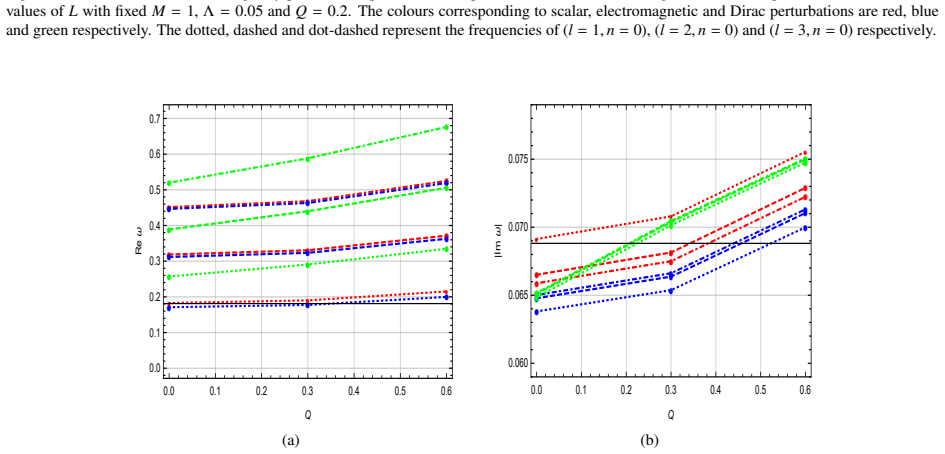
The paper establishes, for the RNdS-like bumblebee black hole with metric function $A(r)=1-\frac{2M}{r}+\frac{2(1+L)}{2+L}\frac{Q^2}{r^2}-\frac{1}{3}(1+L)r^2\Lambda$, that the effective potentials for scalar ($V_s$), electromagnetic ($V_e$) and Dirac ($V_d$) perturbations all decrease as the Lorentz-violation parameter $L$ increases, while they all increase as charge $Q$ increases. From the resulting greybody bounds, $T\ge \operatorname{sech}^2\!\left(\frac{\sqrt{1+L}}{2\omega}\int_{r_h}^{r_c} \frac{V}{A}\,dr\right)$, it follows that greybody factors rise with $L$ and fall with $Q$. Quasinormal frequencies computed at 6th-order WKB with Padé approximation show the same monotonicity: larger $L$ lowers both the real frequency and the damping magnitude, larger $Q$ raises them, and the time-domain profiles corroborate this. For the RNAdS-like black hole, the effect of $L$ is perturbation-dependent: it lowers the potential for Dirac perturbations but raises it for scalar and electromagnetic ones. The paper also derives the photon sphere radius $r_p = \frac{3M}{2} + \frac{1}{2}\sqrt{9M^2 - \frac{16(1+L)Q^2}{2+L}}$, independent of $\Lambda$, and shows the shadow radius of the RNdS case decreases with both $L$ and $Q$.
Load-bearing premise
The greybody bound derivation assumes the effective potential is non-negative between the horizons after setting $h=\omega$ and dropping the absolute value in the Visser–Boonserm integrand, but the massive scalar and Dirac plots with $m=0.1$ and $\Lambda=0.05$ use masses below the critical value $m_c=\sqrt{2\Lambda/3}\approx 0.1826$, where the potential is not positive throughout.
Editorial extensions
If this is right
- If $L$ is positive, the RNdS bumblebee black hole rings at a lower frequency and damps more slowly than its general-relativity counterpart with the same $M$, $Q$, and $\Lambda$, and the effect grows with $L$ across scalar, electromagnetic, and Dirac perturbations.
- Larger $L$ raises the rigorous greybody bound, meaning a larger fraction of Hawking radiation escapes to infinity and the distant spectrum carries a Lorentz-violation signature.
- Larger $Q$ does the opposite in every channel, so charge and Lorentz violation can in principle be disentangled in ringdown and greybody observables.
- The photon-sphere radius is independent of $\Lambda$ but shrinks with $L$ and $Q$, and the RNdS shadow radius shrinks with both, connecting the perturbation observables to black hole shadow measurements.
- For the RNAdS-like black hole, constraints on $L$ must be field-dependent: scalar and electromagnetic potentials react oppositely to Dirac potentials as $L$ grows.
Reading between the lines
- The paper's pattern — lower barrier implies higher greybody bound and lower QNM frequency — is natural but not proven analytically; one could test the same monotonicity with a continued-fraction or direct-integration code for a single parameter set to check whether the WKB/Padé result is an artifact of the approximation.
- Since the eikonal (large-$\ell$) limit of QNMs is usually tied to the photon sphere, the reported decrease of $r_p$ with $L$ predicts that the real part of high-$\ell$ QNMs should decrease with $L$; comparing that prediction with the paper's low-$\ell$ tables would provide a consistency test.
- The rigorous-bound derivation drops the absolute value in the Visser–Boonserm integrand; restoring it, or restricting the analysis to $m>m_c$, could soften the claimed monotonic rise of the greybody factor with $L$ for massive scalar fields.
Editorial analysis
A structured set of objections, weighed in public.
Referee Report
Summary. This manuscript studies scalar, electromagnetic, and Dirac perturbations of charged, cosmological-constant black holes in bumblebee gravity, using the metric of Eqs. (1)-(2). It derives effective potentials, applies the Visser-Boonserm rigorous bound to obtain greybody factors, computes quasinormal frequencies with 6th-order WKB and Padé approximations, presents time-domain evolutions, and discusses photon-sphere and shadow radii. The central claims are that the Lorentz-violation parameter L and charge Q control the effective potential heights, greybody bounds, and QNM frequencies in a systematic way, with L decreasing the potential for RNdS black holes and Q increasing it according to the body of the paper, although the abstract states the opposite for Q.
Significance. If the calculations were correct, the paper would provide a useful extension of bumblebee-gravity phenomenology by comparing three perturbation channels and relating QNMs, greybody factors, and shadow observables. The manuscript has some tangible strengths: it reports WKB and Padé results with error estimates, includes time-domain profiles, and gives an analytic photon-sphere formula. However, several load-bearing statements are internally contradictory, the Dirac decoupling that underlies the fermion results is not derived, and the greybody-bound applications violate the stated validity conditions. In its current form the manuscript cannot be used as a reliable source for the claimed parameter dependences.
major comments (5)
- [Abstract vs. Sections 3-4] The abstract states that increasing charge Q reduces the effective potential in all perturbations, but the body and figures show the opposite. For example, Figs. 4, 6, and 8 show that increasing Q from 0.1 to 0.6 raises the peak of the scalar, electromagnetic, and Dirac potentials for both RNdS and RNAdS black holes, and the text in Sections 3 and 4 states this explicitly. The conclusion also states that the height of the effective potentials increases with Q. The abstract must be corrected to match the actual results, and all summaries need to be checked for consistency.
- [Section 7, Table 1] The text in Section 7 says that increasing L increases both the real part and the absolute value of the imaginary part of the QNM frequencies for the RNdS-like black hole, but Table 1 shows the opposite for all three channels. For example, for the scalar field with l=1, n=0, the Padé value of Re(omega) decreases from 0.212355 to 0.179031 to 0.145461 as L goes from 0 to 0.3 to 0.6, and |Im(omega)| decreases from 0.0755182 to 0.0649739 to 0.0532054. The same decreasing trend is visible in the electromagnetic and Dirac rows. The sentence immediately after, which says increasing L 'prevents the rise' of oscillation and damping, contradicts the preceding sentence. This internal contradiction affects one of the central quantitative claims of the paper.
- [Section 4, Eqs. (23)-(29)] The reduction of the massive Dirac equation to the decoupled Schrödinger-like equations is not demonstrated. The text jumps from the coupled system (23) to the rotated variables (24), then to Eq. (25) with only 'After some calculations,' and then introduces the frequency-dependent coordinate r_hat* in Eq. (26) and the potential Vdm± in Eq. (29). Because r_hat* depends on omega and r, it is not shown that the QNM boundary conditions are preserved under this transformation, and the derivative dW±/dr_hat* in Eq. (29) is not derived. Since the Dirac rows of Tables 1-2 and the fermion greybody bounds both rely on Vdm±, the Dirac-sector results are unsupported without a complete derivation or a reference to a standard decoupling that applies to this metric.
- [Section 5, Eqs. (31)-(38)] The rigorous greybody bound is applied without the absolute value required when h=omega. In Eq. (32), the term (omega^2 - V - h^2)^2 becomes V^2 after setting h=omega, so Eq. (33) should contain |V|/(2omega), not V/(2omega). This is not a minor technicality: Figs. 10 and 13 use m=0.1 with Lambda=0.05, which is below the paper's own critical mass mc=sqrt(2Lambda/3) ~ 0.1826, and Section 3 explicitly says that for m<mc the scalar effective potential has an additional zero and changes sign between the horizons. The bound in Eq. (35) is therefore applied outside its validity regime. In addition, Eq. (38) claims that the integral of |dW/dr*| equals W evaluated at the endpoints, which is only true if dW/dr* does not change sign and W has the same value at both endpoints; the absolute value makes this step invalid in general. The fermion greybody derivation in Section 5.2 needs to be redone with the absolute value and with parameters satisfying the positivity condition.
- [Section 5.2.2, Eq. (46)] Equation (46) is dimensionally inconsistent. In natural units, omega, m, and r have inverse-length and length dimensions respectively, while kappa is a dimensionless angular eigenvalue. The argument of the sech function contains the factor (rc-rh) kappa^2/(rc rh), which has dimension 1/length, multiplied by the parenthesis (1 + m^2/(kappa^4 rc rh)), in which the second term has dimension 1/length^4. The overall argument therefore does not reduce to a dimensionless number, so Eq. (46) cannot be a valid expression for a transmission bound. The approximation leading from Eq. (43) to Eq. (46) also needs to be re-examined, since Eq. (43) defines mu_tilde = m/kappa but Eq. (46) contains m^2/kappa^4 in a different combination.
minor comments (5)
- [Eq. (36)] The denominator '3Q^2(2+L)' in the last term appears to be a typo: the Q^2 factor should cancel, leaving 3(2+L), since the integral of the charge term is proportional to Q^2 divided by (2+L).
- [Eq. (29)] There is a typo in the derivative term where 'k^2_+' appears instead of 'kappa_+^2', and the displayed form of Vdm± would benefit from being typeset in a single equation rather than split with an inline equals sign.
- [Eq. (54)] The condition for an unstable circular photon orbit should be V''(r_p) < 0, not V''(r_p) = 0; the text writes all three conditions as equalities, which is the condition for an inflection point rather than a maximum. Only Eq. (55) is used in the subsequent derivation, so this does not affect the photon-sphere radius, but the mathematical statement is incorrect.
- [Figures 19-20 captions] The caption of Fig. 19 says 'The parameters are taken as L=0.2' while the figure varies L; this should presumably read Q=0.2. The same issue appears in the caption of Fig. 20, which says L=0.2 while varying Q.
- [Section 6, Figure captions] Several greybody comparison figures, such as Figs. 14(b), 15(b), and 16(b), are labeled with Lambda=-0.05 even though they compare SdS-like and RNdS-like black holes that require a positive cosmological constant; the captions and the text should be made consistent.
Circularity Check
No significant circularity: the charged-bumblebee QNM, greybody, and shadow results are computed from an externally imported metric using standard perturbation methods, with no fitted parameter or self-citation used to force the central claims.
full rationale
The central derivation chain is self-contained. The RNdS/RNAdS-like bumblebee metric, Eqs. (1)-(2), is imported from the external reference [52]; the scalar and electromagnetic effective potentials, Eqs. (8)-(10), are obtained by separating the Klein-Gordon and Maxwell equations under the tortoise coordinate (6); the Dirac potential, Eq. (29), is presented as a reduction of the Dirac equation via the Chandrasekhar transformation (24); and the photon-sphere and shadow results, Eqs. (55)-(58), follow algebraically from the null-geodesic conditions. No parameter is fitted to the QNM frequencies, greybody bounds, or shadow radii, and the WKB/Pade and rigorous-bound computations are standard independent methods applied to those potentials. The self-citations [44, 54, 69] appear only as background comparisons (for example, that Schwarzschild/SdS bumblebee photon radii are L-independent) and are not load-bearing for the new charged results. Two rigor concerns are noted but are not circularity: the Dirac decoupling between Eqs. (24) and (29) is asserted with 'After some calculations' and would need independent verification, and several figures use m=0.1 with Lambda=0.05, below the paper's own critical mass m_c = sqrt(2*Lambda/3) ~ 0.183, which can invalidate the positivity assumption in the greybody bound (33)-(34). These are matters of correctness and validity, not reductions of the output to the input by construction.
Assumptions & free parameters
free parameters (1)
- Time-domain initial wave packet parameters (k1, sigma) =
not specified
assumptions (4)
- domain assumption Bumblebee metric (1)-(2) is a valid charged black hole solution with cosmological constant in Einstein-bumblebee gravity.
- domain assumption Linear test-field perturbation on the fixed background is valid; backreaction is negligible.
- domain assumption The Visser-Boonserm bound (31) applies with h=omega and with the absolute value in the integrand omitted when integrating over the two-horizon region.
- ad hoc to paper The Chandrasekhar-type decoupling (19)-(24) reduces the Dirac equation to the form (28) with the stated frequency-dependent potential.
Cite this review
Pith. "Pith review of Quasinormal modes and greybody factors of charge black hole in bumblebee gravity model." pith.science (2026). https://pith.science/paper/6JPBXFUP
@misc{pith2026250602508,
  author       = {Pith},
  title        = {Pith review of: Quasinormal modes and greybody factors of charge black hole in bumblebee gravity model},
  year         = {2026},
  howpublished = {\url{https://pith.science/paper/6JPBXFUP}},
  note         = {Machine review of arXiv:2506.02508}
}
abstract
In this paper, we investigate the Dirac field, scalar field and electromagnetic field perturbations of Reissner-Nordstorm-de Sitter (RNdS) and Reissner-Nordstorm-(anti)-de Sitter (RNAdS)-like black holes within the frame work of Einstein-bumblebee gravity. The effective potential, greybody factor and quasinormal modes (QNMs) are also explored by using Dirac equation, Klein-Gordon equation and Maxwell's equation. We find that for RNdS-like black hole increasing the Lorentz violation parameter $L$ consistently leads to decrease in the effective potential for all types of perturbations but for RNAdS case the influence of $L$ varies depending on the types of perturbation. Further for both RNdS and RNAdS-like black holes, increasing charge $Q$ reduces the effective potential in all the perturbations. The greybody factors of all the types of perturbations are also discussed. The results show that the greybody factors depend on the shape of the effective potential: higher (lower) potentials gives lower (higher) greybody factors. The QNMs frequencies of RNdS-like black hole for the massless field perturbations are discussed by using 6th order WKB approximation and Pad\'e approximation. We also analyze the time-domain profiles of the perturbations. The effects of Lorentz violation parameter $L$ and charge $Q$ to the photon sphere radius and shadow radius are also discussed. It is noted that increasing $Q$ and $L$ reduce the rise of shadow radius for RNdS-like black hole.
Figures


Figures from the paper (21 more)




Forward citations
Cited by 1 Pith paper
-
How does nonmetricity shape quantum emission from rotating bumblebee black holes?
In rotating metric-affine bumblebee black holes, nonmetricity makes the surface gravity and Hawking temperature depend on latitude and couples angular channels, so a global thermal spectrum does not exist.
Reference graph
Works this paper leans on
- [52]
-
[1]
Maldacena, Adv
J.M. Maldacena, Adv. Theor. Math. Phys. 2 (1998) 231-252
1998
-
[2]
Gubser, I.R
S.S. Gubser, I.R. Klebanov, A.M. Polyakov, Phys. Lett. B 428 (1998) 105
1998
-
[3]
Alfaro, H.A
J. Alfaro, H.A. Morales-Tecotl, I.F. Urrutia, Phy. Rev. D 65 (2002) 103509
2002
-
[4]
Rovelli, L
C. Rovelli, L. Smolin, Nucl. Phys. B 331 (1990) 80
1990
- [5]
-
[6]
Y .L. Onika, T.S. Ibungochouba, I.M. Ablu, Gen. Relativ. Gravit. 54 (2022) 77
work page 2022
-
[7]
Y .S. Priyobarta, T.S. Ibungochouba, I.M. Ablu, A.S. Keshwarjit, Int. J. Mod. Phys. D 31 (2022) 2250106
work page 2022
Show all 84 references
-
[8]
Media, S
N. Media, S. Christina, T.S. Ibungochouba, Int. J. Mod. Phys. A 39 (2024) 2450105
2024
-
[9]
Onika, N
Y .L. Onika, N. Media, T.S. Ibungochouba, Int. J. Mod. Phys. A 38 (2023) 2350180
2023
-
[10]
Priyobarta, T.S
Y .S. Priyobarta, T.S. Ibungochouba, S.S. Niranjan, Chin. Phys. C 48 (2024) 115111
2024
-
[11]
Media, Y .S
N. Media, Y .S. Priyobarta, Y .L. Onika, T.S. Ibungochouba, Gen. Relativ. Gravit. 57 (2025) 80. 26
2025
-
[12]
Media, T
N. Media, T. S. Ibungochouba, Int. J. Theo. Phys. 64 (2025) 82
2025
-
[13]
Kostelecky, S.Samuel, Phys
V .A. Kostelecky, S.Samuel, Phys. Rev. D 39 (1989) 683
1989
-
[14]
Kostelecky, Phys
V .A. Kostelecky, Phys. Rev. D 69 (2004) 105009
2004
-
[15]
Casana, A
R. Casana, A. Cavalcante, F.P. Poulis, E.B. Santos, Phys. Rev. D 97 (2018) 104001
2018
-
[16]
Gullu, A
I. Gullu, A. Ovgun, Ann. Phys. 436 (2022) 168721
2022
-
[17]
C. Ding, X. Chen, X. Fu, Nucl. Phys. B 975 (2022) 115688
2022
-
[18]
Övgün, K
A. Övgün, K. Jusufi,˙I Sakalli, Phys. Rev. D 99 (2019) 024042
2019
-
[19]
C. Ding, X. Chen, Chin. Phys. C 45 (2021) 025106
2021
-
[20]
S.K. Jha, A. Rahaman, Eur. Phys. J. C 81 (2021) 345
2021
-
[21]
D. J. Gogoi, U. D. Goswami, J. Cosmol. Astropart. Phys. 06 (2022) 029
2022
-
[22]
S. W. Hawking, Nature, 248 (1974) 30
1974
-
[23]
Fernando, Gen
S. Fernando, Gen. Relativ. Gravit. 37 (2005) 461
2005
-
[24]
Kim, J.J
W. Kim, J.J. Oh, J. Korean Phys. Soc. 52 (2008) 986
2008
-
[25]
Parikh, F
M.K. Parikh, F. Wilczek, Phys. Rev. Lett. 85 (2000) 5042
2000
-
[26]
Konoplyaa, A.F
R.A. Konoplyaa, A.F. Zinhailoa, Phys. Lett. B. 810 (2020) 135793
2020
-
[27]
Visser, Phys
M. Visser, Phys. Rev. A 59 (1999) 427
1999
-
[28]
Boonserm, M
P. Boonserm, M. Visser, Ann. Phys. 323 (2008) 2779
2008
-
[29]
Konoplya, A
R.A. Konoplya, A. Zhidenko, Rev. Mod. Phys. 83 (2011) 793
2011
-
[30]
Berti, V
E. Berti, V . Cardoso, A.O. Starinets, Class. Quantum Grav. 26 (2009) 163001
2009
-
[31]
Dreyer, Phys
O. Dreyer, Phys. Rev. Lett. 90 (2003) 081301
2003
-
[32]
Maggiore, Phys
M. Maggiore, Phys. Rev. Lett. 100 (2008) 141301
2008
-
[33]
Vishveshwara, Nature (London) 227 (1970) 936
C.V . Vishveshwara, Nature (London) 227 (1970) 936
1970
-
[34]
Davis, R
M. Davis, R. Ruffini, W.H. Press, and R.H. Rice, Phys. Rev. Lett. 27 (1971) 1466
1971
-
[35]
Dorband, E
E.N. Dorband, E. Berti, P. Diener, E. Schnetter, and M. Tiglio, Phys. Rev. D 74 (2006) 084028
2006
-
[36]
Nollert and B.G
H.P. Nollert and B.G. Schmidt, Phys. Rev. D 45 (1992) 2617
1992
-
[37]
Andersson, Proc
N. Andersson, Proc. R. Soc. London 439 (1992) 47
1992
-
[38]
E. W. Leaver, Proc. R. Soc. Lond. A 402 (1985) 285
1985
-
[39]
Ferrari, B
V . Ferrari, B. Mashhoon, Phys. Rev. D 30 (1984) 295
1984
-
[40]
R. A. Konoplya, A. Zhidenko, Rev. Mod. Phys 83 (2011) 793
2011
-
[41]
Schutz and C.M
B.F. Schutz and C.M. Will, Astrophys. J. Lett. 291 (1985) L33
1985
-
[42]
Iyer and C.M
S. Iyer and C.M. Will, Phys.Rev. D 35 (1987) 3621
1987
-
[43]
Cho, Phys
H.T. Cho, Phys. Rev. D 68 (2003) 024003. 27
2003
-
[44]
Priyobarta, T.S
Y .S. Priyobarta, T.S. Ibungochouba, Eur. Phys. J. C. 84 (2024) 1245
2024
-
[45]
S. Devi, R. Roy, S. Chakrabarti, Eur. Phys. J. C. 80 (2020) 760
2020
-
[46]
K. J. Sohan, R. Anisur, Nucl. Phys. B 1002 (2024) 116536
2024
-
[47]
K. J. Sohan, Eur. Phys. J. C 83 (2023) 952
2023
-
[48]
L. Jin, M. Hong, L. Kai, Phys. Rev. D 88 (2013) 064001
2013
-
[49]
Al-Badawi, S.K. Jha, A. Rahaman, Eur. Phys. J. C. 84 (2024) 145
2024
-
[50]
Gogoi, A
D.J. Gogoi, A. Ovgun, M. Koussour, Eur. Phys. J. C 83 (2023) 700
2023
-
[51]
Jianhui, B
L. Jianhui, B. G. Moises, Z. Xiangdong, Phys. Rev. D 109 (2024) 104039
2024
-
[53]
Chowdhury, N
A. Chowdhury, N. Banerjee, Phys. Lett. B 805 (2020) 135417
2020
-
[54]
Uniyal, S.Kanzi, I
A. Uniyal, S.Kanzi, I. Sakalli, Eur. Phys. J. C 83 (2023) 668
2023
-
[55]
Boonserm, T.Ngampitipam, P
P. Boonserm, T.Ngampitipam, P. Wongjun, Eur. Phys. J. C 78 (2018) 492
2018
-
[56]
Boonserm, C.H
P. Boonserm, C.H. Chen, T.Ngampitipam, P. Wongjun, Phys. Rev. D 104 (2021) 084054
2021
-
[57]
Synge, Mon
J.L. Synge, Mon. Not. R. Astron. Soc. 131 (1966) 463
1966
-
[58]
Luminet, Astron
J.P. Luminet, Astron. Astrophys. 75 (1979) 228
1979
-
[59]
Bardeen, in Proceedings, Ecole d’Eté dePhysique Théorique: Les Astres Occlus : Les Houches, France, August, 1972 (1973) 215-240
J.M. Bardeen, in Proceedings, Ecole d’Eté dePhysique Théorique: Les Astres Occlus : Les Houches, France, August, 1972 (1973) 215-240
1973
-
[60]
de Vries, Class
A. de Vries, Class. Quantum Gravity 17 (1999)123
1999
-
[61]
Bambi, F
C. Bambi, F. Caravelli, L. Modesto, Phys. Lett. B 711 (2012) 10
2012
-
[62]
Atamurotov, A
F. Atamurotov, A. Abdujabbarov, B. Ahmedov, Phys. Rev. D 88 (2013) 064004
2013
-
[63]
T.- T.Sui, Q.M. Fu, W.D. Guo, Phys. Lett.B 845 (2023) 138135
2023
-
[64]
Akiyama et al
K. Akiyama et al. (Event Horizon Telescope), Astrophys. J. Lett. 875 (2019) L1
2019
-
[65]
Akiyama et al
K. Akiyama et al. (Event Horizon Telescope), Astrophys. J. Lett. 875 (2019) L4
2019
-
[66]
Akiyama et al
K. Akiyama et al. (Event Horizon Telescope), Astrophys. J. Lett. 930 (2022) L12
2022
-
[67]
Maluf, J.C.S
R.V . Maluf, J.C.S. Neves, Phys. Rev. D 103 (2021) 044002
2021
-
[68]
R. N. Izmailov, K. K. Nandi, Class. Quantum Grav. 39 (2022) 215006
2022
-
[69]
Priyobarta, I.D
Y .S. Priyobarta, I.D. Roshila, T.S. Ibungochouba, arXiv:2504.09108, 2025
2025 arXiv
-
[70]
Ibungochouba, Chin
T.S. Ibungochouba, Chin. Phys. B 24 (2015) 070401
2015
-
[71]
M. E. Peskin, CRC press (2018)
2018
-
[72]
Cardoso, Jose
V . Cardoso, Jose. P. S. Lemos, Phys. Rev. D 64 (2001) 084017
2001
-
[73]
Konoplya, Phys
R.A. Konoplya, Phys. Rev. D 68, (2003) 024018
2003
-
[74]
Chandrasekhar, Clarendon Press, Oxford (1983)
S. Chandrasekhar, Clarendon Press, Oxford (1983). 251 (1995) 267. 28
1983
-
[75]
Hawking Commun
S.W. Hawking Commun. Math. Phys. 43 (1975) 199
1975
-
[76]
Ngampitipan, P Boonserm, J
T. Ngampitipan, P Boonserm, J. Phys. Conf. Ser. 435 (2013) 012027
2013
-
[77]
Matyjasek, M
J. Matyjasek, M. Opala, Phys. Rev. D 96 (2017) 024011
2017
-
[78]
Matyjasek, M
J. Matyjasek, M. Telecka, Phys. Rev. D 100 (2019) 124006
2019
-
[79]
G Mossand, N
I. G Mossand, N. P James, Class. Quantum Grav. 19 (2002) 2323
2002
-
[80]
Gundlach, P
C. Gundlach, P. H Richard , J. Pullin, Phys. Rev. D 49 (1994) 890
1994
-
[81]
Karmakar, D.J
R. Karmakar, D.J. Gogoi, U. D. Goswami, Phys. Dark Universe. 41 (2023) 101249
2023
-
[82]
Konoplya, Phys
R.A. Konoplya, Phys. Lett. B 795 (2019) 1–6
2019
-
[83]
Perlick, O.Y
V . Perlick, O.Y . Tsupko, Phys. Rep. 947 (2022) 1
2022
-
[84]
Cardoso, A
V . Cardoso, A. S. Miranda, E. Berti, W. Helvi , V . T. Zanchin, Phys. Rev. D 79 (2009) 064016 . 29
2009
Reviewed August 7, 2026 · model on record in the stance chip above.
Discussion (0). Sign in to comment.