REVIEW 2 major objections 7 minor 2 cited by
Think Twice, Act Once: A Co-Evolution Framework of LLM and RL for Large-Scale Decision Making
T0 review · 2 major / 7 minor · reviewed 2026-08-07 · deepseek-v4-flash
Pith's one-line read This paper claims that an LLM used only during training as an action corrector and reward critic lifts RL to the best reported results on three large power-grid control tasks.
desk verdict Sensible offline LLM-RL integration with impressive L2RPN numbers, but the headline gains may owe more to the Grid2Op-validated retry loop than to the LLM's reasoning; needs a proposer control before the SOTA claim holds. read the letter →
The pith
A machine-rendered reading of the paper's core claim, the machinery that carries it, and where it could break.
The reading
What carries the argument
The load-bearing mechanism is the dual-role trajectory-refinement loop that runs while the RL policy trains. The Policy Actor $f^{\text{LLM}}$ (Eq. 4) is invoked on sampled transitions with reward below $\bar{r}$; it receives the state, the RL action, and a 'bad action' negative example in text, and proposes a corrected action that the Grid2Op simulator must confirm before the new transition is stored in the separate buffer $\mathcal{D}_{\text{LLM}}$. The Value Critic $g^{\text{LLM}}$ (Eq. 5) is invoked on key trajectory points, selected by reward magnitude or line-flow change, and returns reward adjustments confined to $\{-2K,-K,+K,+2K\}$ — a discretized analogue of temporal-credit assignment. The mixed sampling distribution $p_{\text{mix}}$ (Eq. 9) with importance weights $w_r(\tau)$ (Eq. 8) then transfers the LLM's improvements into the SAC (Soft Actor-Critic) policy update (Eq. 10), while the same mixed buffer becomes a low-rank adaptation (LoRA) fine-tuning set for the LLM; that two-way flow of data is what the name 'co-evolution' refers to.
What would settle it
Repeat the WCCI 2022 experiment with the Grid2Op validation loop disabled so every LLM-proposed action is accepted un-checked; the claim would be falsified if the 75.9 episode reward and the 145% margin over the expert-guided RL baseline do not fall substantially, because the paper's own Figure 5b shows unvalidated LLM suggestions are poor for long-horizon control. A second check would scramble the text serialization of states and actions while keeping simulation validation intact; if performance stays high, the gains come from the validation filter rather than from LLM reasoning.
Extended reading notes
Core claim
ACE's central claim is that separating LLM reasoning from RL execution — 'think twice, act once' — removes the sample-inefficiency and latency bottlenecks at the same time. During training the Policy Actor takes transitions whose reward $r$ falls below a threshold $\bar{r}$, converts state and action into text, and proposes a corrected action $\hat{a}_t$; the correction is accepted only after Grid2Op simulation confirms it, with up to five revision rounds allowed. The Value Critic takes trajectory snippets at key decision points and returns reward adjustments on a discrete grid $\{-2K,-K,+K,+2K\}$, acting as an implicit multi-step temporal-difference, TD($\lambda$), whose credit assignment does not assume exponential decay. Refined transitions live in a separate LLM buffer, and a mixed sampling distribution with reward-based weights $w_r(\tau)$ feeds the RL updates while also supplying fine-tuning data that improves the LLM coach. At deployment only the RL agent acts, and ACE reports the highest episode rewards on all three L2RPN challenges, with the largest gain (145% over the expert-guided RL backbone) in the WCCI 2022 IEEE-118 environment; ablations on WCCI 2020 show that removing the Actor drops the reward from 69.8 to 48.3 and removing the Critic drops it to 61.5.
Load-bearing premise
The load-bearing premise is that a fast, faithful simulator of the real system is always available during training to validate every LLM-proposed action; if that simulator is missing, slow, or inaccurate, the think-twice loop cannot run, and the paper's own evidence indicates LLM suggestions alone are unreliable over long horizons.
Editorial extensions
If this is right
- Deployment stays real-time even though the coach is a 7B-parameter LLM, because the LLM never acts online and test-time latency is set by the RL policy alone.
- A few hundred targeted refinements substitute for tens of thousands of environment samples: ACE needs 287 to 682 refinements on top of 40–50K samples where baselines need 100–200K.
- LLM reward re-scoring is a real source of gain, not a rounding error: without the Value Critic the WCCI 2020 episode reward falls from 69.8 to 61.5, and without the Policy Actor to 48.3.
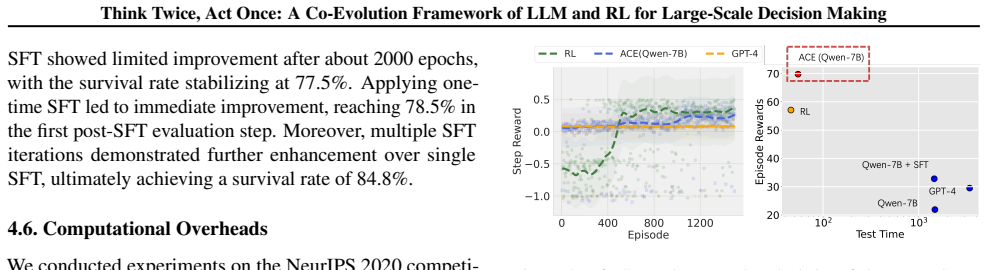
- Fine-tuning the coach on the mixed buffer closes the loop: three rounds of SFT let the Qwen2-7B-based ACE beat its untuned self and the non-tuned GPT-4 variant on refined step rewards and independent decision-making.
- Offline selective refinement beats policy-regularization-style LLM guidance: the modified LLM4Teach baseline stays near the RL backbone (64.4 on WCCI 2020) while ACE reaches 69.8.
Reading between the lines
- Beyond the paper: none of ACE's equations is power-grid-specific, so the design should transfer to other control domains that have a fast simulator and textual state-action serialization, such as traffic control or cloud resource management.
- Beyond the paper: the paper's evidence that unvalidated LLM suggestions degrade over long horizons suggests a direct stress test — vary simulator fidelity and measure how much of the 22%, 13%, and 145% margins survive.
- Beyond the paper: since SFT on the mixed buffer independently improved the LLM's own decisions by 10.9%, a longer co-evolution loop might eventually shrink the coach to a small distilled policy, leaving only the fast RL controller at deployment.
- Beyond the paper: the discrete reward adjustments and five-round cap imply a refinement budget; a promising extension is to make that budget adaptive, spending more rounds when the simulator's margin between the RL action and the LLM fix is small.
Editorial analysis
A structured set of objections, weighed in public.
Referee Report
Summary. This paper proposes ACE, a framework that combines an LLM and an RL agent for large-scale power grid control. During training, the LLM acts as a Policy Actor that refines low-reward actions, with each proposal simulated in Grid2Op and up to five retries, and as a Value Critic that adjusts rewards at selected trajectory points. Refined transitions are pooled with RL transitions in a mixed replay buffer using reward-weighted sampling, and the LLM is occasionally fine-tuned on this buffer. At deployment, only the RL policy acts. Experiments on three L2RPN challenges report substantial improvements over the RL backbone and over LLM-only and LLM4Teach baselines, while requiring only a few hundred LLM refinements.
Significance. If the reported gains are genuinely due to LLM reasoning, this is a practical and timely contribution: it separates offline LLM guidance from online RL execution, addressing the real-time latency problem of LLM-based control in industrial settings. The sample-efficiency numbers (287-682 refinements vs 100K-200K environment steps) are striking, and the ablations show that both the actor and critic components contribute on WCCI 2020. The paper is also honest about the limitations of pure LLM control. However, the central attribution of the improvements to LLM reasoning remains unresolved because no control replaces the LLM proposer with a random or rule-based proposer under the same Grid2Op validation and retry protocol. In addition, the state-of-the-art claim on WCCI 2022 lacks comparison with the actual challenge winner or the cited AlphaZero-based method. These issues do not refute the empirical results, but they currently prevent the paper from establishing its central causal claim.
major comments (2)
- [Algorithm 1, Section 4.3] The attribution of ACE's gains to LLM reasoning is not identified. In Algorithm 1 (lines 10-18) and Section 4.3, every fLLM action is simulated in Grid2Op, and up to five rounds of new proposals are allowed until the refined action beats the RL action. No control replaces fLLM with a random or rule-based proposer under the same validation and retry budget. The 'w/o Multi-round' ablation in Table 2 only removes the retry loop, not the LLM, and Figure 5(b) shows unvalidated LLM suggestions are poor for long-horizon control. The reported improvements over the RL backbone (22%, 13%, 145% in Table 1) could therefore come from the validated retry procedure rather than from LLM reasoning. Please add a control that uses a non-LLM proposer (e.g., random actions or a simple heuristic) with identical Grid2Op validation and the same five-round retry limit, and report the resulting episode rewards.
- [Table 1, Section 4.1] The state-of-the-art claim on WCCI 2022 is not supported by the selected baselines. Table 1 compares ACE only to the authors' own expert-guided RL backbone and to a modified LLM4Teach. For WCCI 2022, Section 4.1 cites Dorfer et al. (2022) but the paper never compares ACE to that method or to the actual L2RPN WCCI 2022 challenge winner. 'State-of-the-art' requires comparison with the best known methods on that benchmark; please add such comparisons or restrict the claim to the considered baselines.
minor comments (7)
- [Eq. (6) and Eq. (8)] The symbol β denotes the mixing ratio in Eq. (6) and also the temperature in the exponential of Eq. (8); using the same symbol for two quantities in the same derivation is confusing and should be corrected.
- [Table A.2, Section 4.5] Table A.2 lists 'Reward threshold (¯r & r) 0.1 & 0.5', while Section 4.5 reports experiments with r ∈ {-0.3, 0, 0.3} and Table 3 shows the default r = 0. Please clarify the default threshold values.
- [Table 1 footnote] The dagger marker † is attached both to ACE (Qwen2-7B + SFT) and to ACE (GPT-4), but the footnote says ACE (GPT-4) does not include SFT; use separate markers for the SFT and no-SFT configurations to avoid ambiguity.
- [Section 3.3, Algorithm 1] Algorithm 1 (line 18) stores all refined transitions in D_LLM, whereas Eq. (9) filters them with Iv(τ) at sampling time; please state explicitly whether invalid refinements are discarded at storage time or stored and down-weighted.
- [Section 3.3] The sentence 'we apply low-rank adaptation fine-tuning on Dmix with reward signals as labels' is under-specified; please define the loss function and describe how the reward labels are used (supervised action prediction, preference ranking, or other).
- [Appendix A.2] There are typographical errors in Table A.2: 'SFT buffer size 10,00' should be 10,000, and 'Max Token off LLM' should be 'Max Token of fLLM'.
- [Section 5.1, Figure 5] The text refers to Figure 5(a) and 5(b), but the caption describes left/right panels; align the in-text references with the figure labels.
Circularity Check
No significant circularity: ACE's benchmark claims are anchored to external Grid2Op rewards, and no load-bearing step reduces to its inputs by construction.
full rationale
The paper's chain of evidence is self-contained against an external environment. The Actor/Critic refinement (Eqs. 4-5) generates candidate actions and rewards, but Algorithm 1 line 18 requires every refinement to be simulated in Grid2Op before entering D_LLM, and Eq. (8) weights transitions by the simulated reward rather than by the LLM's own estimate. The final episode rewards in Table 1 are computed by the RL agent on L2RPN test episodes, an external benchmark; they are neither fitted parameters nor restatements of the refinement outputs. The only self-referential element, online LoRA fine-tuning of fLLM on Dmix, is grounded by simulator rewards and RL-generated trajectories, and the paper's headline claims do not depend on a self-citation or an imported uniqueness theorem. The attribution of gains to LLM reasoning rather than to the simulator-validated retry loop is a legitimate experimental-design concern, but it is an attribution risk, not circularity.
Assumptions & free parameters
free parameters (6)
- Reward adjustment scale K =
0.2 / 0.5 in Table A.2; ablation values 0.2, 0.3, 0.4
- Bad-case threshold r =
0 in the main config; ablation values -0.3, 0, 0.3
- Critical trajectory threshold r_bar =
0.1 per Table A.2 ('reward threshold (r_bar & r) 0.1 & 0.5')
- Mixing ratio beta =
0.5
- LLM query intervals =
fLLM 256 steps, gLLM 32 steps
- SFT frequency =
once per 100 generated samples for ACE (Qwen2-7B)
assumptions (4)
- domain assumption The MDP reward r_t = load_t / prod_t (or -lambda_fail on termination) is an adequate proxy for real grid operational quality.
- domain assumption The Grid2Op simulator is a faithful, fast ground truth for grid state transitions.
- ad hoc to paper Bounded LLM reward shaping does not degrade the optimal policy.
- standard math SAC remains stable under the weighted mixed-buffer sampling distribution.
Cite this review
Pith. "Pith review of Think Twice, Act Once: A Co-Evolution Framework of LLM and RL for Large-Scale Decision Making." pith.science (2026). https://pith.science/paper/7EKWY7X6
@misc{pith2026250602522,
  author       = {Pith},
  title        = {Pith review of: Think Twice, Act Once: A Co-Evolution Framework of LLM and RL for Large-Scale Decision Making},
  year         = {2026},
  howpublished = {\url{https://pith.science/paper/7EKWY7X6}},
  note         = {Machine review of arXiv:2506.02522}
}
read the original abstract
Recent advancements in Large Language Models (LLMs) and Reinforcement Learning (RL) have shown significant promise in decision-making tasks. Nevertheless, for large-scale industrial decision problems, both approaches face distinct challenges: LLMs lack real-time long-sequence decision-making capabilities, while RL struggles with sample efficiency in vast action spaces. To bridge this gap, we propose Agents Co-Evolution (ACE), a synergistic framework between LLMs and RL agents for large-scale decision-making scenarios. ACE introduces a dual-role trajectory refinement mechanism where LLMs act as both Policy Actor and Value Critic during RL's training: the Actor refines suboptimal actions via multi-step reasoning and environment validation, while the Critic performs temporal credit assignment through trajectory-level reward shaping. Concurrently, RL agent enhances LLMs' task-specific decision-making with high-quality fine-tuning datasets generated via prioritized experience replay. Through extensive experiments across multiple power grid operation challenges with action spaces exceeding 60K discrete actions, ACE demonstrates superior performance over existing RL methods and LLM-based methods.
Figures


Figures from the paper (4 more)



Forward citations
Cited by 2 Pith papers
-
Thinking vs. Doing: Agents that Reason by Scaling Test-Time Interaction
Scaling the number of interaction steps, trained via a curriculum over rollout horizon, improves web-agent task success and outperforms scaling per-step reasoning under fixed token budgets.
-
AIGB-R1: Self-Evolving Generative Auto-Bidding via Hierarchical Planner-Executor Optimization
AIGB-R1 couples an LLM strategy planner with a prompt-conditioned Decision Transformer executor and trains both end-to-end with a decoupled-GRPO self-evolving loop, reporting the highest Score on the AuctionNet benchmark.
Reference graph
Works this paper leans on
-
[1]
Limit your changes no more than 5 lines id
-
[2]
This indirect approach may help redistribute the load and reduce stress on overloaded lines
Consider adjusting the topology of their shared (connected) lines. This indirect approach may help redistribute the load and reduce stress on overloaded lines
-
[3]
Response Format: Please analyze the situation and provide your response in the following format:
Reason from the example line changes, and avoid outputting the BAD line change. Response Format: Please analyze the situation and provide your response in the following format:
-
[4]
Use ONLY values 0 or 1 in new bus id
-
[5]
Consider line cooldown constraints. Input State-Action Parsing forg LLM Episode Overview: - Total steps: 14 - Initial time step: 2012-4-23-6-55 - Final time step: 2012-8-23-5-15 - Cumulative reward: 34.46 Key Timestep Analysis: - Time step 2012-4-23-6-55: Action:{73: 1}Reward: -0.48 Highest line usage: 90.68% (Line 39) Overloaded lines: 0 Key reason: Firs...
work page 2012
-
[6]
Analysis of critical issues
-
[7]
Reason and analysis why the provided line change examples are BAD if provided
-
[8]
Propose your response to target line changes (Use ONLY values 0 or 1 in bus id.)] proposed line changes: {line id: new bus id, line id: new bus id} Remember:
Show all 19 references
-
[9]
Do not add any bold formatting, asterisks, or other special characters
Use exactly the format shown above. Do not add any bold formatting, asterisks, or other special characters
-
[10]
For proposed line changes, only include the chosen lines and the target topology
-
[13]
Key decision point indices are the time step indices in the episode (starting from 0), select up to 4 most important decision points
-
[14]
Reward adjustments can only be one of +0.4, +0.2, -0.2, -0.4
-
[15]
Provide your analysis results in the following format: Key Decision Point Indices: [X, Y , A, B] Reward Adjustments: [W, V , T, S]
Both lists must be of the same length and correspond in order Response Format: Please analyze the below information and select decision points where the reward estimation might be erroneous. Provide your analysis results in the following format: Key Decision Point Indices: [X,...
-
[16]
Index X (Adjustment W): [Explain why this decision point is important and why this adjustment value was chosen]
-
[17]
Index Y (Adjustment V): [Explain why this decision point is important and why this adjustment value was chosen]
-
[18]
Index A (Adjustment T): [Explain why this decision point is important and why this adjustment value was chosen]
-
[19]
For fLLM, this includes power grid topology rules and operational constraints, while for gLLM, it focuses on reward assessment criteria and safety standards
Index B (Adjustment S): [Explain why this decision point is important and why this adjustment value was chosen] While fLLM and gLLM serve different roles in ACE, their prompts share a structured design pattern consisting of two essential components: Task Description Prefix: A ...
-
[6299]
Nam, T., Lee, J., Zhang, J., Hwang, S
IEEE, 2018. Nam, T., Lee, J., Zhang, J., Hwang, S. J., Lim, J. J., and Pertsch, K. Lift: Unsupervised reinforcement learn- ing with foundation models as teachers.arXiv preprint arXiv:2312.08958, 2023. Nazeer, M. S., Laschi, C., and Falotico, E. Soft dagger: Sample-efficient im...
2018 arXiv
-
[8677]
Fu, J., Luo, K., and Levine, S
PMLR, 2023b. Fu, J., Luo, K., and Levine, S. Learning robust rewards with adversarial inverse reinforcement learning.arXiv preprint arXiv:1710.11248, 2017. Fu, Y ., Xue, L., Huang, Y ., Brabete, A.-O., Ustiugov, D., Pa- tel, Y ., and Mai, L. Serverlessllm: Low-latency serverle...
2017 arXiv
Reviewed August 7, 2026 · model on record in the stance chip above.
Discussion (0). Sign in to comment.