REVIEW 4 major objections 6 minor 35 references
Contrast & Compress: Learning Lightweight Embeddings for Short Trajectories
T0 review · 4 major / 6 minor · reviewed 2026-08-07 · deepseek-v4-flash
Pith's one-line read The paper shows that compact Transformer encoders trained with cosine-similarity triplets can compress short trajectories into 16-dimensional embeddings that retrieve semantically and directionally similar maneuvers on Argoverse 2…
desk verdict The cosine-vs-FFT comparison is new and the gap is large, but the semantic-directional claim rests on a near-duplicate positive definition and an evaluation metric that mirrors the training objective. read the letter →
The pith
A machine-rendered reading of the paper's core claim, the machinery that carries it, and where it could break.
The reading
What carries the argument
The mechanism is a Transformer encoder with contrastive triplet training on trajectory inputs. Each trajectory is translated to the origin and rotated to a canonical heading, flattened, padded, and fed through stacked encoder layers with multi-head attention; the hidden states are averaged over time to produce a fixed-dimensional embedding. The load-bearing piece is the triplet-mining similarity, Eq. (2): $s_{ij}=(1+\alpha d_{ij})^{-1}\cos(\Delta p_i,\Delta p_j)$, with $\alpha=0.5$, where $d_{ij}$ is average displacement error and $\Delta p_i$ is the trajectory's endpoint-minus-startpoint vector. Pairs scoring above 0.7 are positives, pairs below are negatives, negative examples are drawn by random mining in large batches, and embeddings are L2-normalized before the triplet loss is applied.
What would settle it
A concrete check: take the trained 16-dimensional cosine model, retrieve the six nearest neighbors for queries with known maneuver labels (for example, left turn, right turn, or lane change, labeled independently of the paper's similarity formula), and measure how often the retrieved neighbors share the query's label. If the cosine embeddings do not retrieve same-label neighbors substantially better than the FFT baseline and better than chance, the paper's claim that the embeddings capture semantic and directional intent is not confirmed, whatever the minADE scores say.
Extended reading notes
Core claim
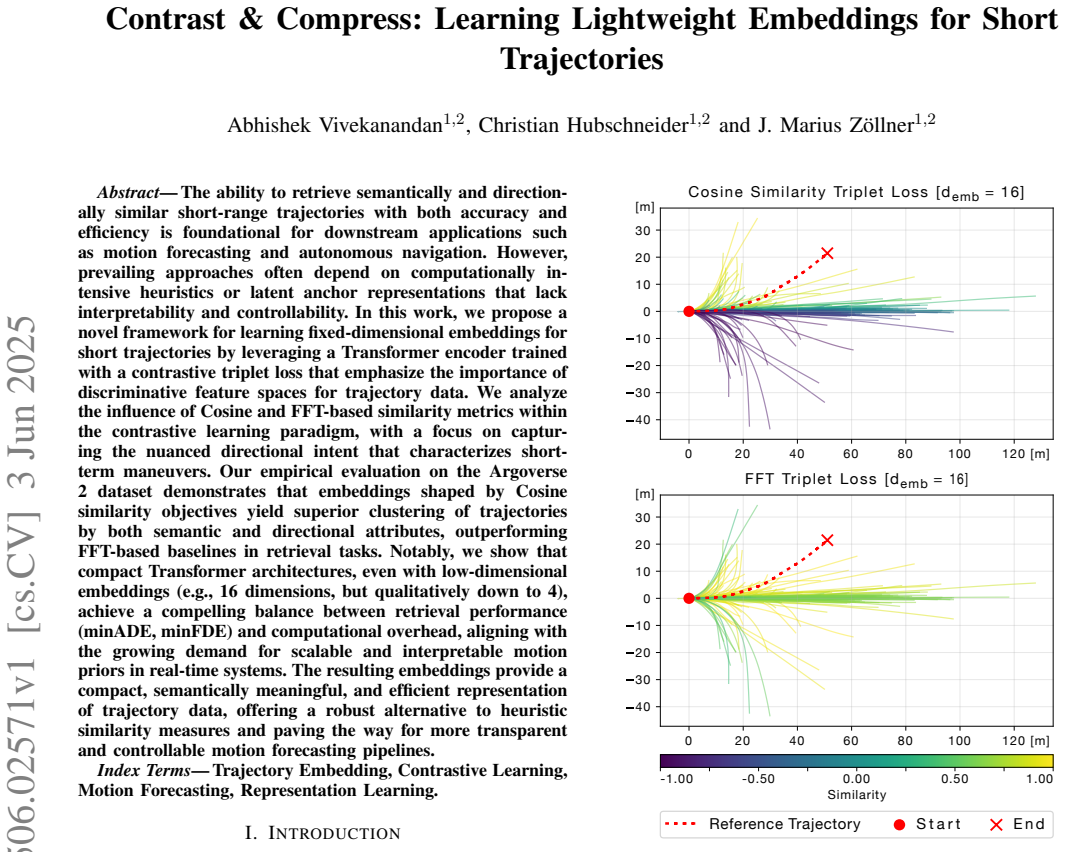
The central claim is that the quality of a learned trajectory embedding for short-range motion is set by the input-space similarity used to mine contrastive triplets. With cosine similarity — a weighted combination of inverse average displacement error and the cosine of the overall displacement vector, as in Eq. (2) — 16-dimensional embeddings from a small Transformer cluster trajectories by semantic and directional attributes: t-SNE reveals distinct clusters for maneuvers such as left turns and straight driving, and nearest neighbors in embedding space match those intents. Embeddings trained with FFT-based similarity, which keeps only frequency magnitudes and therefore discards the sign of direction, fail to separate left from right turns and score roughly three to four times worse on minADE and minFDE. The paper also finds that a compact 4-head, 1-or-2-layer encoder outperforms a larger 8-head, 4-layer model, and that an embedding dimension near 16 is a sweet spot, with 4 and 8 showing degradation and 64 and 128 providing no consistent gain.
Load-bearing premise
The hand-built similarity score in Eq. (2), which blends average displacement error with the cosine of the overall motion direction and uses a 0.7 threshold and alpha=0.5, is assumed to be the true ground-truth notion of trajectory similarity for short-range driving, and the normalized-frame minADE and minFDE metrics are assumed to be the right measure of retrieval quality.
Editorial extensions
If this is right
- Once trajectories are embedded, retrieval becomes a single vector-distance computation on precomputed embeddings, replacing the O(N^2) cost of pairwise DTW, Hausdorff, and similar heuristics with indexed nearest-neighbor search.
- The smallest architecture tested (4H1L) with 16-dim embeddings gives the best endpoint accuracy (minFDE 0.4506 m), so real-time forecasting need not sacrifice endpoint quality.
- Cosine-based embeddings keep left and right turns from the same start point separated, an ability the paper shows FFT-based embeddings lack and one that matters for intersection safety.
- Downstream motion forecasting models can consume these embeddings directly as directional anchors or priors, since the latent space is explicitly organized by intent rather than by a latent anchor that has no clear meaning.
Reading between the lines
- A testable extension is to reuse the same encoder as a case-based planner: embed a partially observed maneuver, retrieve similar full trajectories, and use those as completions, which the paper does not evaluate.
- The exact gap between cosine and FFT may depend on the fixed threshold 0.7 and alpha 0.5; sweeping these parameters or mining negatives in embedding space could either widen or shrink the reported difference.
- Because the training positives are defined by the same ADE term that minADE scores at test time, the retrieval numbers partly measure self-consistency; an independent maneuver-label benchmark would better test the semantic claim.
- The design suggests a general recipe for trajectory compression: keep the direction of motion explicit in the contrastive objective, since discarding phase in the frequency domain removes exactly the information that distinguishes opposite-direction intents.
Editorial analysis
A structured set of objections, weighed in public.
Referee Report
Summary. The paper proposes a contrastive-learning framework for learning fixed-dimensional embeddings of short trajectories. A Transformer encoder is trained with a triplet loss, where positive pairs are defined by an input-space similarity score (Eq. 2) that combines ADE with directional cosine similarity. The authors compare cosine-based and FFT-based similarity for triplet selection on Argoverse 2, and report that cosine-based embeddings achieve low minADE/minFDE values with compact architectures and low embedding dimensions (e.g., 16). The paper also provides qualitative t-SNE visualizations and a brief discussion of non-learned retrieval baselines. The main claims are that cosine-based objectives yield superior semantic and directional clustering compared to FFT-based methods, and that lightweight learned embeddings are an efficient alternative to heuristic distance measures.
Significance. If the representation-learning claims were robustly demonstrated, the work would be a useful step toward interpretable and efficient trajectory priors for motion forecasting. The paper includes a systematic architecture and embedding-dimension sweep, and the idea of explicitly pre-training a retrieval-oriented embedding is timely. However, the current evidence for the central 'semantic and directional' claim is weak: positive pairs are near-duplicates under the chosen threshold, the comparison against FFT is confounded, and the qualitative clustering evaluation lacks external labels. The contribution is potentially valuable but needs additional validation.
major comments (4)
- [Section III-C1, Eq. (2)] With alpha=0.5 and a similarity threshold of 0.7, since the cosine term is at most 1, any positive pair must satisfy 1/(1+0.5*d_ij) >= 0.7, i.e., d_ij <= 0.857 m. Argoverse 2 trajectories span tens of meters over the 6 s horizon, so positives are effectively near-duplicate paths rather than semantically related maneuvers. The triplet objective therefore separates near-duplicates from random negatives; it does not by itself organize the embedding space by maneuver type. This undermines the claim that the embeddings capture 'semantic and directional attributes,' especially because the evaluation metrics minADE/minFDE use the same ADE ordering as the positive selection in Eq. (2). Please add external semantic labels (e.g., map-based turn direction or maneuver class) and report cluster purity or retrieval precision with respect to those labels, and separate the positive-pair threshold from the evaluation metric.
- [Section V-B, Table I] The comparison between Cosine and FFT is confounded by training configuration: the Cosine model is trained for 4900 steps with a batch size of up to 4096, while the FFT model is trained for 19400 steps with a batch size of up to 1024. Different batch sizes change the online triplet-mining pool size and the number of gradient updates, and the paper does not report variance over seeds. The claim that Cosine similarity is superior to FFT for triplet selection is therefore not yet established. Please repeat the comparison with matched batch size and training steps (or matched total samples seen and comparable mining conditions) and report error bars over multiple seeds.
- [Section VII] The paper motivates learned embeddings as an alternative to heuristic distance measures but provides no quantitative baseline against DTW, KNN, Fréchet distance, or precomputed distance matrices. Table I and II compare only the two learned variants. The abstract's claim that the embeddings 'outperform FFT-based baselines in retrieval tasks' would be much stronger if accompanied by quantitative retrieval results against non-learned baselines on the same test set, including query latency or memory usage to substantiate the computational-efficiency argument.
- [Section VI-D, Fig. 2] The t-SNE visualization labels clusters by visual inspection (e.g., Cluster 8: left turns, Cluster 18: straight) without external annotations or any quantitative cluster-quality metric. Such visual labeling is insufficient to support the claim that the embedding space is organized by semantics or directionality, as clusters could correspond to trajectory length, speed, or other low-level features. Please report a quantitative cluster evaluation, such as purity with respect to annotated maneuver classes, silhouette score, or a nearest-neighbor retrieval accuracy for semantic classes.
minor comments (6)
- [Section V-B] The phrase 'trained with a contrastive Triplet Loss (Eq. III-C.2)' refers to a subsection rather than an equation; please change to 'Eq. (3)' or 'Section III-C2'.
- [Section I] There is a grammatical error: 'which could functions as a controllable' should be 'which could function as a controllable.'
- [Section III-C1, Eq. (2)] The variable d_ij in Eq. (2) is not explicitly defined as ADE before its first use; please define it clearly in the text.
- [Section VI-B] The statement that FFT-based embeddings 'often struggled to separate left turns versus right turns' is anecdotal; Fig. 1 shows a single example. If this is a key qualitative claim, include quantitative confusion or separation statistics.
- [References] Reference [18] is a duplicate of [10]; one should be removed or replaced with a distinct source.
- [Tables III and IV] The caption of Table III says 'Best results per dropout group are bolded,' but the text version does not show bold markers. Please ensure that the final PDF renders the bolding clearly for all tables.
Circularity Check
Retrieval scores partly reduce to the ADE-based positive-pair definition, while cosine-vs-FFT and t-SNE give independent but weaker support.
-
fitted input called prediction
[Section III-C.1 (Eq. 2), Section V-B, Section IV (minADE definition)]
"We first compute pairwise trajectory distances d_ij (e.g., Average Displacement Error, ADE) between sequences. ... s_ij = 1/(1+α d_ij) cos(Δp_i, Δp_j) (2) ... Online batch mining forms triplets ... based on input-space similarity: positives have a score ≥0.7 and negatives <0.7. ... minADE(q,{T'_k}^K_{k=1}) = min_{1≤k≤K} ADE(q, T'_k)"
With α=0.5 and the stated threshold 0.7, any positive pair must satisfy 1/(1+0.5·d_ij) ≥ 0.7 (since cosine ≤ 1), i.e., d_ij ≤ 0.857 m. The triplet loss is trained to pull such low-ADE pairs together in embedding space, and retrieval is then scored by minADE/minFDE, which are the same ADE/FDE displacement errors used to define positives. The reported minADE ≈ 0.32 m therefore largely recapitulates the training-pair condition on a held-out set rather than independently demonstrating that the embedding captures semantic or directional intent. The FFT comparison does not neutralize this, because FFT positives are selected without the ADE term in Eq. (2), so the cosine model is directly optimized toward the metric on which it is later evaluated.
full rationale
The paper's central quantitative claim—that cosine-trained embeddings achieve low minADE/minFDE retrieval—is partially circular: the positive-pair definition in Eq. (2) uses ADE as the dominant spatial term, and the evaluation metric is minADE/minFDE on the same normalized coordinate frame. Optimizing the triplet loss toward low-ADE positives and then reporting low minADE on a held-out set is a self-consistency check more than an independent validation of semantic quality. This warrants a score around 5 rather than 0. However, the circularity is not total: the held-out test set, the cosine-versus-FFT architectural comparison, and the qualitative t-SNE clusters provide some independent content, even though the FFT baseline is not a neutral control and the cluster labels are assigned post hoc. The self-citations to [8] and [9] concern preprocessing and trajectory-set representation and are not load-bearing for the main derivation. No self-citation chain, uniqueness import, or ansatz smuggling is present. Thus the paper is partially self-consistent by construction but retains meaningful empirical content in the architecture and similarity-metric comparisons.
Assumptions & free parameters
free parameters (5)
- alpha (weighting factor) =
0.5
- similarity threshold =
0.7
- triplet margin m
- batch size =
4096 (Cosine), 1024 (FFT)
- padding length =
1024
assumptions (3)
- domain assumption Agent-centric normalization (translation and rotation to canonical direction) preserves the trajectory shape and directional intent needed for retrieval.
- ad hoc to paper The similarity score in Eq. (2) with alpha=0.5 and threshold 0.7 is a faithful ground-truth label for trajectory similarity.
- domain assumption minADE and minFDE in the normalized frame measure the retrieval quality that matters for downstream motion forecasting.
Cite this review
Pith. "Pith review of Contrast & Compress: Learning Lightweight Embeddings for Short Trajectories." pith.science (2026). https://pith.science/paper/3ORWK6A3
@misc{pith2026250602571,
  author       = {Pith},
  title        = {Pith review of: Contrast & Compress: Learning Lightweight Embeddings for Short Trajectories},
  year         = {2026},
  howpublished = {\url{https://pith.science/paper/3ORWK6A3}},
  note         = {Machine review of arXiv:2506.02571}
}
read the original abstract
The ability to retrieve semantically and directionally similar short-range trajectories with both accuracy and efficiency is foundational for downstream applications such as motion forecasting and autonomous navigation. However, prevailing approaches often depend on computationally intensive heuristics or latent anchor representations that lack interpretability and controllability. In this work, we propose a novel framework for learning fixed-dimensional embeddings for short trajectories by leveraging a Transformer encoder trained with a contrastive triplet loss that emphasize the importance of discriminative feature spaces for trajectory data. We analyze the influence of Cosine and FFT-based similarity metrics within the contrastive learning paradigm, with a focus on capturing the nuanced directional intent that characterizes short-term maneuvers. Our empirical evaluation on the Argoverse 2 dataset demonstrates that embeddings shaped by Cosine similarity objectives yield superior clustering of trajectories by both semantic and directional attributes, outperforming FFT-based baselines in retrieval tasks. Notably, we show that compact Transformer architectures, even with low-dimensional embeddings (e.g., 16 dimensions, but qualitatively down to 4), achieve a compelling balance between retrieval performance (minADE, minFDE) and computational overhead, aligning with the growing demand for scalable and interpretable motion priors in real-time systems. The resulting embeddings provide a compact, semantically meaningful, and efficient representation of trajectory data, offering a robust alternative to heuristic similarity measures and paving the way for more transparent and controllable motion forecasting pipelines.
Figures


Reference graph
Works this paper leans on
-
[1]
Wayformer: Motion Forecasting via Simple & Efficient Attention Networks,
N. Nayakanti, R. Al-Rfou, A. Zhou, K. Goel, K. S. Refaat, and B. Sapp, “Wayformer: Motion Forecasting via Simple & Efficient Attention Networks,” Jul. 2022, arXiv:2207.05844 [cs]
arXiv 2022
-
[2]
Query-Centric Trajectory Prediction,
Z. Zhou, J. Wang, Y . Li, and Y . Huang, “Query-Centric Trajectory Prediction,” in2023 IEEE/CVF Conference on Computer Vision and Pattern Recognition (CVPR). Vancouver, BC, Canada: IEEE, Jun. 2023, pp. 17 863–17 873
work page 2023
-
[3]
Words in motion: Extracting interpretable control vectors for motion transformers,
O. S. Tas and R. Wagner, “Words in motion: Extracting interpretable control vectors for motion transformers,” 2025
work page 2025
-
[4]
Motion Transformer with Global Intention Localization and Local Movement Refinement,
S. Shi, L. Jiang, D. Dai, and B. Schiele, “Motion Transformer with Global Intention Localization and Local Movement Refinement,” Mar. 2023, arXiv:2209.13508 [cs]
arXiv 2023
-
[5]
J. Sun, C. Yuan, S. Sun, S. Wang, Y . Han, S. Ma, Z. Huang, A. Wong, K. P. Tee, and M. H. Ang Jr, “ControlMTR: Control- Guided Motion Transformer with Scene-Compliant Intention Points for Feasible Motion Prediction,” Apr. 2024, arXiv:2404.10295 [cs]
arXiv 2024
-
[6]
PRANK: motion Prediction based on RANKing,
Y . Biktairov, M. Stebelev, I. Rudenko, O. Shliazhko, and B. Yangel, “PRANK: motion Prediction based on RANKing,” inAdvances in Neural Information Processing Systems, vol. 33. Curran Associates, Inc., 2020, pp. 2553–2563
work page 2020
-
[7]
CoverNet: Multimodal Behavior Prediction using Trajectory Sets,
T. Phan-Minh, E. C. Grigore, F. A. Boulton, O. Beijbom, and E. M. Wolff, “CoverNet: Multimodal Behavior Prediction using Trajectory Sets,” Apr. 2020, arXiv:1911.10298 [cs, stat]
arXiv 2020
-
[8]
KI-PMF: Knowledge Integrated Plausible Motion Forecasting
A. Vivekanandan, A. Abouelazm, P. Sch ¨orner, and J. M. Z ¨ollner, “KI- PMF: Knowledge Integrated Plausible Motion Forecasting,” Jul. 2024, arXiv:2310.12007
work page Pith review arXiv 2024
Show all 35 references
-
[9]
Efficient Data Representation for Motion Forecasting: A Scene-Specific Trajectory Set Approach,
A. Vivekanandan and J. M. Z ¨ollner, “Efficient Data Representation for Motion Forecasting: A Scene-Specific Trajectory Set Approach,” Dec. 2024, arXiv:2407.20732 [cs]
2024 arXiv
-
[10]
Billion-scale similarity search with GPUs,
J. Johnson, M. Douze, and H. J ´egou, “Billion-scale similarity search with GPUs,”IEEE Transactions on Big Data, vol. 7, no. 3, pp. 535– 547, 2019
2019
-
[11]
Trajec- tory Similarity Measurement: An Efficiency Perspective,
Y . Chang, E. Tanin, G. Cong, C. S. Jensen, and J. Qi, “Trajec- tory Similarity Measurement: An Efficiency Perspective,” Jun. 2024, arXiv:2311.00960 [cs]
2024 arXiv
-
[12]
FastDTW: Toward Accurate Dynamic Time Warping in Linear Time and Space
S. Salvador and P. Chan, “FastDTW: Toward Accurate Dynamic Time Warping in Linear Time and Space.”
-
[13]
Comparing images using the hausdorff distance,
D. Huttenlocher, G. Klanderman, and W. Rucklidge, “Comparing images using the hausdorff distance,”IEEE Transactions on Pattern Analysis and Machine Intelligence, vol. 15, no. 9, pp. 850–863, 1993
1993
-
[14]
On the marriage of lp-norms and edit distance,
L. Chen and R. Ng, “On the marriage of lp-norms and edit distance,” inProceedings of the Thirtieth International Conference on V ery Large Data Bases - V olume 30, ser. VLDB ’04. VLDB Endowment, 2004, p. 792–803
2004
-
[15]
Contrastive Trajectory Similarity Learning with Dual-Feature Attention,
Y . Chang, J. Qi, Y . Liang, and E. Tanin, “Contrastive Trajectory Similarity Learning with Dual-Feature Attention,” in2023 IEEE 39th International Conference on Data Engineering (ICDE), Apr. 2023, pp. 2933–2945, iSSN: 2375-026X
2023
-
[16]
A Survey of Distance-Based Vessel Trajectory Clustering: Data Pre- processing, Methodologies, Applications, and Experimental Evalua- tion,
M. Liang, R. W. Liu, R. Gao, Z. Xiao, X. Zhang, and H. Wang, “A Survey of Distance-Based Vessel Trajectory Clustering: Data Pre- processing, Methodologies, Applications, and Experimental Evalua- tion,” Jul. 2024, arXiv:2407.11084 [eess] version: 2
2024 arXiv
-
[17]
Attention is All you Need,
A. Vaswani, N. Shazeer, N. Parmar, J. Uszkoreit, L. Jones, A. N. Gomez, L. Kaiser, and I. Polosukhin, “Attention is All you Need,” in Advances in Neural Information Processing Systems, vol. 30. Curran Associates, Inc., 2017. TABLE III: Performance comparison for different mode...
2017
-
[18]
Billion-scale similarity search with GPUs,
J. Johnson, M. Douze, and H. J ´egou, “Billion-scale similarity search with GPUs,”IEEE Transactions on Big Data, vol. 7, no. 3, pp. 535– 547, 2019, publisher: IEEE
2019
-
[19]
Spatio- Temporal Trajectory Similarity Measures: A Comprehensive Survey and Quantitative Study,
D. Hu, L. Chen, H. Fang, Z. Fang, T. Li, and Y . Gao, “Spatio- Temporal Trajectory Similarity Measures: A Comprehensive Survey and Quantitative Study,” Mar. 2023, arXiv:2303.05012 [cs]
2023 arXiv
-
[20]
Trajectory clustering: a partition- and-group framework,
J.-G. Lee, J. Han, and K.-Y . Whang, “Trajectory clustering: a partition- and-group framework,” inProceedings of the 2007 ACM SIGMOD International Conference on Management of Data, ser. SIGMOD ’07. New York, NY , USA: Association for Computing Machinery, 2007, p. 593–604
2007
-
[21]
Learning to Hash for Trajectory Similarity Computation and Search,
L. Deng, Y . Zhao, J. Chen, S. Liu, Y . Xia, and K. Zheng, “Learning to Hash for Trajectory Similarity Computation and Search,” in2024 IEEE 40th International Conference on Data Engineering (ICDE). Utrecht, Netherlands: IEEE, May 2024, pp. 4491–4503
2024
-
[22]
Trajgat: A graph-based long-term dependency modeling approach for trajectory similarity computation,
D. Yao, H. Hu, L. Du, G. Cong, S. Han, and J. Bi, “Trajgat: A graph-based long-term dependency modeling approach for trajectory similarity computation,” inProceedings of the 28th ACM SIGKDD Conference on Knowledge Discovery and Data Mining, ser. KDD ’22. New York, NY , USA: As...
2022
-
[23]
Efficient trajectory similarity computation with contrastive learning,
L. Deng, Y . Zhao, Z. Fu, H. Sun, S. Liu, and K. Zheng, “Efficient trajectory similarity computation with contrastive learning,” inPro- ceedings of the 31st ACM International Conference on Information & Knowledge Management, 2022, pp. 365–374
2022
-
[24]
Computing trajectory similarity in linear time: A generic seed-guided neural metric learning approach,
D. Yao, G. Cong, C. Zhang, and J. Bi, “Computing trajectory similarity in linear time: A generic seed-guided neural metric learning approach,” in2019 IEEE 35th International Conference on Data Engineering (ICDE), 2019, pp. 1358–1369
2019
-
[25]
Action-Based Contrastive Learning for Trajectory Prediction,
“Action-Based Contrastive Learning for Trajectory Prediction,” inLec- ture Notes in Computer Science. Cham: Springer Nature Switzerland, 2022, pp. 143–159, iSSN: 0302-9743, 1611-3349
2022
-
[26]
Informer: Beyond Efficient Transformer for Long Sequence Time- Series Forecasting,
H. Zhou, S. Zhang, J. Peng, S. Zhang, J. Li, H. Xiong, and W. Zhang, “Informer: Beyond Efficient Transformer for Long Sequence Time- Series Forecasting,” Mar. 2021, arXiv:2012.07436 [cs]
2021 arXiv
-
[27]
FlashAttention: Fast and Memory-Efficient Exact Attention with IO-Awareness,
T. Dao, D. Y . Fu, S. Ermon, A. Rudra, and C. R ´e, “FlashAttention: Fast and Memory-Efficient Exact Attention with IO-Awareness,” Jun. 2022, arXiv:2205.14135 [cs]
2022 arXiv
-
[28]
Facenet: A unified embedding for face recognition and clustering,
F. Schroff, D. Kalenichenko, and J. Philbin, “Facenet: A unified embedding for face recognition and clustering,”2015 IEEE Conference on Computer Vision and Pattern Recognition (CVPR), pp. 815–823, 2015
2015
-
[29]
Supplemental Material for Argoverse 2: Next Generation Datasets for Self-driving Perception and Forecasting
B. Wilson, W. Qi, T. Agarwal, J. Lambert, J. Singh, S. Khandelwal, B. Pan, R. Kumar, A. Hartnett, J. K. Pontes, D. Ramanan, P. Carr, and J. Hays, “Supplemental Material for Argoverse 2: Next Generation Datasets for Self-driving Perception and Forecasting.”
-
[30]
Super-convergence: Very fast train- ing of residual networks using large learning rates,
L. N. Smith and N. Topin, “Super-convergence: Very fast train- ing of residual networks using large learning rates,”CoRR, vol. abs/1708.07120, 2017
2017 arXiv
-
[31]
Pytorch: An imperative style, high- performance deep learning library,
A. Paszke, S. Gross, F. Massa, A. Lerer, J. Bradbury, G. Chanan, T. Killeen, Z. Lin, N. Gimelshein, L. Antiga, A. Desmaison, A. K ¨opf, E. Yang, Z. DeVito, M. Raison, A. Tejani, S. Chilamkurthy, B. Steiner, L. Fang, J. Bai, and S. Chintala, “Pytorch: An imperative style, high-...
2019
-
[32]
Mixed Precision Training,
P. Micikevicius, S. Narang, J. Alben, G. Diamos, E. Elsen, D. Garcia, B. Ginsburg, M. Houston, O. Kuchaiev, G. Venkatesh, and H. Wu, “Mixed Precision Training,” Feb. 2018, arXiv:1710.03740 [cs]
2018 arXiv
-
[33]
Learning Sparse Low-Precision Neural Networks With Learnable Regularization,
Y . Choi, M. El-Khamy, and J. Lee, “Learning Sparse Low-Precision Neural Networks With Learnable Regularization,”IEEE Access, vol. 8, pp. 96 963–96 974, 2020, arXiv:1809.00095 [cs]
2020 arXiv
-
[34]
Visualizing data using t-sne,
L. van der Maaten and G. Hinton, “Visualizing data using t-sne,” Journal of Machine Learning Research, vol. 9, no. 86, pp. 2579–2605, 2008
2008
-
[35]
Debiased contrastive learning,
C.-Y . Chuang, J. Robinson, L. Yen-Chen, A. Torralba, and S. Jegelka, “Debiased contrastive learning,” 2020
2020
Reviewed August 7, 2026 · model on record in the stance chip above.
Discussion (0). Sign in to comment.