REVIEW 2 major objections 5 minor 42 references
Learning-based primal-dual optimal control of discrete-time stochastic systems with multiplicative noise
T0 review · 2 major / 5 minor · reviewed 2026-08-07 · deepseek-v4-flash
Pith's one-line read This paper claims that the multiplicative-noise stochastic LQR can be recast as a non-convex primal-dual optimization problem with strong duality, whose KKT conditions yield a learning algorithm that converges when the drift dynamics are…
desk verdict A solid model-based primal-dual extension of LQR to multiplicative-noise systems, with an unproven partially model-free algorithm that the title oversells. read the letter →
The pith
A machine-rendered reading of the paper's core claim, the machinery that carries it, and where it could break.
The reading
What carries the argument
The load-bearing objects are the augmented state $v_k=[x_k;u_k]$ and the generalized Lyapunov operator $\mathcal{D}_{A_F,C_F}X=A_F X A_F' + C_F X C_F'$. Generalized Lyapunov equations in $S$ and $X$ encode, respectively, the state second moment and the Q-function. The stochastic PBH eigenvector test from the paper's cited theory is used to replace the hard stability constraint $F\in\mathcal{F}$ by $S\succeq 0$, which is the step that makes the primal-dual reformulation possible. Strong duality then yields the KKT system, and the equivalence between the dual/primal updates and off-line policy iteration is what transfers the convergence result to the learning algorithms.
What would settle it
Construct a pair $(A,C,Q)$ that is exactly detectable in the finite-window sense of Definition 2 but for which there exists a nonzero symmetric $X$ solving $\mathcal{D}_{A,C}X=\lambda X$ with $CX=0$ and $|\lambda|\ge 1$; finding such an example would invalidate Proposition 2's use of the PBH test, breaking the replacement of the stability constraint by $S\succeq 0$.
Extended reading notes
Core claim
For the system $x_{k+1}=Ax_k+Bu_k+(Cx_k+Du_k)w_k$ with cost $E\sum_{k=0}^\infty (x_k'Qx_k+u_k'Ru_k)$, the control-design problem is equivalent to a primal-dual pair of matrix optimization problems. Using the augmented vector $v_k=(x_k,u_k)$, the primal problem minimizes $\operatorname{Tr}(\Lambda S)$ subject to the generalized Lyapunov equation $A_F S A_F' + C_F S C_F' + [I;F]Z[I;F]' = S$, with the stabilization constraint replaced by $S\succeq 0$. The paper proves strong duality, and the resulting KKT conditions give the dual Lyapunov equation together with the gain update $F=-(X_{22})^{-1}X_{12}'$. The dual variable $X$ converges to the optimal Q-function $X^*$, and Algorithm 1 is shown to be identical to off-line policy iteration, which transfers the convergence proof. Algorithm 2 solves the same system from data when $A$ and $B$ are unknown but $C$ and $D$ are known, and the included motor-control simulation shows the learned gain and Q-function approaching the model-based optimal values.
Load-bearing premise
The PBH eigenvector test, imported from an established theory for infinite-horizon exact observability and detectability, is used under the paper's relaxed finite-window observability definition without a proof that it still holds.
Editorial extensions
If this is right
- Theorem 3 gives the model-based certificate: the dual and primal iterates obey the same equations as off-line policy iteration, so $\lim_{i\to\infty} X^i = X^*$ and $\lim_{i\to\infty} F^i = F^*$.
- Because the dual variable solves the same generalized Lyapunov equation as the Q-function, the algorithm supplies a convergence foundation for Q-learning in multiplicative-noise systems.
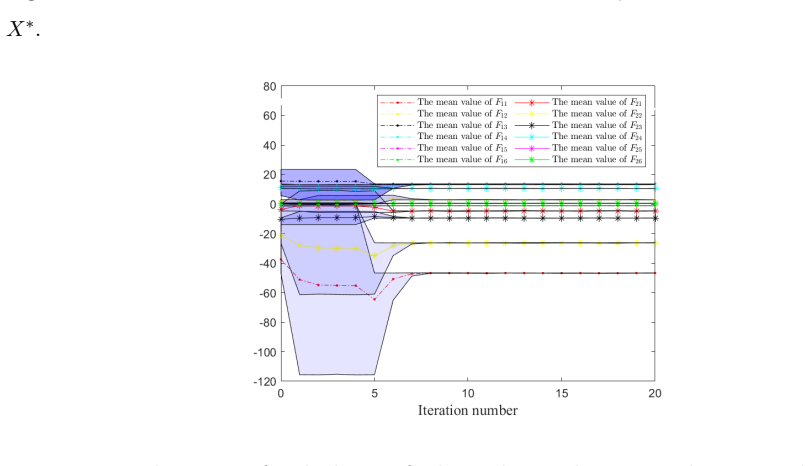
- When the drift matrices $A$ and $B$ are unknown, Algorithm 2 needs only the noise-term matrices $C$ and $D$, and the 15-run Monte Carlo example reaches relative errors near $10^{-2}$ for the gain and $10^{-3}$ for the Q-function by the fourth iteration.
- The deterministic LQR primal-dual results are recovered as a special case, and the same KKT route can be inspected for the fully model-free and indefinite SLQR problems that the paper leaves open.
- The arm-movement simulation indicates that the learned controller reproduces a plausible sensorimotor strategy, giving an illustrative bridge between the algorithm and biological motor learning.
Reading between the lines
- The finite-window relaxation in Definition 2 is where the argument is most exposed: if the PBH test requires the infinite-horizon observation window, Proposition 2's replacement of the stability constraint by $S\succeq 0$ could fail, and with it the strong-duality and KKT route.
- Algorithm 2 estimates $\tilde{S}(F^i)$ and $W(F^i)$ from $H$ sample paths over $M$ steps, but the paper gives no sample-complexity or bias bound; a natural test is whether convergence is maintained as $M$ grows and whether truncation bias vanishes.
- Because the drift matrices $A$ and $B$ never appear explicitly in the data matrices $\tilde{S}(F^i)$ and $W(F^i)$, the same scheme could plausibly be extended to the fully model-free case by estimating the $C$ and $D$ contributions from data; the paper states this case remains unsolved.
- The motor-control simulation is illustrative rather than a neural claim; treating it as evidence about the central nervous system would require a separate argument that biological circuitry actually solves these KKT equations.
Editorial analysis
A structured set of objections, weighed in public.
Referee Report
Summary. The paper studies the discrete-time stochastic linear quadratic regulator (SLQR) with multiplicative noise from a primal-dual optimization viewpoint. It reformulates the SLQR as a non-convex primal problem over the pair (S,F), introduces a dual problem, proves strong duality, derives KKT conditions, and gives a model-based primal-dual algorithm (Algorithm 1) that is shown to be equivalent to off-line policy iteration and hence convergent. It then proposes a partially model-free algorithm (Algorithm 2) for the case where the drift matrices A and B are unknown, using empirical estimates of second-moment matrices from Monte Carlo sample paths, and illustrates it on a human-arm movement example. The central theoretical claims are the strong duality result, the KKT derivation, and the convergence of the model-based primal-dual iterations; the central practical claim is that Algorithm 2 provides a partially model-free SLQR policy design with a rigorous foundation.
Significance. If fully established, the paper would be a useful extension of the primal-dual LQR framework of [18] to multiplicative-noise stochastic systems, and it would connect the classical off-line policy iteration to the Q-function and to a largely model-free implementation. The model-based results, especially Theorem 3 and its equivalence to Lemma 4, are straightforward and appear sound; the strong duality theorem follows the structure of [18] and is credible modulo the missing support discussed below. The paper also gives a concrete simulation with honest error plots. However, the data-driven Algorithm 2 has no convergence or consistency analysis, and the PBH-based replacement of the stabilizing constraint by a semidefinite condition is not fully justified under the paper's relaxed observability/detectability definition. These gaps concern the two load-bearing elements of the claimed contribution, so the significance of the paper in its present form is constrained.
major comments (2)
- [§3.2, Algorithm 2 and Theorem 3] The paper's central practical claim is a partially model-free algorithm when A and B are unknown, but no convergence or consistency theorem is proved for Algorithm 2. Theorem 3 covers only Algorithm 1, whose dual update (56) and primal update (57) are exact model-based steps; the proof works by identifying Algorithm 1 with the off-line policy iteration of Lemma 4. Algorithm 2 replaces ~S(F_i) and W(F_i) with finite-horizon Monte Carlo averages over H sample paths and solves the perturbed equation (59). There is no analysis of how the estimation error propagates into X^i or F^{i+1}, no proof that F^{i+1} remains in the stabilizing set F, and no statement that F^i converges to F*. The abstract's 'rigorous convergence analysis for RL design' and contribution (2) therefore outrun the proved results. This claim must either be proved for Algorithm 2 or substantially weakened.
- [Definition 2, Lemma 2, Proposition 2] Lemma 2 is cited from Theorem 3.7 of [37], where exact observability and exact detectability are defined by requiring y_k ≡ 0 for all k in N, whereas Definition 2 relaxes the condition to k in N_T for a fixed T. The paper gives no proof that the PBH eigenvector test remains valid under this relaxed definition. Proposition 2 then uses Lemma 2 to replace the constraint F in F by S ≽ 0; this replacement is the key step that makes the primal-dual formulation and the KKT framework valid. The same issue affects Proposition 3, which invokes Lemma 2 in a similar way for the pair (A_F, C_F | Λ). Please provide a direct proof of Lemma 2 under Definition 2, or show that finite-horizon and infinite-horizon exact observability/detectability coincide on the second-moment lift, and apply the same fix wherever Lemma 2 is used.
minor comments (5)
- [Remark 3] The claim of quadratic convergence of {P(i)} is asserted without proof ('Following the line of Theorem 2.4.1 of [39], it is easy to show'). If this is a contribution, please give a proof or replace the claim by a weaker statement.
- [Lemma 2 and Proposition 2] In Lemma 2 the condition 'CX = 0' is inconsistent with the notation in Definition 2 and with the usage in Proposition 2, where the condition is [I; F] Z [I; F]' X = 0; it should presumably read 'QX = 0' (or '\tilde Q X = 0'). Also, '|λ| ≽ 1' for complex λ is undefined and should be '|λ| ≥ 1'.
- [Proposition 4 proof] There is a typo in the proof: 'Combing (50), (50) and (51)' should be 'Combining (50) and (51)', and the derivation that X_0* = 0 from trace( ilde S* X_0*) = 0 and ilde S* ≻ 0, X_0* ≽ 0 should be stated explicitly.
- [Section 3.1, dual problem statement] The text contains a LaTeX leftover '/suppress L(X, F, S)' before the definition of the Lagrangian, which should be removed.
- [Section 4 simulation] Please clarify whether the reported F(7) is the output of Algorithm 2 or of the model-based PI, and state the time-truncation horizon M and the number of sample paths H used in the Monte Carlo experiment, since these are free parameters of Algorithm 2.
Circularity Check
No significant circularity; the primal-dual reformulation and convergence are derived from stated assumptions and background theorems rather than from fitted or assumed conclusions.
full rationale
The paper does not fit parameters to data and then call the same quantities predictions, nor does it define a key object in terms of the conclusion. The reformulation of SLQR as (P1-SLQR) is an exact second-moment lift (Proposition 1), and the KKT conditions in Proposition 4 are obtained from the Lagrangian and the strong-duality theorem proved in the paper. Algorithm 1's convergence is shown in Theorem 3 by identifying its dual/primal updates with the policy evaluation and improvement steps of Lemma 4, which is proved in Section 2.2; this is an equivalence argument, not a tautology. Algorithm 2 is empirical and no convergence theorem is supplied, but that is a missing proof/overclaim, not a circular reduction. The PBH and generalized Lyapunov results are cited from [37] (co-authored by the corresponding author), and the finite-window relaxation in Definition 2 creates a possible gap because Lemma 2 is quoted for the original definition; however, this is a correctness risk, not circularity, since the cited results are stated with assumptions that do not include the SLQR optimality result and are not the renamed output of the present derivation. No equation is shown to reduce to an earlier assumed equation by construction.
Assumptions & free parameters
free parameters (3)
- H (Monte Carlo sample paths) =
15
- M (time truncation horizon for S and W) =
not specified
- Initial feedback gain F(0) =
2x6 matrix in Section 4
assumptions (3)
- domain assumption Assumption 1: the system [A,B;C,D] is stabilizable, Q >= 0, R > 0, and (A,C|Q) is exactly observable or exactly detectable.
- ad hoc to paper The relaxed exact observability/detectability definitions in Definition 2 (finite horizon N_T) preserve the PBH eigenvector test of Lemma 2.
- domain assumption The finite-sample estimates of S(F^i) and W(F^i) in Algorithm 2 are accurate enough for the dual update to produce a valid X^i.
Cite this review
Pith. "Pith review of Learning-based primal-dual optimal control of discrete-time stochastic systems with multiplicative noise." pith.science (2026). https://pith.science/paper/CN5CHXFY
@misc{pith2026250602613,
  author       = {Pith},
  title        = {Pith review of: Learning-based primal-dual optimal control of discrete-time stochastic systems with multiplicative noise},
  year         = {2026},
  howpublished = {\url{https://pith.science/paper/CN5CHXFY}},
  note         = {Machine review of arXiv:2506.02613}
}
read the original abstract
Reinforcement learning (RL) is an effective approach for solving optimal control problems without knowing the exact information of the system model. However, the classical Q-learning method, a model-free RL algorithm, has its limitations, such as lack of strict theoretical analysis and the need for artificial disturbances during implementation. This paper explores the partially model-free stochastic linear quadratic regulator (SLQR) problem for a system with multiplicative noise from the primal-dual perspective to address these challenges. This approach lays a strong theoretical foundation for understanding the intrinsic mechanisms of classical RL algorithms. We reformulate the SLQR into a non-convex primal-dual optimization problem and derive a strong duality result, which enables us to provide model-based and model-free algorithms for SLQR optimal policy design based on the Karush-Kuhn-Tucker (KKT) conditions. An illustrative example demonstrates the proposed model-free algorithm's validity, showcasing the central nervous system's learning mechanism in human arm movement.
Figures


Reference graph
Works this paper leans on
-
[18]
Lee, D., & Hu, J. (2019). Primal-dual Q-learning framew ork for LQR design. IEEE Trans- actions on Automatic Control , 64(9), 3756-3763
work page 2019
-
[37]
Zhang, W., Xie, L., & Chen, B. S. (2017). Stochastic H2/H∞ Control: A Nash Game Approach. CRC Press
work page 2017
-
[1]
Anderson, B. D. O., & Moore, J. B. (1989). Optimal Control-Linear Quadratic Methods . Prentice-Hall, New York
work page 1989
-
[2]
Bertsekas, D. P., & Tsitsiklis, J. N. (1996). Neuro-Dynamic Programming. Belmont, MA, USA: Athena Scientific. 29
work page 1996
-
[3]
Busoniu, L., de Bruin, T., Tolic, D., Kober, J., & Palunko, I. (2018). Reinforcement learning for control: Performance, stability, and deep approximato rs. Annual Reviews in Control , 46, 8-28
work page 2018
-
[4]
Boyd, B., & Vandenberghe, V. (2004). Convex Optimization . Cambridge University Press
work page 2004
-
[5]
Cui, L., Pang, B., Krstic, M., & Jiang, Z.-P. (2025). Lear ning-based adaptive optimal control of linear time-delay systems: A value iteration app roach. Automatica, 171, 111944
work page 2025
-
[6]
El Bouhtouri, A., Hinrichsen, D., & Pritchard, A. J. (199 9). H∞-type control for discrete- time stochastic systems. Int. J. Robust Nonlinear Control , 9, 923-948
Show all 42 references
-
[7]
Chen, S., Li, X., & Zhou, X. (1998). Stochastic linear qua dratic regulators with indefinite control weight costs. SIAM J. Contr. Optim., 36, 1685-1702
1998
-
[8]
Dombrovskii, V. V. & Lyashenko, E. A. (2003). A linear qua dratic control for discrete systems with random parameters and multiplicative noise and its application to investment portfolio optimization. Automat. Remote Control , 64, 1558-1570
2003
-
[9]
Farjadnasab, M., & Babazadeh, M. (2022). Model-free LQR design by Q-function learning. Automatica, 137, 110060
2022
-
[10]
M., & Mesbahi, M
Fazel, M., Ge, R., Kakade, S. M., & Mesbahi, M. (2018). Gl obal convergence of policy gradient methods for the linear quadratic regulator. In International conference on machine learning, 1467-1476. Stockholm, Sweden
2018
-
[11]
Huang, Y., Zhang, W., & Zhang, H. (2008). Infinite horizon linear quadratic optimal control for discrete time stochastic systems. Asian Journal of Control , 10(5), 608-615
2008
-
[12]
Jiang, X., Wang, Y., Zhao, D., & Shi, L. (2024). Online Pareto optimal control of mean-field stochastic multi-player systems using policy iteration. Science China Information Sciences , 67(4), 140202:1-140202:17
2024
-
[13]
Kleinman, D. L. (1968), On an iterative technique for Riccati equation computations, IEEE Transactions on Automatic Control , 13, 114-115
1968
-
[14]
Kalman, R. E. (1960). Contributions to the theory of opt imal control. Bol. Soc. Mat. Mex. , 5(2), 102-119. 30
1960
-
[15]
Karl, K. & Tu, S. (2019). Finite-time analysis of approx imate policy iteration for the linear quadratic regulator. In International conference on machine learning , 8514-8524. Vancou- ver, Canada
2019
-
[16]
L., & Jiang, Z
Kiumarsi, B., Lewis, F. L., & Jiang, Z. P. (2017). H∞ control of linear discrete-time systems: Off-policy reinforcement learning. Automatica, 78, 144-152
2017
-
[17]
Lewis, F. L. (1986). Optimal Control. John Wiley & Sons
1986
-
[19]
Lai, J., Xiong, J., & Shu, Z. (2023). Model-free optimal control of discrete-time systems with additive and multiplicative noises. Automatica, 147, 110685
2023
-
[20]
X., Wang, Y., & Kang, Y
Li, M., Qin, J., Zheng, W. X., Wang, Y., & Kang, Y. (2022). Model-free design of stochastic LQR controller from a primal-dual optimization perspectiv e. Automatica, 140, 110253
2022
-
[21]
Liu, D., & Todorov, E. (2007). Evidence for the flexible s ensorimotor strategies predicted by optimal feedback control. The Journal of Neuroscience , 27(35), 93354-9368
2007
-
[22]
Oura, R., Ushio, T., & Sakakibara, A. (2024). Bounded synthesis and reinforcement learning of supervisors for stochastic discrete event systems with L TL specifications. IEEE Trans- actions on Automatic Control , 69(10), 6668–6683
2024
-
[23]
Pang, B., & Jiang, Z. P. (2022). Reinforcement learning for adaptive optimal stationary control of linear stochastic systems. IEEE Transactions on Automatic Control , 68(4), 2383- 2390
2022
-
[24]
Pang, B., Cui, L., & Jiang, Z. P. (2022). Human motor lear ning is robust to control- dependent noise. Biological Cybernetics, 116, 307-325
2022
-
[25]
Sun, J. & J. Yong. (2023). Stochastic linear-quadratic optimal control problems-Recent developments. Annual Reviews in Control , 56, 100899
2023
-
[26]
& Benjamin, R
Stephen, T. & Benjamin, R. (2019). The gap between model -based and model-free methods on the linear quadratic regulator: An asymptotic viewpoint . In Proceedings of the Confer- ence on Learning Theory , 3036-3083. 31
2019
-
[27]
Vrabie, D., Pastravanu, O., Abu-Khalaf, M., & Lewis, F. L. (2009). Adaptive optimal control for continuous-time linear systems based on policy iteration. Automatica, 45(2), 477-484
2009
-
[28]
Wang, Y., You, K., Huang, D., & Shang, C. (2025). Data-dr iven output prediction and control of stochastic systems: An innovation-based approa ch. Automatica, 171, 111897
2025
-
[29]
J., & Dayan, P
Watkins, C. J., & Dayan, P. (1992). Q-Learning. Machine Learning, 8, 279-292
1992
-
[30]
Werbos, P. J. (1991). A Menu of Designs for Reinforcement Learning Over Time . Cam- bridge, MA, USA: MIT Press
1991
-
[31]
Wonham, W. M. (1968). On a matrix Riccati equation of sto chastic control. SIAM Journal on Control, 6(4), 681-697
1968
-
[32]
D., Zhang, S., & Zhou, X
Yao, D. D., Zhang, S., & Zhou, X. Y. (2001). Stochastic linear-quadratic control via semidef- inite programming. SIAM Journal on Control and Optimization , 40(3), 801-823
2001
-
[33]
Y., Nevena, L., & Csaba, S
Yasin, A. Y., Nevena, L., & Csaba, S. (2019). Model-free linear quadratic control via reduction to expert prediction. In Proceedings of the International Conference on Artificial Intelligence and Statistics , 3108-3117
2019
-
[34]
Yuan, K., Xu, W., & Ling, Q. (2020). Can primal methods outperform primal-dual methods in decentralized dynamic optimization?. IEEE Transactions on Signal Processing, 68, 4466- 4480
2020
-
[35]
Zhang, H., & Ringh, A. (2023). Inverse linear-quadrati c discrete-time finite horizon opti- mal control for indistinguishable homogeneous agents: A co nvex optimization approach. Automatica, 148, 110758
2023
-
[36]
Zhang, W., & Chen, B. S. (2004). On stabilizability and e xact observability of stochastic systems with their applications. Automatica, 40(1), 87-94
2004
-
[38]
Zhang, W., Zhang, H., & Chen, B. S. (2008). Generalized L yapunov equation approach to state-dependent stochastic stabilization/detectabil ity criterion. IEEE Transactions on Automatic Control, 53(7), 1630-1642. 32
2008
-
[39]
Zhang, W. (1998). Study on the algebraic Riccati equati on arising from infinite horizon stochastic LQ optimal control. Zhejiang University, PhD di ssertation
1998
-
[40]
Zhang, W., Guo, J., & Jiang, X. (2025). Model-free H∞ control of Itˆ o stochastic system via off-policy reinforcement learning. Automatica, 174, 112144
2025
-
[41]
Zhang, W., Yu, Z., & Jiang, X. (2024). Finite-time annul ar domain stability and asyn- chronous H∞ control for stochastic switching Markov jump systems. IEEE Transactions on Automatic Control , 699, 6277-6284
2024
-
[42]
Zhao, B., & You, K. (2023). Survey of recent progress in d ata-driven policy optimization for controller design (in Chinese). Scientia Sinica Informationis , 53(6), 1027–1049. 33
2023
Reviewed August 7, 2026 · model on record in the stance chip above.
Discussion (0). Sign in to comment.