REVIEW 3 major objections 4 minor 113 references
ControlMambaIR: Conditional Controls with State-Space Model for Image Restoration
T0 review · 3 major / 4 minor · reviewed 2026-08-07 · deepseek-v4-flash
Pith's one-line read ControlMambaIR: a Mamba-based condition network inside a diffusion model improves perceptual quality for deraining, deblurring, and denoising while keeping distortion metrics competitive.
desk verdict A plausible Mamba-conditioned diffusion architecture, but the central comparative claim is contradicted by the paper's own Gaussian-denoising table. read the letter →
The pith
A machine-rendered reading of the paper's core claim, the machinery that carries it, and where it could break.
The reading
What carries the argument
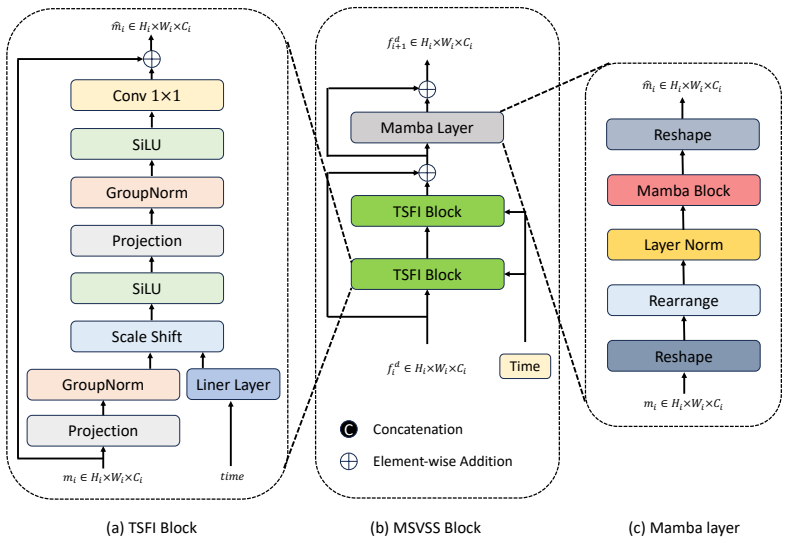
The load-bearing object is ControlMambaIR's condition-control path: a parallel encoder that processes the low-quality image and injects its multi-scale features into the diffusion decoder through skip connections, alongside the encoder features from the noisy image. The blocks are Vision State-Space (VSS) blocks in the encoder and condition branch, Multi-Scale VSS (MSVSS) blocks in the decoder, and Temporal-Spatial Feature Interaction (TSFI) blocks that modulate features with timestep-dependent scale and shift. The decoder predicts the added noise $\epsilon_\theta(z_t,t,c_f)$ from the noisy input $z_t$, timestep $t$, and condition $c_f$. What this machinery is doing is testing whether a selective state-space model can deliver the fine-grained spatial conditioning that diffusion models lack in restoration; the paper's comparative claim is that it can, more cheaply than attention.
What would settle it
Retrain the strongest baselines, including Restormer, Uformer, and IR-SDE, on exactly the DIV2K, BSD500, and WaterlooED subset used here, with the same patch size, iteration count, and diffusion inference budget, and recompute LPIPS and FID over several seeds; the central claim fails if ControlMambaIR no longer leads on the perceptual metrics.
Extended reading notes
Core claim
On the paper's own terms, the central discovery is that substituting a Mamba-based condition network for the usual CNN- or attention-based controls in a diffusion restoration model consistently lowers LPIPS and FID across deraining, deblurring, and denoising benchmarks while preserving roughly comparable PSNR and SSIM. The supporting experiments show best-in-table perceptual scores on Rain100H, Rain100L, SIDD, and across Gaussian noise levels on CBSD68, Kodak24, and McMaster, at a reported 37G MACs. The module ablation attributes the gain to pairing diffusion with Mamba rather than with attention or no diffusion, and the prediction-target ablation identifies direct noise prediction as the best objective. The paper also asserts that this is achieved with roughly half the training data of compared denoisers because Flickr2K was not used.
Load-bearing premise
The load-bearing premise is that the comparison is fair: the numbers reported for other methods can be taken as the best those methods can do, even though they were trained on larger datasets than ControlMambaIR and with details that are not fully reported.
Editorial extensions
If this is right
- The reported 37G MACs suggest that Mamba-based conditioning can deliver diffusion restoration at a fraction of the computational cost of transformer-based condition networks.
- Direct noise prediction should be kept as the training objective for this architecture, since it beats image-start and v-parameterization on both distortion and perceptual metrics in the ablation.
- The architecture transfers across deraining, deblurring, and denoising without task-specific redesign, so the conditional-control principle is not tied to one degradation type.
- If the data-efficiency result is real, diffusion restoration with this condition network needs only about half the training data of the compared denoisers to reach better perceptual quality.
Reading between the lines
- The tables imply a perceptual-fidelity versus pixel-fidelity trade-off that the text does not spell out: where ControlMambaIR wins most on LPIPS and FID, it often trails on PSNR and SSIM, so the method is a better fit for human-facing viewing than for downstream tasks that need exact pixel accuracy.
- Because the condition branch is structurally independent of the diffusion backbone, a natural extension the paper does not run is to swap the VSS blocks for another linear-time sequence model to test whether the gain comes from selective state spaces specifically or from any cheap conditional skip-connection path.
- A fully matched head-to-head, with the same parameter count, same training set, same iteration budget, and same seed while varying only the condition backbone, would be the cleanest test of the Mamba-versus-attention claim, since the reported module ablation changes more than one factor at a time.
Editorial analysis
A structured set of objections, weighed in public.
Referee Report
Summary. The paper proposes ControlMambaIR, a U-shaped encoder-decoder architecture in which a Mamba-based control network (ControlNet-style) provides conditional low-quality-image features to a diffusion model that predicts added Gaussian noise. The method is evaluated on deraining (Rain100H/Rain100L), deblurring (GoPro), real-image denoising (SIDD), and Gaussian denoising (CBSD68/Kodak24/McMaster). The central claims are that the method consistently surpasses existing methods in perceptual metrics (LPIPS, FID) while maintaining comparable distortion metrics (PSNR, SSIM), and that the Mamba architecture is especially well suited as a conditional control network for diffusion models. Ablation studies compare prediction targets (noise, image start, v-parameterization) and module configurations (Diffusion, Attention, Mamba).
Significance. If the comparative claims were supported, the paper would offer a useful data point on combining state-space models with diffusion-based conditional image restoration, and the reported deraining results (Tables 1–2, e.g., Rain100H PSNR 33.86 vs. IR-SDE 31.65) are interesting. The architecture is clearly described and the ablation on prediction targets is a reasonable design study. However, the paper's central claim of 'comparable' distortion performance is contradicted by its own Gaussian-denoising table, and the perceptual-superiority claim rests on an unmatched comparison protocol with no error bars, no retrained baselines, and no released code or checkpoints. As presented, the evidence does not establish the paper's headline conclusions.
major comments (3)
- [Abstract, Sec. 7, Sec. 6.5, Table 5] The abstract states that the method 'maintain[s] comparable performance in image distortion metrics, including PSNR and SSIM,' and Sec. 7 concludes that it 'consistently outperforms existing methods in both distortion and perceptual quality measures.' These claims are contradicted by Table 5. For Gaussian denoising on CBSD68 at sigma=15, ControlMambaIR achieves 32.17 dB / 0.903 SSIM versus SwinIR's 34.42 dB / 0.936 SSIM; at sigma=50 on the same dataset, it achieves 26.46 dB / 0.745 versus Restormer's 28.60 dB / 0.813. Gaps of roughly 2–2.5 dB PSNR and 0.03–0.07 SSIM are not 'comparable' by conventional standards in image restoration. Section 6.5 itself concedes that the method 'is lower than the state-of-art methods in terms of PNSR and SSIM scores.' The central comparative claim is therefore internally inconsistent and must be corrected before the paper's conclusions can be accepted.
- [Sec. 6.6, Table 6] There is a direct numerical inconsistency in the ablation on prediction targets. The text states that the 'predict noise' target achieves 'a PSNR of 39.31dB, an SSIM of 0.948,' while Table 6 reports 39.11 dB PSNR and 0.930 SSIM for the same configuration. Since the 'predict noise' row in Table 6 is also the reported SIDD result in Table 4, this discrepancy undermines confidence in the reproducibility of the quantitative results. The authors should verify all reported numbers and correct the inconsistency.
- [Sec. 6.5, comparison protocol] The perceptual-superiority claim on Gaussian denoising is not established by the current comparison protocol. Section 6.5 states that ControlMambaIR was trained on DIV2K, BSD500, and WaterlooED, while the cited baselines (DnCNN, SwinIR, Restormer, etc.) were trained with additional data such as Flickr2K. The baselines are not retrained under matched training data, and no error bars or multiple-seed results are reported. Consequently, the LPIPS/FID advantages in Table 5 could be driven by training-data differences, inference budgets, or evaluation randomness rather than by the proposed architecture. A matched comparison with retrained baselines and variance estimates is needed to support the claim that Mamba-based conditional control outperforms CNN- and Attention-based alternatives in this setting.
minor comments (4)
- [Sec. 4, Eq. (7)] The discretization formula for B appears to be incorrect: the standard ZOH formula is B = (exp(Delta*A) - I) A^{-1} B (or an approximation), not (Delta*A)^{-1}(exp(Delta*A) - I)B. Please check the derivation and notation.
- [Sec. 6.5 and Table 6] The dataset name is consistently misspelled as 'SSID' in the text and in the Table 6 caption; the correct name is 'SIDD.'
- [Sec. 6.5 and Sec. 6.3] There are repeated typos: 'PNSR' should be 'PSNR' in Sec. 6.5, and 'denlurring' should be 'deblurring' in Sec. 6.3. Also, in Sec. 1, 'detaining' appears where 'denoising' is intended.
- [Sec. 7, Table 7] Table 7 lists DnCNN at 37G MACs and ControlMambaIR at 37G MACs, yet the text says 'the lowest MACs of 37G... achieved by our method.' Since the table shows a tie with DnCNN, the claim should be revised to 'tied for the lowest' or the MACs should be recomputed.
Circularity Check
No significant circularity: the paper is an empirical architecture paper whose claims are evaluated against external benchmarks, not derived from its own assumptions.
full rationale
ControlMambaIR is a conventional empirical architecture paper: it combines a U-Net with VSS/MSVSS blocks and a ControlNet conditioned on the low-quality image, trains with an L1 noise-prediction diffusion objective, and evaluates against standard benchmarks (Rain100H/L, GoPro, SIDD, CBSD68, Kodak24, McMaster). There is no derivation chain in which an output is defined in terms of its own prediction or in which a fitted parameter is renamed as a finding. The paper's central comparative claims are supported by tables of externally computed metrics; even where the paper concedes lower distortion performance (Section 6.5: 'ControlMambaIR is lower than the state-of-art methods in terms of PNSR and SSIM scores'), that concession is a correctness/validity concern, not circularity. The conclusion that Mamba is well-suited for conditional control is an ablation result (Table 8), not an imported uniqueness theorem or ansatz smuggled in by citation. The only self-citation, Yang et al. [62], appears in related work as context and is not load-bearing for the architecture or the main claims. No quantity in Equations (1)-(20) is defined in terms of the target result, and no prediction is statistically forced by construction. Accordingly, the paper receives a circularity score of 0.
Assumptions & free parameters
free parameters (3)
- Diffusion inference step budget =
100
- Training iterations =
500,000
- Architecture channel width C and per-stage block counts L1-L4 =
not reported
assumptions (4)
- domain assumption The low-quality image cf provides sufficient conditioning for noise prediction in the reverse diffusion process.
- domain assumption LPIPS and FID are appropriate primary metrics, and PSNR/SSIM can be sacrificed for perceptual gains.
- domain assumption Published baseline numbers are directly comparable to the authors' runs.
- standard math Standard DDPM equations (Eqs. 1-5) and SSM discretization (Eqs. 6-9) from prior work are correct and applicable.
Cite this review
Pith. "Pith review of ControlMambaIR: Conditional Controls with State-Space Model for Image Restoration." pith.science (2026). https://pith.science/paper/VBC425RQ
@misc{pith2026250602633,
  author       = {Pith},
  title        = {Pith review of: ControlMambaIR: Conditional Controls with State-Space Model for Image Restoration},
  year         = {2026},
  howpublished = {\url{https://pith.science/paper/VBC425RQ}},
  note         = {Machine review of arXiv:2506.02633}
}
read the original abstract
This paper proposes ControlMambaIR, a novel image restoration method designed to address perceptual challenges in image deraining, deblurring, and denoising tasks. By integrating the Mamba network architecture with the diffusion model, the condition network achieves refined conditional control, thereby enhancing the control and optimization of the image generation process. To evaluate the robustness and generalization capability of our method across various image degradation conditions, extensive experiments were conducted on several benchmark datasets, including Rain100H, Rain100L, GoPro, and SSID. The results demonstrate that our proposed approach consistently surpasses existing methods in perceptual quality metrics, such as LPIPS and FID, while maintaining comparable performance in image distortion metrics, including PSNR and SSIM, highlighting its effectiveness and adaptability. Notably, ablation experiments reveal that directly noise prediction in the diffusion process achieves better performance, effectively balancing noise suppression and detail preservation. Furthermore, the findings indicate that the Mamba architecture is particularly well-suited as a conditional control network for diffusion models, outperforming both CNN- and Attention-based approaches in this context. Overall, these results highlight the flexibility and effectiveness of ControlMambaIR in addressing a range of image restoration perceptual challenges.
Figures


Figures from the paper (8 more)


Reference graph
Works this paper leans on
-
[1]
L. I. Rudin, S. Osher, E. Fatemi, Nonlinear total variation based noise removal algorithms, Physica D: Nonlinear Phenomena 60 (1992) 259– 268
1992
-
[2]
W. H. Richardson, Bayesian-based iterative method of image restoration, Journal of the Optical Society of America 62 (1972) 55–59
1972
-
[3]
L. B. Lucy, An iterative technique for the rectification of observed distributions, The Astronomical Journal 79 (1974) 745–754
1974
-
[4]
Geman, D
S. Geman, D. Geman, Stochastic relaxation, gibbs distributions, and the bayesian restoration of images, IEEE Transactions on Pattern Analysis and Machine Intelligence PAMI-6 (1984) 721–741
1984
-
[5]
T. F. Chan, C.-K. Wong, Total variation blind deconvolution, IEEE transactions on image processing : a publication of the IEEE Signal Processing Society 7 3 (1998) 370–5. 34
1998
-
[6]
L. Ma, J. Yu, T. Zeng, Sparse representation prior and total variation- based image deblurring under impulse noise, SIAM J. Imaging Sci. 6 (2013) 2258–2284
2013
-
[7]
S. Rani, S. Jindal, B. Kaur, A brief review on image restoration tech- niques, International Journal of Computer Applications 150 (2016) 30–33
2016
-
[8]
Huang, J
Y. Huang, J. Huang, J. Liu, M. Yan, Y. Dong, J. Lv, S. Chen, Wavedm: Wavelet-baseddiffusionmodelsforimagerestoration, IEEETransactions on Multimedia 26 (2023) 7058–7073
2023
Show all 113 references
-
[9]
Buades, B
A. Buades, B. Coll, J.-M. Morel, A non-local algorithm for image denoising, 2005 IEEE Computer Society Conference on Computer Vision and Pattern Recognition (CVPR’05) 2 (2005) 60–65 vol. 2
2005
-
[10]
Ronneberger, P
O. Ronneberger, P. Fischer, T. Brox, U-net: Convolutional networks for biomedical image segmentation, ArXiv abs/1505.04597 (2015)
2015 arXiv
-
[11]
Szegedy, S
C. Szegedy, S. Ioffe, V. Vanhoucke, A. A. Alemi, Inception-v4, inception- resnet and the impact of residual connections on learning, ArXiv abs/1602.07261 (2016)
2016 arXiv
-
[12]
Dosovitskiy, L
A. Dosovitskiy, L. Beyer, A. Kolesnikov, D. Weissenborn, X. Zhai, T. Un- terthiner, M. Dehghani, M. Minderer, G. Heigold, S. Gelly, J. Uszkoreit, N. Houlsby, An image is worth 16x16 words: Transformers for image recognition at scale, ArXiv abs/2010.11929 (2020)
2020 arXiv
-
[13]
S. H. Khan, M. Naseer, M. Hayat, S. W. Zamir, F. S. Khan, M. Shah, Transformers in vision: A survey, ACM Computing Surveys (CSUR) 54 (2021) 1–41
2021
-
[14]
Z. Wang, X. Cun, J. Bao, J. Liu, Uformer: A general u-shaped trans- former for image restoration, 2022 IEEE/CVF Conference on Computer Vision and Pattern Recognition (CVPR) (2021) 17662–17672
2021
-
[15]
C. Guo, Q. Yan, S. Anwar, R. Cong, W. Ren, C. Li, Image dehaz- ing transformer with transmission-aware 3d position embedding, 2022 IEEE/CVF Conference on Computer Vision and Pattern Recognition (CVPR) (2022) 5802–5810. 35
2022
-
[16]
Zhang, W
K. Zhang, W. Zuo, Y. Chen, D. Meng, L. Zhang, Beyond a gaussian denoiser: Residual learning of deep cnn for image denoising, IEEE Transactions on Image Processing 26 (2016) 3142–3155
2016
-
[17]
Zhang, W
K. Zhang, W. Zuo, L. Zhang, Ffdnet: Toward a fast and flexible solution for cnn-based image denoising, IEEE Transactions on Image Processing 27 (2017) 4608–4622
2017
-
[18]
Y. Pan, C. Ren, X. Wu, J. Huang, X. He, Real image denoising via guided residual estimation and noise correction, IEEE Transactions on Circuits and Systems for Video Technology 33 (2023) 1994–2000
2023
-
[19]
M. Yao, D. He, X. Li, F. Li, Z. Xiong, Toward interactive self-supervised denoising, IEEE Transactions on Circuits and Systems for Video Tech- nology 33 (2023) 5360–5374
2023
-
[20]
J. Xu, D. Ren, L. Zhang, D. Zhang, Patch group based bayesian learning for blind image denoising, in: ACCV Workshops, 2016
2016
-
[21]
C. Dong, C. C. Loy, K. He, X. Tang, Learning a deep convolutional net- work for image super-resolution, in: European Conference on Computer Vision, 2014
2014
-
[22]
C. Dong, C. C. Loy, K. He, X. Tang, Image super-resolution using deep convolutional networks, IEEE Transactions on Pattern Analysis and Machine Intelligence 38 (2014) 295–307
2014
-
[23]
J. Kim, J. K. Lee, K. M. Lee, Accurate image super-resolution using very deep convolutional networks, 2016 IEEE Conference on Computer Vision and Pattern Recognition (CVPR) (2015) 1646–1654
2015
-
[24]
C. Wang, X. Xing, Z. Su, J. Chen, Dcsfn: Deep cross-scale fusion network for single image rain removal, Proceedings of the 28th ACM International Conference on Multimedia (2020)
2020
-
[25]
C. Wang, J. shan Pan, X. Wu, Online-updated high-order collaborative networks for single image deraining, in: AAAI Conference on Artificial Intelligence, 2022
2022
-
[26]
X. Cui, C. Wang, D. Ren, Y. Chen, P. Zhu, Semi-supervised image deraining using knowledge distillation, IEEE Transactions on Circuits and Systems for Video Technology 32 (2022) 8327–8341. 36
2022
-
[27]
D. Ren, W. Zuo, Q. Hu, P. F. Zhu, D. Meng, Progressive image deraining networks: A better and simpler baseline, 2019 IEEE/CVF Conference on Computer Vision and Pattern Recognition (CVPR) (2019) 3932–3941
2019
-
[28]
D. Ren, W. Shang, P. Zhu, Q. Hu, D. Meng, W. Zuo, Single image deraining using bilateral recurrent network, IEEE Transactions on Image Processing 29 (2020) 6852–6863
2020
-
[29]
D. Ren, W. Zuo, D. Zhang, L. Zhang, M.-H. Yang, Simultaneous fidelity and regularization learning for image restoration, IEEE Transactions on Pattern Analysis and Machine Intelligence 43 (2018) 284–299
2018
-
[30]
L. Cai, S. Li, D. Ren, P. Wang, Dual recursive network for fast image deraining, 2019 IEEE International Conference on Image Processing (ICIP) (2019) 2756–2760
2019
-
[31]
X. Xu, J. shan Pan, Y. Zhang, M.-H. Yang, Motion blur kernel esti- mation via deep learning, IEEE Transactions on Image Processing 27 (2018) 194–205
2018
-
[32]
X. Tao, H. Gao, Y. Wang, X. Shen, J. Wang, J. Jia, Scale-recurrent network for deep image deblurring, 2018 IEEE/CVF Conference on Computer Vision and Pattern Recognition (2018) 8174–8182
2018
-
[33]
Zhang, J
J. Zhang, J. shan Pan, J. S. J. Ren, Y. Song, L. Bao, R. W. H. Lau, M.-H. Yang, Dynamic scene deblurring using spatially variant recurrent neural networks, 2018 IEEE/CVF Conference on Computer Vision and Pattern Recognition (2018) 2521–2529
2018
-
[34]
D. Ren, W. Shang, Y. Yang, W. Zuo, Aggregating nearest sharp features via hybrid transformers for video deblurring, Information Sciences (2023)
2023
-
[35]
S. W. Zamir, A. Arora, S. H. Khan, M. Hayat, F. S. Khan, M.-H. Yang, L. Shao, Multi-stage progressive image restoration, 2021 IEEE/CVF Conference on Computer Vision and Pattern Recognition (CVPR) (2021) 14816–14826
2021
-
[36]
Z. Liu, Y. Lin, Y. Cao, H. Hu, Y. Wei, Z. Zhang, S. Lin, B. Guo, Swin transformer: Hierarchical vision transformer using shifted windows, 37 2021 IEEE/CVF International Conference on Computer Vision (ICCV) (2021) 9992–10002
2021
-
[37]
Liang, J
J. Liang, J. Cao, G. Sun, K. Zhang, L. V. Gool, R. Timofte, Swinir: Imagerestorationusingswintransformer, 2021IEEE/CVFInternational Conference on Computer Vision Workshops (ICCVW) (2021) 1833–1844
2021
-
[38]
S. W. Zamir, A. Arora, S. H. Khan, M. Hayat, F. S. Khan, M.-H. Yang, Restormer: Efficient transformer for high-resolution image restoration, 2022 IEEE/CVF Conference on Computer Vision and Pattern Recogni- tion (CVPR) (2021) 5718–5729
2021
-
[39]
S. Chen, T. Ye, Y. Liu, E. Chen, Dual-former: Hybrid self-attention transformer for efficient image restoration, ArXiv abs/2210.01069 (2022)
2022 arXiv
-
[40]
Z. Chen, Y. Zhang, J. Gu, Y. Zhang, L. Kong, X. Yuan, Cross ag- gregation transformer for image restoration, ArXiv abs/2211.13654 (2022)
2022 arXiv
-
[41]
Arjovsky, S
M. Arjovsky, S. Chintala, L. Bottou, Wasserstein gan, ArXiv abs/1701.07875 (2017)
2017 arXiv
-
[42]
L. Dinh, D. Krueger, Y. Bengio, Nice: Non-linear independent compo- nents estimation, arXiv: Learning (2014)
2014
-
[43]
Ledig, L
C. Ledig, L. Theis, F. Huszár, J. Caballero, A. P. Aitken, A. Tejani, J. Totz, Z. Wang, W. Shi, Photo-realistic single image super-resolution using a generative adversarial network, 2017 IEEE Conference on Com- puter Vision and Pattern Recognition (CVPR) (2016) 105–114
2016
-
[44]
Z. Chen, Z. Zeng, H. lan Shen, X. Zheng, P. Dai, P. Ouyang, Dn-gan: Denoising generative adversarial networks for speckle noise reduction in optical coherence tomography images, Biomed. Signal Process. Control. 55 (2020)
2020
-
[45]
J. Yu, Z. L. Lin, J. Yang, X. Shen, X. Lu, T. S. Huang, Generative image inpainting with contextual attention, 2018 IEEE/CVF Conference on Computer Vision and Pattern Recognition (2018) 5505–5514. 38
2018
-
[46]
Kupyn, V
O. Kupyn, V. Budzan, M. Mykhailych, D. Mishkin, J. Matas, Deblurgan: Blind motion deblurring using conditional adversarial networks, 2018 IEEE/CVF Conference on Computer Vision and Pattern Recognition (2017) 8183–8192
2017
-
[47]
L. Dinh, J. N. Sohl-Dickstein, S. Bengio, Density estimation using real nvp, ArXiv abs/1605.08803 (2016)
2016 arXiv
-
[48]
D. P. Kingma, P. Dhariwal, Glow: Generative flow with invertible 1x1 convolutions, ArXiv abs/1807.03039 (2018)
2018 arXiv
-
[49]
Y. Kim, D. Son, Noise conditional flow model for learning the super- resolution space, 2021 IEEE/CVF Conference on Computer Vision and Pattern Recognition Workshops (CVPRW) (2021) 424–432
2021
-
[50]
X. Wei, H. V. Gorp, L. Gonzalez-Carabarin, D. Freedman, Y. C. Eldar, R. J. G. van Sloun, Image denoising with deep unfolding and normalizing flows, ICASSP 2022 - 2022 IEEE International Conference on Acoustics, Speech and Signal Processing (ICASSP) (2022) 1551–1555
2022
-
[51]
Y. Ren, X. Yu, R. Zhang, T. H. Li, S. Liu, G. Li, Structureflow: Image inpainting via structure-aware appearance flow, 2019 IEEE/CVF International Conference on Computer Vision (ICCV) (2019) 181–190
2019
-
[52]
Z. Cai, J. Tang, S. Mukherjee, J. Li, C.-B. Schonlieb, X. Zhang, Nf-ula: Langevin monte carlo with normalizing flow prior for imaging inverse problems, ArXiv abs/2304.08342 (2023)
2023 arXiv
-
[53]
J. Ho, A. Jain, P. Abbeel, Denoising diffusion probabilistic models, ArXiv abs/2006.11239 (2020)
2020 arXiv
-
[54]
Dhariwal, A
P. Dhariwal, A. Nichol, Diffusion models beat gans on image synthesis, ArXiv abs/2105.05233 (2021)
2021 arXiv
-
[55]
Y. Song, J. N. Sohl-Dickstein, D. P. Kingma, A. Kumar, S. Ermon, B.Poole, Score-basedgenerativemodelingthroughstochasticdifferential equations, ArXiv abs/2011.13456 (2020)
2020 arXiv
-
[56]
J. Song, C. Meng, S. Ermon, Denoising diffusion implicit models, ArXiv abs/2010.02502 (2020). 39
2020 arXiv
-
[57]
R. S. Roman, E. Nachmani, L. Wolf, Noise estimation for generative diffusion models, ArXiv abs/2104.02600 (2021)
2021 arXiv
-
[58]
Bansal, E
A. Bansal, E. Borgnia, H.-M. Chu, J. Li, H. Kazemi, F. Huang, M. Gold- blum, J. Geiping, T. Goldstein, Cold diffusion: Inverting arbitrary image transforms without noise, ArXiv abs/2208.09392 (2022)
2022 arXiv
-
[59]
S. Chen, P. Sun, Y. Song, P. Luo, Diffusiondet: Diffusion model for ob- ject detection, 2023 IEEE/CVF International Conference on Computer Vision (ICCV) (2022) 19773–19786
2022
-
[60]
Z. Luo, F. K. Gustafsson, Z. Zhao, J. Sjölund, T. B. Schön, Image restoration with mean-reverting stochastic differential equations, in: International Conference on Machine Learning, 2023
2023
-
[61]
J. Wu, H. Wu, G. Yuan, Detail-aware image denoising via structure preserved network and residual diffusion model, The Visual Computer (2024)
2024
-
[62]
C. Yang, C. Wang, L. Liang, Z. Su, Real-world image denoising via efficient diffusion model with controllable noise generation, J. Electronic Imaging 33 (2024)
2024
-
[63]
B. Xia, Y. Zhang, S. Wang, Y. Wang, X. Wu, Y. Tian, W. Yang, L. V. Gool, Diffir: Efficient diffusion model for image restoration, 2023 IEEE/CVF International Conference on Computer Vision (ICCV) (2023) 13049–13059
2023
-
[64]
Z. Yue, J. Wang, C. C. Loy, Efficient diffusion model for image restora- tion by residual shifting, IEEE Transactions on Pattern Analysis and Machine Intelligence 47 (2024) 116–130
2024
-
[65]
J. Song, D. Huang, X. Huang, M. Ruan, H. Zeng, Torch-advent- civilization-evolution: Accelerating diffusion model for image restora- tion, IEEE Transactions on Circuits and Systems for Video Technology (2024)
2024
-
[66]
R. Wu, L. Sun, Z. Ma, L. Zhang, One-step effective diffusion network for real-world image super-resolution, ArXiv abs/2406.08177 (2024). 40
2024 arXiv
-
[67]
Zheng, X.-M
D. Zheng, X.-M. Wu, S. Yang, J. Zhang, J. Hu, W.-S. Zheng, Selective hourglass mapping for universal image restoration based on diffusion model, 2024 IEEE/CVF Conference on Computer Vision and Pattern Recognition (CVPR) (2024) 25445–25455
2024
-
[68]
A. Gu, K. Goel, C. R’e, Efficiently modeling long sequences with structured state spaces, ArXiv abs/2111.00396 (2021)
2021 arXiv
-
[69]
A. Gu, I. Johnson, K. Goel, K. K. Saab, T. Dao, A. Rudra, C. R’e, Combining recurrent, convolutional, and continuous-time models with linear state-space layers, in: Neural Information Processing Systems, 2021
2021
-
[70]
Smith, A
J. Smith, A. Warrington, S. W. Linderman, Simplified state space layers for sequence modeling, ArXiv abs/2208.04933 (2022)
2022 arXiv
-
[71]
A new approach to linear filtering and prediction problems, 2002
2002
-
[72]
T. Dao, D. Y. Fu, K. K. Saab, A. W. Thomas, A. Rudra, C. Ré, Hungry hungry hippos: Towards language modeling with state space models, ArXiv abs/2212.14052 (2022)
2022 arXiv
-
[73]
Mehta, A
H. Mehta, A. Gupta, A. Cutkosky, B. Neyshabur, Long range language modeling via gated state spaces, ArXiv abs/2206.13947 (2022)
2022 arXiv
-
[74]
Soydan, N
T. Soydan, N. Zubic, N. Messikommer, S. Mishra, D. Scaramuzza, S7: Selective and simplified state space layers for sequence modeling, ArXiv abs/2410.03464 (2024)
2024 arXiv
-
[75]
A. Gu, T. Dao, Mamba: Linear-time sequence modeling with selective state spaces, ArXiv abs/2312.00752 (2023)
2023 arXiv
-
[76]
Y. Liu, Y. Tian, Y. Zhao, H. Yu, L. Xie, Y. Wang, Q. Ye, Y. Liu, Vmamba: Visual state space model, ArXiv abs/2401.10166 (2024)
2024 arXiv
-
[77]
L. Zhu, B. Liao, Q. Zhang, X. Wang, W. Liu, X. Wang, Vision mamba: Efficient visual representation learning with bidirectional state space model, ArXiv abs/2401.09417 (2024)
2024 arXiv
-
[78]
Y. Yue, Z. Li, Medmamba: Vision mamba for medical image classifica- tion, ArXiv abs/2403.03849 (2024). 41
2024 arXiv
-
[79]
Nasiri-Sarvi, M
A. Nasiri-Sarvi, M. S. Hosseini, H. Rivaz, Vision mamba for classification of breast ultrasound images, ArXiv abs/2407.03552 (2024)
2024 arXiv
-
[80]
J. Ruan, S. Xiang, Vm-unet: Vision mamba unet for medical image segmentation, ArXiv abs/2402.02491 (2024)
2024 arXiv
-
[81]
Y. Yang, Z. Xing, L. Zhu, Vivim: a video vision mamba for medical video segmentation, 2024
2024
-
[82]
R. Wu, Y. Liu, P. Liang, Q. Chang, H-vmunet: High-order vision mamba unet for medical image segmentation, ArXiv abs/2403.13642 (2024)
2024 arXiv
-
[83]
J. Wang, J. Chen, D. Z. Chen, J. Wu, Lkm-unet: Large kernel vision mamba unet for medical image segmentation, 2024
2024
-
[84]
Zheng, C
Z. Zheng, C. Wu, U-shaped vision mamba for single image dehazing, ArXiv abs/2402.04139 (2024)
2024 arXiv
-
[85]
H. Zhou, X. Wu, H. Chen, X. Chen, X. He, Rsdehamba: Lightweight vision mamba for remote sensing satellite image dehazing, ArXiv abs/2405.10030 (2024)
2024 arXiv
-
[86]
R. Deng, T. Gu, Cu-mamba: Selective state space models with channel learning for image restoration, 2024 IEEE 7th International Conference on Multimedia Information Processing and Retrieval (MIPR) (2024) 328–334
2024
-
[87]
H. Guo, J. Li, T. Dai, Z. Ouyang, X. Ren, S.-T. Xia, Mambair: A simple baseline for image restoration with state-space model, in: European Conference on Computer Vision, 2024
2024
-
[88]
D. P. Kingma, J. Ba, Adam: A method for stochastic optimization, CoRR abs/1412.6980 (2014)
2014 arXiv
-
[89]
Loshchilov, F
I. Loshchilov, F. Hutter, Sgdr: Stochastic gradient descent with warm restarts, arXiv: Learning (2016)
2016
-
[90]
Zhang, P
R. Zhang, P. Isola, A. A. Efros, E. Shechtman, O. Wang, The un- reasonable effectiveness of deep features as a perceptual metric, 2018 IEEE/CVF Conference on Computer Vision and Pattern Recognition (2018) 586–595. 42
2018
-
[91]
Heusel, H
M. Heusel, H. Ramsauer, T. Unterthiner, B. Nessler, S. Hochreiter, Gans trained by a two time-scale update rule converge to a local nash equilibrium, in: Neural Information Processing Systems, 2017
2017
-
[92]
Z. Wang, A. C. Bovik, H. R. Sheikh, E. P. Simoncelli, Image quality assessment: from error visibility to structural similarity, IEEE Transac- tions on Image Processing 13 (2004) 600–612
2004
-
[93]
Menon, A
S. Menon, A. Damian, S. Hu, N. Ravi, C. Rudin, Pulse: Self-supervised photoupsamplingvialatentspaceexplorationofgenerativemodels, 2020 IEEE/CVF Conference on Computer Vision and Pattern Recognition (CVPR) (2020) 2434–2442
2020
-
[94]
Z. Wang, A. C. Bovik, Mean squared error: Love it or leave it? a new look at signal fidelity measures, IEEE Signal Processing Magazine 26 (2009) 98–117
2009
-
[95]
W. Yang, R. T. Tan, J. Feng, J. Liu, Z. Guo, S. Yan, Deep joint rain detection and removal from a single image, 2017 IEEE Conference on Computer Vision and Pattern Recognition (CVPR) (2016) 1685–1694
2016
-
[96]
W. Yang, R. T. Tan, J. Feng, Z. Guo, S. Yan, J. Liu, Joint rain detection and removal from a single image with contextualized deep networks, IEEE Transactions on Pattern Analysis and Machine Intelligence 42 (2020) 1377–1393
2020
-
[97]
Z. Tu, H. Talebi, H. Zhang, F. Yang, P. Milanfar, A. C. Bovik, Y. Li, Maxim: Multi-axis mlp for image processing, 2022 IEEE/CVF Con- ference on Computer Vision and Pattern Recognition (CVPR) (2022) 5759–5770
2022
-
[98]
S. Nah, T. H. Kim, K. M. Lee, Deep multi-scale convolutional neu- ral network for dynamic scene deblurring, 2017 IEEE Conference on Computer Vision and Pattern Recognition (CVPR) (2016) 257–265
2016
-
[99]
Kupyn, T
O. Kupyn, T. Martyniuk, J. Wu, Z. Wang, Deblurgan-v2: Deblurring (orders-of-magnitude) faster and better, 2019 IEEE/CVF International Conference on Computer Vision (ICCV) (2019) 8877–8886. 43
2019
-
[100]
Zhang, W
K. Zhang, W. Luo, Y. Zhong, L. Ma, B. Stenger, W. Liu, H. Li, Deblur- ring by realistic blurring, 2020 IEEE/CVF Conference on Computer Vision and Pattern Recognition (CVPR) (2020) 2734–2743
2020
-
[101]
Anwar, N
S. Anwar, N. Barnes, Real image denoising with feature attention, 2019 IEEE/CVF International Conference on Computer Vision (ICCV) (2019) 3155–3164
2019
-
[102]
Z. Yue, Q. Zhao, L. Zhang, D. Meng, Dual adversarial network: Toward real-world noise removal and noise generation, ArXiv abs/2007.05946 (2020)
2020 arXiv
-
[103]
S. W. Zamir, A. Arora, S. H. Khan, M. Hayat, F. S. Khan, M.-H. Yang, L. Shao, Cycleisp: Real image restoration via improved data synthesis, 2020 IEEE/CVF Conference on Computer Vision and Pattern Recognition (CVPR) (2020) 2693–2702
2020
-
[104]
Abdelhamed, S
A. Abdelhamed, S. Lin, M. S. Brown, A high-quality denoising dataset for smartphone cameras, 2018 IEEE/CVF Conference on Computer Vision and Pattern Recognition (2018) 1692–1700
2018
-
[105]
Agustsson, R
E. Agustsson, R. Timofte, Ntire 2017 challenge on single image super- resolution: Dataset and study, 2017 IEEE Conference on Computer Vision and Pattern Recognition Workshops (CVPRW) (2017) 1122– 1131
2017
-
[106]
Arbeláez, M
P. Arbeláez, M. Maire, C. C. Fowlkes, J. Malik, Contour detection and hierarchical image segmentation, IEEE Transactions on Pattern Analysis and Machine Intelligence 33 (2011) 898–916
2011
-
[107]
K. Ma, Z. Duanmu, Q. Wu, Z. Wang, H. Yong, H. Li, L. Zhang, Waterloo exploration database: New challenges for image quality assessment models, IEEE Transactions on Image Processing 26 (2017) 1004–1016
2017
-
[108]
D. R. Martin, C. C. Fowlkes, D. Tal, J. Malik, A database of human segmented natural images and its application to evaluating segmentation algorithms and measuring ecological statistics, Proceedings Eighth IEEE International Conference on Computer Vision. ICCV 2001 2 (2001) 41...
2001
-
[109]
Franzen, Kodak lossless true color image suite: Photocd pcd0992
R. Franzen, Kodak lossless true color image suite: Photocd pcd0992. 44
-
[110]
Zhang, X
L. Zhang, X. Wu, A. Buades, X. Li, Color demosaicking by local direc- tional interpolation and nonlocal adaptive thresholding, J. Electronic Imaging 20 (2011) 023016
2011
-
[111]
Zhang, W
K. Zhang, W. Zuo, S. Gu, L. Zhang, Learning deep cnn denoiser prior for image restoration, 2017 IEEE Conference on Computer Vision and Pattern Recognition (CVPR) (2017) 2808–2817
2017
-
[112]
C. Tian, Y. Xu, Z. Li, W. Zuo, L. Fei, H. Liu, Attention-guided cnn for image denoising, Neural networks : the official journal of the International Neural Network Society 124 (2020) 117–129
2020
-
[113]
Salimans, J
T. Salimans, J. Ho, Progressive distillation for fast sampling of diffusion models (2022). arXiv:2202.00512. 45
2022 arXiv
Reviewed August 7, 2026 · model on record in the stance chip above.
Discussion (0). Sign in to comment.