REVIEW 4 major objections 5 minor 50 references
Joint Optimization based on Two-phase GNN in RIS- and DF-assisted MISO Systems with Fine-grained Rate Demands
T0 review · 4 major / 5 minor · reviewed 2026-08-07 · deepseek-v4-flash
Pith's one-line read A two-phase GNN learns RIS phase shifts, beamforming, and relay selection directly from CSI, while a penalty term balances sum rate against per-user rate demands.
desk verdict The fine-grained rate penalty loss is a reasonable idea, but the GNN as described cannot perform the relay selection or inter-group optimization the paper claims. read the letter →
The pith
A machine-rendered reading of the paper's core claim, the machinery that carries it, and where it could break.
The reading
What carries the argument
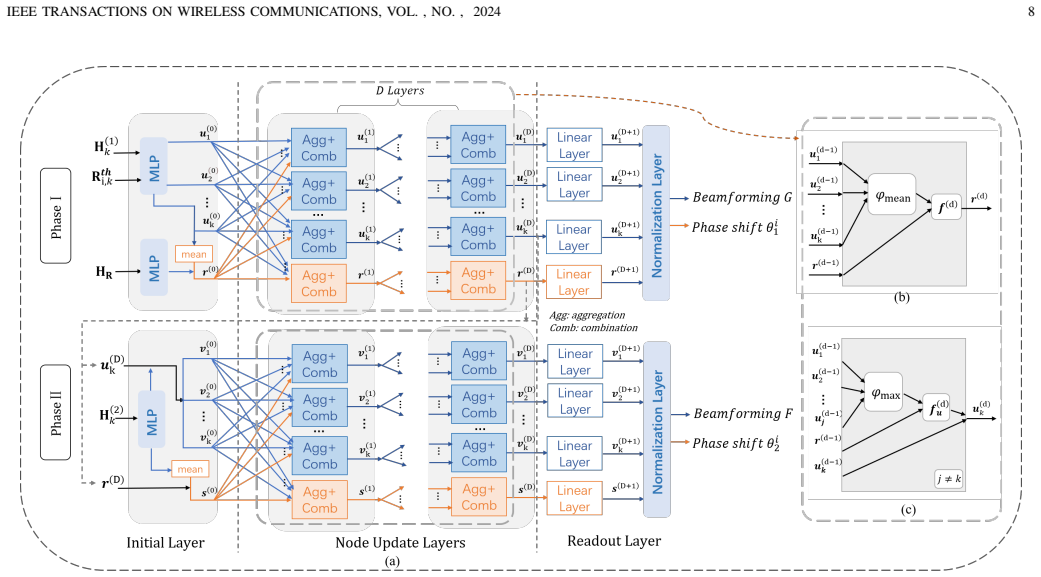
The named central object is the two-phase GNN, a message-passing network with one RIS node and $K$ user nodes in each phase. In phase one, user-node features are built from the BS-to-user and BS-to-RIS channel matrices, the RIS node aggregates them with a mean operation, user nodes aggregate one another with a max operation to capture worst-case interference, and readout layers map the final features to the BS beamforming vectors $g_k$ and quantized RIS phases $\theta_i^1$. Phase two repeats the same structure on the relay-to-user and relay-to-RIS channels to produce relay beamforming $f_k$ and $\theta_i^2$. The carrying mechanism is the penalty-augmented loss: negative sum rate plus $\beta \min(0, \gamma^R_{j,k} - \gamma^R_{th})$ and $\lambda \min(0, R_{i,k} - R^{th}_{i,k})$, which is what makes the satisfaction ratio tunable. As defined, the graph contains no relay nodes, group nodes, or relay-selection variable, so relay selection is performed as a separate step after the GNN readouts rather than as a message-passing output.
What would settle it
Extend the graph with explicit relay nodes and optionally group nodes carrying relay- and group-specific channel features, retrain under the same loss, and compare relay-selection decisions, sum rate, and satisfaction ratios with the original architecture; unchanged performance would indicate the reported relay-selection gains do not come from learned message passing.
Extended reading notes
Core claim
The paper's central claim is that jointly optimizing both transmission phases of a RIS- and DF-assisted MISO system—active beamforming at the BS and relays, passive phase shifts at the RISs, and the choice of which relay forwards—can be learned end-to-end by a two-phase GNN from CSI, while fine-grained rate demands are enforced through a penalty-augmented loss. The authors define the JOFD-TG algorithm: a first-phase graph outputs the BS beamforming matrix and the first-phase RIS phase shifts, a second-phase graph outputs the relay beamforming matrix and the second-phase phase shifts, and the loss subtracts the sum rate plus penalty terms that activate when a relay SINR or a user rate falls below its threshold. Simulations compare against random phase shifts, particle swarm optimization, and a DNN, and report that the GNN achieves higher sum rate and higher satisfaction ratios, that the fine-grained user-level granularity outperforms coarse- and group-level granularity, and that adjusting the penalty weight can drive the satisfaction ratio toward 100%.
Load-bearing premise
The load-bearing premise is that a message-passing graph containing only one RIS node and $K$ user nodes is enough to represent multiple relays, multiple groups, inter-group competition, and relay selection; the paper specifies no mechanism by which relay identity or group membership enters the learned variables.
Editorial extensions
If this is right
- If the central claim holds, the same two-phase GNN can be retrained for new deployments without per-realization optimization, since it learns from CSI in an unsupervised way.
- The penalty parameter $\lambda$ provides a single dial for fairness: increasing it raises the fraction of users meeting their rate thresholds, at some cost in raw sum rate.
- Fine-grained, per-user thresholds should dominate group-level or coarse thresholds in both sum rate and satisfaction, because the network can allocate resources to individual needs.
- Relay placement and selection can matter more than RIS phase tuning in this two-phase topology, so system designers should prioritize relay positioning and the relay-selection rule.
- The model's permutation-invariant aggregation should let it generalize to different numbers of users, with graceful degradation as the training and testing user counts diverge.
Reading between the lines
- Not pursued in the paper: making relay selection an explicit part of the learned graph by adding relay nodes and edges would test whether the reported relay-selection gains actually come from message passing or from the separate post-training selection rule.
- The penalty-loss idea transfers naturally to other constrained resource-allocation problems where a hard requirement can be softened into a tunable penalty, such as latency or energy constraints in network slicing.
- One could probe the fairness-optimal operating point by plotting the full trade-off curve of sum rate against satisfaction ratio as the penalty weight varies, and then choosing the weight from an operator-defined service objective.
- If the graph were extended with group nodes, the claimed inter-group competition might become representable as a learned resource-allocation mechanism rather than an emergent effect of relay selection.
Editorial analysis
A structured set of objections, weighed in public.
Referee Report
Summary. The paper considers a downlink MISO system with a multi-antenna base station, multiple RISs, multiple half-duplex DF relays, and users clustered into groups with fine-grained rate thresholds. It formulates a sum-rate maximization problem P1 with power, DF-decoding, rate-threshold, and discrete-phase constraints, and proposes an unsupervised two-phase graph neural network that takes CSI as input and outputs RIS phase shifts, BS beamforming vectors, and relay beamforming vectors. A penalty-based loss is introduced to trade off sum rate against fine-grained rate-demand satisfaction. Simulations compare the method with DNN, PSO, and random baselines and report higher sum rates and satisfaction ratios, plus generalization across different numbers of users.
Significance. If the architecture actually realized the claimed joint optimization, the paper would be a useful contribution: it is among the first in the reviewed comparison to combine group-level inter/intra trade-offs with per-user fine-grained rate demands, and the unsupervised penalty formulation is a simple way to control satisfaction ratio. Strengths include an explicit permutation-invariant feature design, a generalization study in Table IV, and comparison against several baselines. However, the central architectural claim is not supported by the described graph, and there are dimensional errors in the signal model; the experimental results therefore cannot be interpreted as validating the claimed method until these issues are fixed.
major comments (4)
- [§IV.A, §IV.B, Algorithm 1] The message-passing graph in both phases is explicitly described as fully connected with K+1 nodes: one RIS node and K user nodes (e.g., 'comprising K+1 nodes... one node dedicated to the RIS... along with K nodes assigned to the users'). There are no relay nodes and no group nodes, and the readouts produce θ_i, g_k, and f_k with no relay index. Since the system model in §III includes J DF relays and I groups, and P1 constraint C2 in (10b) sums over j=1..J of tr(F_j F_j^H), the network cannot represent distinct relay beamforming matrices, relay-selection decisions, or group-level competition. Algorithm 1 line 16 instructs to 'Select the appropriate relay' without specifying a selection variable, node, or output. Consequently the abstract's claim of simultaneously and autonomously learning 'phase shifts, beamforming, and relay selection' is not supported by the described architecture.
- [§III.C, §IV.A, §IV.B] No mechanism in the GNN encodes grouping. The graph has one RIS node and K user nodes; no node or aggregation is indexed by group i. The loss functions (29)–(31) include sums over i and group-threshold penalties, but the architecture has no group-level representation, so the claimed modelling of 'intra-group cooperation' and 'inter-group competition' (Section III, Section V.B.3) is not realized by the network. The text states 'inter-group competition is dynamically balanced through relay selection,' but relay selection itself is absent from the graph.
- [§III.A, Eqs. (3)–(4)] Equation (3) is dimensionally invalid: H_i θ_i^1 is an M×1 vector while (H^B_{i,k})^T is a 1×M row vector, so the sum and the outer transpose are undefined. This error propagates into the SINR expression (4) and into the input definitions (11) for the first-phase GNN, and it prevents the model from being unambiguously instantiated. All expressions involving (H^B_{i,k})^T need to be corrected, presumably to use H^B_{i,k} or its conjugate transpose in the appropriate inner product.
- [§III.A, Eqs. (5)–(8), (29)–(31)] The relay-dependent quantities are not consistently defined. The second-phase SINR γ^(2)_{i,k} in (8) depends only on f_k and has no relay index j, while γ^R_{j,k} in (6) depends on α_k, which itself depends on j; the notation in (6) mixes j and k indices in the denominator. The loss functions sum β over j=1..J of min(0,γ^R_{j,k}−γ^R_th), which either adds the same penalty J times if γ^R_{j,k} does not depend on j, or requires J distinct relay beamformers that the network does not output. The power constraint C2 in (10b) uses F_j while the phase-2 readout outputs f_k ∈ C^L; the relationship between F_j and f_k is never defined. These inconsistencies make the training objective not well matched to P1.
minor comments (5)
- [Eq. (30)] The group-granularity loss is written with weight λ, but the following sentence refers to μ as the weight coefficient; the notation should be aligned.
- [Fig. 5, Section V.B] The label 'JOFG-Random' appears to be a typo for 'JOFD-Random', and the names JOGD-TG/JOCD-TG are used inconsistently across the text and figures.
- [Abstract] The abstract contains 'low date rates', which should be 'low data rates'.
- [Table III, Fig. 9] The penalty weights β and λ are fixed at 1000, and only λ is swept in Fig. 9; a similar sweep or ablation for β would better support the claim that the satisfaction ratio is tunable via the penalty parameter.
- [Algorithm 1, line 7] The neighbor set N(k) is used, but the graph is fully connected for user nodes; clarifying that N(k) denotes all other users in the fully connected setting would improve readability.
Circularity Check
No significant circularity: the central claim is an empirical performance comparison against explicit baselines, and no load-bearing result reduces to its own inputs or to a self-citation chain.
full rationale
The paper's central contribution is an unsupervised GNN trained with an explicit objective in equations (29)-(31), and its claim is that this trained model outperforms random, PSO, and DNN baselines in simulation. That claim is an empirical comparison, not a derivation forced by construction. The penalty terms in the loss functions are defined directly in terms of the same rate thresholds used in the satisfaction-ratio evaluation; this is the intended mechanism of a Lagrangian-style penalty method, and reporting higher satisfaction as lambda increases is a validation that the optimizer enforces its own constraint, not a circular prediction. The GNN architecture in Sections IV.A and IV.B is fully specified by the paper's own equations (17)-(28), and no unverified external result is imported to make the derivation work. The paper cites prior work ([30], [31], [34], [44]) for training setups and system configurations, but these citations are incidental and not load-bearing; none of them supplies a uniqueness theorem or a premise that already contains the paper's conclusion. The most notable gap—Algorithm 1 line 16 states "Select the appropriate relay to calculate the sum rate" without specifying a selection mechanism, and the graph has no relay nodes or relay-indexed outputs—is a representational completeness and correctness concern, not a circularity of the kind defined in this analysis. Accordingly, no circular step is identified.
Assumptions & free parameters
free parameters (4)
- penalty weight lambda =
1000 (default), 2000 for near-100% satisfaction
- relay SINR penalty weight beta =
1000
- feature dimension q =
128
- number of node update layers D =
3
assumptions (3)
- domain assumption Channels are quasi-static Rician (RIS links) and Rayleigh (other links), and remain constant during the two phases.
- domain assumption DF relays decode all user signals perfectly in the first phase.
- ad hoc to paper A graph with one RIS node and K user nodes can represent multiple relays, multiple groups, and relay selection.
Cite this review
Pith. "Pith review of Joint Optimization based on Two-phase GNN in RIS- and DF-assisted MISO Systems with Fine-grained Rate Demands." pith.science (2026). https://pith.science/paper/RVP6UR7M
@misc{pith2026250602642,
  author       = {Pith},
  title        = {Pith review of: Joint Optimization based on Two-phase GNN in RIS- and DF-assisted MISO Systems with Fine-grained Rate Demands},
  year         = {2026},
  howpublished = {\url{https://pith.science/paper/RVP6UR7M}},
  note         = {Machine review of arXiv:2506.02642}
}
read the original abstract
Reconfigurable intelligent Surfaces (RIS) and half-duplex decoded and forwarded (DF) relays can collaborate to optimize wireless signal propagation in communication systems. Users typically have different rate demands and are clustered into groups in practice based on their requirements, where the former results in the trade-off between maximizing the rate and satisfying fine-grained rate demands, while the latter causes a trade-off between inter-group competition and intra-group cooperation when maximizing the sum rate. However, traditional approaches often overlook the joint optimization encompassing both of these trade-offs, disregarding potential optimal solutions and leaving some users even consistently at low date rates. To address this issue, we propose a novel joint optimization model for a RIS- and DF-assisted multiple-input single-output (MISO) system where a base station (BS) is with multiple antennas transmits data by multiple RISs and DF relays to serve grouped users with fine-grained rate demands. We design a new loss function to not only optimize the sum rate of all groups but also adjust the satisfaction ratio of fine-grained rate demands by modifying the penalty parameter. We further propose a two-phase graph neural network (GNN) based approach that inputs channel state information (CSI) to simultaneously and autonomously learn efficient phase shifts, beamforming, and relay selection. The experimental results demonstrate that the proposed method significantly improves system performance.
Figures


Figures from the paper (6 more)


Reference graph
Works this paper leans on
-
[31]
B.-J. Chen, R. Y . Chang, F.-T. Chien, and H. V . Poor, “Graph neural network-based joint beamforming for hybrid relay and reconfigurable intelligent surface aided multiuser systems,”IEEE Wireless Communi- cations Letters, vol. 12, no. 10, pp. 1811–1815, 2023
work page 2023
-
[1]
Intelligent reflecting surface-aided wireless communications: A tutorial,
Q. Wu, S. Zhang, B. Zheng, C. You, and R. Zhang, “Intelligent reflecting surface-aided wireless communications: A tutorial,”IEEE Transactions on Communications, vol. 69, no. 5, pp. 3313–3351, 2021
2021
-
[2]
J. Du, M. Xu, S. S. Gill, and H. Wu, “Computation energy efficiency maximization for intelligent reflective surface-aided wireless powered mobile edge computing,”IEEE Transactions on Sustainable Computing, vol. 9, no. 3, pp. 371–385, 2024
work page 2024
-
[3]
Performance analysis and power allocation for covert mobile edge computing with ris- aided noma,
Y . Cheng, J. Lu, D. Niyato, B. Lyu, M. Xu, and S. Zhu, “Performance analysis and power allocation for covert mobile edge computing with ris- aided noma,”IEEE Transactions on Mobile Computing, vol. 23, no. 5, pp. 4212–4227, 2024
work page 2024
-
[4]
Ai-assisted network-slicing based next-generation wireless networks,
X. Shen, J. Gao, W. Wu, K. Lyu, M. Li, W. Zhuang, X. Li, and J. Rao, “Ai-assisted network-slicing based next-generation wireless networks,” IEEE Open Journal of Vehicular Technology, vol. 1, pp. 45–66, 2020
2020
-
[5]
J. Lyu and R. Zhang, “Hybrid active/passive wireless network aided by intelligent reflecting surface: System modeling and performance analysis,”IEEE Transactions on Wireless Communications, vol. 20, no. 11, pp. 7196–7212, 2021
work page 2021
-
[6]
Asymptotic max-min sinr analysis of reconfigurable intelligent surface assisted miso systems,
Q.-U.-A. Nadeem, A. Kammoun, A. Chaaban, M. Debbah, and M.-S. Alouini, “Asymptotic max-min sinr analysis of reconfigurable intelligent surface assisted miso systems,”IEEE Transactions on Wireless Commu- nications, vol. 19, no. 12, pp. 7748–7764, 2020
work page 2020
-
[7]
Split learning over wireless networks: Parallel design and resource management,
W. Wu, M. Li, K. Qu, C. Zhou, X. Shen, W. Zhuang, X. Li, and W. Shi, “Split learning over wireless networks: Parallel design and resource management,”IEEE Journal on Selected Areas in Communications, vol. 41, no. 4, pp. 1051–1066, 2023
2023
Show all 50 references
-
[9]
Energy effi- cient resource allocation for uplink ris-aided millimeter-wave networks with noma,
X. Yu, G. Wang, X. Huang, K. Wang, W. Xu, and Y . Rui, “Energy effi- cient resource allocation for uplink ris-aided millimeter-wave networks with noma,”IEEE Transactions on Mobile Computing, vol. 23, no. 1, pp. 423–436, 2024
2024
-
[10]
Energy-efficient hybrid offloading for backscatter-assisted wirelessly powered mec with recon- figurable intelligent surfaces,
S. Zargari, C. Tellambura, and S. Herath, “Energy-efficient hybrid offloading for backscatter-assisted wirelessly powered mec with recon- figurable intelligent surfaces,”IEEE Transactions on Mobile Computing, vol. 22, no. 9, pp. 5262–5279, 2023
2023
-
[11]
Delay guaranteed joint user association and channel allocation for fog radio access networks,
M. You, G. Zheng, T. Chen, H. Sun, and K.-C. Chen, “Delay guaranteed joint user association and channel allocation for fog radio access networks,”IEEE Transactions on Wireless Communications, vol. 20, no. 6, pp. 3723–3733, 2021
2021
-
[12]
Joint active and passive beamforming design for secure ris-aided isac system,
J. Ye, J. Dai, C. Pan, K. Wang, and J. Li, “Joint active and passive beamforming design for secure ris-aided isac system,”IEEE Wireless Communications Letters, vol. 14, no. 3, pp. 916–920, 2025
2025
-
[13]
Decode- and-forward relaying for cooperative noma systems with direct links,
H. Liu, Z. Ding, K. J. Kim, K. S. Kwak, and H. V . Poor, “Decode- and-forward relaying for cooperative noma systems with direct links,” IEEE Transactions on Wireless Communications, vol. 17, no. 12, pp. 8077–8093, 2018
2018
-
[14]
Optimization of decode- and-forward relaying and ris aided miso system,
J. Zhao, Z. Bai, Y . Cai, S. Guo, and K. Kwak, “Optimization of decode- and-forward relaying and ris aided miso system,” in2022 IEEE 22nd International Conference on Communication Technology (ICCT), 2022, pp. 266–270
2022
-
[15]
Qos-balancing algorithm for optimal relay selection in heterogeneous vehicular networks,
A. Alnasser, H. Sun, and J. Jiang, “Qos-balancing algorithm for optimal relay selection in heterogeneous vehicular networks,”IEEE Transactions on Intelligent Transportation Systems, vol. 23, no. 7, pp. 8223–8233, 2022
2022
-
[16]
Notice of violation of ieee pub- lication principles: Performance of af and df relays by employing half duplex and full duplex mode,
B. D. Moubagou and Y . Y . Chang, “Notice of violation of ieee pub- lication principles: Performance of af and df relays by employing half duplex and full duplex mode,” inProceedings of 2013 2nd International Conference on Measurement, Information and Control, vol. 02, 2013, p...
2013
-
[17]
Successive decode-and-forward relaying with reconfigurable intelligent surfaces,
Z. Abdullah, S. Kisseleff, K. Ntontin, W. Alves Martins, S. Chatzino- tas, and B. Ottersten, “Successive decode-and-forward relaying with reconfigurable intelligent surfaces,” inICC 2022 - IEEE International Conference on Communications, 2022, pp. 2633–2638
2022
-
[18]
A hybrid relay and intelligent reflecting surface network and its ergodic performance analysis,
Z. Abdullah, G. Chen, S. Lambotharan, and J. A. Chambers, “A hybrid relay and intelligent reflecting surface network and its ergodic performance analysis,”IEEE Wireless Communications Letters, vol. 9, no. 10, pp. 1653–1657, 2020
2020
-
[19]
On performance of low-power wide-area networks with the combining of reconfigurable intelligent surfaces and relay,
P. T. Tran, B. C. Nguyen, T. M. Hoang, and T. N. Nguyen, “On performance of low-power wide-area networks with the combining of reconfigurable intelligent surfaces and relay,”IEEE Transactions on Mobile Computing, vol. 22, no. 10, pp. 6086–6096, 2023
2023
-
[20]
Hybrid relay- reflecting intelligent surface-assisted wireless communications,
N. T. Nguyen, Q.-D. Vu, K. Lee, and M. Juntti, “Hybrid relay- reflecting intelligent surface-assisted wireless communications,”IEEE Transactions on Vehicular Technology, vol. 71, no. 6, pp. 6228–6244, 2022
2022
-
[21]
Joint beam- forming and reconfigurable intelligent surface design for two-way relay networks,
J. Wang, Y .-C. Liang, J. Joung, X. Yuan, and X. Wang, “Joint beam- forming and reconfigurable intelligent surface design for two-way relay networks,”IEEE Transactions on Communications, vol. 69, no. 8, pp. 5620–5633, 2021
2021
-
[22]
Joint beamforming design for multiuser miso downlink aided by a reconfigurable intelligent surface and a relay,
M. Obeed and A. Chaaban, “Joint beamforming design for multiuser miso downlink aided by a reconfigurable intelligent surface and a relay,” IEEE Transactions on Wireless Communications, vol. 21, no. 10, pp. 8216–8229, 2022
2022
-
[23]
Weighted sum- rate maximization for reconfigurable intelligent surface aided wireless networks,
H. Guo, Y .-C. Liang, J. Chen, and E. G. Larsson, “Weighted sum- rate maximization for reconfigurable intelligent surface aided wireless networks,”IEEE Transactions on Wireless Communications, vol. 19, no. 5, pp. 3064–3076, 2020
2020
-
[24]
Reconfigurable intelligent surface enhanced multi-user miso symbiotic radio system,
J. Hu, Y .-C. Liang, and Y . Pei, “Reconfigurable intelligent surface enhanced multi-user miso symbiotic radio system,”IEEE Transactions on Communications, vol. 69, no. 4, pp. 2359–2371, 2021
2021
-
[25]
Deep learning-based beamforming for intelligent reflecting surface-assisted mmwave systems,
Y . Ahn and B. Shim, “Deep learning-based beamforming for intelligent reflecting surface-assisted mmwave systems,” in2021 International Con- ference on Information and Communication Technology Convergence (ICTC), 2021, pp. 1731–1734
2021
-
[26]
Time-varying channel prediction for ris-assisted mu-miso networks via deep learning,
W. Xu, J. An, Y . Xu, C. Huang, L. Gan, and C. Yuen, “Time-varying channel prediction for ris-assisted mu-miso networks via deep learning,” IEEE Transactions on Cognitive Communications and Networking, vol. 8, no. 4, pp. 1802–1815, 2022
2022
-
[27]
Deep reinforcement learning based intelligent reflecting surface for secure wireless communications,
H. Yang, Y . Zhao, Z. Xiong, J. Zhao, D. Niyato, K.-Y . Lam, and Q. Wu, “Deep reinforcement learning based intelligent reflecting surface for secure wireless communications,” inGLOBECOM 2020 - 2020 IEEE Global Communications Conference, 2020, pp. 1–6
2020
-
[28]
Deep reinforcement learning based beamforming codebook design for ris- aided mmwave systems,
A. Abdallah, A. Celik, M. M. Mansour, and A. M. Eltawil, “Deep reinforcement learning based beamforming codebook design for ris- aided mmwave systems,” in2023 IEEE 20th Consumer Communications & Networking Conference (CCNC), 2023, pp. 1020–1026
2023
-
[29]
Deep reinforce- ment learning based on location-aware imitation environment for ris- aided mmwave mimo systems,
W. Xu, J. An, C. Huang, L. Gan, and C. Yuen, “Deep reinforce- ment learning based on location-aware imitation environment for ris- aided mmwave mimo systems,”IEEE Wireless Communications Letters, vol. 11, no. 7, pp. 1493–1497, 2022
2022
-
[30]
Learning to reflect and to beamform for intelligent reflecting surface with implicit channel estimation,
T. Jiang, H. V . Cheng, and W. Yu, “Learning to reflect and to beamform for intelligent reflecting surface with implicit channel estimation,”IEEE Journal on Selected Areas in Communications, vol. 39, no. 7, pp. 1931– 1945, 2021
1931
-
[32]
Joint phase shift and beamforming design in a multi-user miso star-ris assisted downlink noma network,
T. Wang, F. Fang, and Z. Ding, “Joint phase shift and beamforming design in a multi-user miso star-ris assisted downlink noma network,” IEEE Transactions on Vehicular Technology, vol. 72, no. 7, pp. 9031– 9043, 2023
2023
-
[33]
Joint beamforming and reflecting design in reconfigurable intelligent surface-aided multi- user communication systems,
X. Ma, S. Guo, H. Zhang, Y . Fang, and D. Yuan, “Joint beamforming and reflecting design in reconfigurable intelligent surface-aided multi- user communication systems,”IEEE Transactions on Wireless Commu- nications, vol. 20, no. 5, pp. 3269–3283, 2021
2021
-
[34]
Deep reinforcement learning-based relay selection in intelligent reflecting surface assisted cooperative networks,
C. Huang, G. Chen, Y . Gong, M. Wen, and J. A. Chambers, “Deep reinforcement learning-based relay selection in intelligent reflecting surface assisted cooperative networks,”IEEE Wireless Communications Letters, vol. 10, no. 5, pp. 1036–1040, 2021
2021
-
[35]
Low-complexity channel estima- tion and passive beamforming for ris-assisted mimo systems relying on discrete phase shifts,
J. An, C. Xu, L. Gan, and L. Hanzo, “Low-complexity channel estima- tion and passive beamforming for ris-assisted mimo systems relying on discrete phase shifts,”IEEE Transactions on Communications, vol. 70, no. 2, pp. 1245–1260, 2022
2022
-
[36]
Codebook-based solutions for reconfigurable intelligent surfaces and their open challenges,
J. An, C. Xu, Q. Wu, D. W. K. Ng, M. Di Renzo, C. Yuen, and L. Hanzo, “Codebook-based solutions for reconfigurable intelligent surfaces and their open challenges,”IEEE Wireless Communications, vol. 31, no. 2, pp. 134–141, 2024
2024
-
[37]
Federated learning in multi-ris-aided systems,
W. Ni, Y . Liu, Z. Yang, H. Tian, and X. Shen, “Federated learning in multi-ris-aided systems,”IEEE Internet of Things Journal, vol. 9, no. 12, pp. 9608–9624, 2022
2022
-
[38]
Cnn-enabled joint active and passive beamforming for ris-assisted mu-mimo systems,
Z. He, F. H ´eliot, and Y . Ma, “Cnn-enabled joint active and passive beamforming for ris-assisted mu-mimo systems,” in2023 IEEE 97th Vehicular Technology Conference (VTC2023-Spring), 2023, pp. 1–6
2023
-
[39]
Unsupervised learning- based joint active and passive beamforming design for reconfigurable intelligent surfaces aided wireless networks,
H. Song, M. Zhang, J. Gao, and C. Zhong, “Unsupervised learning- based joint active and passive beamforming design for reconfigurable intelligent surfaces aided wireless networks,”IEEE Communications Letters, vol. 25, no. 3, pp. 892–896, 2021. IEEE TRANSACTIONS ON WIRELESS COM...
2021
-
[40]
A deep learning scheme for integrated active and passive beamforming in reconfigurable intelligent surface aided wireless miso networks,
V . D. Potu, V . S. Sunku, M. M., and P. S. B. M., “A deep learning scheme for integrated active and passive beamforming in reconfigurable intelligent surface aided wireless miso networks,” in2022 International Conference on Wireless Communications Signal Processing and Net- w...
2022
-
[41]
Joint trajectory and passive beamforming design for intelligent reflecting surface-aided uav commu- nications: A deep reinforcement learning approach,
L. Wang, K. Wang, C. Pan, and N. Aslam, “Joint trajectory and passive beamforming design for intelligent reflecting surface-aided uav commu- nications: A deep reinforcement learning approach,”IEEE Transactions on Mobile Computing, vol. 22, no. 11, pp. 6543–6553, 2023
2023
-
[42]
Relay-assisted transmission with fairness constraint for cellular networks,
E. Liu, Q. Zhang, and K. K. Leung, “Relay-assisted transmission with fairness constraint for cellular networks,”IEEE Transactions on Mobile Computing, vol. 11, no. 2, pp. 230–239, 2012
2012
-
[43]
Medium access with adaptive relay selection in cooperative wireless networks,
H. Adam, E. Yanmaz, and C. Bettstetter, “Medium access with adaptive relay selection in cooperative wireless networks,”IEEE Transactions on Mobile Computing, vol. 13, no. 9, pp. 2042–2057, 2014
2014
-
[44]
Hybrid relay and reconfigurable intelligent surface assisted multiuser miso systems,
T.-Y . Kan, R. Y . Chang, F.-T. Chien, B.-J. Chen, and H. V . Poor, “Hybrid relay and reconfigurable intelligent surface assisted multiuser miso systems,”IEEE Transactions on Vehicular Technology, vol. 72, no. 6, pp. 7653–7668, 2023
2023
-
[45]
Large intelligent surface-assisted wireless communication exploiting statistical csi,
Y . Han, W. Tang, S. Jin, C.-K. Wen, and X. Ma, “Large intelligent surface-assisted wireless communication exploiting statistical csi,”IEEE Transactions on Vehicular Technology, vol. 68, no. 8, pp. 8238–8242, 2019
2019
-
[46]
Intelligent reflecting surface-assisted cognitive radio system,
J. Yuan, Y .-C. Liang, J. Joung, G. Feng, and E. G. Larsson, “Intelligent reflecting surface-assisted cognitive radio system,”IEEE Transactions on Communications, vol. 69, no. 1, pp. 675–687, 2021
2021
-
[47]
PySwarms, a research-toolkit for Particle Swarm Optimization in Python,
L. J. V . Miranda, “PySwarms, a research-toolkit for Particle Swarm Optimization in Python,”Journal of Open Source Software, vol. 3,
-
[48]
Stacked intelligent metasurfaces for efficient holographic mimo communications in 6g,
J. An, C. Xu, D. W. K. Ng, G. C. Alexandropoulos, C. Huang, C. Yuen, and L. Hanzo, “Stacked intelligent metasurfaces for efficient holographic mimo communications in 6g,”IEEE Journal on Selected Areas in Communications, vol. 41, no. 8, pp. 2380–2396, 2023. Huijun Tangreceived ...
2023
-
[51]
He is currently a Professor with the School of Cyberspace, Hangzhou Dianzi University, Hangzhou, China
From 2018 to 2021, he was a lecturer with the Center of Biosafety Research and Strategy of Tianjin University. He is currently a Professor with the School of Cyberspace, Hangzhou Dianzi University, Hangzhou, China. His current research interests in- clude complex network analy...
2018
-
[2004]
His research interests in- clude biomedical signal processing, wireless sensor networks, biometrics, and machine learning
He is currently a Full Professor at Hangzhou Dianzi University, China. His research interests in- clude biomedical signal processing, wireless sensor networks, biometrics, and machine learning. Huaming Wu(Senior Member, IEEE) received the B.E. and M.S. degrees from Harbin Inst...
2009
-
[2018]
Available: https://doi.org/10.21105/joss.00433
[Online]. Available: https://doi.org/10.21105/joss.00433
Reviewed August 7, 2026 · model on record in the stance chip above.
Discussion (0). Sign in to comment.