REVIEW 2 major objections 4 minor 96 references
Thermodynamics and Shadows of Kerr black holes endowed with a global monopole charge
T0 review · 2 major / 4 minor · reviewed 2026-08-07 · deepseek-v4-flash
Pith's one-line read This paper claims that a Kerr black hole carrying a global monopole charge produces larger, rounder shadows whose angular diameters fall inside the EHT-observed ranges for small values of the monopole parameter.
desk verdict The rotating metric in Eq. (4) does not reduce to the static monopole spacetime in Eq. (1), so the shadow and thermodynamic results are computed for a different, physically mislabeled spacetime. read the letter →
The pith
A machine-rendered reading of the paper's core claim, the machinery that carries it, and where it could break.
The reading
What carries the argument
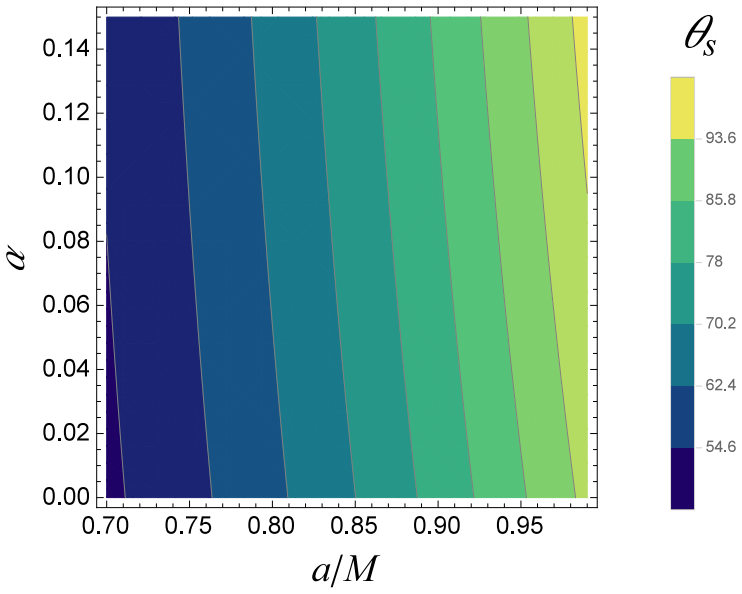
The object that carries the argument is the rotating global-monopole metric of Eq. (4), a Kerr-like line element with $\Delta(r) = r^2 - 2Mr + a^2 - 8\pi\alpha^2 r^2$, obtained from the static monopole solution by the Newman-Janis algorithm. This $\Delta$ fixes the horizon radii $r_\pm = (M \pm \sqrt{M^2 + (8\pi\alpha^2 - 1)a^2})/(1 - 8\pi\alpha^2)$ and enters the effective potential $V_{\mathrm{eff}}$ for photon orbits. The shadow then follows from Hamilton-Jacobi/Carter separability, giving impact parameters $\xi$ and $\eta$, celestial coordinates $X$ and $Y$, and the observables shadow radius $R_s$, distortion $\delta_s$, area $A$, and oblateness $D$; the angular diameter is computed as $\theta_s = 2 r_0^{-1}\sqrt{A/\pi}$. The thermodynamic quantities $T$, $C$, and $G$ are built from the same horizon condition $\Delta(r_h)=0$.
What would settle it
Substitute $a=0$ in Eq. (4) and compare directly with Eq. (1): because $g_{tt}$ differs by the $8\pi\alpha^2$ term, the rotating metric is not the rotating counterpart of the stated static spacetime, and repeating the shadow-diameter calculation with a correctly reduced rotating metric would show whether the quoted bounds $\alpha \in (0,0.08)$ and $\alpha \in (0,0.04)$ survive.
Extended reading notes
Core claim
On its own terms, the paper establishes that a Kerr black hole endowed with a global monopole charge $\alpha$ is a continuous deformation of the Kerr spacetime whose shadow is larger and more circular than the Kerr shadow. The key quantitative claim is that the angular diameter of the shadow grows with $\alpha$ and shrinks with the spin $a$: for $a \in (0.7M, 0.99M)$ and $\alpha \in (0, 0.08)$, the M87 shadow diameter lies between $39\,\mu\mathrm{as}$ and $51\,\mu\mathrm{as}$, overlapping the EHT value $42 \pm 3\,\mu\mathrm{as}$; for Sgr A*, $\alpha \in (0, 0.04)$ gives $50\,\mu\mathrm{as}$ to $55\,\mu\mathrm{as}$, inside $48.7 \pm 7\,\mu\mathrm{as}$. The paper also derives the thermodynamic consequences of the same metric: the monopole lowers the Hawking temperature relative to Kerr, shifts the heat-capacity divergence, and leaves the Gibbs free energy positive, so the rotating monopole black hole is locally stable only in patches and globally unstable. All formulas reduce to Kerr when $\alpha=0$.
Load-bearing premise
The load-bearing premise is that Eq. (4) really is the rotating version of the static global-monopole spacetime, but setting $a=0$ in Eq. (4) gives $g_{tt}=-(1-2M/r)$, whereas Eq. (1) requires $g_{tt}=-(1-2M/r-8\pi\alpha^2)$; the $8\pi\alpha^2$ term drops out of the time-time component of the rotating metric, so the thermodynamic and shadow results inherit that mismatch.
Editorial extensions
If this is right
- For $a \in (0.7M, 0.99M)$ and $\alpha \in (0, 0.08)$, the predicted M87 angular diameter lies between $39\,\mu\mathrm{as}$ and $51\,\mu\mathrm{as}$, overlapping the EHT measurement $42 \pm 3\,\mu\mathrm{as}$.
- For the same spin range and $\alpha \in (0, 0.04)$, the predicted Sgr A* diameter lies between $50\,\mu\mathrm{as}$ and $55\,\mu\mathrm{as}$, inside the EHT range $48.7 \pm 7\,\mu\mathrm{as}$.
- Monopole charge makes the shadow radius and area increase, the distortion decrease, and the oblateness increase, so the shadow looks larger and more circular than the Kerr shadow.
- The Hawking temperature is lower than Kerr's for the same horizon radius, and the heat capacity diverges at $r_h = a/\sqrt{8\pi\alpha^2 - 1}$, marking a local stability transition.
- Every result reduces to the standard Kerr spacetime when $\alpha \to 0$, so the model is a one-parameter deformation of Kerr that EHT-type measurements can constrain.
Reading between the lines
- Editorial inference: a corrected rotating metric that keeps the full $1-2M/r-8\pi\alpha^2$ time-time component would likely preserve the qualitative trend of larger, rounder shadows, but the numerical EHT bounds on $\alpha$ could shift and should not be treated as robust until the metric is fixed.
- Editorial inference: because shadow diameter grows with $\alpha$ and shrinks with spin $a$, a single shadow image cannot cleanly separate monopole charge from spin; full image comparisons or multiple black-hole targets would be needed to break that degeneracy.
- Editorial inference: the same area-based angular-diameter pipeline could be applied to other topological-defect or exotic-matter spacetimes, and the monotone $\alpha$-$\theta_s$ relation offers a simple null test: if future ngEHT diameters fall below the Kerr prediction, enlargement from a monopole charge would be excluded.
- Editorial inference: the thermodynamic side predicts a monopole-dependent shift in temperature and in the heat-capacity divergence, so future quasinormal-mode or ringdown observations that constrain $T$ or the stability threshold could independently probe $\alpha$ without using shadows.
Editorial analysis
A structured set of objections, weighed in public.
Referee Report
Summary. The manuscript constructs a Kerr-like metric intended to describe a rotating black hole with a global monopole charge, computes its horizon structure and thermodynamic quantities (temperature, heat capacity, Gibbs free energy), derives photon geodesics via the Hamilton-Jacobi/Carter method, computes shadow radius, distortion, area, and oblateness, and compares the angular diameter of the shadow with EHT observations of M87 and Sgr A*. The authors claim that certain ranges of the global monopole charge α and spin a are consistent with EHT data. The central issue is that the rotating metric used throughout, Eq. (4), is not the a=0 limit of the stated static monopole spacetime, so the calculation is performed for a different spacetime.
Significance. Should the metric error be repaired and the calculations redone, the standard observables pipeline could yield useful constraints on a possible global monopole charge. The paper is self-contained and presents explicit analytic expressions and tabulated observables; it also uses the stated masses and distances in Eq. (31) when computing angular diameters, so I do not share the concern that distance and mass are ignored. However, because the starting metric (4) is internally inconsistent with the static model (1)-(2), the thermodynamic and shadow results, including the EHT consistency claims, do not apply to the advertised spacetime. This is a load-bearing defect, not a presentation issue.
major comments (2)
- [Sec. II, Eq. (4) vs. Eq. (1)] Setting a=0 in the rotating metric (4) yields g_tt = -(1 - 2M/r) and g_rr = [1 - 2M/r - 8πα^2]^{-1}; the former lacks the -8πα^2 term present in the static monopole metric (1)-(2). Hence Eq. (4) is not the rotating version of Eq. (1), and the spacetime actually studied is not the Kerr black hole with a global monopole charge. This is not a cosmetic issue: the temperature, heat capacity, and Gibbs free energy in Eqs. (7)-(10), the geodesic equations (13)-(18), the impact parameters (21)-(22), the shadow contour (26), and all observables in Tables I-IV are computed from this metric. The claimed EHT constraints on α therefore do not follow from the stated model.
- [Sec. VI, Tables III and IV] The abstract states that for α∈(0,0.08) and a∈(0.7M,0.99M) the M87 angular diameter varies from 39 to 51 μas and that the results are consistent with EHT. Table III shows α=0.08 gives θ_s≈50-51 μas, which is outside the quoted EHT value 42±3 μas; even at 3σ the upper bound is 45 μas. Thus only a subrange of the claimed α interval is consistent with M87 observations, and the paper does not determine the claimed upper limit α<0.08. The same issue appears in Table IV for Sgr A*, where α=0.08 gives θ_s≈67-68 μas versus the quoted 48.7±7 μas; the α∈(0,0.04) range is more defensible but is not derived from a fitting or intersection procedure. The consistency claim is therefore not supported by the tables.
minor comments (4)
- [Sec. V and Conclusion] The text near Eq. (30) says oblateness D increases with α, and Table II confirms this, but the second-to-last bullet of the Conclusion states 'oblatness D decreases'; the Conclusion bullet should be corrected.
- [Fig. 7] The lower-right panel legend entry 'α = 1.2' is presumably a typo for 'α = 0.12'.
- [Eq. (9)] The denominator (8πα^2 - 1)r_h^2 - a^2 is negative for all r_h when α < 1/sqrt(8π), so the claimed divergence at r_h = a/sqrt(8πα^2 - 1) has no real solution for the parameter values plotted in Figs. 4-6; the domain of the claim should be stated.
- [Table IV] For α=0 and a/M=0.7, a direct evaluation of Eq. (31) using the area in Table II, M=4×10^6 M_sun, and distance 8 kpc gives about 50.5 μas, whereas the table lists 52.459 μas; the discrepancy should be explained.
Circularity Check
No significant circularity: the shadow and thermodynamic results are derived from the written metric and compared with, not fitted to, EHT data.
full rationale
The paper's derivation chain is self-contained in the relevant sense: the static monopole metric (1)-(2) leads to the claimed rotating metric (4)-(5) via the Newman-Janis algorithm as cited to reference [14]; the geodesic equations (13)-(18), effective potential (19), impact parameters (21)-(22), shadow observables (23)-(30), and angular diameters (31) are all algebraic consequences of that metric. The EHT values enter only in Section VI as external comparison data: the parameters alpha and a are scanned over intervals rather than fitted to the observed angular diameters, and the reported ranges of theta_s are statements about the model, not predictions manufactured by construction from the observations. The authors' self-citations (e.g., Refs. [47,48,55,77,78,91]) appear only in the introductory literature survey and are not load-bearing for the metric, geodesic, thermodynamic, or shadow derivations; the central rotating metric is attributed to the external reference [14]. The most substantive concern is that Eq. (4) does not reduce to Eq. (1) when a=0, since g_tt misses the -8 pi alpha^2 term; however, that is an internal correctness or labeling problem about which spacetime is being studied, not a circularity in which a conclusion is assumed in its own derivation. No step satisfies the threshold of reducing to its inputs by definition, fitted-input renaming, or a load-bearing self-citation chain, so the circularity score is 0.
Assumptions & free parameters
free parameters (2)
- global monopole charge α =
scanned over (0, 0.15)
- spin parameter a =
scanned over (0.7M, 0.99M)
assumptions (3)
- domain assumption Metric (4) is the rotating global monopole spacetime
- standard math Carter separability of the Hamilton-Jacobi equation
- domain assumption The shadow area angular diameter (31) can be compared directly to EHT ring observations
Cite this review
Pith. "Pith review of Thermodynamics and Shadows of Kerr black holes endowed with a global monopole charge." pith.science (2026). https://pith.science/paper/2FKR6BQ5
@misc{pith2026250602653,
  author       = {Pith},
  title        = {Pith review of: Thermodynamics and Shadows of Kerr black holes endowed with a global monopole charge},
  year         = {2026},
  howpublished = {\url{https://pith.science/paper/2FKR6BQ5}},
  note         = {Machine review of arXiv:2506.02653}
}
abstract
In this article, we present the thermodynamic and shadow properties of rotating black holes with global monopole charge. The angular diameter of Sgr A$^{*}$ black hole is 48.7 $\pm$ 7 $\mu as$, which is 8 $kps$ far away having a mass of $M = 4.0_{-0.6}^{+1.1} \times 10^6 M\odot$ as observed by Event Horizon Telescope and for the M87 black hole, the observed angular diameter is $\theta_d = 42 \pm 3 \mu$as, which is almost $16$ $Mpc$ far away with a mass of $M = (6.5 \pm 0.7) \times 10^9 M_\odot$. The global monopole charge parameter $\alpha$ strongly affects the shape and size of the black hole shadow. We derived all the necessary equations to obtain the angular diameter of the rotating black hole shadow with the effect of the global monopole charge parameter $\alpha$. For $\alpha$ $\in$ (0, 0.08) with $a$ $\in$ $(0.7 M, 0.99 M)$, the angular diameter of M87 black hole shadow varies from $39$ $\mu as$ to $51$ $\mu as$. The angular diameter of Sgr A$^{*}$ black hole with global monopole charge parameter $\alpha$ $\in$ (0, 0.04) and $a$ $\in$ $(0.7 M, 0.99 M)$, varies from $50$ $\mu as$ to $55$ $\mu as$. For bound values of $\alpha$ and $a$, our results are consistent with the EHT observations.
Figures


Figures from the paper (10 more)


Reference graph
Works this paper leans on
- [14]
-
[1]
K. Schwarzschild, Sitzungsber. Preuss. Akad. Wiss. Ber lin (Math. Phys. ) 1916, 189-196 (1916) [arXiv:physics/9905030 [physics]]
arXiv 1916
-
[2]
Reissner, Annalen der Physik , vol
H. Reissner, Annalen der Physik , vol. 355, no. 9, pp. 106–120 (1916)
1916
-
[3]
Nordstr¨ om,Koninklijke Nederlandsche Akademie van Wetenschappen Pro ceedings, vol
G. Nordstr¨ om,Koninklijke Nederlandsche Akademie van Wetenschappen Pro ceedings, vol. 20, pp. 1238–1245 (1918)
1918
-
[4]
Weyl, Annalen der Physik , vol
H. Weyl, Annalen der Physik , vol. 359, no. 18, pp. 117–145 (1917)
1917
-
[5]
G. B. Jeffery, Proceedings of the Royal Society of London. Series A, Contain ing Papers of a Mathematical and Physical Character , vol. 99, no. 697, pp. 123–134 (1921)
1921
-
[6]
Gravitational field of a spinning mass as an ex ample of algebraically special metrics,
R. P. Kerr, “Gravitational field of a spinning mass as an ex ample of algebraically special metrics,” Physical Review Letters , vol. 11, no. 5, pp. 237–238 (1963)
1963
-
[7]
Note on the Kerr spinning-pa rticle metric,
E. T. Newman and A. I. Janis, “Note on the Kerr spinning-pa rticle metric,” Journal of Mathematical Physics , vol. 6, no. 6, pp. 915–917 (1965)
1965
Show all 96 references
-
[8]
Metric of a rotating, charged mass,
E. T. Newman, R. Couch, K. Chinnapared, A. Exton, A. Praka sh, and R. Torrence, “Metric of a rotating, charged mass,” Journal of Mathematical Physics , vol. 6, no. 6, pp. 918–919 20 (1965)
1965
-
[9]
Gravitational field of a glo bal monopole,
M. Barriola and A. Vilenkin, “Gravitational field of a glo bal monopole,” Physical Review Letters, vol. 63, no. 4, pp. 341–343 (1989)
1989
-
[10]
Dadhich, K
N. Dadhich, K. Narayan and U. A. Yajnik, Pramana 50, 307-314 (1998) [arXiv:gr-qc/9703034 [gr-qc]]
1998 arXiv
-
[11]
J. M. Bardeen, B. Carter, and S. W. Hawking, Commun. Math. Phys. 31, 161–170 (1973)
1973
-
[12]
S. W. Hawking, Commun. Math. Phys. 43, 199 (1975), [Erratum: Commun. Math. Phys. 46, 206 (1976)]
1975
-
[13]
J. D. Bekenstein, Phys. Rev. D 7, 2333–2346 (1973)
1973
-
[15]
Akiyama et al
K. Akiyama et al. [Event Horizon Telescope], Astrophys. J. Lett. 875, L1 (2019) [arXiv:1906.11238 [astro-ph.GA]]
2019 arXiv
-
[16]
Akiyama et al
K. Akiyama et al. [Event Horizon Telescope], Astrophys. J. Lett. 875, no.1, L5 (2019) [arXiv:1906.11242 [astro-ph.GA]]
2019 arXiv
-
[17]
Akiyama et al
K. Akiyama et al. [Event Horizon Telescope], Astrophys. J. Lett. 875, no.1, L6 (2019) [arXiv:1906.11243 [astro-ph.GA]]
2019 arXiv
-
[18]
Akiyama et al
K. Akiyama et al. [Event Horizon Telescope], Astrophys. J. Lett. 875, no.1, L3 (2019) [arXiv:1906.11240 [astro-ph.GA]]
2019 arXiv
-
[19]
Akiyama et al
K. Akiyama et al. [Event Horizon Telescope], Astrophys. J. Lett. 875, no.1, L4 (2019) [arXiv:1906.11241 [astro-ph.GA]]
2019 arXiv
-
[20]
Akiyama et al
K. Akiyama et al. [Event Horizon Telescope], Astrophys. J. Lett. 875, no.1, L2 (2019) [arXiv:1906.11239 [astro-ph.IM]]
2019 arXiv
-
[21]
Akiyama et al
K. Akiyama et al. [Event Horizon Telescope], Astrophys. J. Lett. 930, no.2, L15 (2022) [arXiv:2311.08697 [astro-ph.HE]]
2022 arXiv
-
[22]
Akiyama et al
K. Akiyama et al. [Event Horizon Telescope], Astrophys. J. Lett. 930, no.2, L16 (2022) [arXiv:2311.09478 [astro-ph.HE]]
2022 arXiv
-
[23]
Akiyama et al
K. Akiyama et al. [Event Horizon Telescope], Astrophys. J. Lett. 930, no.2, L13 (2022) [arXiv:2311.08679 [astro-ph.HE]]
2022 arXiv
-
[24]
Akiyama et al
K. Akiyama et al. [Event Horizon Telescope], Astrophys. J. Lett. 930, no.2, L14 (2022) [arXiv:2311.09479 [astro-ph.HE]]
2022 arXiv
-
[25]
Akiyama et al
K. Akiyama et al. [Event Horizon Telescope], Astrophys. J. Lett. 930, no.2, L12 (2022) 21 [arXiv:2311.08680 [astro-ph.HE]]
2022 arXiv
-
[26]
Akiyama et al
K. Akiyama et al. [Event Horizon Telescope], Astrophys. J. Lett. 930, no.2, L17 (2022) [arXiv:2311.09484 [astro-ph.HE]]
2022 arXiv
-
[27]
J. L. Synge, Mon. Not. R. Astron. Soc. 131, 463–466 (1966)
1966
-
[28]
J. M. Bardeen, Les Astres Occlus, edited by C. DeWitt and B. S. DeWitt (Gordon and Breach, New York, 1973), pp. 215–240
1973
-
[29]
J. P. Luminet, Astron. Astrophys. 75, 228–235 (1979)
1979
-
[30]
R. A. Cunningham, E. Gabathuler, M. Sproston, and D. G. T aylor, Conf. Proc. C 730508, 298 (1973)
1973
- [31]
-
[32]
Falcke, F
H. Falcke, F. Melia and E. Agol, Astrophys. J. Lett. 528, L13 (2000) [arXiv:astro-ph/9912263 [astro-ph]]
2000 arXiv
-
[33]
de Vries, Class
A. de Vries, Class. Quantum Grav. 17, 123–144 (2000)
2000
-
[34]
Z. Q. Shen, K. Y. Lo, M. C. Liang, P. T. P. Ho and J. H. Zhao, N ature 438, 62 (2005) [arXiv:astro-ph/0512515 [astro-ph]]
2005 arXiv
-
[35]
Yumoto, D
A. Yumoto, D. Nitta, T. Chiba and N. Sugiyama, Phys. Rev. D 86, 103001 (2012) [arXiv:1208.0635 [gr-qc]]
2012 arXiv
-
[36]
Atamurotov, A
F. Atamurotov, A. Abdujabbarov and B. Ahmedov, Phys. Re v. D 88, no.6, 064004 (2013)
2013
-
[37]
A. A. Abdujabbarov, L. Rezzolla and B. J. Ahmedov, Mon. N ot. Roy. Astron. Soc. 454, no.3, 2423-2435 (2015) [arXiv:1503.09054 [gr-qc]]
2015 arXiv
-
[38]
P. V. P. Cunha and C. A. R. Herdeiro, Gen. Rel. Grav. 50, no.4, 42 (2018) [arXiv:1801.00860 [gr-qc]]
2018 arXiv
-
[39]
Kumar and S
R. Kumar and S. G. Ghosh, Astrophys. J. 892, 78 (2020) doi:10.3847/1538-4357/ab77b0 [arXiv:1811.01260 [gr-qc]]
2020 arXiv
-
[40]
Afrin and S
M. Afrin and S. G. Ghosh, Universe 8, no.1, 52 (2022) [arXiv:2112.15038 [gr-qc]]
2022 arXiv
-
[41]
Hioki and K
K. Hioki and K. i. Maeda, Phys. Rev. D 80, 024042 (2009) [arXiv:0904.3575 [astro-ph.HE]]
2009 arXiv
- [42]
-
[43]
X. Q. Li, H. P. Yan, X. J. Yue, S. W. Zhou and Q. Xu, JCAP 05, 048 (2024) [arXiv:2401.18066 [gr-qc]]
2024 arXiv
-
[44]
Amarilla, E
L. Amarilla, E. F. Eiroa and G. Giribet, Phys. Rev. D 81, 124045 (2010) [arXiv:1005.0607 [gr-qc]]. 22
2010 arXiv
-
[45]
Amarilla and E
L. Amarilla and E. F. Eiroa, Phys. Rev. D 85, 064019 (2012) [arXiv:1112.6349 [gr-qc]]
2012 arXiv
-
[46]
Amarilla and E
L. Amarilla and E. F. Eiroa, Phys. Rev. D 87, no.4, 044057 (2013) [arXiv:1301.0532 [gr-qc]]
2013 arXiv
-
[47]
M. Amir, B. P. Singh and S. G. Ghosh, Eur. Phys. J. C 78, no.5, 399 (2018) [arXiv:1707.09521 [gr-qc]]
2018 arXiv
-
[48]
B. P. Singh and S. G. Ghosh, Annals Phys. 395, 127-137 (2018) [arXiv:1707.07125 [gr-qc]]
2018 arXiv
-
[49]
Mizuno, Z
Y. Mizuno, Z. Younsi, C. M. Fromm, O. Porth, M. De Laurent is, H. Olivares, H. Falcke, M. Kramer and L. Rezzolla, Nature Astron. 2, no.7, 585-590 (2018) [arXiv:1804.05812 [astro- ph.GA]]
2018 arXiv
-
[50]
Allahyari, M
A. Allahyari, M. Khodadi, S. Vagnozzi and D. F. Mota, JCA P 02, 003 (2020) [arXiv:1912.08231 [gr-qc]]
2020 arXiv
-
[51]
Papnoi, F
U. Papnoi, F. Atamurotov, S. G. Ghosh and B. Ahmedov, Phy s. Rev. D 90, no.2, 024073 (2014) [arXiv:1407.0834 [gr-qc]]
2014 arXiv
-
[52]
Kumar, S
R. Kumar, S. G. Ghosh and A. Wang, Phys. Rev. D 101, no.10, 104001 (2020) [arXiv:2001.00460 [gr-qc]]
2020 arXiv
- [53]
-
[54]
Kumar, B
R. Kumar, B. P. Singh and S. G. Ghosh, Annals Phys. 420, 168252 (2020) [arXiv:1904.07652 [gr-qc]]
2020 arXiv
-
[55]
Kumar, B
R. Kumar, B. P. Singh, M. S. Ali and S. G. Ghosh, Phys. Dark Univ. 34, 100881 (2021) [arXiv:1712.09793 [gr-qc]]
2021 arXiv
-
[56]
B. P. Singh, Annals Phys. 441, 168892 (2022) [arXiv:1711.02898 [gr-qc]]
2022 arXiv
-
[57]
Kumar, A
R. Kumar, A. Kumar and S. G. Ghosh, Astrophys. J. 896, no.1, 89 (2020) [arXiv:2006.09869 [gr-qc]]
2020 arXiv
-
[58]
Kumar, S
R. Kumar, S. U. Islam and S. G. Ghosh, Eur. Phys. J. C 80, no.12, 1128 (2020) [arXiv:2004.12970 [gr-qc]]
2020 arXiv
-
[59]
Kumar and S
R. Kumar and S. G. Ghosh, Class. Quant. Grav. 38, no.8, 8 (2021) [arXiv:2004.07501 [gr-qc]]
2021 arXiv
-
[60]
Kumar, S
R. Kumar, S. G. Ghosh and A. Wang, Phys. Rev. D 100, no.12, 124024 (2019) [arXiv:1912.05154 [gr-qc]]
2019 arXiv
-
[61]
Kumar, D
A. Kumar, D. V. Singh and S. Upadhyay, Int. J. Mod. Phys. A 39, no.31, 2450136 (2024) [arXiv:2412.14230 [gr-qc]]
2024 arXiv
-
[62]
B. K. Vishvakarma, D. V. Singh and S. Siwach, Eur. Phys. J . Plus 138, no.6, 536 (2023) [arXiv:2304.14754 [gr-qc]]. 23
2023 arXiv
-
[63]
S. G. Ghosh, R. Kumar and S. U. Islam, JCAP 03, 056 (2021) [arXiv:2011.08023 [gr-qc]]
2021 arXiv
-
[64]
Guo and P
M. Guo and P. C. Li, Eur. Phys. J. C 80, no.6, 588 (2020) [arXiv:2003.02523 [gr-qc]]
2020 arXiv
-
[65]
Afrin and S
M. Afrin and S. G. Ghosh, Astrophys. J. 932, no.1, 51 (2022) [arXiv:2110.05258 [gr-qc]]
2022 arXiv
-
[66]
Vagnozzi, R
S. Vagnozzi, R. Roy, Y. D. Tsai, L. Visinelli, M. Afrin, A . Allahyari, P. Bambhaniya, D. Dey, S. G. Ghosh and P. S. Joshi, et al. Class. Quant. Grav. 40, no.16, 165007 (2023) [arXiv:2205.07787 [gr-qc]]
2023 arXiv
-
[67]
Vagnozzi and L
S. Vagnozzi and L. Visinelli, Phys. Rev. D 100, no.2, 024020 (2019) [arXiv:1905.12421 [gr-qc]]
2019 arXiv
-
[68]
Afrin, R
M. Afrin, R. Kumar and S. G. Ghosh, Mon. Not. Roy. Astron. Soc. 504, no.4, 5927-5940 (2021) [arXiv:2103.11417 [gr-qc]]
2021 arXiv
-
[69]
X. J. Gao, T. T. Sui, X. X. Zeng, Y. S. An and Y. P. Hu, Eur. Ph ys. J. C 83, 1052 (2023) [arXiv:2311.11780 [gr-qc]]
2023 arXiv
-
[70]
S. G. Ghosh and R. K. Walia, doi:10.1142/9789811269776 0084 [arXiv:2203.07775 [gr-qc]]
-
[71]
S. Li, T. Mirzaev, A. A. Abdujabbarov, D. Malafarina, B. Ahmedov and W. B. Han, Phys. Rev. D 106, no.8, 084041 (2022) [arXiv:2207.10933 [gr-qc]]
2022 arXiv
-
[72]
Sengo, P
I. Sengo, P. Cunha, V.P., C. A. R. Herdeiro and E. Radu, JC AP 01, 047 (2023) [arXiv:2209.06237 [gr-qc]]
2023 arXiv
-
[73]
W. Liu, D. Wu, X. Fang, J. Jing and J. Wang, JCAP 08, 035 (2024) [arXiv:2406.00579 [gr-qc]]
2024 arXiv
-
[74]
Umarov, O
D. Umarov, O. Yunusov, F. Atamurotov, A. Abdujabbarov a nd S. G. Ghosh, Chin. Phys. C 49, no.5, 055102 (2025)
2025
-
[75]
Ahmed, S
F. Ahmed, S. U. Islam and S. G. Ghosh, JHEAp 46, 100350 (2025)
2025
-
[76]
Turakhonov, F
Z. Turakhonov, F. Atamurotov, S. G. Ghosh and A. Abdujab barov, Phys. Dark Univ. 48, 101880 (2025)
2025
-
[77]
B. P. Singh, Phys. Dark Univ. 42, 101279 (2023) [arXiv:2301.00956 [gr-qc]]
2023 arXiv
-
[78]
B. P. Singh, M. S. Ali and S. G. Ghosh, Commun. Theor. Phys . 77, no.7, 075407 (2025) [arXiv:2207.11907 [gr-qc]]
2025 arXiv
-
[79]
Kumar Walia, S
R. Kumar Walia, S. G. Ghosh and S. D. Maharaj, Astrophys. J. 939, no.2, 77 (2022) [arXiv:2207.00078 [gr-qc]]
2022 arXiv
-
[80]
C. Liu, T. Zhu, Q. Wu, K. Jusufi, M. Jamil, M. Azreg-A ¨ ınou and A. Wang, Phys. Rev. D 101, no.8, 084001 (2020) [erratum: Phys. Rev. D 103, no.8, 089902 (2021)] [arXiv:2003.00477 [gr-qc]]
2020 arXiv
-
[81]
Brahma, C
S. Brahma, C. Y. Chen and D. h. Yeom, Phys. Rev. Lett. 126, no.18, 181301 (2021) 24 [arXiv:2012.08785 [gr-qc]]
2021 arXiv
-
[82]
Kumar Walia, JCAP 03, 029 (2023) [arXiv:2207.02106 [gr-qc]]
R. Kumar Walia, JCAP 03, 029 (2023) [arXiv:2207.02106 [gr-qc]]
2023 arXiv
-
[83]
S. U. Islam, J. Kumar, R. Kumar Walia and S. G. Ghosh, Astr ophys. J. 943, no.1, 22 (2023) [arXiv:2211.06653 [gr-qc]]
2023 arXiv
-
[84]
Afrin, S
M. Afrin, S. Vagnozzi and S. G. Ghosh, Astrophys. J. 944, no.2, 149 (2023) [arXiv:2209.12584 [gr-qc]]
2023 arXiv
-
[85]
J. Yang, C. Zhang and Y. Ma, Eur. Phys. J. C 83, no.7, 619 (2023) [arXiv:2211.04263 [gr-qc]]
2023 arXiv
-
[86]
B. P. Singh, R. Kumar and S. G. Ghosh, New Astron. 99, 101945 (2023)
2023
-
[87]
Y. Hou, M. Guo and B. Chen, Phys. Rev. D 104, no.2, 024001 (2021) [arXiv:2103.04369 [gr-qc]]
2021 arXiv
-
[88]
Vagnozzi and L
S. Vagnozzi and L. Visinelli, Res. Notes AAS 6, no.5, 106 (2022) [arXiv:2205.11314 [astro- ph.GA]]
2022 arXiv
-
[89]
Banerjee, S
I. Banerjee, S. Chakraborty and S. SenGupta, Phys. Rev. D 106, no.8, 084051 (2022) [arXiv:2207.09003 [gr-qc]]
2022 arXiv
-
[90]
A. S. Lemos, J. A. V. Campos and F. A. Brito, Phys. Rev. D 110, no.6, 064079 (2024) [arXiv:2407.04609 [gr-qc]]
2024 arXiv
-
[91]
B. P. Singh, Annals Phys. 470, 169803 (2024) [arXiv:2409.07951 [gr-qc]]
2024 arXiv
-
[92]
Chandrasekhar, The Mathematical Theory of Black Holes (Oxford University Press, New York, 1985)
S. Chandrasekhar, The Mathematical Theory of Black Holes (Oxford University Press, New York, 1985)
1985
-
[93]
Carter, Phys
B. Carter, Phys. Rev. Lett. 26, 331-333 (1971)
1971
-
[94]
A. V. Frolov and V. P. Frolov, Phys. Rev. D 90, no.12, 124010 (2014) [arXiv:1408.6316 [gr-qc]]
2014 arXiv
-
[95]
Black holes,
J. Bardeen, “Black holes,” in Black Holes , edited by C. DeWitt and B. S. DeWitt (Gordon and Breach, New York, 1973)
1973
-
[96]
Bambi, K
C. Bambi, K. Freese, S. Vagnozzi and L. Visinelli, Phys. Rev. D 100, no.4, 044057 (2019) [arXiv:1904.12983 [gr-qc]]. 25
2019 arXiv
Reviewed August 7, 2026 · model on record in the stance chip above.
Discussion (0). Sign in to comment.