REVIEW 4 major objections 4 minor 41 references
MotionRAG-Diff: A Retrieval-Augmented Diffusion Framework for Long-Term Music-to-Dance Generation
T0 review · 4 major / 4 minor · reviewed 2026-08-07 · deepseek-v4-flash
Pith's one-line read MotionRAG-Diff proposes a retrieval-then-diffusion pipeline that generates long, music-synchronized dance, reporting best beat alignment on AIST++ and FineDance.
desk verdict A sensible but incremental retrieval-plus-diffusion pipeline whose own tables do not support its SOTA claim, and whose abstract contradicts its method on 'unsupervised' learning. read the letter →
The pith
A machine-rendered reading of the paper's core claim, the machinery that carries it, and where it could break.
The reading
What carries the argument
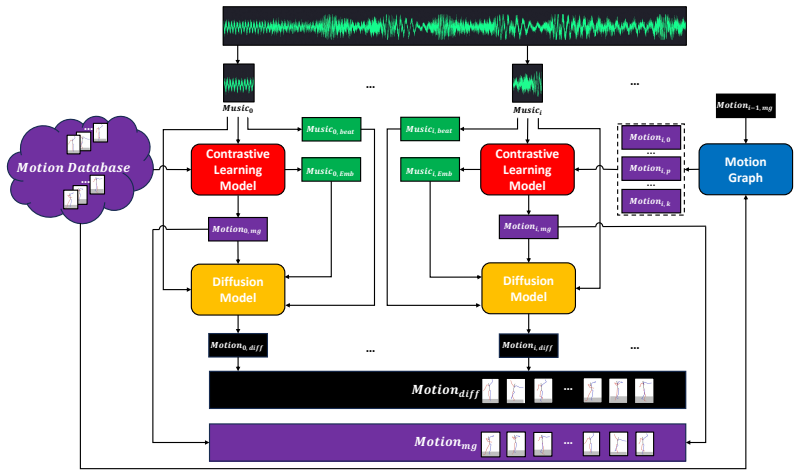
The load-bearing machinery is the retrieval-augmented loop around a paired embedding space. In stage 1, MoMask-style motion encoding and a Wav2Clip-style music encoder are aligned with an InfoNCE contrastive loss, and a TANGO-style motion graph connects motion clips whose last N frames have compatible position and velocity, prunes to the largest strongly connected component, and stitches retrieved segments with joint-angle smoothing. In stage 2, a Diffusion Transformer (DiT) based diffusion model, following the EDGE formulation, is conditioned through a multi-condition pairwise fusion network that cross-attends four signals, raw music (encoded with Jukebox), extracted beats, top-k retrieved motions, and contrastive music embeddings, under the objective $L_{\mathrm{total}}=L_{\mathrm{simple}}+\lambda_{\mathrm{pos}}L_{\mathrm{pos}}+\lambda_{\mathrm{vel}}L_{\mathrm{vel}}+\lambda_{\mathrm{contact}}L_{\mathrm{contact}}$. The pairwise fusion of these conditions is what lets the diffusion stage refine global music-motion synchronization rather than only local pose quality.
What would settle it
Measure frame-to-frame acceleration discontinuities at every stitching boundary in the stage-1 motion graph output. If those discontinuities are no smaller than at random concatenation boundaries, the Algorithm-1 compatibility rule is not creating seamless transitions, and the retrieval stage cannot be the source of the reported temporal coherence.
Extended reading notes
Core claim
The paper's central claim is that retrieval and generation do not have to be competing strategies: a contrastive encoder can select semantically relevant motion segments from a motion graph, and a multi-condition diffusion model can refine those segments so the final dance is both physically realistic and musically synchronized. The authors support this with two-stage results: MotionRAG-Diff reports the highest BAS on AIST++ (0.2874 at stage 1) and the highest BAS on FineDance (0.2631 at stage 2), and stage 1 achieves the lowest FIDk on FineDance (10.51). The same tables show the trade-offs: diffusion refinement lowers FIDk on AIST++ but reduces diversity relative to stage 1, and the paper explicitly acknowledges that motion diversity remains constrained by the pre-built motion graph. The paper frames the overall result as establishing a new paradigm for music-driven dance generation by synergizing retrieval-based template fidelity with diffusion-based creative enhancement.
Load-bearing premise
The load-bearing premise is that connecting motion clips whose last N frames have small position and velocity differences by threshold T yields seamless, kinematically valid transitions, with N and T left unspecified and pruning assumed to preserve the dance distribution.
Editorial extensions
If this is right
- Long music inputs can be processed in arbitrary duration by stitching graph-retrieved motion segments and then refining the whole sequence with diffusion.
- Beat alignment, measured by BAS, is highest for MotionRAG-Diff on both benchmarks: 0.2874 on AIST++ (stage 1) and 0.2631 on FineDance (stage 2) among the compared methods.
- On FineDance, the stage-1 retrieval output reaches FIDk=10.51, a 73.1% improvement over the previous best compared method, Lodge++, indicating that graph retrieval alone supplies high kinematic fidelity.
- Diffusion refinement improves synchronization but can sacrifice diversity: on FineDance, Divk drops from 10.67 (stage 1) to 8.94 (stage 2).
Reading between the lines
- Beyond the paper, the contrastive retrieval's contribution could be isolated by replacing the learned retriever with random motion-graph retrieval; if BAS gains persist, the reported synchronization improvement comes mainly from graph structure or diffusion rather than the learned music-motion alignment.
- A testable scaling prediction follows from the design: enlarging the motion library should improve FID more than adding diffusion compute, since retrieval is the main source of kinematic fidelity in the two-stage pipeline.
- The separate stage-1 and stage-2 results suggest a deployment choice the paper does not fully explore: stage 1 alone is preferable where diversity and fidelity matter most, while stage 2 is preferable where beat-level synchronization is the priority.
Editorial analysis
A structured set of objections, weighed in public.
Referee Report
Summary. The paper proposes MotionRAG-Diff, a two-stage pipeline for long-term music-to-dance generation. Stage1 uses a contrastively trained music/motion embedding and a motion graph to retrieve and stitch motion segments; stage2 refines the retrieved motion with a multi-condition diffusion model conditioned on raw music, beat, top-k retrieved motions, and contrastive embeddings. The paper claims state-of-the-art quality, diversity, and beat alignment on AIST++ and FineDance, positioning the work as a new paradigm for music-driven dance synthesis. The core technical contribution is the retrieval-augmented design with pairwise fusion of multiple conditioning signals.
Significance. If the reported results held for the full system, the hybrid retrieval-plus-diffusion design would be a useful contribution to long-form dance synthesis. The paper is clearly structured and the two-stage idea is coherent, and using standard metrics (FID, DIV, BAS) facilitates comparison. However, its central empirical claim is unsupported by its own tables, and the paper switches between stage1 and stage2 results when claiming superiority. The claimed 'unsupervised' correspondence is also not consistent with the supervised contrastive training described. These issues undermine the paper's main conclusion rather than being cosmetic.
major comments (4)
- [§4.4, Tables 1–2] The paper's headline claim that MotionRAG-Diff achieves state-of-the-art performance is not supported by the reported numbers for the full pipeline. On AIST++ (Table 1), Ours(stage2) is not best on any metric: FID_k=26.23 vs. Bailando++ 17.59, FID_g=17.66 vs. 10.10, DIV_k=5.62 vs. 8.64, DIV_g=3.79 vs. 6.50, and BAS=0.2545 vs. 0.2720. On FineDance (Table 2), Ours(stage2) is best only on BAS (0.2631), while FID_k=32.25 is worse than Ours(stage1) 10.51, and FID_g=57.63 is worse than Lodge 35.52. The only comparisons that beat prior methods use the stage1 output, i.e., retrieval without diffusion refinement. The sentence in §4.4 claiming a 73.1% FID_k reduction versus Lodge++ uses the stage1 value (10.51), not the end-to-end stage2 value (32.25), and is therefore misleading about the complete system.
- [§4.3, §4.4, §5] The evaluation mixes results from the two stages as if they were one method. Section 4.3 reports 'the highest score of 0.2874 in stage1' on AIST++, but Table 1 lists stage2 BAS as 0.2545, which is lower than Bailando++ (0.2720). The abstract and conclusion refer to 'our approach' and 'our method' without distinguishing the intermediate retrieval output from the final diffusion-refined output. Since the claimed SOTA status is entirely an artifact of this stage mixing, the paper's central conclusion is not established for the end-to-end system.
- [§2, §3.1, Abstract] The claim of 'unsupervised semantic correspondence without paired data' is contradicted by the methodology. The motion encoder is fine-tuned on AIST++ and FineDance, the music encoder is trained with an adaptive layer, and Eq. (1) is an InfoNCE loss over <music, motion> pairs. These are supervised or self-supervised uses of paired data, not unsupervised learning in the sense claimed. This overclaim appears in the abstract and Section 2 and should be corrected or removed.
- [§3.2, Algorithm 1] The motion graph edge-building rule depends on two free parameters, N (frames for mean calculation) and T (joint count threshold), but neither is specified in Section 4.2 or elsewhere, and no sensitivity analysis is provided. Because stage1 retrieval is the foundation of the whole pipeline, the reported results cannot be reproduced and the robustness of the graph construction to these thresholds is unknown. The notation 'Count Sp < Tp' and 'Count Sv < Tv' also needs clarification: it is not clear what is being counted or compared.
minor comments (4)
- [Table 1] The Bailando row appears to have missing spacing: '28.169.627.83' should likely read '28.16 9.62 7.83'.
- [Figure 3 caption] The caption contains duplicated text: 'music-motion similarity matrixmusic-motion similarity matrix'.
- [§3.3] The introduction mentions a 'DiT architecture' and Section 3.3 says the diffusion model builds on EDGE, but no specific DiT blocks are identified; please clarify which components are DiT-based and where they are inserted.
- [§4] The paper reports only aggregate quantitative metrics and does not provide qualitative motion visualizations or a user study, which makes claims about 'naturalness' and 'seamless transitions' hard to verify.
Circularity Check
No significant circularity: the pipeline is trained and evaluated on external benchmark data, and the reported weaknesses are acknowledged rather than hidden.
full rationale
The derivation chain is not circular. Stage1 (contrastive retrieval + motion graph) and stage2 (diffusion refinement) are optimized with external objectives (InfoNCE Eq. 1; diffusion reconstruction Eq. 3; auxiliary losses Eqs. 4-7) and evaluated on held-out test sets from AIST++ and FineDance using metrics (FID, DIV, BAS) whose formulas do not consume any fitted parameter of the model. The motion-graph edge rule (Algorithm 1) and pruning are defined from kinematics of the database, not from evaluation targets. Contrastive embeddings are used both for retrieval and as a diffusion condition, but the diffusion model is trained to reconstruct ground-truth motion from those conditions and is scored on motion quality; this is an architectural reuse, not a definitional reduction. All citations (MoMask, Wav2Clip, EDGE, TANGO, DiffDance) are external prior work used for architectural components, so there is no load-bearing self-citation chain. The main weakness is not circularity but an evaluative inconsistency: Tables 1 and 2 show the stage2 full pipeline is not best on most metrics, and the best entries are split between stage1 and stage2 (e.g., AIST++ BAS 0.2874 in stage1 vs 0.2545 in stage2; FineDance FID_k 10.51 in stage1 vs 32.25 in stage2). Thus the SOTA claim depends on selecting different stages per metric. Section 5 explicitly acknowledges constrained diversity and two-stage computational cost, so the limitations are not concealed.
Assumptions & free parameters
free parameters (3)
- N (motion graph mean frames)
- T (joint count threshold)
- top-k retrieval count
assumptions (5)
- standard math DDPM forward and reverse diffusion processes (Eq. 2-3) as defined in Ho et al.
- standard math InfoNCE contrastive loss (Eq. 1) for aligning music and motion embeddings.
- domain assumption Position and velocity compatibility between adjacent motion clips is sufficient for seamless kinematic concatenation.
- domain assumption Pruning to the largest strongly connected component preserves enough dance variety for the target music.
- ad hoc to paper The multi-condition pairwise fusion network improves music-motion synchronization.
Cite this review
Pith. "Pith review of MotionRAG-Diff: A Retrieval-Augmented Diffusion Framework for Long-Term Music-to-Dance Generation." pith.science (2026). https://pith.science/paper/L4JGCIDR
@misc{pith2026250602661,
  author       = {Pith},
  title        = {Pith review of: MotionRAG-Diff: A Retrieval-Augmented Diffusion Framework for Long-Term Music-to-Dance Generation},
  year         = {2026},
  howpublished = {\url{https://pith.science/paper/L4JGCIDR}},
  note         = {Machine review of arXiv:2506.02661}
}
abstract
Generating long-term, coherent, and realistic music-conditioned dance sequences remains a challenging task in human motion synthesis. Existing approaches exhibit critical limitations: motion graph methods rely on fixed template libraries, restricting creative generation; diffusion models, while capable of producing novel motions, often lack temporal coherence and musical alignment. To address these challenges, we propose $\textbf{MotionRAG-Diff}$, a hybrid framework that integrates Retrieval-Augmented Generation (RAG) with diffusion-based refinement to enable high-quality, musically coherent dance generation for arbitrary long-term music inputs. Our method introduces three core innovations: (1) A cross-modal contrastive learning architecture that aligns heterogeneous music and dance representations in a shared latent space, establishing unsupervised semantic correspondence without paired data; (2) An optimized motion graph system for efficient retrieval and seamless concatenation of motion segments, ensuring realism and temporal coherence across long sequences; (3) A multi-condition diffusion model that jointly conditions on raw music signals and contrastive features to enhance motion quality and global synchronization. Extensive experiments demonstrate that MotionRAG-Diff achieves state-of-the-art performance in motion quality, diversity, and music-motion synchronization accuracy. This work establishes a new paradigm for music-driven dance generation by synergizing retrieval-based template fidelity with diffusion-based creative enhancement.
Figures


Figures from the paper (1 more)

Reference graph
Works this paper leans on
-
[1]
Jean-Baptiste Alayrac, Adria Recasens, Rosalia Schneider, Relja Arandjelovi´c, Jason Ramapu- ram, Jeffrey De Fauw, Lucas Smaira, Sander Dieleman, and Andrew Zisserman. Self-supervised multimodal versatile networks.Advances in neural information processing systems, 33:25–37, 2020
work page 2020
-
[2]
Omid Alemi, Jules Françoise, and Philippe Pasquier. Groovenet: Real-time music-driven dance movement generation using artificial neural networks.networks, 8(17):26, 2017
work page 2017
-
[3]
wav2vec 2.0: A framework for self-supervised learning of speech representations.Advances in neural information processing systems, 33:12449–12460, 2020
Alexei Baevski, Yuhao Zhou, Abdelrahman Mohamed, and Michael Auli. wav2vec 2.0: A framework for self-supervised learning of speech representations.Advances in neural information processing systems, 33:12449–12460, 2020
2020
-
[4]
Kang Chen, Zhipeng Tan, Jin Lei, Song-Hai Zhang, Yuan-Chen Guo, Weidong Zhang, and Shi-Min Hu. Choreomaster: choreography-oriented music-driven dance synthesis.ACM Transactions on Graphics (TOG), 40(4):1–13, 2021
work page 2021
-
[5]
Jukebox: A generative model for music.arXiv preprint arXiv:2005.00341, 2020
Prafulla Dhariwal, Heewoo Jun, Christine Payne, Jong Wook Kim, Alec Radford, and Ilya Sutskever. Jukebox: A generative model for music.arXiv preprint arXiv:2005.00341, 2020
arXiv 2005
-
[6]
Fairmotion-tools to load, process and visualize motion capture data
Deepak Gopinath and Jungdam Won. Fairmotion-tools to load, process and visualize motion capture data. 2020
work page 2020
-
[7]
Momask: Generative masked modeling of 3d human motions
Chuan Guo, Yuxuan Mu, Muhammad Gohar Javed, Sen Wang, and Li Cheng. Momask: Generative masked modeling of 3d human motions. InProceedings of the IEEE/CVF Conference on Computer Vision and Pattern Recognition (CVPR), pages 1900–1910, June 2024
work page 1900
-
[8]
Denoising diffusion probabilistic models.Advances in neural information processing systems, 33:6840–6851, 2020
Jonathan Ho, Ajay Jain, and Pieter Abbeel. Denoising diffusion probabilistic models.Advances in neural information processing systems, 33:6840–6851, 2020
2020
Show all 41 references
-
[9]
Dance revolution: Long-term dance generation with music via curriculum learning
Ruozi Huang, Huang Hu, Wei Wu, Kei Sawada, Mi Zhang, and Daxin Jiang. Dance revolution: Long-term dance generation with music via curriculum learning. InInternational conference on learning representations, 2020
2020
-
[10]
Beat-it: Beat-synchronized multi-condition 3d dance generation
Zikai Huang, Xuemiao Xu, Cheng Xu, Huaidong Zhang, Chenxi Zheng, Jing Qin, and Shengfeng He. Beat-it: Beat-synchronized multi-condition 3d dance generation. InEuro- pean Conference on Computer Vision, pages 273–290. Springer, 2024
2024
-
[11]
Morag - multi- fusion retrieval augmented generation for human motion
Sai Shashank Kalakonda, Shubh Maheshwari, and Ravi Kiran Sarvadevabhatla. Morag - multi- fusion retrieval augmented generation for human motion. InProceedings of the IEEE/CVF Winter Conference on Applications of Computer Vision (WACV), 2025
2025
-
[12]
A brand new dance partner: Music-conditioned pluralistic dancing controlled by multiple dance genres
Jinwoo Kim, Heeseok Oh, Seongjean Kim, Hoseok Tong, and Sanghoon Lee. A brand new dance partner: Music-conditioned pluralistic dancing controlled by multiple dance genres. In Proceedings of the IEEE/CVF Conference on Computer Vision and Pattern Recognition, pages 3490–3500, 2022
2022
-
[13]
Exponential moving average versus moving exponential average.Mathematische Semesterberichte, 58:97–107, 2011
Frank Klinker. Exponential moving average versus moving exponential average.Mathematische Semesterberichte, 58:97–107, 2011
2011
-
[14]
Danceformer: Music conditioned 3d dance generation with parametric motion transformer
Buyu Li, Yongchi Zhao, Shi Zhelun, and Lu Sheng. Danceformer: Music conditioned 3d dance generation with parametric motion transformer. InProceedings of the AAAI Conference on Artificial Intelligence, volume 36, pages 1272–1279, 2022
2022
-
[15]
Learning to generate diverse dance motions with transformer.arXiv preprint arXiv:2008.08171, 2020
Jiaman Li, Yihang Yin, Hang Chu, Yi Zhou, Tingwu Wang, Sanja Fidler, and Hao Li. Learning to generate diverse dance motions with transformer.arXiv preprint arXiv:2008.08171, 2020
2008 arXiv
-
[16]
Lodge++: High-quality and long dance generation with vivid choreography patterns.arXiv preprint arXiv:2410.20389, 2024
Ronghui Li, Hongwen Zhang, Yachao Zhang, Yuxiang Zhang, Youliang Zhang, Jie Guo, Yan Zhang, Xiu Li, and Yebin Liu. Lodge++: High-quality and long dance generation with vivid choreography patterns.arXiv preprint arXiv:2410.20389, 2024. 10
-
[17]
Lodge: A coarse to fine diffusion network for long dance generation guided by the characteristic dance primitives
Ronghui Li, YuXiang Zhang, Yachao Zhang, Hongwen Zhang, Jie Guo, Yan Zhang, Yebin Liu, and Xiu Li. Lodge: A coarse to fine diffusion network for long dance generation guided by the characteristic dance primitives. InProceedings of the IEEE/CVF Conference on Computer Vision and...
2024
-
[18]
Finedance: A fine-grained choreography dataset for 3d full body dance generation
Ronghui Li, Junfan Zhao, Yachao Zhang, Mingyang Su, Zeping Ren, Han Zhang, Yansong Tang, and Xiu Li. Finedance: A fine-grained choreography dataset for 3d full body dance generation. InProceedings of the IEEE/CVF International Conference on Computer Vision, pages 10234–10243, 2023
2023
-
[19]
Ai choreographer: Music conditioned 3d dance generation with aist++
Ruilong Li, Shan Yang, David A Ross, and Angjoo Kanazawa. Ai choreographer: Music conditioned 3d dance generation with aist++. InProceedings of the IEEE/CVF international conference on computer vision, pages 13401–13412, 2021
2021
-
[20]
Video motion graphs.arXiv preprint arXiv:2503.20218, 2025
Haiyang Liu, Zhan Xu, Fa-Ting Hong, Hsin-Ping Huang, Yi Zhou, and Yang Zhou. Video motion graphs.arXiv preprint arXiv:2503.20218, 2025
2025 arXiv
-
[21]
Tango: Co-speech gesture video reenactment with hierarchical audio motion embedding and diffusion interpolation.arXiv preprint arXiv:2410.04221, 2024
Haiyang Liu, Xingchao Yang, Tomoya Akiyama, Yuantian Huang, Qiaoge Li, Shigeru Kuriyama, and Takafumi Taketomi. Tango: Co-speech gesture video reenactment with hierarchical audio motion embedding and diffusion interpolation.arXiv preprint arXiv:2410.04221, 2024
-
[22]
Matthew Loper, Naureen Mahmood, Javier Romero, Gerard Pons-Moll, and Michael J. Black. SMPL: A skinned multi-person linear model.ACM Trans. Graphics (Proc. SIGGRAPH Asia), 34(6):248:1–248:16, October 2015
2015
-
[23]
Decoupled weight decay regularization.arXiv preprint arXiv:1711.05101, 2017
Ilya Loshchilov and Frank Hutter. Decoupled weight decay regularization.arXiv preprint arXiv:1711.05101, 2017
2017 arXiv
-
[24]
librosa: Audio and music signal analysis in python.SciPy, 2015:18–24, 2015
Brian McFee, Colin Raffel, Dawen Liang, Daniel PW Ellis, Matt McVicar, Eric Battenberg, and Oriol Nieto. librosa: Audio and music signal analysis in python.SciPy, 2015:18–24, 2015
2015
-
[25]
Learn2dance: Learning statistical music-to-dance mappings for choreography synthesis.IEEE Transactions on Multimedia, 14(3):747–759, 2011
Ferda Ofli, Engin Erzin, Yücel Yemez, and A Murat Tekalp. Learn2dance: Learning statistical music-to-dance mappings for choreography synthesis.IEEE Transactions on Multimedia, 14(3):747–759, 2011
2011
-
[26]
Scalable diffusion models with transformers
William Peebles and Saining Xie. Scalable diffusion models with transformers. InProceedings of the IEEE/CVF international conference on computer vision, pages 4195–4205, 2023
2023
-
[27]
Film: Visual reasoning with a general conditioning layer
Ethan Perez, Florian Strub, Harm De Vries, Vincent Dumoulin, and Aaron Courville. Film: Visual reasoning with a general conditioning layer. InProceedings of the AAAI conference on artificial intelligence, volume 32, 2018
2018
-
[28]
Diffdance: Cascaded human motion diffusion model for dance generation
Qiaosong Qi, Le Zhuo, Aixi Zhang, Yue Liao, Fei Fang, Si Liu, and Shuicheng Yan. Diffdance: Cascaded human motion diffusion model for dance generation. InProceedings of the 31st ACM International Conference on Multimedia, pages 1374–1382, 2023
2023
-
[29]
Bailando: 3d dance generation via actor-critic gpt with choreographic memory
Li Siyao, Weijiang Yu, Tianpei Gu, Chunze Lin, Quan Wang, Chen Qian, Chen Change Loy, and Ziwei Liu. Bailando: 3d dance generation via actor-critic gpt with choreographic memory. InCVPR, 2022
2022
-
[30]
Bailando++: 3d dance gpt with choreographic memory.IEEE Transactions on Pattern Analysis and Machine Intelligence, 45(12):14192–14207, 2023
Li Siyao, Weijiang Yu, Tianpei Gu, Chunze Lin, Quan Wang, Chen Qian, Chen Change Loy, and Ziwei Liu. Bailando++: 3d dance gpt with choreographic memory.IEEE Transactions on Pattern Analysis and Machine Intelligence, 45(12):14192–14207, 2023
2023
-
[31]
Deep unsuper- vised learning using nonequilibrium thermodynamics
Jascha Sohl-Dickstein, Eric Weiss, Niru Maheswaranathan, and Surya Ganguli. Deep unsuper- vised learning using nonequilibrium thermodynamics. InInternational conference on machine learning, pages 2256–2265. pmlr, 2015
2015
-
[32]
Dance with melody: An lstm-autoencoder approach to music-oriented dance synthesis
Taoran Tang, Jia Jia, and Hanyang Mao. Dance with melody: An lstm-autoencoder approach to music-oriented dance synthesis. InProceedings of the 26th ACM international conference on Multimedia, pages 1598–1606, 2018. 11
2018
-
[33]
Motionclip: Exposing human motion generation to clip space
Guy Tevet, Brian Gordon, Amir Hertz, Amit H Bermano, and Daniel Cohen-Or. Motionclip: Exposing human motion generation to clip space. InComputer Vision–ECCV 2022: 17th European Conference, Tel Aviv, Israel, October 23–27, 2022, Proceedings, Part XXII, pages 358–374. Springer, 2022
2022
-
[34]
Human motion diffusion model.arXiv preprint arXiv:2209.14916, 2022
Guy Tevet, Sigal Raab, Brian Gordon, Yonatan Shafir, Daniel Cohen-Or, and Amit H Bermano. Human motion diffusion model.arXiv preprint arXiv:2209.14916, 2022
2022 arXiv
-
[35]
Edge: Editable dance generation from music
Jonathan Tseng, Rodrigo Castellon, and Karen Liu. Edge: Editable dance generation from music. InProceedings of the IEEE/CVF Conference on Computer Vision and Pattern Recognition, pages 448–458, 2023
2023
-
[36]
Wav2clip: Learning robust audio representations from clip
Ho-Hsiang Wu, Prem Seetharaman, Kundan Kumar, and Juan Pablo Bello. Wav2clip: Learning robust audio representations from clip. InICASSP 2022-2022 IEEE International Conference on Acoustics, Speech and Signal Processing (ICASSP), pages 4563–4567. IEEE, 2022
2022
-
[37]
Adan: Adaptive nesterov momentum algorithm for faster optimizing deep models.IEEE Transactions on Pattern Analysis and Machine Intelligence, 2024
Xingyu Xie, Pan Zhou, Huan Li, Zhouchen Lin, and Shuicheng Yan. Adan: Adaptive nesterov momentum algorithm for faster optimizing deep models.IEEE Transactions on Pattern Analysis and Machine Intelligence, 2024
2024
-
[38]
Motiondiffuse: Text-driven human motion generation with diffusion model.IEEE transactions on pattern analysis and machine intelligence, 46(6):4115–4128, 2024
Mingyuan Zhang, Zhongang Cai, Liang Pan, Fangzhou Hong, Xinying Guo, Lei Yang, and Ziwei Liu. Motiondiffuse: Text-driven human motion generation with diffusion model.IEEE transactions on pattern analysis and machine intelligence, 46(6):4115–4128, 2024
2024
-
[39]
Remodiffuse: Retrieval-augmented motion diffusion model
Mingyuan Zhang, Xinying Guo, Liang Pan, Zhongang Cai, Fangzhou Hong, Huirong Li, Lei Yang, and Ziwei Liu. Remodiffuse: Retrieval-augmented motion diffusion model. In Proceedings of the IEEE/CVF International Conference on Computer Vision, pages 364–373, 2023
2023
-
[40]
Audio-driven neural gesture reenactment with video motion graphs
Yang Zhou, Jimei Yang, Dingzeyu Li, Jun Saito, Deepali Aneja, and Evangelos Kalogerakis. Audio-driven neural gesture reenactment with video motion graphs. InProceedings of the IEEE/CVF conference on computer vision and pattern recognition, pages 3418–3428, 2022
2022
-
[41]
Music2dance: Dancenet for music-driven dance generation.ACM Transactions on Multimedia Computing, Communications, and Applications (TOMM), 18(2):1–21, 2022
Wenlin Zhuang, Congyi Wang, Jinxiang Chai, Yangang Wang, Ming Shao, and Siyu Xia. Music2dance: Dancenet for music-driven dance generation.ACM Transactions on Multimedia Computing, Communications, and Applications (TOMM), 18(2):1–21, 2022. 12
2022
Reviewed August 7, 2026 · model on record in the stance chip above.
Discussion (0). Sign in to comment.