REVIEW 3 major objections 4 minor 44 references
LayoutRAG: Retrieval-Augmented Model for Content-agnostic Conditional Layout Generation
T0 review · 3 major / 4 minor · reviewed 2026-08-07 · deepseek-v4-flash
Pith's one-line read The paper claims that conditional layout generation is improved by first retrieving a similar complete layout from a database and then using that reference, through Condition-Modulated Attention, to guide a flow-matching generator, and…
desk verdict A genuinely new retrieval-augmented approach to conditional layout generation with strong results, but the retrieval similarity is undefined for two of the four benchmark tasks, so the paper needs a clarifying revision before the claims are fully supported. read the letter →
The pith
A machine-rendered reading of the paper's core claim, the machinery that carries it, and where it could break.
The reading
What carries the argument
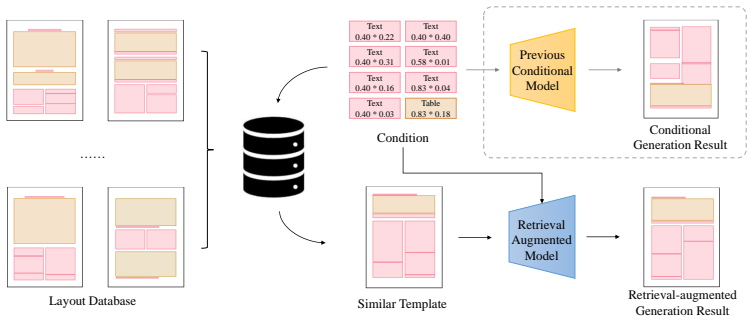
The load-bearing component is Condition-Modulated Attention (CMA), a cross-attention layer that fuses three inputs at each generation step: the current intermediate layout, the retrieved reference layout, and the user condition. CMA projects these features, combines them through matrix dot products, and applies scale and shift regressed from the time embedding, so the model can selectively borrow from the reference rather than copying it wholesale. The retrieval stage is the other essential piece: a per-category count index prunes the candidate set, and Kuhn-Munkres bipartite matching with IoU weights (Eqs. 1-2) ranks the survivors. Together they let the generator use a retrieved example as a concrete hint about how the unknown attributes are usually arranged, instead of treating the condition as the only source of information.
What would settle it
Run the retrieval step exactly as written on the class-only and unconditional tasks and check whether a query element without a bounding box can be passed through Eq. (2); the reported 66% (RICO) and 99% (PubLayNet) retrieval rates and the associated FID gains would require some unspecified substitute similarity for these queries.
Extended reading notes
Core claim
The central claim is that conditional layout generation should be factored into two steps: retrieval and reference-guided generation. Given any subset of layout attributes (class, size, position), the method first narrows a database of training layouts using per-category element counts, then ranks candidates by an IoU-weighted bipartite match between query elements and candidate elements. The best template is passed, together with the user condition, into a Condition-Modulated Attention module that steers the flow-matching vector-field predictor, and in cases where the retrieved template already fits, it can be returned with slight modification. On RICO and PubLayNet the paper reports that this pipeline improves FID over state-of-the-art conditional layout generators on three of the four tested tasks and takes a close second on the remaining one, with higher mIoU on RICO, which it presents as evidence that retrieval is an effective conditioning mechanism.
Load-bearing premise
The approach depends on being able to find a similar layout from the database even when the condition gives no bounding boxes, but the paper's stated similarity measure compares bounding boxes and is undefined when either side has none to compare.
Editorial extensions
If this is right
- The threshold ablation indicates that generation quality tracks retrieval quality: on C+S->P for PubLayNet, FID improves from 1.24 when only low-similarity references are kept to 0.77 when all retrieved references are used, so better databases or retrieval should yield better layouts.
- Because references come from an external database, the model can be adapted after training by replacing or extending that database, which the paper presents as a way to fix failure cases without retraining.
- The raw retrieved layout itself already achieves FID comparable to or better than generative baselines on retrievable test data, so much of the method's value lies in the retrieval stage and not only in the generation stage.
- The gains are largest on tasks with richer conditions (class plus size, and completion), suggesting retrieval guidance is most useful when the user's specification strongly constrains what the unknown attributes should look like.
Reading between the lines
- Editorial inference: the same retrieve-then-reference recipe could transfer to other structured generation problems that have a corpus of exemplars and partial specifications, such as floor-plan design, presentation slide layouts, or scene-graph arrangement, though the paper does not test these settings.
- Editorial inference: since the stated similarity metric needs bounding boxes on both sides, a class-only or unconditional query requires an unspecified fallback; the reported gains for C->S+P and U-Cond therefore rely on an implementation detail the paper does not describe.
- Editorial inference: the authors' observation that irrelevant references degrade gracefully toward the base model suggests a learnable quality gate that decides between retrieval, slight modification, and pure generation could further extend the method; this is not proposed in the paper.
Editorial analysis
A structured set of objections, weighed in public.
Referee Report
Summary. The paper introduces LayoutRAG, a retrieval-augmented framework for content-agnostic conditional layout generation. Given a partial layout condition (class, size, or location attributes), the method retrieves similar layouts from the training database using a category-count index followed by IoU-based bipartite matching, then feeds the retrieved layout as a reference into a flow-matching generator built on LayoutFlow through a Condition-Modulated Attention module. Experiments on RICO and PubLayNet cover four tasks (C->S+P, C+S->P, Completion, U-Cond) and report FID, mIoU, Alignment, and Overlap, claiming state-of-the-art FID in most settings. Ablations analyze retrieval quality, reference quality, and fusion designs, and the paper promises code release upon acceptance.
Significance. If the claims hold, the paper is a useful and timely contribution: it is, to my knowledge, the first application of retrieval augmentation to content-agnostic conditional layout generation, it provides a transparent mechanism for injecting dataset knowledge at inference time, and it reports consistent FID improvements over strong flow/diffusion baselines on two standard benchmarks. The paper also includes extensive comparisons, a raw-retrieval analysis, ablations on reference quality and attention design, and a code-release commitment. The main weakness is that the retrieval similarity measure is not defined for conditions that lack bounding boxes, which affects three of the four benchmark tasks; until that gap is closed, the empirical basis for the headline claim is incomplete.
major comments (3)
- [Section 3.1, Eq. (1)-(2); Table 1] The retrieval similarity measure is undefined for the C->S+P, C+S->P, and U-Cond tasks. In C->S+P the query contains class labels but no bounding boxes; in C+S->P it contains class and size but no location; and in U-Cond the query is empty. For these cases the term IoU(e_i, e_hat_j) in Eq. (2) cannot be evaluated, so the bipartite matching problem in Eq. (1) has no well-defined input. The paper does not specify an alternative similarity or ranking for these box-less conditions, yet Table 1 reports LayoutRAG results for all three tasks and Table 2 reports Raw Retrieval results for U-Cond and C->S+P. Please specify exactly how references are retrieved, ranked, and counted for conditions without bounding boxes, or restrict the performance claims to tasks where the described similarity is actually computable.
- [Section 4.3, Retrieval Result Analyses] The description of retrieval coverage is incomplete. The text states that only 66% of RICO test cases and 99% of PubLayNet test cases can be retrieved by category-based retrieval, but no per-task breakdown is provided, and the inference-time fallback when no reference is found is never described. Since Table 1 reports aggregate metrics over the full test set, it is unclear whether non-retrievable cases are generated by the base LayoutFlow branch without any reference, or by something else. Without specifying this fallback, the reported numbers cannot be reproduced or properly interpreted. Please report per-task retrieval rates and state explicitly what the model does when retrieval fails.
- [Section 4.3, Table 2] Table 2 compares Raw Retrieval with generative models only on the retrievable subset of the test data, and the LayoutRAG rows are empty for U-Cond and C->S+P. This makes the table difficult to interpret: it does not show whether LayoutRAG benefits from retrieval on tasks whose queries have no bounding boxes, nor does it explain why those entries are missing. Please either fill these entries or state explicitly that the retrieval mechanism is not applied to those tasks; otherwise the reader cannot tell which of the results in Table 1 actually exercise the proposed retrieval component.
minor comments (4)
- [Section 3.1, Eq. (1)] The summation indices in the two bipartite-matching constraints appear to be swapped: the first constraint should sum over i for each j, and the second should sum over j for each i, with the index ranges stated consistently.
- [Section 4.1 and elsewhere] There are several typos that should be fixed: 'donates' should be 'denotes' in the description of C->S+P; 'content-agonistic' should be 'content-agnostic' in Section 2.3; 'poct-hoc' should be 'post-hoc' in the Conclusion; and 'yeilds' should be 'yields' in Section 4.3.
- [Table 2] The naming of the unconditional task is inconsistent: the main text uses 'U-Cond' but Table 2 uses 'Uncond'. Please unify the terminology.
- [Section 4.1, Evaluation Metrics] The acronym mIoU is described as 'Maximum Interaction over Union', which is an unusual name for this metric. Please clarify whether it is the mean Intersection over Union over elements or the maximum-matching IoU used in earlier layout-generation papers, and define it precisely.
Circularity Check
No significant circularity: LayoutRAG's retrieval pipeline is an external data mechanism and its central claim is an empirical held-out comparison, not a reduction to its inputs.
full rationale
The paper's central claim is that retrieving layout templates by conditions and using them as references improves conditional layout generation over state-of-the-art models, evaluated with FID, mIoU, alignment, and overlap on held-out test splits of RICO and PubLayNet. This is an empirical comparison against external baselines, not a derivation in which the prediction is defined in terms of the inputs or fit to the evaluated data. The retrieval database is the training set ('we simply select all the training data as entities', Sec. 3.1), and the final generated outputs in Table 1 are produced by the flow-matching model with reference guidance, not by directly returning retrieved samples; Table 2 even shows LayoutRAG improving over Raw Retrieval on C+S->P and Completion. There are no load-bearing self-citations: the base model LayoutFlow [10] is an independent prior work, and no uniqueness claim or ansatz is imported from the present authors' earlier papers. A genuine limitation exists—Eq. (1)-(2) define similarity via IoU between matched bounding boxes, which is undefined for class-only (C->S+P), class+size (C+S->P), and no-condition (U-Cond) queries where query elements lack positions, and Sec. 4.3 reports only 66% of RICO test cases are retrievable—but this is a correctness/coverage gap in the method description, not a circular reduction of the central result to its inputs. Accordingly, no circular step meets the evidentiary bar.
Assumptions & free parameters
free parameters (3)
- L1 regularization weight lambda =
not specified
- Reference dropout probability =
not specified
- Number of retrieved references =
not specified (likely 1)
assumptions (3)
- standard math Flow matching objective for training the vector field predictor
- domain assumption Pre-trained LayoutFlow serves as a reliable base model for extension
- domain assumption The training data used as retrieval database is representative and does not distort evaluation
Cite this review
Pith. "Pith review of LayoutRAG: Retrieval-Augmented Model for Content-agnostic Conditional Layout Generation." pith.science (2026). https://pith.science/paper/EOJIFFFH
@misc{pith2026250602697,
  author       = {Pith},
  title        = {Pith review of: LayoutRAG: Retrieval-Augmented Model for Content-agnostic Conditional Layout Generation},
  year         = {2026},
  howpublished = {\url{https://pith.science/paper/EOJIFFFH}},
  note         = {Machine review of arXiv:2506.02697}
}
read the original abstract
Controllable layout generation aims to create plausible visual arrangements of element bounding boxes within a graphic design according to certain optional constraints, such as the type or position of a specific component. While recent diffusion or flow-matching models have achieved considerable advances in multifarious conditional generation tasks, there remains considerable room for generating optimal arrangements under given conditions. In this work, we propose to carry out layout generation through retrieving by conditions and reference-guided generation. Specifically, we retrieve appropriate layout templates according to given conditions as references. The references are then utilized to guide the denoising or flow-based transport process. By retrieving layouts compatible with the given conditions, we can uncover the potential information not explicitly provided in the given condition. Such an approach offers more effective guidance to the model during the generation process, in contrast to previous models that feed the condition to the model and let the model infer the unprovided layout attributes directly. Meanwhile, we design a condition-modulated attention that selectively absorbs retrieval knowledge, adapting to the difference between retrieved templates and given conditions. Extensive experiment results show that our method successfully produces high-quality layouts that meet the given conditions and outperforms existing state-of-the-art models. Code will be released upon acceptance.
Figures


Figures from the paper (2 more)


Reference graph
Works this paper leans on
-
[1]
Variational transformer networks for layout generation
Diego Martin Arroyo, Janis Postels, and Federico Tombari. Variational transformer networks for layout generation. In Proceedings of the IEEE/CVF Conference on Computer Vision and Pattern Recognition, pages 13642–13652, 2021
work page 2021
-
[2]
Layout representation learning with spatial and structural hierarchies
Yue Bai, Dipu Manandhar, Zhaowen Wang, John Collomosse, and Yun Fu. Layout representation learning with spatial and structural hierarchies. In Proceedings of the AAAI Conference on Artificial Intelligence, volume 37, pages 206–214, 2023
work page 2023
-
[3]
Retrieval-augmented diffusion models
Andreas Blattmann, Robin Rombach, Kaan Oktay, Jonas Müller, and Björn Ommer. Retrieval-augmented diffusion models. Advances in Neural Information Processing Systems, 35:15309–15324, 2022
2022
-
[4]
Improving language models by retrieving from trillions of tokens
Sebastian Borgeaud, Arthur Mensch, Jordan Hoffmann, Trevor Cai, Eliza Rutherford, Katie Millican, George Bm Van Den Driessche, Jean-Baptiste Lespiau, Bogdan Damoc, Aidan Clark, et al. Improving language models by retrieving from trillions of tokens. In International conference on machine learning, pages 2206–2240. PMLR, 2022
2022
-
[5]
Arantxa Casanova, Marlene Careil, Jakob Verbeek, Michal Drozdzal, and Adriana Romero Soriano. Instance-conditioned gan. Advances in Neural Information Processing Systems, 34:27517–27529, 2021
work page 2021
-
[6]
Layoutdm: Transformer-based diffusion model for layout generation
Shang Chai, Liansheng Zhuang, and Fengying Yan. Layoutdm: Transformer-based diffusion model for layout generation. In Proceedings of the IEEE/CVF Conference on Computer Vision and Pattern Recognition, pages 18349–18358, 2023
work page 2023
-
[7]
Towards aligned layout generation via diffusion model with aesthetic constraints
Jian Chen, Ruiyi Zhang, Yufan Zhou, and Changyou Chen. Towards aligned layout generation via diffusion model with aesthetic constraints. In The Twelfth International Conference on Learning Representations,
-
[8]
Rico: A mobile app dataset for building data-driven design applications
Biplab Deka, Zifeng Huang, Chad Franzen, Joshua Hibschman, Daniel Afergan, Yang Li, Jeffrey Nichols, and Ranjitha Kumar. Rico: A mobile app dataset for building data-driven design applications. In Proceedings of the 30th annual ACM symposium on user interface software and technology, pages 845– 854, 2017
work page 2017
Show all 44 references
-
[9]
Vector quantized diffusion model for text-to-image synthesis
Shuyang Gu, Dong Chen, Jianmin Bao, Fang Wen, Bo Zhang, Dongdong Chen, Lu Yuan, and Baining Guo. Vector quantized diffusion model for text-to-image synthesis. In Proceedings of the IEEE/CVF conference on computer vision and pattern recognition, pages 10696–10706, 2022
2022
-
[10]
Layout- flow: flow matching for layout generation
Julian Jorge Andrade Guerreiro, Naoto Inoue, Kento Masui, Mayu Otani, and Hideki Nakayama. Layout- flow: flow matching for layout generation. In European Conference on Computer Vision, pages 56–72. Springer, 2024
2024
-
[11]
Retrieval augmented language model pre-training
Kelvin Guu, Kenton Lee, Zora Tung, Panupong Pasupat, and Mingwei Chang. Retrieval augmented language model pre-training. In International conference on machine learning, pages 3929–3938. PMLR, 2020
2020
-
[12]
Gans trained by a two time-scale update rule converge to a local nash equilibrium.Advances in neural information processing systems, 30, 2017
Martin Heusel, Hubert Ramsauer, Thomas Unterthiner, Bernhard Nessler, and Sepp Hochreiter. Gans trained by a two time-scale update rule converge to a local nash equilibrium.Advances in neural information processing systems, 30, 2017
2017
-
[13]
Retrieval-augmented layout transformer for content-aware layout generation
Daichi Horita, Naoto Inoue, Kotaro Kikuchi, Kota Yamaguchi, and Kiyoharu Aizawa. Retrieval-augmented layout transformer for content-aware layout generation. In Proceedings of the IEEE/CVF Conference on Computer Vision and Pattern Recognition, pages 67–76, 2024
2024
-
[14]
Unifying layout generation with a decoupled diffusion model
Mude Hui, Zhizheng Zhang, Xiaoyi Zhang, Wenxuan Xie, Yuwang Wang, and Yan Lu. Unifying layout generation with a decoupled diffusion model. In Proceedings of the IEEE/CVF Conference on Computer Vision and Pattern Recognition, pages 1942–1951, 2023
1942
-
[15]
Layoutdm: Discrete diffusion model for controllable layout generation
Naoto Inoue, Kotaro Kikuchi, Edgar Simo-Serra, Mayu Otani, and Kota Yamaguchi. Layoutdm: Discrete diffusion model for controllable layout generation. In Proceedings of the IEEE/CVF Conference on Computer Vision and Pattern Recognition, pages 10167–10176, 2023
2023
-
[16]
Layoutformer++: Conditional graphic layout generation via constraint serialization and decoding space restriction
Zhaoyun Jiang, Jiaqi Guo, Shizhao Sun, Huayu Deng, Zhongkai Wu, Vuksan Mijovic, Zijiang James Yang, Jian-Guang Lou, and Dongmei Zhang. Layoutformer++: Conditional graphic layout generation via constraint serialization and decoding space restriction. In Proceedings of the IEEE/...
2023
-
[17]
Constrained graphic layout generation via latent optimization
Kotaro Kikuchi, Edgar Simo-Serra, Mayu Otani, and Kota Yamaguchi. Constrained graphic layout generation via latent optimization. InProceedings of the 29th ACM International Conference on Multimedia, pages 88–96, 2021
2021
-
[18]
Blt: bidirectional layout transformer for controllable layout generation
Xiang Kong, Lu Jiang, Huiwen Chang, Han Zhang, Yuan Hao, Haifeng Gong, and Irfan Essa. Blt: bidirectional layout transformer for controllable layout generation. In European Conference on Computer Vision, pages 474–490. Springer, 2022. 10
2022
-
[19]
Neural design network: Graphic layout generation with constraints
Hsin-Ying Lee, Lu Jiang, Irfan Essa, Phuong B Le, Haifeng Gong, Ming-Hsuan Yang, and Weilong Yang. Neural design network: Graphic layout generation with constraints. In Computer Vision–ECCV 2020: 16th European Conference, Glasgow, UK, August 23–28, 2020, Proceedings, Part III ...
2020
-
[20]
Dlt: Conditioned layout generation with joint discrete-continuous diffusion layout transformer
Elad Levi, Eli Brosh, Mykola Mykhailych, and Meir Perez. Dlt: Conditioned layout generation with joint discrete-continuous diffusion layout transformer. In Proceedings of the IEEE/CVF International Conference on Computer Vision, pages 2106–2115, 2023
2023
-
[21]
Layoutgan: Generating graphic layouts with wireframe discriminators
Jianan Li, Jimei Yang, Aaron Hertzmann, Jianming Zhang, and Tingfa Xu. Layoutgan: Generating graphic layouts with wireframe discriminators. arXiv preprint arXiv:1901.06767, 2019
1901 arXiv
-
[22]
Yaron Lipman, Ricky T. Q. Chen, Heli Ben-Hamu, Maximilian Nickel, and Matthew Le. Flow matching for generative modeling. In The Eleventh International Conference on Learning Representations, 2023. URL https://openreview.net/forum?id=PqvMRDCJT9t
2023
-
[23]
Retrieval-augmented diffusion models for time series forecasting
Jingwei Liu, Ling Yang, Hongyan Li, and Shenda Hong. Retrieval-augmented diffusion models for time series forecasting. Advances in Neural Information Processing Systems, 37:2766–2786, 2024
2024
-
[24]
Flow straight and fast: Learning to generate and transfer data with rectified flow
Xingchao Liu, Chengyue Gong, and qiang liu. Flow straight and fast: Learning to generate and transfer data with rectified flow. In The Eleventh International Conference on Learning Representations, 2023. URL https://openreview.net/forum?id=XVjTT1nw5z
2023
-
[25]
Repaint: Inpainting using denoising diffusion probabilistic models
Andreas Lugmayr, Martin Danelljan, Andres Romero, Fisher Yu, Radu Timofte, and Luc Van Gool. Repaint: Inpainting using denoising diffusion probabilistic models. In Proceedings of the IEEE/CVF conference on computer vision and pattern recognition, pages 11461–11471, 2022
2022
-
[26]
Learning structural similarity of user interface layouts using graph networks
Dipu Manandhar, Dan Ruta, and John Collomosse. Learning structural similarity of user interface layouts using graph networks. In Computer Vision–ECCV 2020: 16th European Conference, Glasgow, UK, August 23–28, 2020, Proceedings, Part XXII 16, pages 730–746. Springer, 2020
2020
-
[27]
SDEdit: Guided image synthesis and editing with stochastic differential equations
Chenlin Meng, Yutong He, Yang Song, Jiaming Song, Jiajun Wu, Jun-Yan Zhu, and Stefano Ermon. SDEdit: Guided image synthesis and editing with stochastic differential equations. In International Conference on Learning Representations, 2022. URL https://openreview.net/forum?id=aB...
2022
-
[28]
GLIDE: Towards photorealistic image generation and editing with text- guided diffusion models
Alexander Quinn Nichol, Prafulla Dhariwal, Aditya Ramesh, Pranav Shyam, Pamela Mishkin, Bob Mcgrew, Ilya Sutskever, and Mark Chen. GLIDE: Towards photorealistic image generation and editing with text- guided diffusion models. In Kamalika Chaudhuri, Stefanie Jegelka, Le Song, C...
2022
-
[29]
Read: Retrieval-enhanced asymmetric diffusion for motion planning
Takeru Oba, Matthew Walter, and Norimichi Ukita. Read: Retrieval-enhanced asymmetric diffusion for motion planning. In Proceedings of the IEEE/CVF Conference on Computer Vision and Pattern Recognition, pages 17974–17984, 2024
2024
-
[30]
Optimal correction cost for object detection evaluation
Mayu Otani, Riku Togashi, Yuta Nakashima, Esa Rahtu, Janne Heikkilä, and Shin’ichi Satoh. Optimal correction cost for object detection evaluation. In Proceedings of the IEEE/CVF Conference on Computer Vision and Pattern Recognition, pages 21107–21115, 2022
2022
-
[31]
Ltsim: Layout transportation-based similarity measure for evaluating layout generation
Mayu Otani, Naoto Inoue, Kotaro Kikuchi, and Riku Togashi. Ltsim: Layout transportation-based similarity measure for evaluating layout generation. CoRR, abs/2407.12356, 2024. URL https://doi.org/10. 48550/arXiv.2407.12356
-
[32]
D3pm: a comprehensive database for protein motions ranging from residue to domain.BMC bioinformatics, 23(1):70, 2022
Cheng Peng, Xinben Zhang, Zhijian Xu, Zhaoqiang Chen, Yanqing Yang, Tingting Cai, and Weiliang Zhu. D3pm: a comprehensive database for protein motions ranging from residue to domain.BMC bioinformatics, 23(1):70, 2022
2022
-
[33]
Efficient attention: Attention with linear complexities
Zhuoran Shen, Mingyuan Zhang, Haiyu Zhao, Shuai Yi, and Hongsheng Li. Efficient attention: Attention with linear complexities. In Proceedings of the IEEE/CVF winter conference on applications of computer vision, pages 3531–3539, 2021
2021
-
[34]
Knn-diffusion: Image generation via large-scale retrieval
Shelly Sheynin, Oron Ashual, Adam Polyak, Uriel Singer, Oran Gafni, Eliya Nachmani, and Yaniv Taigman. Knn-diffusion: Image generation via large-scale retrieval. arXiv preprint arXiv:2204.02849, 2022
2022 arXiv
-
[35]
Retrievalfuse: Neural 3d scene reconstruction with a database
Yawar Siddiqui, Justus Thies, Fangchang Ma, Qi Shan, Matthias Nießner, and Angela Dai. Retrievalfuse: Neural 3d scene reconstruction with a database. In Proceedings of the IEEE/CVF International Conference on Computer Vision, pages 12568–12577, 2021
2021
-
[36]
Denoising diffusion implicit models
Jiaming Song, Chenlin Meng, and Stefano Ermon. Denoising diffusion implicit models. In Interna- tional Conference on Learning Representations, 2021. URL https://openreview.net/forum?id= St1giarCHLP
2021
-
[37]
Generative modeling by estimating gradients of the data distribution
Yang Song and Stefano Ermon. Generative modeling by estimating gradients of the data distribution. Advances in neural information processing systems, 32, 2019. 11
2019
-
[38]
Retrievegan: Image synthesis via differentiable patch retrieval
Hung-Yu Tseng, Hsin-Ying Lee, Lu Jiang, Ming-Hsuan Yang, and Weilong Yang. Retrievegan: Image synthesis via differentiable patch retrieval. In European Conference on Computer Vision, pages 242–257. Springer, 2020
2020
-
[39]
Texture memory- augmented deep patch-based image inpainting
Rui Xu, Minghao Guo, Jiaqi Wang, Xiaoxiao Li, Bolei Zhou, and Chen Change Loy. Texture memory- augmented deep patch-based image inpainting. IEEE Transactions on Image Processing, 30:9112–9124, 2021
2021
-
[40]
Layoutdiffusion: Improving graphic layout generation by discrete diffusion probabilistic models
Junyi Zhang, Jiaqi Guo, Shizhao Sun, Jian-Guang Lou, and Dongmei Zhang. Layoutdiffusion: Improving graphic layout generation by discrete diffusion probabilistic models. In Proceedings of the IEEE/CVF International Conference on Computer Vision, pages 7226–7236, 2023
2023
-
[41]
Redi: efficient learning-free diffusion inference via trajectory retrieval
Kexun Zhang, Xianjun Yang, William Yang Wang, and Lei Li. Redi: efficient learning-free diffusion inference via trajectory retrieval. In International Conference on Machine Learning, pages 41770–41785. PMLR, 2023
2023
-
[42]
Remodiffuse: Retrieval-augmented motion diffusion model
Mingyuan Zhang, Xinying Guo, Liang Pan, Zhongang Cai, Fangzhou Hong, Huirong Li, Lei Yang, and Ziwei Liu. Remodiffuse: Retrieval-augmented motion diffusion model. In Proceedings of the IEEE/CVF International Conference on Computer Vision, pages 364–373, 2023
2023
-
[43]
Publaynet: largest dataset ever for document layout analysis
Xu Zhong, Jianbin Tang, and Antonio Jimeno Yepes. Publaynet: largest dataset ever for document layout analysis. In 2019 International conference on document analysis and recognition (ICDAR), pages 1015–1022. IEEE, 2019. 12
2019
-
[2024]
URL https://openreview.net/forum?id=kJ0qp9Xdsh
Reviewed August 7, 2026 · model on record in the stance chip above.
Discussion (0). Sign in to comment.