REVIEW 3 major objections 3 minor 123 references
Loop-corrected Trilinear Higgs Self-Couplings in the NMSSM with Inverse Seesaw Mechanism
T0 review · 3 major / 3 minor · reviewed 2026-08-07 · deepseek-v4-flash
Pith's one-line read The inverse-seesaw neutrino sector shifts the loop-corrected SM-like Higgs self-coupling by up to 10.5% and the Higgs mass by up to 4.5%.
desk verdict Solid one-loop-plus-vanilla-two-loop calculation of the Higgs trilinear couplings in the NMSSM with inverse seesaw; the 10.5% headline effect is a one-loop ISS contribution, and the missing two-loop (s)neutrino terms are the real soft spot. read the letter →
The pith
A machine-rendered reading of the paper's core claim, the machinery that carries it, and where it could break.
The reading
What carries the argument
The load-bearing object is the effective SM-like trilinear coupling $\hat\lambda_{hhh}^{\rm eff}$, defined as the third derivative of the effective Higgs potential with respect to the neutral Higgs fields at zero external momenta, evaluated in the same mixed on-shell/$\overline{\rm DR}$ renormalization scheme used for the Higgs mass calculation. The inverse seesaw enters through a $9\times9$ neutrino mass matrix with block structure $(0, M_D, 0;\ M_D^T, 0, M_X;\ 0, M_X^T, \mu_X)$ and an 18-by-18 sneutrino mass matrix, and the new one-loop contributions come from triangle diagrams with (s)neutrinos in the loops. The two-loop part is the top/stop-sector contribution taken unchanged from the complex NMSSM without seesaw, which is what makes the mass and coupling corrections directly comparable and gives the reported correlation.
What would settle it
For the benchmark point P1, evaluate the dominant two-loop contributions involving the new sector, such as $O(\alpha_t y_\nu^2)$ or $O(y_\nu^4)$ corrections to the effective potential; if any of them shifts $\lambda_{hhh}^{\rm eff}$ or $M_h$ by more than about one percentage point, then the quoted numbers are not the complete higher-order prediction.
Extended reading notes
Core claim
The paper's claim is that the (s)neutrino sector contributes one-loop corrections to the effective SM-like trilinear Higgs self-coupling that are large enough to survive all applied constraints and are two to three times larger in relative terms than the corresponding corrections to the SM-like Higgs mass. The calculation is organized as an effective coupling at zero external momentum, built from the third derivative of the effective potential, and includes the full one-loop contributions from all sectors with complete momentum dependence, further reduced to the dominant one-loop (s)top and (s)neutrino contributions in the gaugeless limit, and then combined with the two-loop $O(\alpha_t\alpha_s)$ and $O(\alpha_t(\alpha_s+\alpha_t))$ corrections from the complex NMSSM. After requiring a 122-128 GeV SM-like Higgs, LEP/LHC mass bounds, Higgs search and signal-rate constraints, neutrino oscillation data, lepton-flavor-violating decay bounds, and oblique parameters $S,T,U$, the relative difference between the model with and without the seesaw sector reaches 10.5% for the effective SM-like trilinear coupling and 4.5% for the Higgs mass at the highest included order; at the benchmark point P1, elements of the neutrino Yukawa matrix such as $(y_\nu)_{21}=0.95$ drive the effect.
Load-bearing premise
The calculation assumes that the dominant two-loop corrections involving the new neutrino and sneutrino states are negligible, even though the scan uses neutrino Yukawa couplings of about one; if those missing two-loop terms are comparable to the one-loop neutrino contribution, the quoted 10.5% and 4.5% would change.
Editorial extensions
If this is right
- At valid scan points like P1, the loop-corrected effective coupling $\lambda_{hhh}^{\rm eff}$ lies roughly in the range 195-229 GeV, so di-Higgs production rates computed with tree-level couplings would be off by several percent and should be recomputed with the corrected coupling.
- The one-loop corrections to the heavy-Higgs decay $H_2\to H_1H_1$ are about 40% larger than the tree-level rate, and the (s)neutrino sector changes the branching ratios of non-SM-like Higgs decays by up to about 3.4%, which matters for Higgs search exclusions.
- The strong correlation between the (s)neutrino-induced shifts in $M_h$ and $\lambda_{hhh}^{\rm eff}$ means a future measurement of the trilinear coupling can be combined with the measured Higgs mass to discriminate these seesaw scenarios from the NMSSM without the seesaw sector.
- The new corrections are implemented in the public program NMSSMCALC-nuSS, making the predictions usable for further phenomenological scans and collider studies.
Reading between the lines
- The paper's scan treats the neutrino parameters as real and diagonal except for $y_\nu$; allowing complex phases with the same one-loop machinery could shift the quoted $\Delta$ values and would also feed into electric dipole moments, which are not the dominant constraint here.
- The 10.5% effect in $\lambda_{hhh}^{\rm eff}$ is comparable to the 3.5-8% accuracy projected for a 100 TeV collider, so such a machine could probe the inverse seesaw sector directly through di-Higgs production if the large-$y_\nu$ points survive updated LHC searches.
- A simplified SM-plus-inverse-seesaw study cited in the paper found effects of +20% to +30% for $|Y_\nu|>3$; the supersymmetric case here yields smaller effects because fermion and sfermion contributions cancel, so scanning $y_\nu$ beyond the values used here would test whether the cancellation pattern changes the size or sign of $\Delta$.
- Because the two-loop corrections involving the new sector are not computed, the most defensible reading of the 10.5% number is as an estimate of the one-loop (s)neutrino contribution on top of the NMSSM two-loop baseline rather than a complete next-to-next-to-leading-order prediction; a full two-loop calculation including $y_\nu$ would settle the residual uncertainty.
Editorial analysis
A structured set of objections, weighed in public.
Referee Report
Summary. This paper computes the loop-corrected trilinear Higgs self-couplings in the NMSSM extended by an inverse seesaw sector (NMSSM-nuSS). The one-loop contributions are computed with full momentum dependence and include all sectors; for the effective zero-momentum SM-like coupling, the dominant top/stop and (s)neutrino contributions are combined with the O(αtαs) and O(αt^2) two-loop corrections previously obtained for the vanilla CP-violating NMSSM. The results are implemented in the public code NMSSMCALC-nuSS and used to compute heavy-Higgs Higgs-to-Higgs decay widths and branching ratios. After a parameter scan subject to Higgs, neutrino, lepton-flavor-violation, and oblique-parameter constraints, the authors find that the inverse-seesaw sector changes the effective SM-like trilinear coupling by up to 10.5% and the SM-like Higgs mass by up to 4.5% relative to the NMSSM without the seesaw sector, with a strong correlation between the two corrections.
Significance. If the numerical result is robust, the paper establishes a quantitatively significant and correlated imprint of a low-scale seesaw sector on the Higgs potential, which is relevant for Higgs-pair production and future collider measurements of the trilinear Higgs coupling. The calculation is internally checked (UV finiteness, agreement with previous results in limits), the scan employs realistic experimental constraints, and the implementation in a public Fortran code makes the results usable for further phenomenological studies. The main caveat is that the claimed ISS effect is a one-loop-level estimate; the assessment below concerns that caveat.
major comments (3)
- [Sec. 3, Eq. (33)] The two-loop contributions Δλ^{(2,αsαt)} and Δλ^{(2,α_t^2)} are imported unchanged from the CP-violating NMSSM without the inverse seesaw sector and therefore contain no dependence on yν, λX, MX, Aν or BμX. Since the quoted 10.5% effect (Sec. 4.1, Fig. 4) is generated entirely by the one-loop (s)neutrino diagrams, the paper's central number is a one-loop estimate of the ISS contribution dressed with common two-loop top/stop corrections, not a complete higher-order prediction. At the benchmark point P1, (yν)21 = 0.95, so mixed two-loop terms of O(yν^2 αt) and O(yν^4) are not a priori negligible; the authors should either compute or estimate them, or provide a conservative uncertainty band (e.g. from scale variation). Without this, the abstract's 'up to 10.5%' is conditional on an unquantified missing contribution.
- [Sec. 3.1, after Eq. (56)] The neutral-Higgs–sneutrino couplings g_{h_i \tilde n_j \tilde n_k} that enter the central one-loop expression Eq. (54) are not written out; the text says they are 'very lengthy' and will be provided 'upon request'. This makes the derivation impossible to verify from the paper alone and blocks reproduction of the numerical results. Please include the full expressions in an appendix or supplementary material.
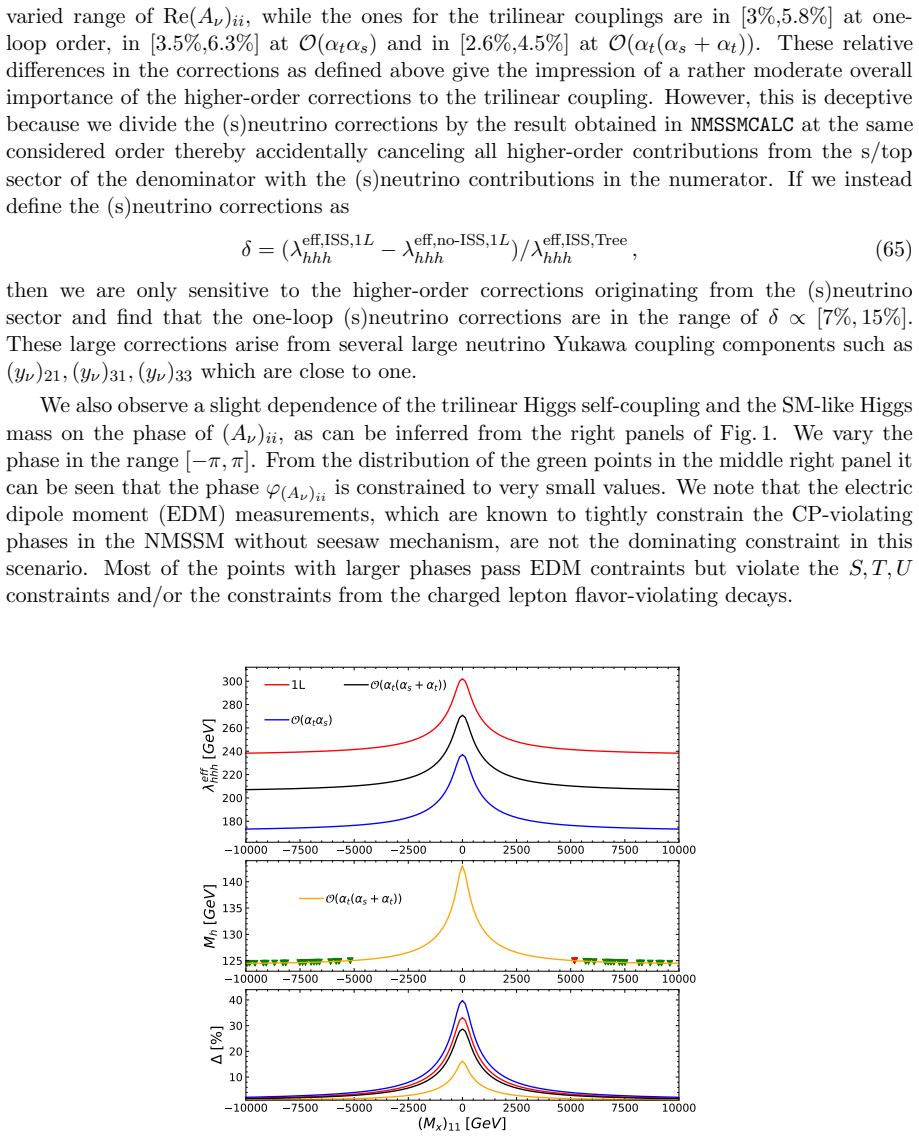
- [Sec. 4.1, Figs. 2 and 3, with Eq. (58)] The one-parameter variations around P1 show SM-like Higgs masses up to 143 GeV (Fig. 2) and relative corrections Δ up to about 40%, far above the 10.5% quoted for the scan. The caption labels green triangles as points satisfying all constraints, but points with Mh = 143 GeV cannot satisfy the 122–128 GeV window of Eq. (58). The text should explicitly distinguish points that pass the Higgs-mass/Higgs-signal constraints from those that do not, and should state that the headline 10.5% applies only to the scan points that satisfy Eq. (58). As written, the reader cannot tell whether the extreme Δ values are included in the claim.
minor comments (3)
- [Abstract and Sec. 5] The abstract quotes 'up to 10%' while Sec. 4.1 and the conclusions quote 10.5%; please unify the number.
- [Sec. 3.2] The effective couplings used for the numerical Δ are computed in the gaugeless limit and include only the (s)top and (s)neutrino one-loop contributions; the 'full one-loop' statement in the abstract would be clearer if it referred to the momentum-dependent calculation of Sec. 3.1 and the effective couplings were described as 'dominant one-loop' contributions.
- [Sec. 4.1] There is a typo 'In particuler' in the discussion of Fig. 3, and in Sec. 5 the phrase 'can reach reach 4.5%' contains a duplicated word.
Circularity Check
No significant circularity: the 10.5% (s)neutrino effect is a scan output, and the imported two-loop terms are independent of the ISS sector.
full rationale
The central claim is derived via Eq. 33 as tree-level plus one-loop NMSSM-nuSS corrections plus two-loop O(alpha_t alpha_s) and O(alpha_t^2) corrections imported from Refs. [76,77]. The one-loop ISS contribution is computed with new explicit diagrams in Eq. 54, carrying dependence on y_nu, lambda_X, M_X, A_nu and the sneutrino mixing matrices; it is not defined in terms of the final 10.5% or 4.5% numbers. The two-loop pieces were previously calculated for the CP-violating NMSSM without the inverse seesaw sector, contain none of the ISS parameters, and are embedded only in the sectors that are identical between the two models; they therefore cannot artificially generate the claimed ISS-induced shift. The quantity Delta in Eq. 64 is a ratio of two separate code outputs (NMSSMCALC-nuSS versus NMSSMCALC) at the same loop order, and the quoted maxima are outputs of a parameter scan subject to external Higgs, neutrino, lepton-flavor-violation, and oblique-parameter constraints; no parameter is fitted to the target 10.5% or 4.5% values. Self-citations to Refs. [51,52,76,77] are present and load-bearing as sources of the model setup, of the mass-calculation framework, and of the vanilla-NMSSM two-loop results, but those cited results do not assume or contain the claimed (s)neutrino-induced coupling shift, so they constitute independent support under their stated approximations. The paper is also transparent in Sec. 4.1 that the (s)neutrino sector enters only at one-loop order and that the two-loop corrections do not depend on neutrino parameters; this is a completeness caveat about omitted ISS-dependent two-loop contributions, not a circular step. No fitted-input-renamed-as-prediction, self-definitional, uniqueness-import, ansatz-by-citation, or known-result-renaming pattern is present.
Assumptions & free parameters
free parameters (2)
- Renormalization scale μ_R =
not specified (enters Eqs. (42)-(44) and (57))
- Scan bounds for (MX)ii, yν, Aν and other ISS parameters =
see Table 1
assumptions (5)
- domain assumption The NMSSM-nuSS superpotential Eq. (1) and soft terms Eq. (3) define the theory.
- domain assumption Inverse seesaw hierarchy |m_μX| << |m_MD| << |m_MX| is satisfied.
- ad hoc to paper Two-loop vanilla NMSSM corrections are valid in NMSSM-nuSS without (s)neutrino two-loop terms.
- domain assumption Effective THCs at zero external momentum in the gaugeless limit are a good approximation.
- domain assumption Mixed OS-DR renormalization scheme from [51] applies consistently to the THCs.
Cite this review
Pith. "Pith review of Loop-corrected Trilinear Higgs Self-Couplings in the NMSSM with Inverse Seesaw Mechanism." pith.science (2026). https://pith.science/paper/GFRMWNXJ
@misc{pith2026250602743,
  author       = {Pith},
  title        = {Pith review of: Loop-corrected Trilinear Higgs Self-Couplings in the NMSSM with Inverse Seesaw Mechanism},
  year         = {2026},
  howpublished = {\url{https://pith.science/paper/GFRMWNXJ}},
  note         = {Machine review of arXiv:2506.02743}
}
abstract
The higher-order corrections for the SM-like Higgs boson mass and the trilinear Higgs self-couplings in the Next-to-Minimal Supersymmetric extension of the Standard Model (NMSSM) with Inverse Seesaw Mechanism are significant and highly correlated. We present here the full one-loop corrections to the trilinear Higgs self-couplings supplemented by the dominant top-Yukawa and strong coupling induced two-loop corrections from our previous calculations in the complex NMSSM. These corrections are performed consistently with the corresponding Higgs boson mass corrections. We discuss in detail the new effects from the extended neutrino and sneutrino sectors on both the trilinear Higgs self-couplings and the SM-like Higgs boson mass. When compared to the case of the NMSSM without Inverse Seesaw Mechanism, the new effects can be up to 10\% for the effective SM-like trilinear Higgs self-couplings, and up to 4.5\% for the SM-like Higgs boson mass for valid parameter points, i.e. points satisfying the Higgs data, the neutrino data, the constraints from the charged lepton flavor-violating decays, and the new physics constraints from the oblique parameters $S, T, U$. The new corrections are also included in the Higgs-to-Higgs decays for the heavy Higgs states and implemented in the new version of the Fortran code NMSSMCALC-nuSS.
Figures


Figures from the paper (2 more)


Reference graph
Works this paper leans on
-
[1]
ATLAS collaboration, G. Aad et al., Observation of a new particle in the search for the Standard Model Higgs boson with the ATLAS detector at the LHC , Phys. Lett. B716 (2012) 1–29, [ 1207.7214]
arXiv 2012
-
[2]
CMS collaboration, S. Chatrchyan et al., Observation of a New Boson at a Mass of 125 GeV with the CMS Experiment at the LHC , Phys. Lett. B716 (2012) 30–61, [1207.7235]
arXiv 2012
-
[3]
ATLAS collaboration, G. Aad et al., A detailed map of Higgs boson interactions by the ATLAS experiment ten years after the discovery , Nature 607 (2022) 52–59, [2207.00092]
arXiv 2022
-
[4]
Tumasyan et al., A portrait of the Higgs boson by the CMS experiment ten years after the discovery
CMS collaboration, A. Tumasyan et al., A portrait of the Higgs boson by the CMS experiment ten years after the discovery. , Nature 607 (2022) 60–68, [ 2207.00043]
arXiv 2022
-
[5]
Fukuda et al., Evidence for oscillation of atmospheric neutrinos , Phys
Super-Kamiokande collaboration, Y. Fukuda et al., Evidence for oscillation of atmospheric neutrinos , Phys. Rev. Lett. 81 (1998) 1562–1567, [ hep-ex/9807003]
arXiv 1998
-
[6]
R. N. Mohapatra, Mechanism for Understanding Small Neutrino Mass in Superstring Theories, Phys. Rev. Lett. 56 (1986) 561–563
1986
-
[7]
R. N. Mohapatra and J. W. F. Valle, Neutrino Mass and Baryon Number Nonconservation in Superstring Models , Phys. Rev. D 34 (1986) 1642
1986
-
[8]
Golfand and E
Y. Golfand and E. Likhtman, Extension of the Algebra of Poincare Group Generators and Violation of p Invariance , JETP Lett. 13 (1971) 323–326
1971
Show all 123 references
-
[9]
D. V. Volkov and V. P. Akulov, Is the Neutrino a Goldstone Particle? , Phys. Lett. B 46 (1973) 109–110
1973
-
[10]
Wess and B
J. Wess and B. Zumino, Supergauge Transformations in Four-Dimensions, Nucl. Phys. B 70 (1974) 39–50
1974
-
[11]
Fayet, Supergauge Invariant Extension of the Higgs Mechanism and a Model for the electron and Its Neutrino , Nucl.Phys
P. Fayet, Supergauge Invariant Extension of the Higgs Mechanism and a Model for the electron and Its Neutrino , Nucl.Phys. B90 (1975) 104–124
1975
-
[12]
Fayet, Spontaneously Broken Supersymmetric Theories of Weak, Electromagnetic and Strong Interactions, Phys
P. Fayet, Spontaneously Broken Supersymmetric Theories of Weak, Electromagnetic and Strong Interactions, Phys. Lett. B 69 (1977) 489
1977
-
[13]
Fayet and S
P. Fayet and S. Ferrara, Supersymmetry, Phys. Rept. 32 (1977) 249–334
1977
-
[14]
H. P. Nilles, M. Srednicki and D. Wyler, Weak Interaction Breakdown Induced by Supergravity, Phys.Lett. B120 (1983) 346
1983
-
[15]
H. P. Nilles, Supersymmetry, Supergravity and Particle Physics , Phys. Rept. 110 (1984) 1–162. 23
1984
-
[16]
Frere, D
J. Frere, D. Jones and S. Raby, Fermion Masses and Induction of the Weak Scale by Supergravity, Nucl.Phys. B222 (1983) 11
1983
-
[17]
Derendinger and C
J. Derendinger and C. A. Savoy, Quantum Effects and SU(2) x U(1) Breaking in Supergravity Gauge Theories, Nucl.Phys. B237 (1984) 307
1984
-
[18]
H. E. Haber and G. L. Kane, The Search for Supersymmetry: Probing Physics Beyond the Standard Model , Phys.Rept. 117 (1985) 75–263
1985
-
[19]
Sohnius, Introducing Supersymmetry, Phys.Rept
M. Sohnius, Introducing Supersymmetry, Phys.Rept. 128 (1985) 39–204
1985
-
[20]
J. F. Gunion and H. E. Haber, Higgs Bosons in Supersymmetric Models. 1. , Nucl. Phys. B 272 (1986) 1
1986
-
[21]
J. F. Gunion and H. E. Haber, Higgs Bosons in Supersymmetric Models. 2. Implications for Phenomenology, Nucl. Phys. B 278 (1986) 449
1986
-
[22]
Slavich et al., Higgs-mass predictions in the MSSM and beyond , Eur
P. Slavich et al., Higgs-mass predictions in the MSSM and beyond , Eur. Phys. J. C 81 (2021) 450, [ 2012.15629]
2021 arXiv
-
[23]
E. A. R. Reyes and R. Fazio, High-Precision Calculations of the Higgs Boson Mass , Particles 5 (2022) 53–73, [ 2112.15295]
2022 arXiv
-
[24]
J. F. Gunion, H. E. Haber, G. L. Kane and S. Dawson, The Higgs Hunter’s Guide , vol. 80. 2000, 10.1201/9780429496448
2000 doi
-
[25]
S. P. Martin, A Supersymmetry primer , Adv. Ser. Direct. High Energy Phys. 18 (1998) 1–98, [hep-ph/9709356]
1998 arXiv
-
[26]
Dawson, The MSSM and why it works , in Theoretical Advanced Study Institute in Elementary Particle Physics (TASI 97): Supersymmetry, Supergravity and Supercolliders, pp
S. Dawson, The MSSM and why it works , in Theoretical Advanced Study Institute in Elementary Particle Physics (TASI 97): Supersymmetry, Supergravity and Supercolliders, pp. 261–339, 6, 1997. hep-ph/9712464
1997 arXiv
-
[27]
Djouadi, The Anatomy of electro-weak symmetry breaking
A. Djouadi, The Anatomy of electro-weak symmetry breaking. II. The Higgs bosons in the minimal supersymmetric model , Phys.Rept. 459 (2008) 1–241, [ hep-ph/0503173]
2008 arXiv
-
[28]
Heinemeyer, M
S. Heinemeyer, M. J. Herrero, S. Penaranda and A. M. Rodriguez-Sanchez, Higgs Boson Masses in the MSSM with Heavy Majorana Neutrinos , JHEP 05 (2011) 063, [1007.5512]
2011 arXiv
-
[29]
Draper and H
P. Draper and H. E. Haber, Decoupling of the Right-handed Neutrino Contribution to the Higgs Mass in Supersymmetric Models , Eur. Phys. J. C 73 (2013) 2522, [ 1304.6103]
2013 arXiv
-
[30]
E. J. Chun, V. S. Mummidi and S. K. Vempati, Anatomy of Higgs mass in Supersymmetric Inverse Seesaw Models , Phys. Lett. B 736 (2014) 470–477, [ 1405.5478]
2014 arXiv
-
[31]
Gogoladze, B
I. Gogoladze, B. He, A. Mustafayev, S. Raza and Q. Shafi, Effects of Neutrino Inverse Seesaw Mechanism on the Sparticle Spectrum in CMSSM and NUHM2 , JHEP 05 (2014) 078, [ 1401.8251]
2014 arXiv
-
[32]
Biek¨ otter, S
T. Biek¨ otter, S. Heinemeyer and C. Mu˜ noz,Precise prediction for the Higgs-boson masses in the µν SSM, Eur. Phys. J. C 78 (2018) 504, [ 1712.07475]. 24
2018 arXiv
-
[33]
Biek¨ otter, S
T. Biek¨ otter, S. Heinemeyer and C. Mu˜ noz,Precise prediction for the Higgs-Boson masses in the µν SSM with three right-handed neutrino superfields , Eur. Phys. J. C 79 (2019) 667, [ 1906.06173]
2019 arXiv
-
[34]
M. Dine, W. Fischler and M. Srednicki, A Simple Solution to the Strong CP Problem with a Harmless Axion , Phys.Lett. B104 (1981) 199
1981
-
[35]
Barbieri, S
R. Barbieri, S. Ferrara and C. A. Savoy, Gauge Models with Spontaneously Broken Local Supersymmetry, Phys.Lett. B119 (1982) 343
1982
-
[36]
J. R. Ellis, J. Gunion, H. E. Haber, L. Roszkowski and F. Zwirner, Higgs Bosons in a Nonminimal Supersymmetric Model , Phys.Rev. D39 (1989) 844
1989
-
[37]
Drees, Supersymmetric Models with Extended Higgs Sector , Int.J.Mod.Phys
M. Drees, Supersymmetric Models with Extended Higgs Sector , Int.J.Mod.Phys. A4 (1989) 3635
1989
-
[38]
Ellwanger, M
U. Ellwanger, M. Rausch de Traubenberg and C. A. Savoy, Particle spectrum in supersymmetric models with a gauge singlet , Phys.Lett. B315 (1993) 331–337, [hep-ph/9307322]
1993 arXiv
-
[39]
Ellwanger, M
U. Ellwanger, M. Rausch de Traubenberg and C. A. Savoy, Higgs phenomenology of the supersymmetric model with a gauge singlet , Z.Phys. C67 (1995) 665–670, [hep-ph/9502206]
1995 arXiv
-
[40]
Ellwanger, M
U. Ellwanger, M. Rausch de Traubenberg and C. A. Savoy, Phenomenology of supersymmetric models with a singlet , Nucl.Phys. B492 (1997) 21–50, [hep-ph/9611251]
1997 arXiv
-
[41]
Elliott, S
T. Elliott, S. King and P. White, Unification constraints in the next-to-minimal supersymmetric standard model, Phys.Lett. B351 (1995) 213–219, [ hep-ph/9406303]
1995 arXiv
-
[42]
King and P
S. King and P. White, Resolving the constrained minimal and next-to-minimal supersymmetric standard models, Phys.Rev. D52 (1995) 4183–4216, [ hep-ph/9505326]
1995 arXiv
-
[43]
Franke and H
F. Franke and H. Fraas, Neutralinos and Higgs bosons in the next-to-minimal supersymmetric standard model, Int.J.Mod.Phys. A12 (1997) 479–534, [hep-ph/9512366]
1997 arXiv
-
[44]
Maniatis, The Next-to-Minimal Supersymmetric extension of the Standard Model reviewed, Int
M. Maniatis, The Next-to-Minimal Supersymmetric extension of the Standard Model reviewed, Int. J. Mod. Phys. A25 (2010) 3505–3602, [ 0906.0777]
2010 arXiv
-
[45]
Ellwanger, C
U. Ellwanger, C. Hugonie and A. M. Teixeira, The Next-to-Minimal Supersymmetric Standard Model, Phys. Rept. 496 (2010) 1–77, [ 0910.1785]
2010 arXiv
-
[46]
Ellwanger, Phenomenological Aspects of the Next-to-Minimal Supersymmetric Standard Model, 0908.4231v1
U. Ellwanger, Phenomenological Aspects of the Next-to-Minimal Supersymmetric Standard Model, 0908.4231v1
-
[47]
Balazs, M
C. Balazs, M. Carena, A. Freitas and C. E. M. Wagner, Phenomenology of the nMSSM from Colliders to Cosmology , JHEP 06 (2007) 066, [ 0705.0431]
2007 arXiv
-
[48]
Gogoladze, N
I. Gogoladze, N. Okada and Q. Shafi, NMSSM and Seesaw Physics at LHC , Phys. Lett. B672 (2009) 235–239, [ 0809.0703]. 25
2009 arXiv
-
[49]
Gogoladze, B
I. Gogoladze, B. He and Q. Shafi, Inverse Seesaw in NMSSM and 126 GeV Higgs Boson , Phys. Lett. B718 (2013) 1008–1013, [ 1209.5984]
2013 arXiv
-
[50]
W. Wang, J. M. Yang and L. L. You, Higgs boson mass in NMSSM with right-handed neutrino, JHEP 07 (2013) 158, [ 1303.6465]
2013 arXiv
-
[51]
T. N. Dao, M. M¨ uhlleitner and A. V. Phan, Loop-corrected Higgs masses in the NMSSM with inverse seesaw mechanism , Eur. Phys. J. C 82 (2022) 667, [ 2108.10088]
2022 arXiv
-
[52]
T. N. Dao, D. N. Le and M. M¨ uhlleitner, Leptonic anomalous magnetic and electric dipole moments in the CP-violating NMSSM with and without inverse seesaw mechanism, Eur. Phys. J. C 82 (2022) 954, [ 2207.12618]
2022
-
[53]
Djouadi, W
A. Djouadi, W. Kilian, M. Muhlleitner and P. M. Zerwas, Testing Higgs selfcouplings at e+ e- linear colliders , Eur. Phys. J. C 10 (1999) 27–43, [ hep-ph/9903229]
1999 arXiv
-
[54]
Djouadi, W
A. Djouadi, W. Kilian, M. Muhlleitner and P. M. Zerwas, Production of neutral Higgs boson pairs at LHC , Eur. Phys. J. C 10 (1999) 45–49, [ hep-ph/9904287]
1999 arXiv
-
[55]
M. M. Muhlleitner, Higgs particles in the standard model and supersymmetric theories . PhD thesis, Hamburg U., 2000. hep-ph/0008127
2000 arXiv
-
[56]
Alison et al., Higgs boson potential at colliders: Status and perspectives , Rev
J. Alison et al., Higgs boson potential at colliders: Status and perspectives , Rev. Phys. 5 (2020) 100045, [ 1910.00012]
2020 arXiv
-
[57]
Aad et al., Combination of searches for Higgs boson pair production in pp collisions at √s = 13 TeV with the ATLAS detector , 2406.09971
ATLAS collaboration, G. Aad et al., Combination of searches for Higgs boson pair production in pp collisions at √s = 13 TeV with the ATLAS detector , 2406.09971
-
[58]
Abouabid, A
H. Abouabid, A. Arhrib, D. Azevedo, J. E. Falaki, P. M. Ferreira, M. M¨ uhlleitner et al., Benchmarking di-Higgs production in various extended Higgs sector models , JHEP 09 (2022) 011, [ 2112.12515]
2022 arXiv
-
[59]
ATLAS collaboration, HL-LHC prospects for the measurement of Higgs boson pair production in the b¯bb¯b final state and combination with the b¯bγγ and b¯bτ +τ − final states at the ATLAS experiment , , CERN, Geneva, 2022
2022
-
[60]
C. F. D¨ urig,Measuring the Higgs Self-coupling at the International Linear Collider . PhD thesis, Hamburg U., Hamburg, 2016. 10.3204/PUBDB-2016-04283
2016 doi
-
[61]
Abramowicz et al., Higgs physics at the CLIC electron–positron linear collider , Eur
H. Abramowicz et al., Higgs physics at the CLIC electron–positron linear collider , Eur. Phys. J. C 77 (2017) 475, [ 1608.07538]
2017 arXiv
-
[62]
Roloff, U
CLICdp collaboration, P. Roloff, U. Schnoor, R. Simoniello and B. Xu, Double Higgs boson production and Higgs self-coupling extraction at CLIC , Eur. Phys. J. C 80 (2020) 1010, [1901.05897]
2020 arXiv
-
[63]
M. L. Mangano, G. Ortona and M. Selvaggi, Measuring the Higgs self-coupling via Higgs-pair production at a 100 TeV p-p collider , Eur. Phys. J. C 80 (2020) 1030, [2004.03505]
2020 arXiv
-
[64]
F. Arco, S. Heinemeyer, M. M¨ uhlleitner and K. Radchenko, Sensitivity to triple Higgs couplings via di-Higgs production in the 2HDM at the (HL-)LHC , Eur. Phys. J. C 83 (2023) 1019, [ 2212.11242]. 26
2023 arXiv
-
[65]
Heinemeyer, M
S. Heinemeyer, M. M¨ uhlleitner, K. Radchenko and G. Weiglein,Higgs Pair Production in the 2HDM: Impact of Loop Corrections to the Trilinear Higgs Couplings and Interference Effects on Experimental Limits , 2403.14776
-
[66]
Feuerstake, E
F. Feuerstake, E. Fuchs, T. Robens and D. Winterbottom, Interference effects in resonant di-Higgs production at the LHC in the Higgs singlet extension , 2409.06651
-
[67]
Hollik and S
W. Hollik and S. Penaranda, Yukawa coupling quantum corrections to the selfcouplings of the lightest MSSM Higgs boson , Eur. Phys. J. C 23 (2002) 163–172, [ hep-ph/0108245]
2002 arXiv
-
[68]
Senaha, Radiative Corrections to Triple Higgs Coupling and Electroweak Phase Transition: Beyond One-loop Analysis , Phys
E. Senaha, Radiative Corrections to Triple Higgs Coupling and Electroweak Phase Transition: Beyond One-loop Analysis , Phys. Rev. D 100 (2019) 055034, [ 1811.00336]
2019 arXiv
-
[69]
Braathen and S
J. Braathen and S. Kanemura, On two-loop corrections to the Higgs trilinear coupling in models with extended scalar sectors , Phys. Lett. B 796 (2019) 38–46, [ 1903.05417]
2019 arXiv
-
[70]
V. D. Barger, M. S. Berger, A. L. Stange and R. J. N. Phillips, Supersymmetric Higgs boson hadroproduction and decays including radiative corrections , Phys. Rev. D 45 (1992) 4128–4147
1992
-
[71]
Dobado, M
A. Dobado, M. J. Herrero, W. Hollik and S. Penaranda, Selfinteractions of the lightest MSSM Higgs boson in the large pseudoscalar mass limit , Phys. Rev. D 66 (2002) 095016, [hep-ph/0208014]
2002 arXiv
-
[72]
K. E. Williams and G. Weiglein, Precise predictions for ha → hbhc decays in the complex MSSM, Phys. Lett. B660 (2008) 217–227, [ 0710.5320]
2008 arXiv
-
[73]
K. E. Williams, H. Rzehak and G. Weiglein, Higher order corrections to Higgs boson decays in the MSSM with complex parameters , Eur. Phys. J. C 71 (2011) 1669, [1103.1335]
2011 arXiv
-
[74]
Brucherseifer, R
M. Brucherseifer, R. Gavin and M. Spira, Minimal supersymmetric Higgs boson self-couplings: Two-loop O(αtαs) corrections, Phys. Rev. D 90 (2014) 117701, [1309.3140]
2014 arXiv
-
[75]
D. T. Nhung, M. Muhlleitner, J. Streicher and K. Walz, Higher Order Corrections to the Trilinear Higgs Self-Couplings in the Real NMSSM , JHEP 11 (2013) 181, [ 1306.3926]
2013 arXiv
-
[76]
M¨ uhlleitner, D
M. M¨ uhlleitner, D. T. Nhung and H. Ziesche, The order O (αtαs) corrections to the trilinear Higgs self-couplings in the complex NMSSM , JHEP 12 (2015) 034, [1506.03321]
2015 arXiv
-
[77]
Borschensky, T
C. Borschensky, T. N. Dao, M. Gabelmann, M. M¨ uhlleitner and H. Rzehak, The trilinear Higgs self-couplings at O(α2 t ) in the CP-violating NMSSM , Eur. Phys. J. C 83 (2023) 118, [2210.02104]
2023 arXiv
-
[78]
Baglio, T
J. Baglio, T. N. Dao and M. M¨ uhlleitner, One-Loop Corrections to the Two-Body Decays of the Neutral Higgs Bosons in the Complex NMSSM , 1907.12060
1907 arXiv
-
[79]
Kanemura, S
S. Kanemura, S. Kiyoura, Y. Okada, E. Senaha and C. P. Yuan, New physics effect on the Higgs selfcoupling , Phys. Lett. B 558 (2003) 157–164, [ hep-ph/0211308]
2003 arXiv
-
[80]
Kanemura, Y
S. Kanemura, Y. Okada, E. Senaha and C. P. Yuan, Higgs coupling constants as a probe of new physics , Phys. Rev. D 70 (2004) 115002, [ hep-ph/0408364]. 27
2004 arXiv
-
[81]
Kanemura, M
S. Kanemura, M. Kikuchi and K. Yagyu, Fingerprinting the extended Higgs sector using one-loop corrected Higgs boson couplings and future precision measurements , Nucl. Phys. B 896 (2015) 80–137, [ 1502.07716]
2015 arXiv
-
[82]
Kanemura, M
S. Kanemura, M. Kikuchi, K. Sakurai and K. Yagyu, Gauge invariant one-loop corrections to Higgs boson couplings in non-minimal Higgs models , Phys. Rev. D 96 (2017) 035014, [ 1705.05399]
2017 arXiv
-
[83]
Basler, M
P. Basler, M. M¨ uhlleitner and J. Wittbrodt,The CP-Violating 2HDM in Light of a Strong First Order Electroweak Phase Transition and Implications for Higgs Pair Production, JHEP 03 (2018) 061, [ 1711.04097]
2018 arXiv
-
[84]
Basler and M
P. Basler and M. M¨ uhlleitner,BSMPT (Beyond the Standard Model Phase Transitions): A tool for the electroweak phase transition in extended Higgs sectors , Comput. Phys. Commun. 237 (2019) 62–85, [ 1803.02846]
2019 arXiv
-
[85]
Basler, M
P. Basler, M. M¨ uhlleitner and J. M¨ uller,Electroweak Phase Transition in Non-Minimal Higgs Sectors, JHEP 05 (2020) 016, [ 1912.10477]
2020 arXiv
-
[86]
Basler, M
P. Basler, M. M¨ uhlleitner and J. M¨ uller,BSMPT v2 a tool for the electroweak phase transition and the baryon asymmetry of the universe in extended Higgs Sectors , Comput. Phys. Commun. 269 (2021) 108124, [ 2007.01725]
2021 arXiv
-
[87]
Basler, L
P. Basler, L. Biermann, M. M¨ uhlleitner, J. M¨ uller, R. Santos and J. a. Viana,BSMPT v3 A Tool for Phase Transitions and Primordial Gravitational Waves in Extended Higgs Sectors, 2404.19037
-
[88]
Braathen and S
J. Braathen and S. Kanemura, Leading two-loop corrections to the Higgs boson self-couplings in models with extended scalar sectors , Eur. Phys. J. C 80 (2020) 227, [1911.11507]
2020 arXiv
-
[89]
H. Bahl, J. Braathen and G. Weiglein, New Constraints on Extended Higgs Sectors from the Trilinear Higgs Coupling , Phys. Rev. Lett. 129 (2022) 231802, [ 2202.03453]
2022 arXiv
-
[90]
H. Bahl, J. Braathen, M. Gabelmann and G. Weiglein, anyH3: precise predictions for the trilinear Higgs coupling in the Standard Model and beyond , Eur. Phys. J. C 83 (2023) 1156, [2305.03015]
2023 arXiv
-
[91]
H. Bahl, J. Braathen, M. Gabelmann and S. Paßehr, Generic two-loop results for trilinear and quartic scalar self-interactions , 2503.15645
-
[92]
Krause, R
M. Krause, R. Lorenz, M. Muhlleitner, R. Santos and H. Ziesche, Gauge-independent Renormalization of the 2-Higgs-Doublet Model , JHEP 09 (2016) 143, [ 1605.04853]
2016 arXiv
-
[93]
Bojarski, G
F. Bojarski, G. Chalons, D. Lopez-Val and T. Robens, Heavy to light Higgs boson decays at NLO in the Singlet Extension of the Standard Model , JHEP 02 (2016) 147, [1511.08120]
2016 arXiv
-
[94]
Krause, D
M. Krause, D. Lopez-Val, M. Muhlleitner and R. Santos, Gauge-independent Renormalization of the N2HDM , JHEP 12 (2017) 077, [ 1708.01578]. 28
2017 arXiv
-
[95]
Krause, M
M. Krause, M. M¨ uhlleitner and M. Spira, 2HDECAY —A program for the calculation of electroweak one-loop corrections to Higgs decays in the Two-Higgs-Doublet Model including state-of-the-art QCD corrections , Comput. Phys. Commun. 246 (2020) 106852, [1810.00768]
2020 arXiv
-
[96]
Denner, S
A. Denner, S. Dittmaier and J.-N. Lang, Renormalization of mixing angles , JHEP 11 (2018) 104, [ 1808.03466]
2018 arXiv
-
[97]
Krause and M
M. Krause and M. M¨ uhlleitner,ewN2HDECAY - A program for the Calculation of Electroweak One-Loop Corrections to Higgs Decays in the Next-to-Minimal Two-Higgs-Doublet Model Including State-of-the-Art QCD Corrections , Comput. Phys. Commun. 247 (2020) 106924, [ 1904.02103]
2020 arXiv
-
[98]
Krause and M
M. Krause and M. M¨ uhlleitner,Impact of Electroweak Corrections on Neutral Higgs Boson Decays in Extended Higgs Sectors , JHEP 04 (2020) 083, [ 1912.03948]
2020 arXiv
-
[99]
Azevedo, P
D. Azevedo, P. Gabriel, M. Muhlleitner, K. Sakurai and R. Santos, One-loop corrections to the Higgs boson invisible decay in the dark doublet phase of the N2HDM , JHEP 10 (2021) 044, [ 2104.03184]
2021 arXiv
-
[100]
F. Egle, M. M¨ uhlleitner, R. Santos and J. a. Viana, One-loop Corrections to the Higgs Boson Invisible Decay in a Complex Singlet Extension of the SM , 2202.04035
-
[101]
M. D. Goodsell, S. Liebler and F. Staub, Generic calculation of two-body partial decay widths at the full one-loop level , Eur. Phys. J. C77 (2017) 758, [ 1703.09237]
2017 arXiv
-
[102]
Baglio and C
J. Baglio and C. Weiland, Heavy neutrino impact on the triple Higgs coupling , Phys. Rev. D 94 (2016) 013002, [ 1603.00879]
2016 arXiv
-
[103]
Baglio and C
J. Baglio and C. Weiland, The triple Higgs coupling: A new probe of low-scale seesaw models, JHEP 04 (2017) 038, [ 1612.06403]
2017 arXiv
-
[104]
T. N. Dao, R. Gr¨ ober, M. Krause, M. M¨ uhlleitner and H. Rzehak,Two-Loop O(α2 t ) Corrections to the Neutral Higgs Boson Masses in the CP-Violating NMSSM , 1903.11358
1903 arXiv
-
[105]
J. A. Casas and A. Ibarra, Oscillating neutrinos and µ → eγ, Nucl. Phys. B618 (2001) 171–204, [hep-ph/0103065]
2001 arXiv
-
[106]
Arganda, M
E. Arganda, M. J. Herrero, X. Marcano and C. Weiland, Imprints of massive inverse seesaw model neutrinos in lepton flavor violating Higgs boson decays , Phys. Rev. D 91 (2015) 015001, [ 1405.4300]
2015 arXiv
-
[107]
Plehn, M
T. Plehn, M. Spira and P. M. Zerwas, Pair production of neutral Higgs particles in gluon-gluon collisions , Nucl. Phys. B 479 (1996) 46–64, [ hep-ph/9603205]
1996 arXiv
-
[108]
Dawson, S
S. Dawson, S. Dittmaier and M. Spira, Neutral Higgs boson pair production at hadron colliders: QCD corrections , Phys. Rev. D 58 (1998) 115012, [ hep-ph/9805244]
1998 arXiv
-
[109]
F. Arco, S. Heinemeyer and M. M¨ uhlleitner, Large One-Loop Effects of BSM Triple Higgs Couplings on Double Higgs Production at e+e− Colliders, 2505.02947
-
[110]
Kublbeck, M
J. Kublbeck, M. Bohm and A. Denner, Feyn Arts: Computer Algebraic Generation of Feynman Graphs and Amplitudes , Comput.Phys.Commun. 60 (1990) 165–180. 29
1990
-
[111]
Hahn, Generating Feynman diagrams and amplitudes with FeynArts 3 , Comput.Phys.Commun
T. Hahn, Generating Feynman diagrams and amplitudes with FeynArts 3 , Comput.Phys.Commun. 140 (2001) 418–431, [ hep-ph/0012260]
2001 arXiv
-
[112]
Hahn and M
T. Hahn and M. Perez-Victoria, Automatized one loop calculations in four-dimensions and D-dimensions , Comput. Phys. Commun. 118 (1999) 153–165, [ hep-ph/9807565]
1999 arXiv
-
[113]
Elias-Miro, J
J. Elias-Miro, J. R. Espinosa and T. Konstandin, Taming Infrared Divergences in the Effective Potential, JHEP 08 (2014) 034, [ 1406.2652]
2014 arXiv
-
[114]
S. P. Martin, Taming the Goldstone contributions to the effective potential , Phys. Rev. D 90 (2014) 016013, [ 1406.2355]
2014 arXiv
-
[115]
Kumar and S
N. Kumar and S. P. Martin, Resummation of Goldstone boson contributions to the MSSM effective potential , Phys. Rev. D 94 (2016) 014013, [ 1605.02059]
2016 arXiv
-
[116]
Braathen and M
J. Braathen and M. D. Goodsell, Avoiding the Goldstone Boson Catastrophe in general renormalisable field theories at two loops , JHEP 12 (2016) 056, [ 1609.06977]
2016 arXiv
-
[117]
Braathen, M
J. Braathen, M. D. Goodsell and F. Staub, Supersymmetric and non-supersymmetric models without catastrophic Goldstone bosons , Eur. Phys. J. C 77 (2017) 757, [1706.05372]
2017 arXiv
-
[118]
Particle Data Groupcollaboration, R. L. Workman et al., Review of Particle Physics, PTEP 2022 (2022) 083C01
2022
-
[119]
H. Bahl, T. Biek¨ otter, S. Heinemeyer, C. Li, S. Paasch, G. Weiglein et al., HiggsTools: BSM scalar phenomenology with new versions of HiggsBounds and HiggsSignals , Comput. Phys. Commun. 291 (2023) 108803, [ 2210.09332]
2023 arXiv
-
[120]
Bechtle, D
P. Bechtle, D. Dercks, S. Heinemeyer, T. Klingl, T. Stefaniak, G. Weiglein et al., HiggsBounds-5: Testing Higgs Sectors in the LHC 13 TeV Era , 2006.06007
2006 arXiv
-
[121]
Bechtle, S
P. Bechtle, S. Heinemeyer, T. Klingl, T. Stefaniak, G. Weiglein and J. Wittbrodt, HiggsSignals-2: Probing new physics with precision Higgs measurements in the LHC 13 TeV era, Eur. Phys. J. C 81 (2021) 145, [ 2012.09197]
2021 arXiv
-
[122]
Shang and Y
L. Shang and Y. Zhang, EasyScan HEP: A tool for connecting programs to scan the parameter space of physics models , Comput. Phys. Commun. 296 (2024) 109027, [2304.03636]
2024 arXiv
-
[123]
M¨ uhlleitner, D
M. M¨ uhlleitner, D. T. Nhung, H. Rzehak and K. Walz, Two-loop contributions of the order O (αtαs) to the masses of the Higgs bosons in the CP-violating NMSSM , JHEP 05 (2015) 128, [ 1412.0918]. 30 1.5 1.0 0.5 0.0 0.5 1.0 1.5 180 200 220 240 260hhh [GeV] 1L ( t s) ( t( s + t))...
2015 arXiv
Reviewed August 7, 2026 · model on record in the stance chip above.
Discussion (0). Sign in to comment.