REVIEW 4 major objections 5 minor 3 cited by
RobustSplat: Decoupling Densification and Dynamics for Transient-Free 3DGS
T0 review · 4 major / 5 minor · reviewed 2026-08-07 · deepseek-v4-flash
Pith's one-line read Postponing Gaussian densification to iteration 10,000, with a transient mask first supervised at low resolution and then at high resolution, yields the best distractor-free 3D Gaussian Splatting reconstructions on the NeRF On-the-go…
desk verdict Delayed densification plus coarse-to-fine mask supervision is a simple, plausible recipe that beats current 3DGS baselines on transient scenes, though test-set-tuned hyperparameters and no error bars mean the causal story isn't nailed down. read the letter →
The pith
A machine-rendered reading of the paper's core claim, the machinery that carries it, and where it could break.
The reading
What carries the argument
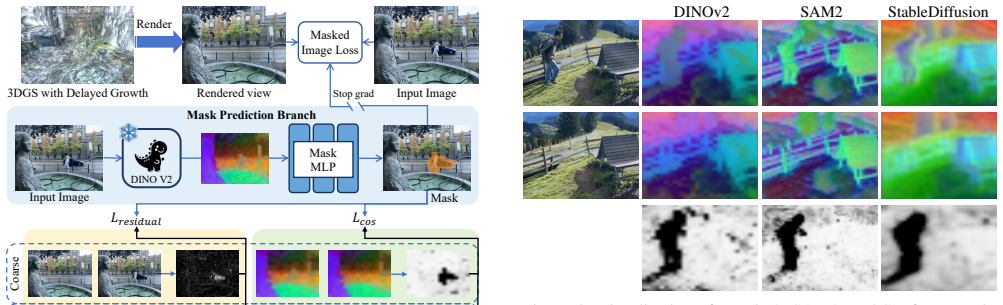
Two scheduling mechanisms carry the argument. Delayed Gaussian growth moves the start of 3DGS adaptive density control from iteration 500 to iteration 10,000 (with pruning and opacity reset shifted to match), so early optimization adjusts the color and shape of existing Gaussians without spawning new primitives that could encode transient objects. Scale-cascaded mask bootstrapping is a curriculum for the transient mask MLP, a two-layer network conditioned on DINOv2 features: it is supervised first by image residuals and the cosine similarity between rendered and captured DINOv2 features at 224×224 resolution, then switched to 504×504 once densification starts, exploiting the fact that low-resolution feature patches cover broader context and are less sensitive to local noise. Together they break the negative feedback loop in which an under-reconstructed static scene mislabels its own smooth regions as transient, which then blocks those regions from ever being reconstructed.
What would settle it
Hand-label the transient objects in a NeRF On-the-go scene, then measure the mask MLP's IoU against those labels during the first 10,000 iterations under low-resolution versus high-resolution supervision with all other settings fixed; if the low-resolution version does not reduce false positives on under-reconstructed static regions, the scale cascade is not doing the claimed work. A second decisive test is a scene where a transient object stays nearly stationary for most of the training frames: under delayed densification that object may be absorbed into static structure before the mask can filter it, and the final rendering would keep it rather than remove it.
Extended reading notes
Core claim
The paper's discovery is a coupling between Gaussian densification and transient-object fitting: densification is what converts moving objects from a mild per-frame inconsistency into persistent 3D artifacts. In vanilla 3DGS, adaptive density control begins at iteration 500, and as training proceeds the newly split and cloned Gaussians increasingly reproduce the transient content in each view, which is why quality degrades over time rather than improving. Disabling densification entirely removes the artifacts and matches a purpose-built robust method, but leaves scenes blurry where the initial SfM point cloud is sparse. RobustSplat therefore keeps densification but delays it to iteration 10,000, and pairs this with a scale-cascaded mask bootstrapping scheme: the mask MLP is first trained on low-resolution image residuals and DINOv2 feature similarity, which integrate broader context and suppress local noise, and then on high-resolution supervision once densification begins, which recovers fine mask boundaries. The paper reports that this combination achieves the best PSNR, SSIM, and LPIPS on all six standard NeRF On-the-go scenes and the best averages on RobustNeRF and NeRF On-the-go II when compared with SpotLessSplats, WildGaussians, Robust3DGaussians, and T-3DGS.
Load-bearing premise
The load-bearing premise is that cosine similarity between DINOv2 features of the rendered and the real image is a reliable and transferable signal for where transient objects are, and specifically that low-resolution features give more robust supervision than high-resolution features during early training; if low-resolution supervision does not actually suppress noise, or the fixed 224-to-504 schedule does not transfer across scenes, the mask will misclassify static regions and the delayed-growth schedule alone will not deliver the reported gains.
Editorial extensions
If this is right
- On unstructured photo collections with moving people or vehicles, a robust 3DGS pipeline can be obtained by changing the densification schedule instead of adding a heavier segmentation or uncertainty network: postponing growth and delaying the opacity reset capture most of the gain.
- The densification start iteration is shown in the paper's ablations to be a first-order design choice: starts at 10,000 iterations beat starts at 500, 2,000, and 5,000 both with and without mask learning.
- Mask supervision resolution acts as a robustness-versus-precision knob, and a coarse-to-fine schedule gives the mask MLP a training curriculum that avoids early misclassification of static regions as transient.
- The two schedules attach to the existing feature-based mask paradigm, so they can be used with other feature extractors (the paper tests SAM2 and Stable Diffusion features with a modest drop in performance) rather than being tied to DINOv2 specifically.
- The gains come without added per-iteration cost: training runs at roughly 15 minutes per scene on an RTX 3090, faster than the WildGaussians and SpotLessSplats baselines it outperforms.
Reading between the lines
- The diagnosis generalizes beyond 3DGS: in any adaptive representation where new capacity is allocated based on current reconstruction error, premature capacity allocation can encode outliers before the consensus structure is known, so deferring allocation may be a general robustness lever for neural rendering.
- The fixed 224-to-504 switch is a discrete version of a supervision-noise curriculum; a natural extension is to tie the switch to measured reconstruction error or to fade resolution continuously rather than stepping it.
- If the proposed mechanism is the true cause, the benefit of delayed growth should scale with the fraction and motion of transient content; on nearly static scenes it should neither help nor hurt much, which is a cheap experiment that would confirm or stress the mechanism.
- Because the mask signal is DINOv2 cosine similarity, the method inherits DINOv2's blind spots, such as consistent failures on rare or unusual objects; ensembling two feature sources might close that gap, but the paper only tests alternatives as single replacements.
Editorial analysis
A structured set of objections, weighed in public.
Referee Report
Summary. The paper identifies the densification stage of 3D Gaussian Splatting as a source of transient-object artifacts and proposes RobustSplat, which (i) postpones Gaussian densification to iteration 10,000 and (ii) supervises a transient-mask MLP with progressively increasing resolution of DINOv2 feature-similarity and residual losses. The method is evaluated on NeRF On-the-go, RobustNeRF, and a harder On-the-go II variant, reporting best average PSNR/SSIM/LPIPS and consistent qualitative improvements.
Significance. If validated, the delayed-growth insight is a simple and transferable design principle for distractor-free 3DGS. The paper includes extensive comparisons against four recent baselines and ablations of each component. However, the current evidence leaves open the possibility that the reported gains come from test-set hyperparameter selection rather than from the delayed-growth mechanism itself; the recommended experiments are feasible within the paper's scope.
major comments (4)
- [Section 3.3, Fig. 5; Section 4.1, Table 1] The densification start iteration is chosen by sweeping over the same six NeRF On-the-go scenes that are later used as the evaluation benchmark (Table 1). The 10K value is therefore a test-set-tuned hyperparameter, and the statement that 'delayed Gaussian growth' is causally responsible for the gains is not yet supported. Please provide a validation split, leave-one-scene-out analysis, or cross-dataset transfer evidence, and report multi-run statistics with error bars.
- [Section 4.3, Table 2; Supplementary B] The ablation labeled 'Delayed Gaussian Growth' (DG) changes three optimization aspects at once: densification start (500 to 10K), opacity reset start (3000 to 15,000), and pruning start (to 10,000). The reported DG improvement therefore conflates the effect of densification timing with changes in opacity reset and pruning. Please isolate the densification start by holding opacity reset and pruning at original values (or by ablating each change separately).
- [Section 3.4, Table 2] The ablation for mask bootstrapping (MB) removes the coarse-to-fine supervision completely; it does not test the paper's specific claim that lower-resolution feature similarity is more robust and that a progressive schedule is beneficial. A comparison among constant low-resolution, constant high-resolution, and different switch iterations/resolution pairs is needed to substantiate Fig. 6 and the design in Eqs. (4)-(5).
- [Section 1, Fig. 2] The motivating observation that disabling densification in vanilla 3DGS 'yields results comparable to SpotLessSplats' is presented for a single scene without quantitative metrics. This claim is the basis for the delayed-growth design; please provide a per-scene table with PSNR/SSIM/LPIPS for 3DGS without densification.
minor comments (5)
- [Section 2] The word 'trainsient' should be 'transient'.
- [Eq. (7) and surrounding text] The phrase 'the right term is 1 if i = 0' is unclear; the term e^{-i/beta_reg} equals 1 at i=0, but the sentence as written could be read as referring to ||1-M_t||.
- [Supplementary Table S1] The runtime table does not include Robust3DGaussians and T-3DGS; please add them or state why they are omitted for parity with the main comparison.
- [Fig. 3 caption] The caption does not explain the 'Coarse/Fine' annotation; please clarify how it maps to the scale-cascaded supervision.
- [Section 4.3, Table 4] The upper and lower parts of Table 4 share the same caption; consider separating them for readability.
Circularity Check
No significant circularity: the paper is an empirical training-method comparison, not a derivation that reduces to its own inputs.
full rationale
RobustSplat is an empirically evaluated training procedure rather than a derivation that fits target constants and then re-predicts them. The central claims, namely that delaying Gaussian densification reduces transient-object artifacts and that coarse-to-fine mask supervision improves early mask estimation, are supported by controlled ablations on standard benchmarks using external baselines. I looked for the specific circularity patterns: there is no equation in the paper where a predicted quantity is defined in terms of the very quantity it is supposed to predict; no fitted parameter is renamed as a prediction; and no load-bearing argument rests on a self-citation chain. The densification start iteration (10K) and other hyperparameters were evidently selected with reference to the evaluated benchmark scenes (Fig. 5 and Implementation Details), which is a model-selection and generalization concern, not a definitional or constructional circularity under the stated rubric. The one co-authored reference in the bibliography is a related-work citation and is not load-bearing. The paper even states its own limitation regarding illumination changes, and that limitation does not reveal any circular dependence. Under the rules requiring a specific quoted reduction before flagging circularity, the honest finding is that the paper is not circular.
Assumptions & free parameters
free parameters (11)
- delayed_densification_start =
10000 iterations
- opacity_reset_start =
15000 iterations
- mask_regularization_weight_lambda_reg =
2.0
- mask_regularization_decay_beta_reg =
2000
- residual_loss_weight_lambda_residual =
0.5
- feature_loss_weight_lambda_cos =
0.5
- low_resolution_feature_size =
224x224
- high_resolution_feature_size =
504x504
- image_downsampling_factor =
8 (4 for arcdetriomphe and patio)
- low_resolution_residual_downsample =
4
- mask_dilation_kernel_size =
7
assumptions (5)
- domain assumption Standard 3DGS optimization with Adam converges to a good static reconstruction when transient regions are masked out.
- domain assumption DINOv2 ViT-S/14 features are semantically consistent under rendering and robust to local noise.
- domain assumption Low-resolution features provide more robust mask supervision than high-resolution features in early training.
- domain assumption The robust residual loss bounds (tau_u=0.6, tau_l=0.8) from SpotLessSplats transfer directly to this training pipeline.
- domain assumption Manually excluding moving objects from test images in On-the-go II yields a fair and unbiased metric.
Cite this review
Pith. "Pith review of RobustSplat: Decoupling Densification and Dynamics for Transient-Free 3DGS." pith.science (2026). https://pith.science/paper/3L5KMGI6
@misc{pith2026250602751,
  author       = {Pith},
  title        = {Pith review of: RobustSplat: Decoupling Densification and Dynamics for Transient-Free 3DGS},
  year         = {2026},
  howpublished = {\url{https://pith.science/paper/3L5KMGI6}},
  note         = {Machine review of arXiv:2506.02751}
}
read the original abstract
3D Gaussian Splatting (3DGS) has gained significant attention for its real-time, photo-realistic rendering in novel-view synthesis and 3D modeling. However, existing methods struggle with accurately modeling scenes affected by transient objects, leading to artifacts in the rendered images. We identify that the Gaussian densification process, while enhancing scene detail capture, unintentionally contributes to these artifacts by growing additional Gaussians that model transient disturbances. To address this, we propose RobustSplat, a robust solution based on two critical designs. First, we introduce a delayed Gaussian growth strategy that prioritizes optimizing static scene structure before allowing Gaussian splitting/cloning, mitigating overfitting to transient objects in early optimization. Second, we design a scale-cascaded mask bootstrapping approach that first leverages lower-resolution feature similarity supervision for reliable initial transient mask estimation, taking advantage of its stronger semantic consistency and robustness to noise, and then progresses to high-resolution supervision to achieve more precise mask prediction. Extensive experiments on multiple challenging datasets show that our method outperforms existing methods, clearly demonstrating the robustness and effectiveness of our method. Our project page is https://fcyycf.github.io/RobustSplat/.
Figures


Figures from the paper (5 more)


Forward citations
Cited by 3 Pith papers
-
Rectifying Mask via Entropy for Distractor-Free 3DGS in Ambiguous Scenarios
RefineSplat removes ambiguous distractors from 3DGS via entropy-aware adaptive masking and density control, releasing an 18-scene Ambiguous wild dataset and reporting SOTA metrics on multiple wild benchmarks.
-
Difix3D-W: Distractor-Free Few-Shot 3D Gaussian Splatting in the Wild
A new sparse-view 3D Gaussian splatting method for unconstrained scenes with distractors combines diffusion-based reference-guided refinement and sparsity-aware Gaussian replication to achieve better rendering quality.
-
SwiftGS: Episodic Priors for Immediate Satellite Surface Recovery
SwiftGS uses episodic meta-training to predict geometry-radiation-decoupled Gaussian primitives and a lightweight SDF for zero-shot 3D satellite surface reconstruction with physics-aware rendering.
Reference graph
Works this paper leans on
-
[1]
Distractor- free generalizable 3d gaussian splatting
Yanqi Bao, Jing Liao, Jing Huo, and Yang Gao. Distractor- free generalizable 3d gaussian splatting. arXiv preprint arXiv:2411.17605, 2024. 3
arXiv 2024
-
[2]
Mip-nerf 360: Unbounded anti-aliased neural radiance fields
Jonathan T Barron, Ben Mildenhall, Dor Verbin, Pratul P Srinivasan, and Peter Hedman. Mip-nerf 360: Unbounded anti-aliased neural radiance fields. In CVPR, 2022. 3
work page 2022
-
[3]
Revising densification in gaussian splatting
Samuel Rota Bul `o, Lorenzo Porzi, and Peter Kontschieder. Revising densification in gaussian splatting. arXiv preprint arXiv:2404.06109, 2024. 3
arXiv 2024
-
[4]
Emerg- ing properties in self-supervised vision transformers
Mathilde Caron, Hugo Touvron, Ishan Misra, Herv ´e J´egou, Julien Mairal, Piotr Bojanowski, and Armand Joulin. Emerg- ing properties in self-supervised vision transformers. In ICCV, 2021. 3
2021
-
[5]
Tensorf: Tensorial radiance fields
Anpei Chen, Zexiang Xu, Andreas Geiger, Jingyi Yu, and Hao Su. Tensorf: Tensorial radiance fields. In ECCV, 2022. 3
2022
-
[6]
Nerf-hugs: Improved neural radiance fields in non-static scenes using heuristics-guided segmentation
Jiahao Chen, Yipeng Qin, Lingjie Liu, Jiangbo Lu, and Guanbin Li. Nerf-hugs: Improved neural radiance fields in non-static scenes using heuristics-guided segmentation. In CVPR, 2024. 3
work page 2024
-
[7]
Hallucinated neural radiance fields in the wild
Xingyu Chen, Qi Zhang, Xiaoyu Li, Yue Chen, Ying Feng, Xuan Wang, and Jue Wang. Hallucinated neural radiance fields in the wild. In CVPR, 2022. 3
work page 2022
-
[8]
Swag: Splatting in the wild images with appearance-conditioned gaussians
Hiba Dahmani, Moussab Bennehar, Nathan Piasco, Luis Roldao, and Dzmitry Tsishkou. Swag: Splatting in the wild images with appearance-conditioned gaussians. arXiv preprint arXiv:2403.10427, 2024. 3
arXiv 2024
Show all 66 references
-
[9]
Robust gaussian splatting
Franc ¸ois Darmon, Lorenzo Porzi, Samuel Rota-Bul `o, and Peter Kontschieder. Robust gaussian splatting. arXiv preprint arXiv:2404.04211, 2024. 3
2024 arXiv
-
[10]
Mini-splatting: Represent- ing scenes with a constrained number of gaussians
Guangchi Fang and Bing Wang. Mini-splatting: Represent- ing scenes with a constrained number of gaussians. InECCV,
-
[11]
Plenoxels: Radiance fields without neural networks
Sara Fridovich-Keil, Alex Yu, Matthew Tancik, Qinhong Chen, Benjamin Recht, and Angjoo Kanazawa. Plenoxels: Radiance fields without neural networks. In CVPR, 2022. 3
2022
-
[12]
Romo: Robust motion seg- mentation improves structure from motion
Lily Goli, Sara Sabour, Mark Matthews, Marcus Brubaker, Dmitry Lagun, Alec Jacobson, David J Fleet, Saurabh Sax- ena, and Andrea Tagliasacchi. Romo: Robust motion seg- mentation improves structure from motion. arXiv preprint arXiv:2411.18650, 2024. 2, 3, 4
2024 arXiv
-
[13]
Sugar: Surface- aligned gaussian splatting for efficient 3d mesh reconstruc- tion and high-quality mesh rendering
Antoine Gu ´edon and Vincent Lepetit. Sugar: Surface- aligned gaussian splatting for efficient 3d mesh reconstruc- tion and high-quality mesh rendering. In CVPR, 2024. 3
2024
-
[14]
Effective rank anal- ysis and regularization for enhanced 3d gaussian splatting
Junha Hyung, Susung Hong, Sungwon Hwang, Jaeseong Lee, Jaegul Choo, and Jin-Hwa Kim. Effective rank anal- ysis and regularization for enhanced 3d gaussian splatting. arXiv preprint arXiv:2406.11672, 2024. 3
2024 arXiv
-
[15]
Relaxing accu- rate initialization constraint for 3d gaussian splatting
Jaewoo Jung, Jisang Han, Honggyu An, Jiwon Kang, Seonghoon Park, and Seungryong Kim. Relaxing accu- rate initialization constraint for 3d gaussian splatting. arXiv preprint arXiv:2403.09413, 2024. 3
2024 arXiv
-
[16]
3d gaussian splatting for real-time radiance field rendering
Bernhard Kerbl, Georgios Kopanas, Thomas Leimk ¨uhler, and George Drettakis. 3d gaussian splatting for real-time radiance field rendering. TOG, 2023. 1, 2, 3, 4, 5, 6, 7, 8
2023
-
[17]
Segment any- thing
Alexander Kirillov, Eric Mintun, Nikhila Ravi, Hanzi Mao, Chloe Rolland, Laura Gustafson, Tete Xiao, Spencer White- head, Alexander C Berg, Wan-Yen Lo, et al. Segment any- thing. In ICCV, 2023. 3, 4
2023
-
[18]
Wildgaussians: 3d gaussian splatting in the wild.arXiv preprint arXiv:2407.08447, 2024
Jonas Kulhanek, Songyou Peng, Zuzana Kukelova, Marc Pollefeys, and Torsten Sattler. Wildgaussians: 3d gaussian splatting in the wild.arXiv preprint arXiv:2407.08447, 2024. 1, 2, 3, 4, 5, 6, 7, 8
2024 arXiv
-
[19]
Semantic-aware occlusion filtering neural radiance fields in the wild
Jaewon Lee, Injae Kim, Hwan Heo, and Hyunwoo J Kim. Semantic-aware occlusion filtering neural radiance fields in the wild. arXiv preprint arXiv:2303.03966, 2023. 3
2023 arXiv
-
[20]
Hybridgs: Decou- pling transients and statics with 2d and 3d gaussian splatting
Jingyu Lin, Jiaqi Gu, Lubin Fan, Bojian Wu, Yujing Lou, Renjie Chen, Ligang Liu, and Jieping Ye. Hybridgs: Decou- pling transients and statics with 2d and 3d gaussian splatting. arXiv preprint arXiv:2412.03844, 2024. 3
2024 arXiv
-
[21]
Vastgaussian: Vast 3d gaussians for large scene reconstruction
Jiaqi Lin, Zhihao Li, Xiao Tang, Jianzhuang Liu, Shiyong Liu, Jiayue Liu, Yangdi Lu, Xiaofei Wu, Songcen Xu, You- liang Yan, et al. Vastgaussian: Vast 3d gaussians for large scene reconstruction. In CVPR, 2024. 3
2024
-
[22]
A large-scale outdoor multi- modal dataset and benchmark for novel view synthesis and implicit scene reconstruction
Chongshan Lu, Fukun Yin, Xin Chen, Wen Liu, Tao Chen, Gang Yu, and Jiayuan Fan. A large-scale outdoor multi- modal dataset and benchmark for novel view synthesis and implicit scene reconstruction. In ICCV, 2023. 3
2023
-
[23]
Sat-nerf: Learning multi-view satellite photogrammetry with transient objects and shadow modeling using rpc cameras
Roger Mar ´ı, Gabriele Facciolo, and Thibaud Ehret. Sat-nerf: Learning multi-view satellite photogrammetry with transient objects and shadow modeling using rpc cameras. In CVPR,
-
[24]
Nerf in the wild: Neural radiance fields for uncon- strained photo collections
Ricardo Martin-Brualla, Noha Radwan, Mehdi SM Sajjadi, Jonathan T Barron, Alexey Dosovitskiy, and Daniel Duck- worth. Nerf in the wild: Neural radiance fields for uncon- strained photo collections. In CVPR, 2021. 2, 3
2021
-
[25]
NeRF: Representing scenes as neural radiance fields for view syn- thesis
Ben Mildenhall, Pratul P Srinivasan, Matthew Tancik, Jonathan T Barron, Ravi Ramamoorthi, and Ren Ng. NeRF: Representing scenes as neural radiance fields for view syn- thesis. In ECCV, 2020. 1, 3
2020
-
[26]
Instant neural graphics primitives with a multires- olution hash encoding
Thomas M ¨uller, Alex Evans, Christoph Schied, and Alexan- der Keller. Instant neural graphics primitives with a multires- olution hash encoding. TOG, 2022. 3
2022
-
[27]
UNISURF: Unifying neural implicit surfaces and radiance fields for multi-view reconstruction
Michael Oechsle, Songyou Peng, and Andreas Geiger. UNISURF: Unifying neural implicit surfaces and radiance fields for multi-view reconstruction. In ICCV, 2021. 3
2021
-
[28]
Dinov2: Learning robust visual features without supervision
Maxime Oquab, Timoth ´ee Darcet, Th ´eo Moutakanni, Huy V o, Marc Szafraniec, Vasil Khalidov, Pierre Fernandez, 9 Daniel Haziza, Francisco Massa, Alaaeldin El-Nouby, et al. Dinov2: Learning robust visual features without supervision. arXiv preprint arXiv:2304.07193, 2023. 2, 3, 4
2023 arXiv
-
[29]
Entity-nerf: Detecting and removing moving entities in ur- ban scenes
Takashi Otonari, Satoshi Ikehata, and Kiyoharu Aizawa. Entity-nerf: Detecting and removing moving entities in ur- ban scenes. In CVPR, 2024. 3
2024
-
[30]
T-3dgs: Removing transient objects for 3d scene re- construction
Vadim Pryadilshchikov, Alexander Markin, Artem Ko- marichev, Ruslan Rakhimov, Peter Wonka, and Evgeny Bur- naev. T-3dgs: Removing transient objects for 3d scene re- construction. arXiv preprint arXiv:2412.00155, 2024. 3, 6, 7, 8
2024 arXiv
-
[31]
Nerf on-the-go: Exploiting uncertainty for distractor-free nerfs in the wild
Weining Ren, Zihan Zhu, Boyang Sun, Jiaqi Chen, Marc Pollefeys, and Songyou Peng. Nerf on-the-go: Exploiting uncertainty for distractor-free nerfs in the wild. In CVPR,
-
[32]
High-resolution image syn- thesis with latent diffusion models
Robin Rombach, Andreas Blattmann, Dominik Lorenz, Patrick Esser, and Bj¨orn Ommer. High-resolution image syn- thesis with latent diffusion models. In CVPR, 2022. 3, 4
2022
-
[33]
Robustnerf: Ignor- ing distractors with robust losses
Sara Sabour, Suhani V ora, Daniel Duckworth, Ivan Krasin, David J Fleet, and Andrea Tagliasacchi. Robustnerf: Ignor- ing distractors with robust losses. In CVPR, 2023. 3, 6, 8
2023
-
[34]
Spotlesssplats: Ignor- ing distractors in 3d gaussian splatting
Sara Sabour, Lily Goli, George Kopanas, Mark Matthews, Dmitry Lagun, Leonidas Guibas, Alec Jacobson, David J Fleet, and Andrea Tagliasacchi. Spotlesssplats: Ignor- ing distractors in 3d gaussian splatting. arXiv preprint arXiv:2406.20055, 2024. 2, 3, 4, 5, 6, 7, 8
2024 arXiv
-
[35]
Compressible-composable nerf via rank-residual de- composition
Jiaxiang Tang, Xiaokang Chen, Jingbo Wang, and Gang Zeng. Compressible-composable nerf via rank-residual de- composition. 2022. 3
2022
-
[36]
Nexussplats: Efficient 3d gaussian splatting in the wild
Yuzhou Tang, Dejun Xu, Yongjie Hou, Zhenzhong Wang, and Min Jiang. Nexussplats: Efficient 3d gaussian splatting in the wild. arXiv preprint arXiv:2411.14514, 2024. 3
2024 arXiv
-
[37]
State of the art on neural rendering
Ayush Tewari, Ohad Fried, Justus Thies, Vincent Sitzmann, Stephen Lombardi, Kalyan Sunkavalli, Ricardo Martin- Brualla, Tomas Simon, Jason Saragih, Matthias Nießner, et al. State of the art on neural rendering. In CGF, 2020. 3
2020
-
[38]
Advances in neural rendering
Ayush Tewari, Justus Thies, Ben Mildenhall, Pratul Srini- vasan, Edgar Tretschk, Yifan Wang, Christoph Lassner, Vincent Sitzmann, Ricardo Martin-Brualla, Stephen Lom- bardi, et al. Advances in neural rendering. arXiv preprint arXiv:2111.05849, 2021. 1, 3
2021 arXiv
-
[39]
Robust 3d gaussian splatting for novel view synthesis in presence of distractors
Paul Ungermann, Armin Ettenhofer, Matthias Nießner, and Barbara Roessle. Robust 3d gaussian splatting for novel view synthesis in presence of distractors. arXiv preprint arXiv:2408.11697, 2024. 3, 6, 7, 8
2024 arXiv
-
[40]
Uw-gs: Distractor-aware 3d gaussian splat- ting for enhanced underwater scene reconstruction
Haoran Wang, Nantheera Anantrasirichai, Fan Zhang, and David Bull. Uw-gs: Distractor-aware 3d gaussian splat- ting for enhanced underwater scene reconstruction. arXiv preprint arXiv:2410.01517, 2024. 3
2024 arXiv
-
[41]
NeuS: Learning neural im- plicit surfaces by volume rendering for multi-view recon- struction
Peng Wang, Lingjie Liu, Yuan Liu, Christian Theobalt, Taku Komura, and Wenping Wang. NeuS: Learning neural im- plicit surfaces by volume rendering for multi-view recon- struction. In NeurIPS, 2021. 3
2021
-
[42]
Desplat: Decom- posed gaussian splatting for distractor-free rendering
Yihao Wang, Marcus Klasson, Matias Turkulainen, Shuzhe Wang, Juho Kannala, and Arno Solin. Desplat: Decom- posed gaussian splatting for distractor-free rendering. arXiv preprint arXiv:2411.19756, 2024. 3
2024 arXiv
-
[43]
Distractor-free novel view synthesis via exploiting memorization effect in optimization
Yukun Wang, Kunhong Li, Minglin Chen, Longguang Wang, Shunbo Zhou, Kaiwen Xue, and Yulan Guo. Distractor-free novel view synthesis via exploiting memorization effect in optimization. In ECCV, 2024. 3
2024
-
[44]
We-gs: An in-the-wild efficient 3d gaussian representation for unconstrained photo collections
Yuze Wang, Junyi Wang, and Yue Qi. We-gs: An in-the-wild efficient 3d gaussian representation for unconstrained photo collections. arXiv preprint arXiv:2406.02407, 2024. 3
2024 arXiv
-
[45]
Dˆ 2nerf: Self-supervised decoupling of dynamic and static objects from a monocular video
Tianhao Wu, Fangcheng Zhong, Andrea Tagliasacchi, For- rester Cole, and Cengiz Oztireli. Dˆ 2nerf: Self-supervised decoupling of dynamic and static objects from a monocular video. 2022. 3
2022
-
[46]
Recent advances in 3d gaussian splatting
Tong Wu, Yu-Jie Yuan, Ling-Xiao Zhang, Jie Yang, Yan- Pei Cao, Ling-Qi Yan, and Lin Gao. Recent advances in 3d gaussian splatting. Computational Visual Media, 2024. 1
2024
-
[47]
Scalable neural indoor scene rendering
Xiuchao Wu, Jiamin Xu, Zihan Zhu, Hujun Bao, Qixing Huang, James Tompkin, and Weiwei Xu. Scalable neural indoor scene rendering. TOG, 2022. 3
2022
-
[48]
Neural fields in visual computing and beyond
Yiheng Xie, Towaki Takikawa, Shunsuke Saito, Or Litany, Shiqin Yan, Numair Khan, Federico Tombari, James Tomp- kin, Vincent Sitzmann, and Srinath Sridhar. Neural fields in visual computing and beyond. CGF, 2022. 3
2022
-
[49]
Splatfacto-w: A nerfstudio implementation of gaussian splatting for unconstrained photo collections
Congrong Xu, Justin Kerr, and Angjoo Kanazawa. Splatfacto-w: A nerfstudio implementation of gaussian splatting for unconstrained photo collections. arXiv preprint arXiv:2407.12306, 2024. 3
2024 arXiv
-
[50]
Wild-gs: Real- time novel view synthesis from unconstrained photo collec- tions
Jiacong Xu, Yiqun Mei, and Vishal M Patel. Wild-gs: Real- time novel view synthesis from unconstrained photo collec- tions. arXiv preprint arXiv:2406.10373, 2024. 3
2024 arXiv
-
[51]
Das3r: Dynamics-aware gaussian splatting for static scene reconstruction
Kai Xu, Tze Ho Elden Tse, Jizong Peng, and Angela Yao. Das3r: Dynamics-aware gaussian splatting for static scene reconstruction. arXiv preprint arXiv:2412.19584, 2024. 3
2024 arXiv
-
[52]
Grid-guided neural radiance fields for large urban scenes
Linning Xu, Yuanbo Xiangli, Sida Peng, Xingang Pan, Nanxuan Zhao, Christian Theobalt, Bo Dai, and Dahua Lin. Grid-guided neural radiance fields for large urban scenes. In CVPR, 2023. 3
2023
-
[53]
Freenerf: Im- proving few-shot neural rendering with free frequency regu- larization
Jiawei Yang, Marco Pavone, and Yue Wang. Freenerf: Im- proving few-shot neural rendering with free frequency regu- larization. In CVPR, 2023. 3
2023
-
[54]
Cross-ray neural radiance fields for novel- view synthesis from unconstrained image collections
Yifan Yang, Shuhai Zhang, Zixiong Huang, Yubing Zhang, and Mingkui Tan. Cross-ray neural radiance fields for novel- view synthesis from unconstrained image collections. In ICCV, 2023. 3
2023
-
[55]
Absgs: Recovering fine details in 3d gaussian splat- ting
Zongxin Ye, Wenyu Li, Sidun Liu, Peng Qiao, and Yong Dou. Absgs: Recovering fine details in 3d gaussian splat- ting. In ACMMM, 2024. 3
2024
-
[56]
Monosdf: Exploring monocu- lar geometric cues for neural implicit surface reconstruction
Zehao Yu, Songyou Peng, Michael Niemeyer, Torsten Sat- tler, and Andreas Geiger. Monosdf: Exploring monocu- lar geometric cues for neural implicit surface reconstruction
-
[57]
Mip-splatting: Alias-free 3d gaussian splat- ting
Zehao Yu, Anpei Chen, Binbin Huang, Torsten Sattler, and Andreas Geiger. Mip-splatting: Alias-free 3d gaussian splat- ting. In CVPR, 2024. 3
2024
-
[58]
Gaussian opacity fields: Efficient and compact surface reconstruc- tion in unbounded scenes
Zehao Yu, Torsten Sattler, and Andreas Geiger. Gaussian opacity fields: Efficient and compact surface reconstruc- tion in unbounded scenes. arXiv preprint arXiv:2404.10772,
-
[59]
Gaussian in the wild: 3d gaussian splatting for unconstrained image collections.arXiv preprint arXiv:2403.15704, 2024
Dongbin Zhang, Chuming Wang, Weitao Wang, Peihao Li, Minghan Qin, and Haoqian Wang. Gaussian in the wild: 3d gaussian splatting for unconstrained image collections.arXiv preprint arXiv:2403.15704, 2024. 3
2024 arXiv
-
[60]
Fregs: 3d gaussian splatting with progressive fre- quency regularization
Jiahui Zhang, Fangneng Zhan, Muyu Xu, Shijian Lu, and Eric Xing. Fregs: 3d gaussian splatting with progressive fre- quency regularization. In CVPR, 2024. 3
2024
-
[61]
Aerial lifting: Neural urban semantic and building in- stance lifting from aerial imagery
Yuqi Zhang, Guanying Chen, Jiaxing Chen, and Shuguang Cui. Aerial lifting: Neural urban semantic and building in- stance lifting from aerial imagery. In CVPR, 2024. 3
2024
-
[62]
Pixel-gs: Density control with pixel- aware gradient for 3d gaussian splatting
Zheng Zhang, Wenbo Hu, Yixing Lao, Tong He, and Hengshuang Zhao. Pixel-gs: Density control with pixel- aware gradient for 3d gaussian splatting. arXiv preprint arXiv:2403.15530, 2024. 3
2024 arXiv
-
[63]
Hugs: Holistic urban 3d scene understanding via gaus- sian splatting
Hongyu Zhou, Jiahao Shao, Lu Xu, Dongfeng Bai, Weichao Qiu, Bingbing Liu, Yue Wang, Andreas Geiger, and Yiyi Liao. Hugs: Holistic urban 3d scene understanding via gaus- sian splatting. In CVPR, 2024. 3
2024
-
[64]
Surface splatting
Matthias Zwicker, Hanspeter Pfister, Jeroen Van Baar, and Markus Gross. Surface splatting. In TOG, pages 371–378,
-
[66]
In the future, we will explore integrating more expressive and efficient feature extractors for mask learning. B. More Details for the Method Training Details The original 3DGS [16] resets the opacity starting from the 3000 iterations while maintaining an interval of 3000 iter...
-
[2001]
4 11 RobustSplat: Decoupling Densification and Dynamics for Transient-Free 3DGS Supplementary Material A. Discussions Sparse Gaussian Initialization and Gaussian Densification The optimization of 3D Gaussian Splatting (3DGS) relies on an initial set of points obtained via Stru...
Reviewed August 7, 2026 · model on record in the stance chip above.
Discussion (0). Sign in to comment.