REVIEW 4 major objections 5 minor 22 references
Optimization of Robotic Liquid Handling as a Capacitated Vehicle Routing Problem
T0 review · 4 major / 5 minor · reviewed 2026-08-07 · deepseek-v4-flash
Pith's one-line read The central claim is that pipette scheduling on an 8-channel liquid handler is exactly a capacitated vehicle routing problem, so an off-the-shelf logistics solver can reorder the work list to cut execution time by up to 37% on random…
desk verdict A genuinely useful CVRP formulation for pipette scheduling, but the headline 37% random-task gain is proxy-level until validated on true execution time. read the letter →
The pith
A machine-rendered reading of the paper's core claim, the machinery that carries it, and where it could break.
The reading
What carries the argument
The load-bearing object is the job-level distance matrix $D' = D_{\text{src}}' + D_{\text{dst}}'$, defined in Equations (3) and (4). It assigns a cost of $t_{1,3,4} + v_j/q$ when two jobs are on adjacent wells and can be performed in the same pipette stroke, and a cost of $\max(0, (v_j - v_i)/q)$ otherwise, with the dummy job representing the depot. This matrix is passed to the OR-Tools CVRP solver, which finds a route through all jobs in $K = \lceil m/8 \rceil$ cycles, each cycle respecting the capacity of eight tips. The machinery works by converting the geometric adjacency of wells into a routing cost, so that minimizing the routing distance maximizes parallel tip usage.
What would settle it
Run the same set of random liquid-handling tasks on a platform whose arm movement time strongly depends on the distance between source and destination plates, schedule them with row-major sorting and with the CVRP method, and compare measured execution times; if the CVRP schedule is not faster, or the computed proxy fails to correlate with measured time, the constant-movement-time premise is falsified.
Extended reading notes
Core claim
The paper's central claim is that the pipette-scheduling problem, where up to eight liquid transfers are batched per aspiration-dispensing cycle, is precisely a capacitated vehicle routing problem: each cycle is a vehicle with capacity eight, the dummy job is the depot, and the distance between jobs is a computed metric built from well adjacency on both the source and destination plates. The discovery is a new application: logistics routing solvers transfer directly to laboratory automation, and minimizing this computed proxy leads to measurable reductions in simulated and real execution time. The authors demonstrate the equivalence through a CVRP formulation and validate it with EvoSim simulations and a real-world campaign, showing consistent gains over row-major, greedy, and long-axis-prioritized baselines.
Load-bearing premise
The time model in Equations (3) and (4) treats arm movement time as a constant and ignores the physical distance between wells; if a liquid handler's movement time grows with distance, the routing cost mis-prices many transitions and the optimized schedule may no longer be the fastest.
Editorial extensions
If this is right
- Liquid-handling tasks can be accelerated without hardware changes, with up to about 37% reduction in execution time on random tasks and 25% (61 minutes) on a real polymer-blend screening campaign.
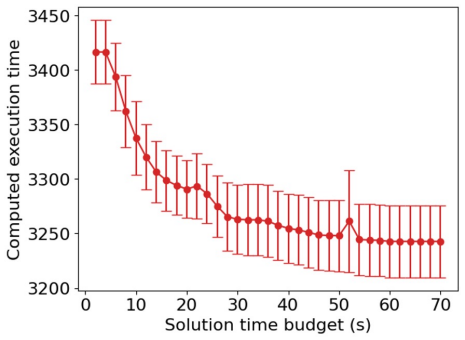
- The method scales to high-density labware: with 120 seconds of solver time it handles up to roughly 14,000 transfers on 1536-well plates, suggesting it fits large combinatorial workflows.
- The computed execution time is validated as a proxy by strong correlation with EvoSim-simulated execution times across 12-, 24-, 96-, and 384-well formats.
- The approach is platform-independent enough to carry over to a JANUS G3 workstation, where the CVRP schedule outperformed all baselines across different aspiration and dispensing speeds.
Reading between the lines
- The CVRP formulation naturally extends to jointly selecting destination well assignments during experimental design rather than only ordering a fixed task matrix, which the paper mentions as a possible future direction.
- On liquid handlers where arm movement time scales with physical distance, the constant-$t_4$ proxy would need a distance-dependent term; otherwise the routing cost could mis-price transitions, a limitation the paper itself flags.
- Integrating the scheduler into active-learning loops could let an autonomous platform trade optimization time against execution time, potentially exploring larger design spaces within reagent shelf-life limits.
- The capacity constant $K=8$ is a parameter of the formulation, so the same code applies to pipettes with other channel counts, a straightforward but untested generalization.
Editorial analysis
A structured set of objections, weighed in public.
Referee Report
Summary. The manuscript proposes treating the scheduling of liquid transfers for an 8-channel, individually addressable pipette as a capacitated vehicle routing problem (CVRP). It defines a job-level execution-time proxy (Eqs. 1-4) in which well adjacency on source and destination plates is binary and arm travel distance is ignored, formulates an integer program (Eq. 5), and solves it with OR-Tools. The method is benchmarked against row-major sorting, LAP, and greedy baselines on randomly generated tasks across plate formats, reporting up to a 37% reduction in the computed proxy (Fig. 5), and the proxy is correlated against Tecan EvoSim for randomly ordered work lists (Fig. 4). A real polymer-blend campaign is optimized, with EvoSim-simulated savings of 61-75 minutes, and one JANUS G3 experiment is reported (Fig. S5).
Significance. If the time proxy is faithful at the schedules the optimizer actually produces, the paper provides a practical, broadly applicable way to reduce liquid-handling time without hardware changes, and the open-source implementation is a valuable asset. The CVRP analogy is clearly explained, and the benchmark coverage across plate formats and task sizes is a strength. However, the load-bearing validation is incomplete: the proxy's fidelity is established only for random orderings, while the headline random-task improvements are measured in the proxy itself; true execution-time evidence at the optimized schedules is limited to the real campaign and a single JANUS run. The constant-t4 simplification creates a concrete risk that the optimizer trades many short moves for a few long moves at zero proxy cost, so the claimed gains may not transfer to true execution time.
major comments (4)
- [Figure 4 and Figure 5; Eqs. (1)-(4)] Figure 4 validates the proxy only against randomly ordered work lists, while the random-task improvement in Figure 5 is reported in terms of the computed proxy D', not EvoSim-simulated or hardware-measured time. The conclusion that 'minimization of the former should lead to minimization of the latter' is therefore not tested on the schedules the optimizer actually produces. Because Eq. (1) charges a constant cost for any non-adjacent move, a CVRP solution can replace many short moves by few long moves at no extra proxy cost, so the 37% headline gain may not transfer to true execution time. I request EvoSim simulation (or hardware execution) of the work lists generated by all methods for the Figure 5 tasks, with actual times reported alongside the proxy.
- [Mathematical formulation, Eq. (1)] The assumption that arm movement time t4 is constant and independent of distance is load-bearing for the proxy. The paper justifies this by experience with 'commercially available liquid handlers we have used,' but no measurement of the movement-time share is provided. The single JANUS G3 experiment (Fig. S5) varies aspiration and dispensing speeds only; it does not vary arm speed, deck geometry, or plate spacing, so it cannot detect regimes in which distance-dependent movement dominates. I ask for a sensitivity analysis (e.g., re-solving with movement cost proportional to distance, or measuring t4 across distances on at least one platform) to bound the error introduced by this simplification.
- [Abstract and Figure 5] The abstract's 'up to 37% reduction in execution time' overstates what is measured for random tasks. Figure 5 reports computed proxy time only, not simulated or measured execution time, so the wording should be qualified as 'computed execution time' until true-time validation for the random-task regime is added. The real-campaign claim is supported by EvoSim simulation, but the random-task claim is not.
- [Equation (5)] The stated mathematical formulation does not include subtour elimination constraints; constraints (5b)-(5e) allow cycles that are disconnected from the dummy depot. The text says Eq. (5) is 'exactly the same as CVRP' and relies on OR-Tools to enforce proper routes. For a mathematical-optimization paper, the formulation should either include the standard subtour elimination constraints or explicitly state that Eq. (5) is a relaxed model whose solutions are repaired/enforced by the routing solver.
minor comments (5)
- [Author affiliations] The affiliation address contains a typo: 'Cambrdige' should be 'Cambridge'; the same typo appears twice.
- [Figure 5 caption] Panels (d) and (f) are both described as 'from 96-well plate to 96-well plate'; if this is not a typo, the difference between the two panels should be stated explicitly.
- [Baseline methods] The LAP method is underspecified: 'iteratively sampling the jobs on the axis that belongs to the larger plate' is ambiguous, and a precise algorithm or pseudocode is needed for reproducibility.
- [Supporting Information, Table S1] The proxy parameters t_src_1,3,4 and t_dst_1,3,4 are set to 1 in the main text, but the EvoSim parameters in Table S1 list only aspiration speed, delays, and retraction speed; please clarify whether these proxy constants were calibrated to the simulator or chosen heuristically, since this affects the interpretation of the correlation in Figure 4.
- [Results and discussion] The text contains a typo: 'e successfully optimized pipetting tasks' should read 'we successfully optimized pipetting tasks.'
Circularity Check
No significant circularity: the time proxy is independently validated against EvoSim, and the real-campaign gain is supported by simulated and hardware measurements.
full rationale
The derivation chain is self-contained. The paper defines a job-level time proxy D' from primitive action times (Eqs. 1-4) and minimizes it under CVRP constraints (Eq. 5); none of the proxy parameters are fitted to the predicted outcome (they are stated constants, t=1, q=100). The proxy is independently checked against an external simulator, EvoSim, on randomly ordered worklists (Fig. 4), which is real evidence that lower D' tracks lower simulated time. The random-task comparison in Fig. 5 does report the computed proxy rather than simulated time, and the constant-t4 assumption in Eq. (1) is a genuine limitation at CVRP-chosen schedules; however, that is a surrogate-validation gap, not a reduction of the conclusion to its input. For the central real-world claim, the paper reports simulated execution time (Fig. 7c) and a hardware run on a JANUS G3 (Fig. S5), so the 61-minute saving is not merely the optimized objective restated. The only self-citation (ref 22) supplies the real-world task data, not a uniqueness theorem or a load-bearing argument. No equation in the paper is equivalent to its inputs by construction, so the circularity score is 0.
Assumptions & free parameters
free parameters (4)
- t_source_1,3,4 =
1 (unitless)
- t_dest_1,3,4 =
1 (unitless)
- q_src (aspiration speed) =
100 µL/s
- q_dst (dispensing speed) =
100 µL/s
assumptions (3)
- domain assumption Arm movement time and tip lowering/withdrawal times are independent of the distance between wells (t4 constant).
- domain assumption The execution time of a pipetting task is accurately captured by pairwise job-level distances D'=D_src'+D_dst' summed along the route.
- domain assumption OR-Tools' CVRP solver produces a feasible and near-optimal solution within the allotted time budget.
Cite this review
Pith. "Pith review of Optimization of Robotic Liquid Handling as a Capacitated Vehicle Routing Problem." pith.science (2026). https://pith.science/paper/NVOKLYXM
@misc{pith2026250602795,
  author       = {Pith},
  title        = {Pith review of: Optimization of Robotic Liquid Handling as a Capacitated Vehicle Routing Problem},
  year         = {2026},
  howpublished = {\url{https://pith.science/paper/NVOKLYXM}},
  note         = {Machine review of arXiv:2506.02795}
}
read the original abstract
We present an optimization strategy to reduce the execution time of liquid handling operations in the context of an automated chemical laboratory. By formulating the task as a capacitated vehicle routing problem (CVRP), we leverage heuristic solvers traditionally used in logistics and transportation planning to optimize task execution times. As exemplified using an 8-channel pipette with individually controllable tips, our approach demonstrates robust optimization performance across different labware formats (e.g., well-plates, vial holders), achieving up to a 37% reduction in execution time for randomly generated tasks compared to the baseline sorting method. We further apply the method to a real-world high-throughput materials discovery campaign and observe that 3 minutes of optimization time led to a reduction of 61 minutes in execution time compared to the best-performing sorting-based strategy. Our results highlight the potential for substantial improvements in throughput and efficiency in automated laboratories without any hardware modifications. This optimization strategy offers a practical and scalable solution to accelerate combinatorial experimentation in areas such as drug combination screening, reaction condition optimization, materials development, and formulation engineering.
Figures


Figures from the paper (4 more)



Reference graph
Works this paper leans on
-
[1]
Koscher, B. A.; Canty, R. B.; McDonald, M. A.; Greenman, K. P.; McGill, C. J.; Bilodeau, C. L.; Jin, W.; Wu, H.; Vermeire, F. H.; Jin, B.; others Autonomous, multiproperty-driven molecular discovery: From predictions to measurements and back. Science 2023, 382, eadi1407
work page 2023
-
[2]
T.; Ayme, J.-F.; Simaei, E.; Fellowes, T.; Clowes, R.; Kotopanov, L.; Shields, C
Dai, T.; Vijayakrishnan, S.; Szczypi \'n ski, F. T.; Ayme, J.-F.; Simaei, E.; Fellowes, T.; Clowes, R.; Kotopanov, L.; Shields, C. E.; Zhou, Z.; others Autonomous mobile robots for exploratory synthetic chemistry. Nature 2024, 1--8
work page 2024
-
[3]
J.; Stevens, J.; Li, J.; Parasram, M.; Damani, F.; Alvarado, J
Shields, B. J.; Stevens, J.; Li, J.; Parasram, M.; Damani, F.; Alvarado, J. I. M.; Janey, J. M.; Adams, R. P.; Doyle, A. G. Bayesian reaction optimization as a tool for chemical synthesis. Nature 2021, 590, 89--96
work page 2021
-
[4]
The rise of self-driving labs in chemical and materials sciences
Abolhasani, M.; Kumacheva, E. The rise of self-driving labs in chemical and materials sciences. Nature Synthesis 2023, 2, 483--492
work page 2023
-
[5]
Tom, G.; Schmid, S. P.; Baird, S. G.; Cao, Y.; Darvish, K.; Hao, H.; Lo, S.; Pablo-Garc \' a, S.; Rajaonson, E. M.; Skreta, M.; others Self-driving laboratories for chemistry and materials science. Chemical Reviews 2024, 124, 9633--9732
work page 2024
-
[6]
Chen, J.; Cross, S. R.; Miara, L. J.; Cho, J.-J.; Wang, Y.; Sun, W. Navigating phase diagram complexity to guide robotic inorganic materials synthesis. Nature Synthesis 2024, 3, 606--614
work page 2024
-
[7]
Nature communications 2025, 16, 1498
Wang, C.; Kim, Y.-J.; Vriza, A.; Batra, R.; Baskaran, A.; Shan, N.; Li, N.; Darancet, P.; Ward, L.; Liu, Y.; others Autonomous platform for solution processing of electronic polymers. Nature communications 2025, 16, 1498
work page 2025
-
[8]
Mehr, S. H. M.; Craven, M.; Leonov, A. I.; Keenan, G.; Cronin, L. A universal system for digitization and automatic execution of the chemical synthesis literature. Science 2020, 370, 101--108
work page 2020
Show all 22 references
-
[9]
S.; Gregoire, J
Stein, H. S.; Gregoire, J. M. Progress and prospects for accelerating materials science with automated and autonomous workflows. Chemical science 2019, 10, 9640--9649
2019
-
[10]
R.; Guo, J.; Fu, T.; Harris, C.; Wang, Y.; Duan, C.; Li \`o , P.; Schwaller, P.; Blundell, T
Du, Y.; Jamasb, A. R.; Guo, J.; Fu, T.; Harris, C.; Wang, Y.; Duan, C.; Li \`o , P.; Schwaller, P.; Blundell, T. L. Machine learning-aided generative molecular design. Nature Machine Intelligence 2024, 6, 589--604
2024
-
[11]
P.; Ramprasad, R
Tran, H.; Gurnani, R.; Kim, C.; Pilania, G.; Kwon, H.-K.; Lively, R. P.; Ramprasad, R. Design of functional and sustainable polymers assisted by artificial intelligence. Nature Reviews Materials 2024, 1--21
2024
-
[12]
Inverse molecular design using machine learning: Generative models for matter engineering
Sanchez-Lengeling, B.; Aspuru-Guzik, A. Inverse molecular design using machine learning: Generative models for matter engineering. Science 2018, 361, 360--365
2018
-
[13]
Rational combinations of targeted cancer therapies: background, advances and challenges
Jin, H.; Wang, L.; Bernards, R. Rational combinations of targeted cancer therapies: background, advances and challenges. Nature Reviews Drug Discovery 2023, 22, 213--234
2023
-
[14]
Sun, X.; Vilar, S.; Tatonetti, N. P. High-throughput methods for combinatorial drug discovery. Science translational medicine 2013, 5, 205rv1--205rv1
2013
-
[15]
J.; Aldeghi, M.; H \"a se, F.; Aspuru-Guzik, A.; Allen, C
Bannigan, P.; Bao, Z.; Hickman, R. J.; Aldeghi, M.; H \"a se, F.; Aspuru-Guzik, A.; Allen, C. Machine learning models to accelerate the design of polymeric long-acting injectables. Nature communications 2023, 14, 35
2023
-
[16]
J.; Patel, R
Tamasi, M. J.; Patel, R. A.; Borca, C. H.; Kosuri, S.; Mugnier, H.; Upadhya, R.; Murthy, N. S.; Webb, M. A.; Gormley, A. J. Machine learning on a robotic platform for the design of polymer--protein hybrids. Advanced Materials 2022, 34, 2201809
2022
-
[17]
G.; Chung, S
Reis, M.; Gusev, F.; Taylor, N. G.; Chung, S. H.; Verber, M. D.; Lee, Y. Z.; Isayev, O.; Leibfarth, F. A. Machine-learning-guided discovery of 19F MRI agents enabled by automated copolymer synthesis. Journal of the American Chemical Society 2021, 143, 17677--17689
2021
-
[18]
A.; Job, H.; Robertson, L
Noh, J.; Doan, H. A.; Job, H.; Robertson, L. A.; Zhang, L.; Assary, R. S.; Mueller, K.; Murugesan, V.; Liang, Y. An integrated high-throughput robotic platform and active learning approach for accelerated discovery of optimal electrolyte formulations. Nature Communications 202...
2024
-
[19]
M.; Tale, S.; Purchel, A
Ting, J. M.; Tale, S.; Purchel, A. A.; Jones, S. D.; Widanapathirana, L.; Tolstyka, Z. P.; Guo, L.; Guillaudeu, S. J.; Bates, F. S.; Reineke, T. M. High-throughput excipient discovery enables oral delivery of poorly soluble pharmaceuticals. ACS central science 2016, 2, 748--755
2016
-
[20]
Devices and systems for laboratory automation; John Wiley & Sons, 2022
Thurow, K.; Junginger, S. Devices and systems for laboratory automation; John Wiley & Sons, 2022
2022
-
[21]
OR-Tools Routing Library
Furnon, V.; Perron, L. OR-Tools Routing Library. https://developers.google.com/optimization/routing/
-
[22]
distance
Wu, G.; Jin, T.; Alexander-Katz, A.; Coley, C. Autonomous Discovery of Functional Random Heteropolymer Blends through Evolutionary Formulation Optimization. ChemRxiv 2024, mcitethebibliography achemso-demo.bib0000664000000000000000000002063715017555015012611 0ustar rootroot@ar...
2024
Reviewed August 7, 2026 · model on record in the stance chip above.
Discussion (0). Sign in to comment.