REVIEW 3 major objections 7 minor 45 references
An open-source finite element toolbox for anisotropic creep and irradiation growth: Application to tube and spacer grid assembly
T0 review · 3 major / 7 minor · reviewed 2026-08-07 · deepseek-v4-flash
Pith's one-line read VPSC-CAFEM embeds grain-level crystal plasticity in Code_Aster and finds that a spacer-grid texture with prismatic planes preferentially normal to the grid minimizes cladding clearance, the quantity that drives fuel-assembly fretting wear.
desk verdict Useful Code_Aster–VPSC coupling, but the spacer-grid texture ranking rests on an underdetermined in-plane orientation. read the letter →
The pith
A machine-rendered reading of the paper's core claim, the machinery that carries it, and where it could break.
The reading
What carries the argument
The central object is the VPSC-CAFEM interface, a UMAT-like user-material coupling that puts the viscoplastic self-consistent (VPSC) polycrystal model, a mean-field scheme computing the anisotropic response of a textured aggregate of hexagonal grains from slip systems, dislocation densities, and irradiation defect populations, at every Gauss point of the Code_Aster mesh. It carries the argument by splitting each strain increment as $\Delta\boldsymbol{\varepsilon} = \mathbf{C}^{-1}:\Delta\boldsymbol{\sigma} + \Delta\boldsymbol{\varepsilon}_{vp}$, with $\mathbf{C}$ the self-consistent elastic stiffness computed by VPSC and $\Delta\boldsymbol{\varepsilon}_{vp}$ the viscoplastic increment; rotating stress, strain, and tangent tensors between the global frame and local crystallographic axes with the rotation matrix $R$; and iterating the Newton-Raphson residual $\mathbf{X}(\Delta\boldsymbol{\sigma}^*)=\Delta\boldsymbol{\varepsilon}^*-\Delta\boldsymbol{\varepsilon}^*_{FE}$ with Jacobian $\mathbf{J}^*_{NR}=\mathbf{C}^{-1}+\mathbf{M}\Delta t$, where $\mathbf{M}$ is the VPSC viscoplastic tangent modulus. A companion Python script assigns local coordinate systems to curved meshes automatically, which is what makes the texture rotations practical for the cladding tube and grid at millions of integration points.
What would settle it
Measure the cladding-to-dimple clearance of an irradiated spacer grid assembly, or of a fretting rig operating at the predicted amplitudes, and compare with the roughly 13-micrometer opening at 20 dpa and with the texture ranking of Tests 1-4: a materially different magnitude, or a texture that does not favor the prismatic-normal orientation, would refute the central claim. A cheaper check is to compare the coupled model's tube strain anisotropy against dedicated irradiation-growth and irradiation-creep experiments on the same heat of material, since the tube response is the most directly calibrated part of the model.
Extended reading notes
Core claim
If the VPSC-CAFEM interface is right, then grain-level VPSC constitutive behavior is faithfully embedded in Code_Aster: stress and strain tensors are rotated between the global finite element frame and the local crystallographic axes at every Gauss point, the elastic strain is recovered analytically from the self-consistent elastic stiffness tensor computed by VPSC, and a Newton-Raphson iteration on the strain residual enforces equilibrium. The paper shows the coupled model reproduces standalone VPSC strain histories for irradiation growth without load and for irradiation creep under 100 and 200 MPa axial loads in a quarter-tube geometry. On the full assembly, the model predicts a maximum clearance opening of about 13 micrometers at 20 dpa for the tested grid texture, smaller than the 28 micrometers reported for a similar geometry in a prior Abaqus-based study, and, across four texture variants, that the clearance decreases steadily as the prismatic planes rotate toward the normal direction of the dimple sheet, with a single crystal in that orientation giving the smallest opening. From this the paper draws its central design claim: a grid texture with prismatic planes preferentially normal to the grid minimizes clearance and thereby contributes to fretting-wear resistance.
Load-bearing premise
The load-bearing premise is that the material parameters and reduced crystallographic textures inherited from an earlier study calibrated for cold-worked Zircaloy-2 irradiation growth at 550 K describe the actual spacer grid material over the entire 0-20 dpa range; the interface validation only demonstrates consistency with standalone VPSC, so if the creep compliance, defect fractions, or textures are unrepresentative, the predicted clearance magnitudes and the texture ranking could change.
Editorial extensions
If this is right
- Code_Aster users can replace semi-empirical constitutive laws for irradiated zirconium with grain-level physics, including texture, dislocation density, and defect population, entirely within an open-source stack.
- A spacer grid processed so its prismatic planes preferentially point along the grid normal should show reduced cladding clearance and improved fretting-wear resistance relative to the as-received texture.
- The predicted 13-micrometer opening at 20 dpa falls inside the 5-30 micrometer transverse displacement range used in ex-reactor fretting wear tests, so the model's wear-risk assessment is testable with existing experimental practice.
- Under a net outward pressure on the cladding, a loss-of-coolant-like condition, the clearance stays closed through 20 dpa, which suggests initial internal pressurization of the cladding could mitigate fretting degradation.
- Because the elastic response is recovered analytically from the self-consistent stiffness tensor, the open-access version of VPSC, which lacks built-in elasticity, can still be used inside a finite element solver.
Reading between the lines
- The texture ranking rests on reduced textures of 7 and 13 orientations taken from an earlier study; a sensitivity run with the full 1144- and 2428-orientation textures would show whether the ranking survives texture-representation error, which the stated 10 percent deviation criterion does not fully guarantee.
- The same coupling is transferable to other hexagonal metals, such as titanium and other zirconium alloys, and to the listed extensions of thermal creep, thermal expansion, and precipitation hardening, so the clearance-versus-texture conclusion is one instance of a general screening capability for fuel components.
- The single-crystal test suggests the benefit scales with prismatic-pole intensity near the grid normal; a few more simulations could produce a design map of clearance against the normal-direction Kearn factor, giving strip processors a quantitative target.
- Since the validation compares the coupled model with standalone VPSC rather than with independent experiment, the physical realism of the 13-micrometer number inherits entirely from the earlier Zircaloy-2 calibration; a direct experimental constraint on clearance would be the missing independent check.
Editorial analysis
A structured set of objections, weighed in public.
Referee Report
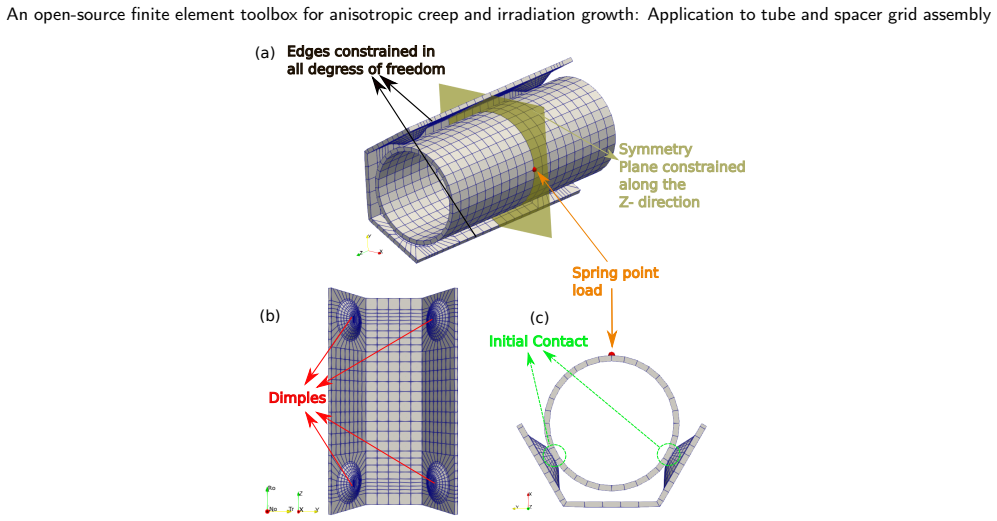
Summary. The paper introduces VPSC-CAFEM, an open-source interface coupling the viscoplastic self-consistent (VPSC) polycrystal model with the finite element solver Code_Aster for simulating anisotropic creep and irradiation growth in zirconium components. The interface uses an additive elastic-viscoplastic strain decomposition, recovers the elastic stiffness analytically from the VPSC self-consistent tensor, and automatically rotates stress/strain tensors between global and local crystallographic frames. The implementation is first checked against standalone VPSC on a quarter-tube geometry (Appendix B), then applied to a PWR spacer-grid and cladding assembly with nonlinear contact, reporting clearance evolution up to 20 dpa for four texture configurations. The paper concludes that a spacer-grid texture with prismatic planes preferentially aligned with the grid normal direction minimizes clearance and improves fretting-wear resistance.
Significance. The open-source VPSC-CAFEM interface is a valuable software contribution: it provides an explicit, reproducible coupling strategy for grain-level VPSC behavior inside Code_Aster, uses an analytically recovered elastic stiffness, supports automated local-axis assignment on curved meshes, and ships the code in a public repository. The internal consistency checks against standalone VPSC in Figs. 19 and 20 are useful and demonstrate that the coupling does not corrupt the constitutive response. However, the quantitative spacer-grid results and the design-oriented conclusion should be read as a demonstration of the tool rather than as validated design guidance: the material parameters and reduced textures are inherited without revalidation, and the local-coordinate construction leaves the in-plane orientation underdetermined. The physical conclusion that prismatic planes near the normal direction minimize clearance is plausible but currently rests on assumptions that need explicit testing.
major comments (3)
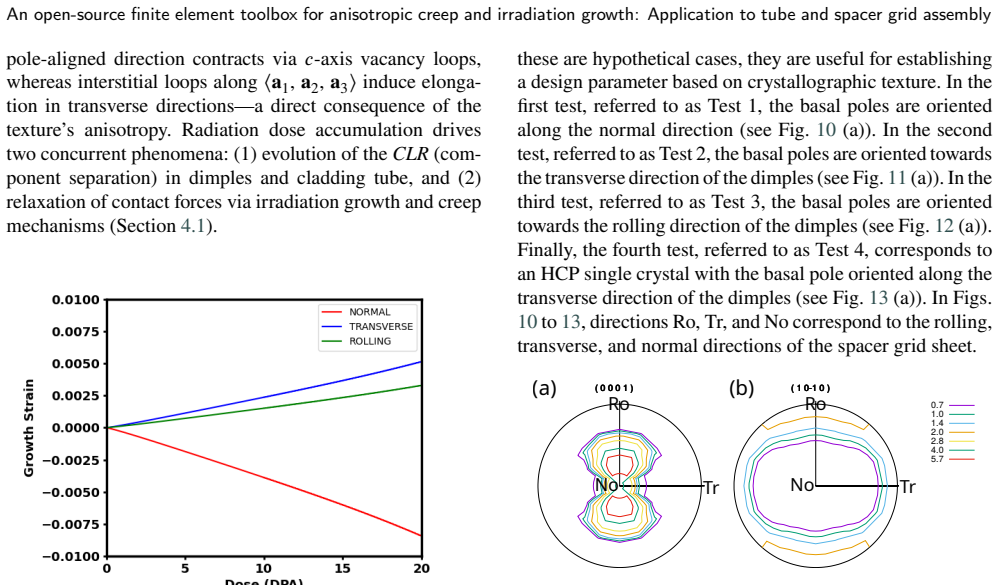
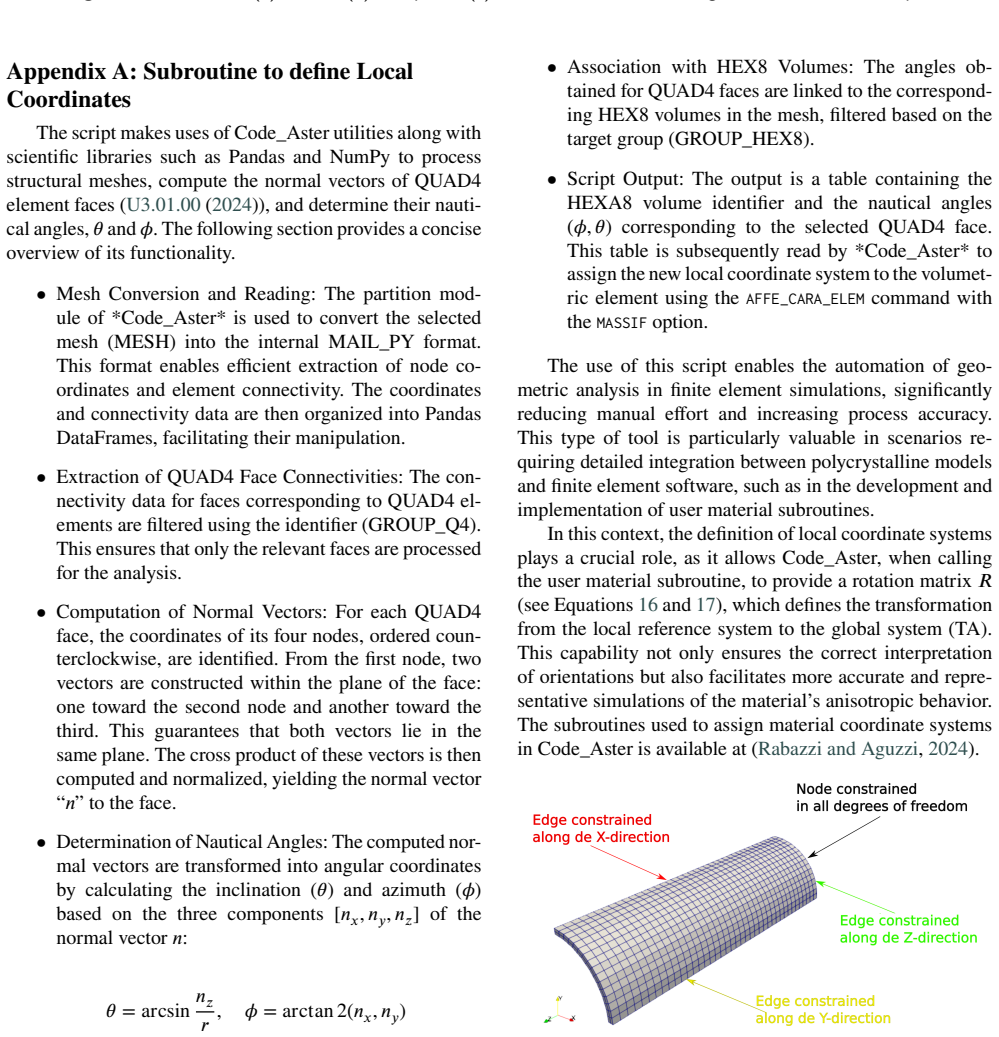
- [3.1.1, Appendix A] The local coordinate system is underdetermined. Appendix A's Python script computes only the face normal and the two nautical angles θ and φ; the rotation about that normal is not specified, and Code_Aster's AFFE_CARA_ELEM MASSIF fixes it by an internal convention tied to the global frame rather than to the material's rolling direction. Since the reduced grid texture is not transversely isotropic (F_Ro = 0.1907 vs. F_Tr = 0.1102), an arbitrary in-plane rotation changes which physical direction is treated as rolling or transverse. Tests 2-4 in Section 4.2 vary the basal pole orientation between Ro and Tr as if these were the true sheet directions after forming, but no forming/stamping simulation or additional Euler angle is provided. If the in-plane axes assigned by this convention do not coincide with the actual material directions, the reported CLR values and the ranking of the textures in Fig. 14 are not representative of the spacer-grid material. The authors should specify the full orientation (e.g., a third Euler angle or a reference direction from the forming process) and, ideally, include a sensitivity study over the in-plane rotation.
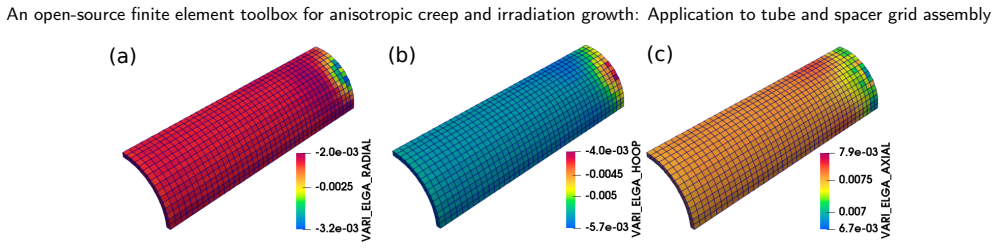
- [Appendix B, Section 4.1] The validation is self-referential. The agreement between VPSC-CAFEM and VPSC-SA in Figs. 19 and 20 demonstrates that the coupling preserves the standalone VPSC response, which is a useful consistency check, but it is not an independent validation of the constitutive model or of the clearance predictions. The comparison with Patra and Tomé (2017) in Section 4.1 is between two simulations sharing the same growth and creep equations, material parameters, and reduced textures. The parameters in Table 1 (B, f_r, f_ic, etc.) are inherited from a calibration of cold-worked Zircaloy-2 irradiation growth at 550 K and are assumed to describe the CONUAR spacer-grid material over the full 0-20 dpa range without revalidation. The paper should state explicitly that the application is a numerical demonstration, and should quantify how sensitive the CLR magnitude and texture ranking are to the inherited parameters.
- [Section 4.1, Figs. 14 and 16] No mesh convergence or uncertainty quantification is reported for the contact problem. The 13 µm clearance and the small differences between tests in Fig. 14 (in some cases only a few micrometers) are not supported without a mesh refinement study, especially because the paper attributes a small side-to-side mismatch to a mesh asymmetry 'on the order of micrometers.' The contact algorithm (node-to-segment, master-slave, friction neglected) and the time stepping should also be tested for convergence, since the conclusions are quantitative and compare configurations that differ by small clearances.
minor comments (7)
- [Section 2.1.1] The text contains typos: 'reaction-diffusioin' should be 'reaction-diffusion' and 'intestitial' should be 'interstitial' in the paragraph introducing Eq. (2).
- [Appendix A] The word 'soubroutine' should be 'subroutine' in the sentence describing the automated local-axis assignment.
- [Section 4.1] The reference to 'Apendix B' should be 'Appendix B' in the sentence about the cladding tube's axial elongation and radial/hoop contraction.
- [Eqs. (16)-(17), (24)] The rotation convention is stated inconsistently: Eq. (16) writes Δε* = R Δε Rᵀ while Eq. (24) writes σ = Rᵀ σ* R. Please make the direction of the rotation matrix R explicit and consistent throughout.
- [Eq. (26)] The convergence metric uses X_ij without identifying it; it should be stated that X_ij is the residual from Eq. (21).
- [Section 4.3 and Section 5] The statements about the effect of prismatic planes near the normal direction appear contradictory: Section 4.3 says a higher presence of such planes results in greater CLR under pressure reversal, while Section 5 concludes that prismatic poles aligned with the normal minimize clearance. These statements need to be reconciled or explicitly distinguished by loading scenario.
- [References] References U2.04.04 and U3.01.00 both carry the title 'The Code_Aster mesh file' but cite different manuals; the citations should be corrected to the relevant Code_Aster documentation.
Circularity Check
No significant circularity: the implementation is verified against the standalone constitutive code it embeds, and the application-level results are forward simulations with externally anchored parameters, not fitted or self-defined quantities.
full rationale
The paper's derivation chain is not circular. The constitutive equations (Sections 2.1.1 and 2.2.1) are adopted by explicit citation from Patra et al. (2017) and Patra and Tome (2017), with material parameters listed in Table 1 and traced to external sources such as Holt et al. (1996) and Simmons (1965); these are stated inputs inherited from prior work, not quantities derived from the paper's own outputs. The VPSC-CAFEM interface is specified by explicit equations (Eqs. 15-26) covering the additive strain decomposition, trial stress, Newton-Raphson residual, Jacobian, and tensor rotations, so the elastic-recovery step does not reduce to the self-citation (Aguzzi and Signorelli, 2024) - the formulas are present in the paper itself. Appendix B compares VPSC-CAFEM with standalone VPSC-SA for the same constitutive model; this is code-to-code verification of the wrapper rather than an independent physical validation, but it is not a circular prediction because no parameter is fitted to the compared outputs and no output is relabeled as an input. The application-level CLR predictions in Section 4 are forward simulations: the texture-ranking conclusion follows from varying an input texture while holding all other inputs fixed, and the 13 micrometer result is externally contextualized by comparison with the independent prior simulations of Patra and Tome (2017) (28 micrometers) and Billerey (2005) (10 micrometers). The possible underdetermination of the in-plane orientation of the grid texture and the absence of a forming simulation are modeling-assumption or correctness concerns, not circularity, because the Ro/Tr directions are used as inputs and are not themselves the quantities being predicted. Minor self-citations (Aguzzi and Signorelli, 2024; Rabazzi and Aguzzi, 2024) appear but are not load-bearing: the first is backed by the equations in this paper, and the second is an open-source code repository. Consequently, no step in the paper's claimed derivation reduces by construction to its own inputs.
Assumptions & free parameters
free parameters (5)
- Irradiation creep compliance B =
5.0e-5 MPa/dpa
- Recombination fraction f_r =
0.97
- Interstitial cluster fraction f_ic =
0.13
- Reference dislocation density rho_ref =
2.26e14 m^-2
- Grain boundary absorption strengths k_j^m =
not listed
assumptions (6)
- domain assumption Additive decomposition of total strain increment into elastic and viscoplastic parts (Eq. 15)
- domain assumption Small strain kinematics with fixed local rotation matrix R (Eqs. 16-17)
- domain assumption Reduced texture sets (7 tube, 13 grid) represent full polycrystal within 10% deviation
- domain assumption Irradiation growth and creep constitutive laws (Eqs. 3-9) with parameters from Patra et al. (2017)
- standard math VPSC tangent linearization represents the effective polycrystal medium (Eq. 13)
- domain assumption Frictionless master-slave contact isolates mechanical clearance evolution
Cite this review
Pith. "Pith review of An open-source finite element toolbox for anisotropic creep and irradiation growth: Application to tube and spacer grid assembly." pith.science (2026). https://pith.science/paper/HXQ3KR2A
@misc{pith2026250602807,
  author       = {Pith},
  title        = {Pith review of: An open-source finite element toolbox for anisotropic creep and irradiation growth: Application to tube and spacer grid assembly},
  year         = {2026},
  howpublished = {\url{https://pith.science/paper/HXQ3KR2A}},
  note         = {Machine review of arXiv:2506.02807}
}
read the original abstract
This work presents an open-source interface that couples the viscoplastic self-consistent (VPSC) model capable of simulating anisotropic creep and irradiation growth in polycrystalline materials with the finite element solver Code_Aster. The interface enables the simulation of the micromechanical response of irradiated zirconium alloy components by integrating grain-level constitutive behavior into a structural FEM framework. A key feature is the automated rotation of stress and strain tensors between the global FEM frame and the local crystallographic axes, a transformation not natively supported by Code_Aster. The elastic strain is recovered analytically using the inverse of the self-consistently stiffness tensor provided by VPSC. As a demonstration, the framework is applied to an actual model of a pressurized water reactor (PWR) spacer grid, based on a patented design, capturing nonlinear contact and the anisotropic response of the cladding and grid. Simulations reveal the micromechanisms controlling the evolution of clearance between components and highlight the role of crystallographic texture in mitigating wear. In particular, a texture with a high fraction of prismatic planes oriented in the normal direction of the grid appears to be the most suitable for spacer design, as it minimizes clearance and contributes to wear resistance. The interface offers a flexible, extensible platform for high-fidelity simulations in nuclear fuel performance analysis.
Figures


Figures from the paper (14 more)






Reference graph
Works this paper leans on
-
[1]
write newline
" write newline "" before.all 'output.state := FUNCTION n.dashify 't := "" t empty not t #1 #1 substring "-" = t #1 #2 substring "--" = not "--" * t #2 global.max substring 't := t #1 #1 substring "-" = "-" * t #2 global.max substring 't := while if t #1 #1 substring * t #2 global.max substring 't := if while FUNCTION word.in bbl.in ":" * " " * FUNCTION f...
-
[2]
author Agouzal, E. , year 2024 . title Reduced order models in quasi-static nonlinear mechanics for state estimation by calibration through data assimilation: application to containment buildings . Ph.D. thesis. Universit \'e de Bordeaux
work page 2024
-
[3]
author Aguzzi, F.E. , author Signorelli, J.W. , year 2024 . title Integraci \'o n del modelo visco-pl \'a stico autoconsistente con leyes bajo irradiaci \'o n de creep y crecimiento en el c \'o digo de elementos finitos Code\_Aster , in: booktitle XL Congreso Argentino de Mec \'a nica Computacional
work page 2024
-
[4]
author Barashev, A.V. , author Golubo, S.I. , author Stoller, R.E. , year 2015 . title Theoretical investigation of microstructure evolution and deformation of zirconium under neutron irradiation . journal Journal of Nuclear Materials volume 461 , pages 85--94
work page 2015
-
[5]
author Billerey, A. , year 2005 . title Evolution of fuel rod support under irradiation--impact on the mechanical behaviour of fuel assemblies . journal Structural behaviour of fuel assemblies for water cooled reactors , pages 101--111
work page 2005
-
[6]
title The rate theory of swelling due to void growth in irradiated metals
year 1972 . title The rate theory of swelling due to void growth in irradiated metals . journal Journal of Nuclear Materials volume 44 , pages 121--135
work page 1972
-
[7]
author Choi, M.H. , author Kang, H.S. , author Yoon, K.H. , author Song, K.N. , year 2004 . title Vibration analysis of a dummy fuel rod continuously supported by spacer grids . journal Nuclear Engineering and Design volume 232 , pages 185--196
work page 2004
-
[8]
title Conuar - combustibles nucleares argentinos
author CONUAR , year 2025 . title Conuar - combustibles nucleares argentinos . https://www.conuar.ar/
work page 2025
Show all 45 references
-
[9]
title E lectricit \'e de France
author EDF , year 1989--2025 . title E lectricit \'e de France. Finite element code\_aster , Analysis of Structures and Thermomechanics for Studies and Research . howpublished Open source on www.code-aster.org
1989
-
[10]
, year 1981
author Ehrlich, K. , year 1981 . title Irradiation creep and interrelation with swelling in austenitic stainless steels . journal Journal of nuclear materials volume 100 , pages 149--166
1981
-
[11]
, year 1988
author Fidleris, V. , year 1988 . title The irradiation creep and growth phenomena . journal Journal of Nuclear Materials volume 159 , pages 22--42
1988
-
[12]
, author Wolfer, W.G
author Foster, J.P. , author Wolfer, W.G. , author Biancheria, A. , author Boltax, A. , year 1972 . title Analysis of irradiation-induced creep of stainless steel in fast spectrum reactors . type Technical Report . Westinghouse Electric Corp., Madison, Pa.(USA). Advanced Reactors Div
1972
-
[13]
, author Barashev, A.V
author Golubov, S.I. , author Barashev, A.V. , author Stoller, R.E. , author Singh, B. , year 2014 . title Breakthrough in Understanding Radiation Growth of Zirconiu . type Technical Report . Oak Ridge National Lab.(ORNL), Oak Ridge, TN (United States)
2014
-
[14]
, author Holt, R.A
author Griffiths, M. , author Holt, R.A. , author Rogerson, A. , year 1995 . title Microstructural aspects of accelerated deformation of zircaloy nuclear reactor components during service . journal Journal of Nuclear Materials volume 225 , pages 245--258
1995
-
[15]
, author Causey, A
author Holt, R. , author Causey, A. , author Christodoulou, N. , author Griffiths, M. , author Ho, E. , author Woo, C. , year 1996 . title Non-linear irradiation growth of cold-worked zircaloy-2 . journal ASTM Special Technical Publication volume 1295 , pages 623--637
1996
-
[16]
, author Qu, J
author Jiang, H. , author Qu, J. , author Lu, R. , author Roger, Y. , author Wang, J.A.J. , year 2016 . title Grid-to-rod flow-induced impact study for pwr fuel in reactor . journal Progress in Nuclear Energy volume 91 , pages 355--361
2016
-
[17]
, author Gue \' rout, F.M
author Joulin, T.P. , author Gue \' rout, F.M. , author Lina, A. , author Moinereau, D. , year 2002 . title Effects of loading conditions and types of motion on pwr fuel rod cladding wear , in: booktitle ASME International Mechanical Engineering Congress and Exposition , pp. p...
2002
-
[18]
, author Buioli, C.P
author Juarez, G. , author Buioli, C.P. , author Flores, A.V. , author Dellagnolo, M. , author Santisteban, J.R. , author Alvarez, M.A.V. , author Azzinari, D. , author Bianchi, D. , author Revesz, A. , author Hoffman, M. , et al., year 2019 . title Evoluci \'o n de la textura...
2019
-
[19]
, author Lee, Y.H
author Kim, H.K. , author Lee, Y.H. , author Lee, K.H. , year 2008 . title On the geometry of the fuel rod supports concerning a fretting wear failure . journal Nuclear Engineering and Design volume 238 , pages 3321--3330
2008
-
[20]
, year 2010
author Kim, K.T. , year 2010 . title A study on the grid-to-rod fretting wear-induced fuel failure observed in the 16 16kofa fuel . journal Nuclear Engineering and Design volume 240 , pages 756--762
2010
-
[21]
, author Suh, J.M
author Kim, K.T. , author Suh, J.M. , year 2009 . title Impact of nuclear fuel assembly design on grid-to-rod fretting wear . journal Journal of nuclear science and technology volume 46 , pages 149--157
2009
-
[22]
, author McCabe, R.J
author Knezevic, M. , author McCabe, R.J. , author Lebensohn, R.A. , author Tom \'e , C.N. , author Liu, C. , author Lovato, M.L. , author Mihaila, B. , year 2013 . title Integration of self-consistent polycrystal plasticity with dislocation density based hardening laws within...
2013
-
[23]
, author Tom \'e , C.N
author Kocks, U.F. , author Tom \'e , C.N. , author Wenk, H.R. , year 2000 . title Texture and anisotropy: preferred orientations in polycrystals and their effect on materials properties . publisher Cambridge university press
2000
-
[24]
, author Tom \'e , C.N
author Lhuillier, D. , author Tom \'e , C.N. , year 1995 . title Modeling of irradiation and thermal creep of pressure tubes: 1. Texture reduction and interpolation . type Technical Report number COG-94-232 RC-1222 . Atomic Energy of Canada Ltd
1995
-
[25]
, author Prudil, A
author Liu, R. , author Prudil, A. , author Zhou, W. , author Chan, P.K. , year 2016 . title Multiphysics coupled modeling of light water reactor fuel performance . journal Progress in Nuclear Energy volume 91 , pages 38--48
2016
-
[26]
, author Montgomery, R
author Liu, W. , author Montgomery, R. , author Tom \'e , C.N. , author Stanek, C. , author Hales, J. , year 2015 . title Vpsc implementation in bison-casl code for modeling large deformation problems , in: booktitle Mathematics and Computations, Supercomputing in Nuclear Appl...
2015
-
[27]
, year 2001
author McGinty, R.D. , year 2001 . title Multiscale representation of polycrystalline inelasticity . publisher Georgia institute of technology
2001
-
[28]
, author Canova, G.R
author Molinari, A. , author Canova, G.R. , author Ahzi, S. , year 1987 . title A self consistent approach of the large deformation polycrystal viscoplasticity . journal Acta Metallurgica volume 35 , pages 2983--2994
1987
-
[29]
, author Robinson, M.T
author Norgett, M.J. , author Robinson, M.T. , author Torrens, I.M. , year 1975 . title A proposed method of calculating displacement dose rates . journal Nuclear engineering and design volume 33 , pages 50--54
1975
-
[30]
, author Tom \'e , C.N
author Patra, A. , author Tom \'e , C.N. , year 2017 . title Finite element simulation of gap opening between cladding tube and spacer grid in a fuel rod assembly using crystallographic models of irradiation growth and creep . journal Nuclear Engineering and Design volume 315 ...
2017
-
[31]
, author Tom \'e , C.N
author Patra, A. , author Tom \'e , C.N. , author Golubov, S.I. , year 2017 . title Crystal plasticity modeling of irradiation growth in zircaloy-2 . journal Philosophical Magazine volume 97 , pages 2018--2051
2017
-
[32]
, author Aguzzi, F
author Rabazzi, S. , author Aguzzi, F. , year 2024 . title Python-code-for-assigning-material-systems-in-code-aster . howpublished https://github.com/Fabrizio1992111/Python-code-for-assigning-material-systems-in-Code-Aster
2024
-
[33]
, author Lebensohn, R.A
author Segurado, J. , author Lebensohn, R.A. , author LLorca, J. , author Tom \'e , C.N. , year 2012 . title Multiscale modeling of plasticity based on embedding the viscoplastic self-consistent formulation in implicit finite elements . journal International Journal of Plastic...
2012
-
[34]
, year 1965
author Simmons, G. , year 1965 . title Single crystal elastic constants and calculated aggregate properties . journal Journal of the Graduate Research Center volume 34 , pages 1
1965
-
[35]
, author Eldrup, M
author Singh, B.N. , author Eldrup, M. , author Zinkle, S.J. , author Golubov, S.I. , year 2002 . title On grain-size-dependent void swelling in pure copper irradiated with fission neutrons . journal Philosophical Magazine A volume 82 , pages 1137--1158
2002
-
[36]
, author Christodoulou, N
author Tom \'e , C.N. , author Christodoulou, N. , author Turner, P.A. , author Miller, M.A. , author Woo, C.H. , author Root, J. , author Holden, T.M. , year 1996 . title Role of internal stresses in the transient of irradiation growth of zircaloy-2 . journal Journal of nucle...
1996
-
[37]
, author R
author Tom \'e , C.N. , author R. A, L. , year 2023 . title Material modeling with the visco-plastic self-consistent (VPSC) approach: theory and practical applications . publisher Elsevier
2023
-
[38]
, author So, C.B
author Tom \'e , C.N. , author So, C.B. , author Woo, C.H. , year 1993 . title Self-consistent calculation of steady-state creep and growth in textured zirconium . journal Philosophical magazine A volume 67 , pages 917--930
1993
-
[39]
, author Tom \'e , C.N
author Turner, P.A. , author Tom \'e , C.N. , author Christodoulou, N. , author Woo, C.H. , year 1999 . title A self-consistent model for polycrystals undergoing simultaneous irradiation and thermal creep . journal Philosophical Magazine A volume 79 , pages 2505--2524
1999
-
[40]
title The Code\_Aster mesh file
author U2.04.04 , year 2024 . title The Code\_Aster mesh file . howpublished https://biba1632.gitlab.io/code-aster-manuals/docs/user/u2.04.04.html
2024
-
[41]
title The Code\_Aster mesh file
author U3.01.00 , year 2024 . title The Code\_Aster mesh file . howpublished https://biba1632.gitlab.io/code-aster-manuals/docs/user/u3.01.00.html
2024
-
[42]
, year 2011
author Williamson, R.L. , year 2011 . title Enhancing the ABAQUS thermomechanics code to simulate multipellet steady and transient LWR fuel rod behavior . journal Journal of Nuclear Materials volume 415 ( number 1 ), pages 74--83
2011
-
[43]
, author Hales, J.D
author Williamson, R.L. , author Hales, J.D. , author Novascone, S.R. , author Tonks, M.R. , author Gaston, D.R. , author Permann, C.J. , author Andrs, D. , author Martineau, R.C. , year 2012 . title Multidimensional multiphysics simulation of nuclear fuel behavior . journal J...
2012
-
[44]
, author Yuan, K
author Yan, J. , author Yuan, K. , author Tatli, E. , author Karoutas, Z. , year 2011 . title A new method to predict grid-to-rod fretting in a pwr fuel assembly inlet region . journal Nuclear Engineering and Design volume 241 , pages 2974--2982
2011
-
[45]
, author Tom \'e , C
author Montgomery, R. , author Tom \'e , C. , author Liu, W. , author Alankar, A. , author Subramanian, G. , author Stanek, C. , year 2017 . title Use of multiscale zirconium alloy deformation models in nuclear fuel behavior analysis . journal Journal of Computational Physics ...
2017
Reviewed August 7, 2026 · model on record in the stance chip above.
Discussion (0). Sign in to comment.