REVIEW 3 major objections 5 minor 41 references
PBR-SR: Mesh PBR Texture Super Resolution from 2D Image Priors
T0 review · 3 major / 5 minor · reviewed 2026-08-07 · deepseek-v4-flash
Pith's one-line read PBR-SR claims that zero-shot super-resolution of PBR material maps is achievable by distilling 2D image super-resolution priors through differentiable rendering, with top PSNR on all five evaluated metrics.
desk verdict Clever zero-shot PBR texture SR that is genuinely new but needs a held-out-lighting evaluation before the relighting claim can be trusted. read the letter →
The pith
A machine-rendered reading of the paper's core claim, the machinery that carries it, and where it could break.
The reading
What carries the argument
The carrying mechanism is the iterative optimization loop around a differentiable PBR renderer. A per-image, per-pixel weighting map is optimized alongside the textures to downweight unreliable pseudo-ground-truth regions such as shadows, specular highlights, and view-inconsistent details; the robust loss uses the squared weights to modulate a normalized mean-squared error. The PBR consistency loss is the identity anchor: it average-pools each refined high-resolution map back to the low-resolution grid and compares it to the input with L1 plus SSIM, so the optimized textures cannot drift away from the low-resolution input while they absorb new detail. A total-variation term suppresses artifacts. The pretrained blind image restoration diffusion model supplies both the albedo initialization and the pseudo-ground-truth renderings.
What would settle it
Render the optimized material maps under an environment map that was not used during optimization and compare PSNR against ground truth; if the margin over a direct texture-super-resolution baseline disappears, the relighting claim is falsified. A second probe is to feed synthetic low-resolution textures generated from ground-truth maps and check whether optimized normal and roughness maps stay close to ground truth under changing lights instead of drifting to compensate for baked shadows.
Extended reading notes
Core claim
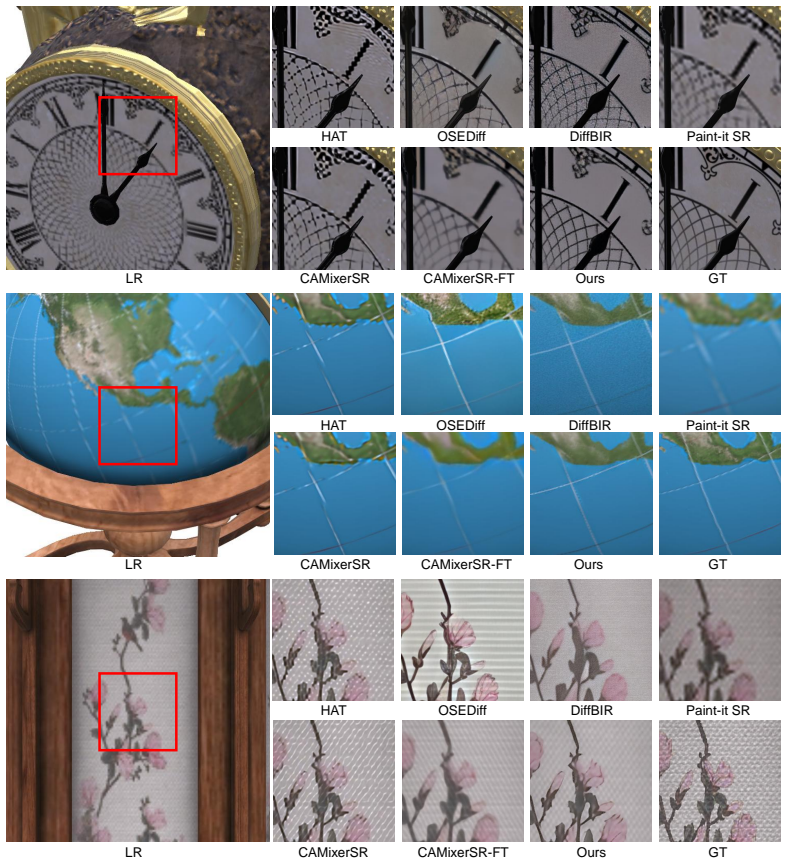
The central claim is that 2D image super-resolution priors can be transferred into 3D PBR texture space by a render-and-distill loop. From multiple viewpoints, the current high-resolution textures are rendered with a differentiable PBR rasterizer, and the same viewpoints are rendered with a conventional rasterizer and upscaled by a pretrained blind image restoration diffusion model to create pseudo-ground-truth images. Optimizing a robust pixel-wise loss between the two forces the texture maps to absorb the added high-frequency detail, while a PBR consistency loss that downsamples the refined maps back to low resolution preserves the input's structure and material identity. The result is a zero-shot super-resolution method that works on artist-designed and AI-generated meshes alike and supports relighting, which direct image super-resolution on texture maps cannot do.
Load-bearing premise
The load-bearing premise is that the pretrained 2D image enhancer produces upscaled example images whose fine detail is true material detail, not hallucination or baked lighting, and that this detail stays correct under lighting the optimizer never saw.
Editorial extensions
If this is right
- Any pretrained 2D image super-resolution model can be plugged into the same loop, so future super-resolution models can improve PBR-SR without retraining or architectural changes.
- PBR-SR upgrades both artist-designed legacy assets and AI-generated PBR textures, though generated textures with weak structural cues limit how much detail can be recovered.
- Because the output is material maps rather than baked appearance, the upsampled textures can be relit under new environments, which direct texture super-resolution and baked-texture super-resolution cannot do.
- The robust pixel weighting allows the optimization to tolerate multi-view inconsistencies and lighting artifacts in the pseudo-ground truths, which is the main reason view-based super-resolution approaches fail.
Reading between the lines
- Inference: the quantitative evaluation of rendering quality uses the same environment lighting for optimization and evaluation, so the relighting claim should be tested with held-out lighting before relying on it.
- Inference: the jointly optimized per-pixel weighting maps encode where the 2D prior is uncertain, and could be reused as confidence maps for material editing or for choosing better viewpoints in a second optimization pass.
- Inference: the same render-and-distill loop should extend to other material properties such as clearcoat, anisotropy, or displacement whenever a differentiable renderer and a pseudo-ground-truth generator exist for those channels.
Editorial analysis
A structured set of objections, weighed in public.
Referee Report
Summary. The paper proposes PBR-SR, a zero-shot method for super-resolving PBR texture maps (albedo, roughness, metallic, normal) on meshes. It initializes high-resolution textures by combining a pretrained image SR model (DiffBIR) on the albedo map with bicubic upsampling of the ARM and normal maps. It then renders the mesh from multiple viewpoints, uses DiffBIR to super-resolve those renderings into pseudo-ground-truth images, and iteratively optimizes the PBR textures so that differentiable renderings match those pseudo-GTs. A robust per-pixel weighting map is introduced to downweight unreliable regions, and PBR consistency and TV losses keep the SR textures faithful to the LR input. Experiments on a self-collected set of 16 PBR meshes report PSNR for albedo, roughness, metallic, normal, and renderings, and the authors claim consistent state-of-the-art performance and support for relighting.
Significance. If its claims hold, PBR-SR would be a practical contribution: it requires no training data, reuses off-the-shelf image SR priors, and directly outputs material maps that can be relit. The formulation is clean and the ablations show that each loss component contributes positively. However, the evidence in the paper is substantially thinner than the claims. The quantitative evaluation is PSNR-only on 16 meshes with no error bars or significance tests, the relighting claim is not tested quantitatively under held-out lighting, and the pseudo-GT supervision comes from the same DiffBIR model used for initialization. These are load-bearing gaps for the core claims of state-of-the-art performance and relighting support, not mere presentation issues.
major comments (3)
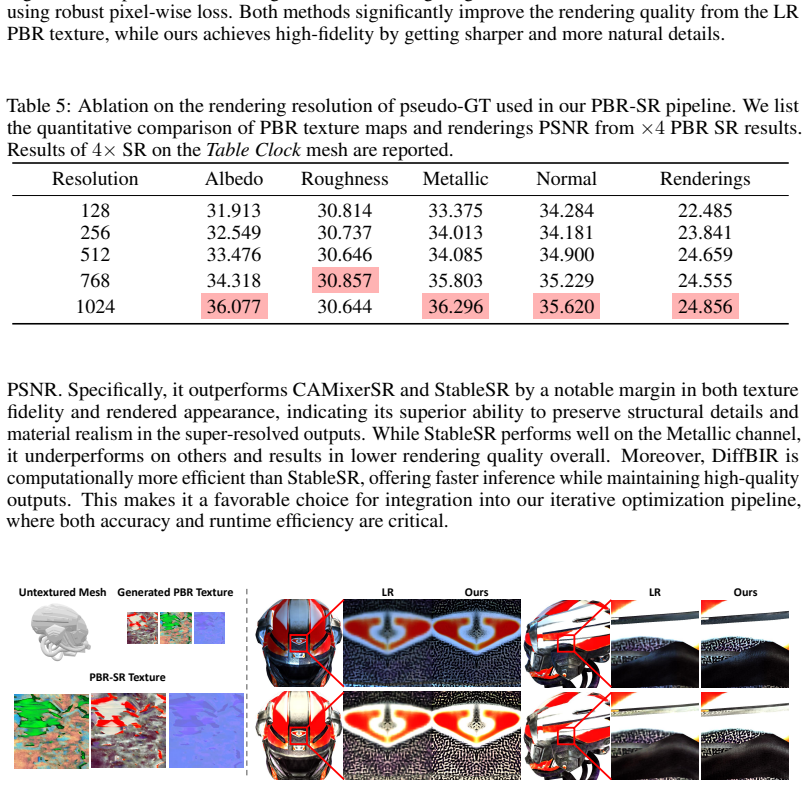
- [Sec. 4.1 and Table 1] The relighting claim is not supported by the evaluation. Sec. 4.1 states that 'Unless explicitly specified, the same environment lighting setup is used for both optimization and evaluation,' and Table 1's rendering PSNR is computed under that same environment. Under a fixed environment map, diffuse irradiance at a surface point is view-independent; only the specular term varies with view. Therefore the multi-view optimization in Eqs. (2)-(3) does not by itself separate material properties from lighting, and the PBR consistency loss in Eq. (6) only enforces pooled LR fidelity, not light invariance. High same-light rendering PSNR can be achieved by absorbing shading into albedo or encoding the fixed light direction into normal/roughness. The only relighting evidence is qualitative (Figs. 5, 6, 8) with no ground-truth or baseline comparison under novel lights. I recommend a held-out environment-map evaluation with quantitative metrics (e.g., PSNR/LPIPS against GT renderings under several unseen environment maps) and comparison to baselines before the 'supporting advanced applications such as relighting' claim is accepted.
- [Sec. 4.1 and Table 1] The state-of-the-art claim rests on a very thin evaluation. The dataset is a self-collected set of only 16 meshes, and Table 1 reports mean PSNR without standard deviations, per-mesh distributions, or significance tests. Several margins are small (e.g., Metallic 31.889 vs. 30.536 for HAT; Normal 29.088 vs. 28.237 for Paint-it SR), so the claim that PBR-SR 'consistently outperforms all baselines' is not statistically supported. In addition, hyperparameters (loss weights, DiffBIR adaptation, rendering resolution) appear to have been selected on the same collection, with Table 5 explicitly tuning resolution on the Table Clock mesh, and no separate validation split is described. The paper should report per-mesh results with uncertainty, run significance tests, and ideally evaluate on a larger or independently collected set.
- [Sec. 3.4 and Sec. 3.5] The supervision loop may limit the method's ability to recover genuine high-frequency material detail. The pseudo-GT images are produced by DiffBIR super-resolving renderings of the initial SR textures, and the albedo initialization is also DiffBIR-based. This creates a self-distillation loop: the optimization can only inject details that DiffBIR hallucinates or extrapolates, and those hallucinations can be baked into the PBR maps while Eq. (6) still passes because it only checks averaged LR fidelity. The paper does not analyze what happens when DiffBIR produces incorrect or inconsistent high-frequency content, nor does it compare against using a different SR prior for initialization versus pseudo-GT generation. I would like to see an explicit discussion or ablation that separates the contribution of the LR fidelity constraint from the prior's hallucinated details, for example by measuring how much of the PSNR gain comes from channels where DiffBIR is known to be unreliable.
minor comments (5)
- [Sec. 3.5.1] The notation in the text is reversed: the predicted rendering is called I^SR_i and the target pseudo-GT is called I^HR_i, but Eq. (3) uses I^SR_i as the target and I^HR_i as the prediction. Please align the notation.
- [Sec. 4.2] The evaluation metrics paragraph contains a typo: 'A higher PNSR value is better' should read 'PSNR'.
- [Supplementary Table 5] The ablation on rendering resolution is reported only on a single mesh (Table Clock). Please clarify that this is a single-mesh study and avoid drawing general conclusions from it without additional meshes.
- [Supplementary Fig. 5] The supplementary material contains a placeholder reference 'Fig. X' in the discussion of the robust pixel-wise loss; this should be fixed to the actual figure number.
- [Sec. 3.2] The handling of the ARM map is unclear: if AO is unavailable, an empty map is allocated in the red channel. Please specify how this placeholder interacts with the PBR consistency loss and the renderer, since an empty AO channel may introduce unintended shading.
Circularity Check
No significant circularity: the optimization is supervised by an external DiffBIR prior and LR-fidelity constraints, while the evaluation uses ground-truth HR PBR maps and renderings never seen by the optimizer.
full rationale
The paper's derivation chain is self-contained against an external benchmark. PBR-SR initializes SR maps from the LR input (Sec 3.2), renders multi-view images, and optimizes the maps to match DiffBIR pseudo-GT renderings (Eq. 3) while enforcing pooled-texture fidelity to the LR input (Eq. 6). None of these targets is the evaluation ground truth. Table 1 reports PSNR against ground-truth HR PBR maps and renderings from novel views ('utilizing PSNR to quantify the difference between renderings from SR PBR results and the ground truth PBR maps'), which the optimization never accesses. Eq. 6 anchors the output to the input but is a constraint, not an equivalence: the HR maps carry independent high-frequency content sourced from the external DiffBIR prior. DiffBIR [22] and the differentiable renderer [17] are external prior works, and there are no load-bearing self-citations or imported uniqueness theorems. The only caveat is that Sec 4.1 states 'Unless explicitly specified, the same environment lighting setup is used for both optimization and evaluation,' so the relighting claim in the abstract and Sec 5 is not quantitatively verified under novel lighting; this is a missing-support/correctness risk, not a circularity.
Assumptions & free parameters
free parameters (3)
- Loss balancing weights (lambda_pix, lambda_reg, lambda_pbr, lambda_tv, lambda_ssim, w_Km) =
100, 0.5, 10, 0.5, 10, 0.1
- DiffBIR adaptation (denoising steps, text prompt) =
5 denoising steps; modified prompts
- Optimization schedule and camera setup =
lr=1e-4, 2000 iterations, batch=4, camera distance 3.25, FoV 10 deg
assumptions (5)
- domain assumption The Cook-Torrance microfacet model and rendering equation adequately represent the material appearance being optimized.
- domain assumption DiffBIR, pretrained on natural images, produces pseudo-GT renderings whose high-frequency content can be transferred to PBR maps.
- domain assumption Supervision from a fixed set of camera views under one environment light generalizes to novel views and lighting.
- domain assumption Average-pooling consistency between SR and LR textures is a sufficient fidelity constraint.
- ad hoc to paper Bicubic upsampling is an adequate initialization for ARM and normal maps.
Cite this review
Pith. "Pith review of PBR-SR: Mesh PBR Texture Super Resolution from 2D Image Priors." pith.science (2026). https://pith.science/paper/RW6WL3ZL
@misc{pith2026250602846,
  author       = {Pith},
  title        = {Pith review of: PBR-SR: Mesh PBR Texture Super Resolution from 2D Image Priors},
  year         = {2026},
  howpublished = {\url{https://pith.science/paper/RW6WL3ZL}},
  note         = {Machine review of arXiv:2506.02846}
}
read the original abstract
We present PBR-SR, a novel method for physically based rendering (PBR) texture super resolution (SR). It outputs high-resolution, high-quality PBR textures from low-resolution (LR) PBR input in a zero-shot manner. PBR-SR leverages an off-the-shelf super-resolution model trained on natural images, and iteratively minimizes the deviations between super-resolution priors and differentiable renderings. These enhancements are then back-projected into the PBR map space in a differentiable manner to produce refined, high-resolution textures. To mitigate view inconsistencies and lighting sensitivity, which is common in view-based super-resolution, our method applies 2D prior constraints across multi-view renderings, iteratively refining the shared, upscaled textures. In parallel, we incorporate identity constraints directly in the PBR texture domain to ensure the upscaled textures remain faithful to the LR input. PBR-SR operates without any additional training or data requirements, relying entirely on pretrained image priors. We demonstrate that our approach produces high-fidelity PBR textures for both artist-designed and AI-generated meshes, outperforming both direct SR models application and prior texture optimization methods. Our results show high-quality outputs in both PBR and rendering evaluations, supporting advanced applications such as relighting.
Figures


Figures from the paper (5 more)




Reference graph
Works this paper leans on
-
[19]
3d appearance super- resolution with deep learning
Yawei Li, Vagia Tsiminaki, Radu Timofte, Marc Pollefeys, and Luc Van Gool. 3d appearance super- resolution with deep learning. InCVPR, pages 9671–9680, 2019
work page 2019
-
[1]
Cgtrader models.https://www.cgtrader.com
-
[2]
The gltf v2.0 sample models.https://github.com/KhronosGroup/glTF-Sample-Assets
-
[3]
Poly haven models.https://polyhaven.com/models
-
[4]
Ntire 2017 challenge on single image super-resolution: Dataset and study
Eirikur Agustsson and Radu Timofte. Ntire 2017 challenge on single image super-resolution: Dataset and study. InProceedings of the IEEE conference on computer vision and pattern recognition workshops, pages 126–135, 2017
2017
-
[5]
Pablo Arbelaez, Michael Maire, Charless Fowlkes, and Jitendra Malik. Contour detection and hierarchical image segmentation.IEEE transactions on pattern analysis and machine intelligence, 33(5):898–916, 2010
work page 2010
-
[6]
James F. Blinn. Models of light reflection for computer synthesized pictures. InSIGGRAPH, pages 192–198. ACM, 1977
work page 1977
-
[7]
Physically-based shading at disney
Brent Burley and Walt Disney Animation Studios. Physically-based shading at disney. InAcm Siggraph, volume 2012, pages 1–7. vol. 2012, 2012
work page 2012
Show all 41 references
-
[8]
Text2tex: Text-driven texture synthesis via diffusion models
Dave Zhenyu Chen, Yawar Siddiqui, Hsin-Ying Lee, Sergey Tulyakov, and Matthias Nießner. Text2tex: Text-driven texture synthesis via diffusion models. InProceedings of the IEEE/CVF International Confer- ence on Computer Vision, pages 18558–18568, 2023
2023
-
[9]
Hat: Hybrid attention transformer for image restoration.arXiv preprint arXiv:2309.05239, 2023
Xiangyu Chen, Xintao Wang, Wenlong Zhang, Xiangtao Kong, Yu Qiao, Jiantao Zhou, and Chao Dong. Hat: Hybrid attention transformer for image restoration.arXiv preprint arXiv:2309.05239, 2023
2023
-
[10]
Blender Foundation, Stichting Blender Foundation, Amsterdam, 2018
Blender Online Community.Blender - a 3D modelling and rendering package. Blender Foundation, Stichting Blender Foundation, Amsterdam, 2018
2018
-
[11]
Torrance
Robert L Cook and Kenneth E. Torrance. A reflectance model for computer graphics.ACM Transactions on Graphics (ToG), 1(1):7–24, 1982
1982
-
[12]
Srgs: Super-resolution 3d gaussian splatting.arXiv preprint arXiv:2404.10318, 2024
Xiang Feng, Yongbo He, Yubo Wang, Yan Yang, Wen Li, Yifei Chen, Zhenzhong Kuang, Jianping Fan, Yu Jun, et al. Srgs: Super-resolution 3d gaussian splatting.arXiv preprint arXiv:2404.10318, 2024
2024
-
[13]
Mambair: A simple baseline for image restoration with state-space model.arXiv preprint arXiv:2402.15648, 2024
Hang Guo, Jinmin Li, Tao Dai, Zhihao Ouyang, Xudong Ren, and Shu-Tao Xia. Mambair: A simple baseline for image restoration with state-space model.arXiv preprint arXiv:2402.15648, 2024
2024 arXiv
-
[14]
Decorate3d: Text-driven high-quality texture generation for mesh decoration in the wild
Yanhui Guo, Xinxin Zuo, Peng Dai, Juwei Lu, Xiaolin Wu, Li Cheng, Youliang Yan, Songcen Xu, and Xiaofei Wu. Decorate3d: Text-driven high-quality texture generation for mesh decoration in the wild. In Thirty-seventh Conference on Neural Information Processing Systems (NeurIPS), 2023
2023
-
[15]
Refsr-nerf: Towards high fidelity and super resolution view synthesis
Xudong Huang, Wei Li, Jie Hu, Hanting Chen, and Yunhe Wang. Refsr-nerf: Towards high fidelity and super resolution view synthesis. InProceedings of the IEEE/CVF Conference on Computer Vision and Pattern Recognition, pages 8244–8253, 2023
2023
-
[16]
Real shading in Unreal Engine 4
Brian Karis. Real shading in Unreal Engine 4. InSIGGRAPH Physically Based Shading in Theory and Practice course, 2013
2013
-
[17]
Modular primitives for high-performance differentiable rendering.ACM Transactions on Graphics, 39(6), 2020
Samuli Laine, Janne Hellsten, Tero Karras, Yeongho Seol, Jaakko Lehtinen, and Timo Aila. Modular primitives for high-performance differentiable rendering.ACM Transactions on Graphics, 39(6), 2020. 10
2020
-
[18]
Photo-realistic single image super- resolution using a generative adversarial network
Christian Ledig, Lucas Theis, Ferenc Huszár, Jose Caballero, Andrew Cunningham, Alejandro Acosta, Andrew Aitken, Alykhan Tejani, Johannes Totz, Zehan Wang, et al. Photo-realistic single image super- resolution using a generative adversarial network. InProceedings of the IEEE c...
2017
-
[20]
Swinir: Image restoration using swin transformer
Jingyun Liang, Jiezhang Cao, Guolei Sun, Kai Zhang, Luc Van Gool, and Radu Timofte. Swinir: Image restoration using swin transformer. InProceedings of the IEEE/CVF international conference on computer vision, pages 1833–1844, 2021
2021
-
[21]
Enhanced deep residual networks for single image super-resolution
Bee Lim, Sanghyun Son, Heewon Kim, Seungjun Nah, and Kyoung Mu Lee. Enhanced deep residual networks for single image super-resolution. InProceedings of the IEEE conference on computer vision and pattern recognition workshops, pages 136–144, 2017
2017
-
[22]
Diffbir: Toward blind image restoration with generative diffusion prior
Xinqi Lin, Jingwen He, Ziyan Chen, Zhaoyang Lyu, Bo Dai, Fanghua Yu, Yu Qiao, Wanli Ouyang, and Chao Dong. Diffbir: Toward blind image restoration with generative diffusion prior. InEuropean Conference on Computer Vision, pages 430–448. Springer, 2024
2024
-
[23]
Meshformer: High-quality mesh generation with 3d-guided reconstruction model.arXiv preprint arXiv:2408.10198, 2024
Minghua Liu, Chong Zeng, Xinyue Wei, Ruoxi Shi, Linghao Chen, Chao Xu, Mengqi Zhang, Zhaoning Wang, Xiaoshuai Zhang, Isabella Liu, et al. Meshformer: High-quality mesh generation with 3d-guided reconstruction model.arXiv preprint arXiv:2408.10198, 2024
2024 arXiv
-
[24]
Controlling vision- language models for universal image restoration.arXiv preprint arXiv:2310.01018, 3(8), 2023
Ziwei Luo, Fredrik K Gustafsson, Zheng Zhao, Jens Sjölund, and Thomas B Schön. Controlling vision- language models for universal image restoration.arXiv preprint arXiv:2310.01018, 3(8), 2023
2023 arXiv
-
[25]
Learning generative models of textured 3d meshes from real-world images
Dario Pavllo, Jonas Kohler, Thomas Hofmann, and Aurelien Lucchi. Learning generative models of textured 3d meshes from real-world images. InProceedings of the IEEE/CVF International Conference on Computer Vision, pages 13879–13889, 2021
2021
-
[26]
Morgan Kaufmann, August 2004
Matt Pharr and Greg Humphreys.Physically Based Rendering: From Theory to Implementation (The Interactive 3d Technology Series). Morgan Kaufmann, August 2004
2004
-
[27]
Illumination for computer generated pictures.Commun
Bui Tuong Phong. Illumination for computer generated pictures.Commun. ACM, 18(6):311–317, 1975
1975
-
[28]
Meta 3d assetgen: Text-to-mesh generation with high-quality geometry, texture, and pbr materials.arXiv preprint arXiv:2407.02445, 2024
Yawar Siddiqui, Tom Monnier, Filippos Kokkinos, Mahendra Kariya, Yanir Kleiman, Emilien Garreau, Oran Gafni, Natalia Neverova, Andrea Vedaldi, Roman Shapovalov, et al. Meta 3d assetgen: Text-to-mesh generation with high-quality geometry, texture, and pbr materials.arXiv prepri...
2024 arXiv
-
[29]
Texturify: Generating textures on 3d shape surfaces
Yawar Siddiqui, Justus Thies, Fangchang Ma, Qi Shan, Matthias Nießner, and Angela Dai. Texturify: Generating textures on 3d shape surfaces. InEuropean Conference on Computer Vision, pages 72–88. Springer, 2022
2022
-
[30]
Nerf-sr: High quality neural radiance fields using supersampling
Chen Wang, Xian Wu, Yuan-Chen Guo, Song-Hai Zhang, Yu-Wing Tai, and Shi-Min Hu. Nerf-sr: High quality neural radiance fields using supersampling. InProceedings of the 30th ACM International Conference on Multimedia, pages 6445–6454, 2022
2022
-
[31]
Chan, and Chen Change Loy
Jianyi Wang, Zongsheng Yue, Shangchen Zhou, Kelvin C.K. Chan, and Chen Change Loy. Exploiting diffusion prior for real-world image super-resolution. 2024
2024
-
[32]
Camixersr: Only details need more ”attention”
Yan Wang, Yi Liu, Shijie Zhao, Junlin Li, and Li Zhang. Camixersr: Only details need more ”attention”. InCVPR, pages 25837–25846, June 2024
2024
-
[33]
One-step effective diffusion network for real-world image super-resolution.arXiv preprint arXiv:2406.08177, 2024
Rongyuan Wu, Lingchen Sun, Zhiyuan Ma, and Lei Zhang. One-step effective diffusion network for real-world image super-resolution.arXiv preprint arXiv:2406.08177, 2024
2024 arXiv
-
[34]
Paint-it: Text-to-texture synthesis via deep con- volutional texture map optimization and physically-based rendering
Kim Youwang, Tae-Hyun Oh, and Gerard Pons-Moll. Paint-it: Text-to-texture synthesis via deep con- volutional texture map optimization and physically-based rendering. InProceedings of the IEEE/CVF Conference on Computer Vision and Pattern Recognition, pages 4347–4356, 2024
2024
-
[35]
Texture generation on 3d meshes with point-uv diffusion
Xin Yu, Peng Dai, Wenbo Li, Lan Ma, Zhengzhe Liu, and Xiaojuan Qi. Texture generation on 3d meshes with point-uv diffusion. InProceedings of the IEEE/CVF International Conference on Computer Vision, pages 4206–4216, 2023
2023
-
[36]
Gaussiansr: 3d gaussian super-resolution with 2d diffusion priors.arXiv preprint arXiv:2406.10111, 2024
Xiqian Yu, Hanxin Zhu, Tianyu He, and Zhibo Chen. Gaussiansr: 3d gaussian super-resolution with 2d diffusion priors.arXiv preprint arXiv:2406.10111, 2024. 11
2024 arXiv
-
[37]
Hit-sr: Hierarchical transformer for efficient image super- resolution.arXiv preprint arXiv:2407.05878, 2024
Xiang Zhang, Yulun Zhang, and Fisher Yu. Hit-sr: Hierarchical transformer for efficient image super- resolution.arXiv preprint arXiv:2407.05878, 2024
2024 arXiv
-
[38]
Image super-resolution using very deep residual channel attention networks
Yulun Zhang, Kunpeng Li, Kai Li, Lichen Wang, Bineng Zhong, and Yun Fu. Image super-resolution using very deep residual channel attention networks. InProceedings of the European conference on computer vision (ECCV), pages 286–301, 2018
2018
-
[39]
Dreammat: High-quality pbr material generation with geometry-and light-aware diffusion models.ACM Transactions on Graphics (TOG), 43(4):1–18, 2024
Yuqing Zhang, Yuan Liu, Zhiyu Xie, Lei Yang, Zhongyuan Liu, Mengzhou Yang, Runze Zhang, Qilong Kou, Cheng Lin, Wenping Wang, et al. Dreammat: High-quality pbr material generation with geometry-and light-aware diffusion models.ACM Transactions on Graphics (TOG), 43(4):1–18, 2024
2024
-
[40]
Selective hourglass mapping for universal image restoration based on diffusion model
Dian Zheng, Xiao-Ming Wu, Shuzhou Yang, Jian Zhang, Jian-Fang Hu, and Wei-Shi Zheng. Selective hourglass mapping for universal image restoration based on diffusion model. InProceedings of the IEEE/CVF Conference on Computer Vision and Pattern Recognition, pages 25445–25455, 2024
2024
-
[41]
Nerflix: High-quality neural view synthesis by learning a degradation-driven inter-viewpoint mixer
Kun Zhou, Wenbo Li, Yi Wang, Tao Hu, Nianjuan Jiang, Xiaoguang Han, and Jiangbo Lu. Nerflix: High-quality neural view synthesis by learning a degradation-driven inter-viewpoint mixer. InProceedings of the IEEE/CVF Conference on Computer Vision and Pattern Recognition, pages 12...
2023
Reviewed August 7, 2026 · model on record in the stance chip above.
Discussion (0). Sign in to comment.