REVIEW 3 major objections 4 minor 34 references
Inertia-driven propulsion of asymmetric spinner-dimers at moderate Reynolds numbers
T0 review · 3 major / 4 minor · reviewed 2026-08-07 · deepseek-v4-flash
Pith's one-line read Inertia turns purely rotating asymmetric sphere pairs into self-propelling dimers, with direction tunable by aspect ratio and Reynolds number.
desk verdict Solid LBM study with a genuinely new reversal result; the critical aspect ratio needs dimer-specific convergence checks before it is quantitative. read the letter →
The pith
A machine-rendered reading of the paper's core claim, the machinery that carries it, and where it could break.
The reading
What carries the argument
The carrier of the argument is the inertial secondary flow generated by a single rotating sphere: beyond the purely azimuthal Stokes flow, inertia creates a meridional circulation that draws fluid in at the poles and ejects it near the equator, approximated at small Re by $v_r(r)=-(\omega R^4/8r^2)(3\cos^2\psi-1)(1-R/r)^2\,\mathrm{Re}$ plus the corresponding polar component. When two spheres of different radii share an axis, the unequal secondary flows at the two ends break head-to-tail symmetry, yielding a net hydrodynamic force along the axis. The scaling for the counter-rotating swimmer is built by subtracting the radial flows at the front and rear, giving $\mathrm{Re}_T\cdot\alpha^3/(1-\alpha^3)\sim\mathrm{Re}^2$, and the mechanism analysis identifies two regimes: polar pull at low Re and equatorial jet push at high Re.
What would settle it
Run the co-rotating dimer simulation at Re≈53 in boxes of side 30R and 40R with the same lattice spacing and compare the steady velocity for α=0.7 and α=0.94; if the direction switch disappears or the crossing moves far from α≈0.82, the claimed reversal boundary fails. Alternatively, a tabletop experiment with magnetically driven colloids at Re of order 50 could look for the same reversal as the size ratio is tuned.
Extended reading notes
Core claim
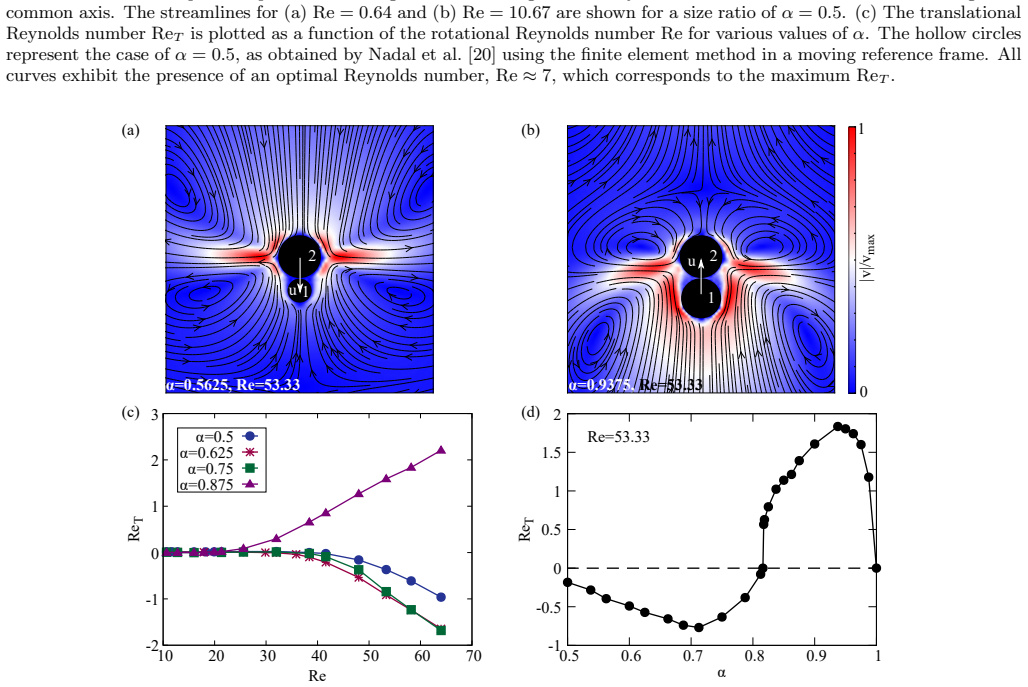
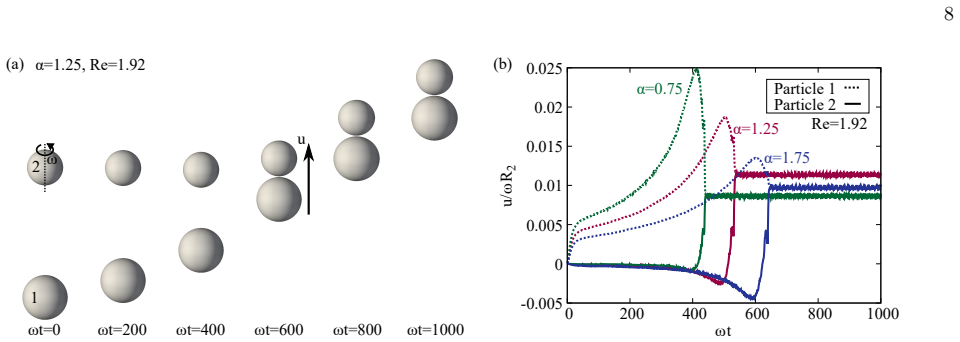
The central claim is that a snowman dimer of two spheres rotating about their common axis translates along that axis whenever inertial secondary flows are significant and the spheres differ in size. For two externally driven co-rotating spheres, the dimer moves toward the larger sphere at low Re, reaches a peak speed near Re≈7, then decelerates; above Re≈20 the direction becomes aspect-ratio dependent, reversing at α≈0.82 for Re=53.33. For a force-free swimmer of two counter-rotating spheres, the dimer always moves toward the smaller sphere, and its translational Reynolds number follows the scaling ReT·α³/(1−α³)∼Re² for Re<5. For a single spinner and a passive cargo, the two spheres first attract, then translate together, with an optimal cargo size ratio between roughly 1.2 and 1.5 that grows with Re. Throughout, the propulsion mechanism shifts from fluid pulled in at the poles at low Re to equatorial jets at high Re, with head-to-tail asymmetry as the common driver.
Load-bearing premise
The results assume that the periodic box of side L=20R and the repulsive contact gap between spheres do not significantly distort the high-Reynolds-number jet flows that set the direction-reversal boundary; if they do, the critical aspect ratio α≈0.82 at Re=53 is not quantitatively robust.
Editorial extensions
If this is right
- A purely rotating asymmetric dimer is a swimmer only when inertia matters; in the Stokes limit it remains stationary.
- The propulsion direction of the externally driven co-rotating dimer can be selected by geometry and rotation rate, with a reversal boundary near α≈0.82 at Re≈53.
- The force-free counter-rotating swimmer always swims toward the smaller sphere, with speed set by the volume asymmetry and controlled by the Re² scaling at low Re.
- A single spinner can pick up and carry a passive particle, with an optimal cargo size near α≈1.2–1.5 that increases with Reynolds number.
- Both propulsion regimes (low-Re polar pulling and high-Re equatorial jet pushing) still obey the same principle, so the design rules carry over across Reynolds numbers.
Reading between the lines
- The reversal boundary at α≈0.82 is likely to shift near confining walls, since the paper notes wall-induced secondary flows may tilt the equatorial jet; a wall could either suppress or enhance the reversal depending on separation.
- The clean α³/(1−α³) collapse for the counter-rotating swimmer suggests the net force is proportional to the difference in sphere volumes; this can be tested experimentally by measuring swim speed as a function of size ratio at fixed torque.
- The cargo-carrying result opens a direct extension to multi-particle transport: a spinner might bind a chain of passive particles, with the optimal payload size growing with Re; the paper does not explore collective cargo loading.
- At even higher Re, the single-spinner jet may become unstable or break axisymmetry, which would modify the dimer propulsion; the paper stops at Re≈100, so the onset of wake asymmetry is a natural next check.
Editorial analysis
A structured set of objections, weighed in public.
Referee Report
Summary. The paper uses lattice Boltzmann simulations (the open-source Ludwig code) to study three rotating-sphere dimer configurations at moderate rotational Reynolds numbers (Re up to roughly 65–80): (i) a co-rotating snowman dimer driven by an external field, (ii) a counter-rotating, torque- and force-free swimmer, and (iii) a single spinner with a passive cargo sphere. The single-sphere flow is validated against Bickley's asymptotic secondary-flow solution and against prior numerical data of Liu & Prosperetti; the low-Re co-rotating dimer is validated against Nadal et al. The main new results are: the co-rotating dimer can reverse its propulsion direction for Re>20, with a critical aspect ratio alpha≈0.82 at Re=53.33; the counter-rotating swimmer translates toward the smaller sphere and obeys a scaling Re_T alpha^3/(1-alpha^3) ~ Re^2 for Re<5; and the spinner-passive cargo dimer translates with a non-monotonic speed as a function of cargo size, with an optimal alpha* that increases with Re.
Significance. If the numerical results are robust, the paper makes a useful contribution to inertial propulsion at moderate Reynolds numbers: it demonstrates a purely geometric and inertia-based direction switch in a simple dimer, gives a clean scaling collapse for the counter-rotating swimmer, and identifies a mechanism for cargo transport by a single spinner. The manuscript has real strengths: the method is validated against an exact asymptotic solution for a single sphere, the low-Re co-rotating results agree with an independent finite-element study, the scaling law is derived from the Bickley secondary flow and then checked against the simulation collapse rather than imposed, and the code is open source. The principal weakness is that the headline quantitative claim—the reversal boundary at alpha≈0.82—is not backed by dimer-specific convergence or uncertainty tests, so the significance is contingent on those tests being supplied.
major comments (3)
- [Results, 'Two co-rotating spheres', Figs. 2 and 4] The reversal boundary alpha≈0.82 at Re=53.33 is a central quantitative result, but no dimer-specific finite-size, resolution, or contact-gap sensitivity study is presented. The only convergence test, Fig. 2a, is for a single sphere and measures the polar radial velocity profile, not the equatorial jet tilt that controls the reversal in Fig. 4a,b. For alpha=0.5–0.5625 the smaller sphere has a radius of only 4–4.5Δx (with R=8Δx), and the repulsive cutoff of 0.5Δx leaves a bound-state gap of order one lattice spacing. These factors could plausibly shift the jet tilt and hence the zero crossing in Fig. 4d. Since the tunable direction is the paper's headline claim, the authors should provide at least one L=30R or L=40R dimer run near Re≈53 and alpha≈0.82, and a resolution test with a larger R in lattice units.
- [Results, 'Two co-rotating spheres', Fig. 3c] The text explicitly attributes the high-Re deviations from Nadal et al. to 'periodic boundary effects, numerical resolution, or the surface distance between the spheres' without quantifying any of these three effects. Because these same effects are exactly those that could shift the reversal threshold in Fig. 4d, the manuscript should either quantify them for the dimer configuration or soften the quantitative reading of the reversal boundary. As written, the admitted discrepancy leaves the high-Re extension of the validated low-Re regime unsupported.
- [Numerical Methods; all results] No error bars, multiple realizations, or time-averaging windows are reported for any of the measured translational velocities. The zero crossing in Fig. 4d is read from a single set of curves, so the precision of the stated alpha≈0.82 is not established. At minimum, the authors should describe how u was time-averaged in the steady state and, for the reversal cases, repeat the runs with independent initial conditions or different grid phasing to assess the sensitivity of the critical alpha.
minor comments (4)
- [Numerical Methods and Validation, Eqs. (1)–(3)] The spherical velocity components are labelled vθ, vr and vψ without defining ψ; since sinψ and cosψ appear, ψ is evidently the polar angle, but the notation should be made explicit and consistent across the equations and the accompanying text.
- [All figures] The symbol for the translational Reynolds number is typeset inconsistently (ReT in some caption text, Re_T on some axes); a single notation should be used throughout.
- [Data Availability] The data availability statement lists only the Ludwig code, not the input scripts, parameter files, or raw output data for the specific runs shown. Providing these would make the quantitative figures reproducible and would strengthen the paper.
- [Conclusions] The concluding statement places the explored range at 'Re≈0...100', but the largest rotational Reynolds number actually reported in the figures appears to be about 65–80; the statement should be checked against the parameter ranges used in Figs. 3–5.
Circularity Check
No significant circularity: all quantitative claims are simulation results or are derived from independent analytic benchmarks; self-citations are methodological and not load-bearing.
full rationale
The paper's central quantitative results are read from lattice-Boltzmann simulations and benchmarked against external work: the single-sphere secondary flow is validated against Bickley's asymptotic solution and Liu & Prosperetti's results; the low-Re co-rotating dimer propulsion is compared with Nadal et al.'s finite-element data; the high-Re direction reversal and the threshold α≈0.82 are read directly from the simulated Re_T-versus-α curve (Fig. 4d), not imposed or fitted. The counter-rotating scaling law Re_T·α^3/(1−α^3) ∼ Re^2 is derived from the independently established Bickley secondary-flow scaling and then checked against the simulated data collapse (Fig. 5e), so the check is not circular. Self-citations (refs 19, 24, 25, 27) are used only for simulation methodology (short-range repulsion) and for the general fact that secondary flows arise in rotating-sphere systems; they do not supply the reversal threshold, the optimal aspect ratios, or the scaling collapse. The absence of a dimer-specific finite-size/resolution study for the high-Re jet flows concerns numerical robustness of the reversal boundary, not circularity. No step in the paper reduces a claimed prediction to its own inputs.
Assumptions & free parameters
free parameters (2)
- Particle contact separation set by repulsion cutoff =
0.5 delta-x
- Lattice resolution for the larger sphere =
R = 8 delta-x
assumptions (4)
- domain assumption No-slip boundary condition on particle surfaces via bounce-back on links
- domain assumption Incompressible Navier-Stokes dynamics captured by the lattice Boltzmann method accurately describe moderate-Re inertial flows
- standard math Bickley asymptotic secondary-flow solution (Eqs. 1-3) is a valid low-Re description
- ad hoc to paper Periodic boundary conditions at L=20R do not qualitatively alter dimer propulsion at high Re
Cite this review
Pith. "Pith review of Inertia-driven propulsion of asymmetric spinner-dimers at moderate Reynolds numbers." pith.science (2026). https://pith.science/paper/XOZ3CBQA
@misc{pith2026250602851,
  author       = {Pith},
  title        = {Pith review of: Inertia-driven propulsion of asymmetric spinner-dimers at moderate Reynolds numbers},
  year         = {2026},
  howpublished = {\url{https://pith.science/paper/XOZ3CBQA}},
  note         = {Machine review of arXiv:2506.02851}
}
read the original abstract
We investigate the translational motion of rotating colloidal systems at moderate Reynolds numbers (Re), focusing on particle dimers in snowman-like configurations under three scenarios: (i) two co-rotating spheres driven by an external field, (ii) two counter-rotating spheres driven by an internal torque as a swimmer, and (iii) a single rotating spinner with a passive sphere for cargo delivery, using hydrodynamic simulations. In all the three cases, the particles are bound together hydrodynamically, and the purely rotational motion of the spinners produces a net propulsion of the dimers along the axis of rotation due to a symmetry breaking. We demonstrate tunable dynamics, where the propulsion direction of the co-rotating dimer can be reversed by tuning the aspect ratio and Reynolds number, as well as cargo transport where a dimer consisting of a single spinner and a passive cargo particle can have a sustained locomotion due to broken head-to-tail symmetry of the overall flow fields. These findings highlight the critical role of inertia in creating locomotion from rotational motion and offer new avenues for controlling and optimizing translational motion in colloidal assemblies through rotational degrees of freedom.
Figures


Figures from the paper (4 more)


Reference graph
Works this paper leans on
-
[1]
Once they come into contact, the two particles move forward together
is drawn toward the rotating particle by hydrodynamic interactions. Once they come into contact, the two particles move forward together. (b) The velocity of the resulting two-particle assembly is shown for different size ratiosα= 0.75,α= 1.25, andα= 1.75. In each case, a constant velocity is eventually reached in the final state. Re=32 Re=16 Re=3.2 Re=1....
-
[2]
Lauga, Bacterial hydrodynamics, Annual Review of Fluid Mechanics48, 105 (2016)
E. Lauga, Bacterial hydrodynamics, Annual Review of Fluid Mechanics48, 105 (2016)
work page 2016
-
[3]
Lauga and T
E. Lauga and T. R. Powers, The hydrodynamics of swim- ming microorganisms, Reports on Progress in Physics72, 096601 (2009)
2009
- [4]
-
[5]
Dreyfus, J
R. Dreyfus, J. Baudry, M. L. Roper, M. Fermigier, H. A. Stone, and J. Bibette, Microscopic artificial swimmers, Nature437, 862 (2005)
2005
-
[6]
D. Klotsa, As above, so below, and also in between: mesoscale active matter in fluids, Soft Matter15, 8946 (2019). 9
work page 2019
-
[7]
N. J. Derr, T. Dombrowski, C. H. Rycroft, and D. Klotsa, Reciprocal swimming at intermediate reynolds number, Journal of Fluid Mechanics952, A8 (2022)
work page 2022
-
[8]
P. Chen, S. Weady, S. Atis, T. Matsuzawa, M. J. Shel- ley, and W. T. Irvine, Self-propulsion, flocking and chi- ral active phases from particles spinning at intermediate reynolds numbers, Nature Physics , 1 (2024)
work page 2024
Show all 34 references
-
[9]
L¨ owen, Inertial effects of self-propelled particles: From active brownian to active langevin motion, The Journal of Chemical Physics152, 040901 (2020)
H. L¨ owen, Inertial effects of self-propelled particles: From active brownian to active langevin motion, The Journal of Chemical Physics152, 040901 (2020)
2020
-
[10]
E. M. Purcell, The efficiency of propulsion by a rotat- ing flagellum, Proceedings of the National Academy of Sciences94, 11307 (1997)
1997
-
[11]
Klumpp, C
S. Klumpp, C. T. Lef` evre, M. Bennet, and D. Faivre, Swimming with magnets: from biological organisms to synthetic devices, Physics Reports789, 1 (2019)
2019
-
[12]
Bricard, J.-B
A. Bricard, J.-B. Caussin, N. Desreumaux, O. Dauchot, and D. Bartolo, Emergence of macroscopic directed mo- tion in populations of motile colloids, Nature503, 95 (2013)
2013
-
[13]
Rodenborn, C.-H
B. Rodenborn, C.-H. Chen, H. L. Swinney, B. Liu, and H. Zhang, Propulsion of microorganisms by a helical flag- ellum, Proceedings of the National Academy of Sciences 110, E338 (2013)
2013
-
[14]
Driscoll, B
M. Driscoll, B. Delmotte, M. Youssef, S. Sacanna, A. Donev, and P. Chaikin, Unstable fronts and motile structures formed by microrollers, Nature Physics13, 375 (2017)
2017
-
[15]
Kaiser, A
A. Kaiser, A. Snezhko, and I. S. Aranson, Flocking ferro- magnetic colloids, Science Advances3, e1601469 (2017)
2017
-
[16]
B. A. Grzybowski, H. A. Stone, and G. M. Whitesides, Dynamic self-assembly of magnetized, millimetre-sized objects rotating at a liquid–air interface, Nature405, 1033 (2000)
2000
-
[17]
Alapan, U
Y. Alapan, U. Bozuyuk, P. Erkoc, A. C. Karacakol, and M. Sitti, Multifunctional surface microrollers for tar- geted cargo delivery in physiological blood flow, Science Robotics5, eaba5726 (2020)
2020
-
[18]
W.-Z. Fang, S. Ham, R. Qiao, and W.-Q. Tao, Magnetic actuation of surface walkers: The effects of confinement and inertia, Langmuir36, 7046 (2020)
2020
-
[19]
Goto and H
Y. Goto and H. Tanaka, Purely hydrodynamic ordering of rotating disks at a finite reynolds number, Nature Com- munications6, 5994 (2015)
2015
-
[20]
Nadal, O
F. Nadal, O. S. Pak, L. Zhu, L. Brandt, and E. Lauga, Rotational propulsion enabled by inertia, The European Physical Journal E37, 1 (2014)
2014
-
[21]
Shen and J
Z. Shen and J. S. Lintuvuori, Collective flows drive cav- itation in spinner monolayers, Physical Review Letters 130, 188202 (2023)
2023
-
[22]
Liu and A
Q. Liu and A. Prosperetti, Wall effects on a rotating sphere, Journal of Fluid Mechanics657, 1 (2010)
2010
-
[23]
Bickley, Lxv
W. Bickley, Lxv. the secondary flow due to a sphere ro- tating in a viscous fluid, The London, Edinburgh, and Dublin Philosophical Magazine and Journal of Science 25, 746 (1938)
1938
-
[24]
Z. Shen, A. W¨ urger, and J. S. Lintuvuori, Hydrodynamic interaction of a self-propelling particle with a wall: Com- parison between an active janus particle and a squirmer model, The European Physical Journal E41, 1 (2018)
2018
-
[25]
Henrich, jlintuvuori, dmarendu, qikaifzj, austin1997, shanCHEN123, ludwig cf, jurijsab, S
kevinstratford, O. Henrich, jlintuvuori, dmarendu, qikaifzj, austin1997, shanCHEN123, ludwig cf, jurijsab, S. G. Leyva, and sumeshpt, ludwig-cf/ludwig: Ludwig 0.22.0 (2024)
2024
-
[26]
Climent, K
E. Climent, K. Yeo, M. R. Maxey, and G. E. Karniadakis, Dynamic self-assembly of spinning particles, Journal of Fluids Engineering129, 379 (2006)
2006
-
[27]
Z. Shen, A. W¨ urger, and J. S. Lintuvuori, Hydrodynamic self-assembly of active colloids: chiral spinners and dy- namic crystals, Soft Matter15, 1508 (2019)
2019
-
[28]
L. Kroo, J. P. Binagia, N. Eckman, M. Prakash, and E. S. Shaqfeh, A freely suspended robotic swimmer propelled by viscoelastic normal stresses, Journal of Fluid Mechan- ics944, A20 (2022)
2022
-
[29]
Shen and J
Z. Shen and J. S. Lintuvuori, Hydrodynamic cluster- ing and emergent phase separation of spherical spinners, Physical Review Research2, 013358 (2020)
2020
-
[30]
Goychuk, V
I. Goychuk, V. O. Kharchenko, and R. Metzler, Molec- ular motors pulling cargos in the viscoelastic cytosol: how power strokes beat subdiffusion, Physical Chemistry Chemical Physics16, 16524 (2014)
2014
-
[31]
J. P. Binagia and E. S. Shaqfeh, Self-propulsion of a freely suspended swimmer by a swirling tail in a viscoelastic fluid, Physical Review Fluids6, 053301 (2021)
2021
-
[32]
The color map represents the magnitude of the secondary flow normalized by the maximum radial velocity obtained from the asymptotic solution. -1 -0.5 0 0 5 10 15 20 vr/vm r L=20R L=30R L=40R BickleyRe=0.0128 Re=0.8 Re=32 0.0001 0.001 0.01 0.1 1 0.01 0.1 1 10 100 max|vr/ωR| Re ...
-
[33]
G. Li, E. Lauga, and A. M. Ardekani, Microswimming in viscoelastic fluids, Journal of Non-Newtonian Fluid Me- chanics297, 104655 (2021)
2021
-
[34]
Theeyancheri, R
L. Theeyancheri, R. Sahoo, P. Kumar, and R. Chakrabarti, In silico studies of active probe dynamics in crowded media, ACS omega7, 33637 (2022)
2022
Reviewed August 7, 2026 · model on record in the stance chip above.
Discussion (0). Sign in to comment.