REVIEW 3 major objections 5 minor 1 cited by
Distributed Retraction-Free and Communication-Efficient Optimization on the Stiefel Manifold
T0 review · 3 major / 5 minor · reviewed 2026-08-07 · deepseek-v4-flash
Pith's one-line read The paper proposes EF-Landing, a distributed retraction-free algorithm for optimization on the Stiefel manifold that compresses communicated gradients while provably retaining the same O(1/√(NK)) linear speedup rate as uncompressed methods.
desk verdict EF-Landing is a genuine algorithmic contribution with a concrete, fixable proof gap in Lemma 5.8; it deserves review, but the theorem proofs need repair and the experiments need more rigor. read the letter →
The pith
A machine-rendered reading of the paper's core claim, the machinery that carries it, and where it could break.
The reading
What carries the argument
The load-bearing object is the Landing descent direction Λ(X) = grad f(X) + λ∇N(X), whose two components are Frobenius-orthogonal for every X; EF-Landing compresses the Euclidean gradient ∇f(X) and plugs the compressed g into grad(g) = skew(gX^T)X, preserving that orthogonality via Proposition 4.1. Convergence is carried by a merit function bound (Lemma 5.8) that lower-bounds ⟨Λ̃(X;g), ∇m(X)⟩, isolating the compression error ∥g − ∇f(X)∥²_F, together with a Lyapunov function that adds per-node compression error, momentum error, and master error to the merit decrease, and a uniform safe step size (Lemma 5.7) that keeps iterates inside the safe region St(p,n)ϵ.
What would settle it
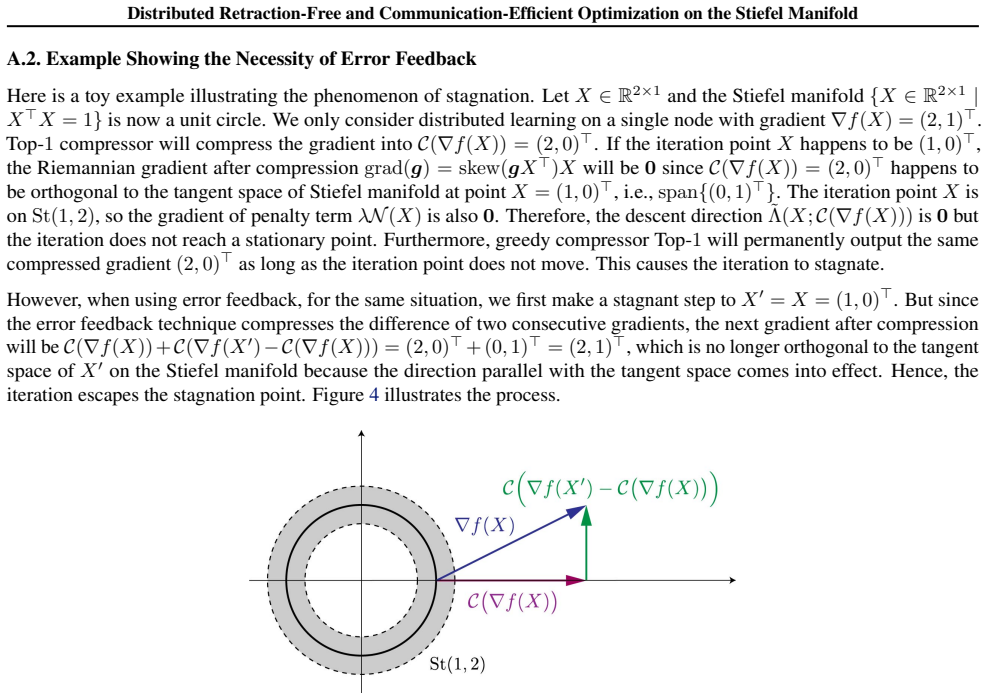
For a smooth objective on a Stiefel manifold with a contractive compressor, construct an instance satisfying all assumptions except that the true gradient bound exceeds the asserted L′; if the step size chosen from the smaller L′ drives iterates out of the safe region or stops convergence, the uniform safe-step-size lemma fails. Alternatively, run the single-node toy example of Appendix A.2 with gradient ∇f = (2,1)^T, the Top-1 compressor, and starting point X = (1,0)^T: if vanilla gradient compression converges rather than stagnating, the claimed necessity of error feedback is refuted.
Extended reading notes
Core claim
The authors establish that for the Landing descent direction Λ(X) = grad f(X) + λ∇N(X), the orthogonality between the Riemannian component gradf(X) = skew(∇f(X)X^T)X and the penalty component ∇N(X) = X(X^T X − I_p) survives communication compression only if one compresses the Euclidean gradient g rather than the whole direction: ⟨skew(gX^T)X, X(X^T X − I_p)⟩ = 0 for every g. They further show that vanilla gradient compression can make iterates stagnate, because a greedy compressed gradient may lie entirely in the orthogonal complement of the tangent space, and prove that error feedback overcomes this. With momentum error feedback and gradient clipping, the merit-function analysis yields a uniform safe step size and a Lyapunov decrease giving O(1/K) in deterministic settings and O(1/√(NK)) linear speedup in stochastic settings, with the compressor's effect confined to higher-order terms.
Load-bearing premise
The entire guarantee rests on Assumption 5.1: every stochastic gradient inside the safe region is uniformly bounded by a known constant L′, which fixes the safe step size and the clipping threshold, and if no finite L′ exists or is unknown, the stated rates do not follow.
Editorial extensions
If this is right
- EF-Landing achieves the same O(1/√(NK)) linear speedup rate as uncompressed stochastic Landing, so communication compression does not change the convergence order.
- In deterministic settings EF-Landing converges at O(1/K), matching the vanilla Landing rate with exact constants when the compressor is the identity.
- Error feedback is necessary for convergence under contractive compression on the Stiefel manifold, even in a deterministic single-node setting, unlike unconstrained optimization.
- The same rates carry over to block-wise Stiefel manifolds, so orthogonally constrained neural-network layers and other structured constraints inherit the guarantees.
- Aggressive compression (θ → 0) slows the constants but not the asymptotic rate, and the influence of the compressor appears only in higher-order terms of the stochastic bound.
Reading between the lines
- The Euclidean-gradient compression insight likely transfers to other retraction-free penalty-based manifold algorithms whose descent directions share the same orthogonal decomposition into a skew-symmetric and a symmetric penalty term.
- The stagnation phenomenon suggests a manifold-aware compressor that projects onto the current tangent space before applying Top-K or Rand-K could avoid the error-feedback overhead entirely, a testable algorithmic variant not explored in the paper.
- Because the experiments set the clipping bound L′ to 10^8, effectively disabling clipping, the theoretical dependence on Assumption 5.1 is empirically untested; a tight L′ may change convergence behavior in ways the paper does not probe.
Editorial analysis
A structured set of objections, weighed in public.
Referee Report
Summary. The paper proposes EF-Landing, a distributed error-feedback version of the retraction-free Landing method for optimization on the Stiefel manifold. Workers compress their Euclidean gradient estimates with a contractive compressor, the master aggregates the compressed gradients and forms the Landing descent direction, and a clipping step keeps iterates in a safe region around the manifold. The main theoretical contributions are a deterministic O(1/K) rate and a stochastic O(1/sqrt(NK)) linear-speedup rate that match the uncompressed Landing algorithm, plus an extension to block-wise Stiefel constraints. The analysis is built on a merit function and a Lyapunov function that track momentum, stochastic, and compression errors.
Significance. If the rate statements are correct, the paper provides a clean answer to the two questions it poses: the Euclidean gradient (rather than the composed Landing direction) is the right object to compress, and error feedback is necessary. Matching the asymptotic rate of uncompressed Landing is a meaningful result, as it shows the Stiefel constraint need not degrade the linear-speedup behavior achieved by error-feedback methods in unconstrained problems. The proof is detailed and mostly self-contained, and the rates are derived rather than fitted; the reduction to vanilla Landing in Corollary 5.12 is a useful consistency check. The main caveats are a localized algebra error in the merit-function bound, a mismatch between the theoretical step-size condition and the experimental step sizes, and an unsupported claim in the block-wise extension.
major comments (3)
- [Appendix B.2, Eq. (41)] The displayed simplification in Eq. (41) is a false inequality. From the estimates above (40), with sigma_1 <= sqrt(1+epsilon) and L, L' <= Lhat, the negative term is bounded below by -Lhat^2 (1+epsilon) (1+sqrt(1+epsilon))^2 / (1-epsilon), not by -4 Lhat^2 (1+epsilon). The displayed denominator 2-(1-epsilon) equals 1+epsilon, whereas the valid lower bound on 2-sigma_1^2 is 1-epsilon; and (L'+L sigma_1)^2 is bounded by Lhat^2 (1+sqrt(1+epsilon))^2, not by 4(1+epsilon) Lhat^2. For epsilon=0.1, sigma_1=sqrt(1.1), L=L'=Lhat, the left side of the claimed inequality in (41) is about 5.13 Lhat^2 while the right side is 4.4 Lhat^2. Consequently the stated mu condition (42) does not follow from the displayed algebra. The gap is repairable by replacing (42) with mu >= [2L(1-epsilon) + 6 sqrt(1+epsilon) L' + (1+epsilon)(1+sqrt(1+epsilon))^2 Lhat^2/(lambda(1-epsilon))] / (3-4epsilon), which preserves the subsequent Lyapunov argument and the rates. As written, however, Lemma 5.8, and therefore Theorem 5.9 and all downstream rate theorems, rest on an unproven step.
- [Section 7 and Appendix D, Tables 2-8] The numerical experiments do not instantiate the step-size regime of the theorems. Lemma 5.7 requires gamma <= gamma_s, with gamma_s of order lambda(1-epsilon)epsilon / ((1+epsilon)^2 (L')^2). With the reported clipping bound L'=10^8 and lambda around 1, gamma_s is on the order of 10^{-16}, yet the experiments use gamma=1.0 or 0.1 (sometimes with decay). The statement in Section 7 that overestimating L' does not incur any loss is the opposite of the lemma's implication: overestimating L' shrinks the allowed uniform step size. The experiments may still be indicative of practical behavior, but they do not validate the theorem's step-size condition. Please either recompute gamma_s from an actual L' or state explicitly that the experiments operate outside the theoretical step-size range.
- [Appendix C.2, around Eq. (75)] The proof of Theorem C.1 relies on the assertion that partial h_j / partial X_k = 0 for k != j, where h_j(X_j) = (1/2) <sym(X_j^T partial f / partial X_j), X_j^T X_j - I>. This is false for a general objective f in problem (13), because partial f / partial X_j typically depends on all blocks, as it does in the convolutional networks of Section 7.2. The cross-block terms in the gradient of the block-wise merit function are therefore omitted from the lower bound (75), so the block-wise theorem is not proven as stated. Either add a block-separability assumption, for example f(X_1,...,X_J;x) = sum_j f_j(X_j) + f_0(x), or extend the merit-function calculation to include the cross terms; with the current text, Theorem C.1 is unsupported.
minor comments (5)
- [Section 2] There is a typo in the Related Work paragraph: 'Optimal compelxity with communicaiton compression' should be 'Optimal complexity with communication compression'.
- [Section 7.1 versus Appendix D.1.2] The main text says the penalty parameter lambda was set to 1 for EF-Landing, while Tables 2-5 in Appendix D.1.2 report lambda=0.5 for the same experiments; please reconcile this discrepancy.
- [Appendix B.2] There is a spelling error: 'sigular values' should be 'singular values' in the text around Eq. (40).
- [Appendix C.2, Eq. (80)] The summation over j appears to start at j=0 in the constraint-violation term, but the block-wise quantities N_j are defined only for j=1,...,J; please correct the index range.
- [Abstract and Section 2] The abstract describes EF-Landing as the 'first' retraction-free and communication-efficient algorithm for distributed stochastic optimization on the Stiefel manifold; in light of the cited works on compression and decentralized manifold methods, please either substantiate the firstness claim precisely or qualify it.
Circularity Check
No significant circularity: the EF-Landing convergence rates are derived from a Lyapunov argument and are not fitted or definitionally tied to their conclusions.
full rationale
The central convergence claims (Theorems 5.9, 5.11, 5.14, and 5.16) are obtained by telescoping a Lyapunov function built from the merit function, momentum and compression error terms, and explicit step-size conditions. The gradient-norm and feasibility rates follow from the coefficients in the Lyapunov descent inequality rather than from any fitted parameter or from a quantity defined in terms of the target rate. The paper does cite earlier Landing work, including Ablin et al. 2024, on which one current co-author (Bin Gao) also appears; that citation supplies the safe-region definition and parts of the merit-function calculus. However, this is a published, externally checkable result and does not itself assert the EF-Landing rates; the EF-Landing-specific compression and error-feedback analysis is carried out in the present appendices. No step was found in which Eq. X equals Eq. Y by construction or in which a fitted input is renamed as a prediction. A separate mathematical concern exists: the inequality in Eq. (41) of Appendix B.2 appears numerically false for some choices of epsilon and sigma_1, which would leave Lemma 5.8 unproved as written; that is a correctness or rigor issue, not a circularity issue, and it does not affect the circularity score. Similarly, the experimental use of L' = 1e8 with gamma = 1 outside the conditions of Lemma 5.7 is a validation/theory mismatch rather than circular reasoning.
Assumptions & free parameters
free parameters (6)
- penalty coefficient lambda =
0.5 or 1.0 in experiments (8.0 for the penalty-method baseline)
- merit-function coefficient mu =
not instantiated; lower-bounded in Lemma 5.8
- gradient clipping bound L' =
1e8 in experiments
- momentum rate eta =
0.1 or 0.5 in experiments
- step size gamma =
0.1 or 1.0 in experiments
- compressor retention ratio or quantization level =
0.1 or 0.2 for Top-K and Rand-K; 8 or 16 for QSGD
assumptions (7)
- domain assumption Assumption 5.1: uniform gradient bound ||grad F(X; xi_i)|| <= L' on the safe region St(p,n)_epsilon
- domain assumption Assumption 5.3: each local objective f_i is L_i-smooth on the safe region
- domain assumption Assumption 5.5: f is lower bounded on the safe region
- domain assumption Assumption 5.6: unbiased stochastic gradients with bounded variance sigma^2
- domain assumption Definition 3.2: contractive compressor with factor alpha in (0,1]
- standard math Safe-region singular-value bounds and merit-function gradient formula from Ablin et al. 2024 (Lemmas B.1 and B.2)
- standard math The merit function m is L_m-smooth on the safe region, with bound taken from Ablin et al. 2024
Cite this review
Pith. "Pith review of Distributed Retraction-Free and Communication-Efficient Optimization on the Stiefel Manifold." pith.science (2026). https://pith.science/paper/MFZIXBDL
@misc{pith2026250602879,
  author       = {Pith},
  title        = {Pith review of: Distributed Retraction-Free and Communication-Efficient Optimization on the Stiefel Manifold},
  year         = {2026},
  howpublished = {\url{https://pith.science/paper/MFZIXBDL}},
  note         = {Machine review of arXiv:2506.02879}
}
read the original abstract
Optimization problems on the Stiefel manifold, ranging from principal component analysis to enhancing neural network robustness, are ubiquitous in machine learning. The Landing algorithm avoids computationally expensive retraction operations on manifolds, making it highly competitive for large-scale problems. This paper extends this method to distributed settings, introducing *EF-Landing*, the first retraction-free and communication-efficient algorithm for distributed stochastic optimization on the Stiefel manifold. By incorporating communication compression and error feedback, EF-Landing ensures convergence and constraint feasibility while significantly reducing communication overhead. We provide sharp convergence guarantees, demonstrating that EF-Landing achieves the same asymptotic linear speedup convergence rate as existing methods without communication compression. Furthermore, our analysis is highly versatile, applying to both deterministic and stochastic settings and encompassing algorithms based on gradient descent or momentum-based gradient descent. We also generalize EF-Landing to operate on block-wise Stiefel manifolds, enabling greater flexibility for structured constraints. Extensive numerical experiments validate our theoretical results.
Figures


Figures from the paper (16 more)




Forward citations
Cited by 1 Pith paper
-
An Embarrassingly Simple Way to Optimize Orthogonal Matrices at Scale
POGO uses a two-step tangent-plus-normal update with lambda = 1/2 to keep iterates near the Stiefel manifold at the cost of five matrix multiplications, making large-scale orthogonality constraints practical.
Reference graph
Works this paper leans on
-
[1]
write newline
" write newline "" before.all 'output.state := FUNCTION n.dashify 't := "" t empty not t #1 #1 substring "-" = t #1 #2 substring "--" = not "--" * t #2 global.max substring 't := t #1 #1 substring "-" = "-" * t #2 global.max substring 't := while if t #1 #1 substring * t #2 global.max substring 't := if while FUNCTION format.date year duplicate empty "emp...
-
[2]
Ablin, P. and Peyré, G. Fast and accurate optimization on the orthogonal manifold without retraction. In Proceedings of The 25th International Conference on Artificial Intelligence and Statistics , pp.\ 5636--5657. PMLR, May 2022
work page 2022
-
[3]
Ablin, P., Vary, S., Gao, B., and Absil, P.-A. Infeasible Deterministic , Stochastic , and Variance - Reduction Algorithms for Optimization under Orthogonality Constraints . Journal of Machine Learning Research, 25 0 (389): 0 1--38, 2024
work page 2024
-
[4]
Absil, P.-A. and Malick, J. Projection-like Retractions on Matrix Manifolds . SIAM Journal on Optimization, 22 0 (1): 0 135--158, January 2012
work page 2012
-
[5]
Trust- Region Methods on Riemannian Manifolds
Absil, P.-A., Baker, C., and Gallivan, K. Trust- Region Methods on Riemannian Manifolds . Foundations of Computational Mathematics, 7 0 (3): 0 303--330, July 2007
work page 2007
-
[6]
Optimization Algorithms on Matrix Manifolds
Absil, P.-A., Mahony, R., and Sepulchre, R. Optimization Algorithms on Matrix Manifolds . Princeton University Press, April 2009
work page 2009
-
[7]
Ahn, K. and Sra, S. From Nesterov ’s Estimate Sequence to Riemannian Acceleration . In Proceedings of Thirty Third Conference on Learning Theory , pp.\ 84--118. PMLR, July 2020
work page 2020
-
[8]
Momentum Improves Optimization on Riemannian Manifolds
Alimisis, F., Orvieto, A., Becigneul, G., and Lucchi, A. Momentum Improves Optimization on Riemannian Manifolds . In Proceedings of The 24th International Conference on Artificial Intelligence and Statistics , pp.\ 1351--1359. PMLR, March 2021
work page 2021
Show all 64 references
-
[9]
QSGD : Communication - Efficient SGD via Gradient Quantization and Encoding
Alistarh, D., Grubic, D., Li, J., Tomioka, R., and Vojnovic, M. QSGD : Communication - Efficient SGD via Gradient Quantization and Encoding . In Advances in Neural Information Processing Systems , volume 30. Curran Associates, Inc., 2017
2017
-
[10]
Unitary Evolution Recurrent Neural Networks
Arjovsky, M., Shah, A., and Bengio, Y. Unitary Evolution Recurrent Neural Networks . In Proceedings of The 33rd International Conference on Machine Learning , pp.\ 1120--1128. PMLR, June 2016
2016
-
[11]
Can We Gain More from Orthogonality Regularizations in Training Deep Networks ? In Advances in Neural Information Processing Systems , volume 31
Bansal, N., Chen, X., and Wang, Z. Can We Gain More from Orthogonality Regularizations in Training Deep Networks ? In Advances in Neural Information Processing Systems , volume 31. Curran Associates, Inc., 2018
2018
-
[12]
signSGD : Compressed Optimisation for Non - Convex Problems
Bernstein, J., Wang, Y.-X., Azizzadenesheli, K., and Anandkumar, A. signSGD : Compressed Optimisation for Non - Convex Problems . In Proceedings of the 35th International Conference on Machine Learning , pp.\ 560--569. PMLR, July 2018
2018
-
[13]
M., Massena, T., and Serrurier, M
Boissin, T., Mamalet, F., Fel, T., Picard, A. M., Massena, T., and Serrurier, M. An adaptive orthogonal convolution scheme for efficient and flexible cnn architectures. arXiv preprint arXiv:2501.07930, 2025
2025 arXiv
-
[14]
Stochastic Gradient Descent on Riemannian Manifolds
Bonnabel, S. Stochastic Gradient Descent on Riemannian Manifolds . IEEE Transactions on Automatic Control, 58 0 (9): 0 2217--2229, September 2013. Conference Name: IEEE Transactions on Automatic Control
2013
-
[15]
Global rates of convergence for nonconvex optimization on manifolds
Boumal, N., Absil, P.-A., and Cartis, C. Global rates of convergence for nonconvex optimization on manifolds. IMA Journal of Numerical Analysis, 39 0 (1): 0 1--33, January 2019
2019
-
[16]
Decentralized Riemannian Gradient Descent on the Stiefel Manifold
Chen, S., Garcia, A., Hong, M., and Shahrampour, S. Decentralized Riemannian Gradient Descent on the Stiefel Manifold . In Proceedings of the 38th International Conference on Machine Learning , pp.\ 1594--1605. PMLR, July 2021
2021
-
[17]
A., and Smith, S
Edelman, A., Arias, T. A., and Smith, S. T. The Geometry of Algorithms with Orthogonality Constraints . SIAM Journal on Matrix Analysis and Applications, 20 0 (2): 0 303--353, June 1998
1998
-
[18]
Momentum Provably Improves Error Feedback ! Advances in Neural Information Processing Systems, 36: 0 76444--76495, December 2023
Fatkhullin, I., Tyurin, A., and Richtarik, P. Momentum Provably Improves Error Feedback ! Advances in Neural Information Processing Systems, 36: 0 76444--76495, December 2023
2023
-
[19]
Parallelizable Algorithms for Optimization Problems with Orthogonality Constraints
Gao, B., Liu, X., and Yuan, Y.-x. Parallelizable Algorithms for Optimization Problems with Orthogonality Constraints . SIAM Journal on Scientific Computing, June 2019
2019
-
[20]
Gao, B., Vary, S., Ablin, P., and Absil, P. A. Optimization flows landing on the Stiefel manifold. IFAC-PapersOnLine, 55 0 (30): 0 25--30, January 2022. ISSN 2405-8963
2022
-
[21]
Golub, G. H. and Zha, H. The canonical correlations of matrix pairs and their numerical computation. Springer, 1995
1995
-
[22]
Deep residual learning for image recognition
He, K., Zhang, X., Ren, S., and Sun, J. Deep residual learning for image recognition. In Proceedings of the IEEE conference on computer vision and pattern recognition, pp.\ 770--778, 2016
2016
-
[23]
Unbiased compression saves communication in distributed optimization: when and how much? Advances in Neural Information Processing Systems, 36, 2024
He, Y., Huang, X., and Yuan, K. Unbiased compression saves communication in distributed optimization: when and how much? Advances in Neural Information Processing Systems, 36, 2024
2024
-
[24]
Analysis of a complex of statistical variables into principal components
Hotelling, H. Analysis of a complex of statistical variables into principal components. Journal of Educational Psychology, 24 0 (6): 0 417--441, 1933
1933
-
[25]
Relations between two sets of variates
Hotelling, H. Relations between two sets of variates. Biometrika, 28: 0 321--377, 1936
1936
-
[26]
and Deng, K
Hu, J. and Deng, K. Improving the communication in decentralized manifold optimization through single-step consensus and compression, July 2024. arXiv:2407.08904 [math]
2024 arXiv
-
[27]
Lower Bounds and Nearly Optimal Algorithms in Distributed Learning with Communication Compression
Huang, X., Chen, Y., Yin, W., and Yuan, K. Lower Bounds and Nearly Optimal Algorithms in Distributed Learning with Communication Compression . Advances in Neural Information Processing Systems, 35: 0 18955--18969, December 2022
2022
-
[28]
P., Rebjock, Q., Stich, S., and Jaggi, M
Karimireddy, S. P., Rebjock, Q., Stich, S., and Jaggi, M. Error Feedback Fixes SignSGD and other Gradient Compression Schemes . In Proceedings of the 36th International Conference on Machine Learning , pp.\ 3252--3261. PMLR, May 2019
2019
-
[29]
Learning multiple layers of features from tiny images.(2009), 2009
Krizhevsky, A., Hinton, G., et al. Learning multiple layers of features from tiny images.(2009), 2009
2009
-
[30]
Mnist handwritten digit database
LeCun, Y., Cortes, C., and Burges, C. Mnist handwritten digit database. ATT Labs [Online]. Available: http://yann.lecun.com/exdb/mnist, 2, 2010
2010
-
[31]
and Martínez-Rubio, D
Lezcano-Casado, M. and Martínez-Rubio, D. Cheap Orthogonal Constraints in Neural Networks : A Simple Parametrization of the Orthogonal and Unitary Group . In Proceedings of the 36th International Conference on Machine Learning , pp.\ 3794--3803. PMLR, May 2019
2019
-
[32]
A Penalty - Free Infeasible Approach for a Class of Nonsmooth Optimization Problems Over the Stiefel Manifold
Liu, X., Xiao, N., and Yuan, Y.-x. A Penalty - Free Infeasible Approach for a Class of Nonsmooth Optimization Problems Over the Stiefel Manifold . Journal of Scientific Computing, 99 0 (2): 0 30, March 2024
2024
-
[33]
Accelerated First -order Methods for Geodesically Convex Optimization on Riemannian Manifolds
Liu, Y., Shang, F., Cheng, J., Cheng, H., and Jiao, L. Accelerated First -order Methods for Geodesically Convex Optimization on Riemannian Manifolds . In Advances in Neural Information Processing Systems , volume 30. Curran Associates, Inc., 2017
2017
-
[34]
Lopes, C. G. and Sayed, A. H. Diffusion Least - Mean Squares Over Adaptive Networks : Formulation and Performance Analysis . IEEE Transactions on Signal Processing, 56 0 (7): 0 3122--3136, July 2008. Conference Name: IEEE Transactions on Signal Processing
2008
-
[35]
McMahan, B., Moore, E., Ramage, D., Hampson, S., and Arcas, B. A. y. Communication- Efficient Learning of Deep Networks from Decentralized Data . In Proceedings of the 20th International Conference on Artificial Intelligence and Statistics , pp.\ 1273--1282. PMLR, April 2017
2017
-
[36]
Achieving Geometric Convergence for Distributed Optimization Over Time - Varying Graphs
Nedić, A., Olshevsky, A., and Shi, W. Achieving Geometric Convergence for Distributed Optimization Over Time - Varying Graphs . SIAM Journal on Optimization, December 2017
2017
-
[37]
and Yuan, X
Patarasuk, P. and Yuan, X. Bandwidth optimal all-reduce algorithms for clusters of workstations. Journal of Parallel and Distributed Computing, 69 0 (2): 0 117--124, 2009
2009
-
[38]
A., and Absil, P.-A
Qi, C., Gallivan, K. A., and Absil, P.-A. Riemannian BFGS Algorithm with Applications . In Diehl, M., Glineur, F., Jarlebring, E., and Michiels, W. (eds.), Recent Advances in Optimization and its Applications in Engineering , pp.\ 183--192, Berlin, Heidelberg, 2010. Springer
2010
-
[39]
Distributed sparsity constrained optimization over the Stiefel manifold
Qu, W., Chen, H., Xiu, X., and Liu, W. Distributed sparsity constrained optimization over the Stiefel manifold. Neurocomputing, 602: 0 128267, October 2024
2024
-
[40]
EF21 : A New , Simpler , Theoretically Better , and Practically Faster Error Feedback
Richtarik, P., Sokolov, I., and Fatkhullin, I. EF21 : A New , Simpler , Theoretically Better , and Practically Faster Error Feedback . In Advances in Neural Information Processing Systems , volume 34, pp.\ 4384--4396. Curran Associates, Inc., 2021
2021
-
[41]
Exact solutions to the nonlinear dynamics of learning in deep linear neural networks
Saxe, A., McClelland, J., and Ganguli, S. Exact solutions to the nonlinear dynamics of learning in deep linear neural networks. In Proceedings of the International Conference on Learning Represenatations 2014. International Conference on Learning Represenatations 2014, 2014
2014
-
[42]
1-bit stochastic gradient descent and its application to data-parallel distributed training of speech DNNs
Seide, F., Fu, H., Droppo, J., Li, G., and Yu, D. 1-bit stochastic gradient descent and its application to data-parallel distributed training of speech DNNs . In Interspeech 2014, pp.\ 1058--1062. ISCA, September 2014
2014
-
[43]
EXTRA : An Exact First - Order Algorithm for Decentralized Consensus Optimization
Shi, W., Ling, Q., Wu, G., and Yin, W. EXTRA : An Exact First - Order Algorithm for Decentralized Consensus Optimization . SIAM Journal on Optimization, May 2015
2015
-
[44]
and Feizi, S
Singla, S. and Feizi, S. Skew orthogonal convolutions. In International Conference on Machine Learning, pp.\ 9756--9766. PMLR, 2021
2021
-
[45]
Stich, S. U. Local sgd converges fast and communicates little. In ICLR 2019-International Conference on Learning Representations, 2019 a
2019
-
[46]
Stich, S. U. Local SGD Converges Fast and Communicates Little . In ICLR 2019 - International Conference on Learning Representations , May 2019 b
2019
-
[47]
Stich, S. U. and Karimireddy, S. P. The Error - Feedback Framework : Better Rates for SGD with Delayed Gradients and Compressed Communication , June 2021. arXiv:1909.05350 [cs]
2021 arXiv
-
[48]
U., Cordonnier, J.-B., and Jaggi, M
Stich, S. U., Cordonnier, J.-B., and Jaggi, M. Sparsified SGD with Memory . In Advances in Neural Information Processing Systems , volume 31. Curran Associates, Inc., 2018
2018
-
[49]
Retraction- Free Decentralized Non -convex Optimization with Orthogonal Constraints , December 2024
Sun, Y., Chen, S., Garcia, A., and Shahrampour, S. Retraction- Free Decentralized Non -convex Optimization with Orthogonal Constraints , December 2024. arXiv:2405.11590 [cs]
2024 arXiv
-
[50]
Tripuraneni, N., Flammarion, N., Bach, F., and Jordan, M. I. Averaging Stochastic Gradient Descent on Riemannian Manifolds . In Proceedings of the 31st Conference On Learning Theory , pp.\ 650--687. PMLR, July 2018
2018
-
[51]
Distributed asynchronous deterministic and stochastic gradient optimization algorithms
Tsitsiklis, J., Bertsekas, D., and Athans, M. Distributed asynchronous deterministic and stochastic gradient optimization algorithms. IEEE Transactions on Automatic Control, 31 0 (9): 0 803--812, September 1986. Conference Name: IEEE Transactions on Automatic Control
1986
-
[52]
Optimization without Retraction on the Random Generalized Stiefel Manifold
Vary, S., Ablin, P., Gao, B., and Absil, P.-A. Optimization without Retraction on the Random Generalized Stiefel Manifold . In Proceedings of the 41st International Conference on Machine Learning , pp.\ 49226--49248. PMLR, July 2024
2024
-
[53]
Wang, J., Chen, Y., Chakraborty, R., and Yu, S. X. Orthogonal Convolutional Neural Networks . pp.\ 11505--11515, 2020
2020
-
[54]
and Liu, X
Wang, L. and Liu, X. Decentralized Optimization Over the Stiefel Manifold by an Approximate Augmented Lagrangian Function . IEEE Transactions on Signal Processing, 70: 0 3029--3041, 2022. Conference Name: IEEE Transactions on Signal Processing
2022
-
[55]
Gradient Sparsification for Communication - Efficient Distributed Optimization
Wangni, J., Wang, J., Liu, J., and Zhang, T. Gradient Sparsification for Communication - Efficient Distributed Optimization . In Advances in Neural Information Processing Systems , volume 31. Curran Associates, Inc., 2018
2018
-
[56]
TernGrad : Ternary Gradients to Reduce Communication in Distributed Deep Learning
Wen, W., Xu, C., Yan, F., Wu, C., Wang, Y., Chen, Y., and Li, H. TernGrad : Ternary Gradients to Reduce Communication in Distributed Deep Learning . In Advances in Neural Information Processing Systems , volume 30. Curran Associates, Inc., 2017
2017
-
[57]
Exact Penalty Function for _ 2,1 Norm Minimization over the Stiefel Manifold
Xiao, N., Liu, X., and Yuan, Y.-x. Exact Penalty Function for _ 2,1 Norm Minimization over the Stiefel Manifold . SIAM Journal on Optimization, December 2021
2021
-
[58]
A class of smooth exact penalty function methods for optimization problems with orthogonality constraints
Xiao, N., Liu, X., and Yuan, Y.-x. A class of smooth exact penalty function methods for optimization problems with orthogonality constraints. Optimization Methods and Software, 37 0 (4): 0 1205--1241, July 2022
2022
-
[59]
Constructing orthogonal convolutions in an explicit manner
Yu, T., Li, J., Cai, Y., and Li, P. Constructing orthogonal convolutions in an explicit manner. In International Conference on Learning Representations, 2022
2022
-
[60]
and Sra, S
Zhang, H. and Sra, S. First-order Methods for Geodesically Convex Optimization . In Conference on Learning Theory , pp.\ 1617--1638. PMLR, June 2016
2016
-
[61]
Reddi, S., and Sra, S
Zhang, H., J. Reddi, S., and Sra, S. Riemannian SVRG : Fast Stochastic Optimization on Riemannian Manifolds . In Advances in Neural Information Processing Systems , volume 29. Curran Associates, Inc., 2016
2016
-
[62]
M.-C., and Johansson, M
Zhang, J., Hu, J., So, A. M.-C., and Johansson, M. Nonconvex Federated Learning on Compact Smooth Submanifolds With Heterogeneous Data . In Globerson, A., Mackey, L., Belgrave, D., Fan, A., Paquet, U., Tomczak, J., and Zhang, C. (eds.), Advances in Neural Information Processin...
2024
-
[63]
Distributed Riemannian Stochastic Gradient Tracking Algorithm on the Stiefel Manifold , January 2025
Zhao, J., Wang, X., and Lei, J. Distributed Riemannian Stochastic Gradient Tracking Algorithm on the Stiefel Manifold , January 2025. arXiv:2405.16900 [math]
2025 arXiv
-
[64]
Faster First - Order Methods for Stochastic Non - Convex Optimization on Riemannian Manifolds
Zhou, P., Yuan, X.-T., and Feng, J. Faster First - Order Methods for Stochastic Non - Convex Optimization on Riemannian Manifolds . In Proceedings of the Twenty - Second International Conference on Artificial Intelligence and Statistics , pp.\ 138--147. PMLR, April 2019
2019
Reviewed August 7, 2026 · model on record in the stance chip above.
Discussion (0). Sign in to comment.