REVIEW 3 major objections 6 minor 62 references
Test Gravitational-Wave Polarizations with Space-Based Detectors
T0 review · 3 major / 6 minor · reviewed 2026-08-07 · deepseek-v4-flash
Pith's one-line read The paper claims that the 1σ uncertainty on the vector-mode amplitude $\alpha_x$ is about 2% larger at inclination $\iota=\pi$ than at $\iota=0$ for 30-day inspiral observations, an asymmetry earlier stationary-phase analyses missed.
desk verdict Small but genuine 2% asymmetry in vector-mode alpha_x estimation; solid study whose headline effect needs robustness checks before I'd fully trust it. read the letter →
The pith
A machine-rendered reading of the paper's core claim, the machinery that carries it, and where it could break.
The reading
What carries the argument
The central object is the ppE waveform model in Eq. (2), where the tensor modes are quadrupole-dominated while the vector, breathing, and longitudinal modes are dipole-dominated, so their gravitational-wave frequency is exactly half the tensor frequency. The orbital-phase and frequency evolution is built in the time domain through Eqs. (3)-(7) and then Fourier-transformed, avoiding the stationary-phase approximation. Detector response enters through the rigid adiabatic approximation with the heliocentric spacecraft coordinates and transfer function, compressed to the independent A and E channels. Fisher information matrix and Bayesian posterior computations then map the waveform into uncertainty estimates for $\alpha_x$, $\alpha_b$, and $\alpha_l$.
What would settle it
Run the same pipeline with the observation time increased to 60 days while keeping all other settings; if the relative difference between $\Delta\alpha_x(\pi)$ and $\Delta\alpha_x(0)$ falls below about 0.5%, the 2% asymmetry is a short-duration effect rather than a general property. Alternatively, replace the dipole-frequency relation with a quadrupole-sourced vector mode whose frequency equals the tensor frequency, and check whether the asymmetry vanishes; if it does, the claim rests entirely on the half-frequency assumption.
Extended reading notes
Core claim
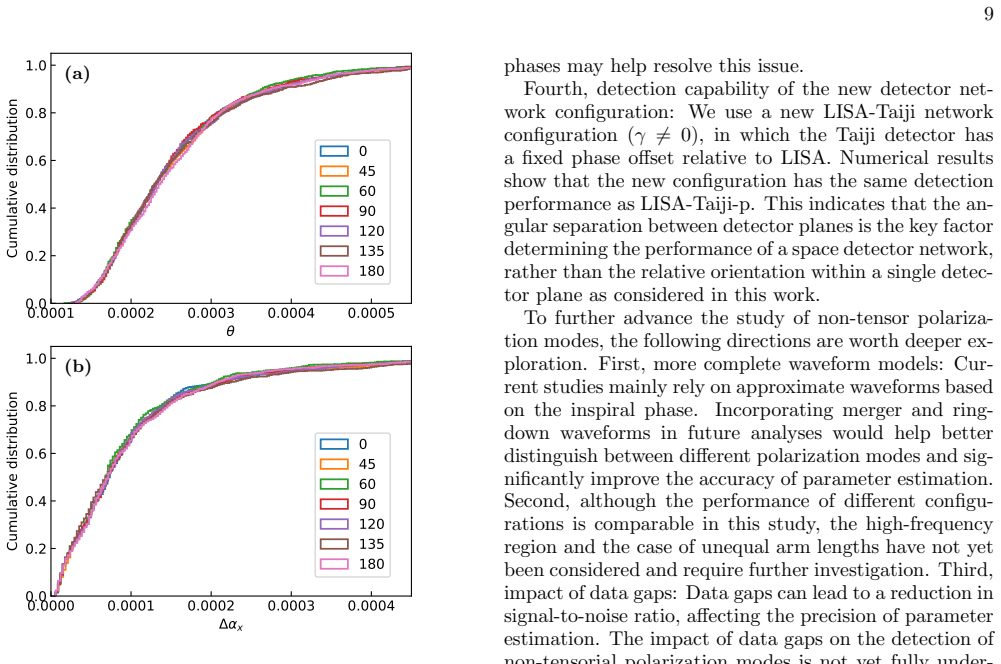
The paper's central claim is that the estimation error of the vector polarization parameter $\alpha_x$ is slightly but genuinely asymmetric with respect to source orientation: $\Delta\alpha_x$ at $\iota=\pi$ exceeds $\Delta\alpha_x$ at $\iota=0$ by roughly 2% for a 30-day inspiral observation. The asymmetry is traced to Eq. (2): the vector-x waveform is proportional to $\cos\iota$, so $h_x$ flips sign between the two inclinations while $h_y$ does not, making $\iota=0$ and $\iota=\pi$ physically distinct signal configurations rather than identical mirror images. The paper further claims that this effect was hidden in previous frequency-domain calculations because the stationary-phase approximation together with long observation times makes the 2% difference visually negligible. In the same model, $\alpha_b$ and $\alpha_l$ are so strongly correlated that inspiral data alone cannot separate them, and rotating Taiji by a fixed phase $\gamma$ relative to LISA leaves parameter-estimation accuracy essentially unchanged.
Load-bearing premise
The result assumes non-tensor modes are dominated by dipole radiation, so their frequency is exactly half the tensor frequency and the ppE parameters $\alpha_d$, $\alpha_q$, $\alpha_x$, $\alpha_b$, and $\alpha_l$ are independent; if a real theory couples those parameters or changes the frequency scaling, the 2% asymmetry and the reported correlations could change or disappear.
Editorial extensions
If this is right
- Inclination must be treated as a signed orientation, not just an angle modulo $\pi$, when forecasting vector-mode constraints with space-based detectors.
- Previous Fisher-matrix forecasts that reported a symmetric $\alpha_x$ curve should be re-checked when they use short observations or sparse frequency grids.
- Reported scalar-mode constraints from inspiral-only data are joint constraints on $\alpha_b$ and $\alpha_l$, not independent measurements.
- The detection performance of a LISA-Taiji network is insensitive to the in-plane orientation of Taiji, so mission planning can choose orientation for other reasons.
- Discriminating breathing from longitudinal scalar modes requires extending beyond inspiral-only waveforms to merger and ringdown.
Reading between the lines
- I interpret the sign-flip mechanism as generic: any analysis where a vector polarization amplitude carries an odd power of $\cos\iota$ will see a similar $\iota=0$ versus $\iota=\pi$ asymmetry, so the effect should also be searched for in ground-based networks with aligned sources, which the paper does not do.
- The paper's $\gamma$-independence is derived under rigid adiabatic, equal-arm assumptions; with realistic time-varying arm lengths or second-generation time-delay interferometry the orientation phase could enter through the transfer function at high frequencies, a regime the paper flags but does not model.
- A clean extension would be to inject a non-tensor signal with nonzero $\alpha_x$, $\alpha_b$, and $\alpha_l$ into an unequal-arm LISA-Taiji configuration; if the recovered asymmetry remains at the 2% level, it becomes a calibration feature for tests of general relativity rather than a nuisance.
- Because the scalar correlation is driven by low-frequency transfer functions approaching unity, choosing a louder, higher-frequency source in the LISA band may separate $\alpha_b$ and $\alpha_l$ before merger-ringdown waveforms are available.
Editorial analysis
A structured set of objections, weighed in public.
Referee Report
Summary. The paper studies how well space-based detectors (Taiji alone and a LISA-Taiji network) can constrain the non-tensor ppE amplitude parameters α_x, α_b, and α_l in gravitational-wave inspiral signals. Rather than using the stationary-phase approximation, the authors generate 30-day time-domain signals from supermassive black hole binaries, Fourier-transform them, and then run both Fisher-matrix and Bayesian (PyMultiNest/Bilby) parameter estimation. The main reported findings are: (i) the 1σ width of α_x is not exactly symmetric under the inclination inversion ι = 0 ↔ ι = π, with Δα_x approximately 2% larger at ι = π; (ii) α_b and α_l are strongly positively correlated, making their independent estimation difficult with inspiral-only signals; and (iii) a new LISA-Taiji configuration with a fixed spacecraft-orientation phase offset γ performs essentially identically to the standard configuration, which the authors explain analytically via the rotation equivalence of the A/E channels. The paper is a parameter-estimation study within a stated ppE model, not a new derivation of alternative-gravity predictions.
Significance. If the 2% asymmetry is robust, it is a useful correction to the common assumption that the vector-mode parameter uncertainty is exactly symmetric under inclination inversion for space-based detectors. The time-domain-plus-FFT treatment is a legitimate methodological alternative to SPA-based forecasts, and the simultaneous use of Bayesian and Fisher methods provides a useful cross-check. The correlation between α_b and α_l is negative-supporting in that it quantifies a known degeneracy in an inspiral-only, low-frequency context. The network-configuration conclusion is well supported by the analytic A/E-channel rotation argument. The main limitation is that the headline asymmetry is a small numerical effect and the paper currently does not demonstrate its robustness against numerical artifacts or statistical noise.
major comments (3)
- [Section III A, Fig. 3] The central claim of a ~2% asymmetry in Δα_x between ι = 0 and ι = π is not yet separated from numerical or statistical uncertainty. The paper reports no error bars or confidence intervals on Δα_x, no convergence test with respect to the FFT sampling rate or duration, no mention of tapering/windowing of the finite 30-day chirp, and no test of the Fisher-matrix finite-difference step. Because the time-domain signal is finite and non-periodic, spectral leakage from the tensor band (f ≈ f_T) into the vector band (f ≈ f_T/2) is a concrete mechanism that could produce or suppress a small asymmetry, and the different sign behavior of h_x and h_y under ι → π could make this leakage asymmetric. I request quantitative checks: repeat the calculation with a Hann or Blackman window, vary T_obs and the sampling rate by factors of two, vary the Fisher derivative step size, and report the scatter of Δα_x across noise realizations. Without these, the 2% effect is not yet established as physical rather than numerical.
- [Section III B vs. Section II A, Eq. (2)] There is an internal inconsistency in the stated source model. Section II A and Eq. (2) assume that the non-tensor modes are dominated by dipole radiation, with amplitudes scaling as (Mω)^{1/3} and frequencies half those of the tensor modes. However, Section III B states: 'we assume that the non-tensor modes are sourced by quadrupole radiation.' This is a direct contradiction. If the intended statement is that the tensor modes are sourced by quadrupole radiation, the sentence should be corrected; if the scalar-mode degeneracy discussion is instead based on a different assumption, the model must be restated consistently. As written, the reader cannot tell which assumption underlies the α_b–α_l correlation result.
- [Section II A and III A] The model assumptions that the ppE parameters (α_d, α_q, α_x, α_b, α_l) are independent and that the non-tensor modes are exactly at half the tensor frequency are explicit, but their consequences for the headline asymmetry are not discussed as a caveat. If a specific alternative theory relates α_x to α_d or predicts a different frequency scaling for the vector modes, the factor-of-two relation, the 2% asymmetry, and the reported correlation structure could all change. I recommend adding an explicit statement that the asymmetry is a property of this particular ppE model, not a generic prediction of all non-tensor-mode theories.
minor comments (6)
- [Section II A] The symbol M is used both for the chirp mass in Eq. (2) and for the total mass M = m_1 + m_2 in Eq. (3). Please use distinct symbols, such as ℳ for chirp mass, to avoid confusion.
- [Section II A] There is a typo: 'paerameters' should be 'parameters' in the sentence just after Eq. (7).
- [Section II D, Eq. (15)] The footnote defining sinc is confusing: the text writes sinc(X) ≡ sin(X)/X but then says numpy defines sinc(X) ≡ sin(πX)/(πX). Please state unambiguously which convention is used in the code and in the equations, since a factor of π in the transfer function is material.
- [Section III A, Fig. 3] The label '2p' in panel (a) is not defined in the caption or text; the caption should say explicitly that the red dashed line corresponds to estimating only α_x and α_b.
- [Section III A] The explanation of the asymmetry in terms of h_x flipping sign under ι = 0 ↔ ι = π should be written more carefully. Since the Fisher matrix involves the square of the derivative of the waveform with respect to α_x, a pure sign flip of h_x would not by itself change the diagonal element; the asymmetry must enter through the way h_x is combined with h_y (given α_x = α_y) and with the detector response. Please expand the derivation so the mechanism is explicit.
- [Section III C] Please report the signal-to-noise ratio of the injections used in the network comparison. Since parameter uncertainties scale inversely with SNR, absolute values across configurations and with previous work are otherwise difficult to interpret.
Circularity Check
No significant circularity; parameter-estimation consistency study with a non-load-bearing self-citation and independent numerical checks.
full rationale
The central asymmetry claim is a direct mathematical consequence of the assumed ppE waveform, Eq. (2), not a fit relabeled as a prediction: the paper states that h_x at iota=0 is minus h_x at iota=pi while h_y is unchanged, calling this 'the fundamental source of the asymmetry.' The Fisher and Bayesian widths are computed by injecting a waveform with fixed parameters and recovering with the same model, which is a standard self-consistency measure of expected statistical uncertainty rather than circular reasoning. The comparison with Ref. [40] ('As a verification, we have placed the results from Ref. [40] in Fig. 3(b)') involves a prior paper with overlapping authorship (Chang Liu), but it is used only as corroboration; the paper's own Fig. 3(a) carries the claim, and the orbital-frequency formulas taken from Refs. [39,40] are standard ppE expressions. The network phase-offset null result is supported by an explicit external argument from Ref. [62] (A/E channels are equivalent to rotated L-shaped interferometers, so an in-plane rotation is a linear channel transformation) together with an 1800-source numerical average, so it is an independent numerical check rather than an imported conclusion. The paper also explicitly flags its own limitations, e.g. 'the reliability of the sensitivity curves remains to be verified' in Sec. III C. The remaining concerns, such as lack of windowing or convergence tests for the FFT-based Fisher estimate and absence of error bars on Delta_alpha_x, are numerical robustness risks rather than circularity. Overall the derivation chain is self-contained, with only a minor, non-load-bearing self-citation.
Assumptions & free parameters
free parameters (4)
- Observation duration T_obs =
30 days
- Injected dipole ppE parameter alpha_d =
0.001
- Fiducial ppE amplitudes for the Bayesian injection =
Values displayed in Fig. 4 (approximate central values near 0.79, 0.10 and 0.13 are not stated in the text)
- Fixed source parameters =
M1=M2=1e5 M_sun, D_L=6790 Mpc, theta=pi/4, phi=pi, psi=0.1, iota=pi/4 for the fiducial run
assumptions (5)
- domain assumption The six polarization modes of Eq. (1) and the leading-order ppE waveform of Eq. (2) with tensor quadrupole radiation and non-tensor dipole radiation are correct.
- domain assumption Due to rotational symmetry between vector modes x and y, alpha_x = alpha_y.
- domain assumption The ppE parameters alpha_d, alpha_q, alpha_x, alpha_b and alpha_l are independent.
- domain assumption The rigid adiabatic approximation, equal-arm assumption, and use of the A and E channels for LISA and Taiji are valid.
- domain assumption The adopted noise power spectral densities for LISA and Taiji, including the confusion noise model, are accurate.
Cite this review
Pith. "Pith review of Test Gravitational-Wave Polarizations with Space-Based Detectors." pith.science (2026). https://pith.science/paper/H4PSQQ2F
@misc{pith2026250602909,
  author       = {Pith},
  title        = {Pith review of: Test Gravitational-Wave Polarizations with Space-Based Detectors},
  year         = {2026},
  howpublished = {\url{https://pith.science/paper/H4PSQQ2F}},
  note         = {Machine review of arXiv:2506.02909}
}
abstract
In this work, we systematically investigate the capability of space-based gravitational wave detectors in constraining parameters of non-tensor polarization modes. Using Bayesian inference and Fisher Information Matrix methods, we analyze gravitational wave signals from the inspiral phase of supermassive binary black hole mergers. By starting with time-domain signals and applying Fourier transforms, we avoid the use of the stationary phase approximation. We found an asymmetry in the estimation of the vector-mode parameter $\alpha_x$ at inclination angles $\iota = 0$ and $\iota = \pi$, which has not been explicitly pointed out in previous studies. We also observe strong correlations between scalar-mode parameters, $\alpha_b$ and $\alpha_l$, which currently limit their independent estimation. These findings underscore the importance of using complete inspiral-merger-ringdown waveforms to enhance the ability to distinguish the non-tensor polarization modes. Finally, we employ a new LISA-Taiji network configuration, in which the orientation of spacecrafts of Taiji maintains a fixed phase offset relative to these of LISA. Under the adiabatic approximation and the assumption of equal arms, this phase is found to have no significant effect on data analysis.
Figures


Figures from the paper (2 more)

Reference graph
Works this paper leans on
- [40]
-
[1]
B. P. Abbott, R. Abbott, T. D. Abbott, and et al., Phys- ical Review Letters116, 061102 (2016)
work page 2016
-
[2]
B. P. Abbottet al.(LIGO Scientific, Virgo), Phys. Rev. Lett.116, 061102 (2016), arXiv:1602.03837 [gr-qc]
arXiv 2016
-
[3]
B. P. Abbottet al.(LIGO Scientific, Virgo), Phys. Rev. D100, 104036 (2019), arXiv:1903.04467 [gr-qc]
arXiv 2019
-
[4]
I. H. Stairs, Living Rev. Rel.6, 5 (2003), arXiv:astro- ph/0307536
arXiv 2003
-
[5]
C. M. Will, Living Reviews in Relativity17, 4 (2014)
work page 2014
-
[6]
D. M. Eardley, D. L. Lee, and A. P. Lightman, Phys. Rev. D8, 3308 (1973)
1973
-
[7]
D. M. Eardley, D. L. Lee, A. P. Lightman, R. V. Wagoner, and C. M. Will, Physical Review Letters30, 884 (1973)
work page 1973
Show all 62 references
-
[8]
Brans and R
C. Brans and R. H. Dicke, Phys. Rev.124, 925 (1961)
1961
-
[9]
M. E. S. Alves, O. D. Miranda, and J. C. N. de Araujo, Phys. Lett. B679, 401 (2009), arXiv:0908.0861 [gr-qc]
2009 arXiv
-
[10]
Rizwana Kausar, L
H. Rizwana Kausar, L. Philippoz, and P. Jetzer, Phys. Rev. D93, 124071 (2016), arXiv:1606.07000 [gr-qc]
2016 arXiv
-
[11]
Liang, Y
D. Liang, Y. Gong, S. Hou, and Y. Liu, Phys. Rev. D95, 104034 (2017), arXiv:1701.05998 [gr-qc]
2017 arXiv
-
[12]
R. Niu, X. Zhang, T. Liu, J. Yu, B. Wang, and W. Zhao, Astrophys. J.890, 163 (2019), arXiv:1910.10592 [gr-qc]
2019 arXiv
-
[13]
Jacobson and D
T. Jacobson and D. Mattingly, Phys. Rev. D70, 024003 (2004), arXiv:gr-qc/0402005
2004 arXiv
-
[14]
K. Lin, X. Zhao, C. Zhang, T. Liu, B. Wang, S. Zhang, X. Zhang, W. Zhao, T. Zhu, and A. Wang, Phys. Rev. D 99, 023010 (2019), arXiv:1810.07707 [astro-ph.GA]
2019 arXiv
-
[15]
Zhang, X
C. Zhang, X. Zhao, A. Wang, B. Wang, K. Yagi, N. Yunes, W. Zhao, and T. Zhu, Phys. Rev. D101, 044002 (2020), [Erratum: Phys.Rev.D 104, 069905 10 (2021)], arXiv:1911.10278 [gr-qc]
2020 arXiv
-
[16]
J. D. Bekenstein, Phys. Rev. D70, 083509 (2004), [Er- ratum: Phys.Rev.D 71, 069901 (2005)], arXiv:astro- ph/0403694
2004
- [17]
-
[18]
B. P. Abbottet al.(LIGO Scientific, Virgo), Phys. Rev. Lett.120, 201102 (2018), arXiv:1802.10194 [gr-qc]
2018 arXiv
-
[19]
Yunes and X
N. Yunes and X. Siemens, Living Reviews in Relativity 16, 9 (2013)
2013
-
[20]
Hagihara, N
Y. Hagihara, N. Era, D. Iikawa, A. Nishizawa, and H. Asada, Physical Review D100, 064010 (2019)
2019
-
[21]
Takeda, A
H. Takeda, A. Nishizawa, K. Nagano, Y. Michimura, K. Komori, M. Ando, and K. Hayama, Phys. Rev. D 100, 042001 (2019), arXiv:1904.09989 [gr-qc]
2019 arXiv
-
[22]
Isi and A
M. Isi and A. J. Weinstein, Probing gravitational wave polarizations with signals from compact binary coales- cences (2017), arXiv:1710.03794 [gr-qc]
2017 arXiv
-
[23]
Takeda, A
H. Takeda, A. Nishizawa, Y. Michimura, K. Nagano, K. Komori, M. Ando, and K. Hayama, Phys. Rev. D98, 022008 (2018), arXiv:1806.02182 [gr-qc]
2018 arXiv
-
[24]
Yunes and F
N. Yunes and F. Pretorius, Physical Review D80, 122003 (2009)
2009
-
[25]
Chatziioannou, N
K. Chatziioannou, N. Yunes, and N. Cornish, Physical Review D86, 022004 (2012)
2012
-
[26]
Chatziioannou, N
K. Chatziioannou, N. Yunes, and N. Cornish, Physical Review D95, 129901 (2017)
2017
-
[27]
R. C. Hilborn, Classical and Quantum Gravity38, 085003 (2021)
2021
-
[28]
Amaro-Seoane, H
P. Amaro-Seoane, H. Audley, S. Babak, and et al., Laser interferometer space antenna (2017), arXiv:1702.00786 [astro-ph.IM]
2017 arXiv
-
[29]
Hu and Y.-L
W.-R. Hu and Y.-L. Wu, Natl. Sci. Rev.4, 685 (2017)
2017
-
[30]
J. R. Gair, M. Vallisneri, S. L. Larson, and J. G. Baker, Living Rev. Rel.16, 7 (2013), arXiv:1212.5575 [gr-qc]
2013 arXiv
-
[31]
Philippoz and P
L. Philippoz and P. Jetzer, J. Phys. Conf. Ser.840, 012057 (2017)
2017
-
[32]
Wang, W.-T
G. Wang, W.-T. Ni, W.-B. Han, P. Xu, and Z. Luo, Phys- ical Review D104, 024012 (2021)
2021
-
[33]
Hayama and A
K. Hayama and A. Nishizawa, Physical Review D87, 062003 (2013)
2013
-
[34]
M. Isi, A. J. Weinstein, C. Mead, and M. Pitkin, Physical Review D91, 082002 (2015)
2015
-
[35]
Nishizawa, A
A. Nishizawa, A. Taruya, K. Hayama, S. Kawamura, and M.-a. Sakagami, Physical Review D79, 082002 (2009)
2009
-
[36]
Callister, A
T. Callister, A. S. Biscoveanu, N. Christensen, M. Isi, A. Matas, O. Minazzoli, T. Regimbau, M. Sakellariadou, J. Tasson, and E. Thrane, Physical Review X7, 041058 (2017)
2017
-
[37]
Wang and W.-B
G. Wang and W.-B. Han, Physical Review D104, 104015 (2021)
2021
-
[38]
L. J. Rubbo, N. J. Cornish, and O. Poujade, Physical Review D69, 082003 (2004)
2004
-
[39]
O’Beirne, N
L. O’Beirne, N. J. Cornish, S. J. Vigeland, and S. R. Taylor, Physical Review D99, 124039 (2019)
2019
-
[41]
Poisson and C
E. Poisson and C. M. Will,Gravity: Newtonian, Post- Newtonian, Relativistic(Cambridge University Press, Cambridge ; New York, 2014)
2014
-
[42]
T. A. Apostolatos, C. Cutler, G. J. Sussman, and K. S. Thorne, Phys. Rev. D49, 6274 (1994)
1994
-
[43]
S. V. Dhurandhar, K. R. Nayak, S. Koshti, and J.-Y. Vinet, Classical and Quantum Gravity22, 481 (2005)
2005
-
[44]
K. J. Shuman and N. J. Cornish, Physical Review D105, 064055 (2022)
2022
-
[45]
B.-R. Wang, J. Li, and H. Wang, Eur. Phys. J. C83, 1010 (2023), arXiv:2211.10617 [gr-qc]
2023 arXiv
-
[46]
Wu and J
J. Wu and J. Li, Physical Review D110, 084057 (2024)
2024
-
[47]
A. A. Svidzinsky and R. C. Hilborn, The European Phys- ical Journal Special Topics230, 1149 (2021)
2021
-
[48]
Cutler, Physical Review D57, 7089 (1998)
C. Cutler, Physical Review D57, 7089 (1998)
1998
-
[49]
C. Liu, L. Shao, J. Zhao, and Y. Gao, Monthly Notices of the Royal Astronomical Society496, 182 (2020)
2020
-
[50]
N. J. Cornish and R. W. Hellings, Classical and Quantum Gravity20, 4851 (2003)
2003
-
[51]
Belgacemet al.(LISA Cosmology Working Group), JCAP07, 024, arXiv:1906.01593 [astro-ph.CO]
E. Belgacemet al.(LISA Cosmology Working Group), JCAP07, 024, arXiv:1906.01593 [astro-ph.CO]
1906 arXiv
-
[52]
R. Niu, X. Zhang, T. Liu, J. Yu, B. Wang, and W. Zhao, The Astrophysical Journal890, 163 (2020)
2020
-
[53]
Robson, N
T. Robson, N. J. Cornish, and C. Liu, Class. Quant. Grav.36, 105011 (2019), arXiv:1803.01944 [astro- ph.HE]
2019 arXiv
-
[54]
Cornish and T
N. Cornish and T. Robson, J. Phys. Conf. Ser.840, 012024 (2017), arXiv:1703.09858 [astro-ph.IM]
2017 arXiv
-
[55]
N. J. Cornish and S. L. Larson, Class. Quant. Grav.18, 3473 (2001), arXiv:gr-qc/0103075
2001 arXiv
-
[56]
H. Liu, C. Zhang, Y. Gong, B. Wang, and A. Wang, Physical Review D102, 124011 (2020)
2020
-
[57]
C. M. Biwer, C. D. Capano, S. De, M. Cabero, D. A. Brown, A. H. Nitz, and V. Raymond, Publications of the Astronomical Society of the Pacific131, 024503 (2019)
2019
-
[58]
Ashton, M
G. Ashton, M. H¨ ubner, P. D. Lasky, C. Talbot, K. Ack- ley, S. Biscoveanu, Q. Chu, A. Divakarla, P. J. Easter, B. Goncharov, F. H. Vivanco, J. Harms, M. E. Lower, G. D. Meadors, D. Melchor, E. Payne, M. D. Pitkin, J. Powell, N. Sarin, R. J. E. Smith, and E. Thrane, The Astrop...
2019
-
[59]
Q. Hu, M. Li, R. Niu, and W. Zhao, Physical Review D 103, 064057 (2021), arXiv:2006.05670 [gr-qc]
2021 arXiv
-
[60]
Buchner, A
J. Buchner, A. Georgakakis, K. Nandra, L. Hsu, C. Rangel, M. Brightman, A. Merloni, M. Salvato, J. Donley, and D. Kocevski, Astronomy & Astrophysics 564, A125 (2014)
2014
-
[61]
Kawamuraet al., J
S. Kawamuraet al., J. Phys. Conf. Ser.122, 012006 (2008)
2008
-
[62]
Seto, Physical Review Letters125, 251101 (2020)
N. Seto, Physical Review Letters125, 251101 (2020)
2020
Reviewed August 7, 2026 · model on record in the stance chip above.
Discussion (0). Sign in to comment.