REVIEW 4 major objections 4 minor 39 references
Implicit Regularization of the Deep Inverse Prior Trained with Inertia
T0 review · 4 major / 4 minor · reviewed 2026-08-07 · deepseek-v4-flash
Pith's one-line read Training a Deep Inverse Prior with momentum and Hessian damping provably reaches zero loss exponentially faster than gradient flow when the forward operator is ill-conditioned.
desk verdict Real extension of the authors' DIP analysis to inertial training, but the central rate claim in Theorem 1.3.5(i) is not proven as stated: the PL inequality uses the wrong singular-value constant and the proof needs full row rank. read the letter →
The pith
A machine-rendered reading of the paper's core claim, the machinery that carries it, and where it could break.
The reading
What carries the argument
The argument is carried by a Lyapunov function $V(t) = L_y(y(t)) + \tfrac{1}{2}\|\dot{\theta}(t) + \beta\nabla L_y(y(t))\|^2$, introduced for the DIN system by Alvarez et al. (2002). The MSE loss obeys a gradient-domination inequality whenever $\sigma_{\min}(J_g(\theta(t)))$ stays bounded away from zero, which converts Lyapunov decay into an exponential rate; the choice $\alpha = \sigma_{\min}(J_g(\theta_0))\sigma_A$ and $\beta = 1/(2\alpha)$ balances the two damping terms to maximize the exponent. For the discrete algorithm, a matching discrete Lyapunov sequence $V_\tau = L_y(y_\tau) + \delta_2\|\theta_\tau - \theta_{\tau-1}\|^2$ plays the same role, and the backtracking line search (with finite termination proved via the descent lemma) replaces the global Lipschitz assumption.
What would settle it
Run the continuous-time DIN (or a fine discretization of it) on a linear inverse problem with a known ill-conditioned operator $A$, using a network that satisfies (1.5), and fit the empirical loss decay exponent. If the exponent does not match $\sigma_{\min}(J_g(\theta_0))\sigma_A/2$, or if the loss fails to converge while $\sigma_{\min}(J_g(\theta_0)) > 0$ and $R' < R$ hold, the main theorem is wrong. A simpler check: initializing a narrow network so that $\sigma_{\min}(J_g(\theta_0)) = 0$ should violate the guarantees, and the loss should not exhibit the predicted accelerated decay.
Extended reading notes
Core claim
The central claim is Theorem 1.3.5(i): under the initialization condition $\sigma_{\min}(J_g(\theta_0)) > 0$ and $R' < R$, a DIP network trained with the DIN system with $\alpha = \sigma_{\min}(J_g(\theta_0))\sigma_A$ and $\beta = 1/(2\alpha)$ has its loss converge to zero at the rate $L_y(y(t)) \leq \xi L_y(y(0)) \exp(-\sigma_{\min}(J_g(\theta_0))\sigma_A t/2)$, and its parameters converge to a global minimizer of the loss. This rate is provably faster than the gradient-flow rate from earlier work when the forward operator is ill-conditioned, and the early-stopping bound and the signal-space recovery bound inherit the same acceleration. In the discrete setting (Algorithm 1), the paper proves linear convergence of the loss and parameters under an analogous initialization condition plus a constraint relating the momentum, Hessian-damping, and backtracking parameters, and it gives an overparametrization bound under which a random two-layer DIP satisfies the condition with high probability.
Load-bearing premise
The entire guarantee rests on the initialization condition $\sigma_{\min}(J_g(\theta_0)) > 0$ and $R' < R$: the network Jacobian must be uniformly non-degenerate at start-up and the initial loss small enough that training stays inside a ball where that non-degeneracy persists, and if random initialization lands near a singular region or the network is too narrow, no convergence or recovery guarantee applies.
Editorial extensions
If this is right
- In the ill-conditioned regime (small $\sigma_A$), the continuous-time rate $\exp(-\sigma_{\min}(J_g(\theta_0))\sigma_A t/2)$ is strictly faster than gradient flow's $\exp(-\sigma_{\min}(J_g(\theta_0))^2\sigma_A^2 t/4)$, so the theory accounts for the practical speedup of momentum methods in DIP training.
- The early-stopping bound (1.9) gives a rigorous stopping time that keeps the observation-space error within a constant multiple of the noise level, putting the common DIP early-stopping heuristic on provable footing.
- The overparametrization bound $k \gtrsim n^3 + nm^2$ (with an extra $\kappa(A)^4$ factor for ill-conditioned $A$) specifies when a random two-layer DIP initialization satisfies the convergence condition with high probability.
- The discrete algorithm's linear convergence and recovery guarantees hold without a global Lipschitz gradient, using an adaptive backtracking step-size that terminates in finitely many iterations.
- Signal recovery decomposes into an optimization error (improved by inertia), a noise error, and a modeling error, with the latter two identical to the gradient-flow case.
Reading between the lines
- The ratio of the two exponents, $(\sigma_{\min}(J_g(\theta_0))\sigma_A/2) / (\sigma_{\min}(J_g(\theta_0))^2\sigma_A^2/4) = 2/(\sigma_{\min}(J_g(\theta_0))\sigma_A)$, predicts that the acceleration grows without bound as the forward operator becomes more ill-conditioned; testing over a range of $\sigma_A$ values would separate this prediction from a mere constant-factor improvement.
- Because the discrete rate is sub-optimal, a tighter analysis linearizing the update around the limit point (which the authors leave open) might recover the optimal accelerated rate for the algorithm; such a result would make the discrete guarantees match the continuous ones.
- The initialization condition couples network width, operator conditioning, and initial loss, suggesting a phase transition in trainability as width grows; an empirical plot of convergence probability versus width for fixed $\alpha$ would directly probe this threshold.
- The paper asserts that the overparametrization bound adapts to the discrete algorithm but withholds the proof; filling this gap (or finding a counterexample) would determine whether the discrete recovery guarantees inherit the same width scaling as the continuous ones.
Editorial analysis
A structured set of objections, weighed in public.
Referee Report
Summary. This paper analyzes the Deep Image/Inverse Prior (DIP) framework for linear inverse problems when the network is trained by the second-order inertial system (DIN) with viscous and Hessian-driven damping. In continuous time, under a nondegenerate initialization condition (1.5), Theorem 1.3.5 claims exponential convergence to zero loss at an "optimal accelerated" rate exp(-sigma_min(Jg(theta0)) sigma_A t / 2), parameter convergence to a global minimizer, an early-stopping bound, and a signal recovery bound under a restricted injectivity condition. Theorem 1.3.6 gives a high-probability overparametrization bound for a two-layer network to satisfy (1.5). In discrete time, Algorithm 1 is a backtracking inertial scheme for which Theorem 1.4.2 claims linear convergence and similar recovery guarantees under an analogous initialization condition (1.29). Numerical experiments on toy and deconvolution problems illustrate the influence of alpha and beta.
Significance. If the results were established at the stated strength, the paper would be a valuable extension of DIP theory to inertial training, providing the first convergence and recovery guarantees for a momentum-based algorithm in this self-supervised setting and an explicit comparison with the gradient-flow rates of Buskulic et al. (2024a). The continuous-time Lyapunov analysis is coherent in outline, and Lemma 1.3.12 genuinely fixes an independence issue in the earlier concentration argument. The qualitative message, that inertia can accelerate DIP training in ill-conditioned problems, is plausible and is supported by the experiments. However, several load-bearing points (the PL constant, the discrete overparametrization guarantee, and the restricted-injectivity step in the recovery bound) need correction before the claims at the stated strength can be accepted.
major comments (4)
- [1.3.5.1, Lemma 1.3.8 and Eq. (1.14)] The Polyak-Lojasiewicz bound in Eq. (1.14) is off by a factor of four and silently requires full row rank. Under the lemma's hypothesis sigma_min(Jg(theta(t))) >= sigma_min(Jg(theta0))/2, the best general bound is ||nabla_theta Ly(y(t))|| >= (sigma_min(Jg(theta0))/2) sigma_A ||y(t)-ybar||, i.e. ||nabla_theta Ly(y(t))||^2 >= (sigma_min(Jg(theta0))^2 sigma_A^2 / 2) Ly(y(t)), not 2 sigma_min(Jg(theta0))^2 sigma_A^2 Ly(y(t)). With the corrected constant, the choice alpha = sigma_min(Jg(theta0)) sigma_A, beta = 1/(2 alpha) gives exponent sigma_min(Jg(theta0)) sigma_A / 4 in (1.7)/(1.21), and optimizing (1.19) over alpha and beta gives at best sigma_min(Jg(theta0)) sigma_A / (2 sqrt(2)). The qualitative acceleration over the gradient-flow rate in the ill-conditioned regime appears to survive, but the stated rate and the word "optimal" are not established by the supplied proof. In addition, the inequality ||Jg(theta)^T w|| >= sigma_min(Jg(theta)) ||w|| used to derive (1.14) requires Jg(theta) to have full row rank; condition (1.5), which only stipulates a positive smallest nonzero singular value, does not guarantee this, so Theorem 1.3.5 needs an explicit full row rank assumption or a direct lower bound on sigma_min(A Jg(theta0)).
- [1.4, after Theorem 1.4.2] The discrete setting lacks the high-probability initialization guarantee that the continuous case has. The text states that "Theorem 1.3.6 can be adapted to the new form of R' and R in Theorem 1.4.2 with minor modifications" and leaves the details to the reader. Since Theorem 1.4.2 is entirely conditional on the unverified condition (1.29), there is currently no theorem proving that an overparametrized two-layer DIP network satisfies (1.29) with high probability for Algorithm 1. The claim that the inertial algorithm enjoys "similar recovery guarantees" to the continuous-time case is therefore not fully supported; either the proof should be supplied or the statement should be downgraded to a conjecture.
- [1.3.5.1, proof of Theorem 1.3.5(iii) and Eq. (1.10)] The recovery bound (1.10) uses ||x(t)-x_Sigma'|| <= lambda_min(A; T_Sigma'(x_Sigma'))^{-1} ||A(x(t)-x_Sigma')||, but this inequality only follows if x(t)-x_Sigma' lies in the tangent cone T_Sigma'(x_Sigma'). For the nonlinear manifold Sigma' = g(u, B_{R'+||theta0||}), the chord between two points is generally not in the tangent cone at the projection point, and no curvature or local-closeness assumption is stated that would make it so. As written, the proof of (1.10) is incomplete, and the same issue appears in the discrete recovery bound (1.34). The authors should either prove a restricted injectivity condition on the secant set Sigma' - x_Sigma' (or a local version with x(t) close to x_Sigma') or justify that x(t)-x_Sigma' belongs to T_Sigma'(x_Sigma') for all t.
- [1.3.3, Discussion and consequences] The phrase "optimal accelerated exponential convergence rate" is not justified. No lower bound for the nonconvex DIP objective is given, and the rate obtained is an upper bound coming from a Lyapunov/PL argument; optimality in the strongly convex sense (Nesterov) does not transfer automatically to this nonconvex setting. In light of the corrected PL constant in the first major comment, the exact rate is also changed, so the abstract and Section 1.3.3 should replace "optimal" with a comparison statement such as "accelerated relative to gradient flow under assumptions (1.5)."
minor comments (4)
- [1.3.5.1, Eqs. (1.15)-(1.16)] The bound in (1.15) contains beta^2 and (2 sigma_min(Jg(theta0))^2 sigma_A^2)^{-1}, while the max in the definition of eta in (1.16) is written with beta and (sqrt(2) sigma_min(Jg(theta0)) sigma_A)^{-1} without the square; please correct this inconsistency and re-check the resulting expression for R' in (1.6).
- [1.4, Theorem 1.4.2 and Eq. (1.30)] The initialization condition (1.29) involves s = inf_tau s_tau, which is not known before running Algorithm 1; please state explicitly that the linear rate is relative to the asymptotic backtracking stepsize range and discuss how (1.29) would be checked in practice.
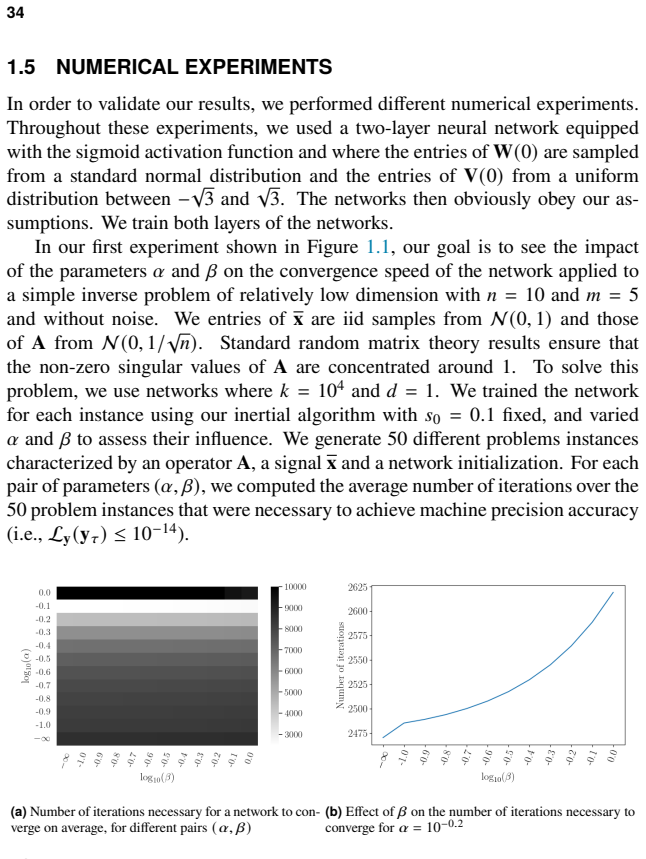
- [1.5, Numerical experiments] In the deconvolution experiment, the authors report sigma_min(A) ~ 1e-5 and ||epsilon|| ~ 150, which make the early-stopping time in (1.9) enormous; the text acknowledges this, but the statement that the experiment "validates the need for early stopping" is in tension with the fact that the quantitative bound cannot be reached in that setting, so the qualitative and quantitative claims should be separated more carefully.
- [Throughout] There are several typographical issues: Eq. (1.9) has a missing closing parenthesis in the logarithm; the probability bound in Theorem 1.3.6 is written as 1 - 5 e^{-(n-1)} - 2 n^{-1} and should be checked for a consistent exponent; and the text says "one-hidden layer network by taking L=2" even though Definition 1.1.1 treats the output layer specially.
Circularity Check
No circular derivation found: the convergence rate follows from a Lyapunov argument and a coercivity inequality, not from fitting; self-citations are building blocks, and the main issue is a proof-constant gap, not circularity.
full rationale
The central rate (1.7) is derived in Section 1.3.5.1 from the Lyapunov function (1.12), the dissipation inequality (1.13), and the PL-type inequality (1.14), with alpha and beta chosen from the assumed singular value sigma_min(Jg(theta0)) sigma_A. These parameters are not fitted to the data whose convergence is predicted, so the claim is conditional rather than self-fulfilling. The comparison with the authors' earlier gradient-flow rate is a benchmark, not a reused conclusion. The paper does rely on the same authors' prior work (Buskulic et al., 2024a) for several lemmas and for the general structure of Theorem 1.3.6, but those results are published, independently stated results used as ingredients rather than as the conclusion itself; they do not make the argument circular. Two non-circular weaknesses are nevertheless worth flagging. First, Eq. (1.14) uses the constant 2 sigma_min(Jg(theta0))^2 sigma_A^2 although Lemma 1.3.8 only assumes sigma_min(Jg(theta(t))) >= sigma_min(Jg(theta0))/2, which yields a factor-4 smaller PL constant and changes the exponent in (1.7); this is a correctness gap in the claimed rate, not a circular reduction. Second, the paper explicitly omits the high-probability verification of the discrete initialization condition (1.29), stating 'We refrain from giving the details which are left to the reader'; this is missing support for the discrete theorem, but it is not an instance of a prediction reducing to its input. Overall, no circular step was identified, and the score reflects only the presence of minor, non-load-bearing self-citations.
Assumptions & free parameters
free parameters (3)
- alpha (viscous damping) =
sigma_min(Jg(theta0)) sigma_A in Theorem 1.3.5; user-chosen in Algorithm 1
- beta (Hessian-driven damping) =
1/(2 alpha) in Theorem 1.3.5; user-chosen in Algorithm 1
- delta and s0 (backtracking parameters) =
delta in (0,2), s0 >= 1 with condition s0(alpha + beta delta) < 1 - delta/2
assumptions (5)
- domain assumption A-1: L_y is the MSE loss, L_y(z) = (1/2)||z - y||^2.
- domain assumption A-2: The activation phi is C^1 with bounded and Lipschitz derivative.
- domain assumption A-3: ker(A) ∩ T_Sigma'(x_Sigma') = {0}.
- domain assumption A-4 to A-6: u uniform on the sphere, W(0) iid Gaussian, V(0) independent with zero-mean bounded unit-variance entries.
- domain assumption y in Im(A) (stated at the start of Section 1.1.1).
Cite this review
Pith. "Pith review of Implicit Regularization of the Deep Inverse Prior Trained with Inertia." pith.science (2026). https://pith.science/paper/73KEXLBF
@misc{pith2026250602986,
  author       = {Pith},
  title        = {Pith review of: Implicit Regularization of the Deep Inverse Prior Trained with Inertia},
  year         = {2026},
  howpublished = {\url{https://pith.science/paper/73KEXLBF}},
  note         = {Machine review of arXiv:2506.02986}
}
read the original abstract
Solving inverse problems with neural networks benefits from very few theoretical guarantees when it comes to the recovery guarantees. We provide in this work convergence and recovery guarantees for self-supervised neural networks applied to inverse problems, such as Deep Image/Inverse Prior, and trained with inertia featuring both viscous and geometric Hessian-driven dampings. We study both the continuous-time case, i.e., the trajectory of a dynamical system, and the discrete case leading to an inertial algorithm with an adaptive step-size. We show in the continuous-time case that the network can be trained with an optimal accelerated exponential convergence rate compared to the rate obtained with gradient flow. We also show that training a network with our inertial algorithm enjoys similar recovery guarantees though with a less sharp linear convergence rate.
Figures


Figures from the paper (1 more)

Reference graph
Works this paper leans on
-
[1]
author Alvarez, F. , author Attouch, H. , author Bolte, J. , author Redont, P. , year 2002 . title A second-order gradient-like dissipative dynamical system with hessian-driven damping.: Application to optimization and mechanics . journal Journal de math \'e matiques pures et appliqu \'e es volume 81 , pages 747--779
work page 2002
-
[2]
author Antun, V. , author Renna, F. , author Poon, C. , author Adcock, B. , author Hansen, A.C. , year 2020 . title On instabilities of deep learning in image reconstruction and the potential costs of ai . journal Proceedings of the National Academy of Sciences volume 117 , pages 30088--30095
work page 2020
-
[3]
author Arora, S. , author Du, S. , author Hu, W. , author Li, Z. , author Wang, R. , year 2019 . title Fine-grained analysis of optimization and generalization for overparameterized two-layer neural networks , in: booktitle International Conference on Machine Learning , pp. pages 322--332
work page 2019
-
[4]
author Arridge, S. , author Maass, P. , author Ozan, O. , author Sch\" o nlieb, C.B. , year 2019 . title Solving inverse problems using data-driven models . journal Acta Numerica volume 28 , pages 1--174
work page 2019
-
[5]
author Attouch, H. , author Chbani, Z. , author Fadili, J. , author Riahi, H. , year 2022 . title First-order optimization algorithms via inertial systems with hessian driven damping . journal Mathematical Programming , pages 1--43
work page 2022
-
[6]
author Attouch, H. , author Fadili, J. , author Kungurtsev, V. , year 2023 . title On the effect of perturbations in first-order optimization methods with inertia and Hessian driven damping . journal Evolution Equations and Control Theory volume 12 , pages 71
work page 2023
-
[7]
author Bartlett, P.L. , author Montanari, A. , author Rakhlin, A. , year 2021 . title Deep learning: a statistical viewpoint . journal Acta numerica volume 30 , pages 87--201
work page 2021
-
[8]
author Bauschke, H.H. , author Combettes, P.L. , year 2017 . title Convex Analysis and Monotone Operator Theory in Hilbert Spaces . CMS Books in Mathematics , publisher Springer International Publishing , address Cham
work page 2017
Show all 39 references
-
[9]
, author Fadili, J
author Buskulic, N. , author Fadili, J. , author Qu \'e au, Y. , year 2024 a. title Convergence and recovery guarantees of unsupervised neural networks for inverse problems . journal Journal of Mathematical Imaging and Vision , pages 1--22
2024
-
[10]
, author Fadili, J
author Buskulic, N. , author Fadili, J. , author Qu \'e au, Y. , year 2024 b. title Recovery guarantees of unsupervised neural networks for inverse problems trained with gradient descent . journal 32nd European Signal Processing Conference
2024
-
[11]
, author Bolte, J
author Castera, C. , author Bolte, J. , author F\'evotte, C. , author Pauwels, E. , year 2021 . title An inertial N ewton algorithm for deep learning . journal J. Mach. Learn. Res. volume 22 , pages 1--31
2021
-
[12]
, author Oyallon, E
author Chizat, L. , author Oyallon, E. , author Bach, F. , year 2019 . title On lazy training in differentiable programming . journal Advances in neural information processing systems volume 32
2019
-
[13]
, author Zhai, X
author Du, S.S. , author Zhai, X. , author Poczos, B. , author Singh, A. , year 2019 . title Gradient Descent Provably Optimizes Over -parameterized Neural Networks , in: booktitle ICLR , pp. pages 1--19
2019
-
[14]
, author Campbell, N
author Duff, M. , author Campbell, N. , author Ehrhardt, M.J. , year 2024 . title Regularising inverse problems with generative machine learning models . journal Journal of Mathematical Imaging and Vision volume 66 , pages 37--56
2024
-
[15]
, author Dong, H
author Fang, C. , author Dong, H. , author Zhang, T. , year 2021 . title Mathematical models of overparameterized neural networks . journal Proceedings of the IEEE volume 109 , pages 683--703
2021
-
[16]
, author Antun, V
author Gottschling, N.M. , author Antun, V. , author Adcock, B. , author Hansen, A.C. , year 2020 . title The troublesome kernel on hallucinations: no free lunches and the accuracy-stability trade-off in inverse problems . journal arXiv preprint arXiv:2001.01258
2020 arXiv
-
[17]
, year 1991
author Haraux, A. , year 1991 . title Syst\`emes dynamiques dissipatifs et applications . volume volume 17 of series Recherches en Math\'ematiques Appliqu\'ees . publisher Masson , address Paris
1991
-
[18]
, author Gabriel, F
author Jacot, A. , author Gabriel, F. , author Hongler, C. , year 2018 . title Neural tangent kernel: Convergence and generalization in neural networks . journal Advances in neural information processing systems volume 31
2018
-
[19]
, author Neubauer, A
author Kaltenbacher, B. , author Neubauer, A. , author Scherzer, O. , year 2008 . title Iterative regularization methods for nonlinear ill-posed problems . volume volume 6 . publisher Walter de Gruyter
2008
-
[20]
, author Bouman, C.A
author Kamilov, U.S. , author Bouman, C.A. , author Buzzard, G.T. , author Wohlberg, B. , year 2023 . title Plug-and-play methods for integrating physical and learned models in computational imaging: Theory, algorithms, and applications . journal IEEE Signal Processing Magazin...
2023
-
[21]
, author Ba, J
author Kingma, D.P. , author Ba, J. , year 2014 . title Adam: A method for stochastic optimization . journal arXiv preprint arXiv:1412.6980
2014 arXiv
-
[22]
, author Sun, Y
author Liu, J. , author Sun, Y. , author Xu, X. , author Kamilov, U.S. , year 2019 . title Image restoration using total variation regularized deep image prior , in: booktitle IEEE International Conference on Acoustics, Speech and Signal Processing (ICASSP) , pp. pages 7715--7719
2019
-
[23]
, author Milanfar, P
author Mataev, G. , author Milanfar, P. , author Elad, M. , year 2019 . title Deepred: Deep image prior powered by red , in: booktitle Proceedings of the IEEE/CVF International Conference on Computer Vision Workshops , pp. pages 0--0
2019
-
[24]
, author Fadili, J
author Maulen-Soto, R. , author Fadili, J. , author Ochs, P. , year 2024 . title Inertial methods with viscous and H essian driven damping for non-convex optimization . howpublished arXiv:2407.12518
2024 arXiv
-
[25]
, author Li, Y
author Monga, V. , author Li, Y. , author Eldar, Y.C. , year 2021 . title Algorithm unrolling: Interpretable, efficient deep learning for signal and image processing . journal IEEE Signal Processing Magazine volume 38 , pages 18--44
2021
-
[26]
, year 2013
author Nesterov, Y. , year 2013 . title Introductory lectures on convex optimization: A basic course . volume volume 87 . publisher Springer Science & Business Media
2013
-
[27]
, author Jalal, A
author Ongie, G. , author Jalal, A. , author Metzler, C.A. , author Baraniuk, R.G. , author Dimakis, A.G. , author Willett, R. , year 2020 . title Deep Learning Techniques for Inverse Problems in Imaging . journal IEEE Journal on Selected Areas in Information Theory , pages 39--56
2020
-
[28]
, author Soltanolkotabi, M
author Oymak, S. , author Soltanolkotabi, M. , year 2019 . title Overparameterized nonlinear learning: Gradient descent takes the shortest path? , in: booktitle International Conference on Machine Learning , pp. pages 4951--4960
2019
-
[29]
, author Soltanolkotabi, M
author Oymak, S. , author Soltanolkotabi, M. , year 2020 . title Toward moderate overparameterization: Global convergence guarantees for training shallow neural networks . journal IEEE Journal on Selected Areas in Information Theory volume 1 , pages 84--105
2020
-
[30]
, author Petersen, P.C
author Pineda, A.F.L. , author Petersen, P.C. , year 2023 . title Deep neural networks can stably solve high-dimensional, noisy, non-linear inverse problems . journal Analysis and Applications volume 21 , pages 49--91
2023
-
[31]
, year 1964
author Polyak, B.T. , year 1964 . title Some methods of speeding up the convergence of iteration methods . journal USSR Computational Mathematics and Mathematical Physics volume 4 , pages 1--17
1964
-
[32]
, author Houdard, A
author Prost, J. , author Houdard, A. , author Almansa, A. , author Papadakis, N. , year 2021 . title Learning local regularization for variational image restoration , in: booktitle International Conference on Scale Space and Variational Methods in Computer Vision , pp. pages 358--370
2021
-
[33]
, author Recht, B
author Rahimi, A. , author Recht, B. , year 2008 . title Weighted sums of random kitchen sinks: Replacing minimization with randomization in learning . journal Advances in neural information processing systems volume 21
2008
-
[34]
, author Mettes, P
author Shi, Z. , author Mettes, P. , author Maji, S. , author Snoek, C.G. , year 2022 . title On measuring and controlling the spectral bias of the deep image prior . journal International Journal of Computer Vision volume 130 , pages 885--908
2022
-
[35]
, author Giryes, R
author Tirer, T. , author Giryes, R. , author Chun, S.Y. , author Eldar, Y.C. , year 2024 . title Deep internal learning: Deep learning from a single input . journal IEEE Signal Processing Magazine volume 41 , pages 40--57
2024
-
[36]
, author Vedaldi, A
author Ulyanov, D. , author Vedaldi, A. , author Lempitsky, V. , year 2018 . title Deep image prior , in: booktitle Proceedings of the IEEE conference on computer vision and pattern recognition , pp. pages 9446--9454
2018
-
[37]
, year 2012
author Vershynin, R. , year 2012 . title Introduction to the non-asymptotic analysis of random matrices , in: booktitle Compressed Sensing : Theory and Applications . publisher Cambridge University Press , address Cambridge , pp. pages 210--268
2012
-
[38]
, author Tirer, T
author Zukerman, J. , author Tirer, T. , author Giryes, R. , year 2021 . title Bp-dip: A backprojection based deep image prior , in: booktitle 28th European Signal Processing Conference , organization IEEE . pp. pages 675--679
2021
-
[39]
write newline
" write newline "" before.all 'output.state := FUNCTION string.to.integer 't := t text.length 'k := #1 'char.num := t char.num #1 substring 's := s is.num s "." = or char.num k = not and char.num #1 + 'char.num := while char.num #1 - 'char.num := t #1 char.num substring FUNCTI...
Reviewed August 7, 2026 · model on record in the stance chip above.
Discussion (0). Sign in to comment.