Nonlinear-enhanced wideband sensing via subharmonic excitation of a quantum harmonic oscillator
Pith reviewed 2026-05-19 10:56 UTC · model grok-4.3
The pith
Subharmonic excitation of engineered Floquet states in a trapped ion's motion measures radio-frequency electric field frequencies below the standard quantum limit using only classical input states.
A machine-rendered reading of the paper's core claim, the machinery that carries it, and where it could break.
Core claim
By driving subharmonic excitation in Raman-engineered Floquet states of the motional degree of freedom of a single calcium ion, the frequency of an applied radio-frequency electric field is measured with an uncertainty of 0.56 Hz at 80 MHz. This result lies below the standard quantum limit that applies to the corresponding linear generator, while the input states remain classical so that coherence time is not shortened by enhanced decoherence.
What carries the argument
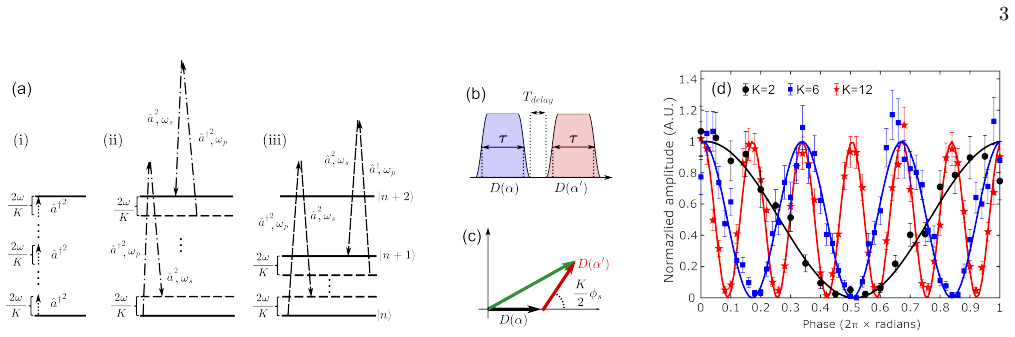
Subharmonic excitation of Raman-engineered Floquet states in the quantum harmonic oscillator, which produces a nonlinear response at a submultiple of the drive frequency to extract frequency information with metrological gain.
If this is right
- Frequency of an 80 MHz electric field is measured with fractional uncertainty 7e-9.
- Metrological gain is obtained while keeping input states classical, preserving coherence time.
- The method is expected to extend to NV centers, solid-state qubits, and neutral atoms.
- Sensing gain becomes available across radio-frequency, microwave, and optical domains without non-classical state preparation.
Where Pith is reading between the lines
- The same subharmonic mechanism could be tested in superconducting mechanical resonators or trapped neutral atoms to check platform independence.
- If the Floquet-state lifetime scales favorably, the approach might allow integration into compact sensors where entangled-state overhead is impractical.
- One could explore whether the subharmonic order can be chosen to match arbitrary drive frequencies, widening the instantaneous bandwidth.
Load-bearing premise
The engineered Floquet states produce a clean subharmonic response that genuinely improves precision below the SQL without unmodeled systematic shifts or extra decoherence that would cancel the reported gain.
What would settle it
A direct side-by-side comparison, under identical total interrogation time and preparation overhead, showing that a conventional linear oscillator measurement on the same ion achieves equal or better uncertainty than 0.56 Hz.
Figures


read the original abstract
A key advantage of quantum metrology is the ability to surpass the standard quantum limit~(SQL) for measurement precision through the use of non-classical states. However, there is typically little to no improvement in precision with the use of non-classical states for measurements whose duration exceeds the decoherence time of the underlying quantum states. Measurements aimed at the ultimate possible precision are thus performed almost exclusively with classical states and, therefore, are constrained by the SQL. Here, we demonstrate that by using the phenomenon of subharmonic excitation, in combination with a recently demonstrated technique of Raman excitation of a harmonic oscillator, the frequency of an electric field can be measured at a resolution below the SQL of the corresponding linear generator. With this method we measure a radio-frequency electrical signal with a fractional frequency uncertainty of 0.56~Hz/80~MHz=7e-9 , which to our knowledge is the most precise frequency measurement of a radio-frequency electrical signal using a quantum harmonic oscillator. Because the input states can be classical, the coherence time is not degraded by the enhanced decoherence typically associated with nonclassical states, thereby improving the ultimate achievable precision. While we demonstrate this technique using motional Raman subharmonic excitation of a single \ca\ ion through engineered Floquet states, this technique is expected to be extendable to other platforms, such as NV centers, solid-state qubits, and neutral atoms, where it can provide metrological gain for sensing across the radio frequency, microwave, and optical domains.
Editorial analysis
A structured set of objections, weighed in public.
Referee Report
Summary. The manuscript demonstrates frequency measurement of a radio-frequency electric field by combining subharmonic excitation with Raman-driven engineered Floquet states in the motional degree of freedom of a single Ca+ ion. Using classical input states, the authors report a fractional frequency uncertainty of 0.56 Hz at 80 MHz (7e-9), claimed to lie below the SQL of the corresponding linear generator while preserving coherence times that would otherwise be limited by non-classical-state decoherence. The technique is presented as extensible to NV centers, neutral atoms, and other platforms for RF-to-optical sensing.
Significance. If the central experimental claim holds, the work supplies a concrete route to metrological gain in wideband sensing without incurring the decoherence penalty of squeezed or entangled states. The explicit use of Raman excitation to create the requisite Floquet states, together with the subharmonic response, constitutes a technically interesting synthesis that could be reproduced on other trapped-ion or solid-state platforms. The reported precision (7e-9) would, if substantiated, represent a notable benchmark for quantum-harmonic-oscillator-based RF metrology.
major comments (2)
- [Results / Experimental demonstration] The abstract and results section assert that the measured uncertainty of 0.56 Hz lies below the SQL of the linear generator, yet no explicit comparison is provided under matched interrogation time, laser intensity, and trap parameters. Without this side-by-side evaluation, the metrological-gain claim cannot be verified from the given data.
- [Methods / Floquet-state engineering] The central assumption that Raman excitation introduces neither unaccounted AC Stark shifts nor motional heating that would degrade the subharmonic response is stated but not supported by a quantitative error budget. A table or paragraph quantifying measured heating rates, differential light shifts, and phase-noise contributions under the operating conditions is required to substantiate that the reported precision is not limited by these systematics.
minor comments (2)
- [Theory] Notation for the subharmonic order and the definition of the effective Floquet frequency should be introduced with an equation in the theory section to avoid ambiguity when the method is extended to other platforms.
- [Figures] Figure captions should explicitly state the total interrogation time and number of experimental repetitions used to extract the 0.56 Hz uncertainty.
Simulated Author's Rebuttal
We thank the referee for their positive assessment of the significance of our work and for the constructive comments. We address each major comment below and describe the revisions that will be incorporated.
read point-by-point responses
-
Referee: [Results / Experimental demonstration] The abstract and results section assert that the measured uncertainty of 0.56 Hz lies below the SQL of the linear generator, yet no explicit comparison is provided under matched interrogation time, laser intensity, and trap parameters. Without this side-by-side evaluation, the metrological-gain claim cannot be verified from the given data.
Authors: We agree that an explicit side-by-side comparison under matched conditions would make the metrological gain clearer. In the revised manuscript we will add a direct comparison of the subharmonic method against standard linear Ramsey interrogation performed with identical interrogation time, laser intensity, and trap parameters. This will quantify the improvement in frequency uncertainty arising from the nonlinear response while using classical states, thereby confirming that the reported 0.56 Hz precision lies below the SQL of the corresponding linear generator. revision: yes
-
Referee: [Methods / Floquet-state engineering] The central assumption that Raman excitation introduces neither unaccounted AC Stark shifts nor motional heating that would degrade the subharmonic response is stated but not supported by a quantitative error budget. A table or paragraph quantifying measured heating rates, differential light shifts, and phase-noise contributions under the operating conditions is required to substantiate that the reported precision is not limited by these systematics.
Authors: We concur that a quantitative error budget is needed to substantiate the claim that Raman-driven Floquet engineering does not introduce limiting systematics. We will add a dedicated paragraph and accompanying table in the Methods section that reports the measured motional heating rates, differential AC Stark shifts, and phase-noise contributions under the exact operating conditions used for the subharmonic measurements. These data show that the combined systematic contribution remains well below the statistical uncertainty of 0.56 Hz. revision: yes
Circularity Check
No circularity: experimental demonstration with independent measurement result
full rationale
The paper reports an experimental demonstration of frequency measurement using subharmonic excitation in Raman-engineered Floquet states of a Ca+ ion's motional harmonic oscillator. The central result is a measured fractional frequency uncertainty of 7e-9, presented as an empirical outcome rather than a theoretical derivation or fitted prediction. No equations, ansatzes, or parameter-fitting procedures are described that would reduce the claimed metrological gain to the inputs by construction. The reference to a 'recently demonstrated technique' is a standard citation to prior work and does not form a load-bearing self-referential loop in the present manuscript's logic. The derivation chain is therefore self-contained against external experimental benchmarks.
Axiom & Free-Parameter Ledger
axioms (1)
- domain assumption Subharmonic excitation of the engineered Floquet states produces a measurable response below the SQL for the linear case while preserving coherence times associated with classical states.
Lean theorems connected to this paper
-
IndisputableMonolith/Foundation/AlexanderDuality.leanalexander_duality_circle_linking unclear?
unclearRelation between the paper passage and the cited Recognition theorem.
by utilizing the parametric excitation of a QHO subharmonic resonance at frequency 2ω/K … the bound on sensitivity … improved as much as σωs = (Kτ(∂f/∂ωs))−1
-
IndisputableMonolith/Cost/FunctionalEquation.leanwashburn_uniqueness_aczel unclear?
unclearRelation between the paper passage and the cited Recognition theorem.
the Kth-order Hamiltonian … involves K−1 commutation operations … displacement α scales as …
What do these tags mean?
- matches
- The paper's claim is directly supported by a theorem in the formal canon.
- supports
- The theorem supports part of the paper's argument, but the paper may add assumptions or extra steps.
- extends
- The paper goes beyond the formal theorem; the theorem is a base layer rather than the whole result.
- uses
- The paper appears to rely on the theorem as machinery.
- contradicts
- The paper's claim conflicts with a theorem or certificate in the canon.
- unclear
- Pith found a possible connection, but the passage is too broad, indirect, or ambiguous to say the theorem truly supports the claim.
Reference graph
Works this paper leans on
- [1]
-
[2]
S. C. Burd, R. Srinivas, J. J. Bollinger, A. C. Wilson, D. J. Wineland, D. Leibfried, D. H. Slichter, and D. T. C. Allcock, Quantum amplification of mechanical oscilla- tor motion, Science 364, 1163 (2019), doi: 10.1126/sci- ence.aaw2884
-
[3]
F. Wolf, C. Shi, J. C. Heip, M. Gessner, L. Pezz` e, A. Smerzi, M. Schulte, K. Hammerer, and P. O. Schmidt, Motional fock states for quantum-enhanced amplitude and phase measurements with trapped ions, Nature Com- munications 10, 2929 (2019)
work page 2019
-
[4]
S. Kn¨ unz, M. Herrmann, V. Batteiger, G. Saathoff, T. W. H¨ ansch, K. Vahala, and T. Udem, Injection locking of a trapped-ion phonon laser, Phys. Rev. Lett. 105, 013004 (2010). 6 FIG. 3. Frequency sensitivity of the subharmonic proto- col. (a-b) Overlapping Allan deviations of frequency for an 80 MHz tone at different subharmonic orders K on the radial (...
work page 2010
-
[5]
M. J. Biercuk, H. Uys, J. W. Britton, A. P. VanDevender, and J. J. Bollinger, Ultrasensitive detection of force and displacement using trapped ions, Nature Nanotechnology 5, 646 (2010)
work page 2010
-
[6]
K. A. Gilmore, J. G. Bohnet, B. C. Sawyer, J. W. Brit- ton, and J. J. Bollinger, Amplitude sensing below the zero-point fluctuations with a two-dimensional trapped- ion mechanical oscillator, Phys. Rev. Lett. 118, 263602 (2017)
work page 2017
-
[7]
Z. Liu, Y. Wei, L. Chen, J. Li, S. Dai, F. Zhou, and M. Feng, Phonon-laser ultrasensitive force sensor, Phys. Rev. Appl. 16, 044007 (2021)
work page 2021
-
[8]
W. C. Campbell and P. Hamilton, Rotation sensing with trapped ions*, Journal of Physics B: Atomic, Molecular and Optical Physics 50, 064002 (2017)
work page 2017
-
[9]
R. Bradley, J. Clarke, D. Kinion, L. J. Rosenberg, K. van Bibber, S. Matsuki, M. M¨ uck, and P. Sikivie, Microwave cavity searches for dark-matter axions, Rev. Mod. Phys. 75, 777 (2003)
work page 2003
-
[10]
B. P. Abbott et al. (LIGO Scientific Collaboration and Virgo Collaboration), Observation of gravitational waves from a binary black hole merger, Phys. Rev. Lett. 116, 061102 (2016)
work page 2016
-
[11]
H. Wu, G. D. Mitts, C. Z. C. Ho, J. A. Rabinowitz, and E. R. Hudson, Wideband electric field quantum sensing via motional raman transitions, Nature Physics 10.1038/s41567-024-02753-0 (2025)
-
[12]
S. F. Huelga, C. Macchiavello, T. Pellizzari, A. K. Ekert, M. B. Plenio, and J. I. Cirac, Improvement of frequency standards with quantum entanglement, Phys. Rev. Lett. 79, 3865 (1997)
work page 1997
-
[13]
K. G. Johnson, J. D. Wong-Campos, B. Neyenhuis, J. Mizrahi, and C. Monroe, Ultrafast creation of large schr¨ odinger cat states of an atom, Nature Communica- tions 8, 697 (2017)
work page 2017
-
[14]
C. Monroe, D. M. Meekhof, B. E. King, and D. J. Wineland, A “schr¨ odinger cat” superposition state of an atom, Science 272, 1131 (1996)
work page 1996
-
[15]
K. C. McCormick, J. Keller, S. C. Burd, D. J. Wineland, A. C. Wilson, and D. Leibfried, Quantum-enhanced sens- ing of a single-ion mechanical oscillator, Nature 572, 86 (2019)
work page 2019
-
[16]
Wolf, Motional quantum state engineering for quantum logic spectroscopy of molecular ions, Ph.D
F. Wolf, Motional quantum state engineering for quantum logic spectroscopy of molecular ions, Ph.D. thesis, Leibniz Universit at Hannover (2018)
work page 2018
-
[17]
L. Pezz` e, A. Smerzi, M. K. Oberthaler, R. Schmied, and P. Treutlein, Quantum metrology with nonclassical states of atomic ensembles, Rev. Mod. Phys. 90, 035005 (2018)
work page 2018
-
[18]
L. D. Landau and E. M. Lifshitz, Mechanics, Third Edi- tion: Volume 1 (Course of Theoretical Physics) , 3rd ed. (Butterworth-Heinemann, 1976)
work page 1976
-
[19]
M. Sudakov, N. Konenkov, D. Douglas, and T. Glebova, Excitation frequencies of ions confined in a quadrupole field with quadrupole excitation, Journal of the American Society for Mass Spectrometry 11, 10 (2000)
work page 2000
-
[20]
X. Zhao, V. L. Ryjkov, and H. A. Schuessler, Parametric excitations of trapped ions in a linear rf ion trap, Phys. Rev. A 66, 063414 (2002)
work page 2002
-
[21]
B. Collings and D. Douglas, Observation of higher order quadrupole excitation frequencies in a linear ion trap, Journal of the American Society for Mass Spectrometry 11, 1016 (2000)
work page 2000
-
[22]
G. Tommaseo, P. Paasche, C. Angelescu, and G. Werth, Subharmonic excitation of the eigenmodes of charged particles in a penning trap, Eur. Phys. J. D28, 39 (2003)
work page 2003
-
[23]
R. Trebino and L. A. Rahn, Subharmonic resonances in higher-order collision-enhanced wave mixing in a sodium- seeded flame, Opt. Lett. 12, 912 (1987)
work page 1987
-
[24]
F. S. Cataliotti, R. Scheunemann, T. W. H¨ ansch, and M. Weitz, Superresolution of pulsed multiphoton raman transitions, Phys. Rev. Lett. 87, 113601 (2001)
work page 2001
-
[25]
M. Ernst, A. Samoson, and B. H. Meier, De- coupling and recoupling using continuous-wave irradiation in magic-angle-spinning solid-state nmr: A unified description using bimodal floquet theory, The Journal of Chemical Physics 123, 064102 (2005), https://pubs.aip.org/aip/jcp/article- pdf/doi/10.1063/1.1944291/15368777/064102 1 online.pdf. 7
-
[26]
G. Wang, Y.-X. Liu, J. M. Schloss, S. T. Alsid, D. A. Braje, and P. Cappellaro, Sensing of arbitrary-frequency fields using a quantum mixer, Phys. Rev. X 12, 021061 (2022)
work page 2022
-
[27]
D. Leibfried, R. Blatt, C. Monroe, and D. Wineland, Quantum dynamics of single trapped ions, Rev. Mod. Phys. 75, 281 (2003)
work page 2003
-
[28]
G. Zarantonello, H. Hahn, J. Morgner, M. Schulte, A. Bautista-Salvador, R. F. Werner, K. Hammerer, and C. Ospelkaus, Robust and resource-efficient microwave near-field entangling 9be+ gate, Phys. Rev. Lett. 123, 260503 (2019)
work page 2019
-
[29]
X. Deng, S. Li, Z.-J. Chen, Z. Ni, Y. Cai, J. Mai, L. Zhang, P. Zheng, H. Yu, C.-L. Zou, S. Liu, F. Yan, Y. Xu, and D. Yu, Quantum-enhanced metrology with large fock states, Nature Physics 10.1038/s41567-024- 02619-5 (2024)
-
[30]
S. Deffner and S. Campbell, Quantum speed limits: from heisenberg’s uncertainty principle to optimal quantum control, Journal of Physics A: Mathematical and The- oretical 50, 453001 (2017)
work page 2017
-
[31]
Q. A. Turchette, C. J. Myatt, B. E. King, C. A. Sack- ett, D. Kielpinski, W. M. Itano, C. Monroe, and D. J. Wineland, Decoherence and decay of motional quantum states of a trapped atom coupled to engineered reservoirs, Phys. Rev. A 62, 053807 (2000)
work page 2000
-
[32]
C. J. Myatt, B. E. King, Q. A. Turchette, C. A. Sackett, D. Kielpinski, W. M. Itano, C. Monroe, and D. J. Wineland, Decoherence of quantum superpositions through coupling to engineered reservoirs, Nature 403, 269 (2000)
work page 2000
-
[33]
F. Wolf and P. Schmidt, Quantum sensing of oscillating electric fields with trapped ions, Measurement: Sensors 18, 100271 (2021)
work page 2021
-
[34]
J. Johansson, P. Nation, and F. Nori, Qutip: An open- source python framework for the dynamics of open quan- tum systems, Computer Physics Communications 183, 1760 (2012)
work page 2012
-
[35]
J. Johansson, P. Nation, and F. Nori, Qutip 2: A python framework for the dynamics of open quantum systems, Computer Physics Communications 184, 1234 (2013). 8 Supplementary Information Appendix A: Theoretical Analysis FIG. 4. Implementation of subharmonic excitation on the radial and axial modes, respectively. (a) Subharmonic excitation is applied to exc...
work page 2013
discussion (0)
Sign in with ORCID, Apple, or X to comment. Anyone can read and Pith papers without signing in.