REVIEW 5 major objections 6 minor 59 references
InterMamba: Efficient Human-Human Interaction Generation with Adaptive Spatio-Temporal Mamba
T0 review · 5 major / 6 minor · reviewed 2026-08-07 · deepseek-v4-flash
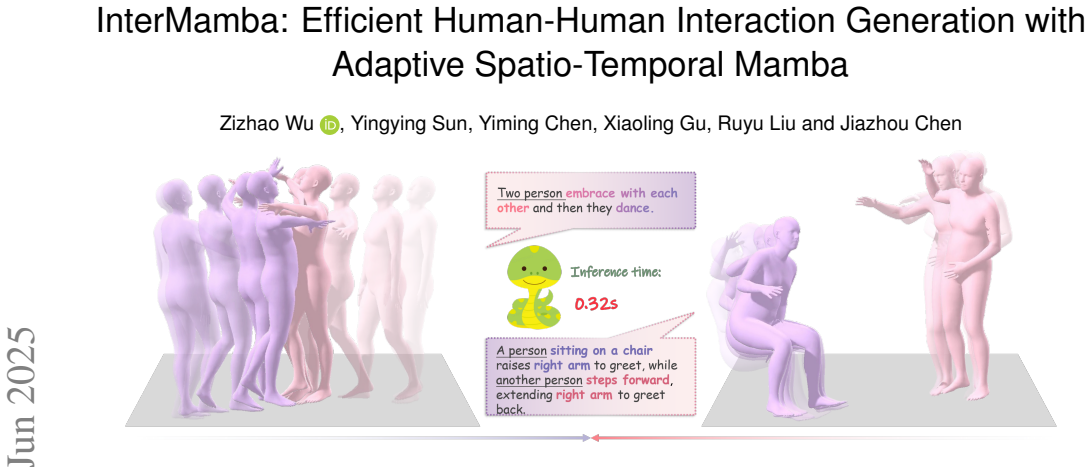
Pith's one-line read InterMamba replaces transformer attention with an adaptive spatial/temporal Mamba backbone and reports state-of-the-art text-motion alignment for two-person interaction generation at roughly half the inference time of InterGen.
desk verdict Sound first Mamba-based HHI architecture, but the abstract's efficiency claim mixes configurations and the SOTA claim conflicts with the paper's own FID/MModality tables. read the letter →
The pith
A machine-rendered reading of the paper's core claim, the machinery that carries it, and where it could break.
The reading
What carries the argument
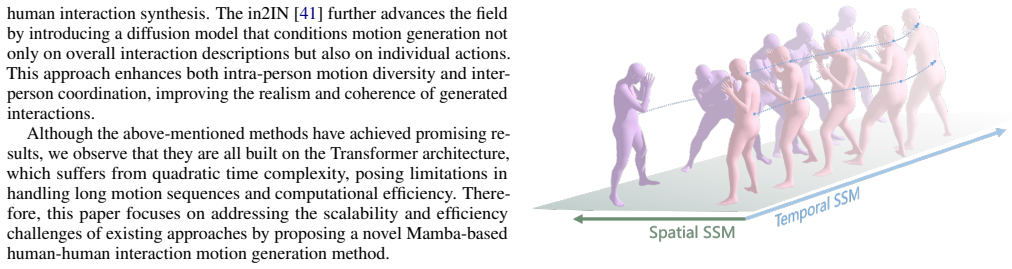
The load-bearing object is the Adaptive Spatio-Temporal Mamba (ASTM) block: two parallel selective state-space branches—one scanning the frame (temporal) dimension and one scanning the joint (spatial) dimension—merged by learnable weights w_alpha and w_beta. Self-ASTM uses ASTM to model each person's own motion, while Cross-ASTM replaces the SSM with a Mix-SSM (MSSM) whose B, C, and Δ matrices are generated from the LIIA interaction feature while the person's own feature serves as the query, making the state update depend on the partner. LIIA aggregates the two people's features with adaptive layer normalization plus 1×1 and 3×3 convolutions and feeds the interaction signal into both Cross-ASTM branches.
What would settle it
Rerun InterGen and in2IN with the paper's own evaluation script on the same RTX 4090 and data splits; if the rerun gives InterGen an inference time near 0.57 seconds rather than 1.233 seconds, or R-Precision comparable to InterMamba's, the claimed 2.2x speedup and state-of-the-art alignment are not reproduced.
Extended reading notes
Core claim
InterMamba replaces the transformer blocks of existing interaction generators with an Adaptive Spatio-Temporal Mamba (ASTM): one selective state-space branch scans the temporal dimension of each person's motion while a parallel branch scans the spatial joint dimension, and a learned scalar pair reweights the two branches. The Self-ASTM block captures long-range dependencies within a single person; the Cross-ASTM block, built on a Mix-SSM, lets interaction features derived from both people generate the SSM parameters (B, C, Δ) that govern the other person's state update, so the recurrence itself becomes interaction-aware. A Local Interaction Information Aggregation module (LIIA), two convolutions after adaptive layer normalization, produces those interaction features. The paper reports state-of-the-art R-Precision (0.475/0.625/0.706 on InterHuman and 0.457/0.642/0.742 on Inter-X) and the lowest multi-modal distance among compared methods, with FID slightly above a few baselines, and inference at 0.567 seconds (117M parameters) or 0.325 seconds (66M parameters) on a single RTX 4090.
Load-bearing premise
The claimed speed and accuracy advantages over InterGen, in2IN, and other baselines assume those baselines were evaluated on the same data splits, evaluation code, and hardware as InterMamba, but the paper only reports its own hardware.
Editorial extensions
If this is right
- Longer interaction sequences can be synthesized without the quadratic attention cost, so the method scales to denser and longer interactions at a fixed GPU budget.
- The learned fusion weights give an explicit control point for trading spatial contact and structure against temporal smoothness, potentially useful for editing or constraint injection.
- The 66M UltraLight variant fits the efficiency claim, making real-time interaction generation plausible on a single consumer GPU.
- Conditioning SSM parameters on partner-derived interaction features suggests a general recipe for multi-agent state-space models beyond two-person motion.
- Because inference still uses 50 DDIM sampling steps, combining the backbone with one-step or flow-based samplers is a direct route to further speedup.
Reading between the lines
- The same two-branch adaptive SSM design could transfer to other paired sequence tasks, such as hand-object interaction or human-scene interaction, by swapping the LIIA interaction features for object or scene context.
- Because the spatial and temporal branches are decoupled, one could probe the learned weights w_alpha and w_beta for different action categories to see when joint-level structure matters more than frame-level continuity, an analysis the paper does not report.
- If the adaptive parameters are as critical to convergence as the ablation suggests, a parameter-only version of the model (without the diffusion sampler) might serve as a fast predictor for motion editing or retiming, though the paper does not test this.
Editorial analysis
A structured set of objections, weighed in public.
Referee Report
Summary. The paper proposes InterMamba, a diffusion-based human-human interaction generation method that replaces transformer backbones with Mamba-style selective state space models. It introduces an Adaptive Spatio-Temporal Mamba (ASTM) module with parallel spatial and temporal SSM branches fused by learnable scalars, a Self-ASTM block for per-character motion modeling, a Cross-ASTM block with a Mix-SSM that uses interaction features to condition the SSM parameters, and a Local Interaction Information Aggregation (LIIA) module. Experiments on InterHuman and Inter-X report improvements in R-Precision and MMDist over prior work, with a claimed state-of-the-art efficiency of 66M parameters and 0.57s inference. The paper also includes ablations of the proposed modules.
Significance. If the claims are validated after revision, the work provides a novel and plausible efficient alternative to transformer-based interaction generation, with a clearly described architecture and standard benchmark experiments. The use of 95% confidence intervals on the quantitative metrics is a strength, as is the explicit complexity analysis. However, the current presentation overstates the results: the headline efficiency numbers are internally inconsistent, the ablation narrative conflicts with its own tables, and the state-of-the-art claim is not supported on all reported metrics. The core architectural idea remains valuable and the manuscript is worth revising.
major comments (5)
- [Abstract and Table 3] The abstract states that the method 'requires a minimal parameter size of just 66M—only 36% of InterGen's—while achieving an average inference speed of 0.57 seconds, which is 46% of InterGen's execution time.' According to Table 3, the 66M parameter count belongs to Ours (UltraLight) with 0.325s, while 0.567s belongs to Ours (117M). No single configuration satisfies both ratios. The efficiency claim should be reworded to identify which variant has which property, and the quality metrics for the UltraLight variant should be reported if it is being promoted.
- [Sections 5.2.1 and 5.2.2] The section titles are swapped. Section 5.2.1 is titled 'Qualitative Comparison' but discusses Tables 1 and 2 (quantitative), while Section 5.2.2 is titled 'Quantitative Comparison' but discusses Fig. 7 (qualitative). The reader cannot easily determine which evidence supports the SOTA claim. Rename the sections or reorganize the content.
- [Section 5.3, Tables 4 and 5] The ablation text does not match the tables. The 'Effect of Self-ASTM Block' paragraph says 'The first row in Tab. ?? shows that using only the Self-ASTM results in an R-Precision of 0.371 and an FID of 5.918,' but the first row of Table 5 has no modules (the baseline), and the row with Self-ASTM only has R-Precision 0.409 and FID 8.524. The 'Effect of Cross-ASTM' paragraph credits an R-Precision improvement to 0.409 to the cross-ASTM block, but that value is already achieved by Self-ASTM alone. Additionally, Table 4 reports metrics for 'w/o adaptive param.' while the text says the model 'fails to converge.' These inconsistencies undermine the ablation conclusions and need to be corrected.
- [Tables 1 and 2] The abstract and Section 5.2.1 claim 'state-of-the-art results,' but Table 1 shows InterMamba's FID (5.945) is worse than both InterGen (5.918) and in2IN (5.535), and its MModality (0.993) is substantially lower than InterGen (2.141) and in2IN (1.215). The same pattern appears in Table 2, where InterMamba's MModality (2.593) is below InterGen (3.686). The claim should be restricted to the metrics where the method actually excels (R-Precision, MMDist, and efficiency) or the text should explicitly discuss these trade-offs.
- [Table 3 and Section 5.2.3] The efficiency comparison may not be controlled. The paper reports only that inference was run on a single RTX 4090, without stating whether the baseline times for InterGen and in2IN were measured in the same environment or taken from prior work. The table also contains an internal contradiction: the text says 'FLOPs data is unavailable' for in2IN, but the table lists 33.72G for in2IN. The in2IN entry is also cited as [52] (the Inter-X dataset) rather than [41]. Please clarify the measurement conditions and resolve these inconsistencies, or the 2.2x speedup claim is not fully supported.
minor comments (6)
- [Table 1 caption / Section 5.2.1] Table 1 caption says all evaluations are run 20 times, but Section 5.2.1 says MModality is run 5 times; align these statements.
- [Equation (13)] Equation (13) contains the typo 'MSSMsoat'; it should be 'MSSMspat' to match the text.
- [Tables 1 and 3 / Section 5.1] The naming of the lightweight model is inconsistent: 'InterMamba (light)' in Table 1, 'Ours (UltraLight)' in Table 3, and 'ultra-light variant' in Section 5.1. Use one term throughout.
- [Section 5.3] Section 5.3 contains an unresolved cross-reference 'Tab. ??'; replace with the correct table number.
- [Figure 8] Figure 8 plots parameters α and β but does not specify whether these are w_alpha and w_beta from Eq. (9) or alpha_c and beta_c from Eq. (13); clarify in the caption or text.
- [Abstract and Section 1] The abstract and Section 1 use 'real-time' for a 0.57s inference time; given that 50 DDIM steps are used, please either define real-time or soften this wording.
Circularity Check
No significant circularity: the claimed quality and efficiency results are benchmark measurements against external baselines, and the adaptive parameters are trained, not fitted to the target metrics.
full rationale
The paper is an empirical architecture paper rather than a derivation from first principles. Its central claim, state-of-the-art quality and efficiency on InterHuman and InterX, is supported by comparisons against external baselines such as InterGen, in2IN, ComMDM, and RIG, using standard metrics and shared evaluation protocols. No equation in the paper defines a predicted quantity in terms of the very measurement it is supposed to explain. The adaptive fusion weights w_alpha and w_beta in Eq. (9), and alpha_c and beta_c in Eq. (13), are learnable parameters optimized during training; they are not constants fitted to the reported R-Precision, FID, or inference-time values. The MSSM design, in which interaction features generate B, C, and Delta while individual features serve as the query, is a stated architectural choice, not an equivalence between input and output. Reusing InterGen's loss function (Eq. 14) and evaluation metrics is methodological reuse, not circularity, because the reported numbers are not logically forced by the form of the loss. The two self-citations in the references ([36] and [50]) appear only as background context and are not load-bearing for the central claim. Two internal inconsistencies exist, but they are correctness or presentation issues, not circular steps: the abstract pairs the 66M UltraLight parameter count with the 0.57s inference time of the 117M model, and the ablation R-Precision in Table 4 (0.705) differs from the full-model R-Precision in Table 1 (0.475). These do not amount to a derivation that reduces to its own inputs. Therefore, the circularity score is 0.
Assumptions & free parameters
free parameters (6)
- Adaptive fusion weights w_alpha and w_beta =
learned during training
- Cross fusion weights alpha_c and beta_c =
learned during training
- Classifier-free guidance coefficient =
3.5
- DDIM sampling steps =
50
- SSM state size =
16
- Loss weights lambda_vel, lambda_foot, lambda_BL, lambda_DM, lambda_RO =
from InterGen
assumptions (5)
- standard math Standard diffusion and DDIM sampling are valid generative procedures.
- standard math Mamba selective SSM equations and zero-order-hold discretization correctly model sequence dependencies.
- domain assumption The joint representation (global positions, velocities, 6D local rotations, foot contact) is sufficient to describe human-human interaction motion.
- domain assumption Frozen CLIP-ViT-L/14 text embeddings are semantically aligned with motion features after training.
- ad hoc to paper Parallel spatial and temporal SSM branches combined by linear scalars can express the spatio-temporal dependencies needed for interactions.
Cite this review
Pith. "Pith review of InterMamba: Efficient Human-Human Interaction Generation with Adaptive Spatio-Temporal Mamba." pith.science (2026). https://pith.science/paper/BTCNRDLH
@misc{pith2026250603084,
  author       = {Pith},
  title        = {Pith review of: InterMamba: Efficient Human-Human Interaction Generation with Adaptive Spatio-Temporal Mamba},
  year         = {2026},
  howpublished = {\url{https://pith.science/paper/BTCNRDLH}},
  note         = {Machine review of arXiv:2506.03084}
}
read the original abstract
Human-human interaction generation has garnered significant attention in motion synthesis due to its vital role in understanding humans as social beings. However, existing methods typically rely on transformer-based architectures, which often face challenges related to scalability and efficiency. To address these issues, we propose a novel, efficient human-human interaction generation method based on the Mamba framework, designed to meet the demands of effectively capturing long-sequence dependencies while providing real-time feedback. Specifically, we introduce an adaptive spatio-temporal Mamba framework that utilizes two parallel SSM branches with an adaptive mechanism to integrate the spatial and temporal features of motion sequences. To further enhance the model's ability to capture dependencies within individual motion sequences and the interactions between different individual sequences, we develop two key modules: the self-adaptive spatio-temporal Mamba module and the cross-adaptive spatio-temporal Mamba module, enabling efficient feature learning. Extensive experiments demonstrate that our method achieves state-of-the-art results on two interaction datasets with remarkable quality and efficiency. Compared to the baseline method InterGen, our approach not only improves accuracy but also requires a minimal parameter size of just 66M ,only 36% of InterGen's, while achieving an average inference speed of 0.57 seconds, which is 46% of InterGen's execution time.
Figures

Figures from the paper (5 more)


Reference graph
Works this paper leans on
-
[52]
L. Xu, X. Lv, Y . Yan, X. Jin, S. Wu, C. Xu, Y . Liu, Y . Zhou, F. Rao, X. Sheng, et al. Inter-x: Towards versatile human-human interaction analysis. In Proceedings of the IEEE/CVF Conference on Computer Vision and Pattern Recognition, pp. 22260–22271, 2024. 2, 6, 8
work page 2024
-
[41]
P. Ruiz-Ponce, G. Barquero, C. Palmero, S. Escalera, and J. García- Rodríguez. in2in: Leveraging individual information to generate human interactions. In Proceedings of the IEEE/CVF Conference on Computer Vision and Pattern Recognition (CVPR) Workshops, pp. 1941–1951, June
work page 1941
-
[1]
A. Aristidou, A. Yiannakidis, K. Aberman, D. Cohen-Or, A. Shamir, and Y . Chrysanthou. Rhythm is a dancer: Music-driven motion synthesis with global structure. IEEE Transactions on Visualization and Computer Graphics, 2022. 2
work page 2022
- [2]
-
[3]
Z. Cao, H. Gao, K. Mangalam, Q.-Z. Cai, M. V o, and J. Malik. Long-term human motion prediction with scene context. In ECCV, pp. 387–404,
-
[4]
X. Chen, B. Jiang, W. Liu, Z. Huang, B. Fu, T. Chen, and G. Yu. Executing your commands via motion diffusion in latent space. In Proceedings of the IEEE/CVF Conference on Computer Vision and Pattern Recognition, pp. 18000–18010, 2023. 2
work page 2023
-
[5]
T. Dao. FlashAttention-2: Faster attention with better parallelism and work partitioning. In International Conference on Learning Representations (ICLR), 2024. 1
work page 2024
-
[6]
A. Dosovitskiy, L. Beyer, A. Kolesnikov, D. Weissenborn, X. Zhai, T. Un- terthiner, M. Dehghani, M. Minderer, G. Heigold, S. Gelly, J. Uszkoreit, and N. Houlsby. An image is worth 16x16 words: Transformers for image recognition at scale. In International Conference on Learning Representations, ICLR, 2021. 3
work page 2021
Show all 59 references
-
[7]
D. Y . Fu, T. Dao, K. K. Saab, A. W. Thomas, A. Rudra, and C. Ré. Hungry hungry hippos: Towards language modeling with state space models.arXiv preprint arXiv:2212.14052, 2022. 3
2022 arXiv
-
[8]
K. Gong, D. Lian, H. Chang, C. Guo, Z. Jiang, X. Zuo, M. B. Mi, and X. Wang. TM2D: bimodality driven 3d dance generation via music-text integration. In IEEE/CVF International Conference on Computer Vision, ICCV, pp. 9908–9918. IEEE, 2023. 2
2023
-
[9]
Gu and T
A. Gu and T. Dao. Mamba: Linear-time sequence modeling with selective state spaces. arXiv preprint arXiv:2312.00752, 2023. 2, 3
2023 arXiv
-
[10]
A. Gu, I. Johnson, K. Goel, K. Saab, T. Dao, A. Rudra, and C. Ré. Com- bining recurrent, convolutional, and continuous-time models with linear state-space layers, 2021. 2, 3
2021
-
[11]
C. Guo, Y . Mu, M. G. Javed, S. Wang, and L. Cheng. Momask: Generative masked modeling of 3d human motions. In Proceedings of the IEEE/CVF Conference on Computer Vision and Pattern Recognition, pp. 1900–1910,
1900
-
[12]
C. Guo, S. Zou, X. Zuo, S. Wang, W. Ji, X. Li, and L. Cheng. Generating diverse and natural 3d human motions from text. In Proceedings of the IEEE/CVF Conference on Computer Vision and Pattern Recognition, pp. 5152–5161, 2022. 1, 2, 6, 7
2022
-
[13]
C. Guo, X. Zuo, S. Wang, S. Zou, Q. Sun, A. Deng, M. Gong, and L. Cheng. Action2motion: Conditioned generation of 3d human motions. In Proceedings of the 28th ACM International Conference on Multimedia, pp. 2021–2029, 2020. 2
2021
-
[14]
Hasani, M
R. Hasani, M. Lechner, T.-H. Wang, M. Chahine, A. Amini, and D. Rus. Liquid structural state-space models. arXiv preprint arXiv:2209.12951,
-
[15]
Hernandez, J
A. Hernandez, J. Gall, and F. Moreno-Noguer. Human motion predic- tion via spatio-temporal inpainting. In Proceedings of the IEEE/CVF International Conference on Computer Vision, pp. 7134–7143, 2019. 2
2019
-
[16]
J. Ho, A. Jain, and P. Abbeel. Denoising diffusion probabilistic models. Advances in neural information processing systems, 33:6840–6851, 2020. 1, 3
2020
-
[17]
Ho and T
J. Ho and T. Salimans. Classifier-free diffusion guidance. arXiv preprint arXiv:2207.12598, 2022. 6
2022 arXiv
-
[18]
M. G. Javed, C. Guo, L. Cheng, and X. Li. Intermask: 3d human inter- action generation via collaborative masked modeling. In The Thirteenth International Conference on Learning Representations, 2025. 1
2025
-
[19]
Jiang, Z
N. Jiang, Z. Zhang, H. Li, X. Ma, Z. Wang, Y . Chen, T. Liu, Y . Zhu, and S. Huang. Scaling up dynamic human-scene interaction modeling. In IEEE/CVF Conference on Computer Vision and Pattern Recognition, CVPR, pp. 1737–1747. IEEE, 2024. 2
2024
-
[20]
J. Kim, J. Kim, and S. Choi. Flame: Free-form language-based motion synthesis & editing. In Proceedings of the AAAI Conference on Artificial Intelligence, vol. 37:7, pp. 8255–8263, 2023. 1, 2
2023
-
[21]
J. Li, A. Clegg, R. Mottaghi, J. Wu, X. Puig, and C. K. Liu. Controllable human-object interaction synthesis. In A. Leonardis, E. Ricci, S. Roth, O. Russakovsky, T. Sattler, and G. Varol, eds.,Computer Vision - ECCV, vol. 15099 of Lecture Notes in Computer Science, pp. 54–72, 2024. 2
2024
-
[22]
R. Li, S. Yang, D. A. Ross, and A. Kanazawa. Ai choreographer: Music conditioned 3d dance generation with aist++. In Proceedings of the IEEE/CVF International Conference on Computer Vision , pp. 13401– 13412, 2021. 2
2021
-
[23]
Liang, J
H. Liang, J. Bao, R. Zhang, S. Ren, Y . Xu, S. Yang, X. Chen, J. Yu, and L. Xu. OMG: towards open-vocabulary motion generation via mixture of controllers. In IEEE/CVF Conference on Computer Vision and Pattern Recognition, CVPR 2024, pp. 482–493. IEEE, 2024. 2
2024
-
[24]
Liang, W
H. Liang, W. Zhang, W. Li, J. Yu, and L. Xu. Intergen: Diffusion-based multi-human motion generation under complex interactions. International Journal of Computer Vision, pp. 1–21, 2024. 1, 2, 3, 6, 7, 8
2024
-
[25]
B. Lin, W. Jiang, P. Chen, Y . Zhang, S. Liu, and Y .-C. Chen. MTMamba: Enhancing multi-task dense scene understanding by mamba-based de- coders. In European Conference on Computer Vision, 2024. 5
2024
-
[26]
H. Liu, M. Zaharia, and P. Abbeel. Ring attention with blockwise trans- formers for near-infinite context. arXiv preprint arXiv:2310.01889, 2023. 1
2023 arXiv
-
[27]
J. Liu, R. Yu, Y . Wang, Y . Zheng, T. Deng, W. Ye, and H. Wang. Point mamba: A novel point cloud backbone based on state space model with octree-based ordering strategy. arXiv preprint arXiv:2403.06467, 2024. 3
2024 arXiv
-
[28]
Y . Liu, Y . Tian, Y . Zhao, H. Yu, L. Xie, Y . Wang, Q. Ye, and Y . Liu. Vmamba: Visual state space model. arXiv preprint arXiv:2401.10166,
-
[29]
Z. Liu, Y . Lin, Y . Cao, H. Hu, Y . Wei, Z. Zhang, S. Lin, and B. Guo. Swin transformer: Hierarchical vision transformer using shifted windows. In Proceedings of the IEEE/CVF International Conference on Computer Vision (ICCV), 2021. 1
2021
-
[30]
Martinez, M
J. Martinez, M. J. Black, and J. Romero. On human motion prediction using recurrent neural networks. In Proceedings of the IEEE conference on computer vision and pattern recognition, pp. 2891–2900, 2017. 2
2017
-
[31]
S. Miao, Z. Lu, M. Liu, J. Duarte, and P. Li. Locality-sensitive hashing- based efficient point transformer with applications in high-energy physics. arXiv preprint arXiv:2402.12535, 2024. 1
2024 arXiv
-
[32]
A. Q. Nichol and P. Dhariwal. Improved denoising diffusion probabilistic models. In International conference on machine learning, pp. 8162–8171. PMLR, 2021. 6
2021
-
[33]
X. Pan, T. Ye, Z. Xia, S. Song, and G. Huang. Slide-transformer: Hier- archical vision transformer with local self-attention. In Proceedings of the IEEE/CVF conference on computer vision and pattern recognition, pp. 2082–2091, 2023. 1
2023
-
[34]
J. Park, H. Kim, K. Ko, M. Kim, and C. Kim. Videomamba: Spatio- temporal selective state space model. In Computer Vision - ECCV, vol. 15083 of Lecture Notes in Computer Science, pp. 1–18, 2024. 3
2024
-
[35]
X. Peng, S. Mao, and Z. Wu. Trajectory-aware body interaction trans- former for multi-person pose forecasting. In IEEE/CVF Conference on Computer Vision and Pattern Recognition, CVPR 2023, Vancouver, BC, Canada, June 17-24, 2023, pp. 17121–17130. IEEE, 2023. doi: 10.1109/ CVPR...
2023
- [36]
-
[37]
Petrovich, M
M. Petrovich, M. J. Black, and G. Varol. Action-conditioned 3d human motion synthesis with transformer vae. In Proceedings of the IEEE/CVF International Conference on Computer Vision, pp. 10985–10995, 2021. 2
2021
-
[38]
Petrovich, M
M. Petrovich, M. J. Black, and G. Varol. Temos: Generating diverse human motions from textual descriptions. In European Conference on Computer Vision, pp. 480–497. Springer, 2022. 2, 6, 7
2022
-
[39]
Pietruszka, Ł
M. Pietruszka, Ł. Borchmann, and Ł. Garncarek. Sparsifying transformer models with trainable representation pooling. In Proceedings of the 60th Annual Meeting of the Association for Computational Linguistics (Vol- ume 1: Long Papers) , pp. 8616–8633. Association for Computatio...
2022
-
[40]
Pinyoanuntapong, P
E. Pinyoanuntapong, P. Wang, M. Lee, and C. Chen. Mmm: Generative masked motion model. In Proceedings of the IEEE/CVF Conference on Computer Vision and Pattern Recognition, pp. 1546–1555, 2024. 2
2024
-
[42]
Shafir, G
Y . Shafir, G. Tevet, R. Kapon, and A. H. Bermano. Human motion diffusion as a generative prior. arXiv preprint arXiv:2303.01418, 2023. 1, 2, 6, 7
2023 arXiv
-
[43]
Tanaka and K
M. Tanaka and K. Fujiwara. Role-aware interaction generation from textual description. In ICCV, 2023. 6, 7
2023
-
[44]
Tevet, B
G. Tevet, B. Gordon, A. Hertz, A. H. Bermano, and D. Cohen-Or. Mo- tionclip: Exposing human motion generation to clip space. In European Conference on Computer Vision, pp. 358–374. Springer, 2022. 2
2022
-
[45]
Tevet, S
G. Tevet, S. Raab, B. Gordon, Y . Shafir, D. Cohen-Or, and A. H. Bermano. Human motion diffusion model. In The Eleventh International Conference on Learning Representations, ICLR, 2023. 2, 6, 7
2023
-
[46]
Tseng, R
J. Tseng, R. Castellon, and K. Liu. Edge: Editable dance generation from music. In Proceedings of the IEEE/CVF Conference on Computer Vision and Pattern Recognition, pp. 448–458, 2023. 2
2023
-
[47]
van den Oord, O
A. van den Oord, O. Vinyals, and K. Kavukcuoglu. Neural discrete representation learning. In I. Guyon, U. von Luxburg, S. Bengio, H. M. Wallach, R. Fergus, S. V . N. Vishwanathan, and R. Garnett, eds.,Advances in Neural Information Processing Systems, pp. 6306–6315, 2017. 1
2017
-
[48]
J. Wang, S. Yan, B. Dai, and D. Lin. Scene-aware generative network for human motion synthesis. In Proceedings of the IEEE/CVF Conference on Computer Vision and Pattern Recognition, pp. 12206–12215, 2021. 1, 2
2021
-
[49]
Z. Wang, Y . Chen, B. Jia, P. Li, J. Zhang, J. Zhang, T. Liu, Y . Zhu, W. Liang, and S. Huang. Move as you say, interact as you can: Language-guided human motion generation with scene affordance. InIEEE/CVF Conference on Computer Vision and Pattern Recognition, CVPR, pp. 433–4...
-
[50]
Z. Wu, S. Mao, C. Zhang, Y . Wang, and M. Zeng. Contrastive disentan- glement for self-supervised motion style transfer. Multim. Tools Appl., 83(27):70523–70544, 2024. 1, 2
2024
-
[51]
Y . Xie, V . Jampani, L. Zhong, D. Sun, and H. Jiang. Omnicontrol: Con- trol any joint at any time for human motion generation. In The Twelfth International Conference on Learning Representations, 2024. 2
2024
-
[53]
L. Xu, Z. Song, D. Wang, J. Su, Z. Fang, C. Ding, W. Gan, Y . Yan, X. Jin, X. Yang, W. Zeng, and W. Wu. Actformer: A gan-based transformer towards general action-conditioned 3d human motion generation. In IEEE/CVF International Conference on Computer Vision, ICCV, pp. 2228–
-
[54]
Zhang, Z
M. Zhang, Z. Cai, L. Pan, F. Hong, X. Guo, L. Yang, and Z. Liu. Mo- tiondiffuse: Text-driven human motion generation with diffusion model. arXiv preprint arXiv:2208.15001, 2022. 2, 3
2022 arXiv
-
[55]
Zhang, X
M. Zhang, X. Guo, L. Pan, Z. Cai, F. Hong, H. Li, L. Yang, and Z. Liu. Remodiffuse: Retrieval-augmented motion diffusion model. In IEEE/CVF International Conference on Computer Vision, ICCV, pp. 364–373. IEEE,
-
[56]
Zhang, H
M. Zhang, H. Li, Z. Cai, J. Ren, L. Yang, and Z. Liu. Finemogen: Fine- grained spatio-temporal motion generation and editing. NeurIPS, 2023. 1, 2
2023
-
[57]
Zhang, A
Z. Zhang, A. Liu, I. Reid, R. Hartley, B. Zhuang, and H. Tang. Motion mamba: Efficient and long sequence motion generation with hierarchical and bidirectional selective ssm. arXiv preprint arXiv:2403.07487, 2024. 3
2024 arXiv
-
[58]
Zhong, L
C. Zhong, L. Hu, Z. Zhang, and S. Xia. Attt2m: Text-driven human motion generation with multi-perspective attention mechanism. In IEEE/CVF International Conference on Computer Vision, ICCV, pp. 509–519. IEEE,
-
[59]
L. Zhu, B. Liao, Q. Zhang, X. Wang, W. Liu, and X. Wang. Vision mamba: Efficient visual representation learning with bidirectional state space model. arXiv preprint arXiv:2401.09417, 2024. 3
2024 arXiv
Reviewed August 7, 2026 · model on record in the stance chip above.
Discussion (0). Sign in to comment.