REVIEW 3 major objections 4 minor 2 references
Synergy-Informed Design of Platform Trials for Combination Therapies
T0 review · 3 major / 4 minor · reviewed 2026-08-07 · deepseek-v4-flash
Pith's one-line read A generalized Dunnett's procedure plus a synergy parameter yields optimal arm allocation and false-positive control in combination platform trials.
desk verdict The paper's central power and allocation derivation inverts the variance denominator, so the claimed optimal designs and sample sizes don't follow; the false-positive-control part may be salvageable, but the main design contribution is invalid as stated. read the letter →
The pith
A machine-rendered reading of the paper's core claim, the machinery that carries it, and where it could break.
The reading
What carries the argument
The core device is the correlation formula (Eq. 2) for the two test statistics, which expresses the correlation between the combination-versus-control and monotherapy-versus-control comparisons in terms of inter-arm endpoint correlations and sample sizes. This correlation replaces the classical shared-control-only correlation in the joint null distribution, and the same formula is embedded in the Wald noncentrality parameters (Eq. 7) that define power. Equating the two noncentrality parameters under the assumption $\rho_{AB,A}=0$ yields the closed-form optimal allocation (Eq. 12), a result that depends only on the synergy parameter $s$.
What would settle it
Estimate $\rho_{AB,A}$ and $\rho_{AB,B}$ from a conventional randomized three-arm trial under the global null: if the observed correlations between arm-level means cluster around zero to within sampling error, Equation (2) reduces to the classical Dunnett correlation and the claimed need for a generalized procedure is not supported by the data.
Extended reading notes
Core claim
The central discovery is that the design of a combination platform trial can be driven by a single synergy parameter $s$, defined by $\delta_{AB}=s\delta_B$, once the correlation between test statistics is correctly specified. The authors show that the correlation between the two $z$-statistics is governed by inter-arm endpoint correlations and sample sizes (Eq. 2), and that replacing the classical shared-control-only correlation with this full correlation yields a generalized Dunnett's procedure that controls FWER, FMER, and MSFP at user-chosen targets. For power, the Wald noncentrality parameters for the two comparisons are cast in closed form (Eq. 7), and maximizing the minimum of the two leads to a closed-form allocation (Eq. 12), namely $p_A^*=(\sqrt{s+1}-1)/s$, $p_B^*=(s+1-\sqrt{s+1})/(s+1)$, and $p_{AB}^*=(s+1-\sqrt{s+1})/(s(s+1))$, under the assumption $\rho_{AB,A}=0$. The authors validate via simulation that the procedure controls error rates and that higher synergy reduces the required sample size while shifting allocation from the combination arm to the monotherapy arm. A real-data analysis using patient-derived xenograft models illustrates the full pipeline.
Load-bearing premise
The load-bearing premise is that the endpoint correlations between the combination arm and the control ($\rho_{AB,A}$) and between the combination and monotherapy ($\rho_{AB,B}$) are real, nonzero quantities that can be estimated from preclinical paired data and will persist in a randomized clinical trial; if these correlations are zero by design, the generalized correlation formula and the closed-form allocation collapse.
Editorial extensions
If this is right
- Combination-trial designers can compute power-maximizing allocation ratios directly from a synergy estimate without numerical optimization when the combination and control arms are uncorrelated.
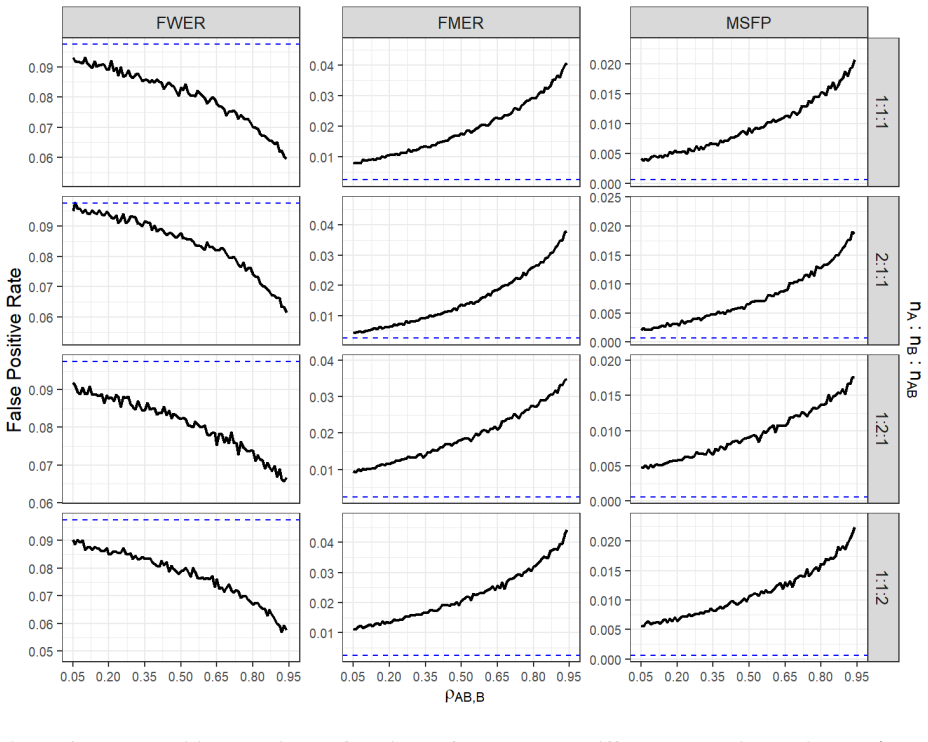
- The generalized Dunnett procedure controls FWER, FMER, and MSFP at user-chosen levels across the simulated range of arm correlations, avoiding the over-conservatism of Bonferroni and Holm and the mis-specified correlation of the classical Dunnett test.
- The pipeline returns a minimal total sample size for a target power while maintaining the chosen false-positive control, enabling pre-trial resource planning.
- Preclinical patient-derived xenograft data can be plugged into the design pipeline to estimate effect sizes, synergy, and inter-arm correlations, making early-phase trials more informative.
- The framework extends to $K$ substudies within one platform, each testing one monotherapy and its combination against a common control.
Reading between the lines
- The closed-form allocation could be tested in a simulation where $\rho_{AB,A}$ is small but nonzero; the paper's formula would still be applied, and a power comparison against the numerical optimum would show how much efficiency is lost.
- A natural extension is to treat $s$, $\delta$, and the inter-arm correlations as uncertain priors rather than point estimates; the design pipeline could then report robust allocations that hedge against misspecified preclinical translation.
- The max-min power criterion treats both hypotheses equally, but regulatory priorities often emphasize the combination hypothesis; re-weighting the objective would shift the closed-form solution, and sensitivity analysis could reveal whether the allocation is stable.
- The same correlation machinery could apply to trials with more than two active components, but the closed-form allocation would likely disappear because the number of equality constraints exceeds the degrees of freedom.
Editorial analysis
A structured set of objections, weighed in public.
Referee Report
Summary. The manuscript proposes a statistical framework for designing early-phase platform trials of combination therapies. The main contributions are a generalized Dunnett's procedure that incorporates correlations between the combination arm and its monotherapy/control arms, an allocation-ratio optimization driven by a synergy parameter, sample-size determination via Monte Carlo binary search, an extension to K substudies, simulation studies, and a real-data application using patient-derived xenograft (PDX) data. An open-source R package is provided.
Significance. If the proposed methods were correct, they would offer a practical toolkit for combination-trial design, combining multiplicity control with synergy-informed sample allocation and translational data integration. The manuscript is clearly organized, contains extensive simulations, and ships an R package with documentation. However, the central power/allocation results contain algebraic errors that invalidate the main methodological claims, and the assumed inter-arm correlations are not justified for a randomized parallel-arm design. These issues are load-bearing, so the contribution as stated cannot be accepted.
major comments (3)
- [§2.3, Eq. (7); Appendix 2] The Wald noncentrality parameters are defined as W = δ² / Var(mean difference). From the variance expressions in Appendix 2, Var(Ȳ_AB − Ȳ_A) = (σ²/N)[1/p_AB + 1/p_A − 2ρ_AB,A/√(p_AB p_A)] and Var(Ȳ_B − Ȳ_A) = (σ²/N)(1/p_A + 1/p_B). Therefore W_AB must equal (N s² δ²/σ²) divided by the first bracket, and W_B must equal (N δ²/σ²) divided by the second bracket. Equation (7) and the final display of Appendix 2 multiply by these brackets, which inverts the noncentrality parameters. This error propagates into the max-min program (8), the equality condition (10), the closed-form allocation (12), the numerical optimization in Appendix 3, the simulations in Section 3.3, and the sample sizes in Table 2. A concrete check: for s = 2 and ρ_AB,A = 0, the allocation from Eq. (12) gives W_AB* = 4(1/0.211 + 1/0.366) ≈ 29.9 and W_B* = 1/0.366 + 1/0.423 ≈ 5.1, so the two noncentrality parameters are not equal and the claimed max-min solution does not equalize them.
- [§2.1, Eq. (2); Appendix 1] The derivation and the proposed generalized Dunnett procedure assume nonzero endpoint correlations ρ_AB,A and ρ_AB,B between the combination arm and the other arms. In a randomized parallel-arm platform trial, patients are randomized to disjoint arms, so the sample means from different arms are independent; consequently ρ_AB,A = ρ_AB,B = 0 by design, and Eq. (2) reduces to the classical Dunnett correlation. If the intended setting is instead a paired design in which the same experimental unit receives multiple treatments (as in the PDX data), the manuscript does not describe how such a trial would be randomized, how the analysis would account for the pairing, or how the correlations would be estimable in a clinical trial. This assumption is load-bearing: without nonzero inter-arm correlations, the claimed generalization of Dunnett's procedure disappears.
- [Appendix 4] The derivation of the closed-form allocation contains an algebraic error. Substituting p_B = 1 − x − y into the equality s²(1/x + 1/y) = 1/y + 1/(1−x−y) gives s²(x+y)(1−x−y) = x(1−x), which expands to y² + (2x−1)y + (1−1/s²)x² + (1/s²−1)x = 0 (after dividing by s²), not y² + (2x−1)y + (1−s²)x² + (s²−1)x = 0 as claimed. The roots y = 1−(s+1)x and y = (s−1)x therefore do not in general solve Eq. (11); for s = 2, the allocation from Eq. (12) does not satisfy Eq. (11) (LHS ≈ 29.9, RHS ≈ 5.1). Thus the closed-form result (12) is unsupported even under the paper's own noncentrality definition.
minor comments (4)
- [§2.3 heading] The text repeatedly uses 'close-form' where 'closed-form' is meant; this should be corrected throughout.
- [§2.3, 'Power definition'] Power is defined as the probability that either |Z1| or |Z2| exceeds a cutoff, but Section 2.4 defines estimated power as the minimum of the two empirical rejection proportions. These are different quantities and the inconsistency should be clarified.
- [Table 1 caption] The caption contains the typo 'Trail parameter estimation'; this should be 'Trial parameter estimation'.
- [§3.3, 'Simulation process'] The text says the initial sample size in the binary search is 20, but Section 2.4 Step 1 describes searching from an initial small N0; the connection between these would be clearer if the default N0 were stated.
Circularity Check
No significant circularity: the paper's design inputs (effect size, synergy, arm correlations) are external preclinical estimates, and the closed-form allocation (Eq. 12) is an analytic solution of the stated optimization problem rather than a fitted value renamed as a prediction. The serious flaw in Eq. (7) is an algebraic inversion error, which is a correctness concern, not circular reasoning.
full rationale
The paper's derivation chain is not circular in any load-bearing sense. The synergy parameter s, effect size delta, and arm correlations rho_AB,A and rho_AB,B are estimated from external PDX data in Section 4 and are not outputs of the trial-design procedure. The generalized Dunnett critical value c* is obtained by solving Eqs. (3)-(5) so that the false-positive metric equals a prespecified target under the assumed null distribution; this is a calibration identity, and the Section 3.2 statement that 'By design, applying these thresholds in rejection decisions guarantees control of false positives exactly at the desired targets' is true by construction but is not a prediction claimed independently of the inputs. The closed-form allocation ratios in Eq. (12) are derived in Appendix 4 by solving the simplified max-min problem in Eqs. (10)-(11), with a stated assumption rho_AB,A = 0, and the derivation is self-contained mathematical optimization rather than a fitted parameter presented as a finding. The authors explicitly acknowledge the input-dependence of their design: 'If the assumed correlation structure or synergy effect from preclinical experiments is misspecified, the optimized allocation or calculated sample size may not yield the intended power in the actual trial' (Discussion, Section 5). That acknowledgment confirms that the parameters are assumptions, not circularly derived conclusions. The paper's central technical problem is different: Equation (7) and Appendix 2 multiply by the variance expression where the noncentrality parameter definition requires division by it, so the optimal-allocation and sample-size results do not follow from the stated Wald noncentrality parameters. That is an algebraic/statistical correctness issue, not a self-referential or circular argument. There are no load-bearing self-citations, imported uniqueness theorems, or ansatz smuggled via citation. The questionable assumption of nonzero arm-level correlations in a randomized parallel-arm trial is a modeling misspecification concern, not circularity. Therefore the appropriate circularity score is 0.
Assumptions & free parameters
free parameters (5)
- synergy parameter s =
1.161 to 18.392 in PDX analysis (Table 1)
- monotherapy effect delta =
0.028 to 0.663 in PDX analysis (Table 1)
- inter-arm correlation rho_AB,A =
0.227 to 0.626 in PDX analysis
- inter-arm correlation rho_AB,B =
0.250 to 0.711 in PDX analysis
- common variance sigma^2 =
1 after standardization
assumptions (7)
- domain assumption Continuous endpoint with normal approximation or CLT for sample means
- domain assumption Common variance sigma^2 across all arms
- domain assumption Independence of control A and monotherapy B, rho_A,B=0
- standard math Correlation between sample means equals correlation between individual endpoints
- ad hoc to paper Nonzero rho_AB,A and rho_AB,B can be carried from preclinical paired data into clinical trial design
- standard math At the max-min optimum, W_AB = W_B
- ad hoc to paper For the closed-form allocation, rho_AB,A = 0
Cite this review
Pith. "Pith review of Synergy-Informed Design of Platform Trials for Combination Therapies." pith.science (2026). https://pith.science/paper/GZTAUE76
@misc{pith2026250603086,
  author       = {Pith},
  title        = {Pith review of: Synergy-Informed Design of Platform Trials for Combination Therapies},
  year         = {2026},
  howpublished = {\url{https://pith.science/paper/GZTAUE76}},
  note         = {Machine review of arXiv:2506.03086}
}
read the original abstract
Combination drug therapies hold significant promise for enhancing treatment efficacy, particularly in fields such as oncology, immunotherapy, and infectious diseases. However, designing clinical trials for these regimens poses unique statistical challenges due to multiple hypothesis testing, shared control groups, and overlapping treatment components that induce complex correlation structures. In this paper, we develop a novel statistical framework tailored for early-phase translational combination therapy trials, with a focus on platform trial designs. Our methodology introduces a generalized Dunnett's procedure that controls false positive rates by accounting for the correlations between treatment arms. Additionally, we propose strategies for power analysis and sample size optimization that leverage preclinical data to estimate effect sizes, synergy parameters, and inter-arm correlations. Simulation studies demonstrate that our approach not only controls various false positive metrics under diverse trial scenarios but also informs optimal allocation ratios to maximize power. A real-data application further illustrates the integration of translational preclinical insights into the clinical trial design process. An open-source R package is provided to support the application of our methods in practice. Overall, our framework offers statistically rigorous guidance for the design of early-phase combination therapy trials, aiming to enhance the efficiency of the bench-to-bedside transition.
Figures


Figures from the paper (2 more)


Reference graph
Works this paper leans on
-
[14]
The Stroke Preclinical Assessment Network: Rationale, design, feasibility, and stage 1 results
Lyden PD, Bosetti F, Diniz MA, et al. The Stroke Preclinical Assessment Network: Rationale, design, feasibility, and stage 1 results. Stroke. 2022;53(5):1802-1812. 15. Choodari-Oskooei B, Thwin SS, Blenkinsop A, Widmer M, Althabe F, Parmar MK. Treatment selection in multi-arm multi-stage designs: With application to a postpartum haemorrhage trial. Clin Tr...
work page 2022
-
[31]
Ristl R, Götte H, Schüler A, Posch M, König F. Simultaneous inference procedures for the comparison of multiple characteristics of two survival functions. Stat Methods Med Res. 2024;33(4):589-610. 32. Bonnini S, Assegie GM, Trzcinska K. Review about the permutation approach in hypothesis testing. Mathematics. 2024;12(17):2617. 33. Lee KM, Brown LC, Jaki T...
work page 2024
Reviewed August 7, 2026 · model on record in the stance chip above.
Discussion (0). Sign in to comment.