REVIEW 4 major objections 6 minor 47 references
Revisiting Continuity of Image Tokens for Cross-domain Few-shot Learning
T0 review · 4 major / 6 minor · reviewed 2026-08-07 · deepseek-v4-flash
Pith's one-line read The paper argues that image-token continuity in a Vision Transformer builds large spatial patterns that fail to transfer across big domain gaps, so deliberately disrupting that continuity during source training lets the model rely on…
desk verdict A useful and likely real training augmentation for CDFSL, wrapped in an interpretive story that the current evidence doesn't yet support. read the letter →
The pith
A machine-rendered reading of the paper's core claim, the machinery that carries it, and where it could break.
The reading
What carries the argument
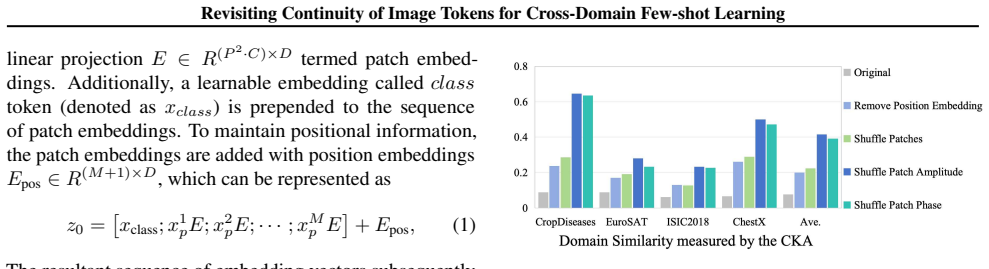
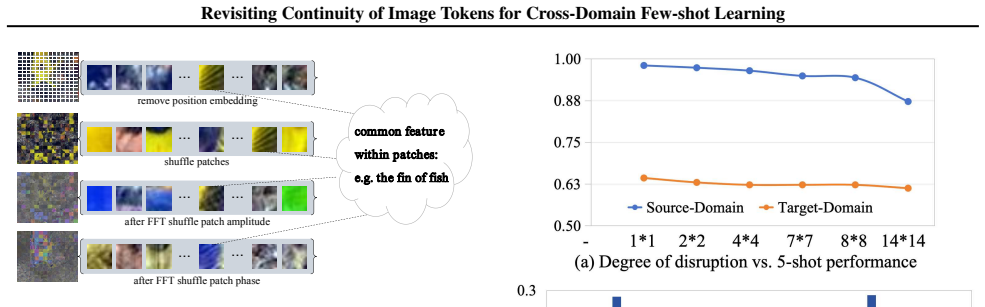
Image-token continuity is the spatial smoothness between adjacent patches that Vision Transformers normally receive through positional embeddings; the paper's central operations remove or scramble that smoothness. Four probes define the phenomenon: removing positional embeddings, shuffling patches, shuffling patch amplitude spectra, and shuffling patch phase spectra. The method itself combines a warm-up spatial shuffle with a balanced frequency-domain disruption in which patches are clustered by appearance, each cluster's amplitude distribution is modeled as a Gaussian, and resampled amplitudes are re-assigned to keep disruption diverse even when one style dominates an image. These operations carry the argument by converting 'large across-patch patterns' into 'small within-patch patterns' during source training.
What would settle it
Run the continuity-disruption experiment on a target domain deliberately built to keep large patterns transferable — for instance, the same classes photographed with modest style changes rather than radically new image types. The paper's interpretation predicts target accuracy should barely fall under disruption; if it falls roughly as much as source accuracy does, the 'large patterns never transfer' explanation is wrong. A complementary check is to replace CKA with a direct transfer metric such as linear-probe accuracy from source features to target labels.
Extended reading notes
Core claim
The paper's central claim is that image-token continuity is a source-domain crutch: it lets a ViT assemble large, class-specific spatial patterns, and those are exactly the patterns that fail to carry over to distant target domains. Disrupting continuity, the paper argues, forces the model to recognize mainly the small patterns contained inside individual patches, which are more likely to recur in a different domain. The evidence is that four different continuity-disruption operators all increase the CKA similarity between source and target features while decreasing source accuracy, and that shrinking the preserved pattern size in a pseudo-patch experiment increases that similarity monotonically. The method ReCIT operationalizes the interpretation by a warm-up stage of spatial patch shuffling followed by a balanced frequency-domain amplitude reshuffling, and the paper reports consistent accuracy gains over the best previous methods on ChestX, ISIC2018, EuroSAT, and CropDiseases at 1-shot and 5-shot.
Load-bearing premise
The load-bearing premise is that the CKA similarity increases seen after disruption reflect genuine alignment of transferable features rather than both domains being mapped onto similarly degenerate representations.
Editorial extensions
If this is right
- Training a ViT on the source domain with token-continuity disruption becomes a target-free recipe for cross-domain few-shot accuracy, since the augmentation needs no target labels.
- The benefit should grow as the domain gap grows: near-domain targets, where large patterns do transfer, should see smaller gains or even losses.
- Attention maps after such training should spread across smaller scattered patterns rather than concentrating on one holistic object, matching the paper's qualitative evidence.
- Because the method acts on input structure rather than on loss geometry, it can be composed with other CDFSL techniques such as prototypical or finetuning-based classifiers.
- Domain-similarity metrics like CKA should rise after training, offering a model-selection signal without needing target labels.
Reading between the lines
- Beyond the paper: the interpretation suggests a testable scaling law — the optimal patch-shuffle intensity should track the estimated source–target domain distance, with harsher disruption helping only when that distance is large.
- Beyond the paper: the within-patch versus across-patch story connects to frequency-domain accounts of domain shift, since amplitude reshuffling may predominantly remove style information carried by inter-patch statistics, a claim the paper gestures at but does not isolate.
- Beyond the paper: the method could plausibly transfer to domain generalization and few-shot class-incremental learning, where avoiding source-specific holistic features is also beneficial, though the paper only lists these as possible future applications.
Editorial analysis
A structured set of objections, weighed in public.
Referee Report
Summary. The paper studies the role of image-token continuity in Vision Transformers (ViTs) for Cross-Domain Few-Shot Learning (CDFSL). It reports a phenomenon: various ways of breaking continuity (removing positional embeddings, shuffling patches, shuffling amplitude or phase in the frequency domain) cause a substantial drop in source-domain accuracy but only a marginal drop in target-domain accuracy. The authors interpret this as continuity helping the model learn large spatial patterns across patches, which are less transferable under large domain gaps, while small within-patch patterns are the main transferable ones. Based on this interpretation, they propose ReCIT, which combines a warm-up spatial-domain patch shuffling and a balanced frequency-domain amplitude shuffling during source training. Experiments on four CDFSL benchmarks (ChestX, ISIC2018, EuroSAT, CropDiseases) show consistent improvements over existing ViT-based methods.
Significance. If the reported gains are reproducible, ReCIT is a simple and effective augmentation strategy for CDFSL that requires no changes to the target-domain pipeline, and the observed phenomenon is interesting for understanding ViT transferability. The paper provides code and model availability, and the ablation study in Table 2 supports the contribution of each component. However, the load-bearing interpretation of why the method works rests on CKA-based domain-similarity measurements that the paper itself cites as potentially unreliable, and the pseudo-patch validation experiment has a confound. These issues undermine the causal narrative but do not invalidate the empirical method, which is evaluated on held-out target classes with standard protocols.
major comments (4)
- [Section 2.3, Fig. 2] The claim that disrupting continuity reduces the domain gap relies entirely on CKA similarity as a proxy for domain distance. Davari et al. (2022), which the authors cite, shows that CKA can be unreliable when representations are degenerate or when models are compared under different training conditions. Here, source accuracy drops substantially under disruption (Fig. 1a), so the higher CKA between source and target may reflect a shared low-rank or collapsed feature subspace rather than the alignment of genuinely transferable small-scale patterns. Please add complementary evidence—such as target-class linear separability, effective dimensionality, or direct transfer probes—and verify that the phenomenon persists when controlling for representation collapse.
- [Section 2.4, Fig. 4] The pseudo-patch experiment confounds the spatial scale of preserved patterns with the severity of perturbation. As the pseudo-patch size decreases, the number of shuffled units increases, so the monotonic CKA increase and accuracy decrease could be driven by stronger corruption rather than by the spatial size of maintained patterns. To substantiate the hypothesis quantitatively, control for the total amount of disruption (e.g., match the number of shuffled units) or measure the scale of captured patterns more directly (e.g., attention distance, spectral analysis).
- [Section 3.2, Eqs. (20)-(21)] The balanced frequency-domain disruption samples proportions p_Ai from a normal distribution and normalizes them by their sum. Since the normal is centered at zero, the p_Ai and hence the recomposed amplitude A_j^p can be negative. Amplitude spectra are magnitudes and should be non-negative. The manuscript does not state any clipping or absolute-value operation, so the method as described is not fully defined, and the sensitivity study of alpha (Fig. 7a) is hard to interpret without knowing how negative amplitudes are treated in the inverse DFT.
- [Tables 1 and 3] The reported improvements over the strongest baseline (AttnTemp) are small (e.g., +0.31 at 1-shot and +0.45 at 5-shot in the FT setting), and the main comparison tables do not include standard deviations or confidence intervals. Without error bars or paired statistical tests over episodes, it is unclear whether these differences are meaningful beyond noise. Please report the variance or the number of seeds/episodes used for the main comparisons.
minor comments (6)
- [Section 3] The method is described as 'simple' in the abstract, but the balanced frequency-domain disruption with clustering and Gaussian sampling is fairly involved; consider simplifying the exposition or clarifying the notation.
- [Section 2.2, Eqs. (9)-(13)] Define iDFT and the dimensions of the Fourier transform explicitly to avoid ambiguity.
- [Section 2.3] The phrase 'aligned to the channel dimension' is unclear; specify the exact preprocessing of features before computing CKA.
- [Table 2] The row labels (a)-(g) are not explained in the caption; add a note describing what each row corresponds to.
- [Appendix D] The source-domain accuracy drop (97.78 to 96.33) is presented as a trade-off; consider discussing the practical implications for applications that need both source and target performance.
- [Figure 8] The attention heatmaps are qualitative; add a quantitative metric such as average attention distance to support the claim that the model attends to smaller patterns.
Circularity Check
No significant circularity: the phenomenon motivates the method; target evaluation is held out and no fitted quantity is renamed as a prediction.
full rationale
The derivation chain is: (1) empirical observation that continuity-disrupting augmentations reduce source accuracy more than target accuracy (Fig. 1); (2) CKA-based domain-similarity diagnostics (Fig. 2); (3) interpretation that cross-patch large patterns transfer worse than within-patch small patterns (Sec. 2.4); (4) ReCIT method applying shuffled patches and balanced amplitude shuffling during source training; (5) held-out evaluation on four CDFSL benchmarks (Table 1). No fitted parameter is renamed as a prediction: target support/query sets are held out, the source loss is standard cross-entropy on miniImageNet, and CKA is used as a diagnostic rather than a training objective. The pseudo-patch experiment varies the spatial scale of preserved patterns and observes monotone changes in CKA and accuracy; the independent variable is close to the definition of 'scale of preserved patterns,' but the direction and magnitude of the effects are empirical, not constructed. The one citation of the authors' prior work for 'larger patterns are always harder to transfer than smaller ones' (Zou et al., 2024b) is an assumption, not an equation or fitted value, and the paper's ablations and held-out accuracy gains support the interpretation independently. A real evidentiary limitation exists: CKA is cited via Davari et al. 2022, which documents CKA's unreliability across data conditions, so the increased CKA under disruption could partly reflect feature collapse rather than transferable small-pattern alignment; this weakens the causal interpretation but does not make the derivation circular. The Impact Statement's scope caveat about four target domains is likewise a limitation, not a circularity. Overall, no equation reduces to its own input and no self-citation forces the central result.
Assumptions & free parameters
free parameters (3)
- similarity threshold sim =
0.3
- std alpha for proportion sampling =
not reported exactly (larger is better until plateau)
- random patch configuration in warm-up =
unspecified distribution
assumptions (5)
- domain assumption CKA similarity between source and target features is a valid measure of domain distance and transferability.
- domain assumption Larger spatial patterns are always harder to transfer than smaller ones.
- domain assumption Amplitude spectra carry domain or style information, so shuffling amplitudes removes style bias.
- standard math Fourier amplitude and phase recombination preserves reconstructable images while altering continuity.
- ad hoc to paper Shuffling patches mainly disrupts cross-patch spatial continuity while preserving within-patch patterns.
Cite this review
Pith. "Pith review of Revisiting Continuity of Image Tokens for Cross-domain Few-shot Learning." pith.science (2026). https://pith.science/paper/YG6XFPXB
@misc{pith2026250603110,
  author       = {Pith},
  title        = {Pith review of: Revisiting Continuity of Image Tokens for Cross-domain Few-shot Learning},
  year         = {2026},
  howpublished = {\url{https://pith.science/paper/YG6XFPXB}},
  note         = {Machine review of arXiv:2506.03110}
}
read the original abstract
Vision Transformer (ViT) has achieved remarkable success due to its large-scale pretraining on general domains, but it still faces challenges when applying it to downstream distant domains that have only scarce training data, which gives rise to the Cross-Domain Few-Shot Learning (CDFSL) task. Inspired by Self-Attention's insensitivity to token orders, we find an interesting phenomenon neglected in current works: disrupting the continuity of image tokens (i.e., making pixels not smoothly transited across patches) in ViT leads to a noticeable performance decline in the general (source) domain but only a marginal decrease in downstream target domains. This questions the role of image tokens' continuity in ViT's generalization under large domain gaps. In this paper, we delve into this phenomenon for an interpretation. We find continuity aids ViT in learning larger spatial patterns, which are harder to transfer than smaller ones, enlarging domain distances. Meanwhile, it implies that only smaller patterns within each patch could be transferred under extreme domain gaps. Based on this interpretation, we further propose a simple yet effective method for CDFSL that better disrupts the continuity of image tokens, encouraging the model to rely less on large patterns and more on smaller ones. Extensive experiments show the effectiveness of our method in reducing domain gaps and outperforming state-of-the-art works. Codes and models are available at https://github.com/shuaiyi308/ReCIT.
Figures

Figures from the paper (7 more)


Reference graph
Works this paper leans on
-
[1]
write newline
" write newline "" before.all 'output.state := FUNCTION n.dashify 't := "" t empty not t #1 #1 substring "-" = t #1 #2 substring "--" = not "--" * t #2 global.max substring 't := t #1 #1 substring "-" = "-" * t #2 global.max substring 't := while if t #1 #1 substring * t #2 global.max substring 't := if while FUNCTION format.date year duplicate empty "emp...
-
[2]
Emerging properties in self-supervised vision transformers
Caron, M., Touvron, H., Misra, I., J\'egou, H., Mairal, J., Bojanowski, P., and Joulin, A. Emerging properties in self-supervised vision transformers. In Proceedings of the International Conference on Computer Vision (ICCV), 2021
2021
-
[3]
Chen, G., Peng, P., Ma, L., Li, J., Du, L., and Tian, Y. Amplitude-phase recombination: Rethinking robustness of convolutional neural networks in frequency domain. In Proceedings of the IEEE/CVF International Conference on Computer Vision, pp.\ 458--467, 2021
work page 2021
-
[4]
Accumulated trivial attention matters in vision transformers on small datasets
Chen, X., Hu, Q., Li, K., Zhong, C., and Wang, G. Accumulated trivial attention matters in vision transformers on small datasets. In Proceedings of the IEEE/CVF Winter Conference on Applications of Computer Vision (WACV), pp.\ 3984--3992, January 2023
work page 2023
-
[5]
Conditional positional encodings for vision transformers
Chu, X., Tian, Z., Zhang, B., Wang, X., and Shen, C. Conditional positional encodings for vision transformers. arXiv preprint arXiv:2102.10882, 2021
arXiv 2021
-
[6]
Codella, N., Rotemberg, V., Tschandl, P., Celebi, M. E., Dusza, S., Gutman, D., Helba, B., Kalloo, A., Liopyris, K., Marchetti, M., Kittler, H., and Halpern, A. Skin lesion analysis toward melanoma detection 2018: A challenge hosted by the international skin imaging collaboration (isic), 2019
work page 2018
-
[7]
Confess: A framework for single source cross-domain few-shot learning
Das, D., Yun, S., and Porikli, F. Confess: A framework for single source cross-domain few-shot learning. In International Conference on Learning Representations, 2022
work page 2022
-
[8]
Reliability of cka as a similarity measure in deep learning, 2022
Davari, M., Horoi, S., Natik, A., Lajoie, G., Wolf, G., and Belilovsky, E. Reliability of cka as a similarity measure in deep learning, 2022
work page 2022
Show all 47 references
-
[9]
Imagenet: A large-scale hierarchical image database
Deng, J., Dong, W., Socher, R., Li, L.-J., Li, K., and Fei-Fei, L. Imagenet: A large-scale hierarchical image database. In Proceedings of the IEEE/CVF Conference on Computer Vision and Pattern Recognition, pp.\ 248--255. Ieee, 2009
2009
-
[10]
An image is worth 16x16 words: Transformers for image recognition at scale, 2021
Dosovitskiy, A., Beyer, L., Kolesnikov, A., Weissenborn, D., Zhai, X., Unterthiner, T., Dehghani, M., Minderer, M., Heigold, G., Gelly, S., Uszkoreit, J., and Houlsby, N. An image is worth 16x16 words: Transformers for image recognition at scale, 2021
2021
-
[11]
Meta-fdmixup: Cross-domain few-shot learning guided by labeled target data
Fu, Y., Fu, Y., and Jiang, Y.-G. Meta-fdmixup: Cross-domain few-shot learning guided by labeled target data. In Proceedings of the 29th ACM international conference on multimedia, pp.\ 5326--5334, 2021
2021
-
[12]
Wave-san: Wavelet based style augmentation network for cross-domain few-shot learning, 2022
Fu, Y., Xie, Y., Fu, Y., Chen, J., and Jiang, Y.-G. Wave-san: Wavelet based style augmentation network for cross-domain few-shot learning, 2022
2022
-
[13]
Styleadv: Meta style adversarial training for cross-domain few-shot learning, 2023
Fu, Y., Xie, Y., Fu, Y., and Jiang, Y.-G. Styleadv: Meta style adversarial training for cross-domain few-shot learning, 2023
2023
-
[14]
C., Karlinsky, L., Codella, J
Guo, Y., Codella, N. C., Karlinsky, L., Codella, J. V., Smith, J. R., Saenko, K., Rosing, T., and Feris, R. A broader study of cross-domain few-shot learning. In Proceedings of the IEEE/CVF European Conference on Computer Vision, pp.\ 124--141. Springer, 2020
2020
-
[15]
Eurosat: A novel dataset and deep learning benchmark for land use and land cover classification, 2019
Helber, P., Bischke, B., Dengel, A., and Borth, D. Eurosat: A novel dataset and deep learning benchmark for land use and land cover classification, 2019
2019
-
[16]
and Ma, A
Hu, Y. and Ma, A. J. Adversarial feature augmentation for cross-domain few-shot classification, 2022
2022
-
[17]
Kingma, D. P. and Ba, J. Adam: A method for stochastic optimization, 2017
2017
-
[18]
Similarity of neural network representations revisited
Kornblith, S., Norouzi, M., Lee, H., and Hinton, G. Similarity of neural network representations revisited. In International Conference on Machine Learning, pp.\ 3519--3529. PMLR, 2019
2019
-
[19]
Ranking distance calibration for cross-domain few-shot learning, 2022
Li, P., Gong, S., Wang, C., and Fu, Y. Ranking distance calibration for cross-domain few-shot learning, 2022
2022
-
[20]
Revisiting local descriptor based image-to-class measure for few-shot learning
Li, W., Wang, L., Xu, J., Huo, J., Gao, Y., and Luo, J. Revisiting local descriptor based image-to-class measure for few-shot learning. In Proceedings of the IEEE/CVF conference on computer vision and pattern recognition, pp.\ 7260--7268, 2019
2019
-
[21]
Swin transformer: Hierarchical vision transformer using shifted windows
Liu, Z., Lin, Y., Cao, Y., Hu, H., Wei, Y., Zhang, Z., Lin, S., and Guo, B. Swin transformer: Hierarchical vision transformer using shifted windows. In Proceedings of the IEEE/CVF International Conference on Computer Vision (ICCV), 2021
2021
-
[22]
Reconstruction target matters in masked image modeling for cross-domain few-shot learning
Ma, R., Zou, Y., Li, Y., and Li, R. Reconstruction target matters in masked image modeling for cross-domain few-shot learning. arXiv preprint arXiv:2412.19101, 2024
2024 arXiv
-
[23]
Using deep learning for image-based plant disease detection
Mohanty, S., Hughes, D., and Salath \'e , M. Using deep learning for image-based plant disease detection. Frontiers in Plant Science, 7 0 (September), September 2016. ISSN 1664-462X. doi:10.3389/fpls.2016.01419. Publisher Copyright: 2016 Mohanty, Hughes and Salath \'e
2016
-
[24]
M., Ranasinghe, K., Khan, S
Naseer, M. M., Ranasinghe, K., Khan, S. H., Hayat, M., Shahbaz Khan, F., and Yang, M.-H. Intriguing properties of vision transformers. In Ranzato, M., Beygelzimer, A., Dauphin, Y., Liang, P., and Vaughan, J. W. (eds.), Advances in Neural Information Processing Systems, volume ...
2021
-
[25]
Understanding cross-domain few-shot learning based on domain similarity and few-shot difficulty, 2022
Oh, J., Kim, S., Ho, N., Kim, J.-H., Song, H., and Yun, S.-Y. Understanding cross-domain few-shot learning based on domain similarity and few-shot difficulty, 2022
2022
-
[26]
Phoo, C. P. and Hariharan, B. Self-training for few-shot transfer across extreme task differences, 2021
2021
-
[27]
Rapid learning or feature reuse? towards understanding the effectiveness of maml
Raghu, A., Raghu, M., Bengio, S., and Vinyals, O. Rapid learning or feature reuse? towards understanding the effectiveness of maml. In Proceedings of the International Conference on Learning Representations, 2019
2019
-
[28]
Espt: A self-supervised episodic spatial pretext task for improving few-shot learning
Rong, Y., Lu, X., Sun, Z., Chen, Y., and Xiong, S. Espt: A self-supervised episodic spatial pretext task for improving few-shot learning. In Proceedings of the AAAI Conference on Artificial Intelligence, volume 37, pp.\ 9596--9605, 2023
2023
-
[29]
Shell Xu, Da Li, J. S. Pushing the limits of simple pipelines for few-shot learning: External data and fine-tuning make a difference, 2022
2022
-
[30]
Explanation-guided training for cross-domain few-shot classification
Sun, J., Lapuschkin, S., Samek, W., Zhao, Y., Cheung, N.-M., and Binder, A. Explanation-guided training for cross-domain few-shot classification. In 2020 25th international conference on pattern recognition (ICPR), pp.\ 7609--7616. IEEE, 2021
2020
-
[31]
Cross-domain few-shot classification via learned feature-wise transformation
Tseng, H.-Y., Lee, H.-Y., Huang, J.-B., and Yang, M.-H. Cross-domain few-shot classification via learned feature-wise transformation. In Proceedings of the International Conference on Learning Representations, 2020
2020
-
[32]
Matching networks for one shot learning
Vinyals, O., Blundell, C., Lillicrap, T., Kavukcuoglu, K., and Wierstra, D. Matching networks for one shot learning. In Proceedings of the International Conference on Neural Information Processing Systems, pp.\ 3637--3645, 2016
2016
-
[33]
Walsh, R., Osman, I., and Shehata, M. S. Masked embedding modeling with rapid domain adjustment for few-shot image classification. IEEE Transactions on Image Processing, 32: 0 4907--4920, 2023. doi:10.1109/TIP.2023.3306916
2023
-
[34]
and Deng, Z.-H
Wang, H. and Deng, Z.-H. Cross-domain few-shot classification via adversarial task augmentation, 2021
2021
-
[35]
Wang, X., Peng, Y., Lu, L., Lu, Z., Bagheri, M., and Summers, R. M. Chestx-ray8: Hospital-scale chest x-ray database and benchmarks on weakly-supervised classification and localization of common thorax diseases. In 2017 IEEE Conference on Computer Vision and Pattern Recognitio...
2017 doi
-
[36]
Few-shot classification with feature map reconstruction networks
Wertheimer, D., Tang, L., and Hariharan, B. Few-shot classification with feature map reconstruction networks. In Proceedings of the IEEE/CVF conference on computer vision and pattern recognition, pp.\ 8012--8021, 2021
2021
-
[37]
Tinyvit: Fast pretraining distillation for small vision transformers
Wu, K., Zhang, J., Peng, H., Liu, M., Xiao, B., Fu, J., and Yuan, L. Tinyvit: Fast pretraining distillation for small vision transformers. In European conference on computer vision (ECCV), 2022
2022
-
[38]
Enhancing information maximization with distance-aware contrastive learning for source-free cross-domain few-shot learning
Xu, H., Liu, L., Zhi, S., Fu, S., Su, Z., Cheng, M.-M., and Liu, Y. Enhancing information maximization with distance-aware contrastive learning for source-free cross-domain few-shot learning. IEEE Transactions on Image Processing, 2024
2024
-
[39]
E., Feng, J., and Yan, S
Yuan, L., Chen, Y., Wang, T., Yu, W., Shi, Y., Jiang, Z.-H., Tay, F. E., Feng, J., and Yan, S. Tokens-to-token vit: Training vision transformers from scratch on imagenet. In Proceedings of the IEEE/CVF International Conference on Computer Vision (ICCV), pp.\ 558--567, October 2021
2021
-
[40]
M., and Shum, H.-Y
Zhang, H., Li, F., Liu, S., Zhang, L., Su, H., Zhu, J., Ni, L. M., and Shum, H.-Y. Dino: Detr with improved denoising anchor boxes for end-to-end object detection, 2022
2022
-
[41]
Metagan: An adversarial approach to few-shot learning
Zhang, R., Che, T., Ghahramani, Z., Bengio, Y., and Song, Y. Metagan: An adversarial approach to few-shot learning. In Proceedings of the International Conference on Neural Information Processing Systems, pp.\ 2371--2380, 2018
2018
-
[42]
Revisiting prototypical network for cross domain few-shot learning
Zhou, F., Wang, P., Zhang, L., Wei, W., and Zhang, Y. Revisiting prototypical network for cross domain few-shot learning. In Proceedings of the IEEE/CVF Conference on Computer Vision and Pattern Recognition (CVPR), pp.\ 20061--20070, June 2023
2023
-
[43]
Attention temperature matters in vit-based cross-domain few-shot learning
Zou, Y., Ma, R., Li, Y., and Li, R. Attention temperature matters in vit-based cross-domain few-shot learning. In The Thirty-eighth Annual Conference on Neural Information Processing Systems, a
-
[44]
A closer look at the cls token for cross-domain few-shot learning
Zou, Y., Yi, S., Li, Y., and Li, R. A closer look at the cls token for cross-domain few-shot learning. In The Thirty-eighth Annual Conference on Neural Information Processing Systems, b
-
[45]
Margin-based few-shot class-incremental learning with class-level overfitting mitigation
Zou, Y., Zhang, S., Li, Y., and Li, R. Margin-based few-shot class-incremental learning with class-level overfitting mitigation. Advances in neural information processing systems, 35: 0 27267--27279, 2022
2022
-
[46]
Flatten long-range loss landscapes for cross-domain few-shot learning, 2024 a
Zou, Y., Liu, Y., Hu, Y., Li, Y., and Li, R. Flatten long-range loss landscapes for cross-domain few-shot learning, 2024 a
2024
-
[47]
Compositional few-shot class-incremental learning
Zou, Y., Zhang, S., Zhou, H., Li, Y., and Li, R. Compositional few-shot class-incremental learning. arXiv preprint arXiv:2405.17022, 2024 b
2024 arXiv
Reviewed August 7, 2026 · model on record in the stance chip above.
Discussion (0). Sign in to comment.