REVIEW 2 major objections 6 minor 1 cited by
Cavity-mediated cross-cross-resonance gate
T0 review · 2 major / 6 minor · reviewed 2026-08-07 · deepseek-v4-flash
Pith's one-line read Driving two transmon qubits near a common cavity resonance yields a controlled-phase gate through closed circular motion of the cavity in phase space.
desk verdict Solid two-qubit gate derivation with a clever error-cancellation scheme; the multi-pair metamaterial claim is explicitly deferred to future work. read the letter →
The pith
A machine-rendered reading of the paper's core claim, the machinery that carries it, and where it could break.
The reading
What carries the argument
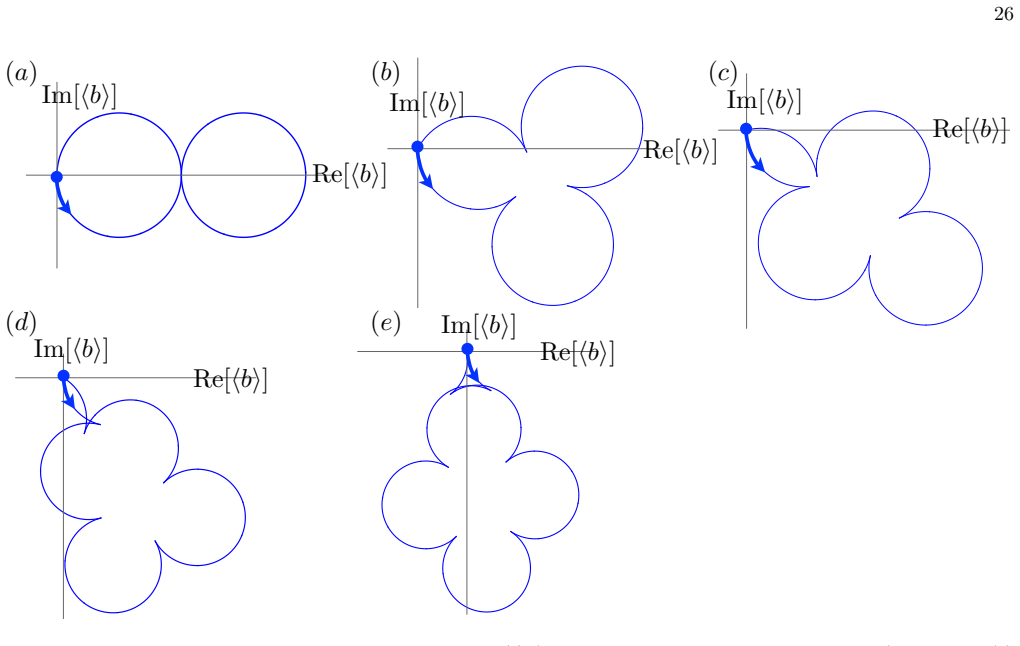
The central object is the effective coupling $H=\epsilon b^\dagger b+M(b+b^\dagger)$ with $M=\frac12\sum_j g_j Z_j\sin\theta_j$, obtained by going to each qubit's dressed basis and dropping off-resonant flip-flop terms. Everything else follows from the displacement identity $b(t)=b(0)+\frac{M}{\epsilon}(1-e^{i\epsilon t})$: the cavity moves on a circle of radius $M/\epsilon$, and when $\epsilon\tau=2\pi n$ the path closes so the propagator reduces to the purely qubit phase $e^{iM^2\tau/\epsilon}$. The flowers cancellation mechanism is a second load-bearing object: simultaneous $\pi$ pulses on both qubits flip the signs of $M$ and of the dispersive shift, so the phase-space trajectory is assembled from circle arcs into a closed even-petal flower ($P\ge4$), exactly canceling the dispersive coupling while leaving the desired conditional phase intact.
What would settle it
A targeted check is to drive two fixed-frequency transmons coupled to a cavity near the cavity frequency and measure the cavity displacement as a function of time via heterodyne or Wigner tomography; the claim predicts exactly $b(t)=b(0)+\frac{M}{\epsilon}(1-e^{i\epsilon t})$, closing to the vacuum at $\tau=2\pi/\epsilon$ only when the hierarchy $\sqrt{\Delta^2+\Omega^2}\gg g,\epsilon$ holds. Violating the hierarchy, or making $\epsilon\tau$ differ from $2\pi n$ by the dispersive shift, should leave a measurable photon population and drop the CZ fidelity, so observing the predicted closure and the predicted $e^{iM^2\tau/\epsilon}$ phase decides the matter.
Extended reading notes
Core claim
The central claim is that two transmons driven at the same near-cavity frequency reduce, under the rotating-wave approximation and the hierarchy $\sqrt{\Delta_j^2+\Omega_j^2}\gg g_j,\epsilon$, to the exactly solvable Hamiltonian $H=\epsilon b^\dagger b+M(b+b^\dagger)$, with $M=\frac12\sum_j g_j Z_j\sin\theta_j$. The cavity displacement obeys $b(t)=b(0)+\frac{M}{\epsilon}(1-e^{i\epsilon t})$, a circle of radius $M/\epsilon$ in phase space. If the gate time satisfies $\epsilon\tau=2\pi n$, the displacement returns to its starting point and the unitary collapses to $U(\tau)=e^{iM^2\tau/\epsilon}$; choosing $2\tau g_1g_2\sin\theta_1\sin\theta_2/\epsilon=\pi$ makes this, up to single-qubit $Z$ rotations, a CZ gate, with fastest time $\tau=\pi/\sqrt{g_1g_2\sin\theta_1\sin\theta_2}$. The paper further claims the dispersive shift $H_{\rm disp}=\sum_i f_i Z_i b^\dagger b$---the dominant correction---can be canceled exactly by requiring $\epsilon\tau$, $f_1\tau$, and $f_2\tau$ to be integer multiples of $\pi$, or by inserting simultaneous $\pi$ pulses so that the phase-space trajectory becomes a closed even-petal 'flower'; this enables the same gate through cavity arrays, including simultaneous gates on up to $N/2$ qubit pairs via distinct eigenmodes.
Load-bearing premise
The scheme rests on the hierarchy $\sqrt{\Delta_j^2+\Omega_j^2}\gg g_j,\epsilon$ (together with the rotating-wave approximation), so that the off-resonant qubit-cavity flip-flop terms are negligible and the dynamics collapse to the simple displacement coupling $M(b+b^\dagger)$; if that hierarchy is not maintained, or if the cavity is significantly populated for times comparable to its decay time, the phase-space circles fail to close cleanly and residual qubit-photon entanglement appears.
Editorial extensions
If this is right
- The ideal gate time is $\tau=\pi/\sqrt{g_1g_2\sin\theta_1\sin\theta_2}$, so near-resonant driving makes the gate faster than schemes that require adiabatic elimination of the cavity.
- The $P=4$ flowers sequence cancels the dispersive coupling exactly and is only about 1.45 times slower than the ideal gate, while the integers approach is typically much slower because $f_i\ll\epsilon$ forces large integers.
- In a metamaterial of $N$ coupled cavities, up to $N/2$ simultaneous two-qubit gates can be applied to arbitrary disjoint qubit pairs using distinct eigenmodes, provided the gate time obeys $\tau\gg N/J$ with $J$ the nearest-neighbor cavity coupling.
- With $P\ge4$ flowers, the error from spectator qubits coupled to the same mode scales as the fourth power of $N g^2/(\Delta\epsilon)$ rather than the square, so the flowers approach is markedly better than the integers approach in multi-qubit settings.
- The offsets of the two flower schedules can cancel always-on $ZZ$ interactions on inactive bonds in a square-lattice architecture.
Reading between the lines
- A natural testable extension is to close the loop with a real-time feedback drive: since the phase-space radius is set by $M/\epsilon$, modulating $\epsilon$ or the Rabi frequencies mid-gate could compensate slow cavity-frequency drift without changing the final $\tau$.
- The paper does not model cavity decay while the mode is significantly populated; a master-equation simulation at $\tau\approx 2\pi/\epsilon$ should reveal an infidelity contribution roughly proportional to $\kappa\tau\langle b^\dagger b\rangle$, which is a concrete quantity an experiment could measure.
- The flowers sequence is a dynamical-decoupling control scheme, so its central prediction---residual photon population vanishes after the full pulse train---can be checked directly by Wigner tomography before undertaking full two-qubit process tomography.
- Whether the simultaneous-gate schedule remains robust when spectator qubits are not dynamically decoupled is left open; the paper shows the multi-qubit error is higher order, but an explicit pulse schedule for arbitrary pairings would be needed to use the scheme as a compiler primitive.
Editorial analysis
A structured set of objections, weighed in public.
Referee Report
Summary. The manuscript proposes a two-qubit controlled-phase gate between superconducting transmon qubits mediated by a cavity or by an array of coupled cavities (a 'metamaterial'), realized by driving both qubits near the cavity resonance ('cross-cross-resonance'). The core derivation (Sec. II) shows that, after dressing each qubit by its drive and applying a second rotating-wave approximation under the hierarchy sqrt(Delta_j^2 + Omega_j^2) >> g_j, epsilon, the dynamics reduce to H = epsilon b^dagger b + M(b + b^dagger) with M a state-dependent number. Because each qubit computational state experiences a different M, the oscillator traces phase-space circles of state-dependent area; at times satisfying epsilon tau = 2 pi n the oscillator returns to its initial state and the unitary is exp(i M^2 tau / epsilon), which yields a CZ gate up to single-qubit rotations when 2 tau g1 g2 sin(theta1) sin(theta2)/epsilon = pi. Two schemes are proposed to cancel the dominant correction, the dispersive shift sum_i f_i Z_i b^dagger b: the 'integers' approach, which requires simultaneously integer values of epsilon tau, f1 tau, f2 tau; and the 'flowers' approach, which applies P pairs of pi-pulses (P even, >=4) timed so that the phase-space trajectory closes even when the dispersive shift is present.
Significance. The central two-qubit construction is a genuine contribution: the derivation of the effective Z(b + b^dagger) Hamiltonian from a microscopic model is self-contained, the phase-space solution is exact and cleanly presented (Eqs. (20)-(26)), and the CZ parameter constraints (Eqs. (25), (29)-(31)) are concrete and checkable. The flowers approach transfers the trapped-ion dynamical-decoupling insight (Ref. [84]) to a cavity setting with a non-trivial extension to nonzero dispersive parameter x, including explicit area formulas (Eqs. (89)-(91)) and a stated gate-time formula (Eq. (95)). The transmon generalization yields closed-form expressions for both the desired interaction and the dispersive shift (Eqs. (47)-(51)), and the error-scaling estimates in Sec. VII.B.1 are transparently labeled as worst-case versus average-case. The paper is honest in flagging its own limitations, notably the deferral of simultaneous multi-pair analysis and of decoherence studies.
major comments (2)
- [Abstract; Sec. VII; Sec. VIII] The abstract and Conclusions state that the gate 'allows one to realize simultaneous gates between multiple pairs of qubits coupled via the same metamaterial,' and the Conclusions repeat 'We showed that...'. The analysis in Sec. VII does not establish this. Sec. VII.B is titled 'Detailed analysis in the case of 2 driven qubits'; its two subsections treat N qubits with 1 photonic mode and 2 qubits with ~N photonic modes, i.e. in both cases only one pair is driven. In Sec. VII.B.2 the authors state that requiring every mode to return to its initial state (epsilon_k tau = 2 pi n_k for all k) is 'very challenging for a large number of modes' and 'We leave to future work to find whether such compensation is possible for large numbers of modes'; Sec. VIII likewise defers 'the case where multiple pairs of qubits are driven simultaneously' to future work. The condition in Eq. (128), g_{i,k} Omega_i / Delta_i << J/N, is derived for a single driven pair while neglecting the other modes; it does not bound the aggregate effect of N-1 spectator modes on the driven qubits, nor does it bound inter-pair crosstalk when N/2 pairs are driven simultaneously at different mode frequencies (each qubit is coupled to every mode through g_{i,k} = g_i eta_{i,k}). The advertised capability is therefore an assumption rather than a result. The fix is either to supply the multi-pair analysis, including an aggregate error bound, or to qualify or remove the claim from the abstract, introduction, and Conclusions and present the metamaterial scheme as an open proposal.
- [Sec. III.B] The practical claims for the flowers approach are derived assuming ideal instantaneous pi-pulses. Eq. (95) states that the P=4 gate is slower than the ideal gate by a factor of only 1.45, and the text concludes the flowers approach is 'likely more promising' than the integers approach. The treatment of non-ideal pulses is, however, only qualitative: the conditions (tau_pi)^{-1} >> epsilon, g Omega/Delta and (tau_pi)^{-1} << Delta^2/Omega are stated, and the dressing-misalignment error is said to be suppressed by Omega/Delta, but no estimate of the resulting infidelity is given, and the total pulse time P tau_pi is not added to T_tot in Eq. (95). Since each evolution interval is tau = 3 pi / (2 epsilon), a complete comparison needs at least an order-of-magnitude statement that tau_pi << tau is compatible with these inequalities for realistic parameters and an estimate of the pulse-induced phase error. I request a quantitative error budget for the pi-pulses or an explicit caveat that Eq. (95) is an ideal-pulse limit.
minor comments (6)
- [Sec. II.B and elsewhere] There are several typos: 'we we will discuss' (end of Sec. II.B), 'antisymmetic' (Sec. IV, below Eq. (97)), 'metameterial' and 'matamaterial' (Sec. VII opening and Sec. VIII), 'for large a large number of modes' (Sec. VII.B.3), and 'CMPG-like' for 'CPMG-like' (Sec. III.B). These should be corrected.
- [Sec. III.B and Sec. VIII] The claim that spin-locking suppresses the dispersive coupling is delegated to companion Ref. [91] ('In Ref. [91], we also show...'). As this support is not contained in the manuscript, the reference should be explicitly marked as a companion paper, or the argument should be summarized.
- [Abstract and Sec. II.A] The abstract and Sec. I describe the cavity as 'actively and significantly populated,' but for the fastest CZ gate (n=1, equal couplings and equal sin(theta)), the phase-space radius is M/epsilon = 1/2, giving a mean photon number of order 1/4 during the gate. The wording should be reconciled with these numbers.
- [Sec. VII opening paragraph] The sentence 'the condition in Eq. (128) enables the metamaterial to mediate up to N/2 simultaneous cross-cross-resonance two-qubit gates' states as a conclusion what is at best a necessary condition for a scheme whose multi-pair analysis is absent; this sentence should be rephrased as a proposal.
- [Sec. II.A (RIP comparison)] The speed comparison with the resonator-induced phase gate and with adiabatically eliminated resonator buses is qualitative; a concrete numerical example with typical transmon/cavity parameters would make the claimed speed advantage testable.
- [Sec. III.B, Fig. 3] The pulse-timing diagram in Fig. 3 does not indicate the pulse duration tau_pi or the idealization that pulses are instantaneous; the caption should state this assumption explicitly.
Circularity Check
No significant circularity: the two-qubit gate derivation is self-contained analytic; the metamaterial multi-pair claim is deferred, not derived by fiat.
full rationale
The paper's central derivation is self-contained. Starting from Eq. (1), a rotating-frame transformation and RWA give Eq. (2); the dressed-basis rotation gives Eq. (7), and the hierarchy sqrt(Delta_j^2+Omega_j^2) >> g_j, epsilon justifies the second RWA leading to Eq. (8), H = epsilon b†b + M(b+b†). The propagator for this Hamiltonian is solved exactly in Eqs. (9)-(26), with the phase-space closure condition epsilon tau = 2 pi n being a stated parameter condition, not an assumed consequence of the desired gate. The CZ condition (29) is likewise a constraint on tau, g1, g2, theta1, theta2, derived from Eq. (26). The dispersive-coupling error is modeled independently in Eqs. (36)-(38), and both cancellation schemes are constructed: the integers approach imposes integer conditions (55)-(58) as explicit tuning requirements, and the flowers approach proves closure in phase space via Eqs. (80)-(93), including nonzero x, so it does not reduce to an ansatz. The only self-citation of substantive content (Ref. [91], which concerns spin-locking and dual-rail suppression) is presented as an alternative or complementary approach, not as a premise of the two-qubit gate derivation. The abstract's claim that the gate allows simultaneous gates between multiple pairs of qubits coupled via the same metamaterial is stronger than what is demonstrated: Sec. VII B analyzes only the case where two qubits are driven, Sec. VII B.2 explicitly leaves the multi-mode compensation problem to future work, and the Conclusions state that extending the analysis to multiple simultaneously driven pairs is future work. That is an overreach or scope gap, not a circularity; no step of the central derivation is equivalent to its own input by construction, and no fitted parameter is renamed as a prediction. Score 0.
Assumptions & free parameters
free parameters (3)
- Integer numbers n_epsilon, n1, n2 in the integers approach =
not fitted; user-chosen integers
- P, the number of petal pairs in the flowers approach =
P = 4 for the fastest gate
- Rabi frequencies Omega1, Omega2 =
not fitted; user-tuned
assumptions (4)
- standard math Rotating-wave approximation (RWA)
- domain assumption Two-level (qubit) truncation of transmons
- domain assumption Neglect of decoherence
- domain assumption Regime condition sqrt(Delta_j^2 + Omega_j^2) >> g_j, epsilon
Cite this review
Pith. "Pith review of Cavity-mediated cross-cross-resonance gate." pith.science (2026). https://pith.science/paper/32O2GD23
@misc{pith2026250603239,
  author       = {Pith},
  title        = {Pith review of: Cavity-mediated cross-cross-resonance gate},
  year         = {2026},
  howpublished = {\url{https://pith.science/paper/32O2GD23}},
  note         = {Machine review of arXiv:2506.03239}
}
read the original abstract
We propose a cavity-mediated gate between two transmon qubits or other nonlinear superconducting elements. The gate is realized by driving both qubits at a frequency that is near-resonant with the frequency of the cavity. Since both qubits are subject to a cross-resonant drive, we call this gate a cross-cross-resonance gate. In close analogy with gates between trapped-ion qubits, in phase space, the state of the cavity makes a circle whose area depends on the state of the two qubits, realizing a controlled-phase gate. We propose two schemes for canceling the dominant error, which is the dispersive coupling. We also show that this cross-cross-resonance gate allows one to realize simultaneous gates between multiple pairs of qubits coupled via the same metamaterial composed of an array of coupled cavities or other linear mediators.
Figures


Figures from the paper (14 more)


Forward citations
Cited by 1 Pith paper
-
Long-Range Entangling Operations via Josephson Junction Metasurfaces
A proposed metasurface-mediated coupling scheme claims centimeter-scale two-qubit entangling gates with over 98% simulated fidelity, but the supporting derivation and simulation details are not provided.
Reference graph
Works this paper leans on
-
[84]
K. N. Smith, G. S. Ravi, J. M. Baker, and F. T. Chong, in2022 55th IEEE/ACM International Symposium on Microar- chitecture (MICRO)(IEEE, 2022) pp. 1092–1109
work page 2022
-
[1]
(B8) In this subsection, we present an alternative derivation of Eq
Alternative derivation of Eq. (B8) In this subsection, we present an alternative derivation of Eq. (B8). We begin by rewriting our Hamiltonian as a sum of the quadratic partH 2 and the quartic partH 4: H=H 2 +H 4,(B9) H2 =νb †b+ X i ωic† i ci + X i gi(c† i b+h.c.),(B10) H4 =− ˜η 2 b†b†bb− X i ηi 2 c† i c† i cici.(B11) We now exactly diagonalizeH 2: H2 = ˜...
-
[2]
bad”) dispersive coupling can be suppressed relative to the desired (“good
2 qubits and∼Nphotonic modes Having discussed the simple case ofNqubits and 1 photonic mode, let us describe another simple case of 2 qubits and∼Nphotonic modes. The Hamiltonian in Eqs. (135-137) then simplifies to H= X k h ϵk(1 +x k)b† kbk +M k(bk +b † k) i ,(166) xk = 1 ϵk 2X i=1 fi,kZi,(167) Mk = 1 2 2X i=1 gi,kZi sinθ i,(168) i.e., the dispersive coup...
-
[3]
As in Sec
Derivation to second order inηand to all orders ing In this subsection, we deriveJ ZZ to second order inηand to all orders ing. As in Sec. B 1, we write our Hamiltonian as a sum of the quadratic partH 2 and the quartic partH 4: H=H 2 +H 4,(B33) H2 =νb †b+ X i ωic† i ci + X i gi(c† i b+h.c.) + ˜g(c† 1c2 +h.c.),(B34) H4 =− ˜η 2 b†b†bb− X i ηi 2 c† i c† i ci...
2000
-
[4]
(B8) are affected by the presence of direct interaction between data qubits
Including direct interaction between data qubits In this subsection, we analyze how ZZ interactions derived in Eq. (B8) are affected by the presence of direct interaction between data qubits. The Hamiltonian is now H=νb †b− ˜η 2 b†b†bb+ X i ωic† i ci − ηi 2 c† i c† i cici + X i gi(c† i b+h.c.) + ˜g(c† 1c2 +h.c.),(B23) where ˜gis the strength of the direct...
-
[5]
Notice that, when ˜g̸= 0, we have a term∼g 3
+ ∆2 1(g2 1 −g 2 2 + ˜g2)) ∆3 1(∆1 −∆ 2)3 , (B25) where ∆ i =ω i −ν. Notice that, when ˜g̸= 0, we have a term∼g 3. The expression forE 2 is the same except the subscripts 1 and 2 are swapped. To calculate the shiftE 12 of|1,1,0⟩to fourth order ing, we apply the Schrieffer-Wolff on the following Hamiltonian, written in the basis{|1,1,0⟩,|1,0,1⟩,|0,1,1⟩,|0,...
-
[6]
If ˜g≪g 2 1/∆, then the ZZ interaction is dominated by the ˜g= 0 answerJ (0) ZZ
-
[7]
We note that our expressions forJ (0) ZZ ,J (1) ZZ , andJ (2) ZZ are in agreement with Appendix D of Ref
If ˜g≫g 2 1/∆, then the ZZ interaction is dominated by ˜g2 2(∆2−∆1+η1) + ˜g2 2(∆1−∆2+η2) fromJ (2) ZZ . We note that our expressions forJ (0) ZZ ,J (1) ZZ , andJ (2) ZZ are in agreement with Appendix D of Ref. [99]. In particular, using the dictionary U1 =−η 1, U2 =−η 2, Uc =−˜η, g12 = ˜g, g1c =g 1, g2c =g 2,∆ 12 =−∆ 21 = ∆1 −∆ 2,∆ 1c = ∆1,∆ 2c = ∆2,(B32)...
Show all 108 references
-
[8]
Y. Chen, C. Neill, P. Roushan, N. Leung, M. Fang, R. Barends, J. Kelly, B. Campbell, Z. Chen, B. Chiaro, A. Dunsworth, E. Jeffrey, A. Megrant, J. Y. Mutus, P. J. J. O’Malley, C. M. Quintana, D. Sank, A. Vainsencher, J. Wenner, T. C. White, M. R. Geller, A. N. Cleland, and J. M...
2014
-
[9]
high energy
+ 2(∆2 1η1 + ∆2 2η2 + (∆1 + ∆2)η1η2)˜g2 −(η 1 +η 2)˜g4) 2(∆1 −∆ 2 −η 1)(∆1 −∆ 2 +η 2)(∆2 1 −˜g2)2(∆2 2 −˜g2)2 . (C4) Ifη 1 =η 2 =η, this simplifies to JZZ = ηg 2 1g2 2 ˜g2(∆4 2 + ∆4 1 +η(∆ 1 + ∆2)(∆2 1 + ∆2 2)−2(∆ 2 1 + ∆2 2 + (∆1 + ∆2)η)˜g2 + 2˜g4) 2(η2 −(∆ 1 −∆ 2)2)(∆2 1 −˜g...
-
[10]
Krantz, M
P. Krantz, M. Kjaergaard, F. Yan, T. P. Orlando, S. Gustavsson, and W. D. Oliver, Appl. Phys. Rev.6, 021318 (2019)
2019
-
[11]
Kjaergaard, M
M. Kjaergaard, M. E. Schwartz, J. Braum¨ uller, P. Krantz, J. I. J. Wang, S. Gustavsson, and W. D. Oliver, Annu. Rev. Condens. Matter Phys.11, 369 (2020)
2020
-
[12]
Blais, A
A. Blais, A. L. Grimsmo, S. M. Girvin, and A. Wallraff, Rev. Mod. Phys.93, 025005 (2021)
2021
-
[13]
Blais, A
A. Blais, A. M. Van Den Brink, and A. M. Zagoskin, Phys. Rev. Lett.90, 127901 (2003)
2003
-
[14]
R. C. Bialczak, M. Ansmann, M. Hofheinz, E. Lucero, M. Neeley, A. D. O’Connell, D. Sank, H. Wang, J. Wenner, M. Steffen, A. N. Cleland, and J. M. Martinis, Nat. Phys.6, 409 (2010)
2010
-
[15]
Dewes, F
A. Dewes, F. R. Ong, V. Schmitt, R. Lauro, N. Boulant, P. Bertet, D. Vion, and D. Esteve, Phys. Rev. Lett.108, 057002 (2012)
2012
-
[16]
Barends, J
R. Barends, J. Kelly, A. Megrant, A. Veitia, D. Sank, E. Jeffrey, T. C. White, J. Mutus, A. G. Fowler, B. Campbell, Y. Chen, Z. Chen, B. Chiaro, A. Dunsworth, C. Neill, P. O’Malley, P. Roushan, A. Vainsencher, J. Wenner, A. N. Korotkov, A. N. Cleland, and J. M. Martinis, Natur...
2014
-
[17]
Yamamoto, M
T. Yamamoto, M. Neeley, E. Lucero, R. C. Bialczak, J. Kelly, M. Lenander, M. Mariantoni, A. D. O’Connell, D. Sank, H. Wang, M. Weides, J. Wenner, Y. Yin, A. N. Cleland, and J. M. Martinis, Phys. Rev. B82, 184515 (2010)
2010
-
[18]
F. Yan, P. Krantz, Y. Sung, M. Kjaergaard, D. Campbell, J. I. J. Wang, T. P. Orlando, S. Gustavsson, and W. D. Oliver, Phys. Rev. Appl.10, 054062 (2018)
2018
-
[19]
Arute, K
F. Arute, K. Arya, R. Babbush, D. Bacon, J. C. Bardin, R. Barends, R. Biswas, S. Boixo, F. G. S. L. Brandao, D. A. Buell, B. Burkett, Y. Chen, Z. Chen, B. Chiaro, R. Collins, W. Courtney, A. Dunsworth, E. Farhi, B. Foxen, A. Fowler, C. Gidney, M. Giustina, R. Graff, K. Guerin,...
2019
-
[20]
Majer, J
J. Majer, J. M. Chow, J. M. Gambetta, J. Koch, B. R. Johnson, J. A. Schreier, L. Frunzio, D. I. Schuster, A. A. Houck, A. Wallraff, A. Blais, M. H. Devoret, S. M. Girvin, and R. J. Schoelkopf, Nature (London)449, 443 (2007)
2007
-
[21]
This is the correct answer forJ ZZ to orderg 4 after it has also been expanded to first order inη, as one can check by expanding Eq
(B18) =−˜η g2 1g2 2 2∆2 1∆2 2 −η 1 g2 1g2 2 2∆2 2(∆2 −∆ 1)2 −η 2 g2 1g2 2 2∆2 1(∆2 −∆ 1)2 (B19) =− (η1∆2 1 +η 2∆2 2 + ˜η(∆1 −∆ 2)2)g2 1g2 2 2∆2 1∆2 2(∆2 −∆ 1)2 ,(B20) where we plugged in expressions for matrix elements ofUthat are correct to lowest nonzero order ing. This is t...
-
[22]
J. M. Gambetta, A. A. Houck, and A. Blais, Phys. Rev. Lett.106, 030502 (2011)
2011
-
[23]
S. J. Srinivasan, A. J. Hoffman, J. M. Gambetta, and A. A. Houck, Phys. Rev. Lett.106, 083601 (2011)
2011
-
[24]
DiCarlo, J
L. DiCarlo, J. M. Chow, J. M. Gambetta, L. S. Bishop, B. R. Johnson, D. I. Schuster, J. Majer, A. Blais, L. Frunzio, S. M. Girvin, and R. J. Schoelkopf, Nature (London)460, 240 (2009)
2009
-
[25]
F. W. Strauch, P. R. Johnson, A. J. Dragt, C. J. Lobb, J. R. Anderson, and F. C. Wellstood, Phys. Rev. Lett.91, 167005 (2003)
2003
-
[26]
DiCarlo, M
L. DiCarlo, M. D. Reed, L. Sun, B. R. Johnson, J. M. Chow, J. M. Gambetta, L. Frunzio, S. M. Girvin, M. H. Devoret, and R. J. Schoelkopf, Nature (London)467, 574 (2010)
2010
-
[27]
Neg ˆ ırneac, H
V. Neg ˆ ırneac, H. Ali, N. Muthusubramanian, F. Battistel, R. Sagastizabal, M. S. Moreira, J. F. Marques, W. J. Vlothuizen, M. Beekman, C. Zachariadis, N. Haider, A. Bruno, and L. DiCarlo, Phys. Rev. Lett.126, 220502 (2021)
2021
-
[28]
A. W. Cross and J. M. Gambetta, Phys. Rev. A91, 032325 (2015)
2015
-
[29]
Puri and A
S. Puri and A. Blais, Phys. Rev. Lett.116, 180501 (2016)
2016
-
[30]
H. Paik, A. Mezzacapo, M. Sandberg, D. T. McClure, B. Abdo, A. D. C´ orcoles, O. Dial, D. F. Bogorin, B. L. T. Plourde, M. Steffen, A. W. Cross, J. M. Gambetta, and J. M. Chow, Phys. Rev. Lett.117, 250502 (2016)
2016
-
[31]
Malekakhlagh, W
M. Malekakhlagh, W. Shanks, and H. Paik, Phys. Rev. A105, 022607 (2022)
2022
-
[32]
Kumph, J
M. Kumph, J. Raftery, A. Finck, J. Blair, A. Carniol, S. Carnevale, G. A. Keefe, V. Arena, S. Hall, D. McKay, and G. Stehlik, arXiv:2406.11770 (2024)
2024 arXiv
-
[33]
Huang, T
Z. Huang, T. Kim, T. Roy, Y. Lu, A. Romanenko, S. Zhu, and A. Grassellino, Phys. Rev. Appl.22, 034007 (2024)
2024
-
[34]
G. S. Paraoanu, Phys. Rev. B74, 140504 (2006)
2006
-
[35]
Rigetti and M
C. Rigetti and M. Devoret, Phys. Rev. B81, 134507 (2010)
2010
-
[36]
P. J. Leek, S. Filipp, P. Maurer, M. Baur, R. Bianchetti, J. M. Fink, M. G¨ oppl, L. Steffen, and A. Wallraff, Phys. Rev. B 79, 180511 (2009)
2009
-
[37]
Poletto, J
S. Poletto, J. M. Gambetta, S. T. Merkel, J. A. Smolin, J. M. Chow, A. D. C´ orcoles, G. A. Keefe, M. B. Rothwell, J. R. Rozen, D. W. Abraham, C. Rigetti, and M. Steffen, Phys. Rev. Lett.109, 240505 (2012)
2012
-
[38]
J. M. Chow, J. M. Gambetta, A. W. Cross, S. T. Merkel, C. Rigetti, and M. Steffen, New J. Phys.15, 115012 (2013)
2013
-
[39]
Zeytino˘ glu, M
S. Zeytino˘ glu, M. Pechal, S. Berger, A. A. Abdumalikov, A. Wallraff, and S. Filipp, Phys. Rev. A91, 043846 (2015)
2015
-
[40]
Egger, M
D. Egger, M. Ganzhorn, G. Salis, A. Fuhrer, P. M¨ uller, P.Kl. Barkoutsos, N. Moll, I. Tavernelli, and S. Filipp, Phys. Rev. Appl.11, 014017 (2019)
2019
-
[41]
Bertet, C
P. Bertet, C. J. P. M. Harmans, and J. E. Mooij, Phys. Rev. B73, 064512 (2006)
2006
-
[42]
A. O. Niskanen, Y. Nakamura, and J.-S. Tsai, Phys. Rev. B73, 094506 (2006)
2006
-
[43]
Y.-X. Liu, L. F. Wei, J. R. Johansson, J. S. Tsai, and F. Nori, Phys. Rev. B76, 144518 (2007)
2007
-
[44]
A. O. Niskanen, K. Harrabi, F. Yoshihara, Y. Nakamura, S. Lloyd, and J. S. Tsai, Science316, 723 (2007)
2007
-
[45]
Beaudoin, M
F. Beaudoin, M. P. Da Silva, Z. Dutton, and A. Blais, Phys. Rev. A86, 022305 (2012)
2012
-
[46]
J. D. Strand, M. Ware, F. Beaudoin, T. A. Ohki, B. R. Johnson, A. Blais, and B. L. T. Plourde, Phys. Rev. B87, 220505 (2013)
2013
-
[47]
Kapit, Phys
E. Kapit, Phys. Rev. A92, 012302 (2015)
2015
-
[48]
A. J. Sirois, M. A. Castellanos-Beltran, M. P. DeFeo, L. Ranzani, F. Lecocq, R. W. Simmonds, J. D. Teufel, and J. Aumentado, Appl. Phys. Lett.106, 172603 (2015)
2015
-
[49]
D. C. McKay, S. Filipp, A. Mezzacapo, E. Magesan, J. M. Chow, and J. M. Gambetta, Phys. Rev. Appl.6, 064007 (2016)
2016
-
[50]
R. K. Naik, N. Leung, S. Chakram, P. Groszkowski, Y. Lu, N. Earnest, D. C. McKay, J. Koch, and D. I. Schuster, Nat. Commun.8, 1904 (2017)
2017
-
[51]
S. A. Caldwell, N. Didier, C. A. Ryan, E. A. Sete, A. Hudson, P. Karalekas, R. Manenti, M. P. Da Silva, R. Sinclair, E. Acala, N. Alidoust, J. Angeles, A. Bestwick, M. Block, B. Bloom, A. Bradley, C. Bui, L. Capelluto, R. Chilcott, J. Cordova, G. Crossman, M. Curtis, S. Deshpa...
2018
-
[52]
Didier, E
N. Didier, E. A. Sete, M. P. da Silva, and C. Rigetti, Phys. Rev. A97, 022330 (2018)
2018
-
[53]
Reagor, C
M. Reagor, C. B. Osborn, N. Tezak, A. Staley, G. Prawiroatmodjo, M. Scheer, N. Alidoust, E. A. Sete, N. Didier, M. P. Da Silva, E. Acala, J. Angeles, A. Bestwick, M. Block, B. Bloom, A. Bradley, C. Bui, S. Caldwell, L. Capelluto, R. Chilcott, J. Cordova, G. Crossman, M. Curtis...
2018
-
[54]
P. C. de Groot, J. Lisenfeld, R. N. Schouten, S. Ashhab, A. Lupa¸ scu, C. J. P. M. Harmans, and J. E. Mooij, Nat. Phys. 6, 763 (2010)
2010
-
[55]
J. M. Chow, A. D. C´ orcoles, J. M. Gambetta, C. Rigetti, B. R. Johnson, J. A. Smolin, J. R. Rozen, G. A. Keefe, M. B. Rothwell, M. B. Ketchen, and M. Steffen, Phys. Rev. Lett.107, 080502 (2011)
2011
-
[56]
Kandala, K
A. Kandala, K. X. Wei, S. Srinivasan, E. Magesan, S. Carnevale, G. A. Keefe, D. Klaus, O. Dial, and D. C. McKay, Phys. Rev. Lett.127, 130501 (2021)
2021
-
[57]
K. X. Wei, E. Magesan, I. Lauer, S. Srinivasan, D. F. Bogorin, S. Carnevale, G. A. Keefe, Y. Kim, D. Klaus, W. Landers, N. Sundaresan, C. Wang, E. J. Zhang, M. Steffen, O. E. Dial, D. C. McKay, and A. Kandala, Phys. Rev. Lett.129, 060501 (2022)
2022
-
[58]
J. M. Chow, J. M. Gambetta, A. D. C´ orcoles, S. T. Merkel, J. A. Smolin, C. Rigetti, S. Poletto, G. A. Keefe, M. B. Rothwell, J. R. Rozen, M. B. Ketchen, and M. Steffen, Phys. Rev. Lett.109, 060501 (2012)
2012
-
[59]
A. D. C´ orcoles, J. M. Gambetta, J. M. Chow, J. A. Smolin, M. Ware, J. Strand, B. L. T. Plourde, and M. Steffen, Phys. Rev. A87, 030301 (2013)
2013
-
[60]
Takita, A
M. Takita, A. D. C´ orcoles, E. Magesan, B. Abdo, M. Brink, A. Cross, J. M. Chow, and J. M. Gambetta, Phys. Rev. Lett. 117, 210505 (2016)
2016
-
[61]
Sheldon, E
S. Sheldon, E. Magesan, J. M. Chow, and J. M. Gambetta, Phys. Rev. A93, 060302 (2016)
2016
-
[62]
Patterson, J
A. Patterson, J. Rahamim, T. Tsunoda, P. Spring, S. Jebari, K. Ratter, M. Mergenthaler, G. Tancredi, B. Vlastakis, M. Esposito, and P. Leek, Phys. Rev. Appl.12, 064013 (2019)
2019
-
[63]
Hazra, K
S. Hazra, K. V. Salunkhe, A. Bhattacharjee, G. Bothara, S. Kundu, T. Roy, M. P. Patankar, and R. Vijay, Appl. Phys. Lett.116, 152601 (2020)
2020
-
[64]
Dogan, D
E. Dogan, D. Rosenstock, L. L. Guevel, H. Xiong, R. A. Mencia, A. Somoroff, K. N. Nesterov, M. G. Vavilov, V. E. Manucharyan, and C. Wang, Phys. Rev. Appl.20(2023)
2023
-
[65]
P. C. de Groot, S. Ashhab, A. Lupa¸ scu, L. DiCarlo, F. Nori, C. J. P. M. Harmans, and J. E. Mooij, New J. Phys.14, 073038 (2012)
2012
-
[66]
Kirchhoff, T
S. Kirchhoff, T. Keßler, P. J. Liebermann, E. Ass´ emat, S. Machnes, F. Motzoi, and F. K. Wilhelm, Phys. Rev. A97, 042348 (2018)
2018
-
[67]
Tripathi, M
V. Tripathi, M. Khezri, and A. N. Korotkov, Phys. Rev. A100, 012301 (2019)
2019
-
[68]
Magesan and J
E. Magesan and J. M. Gambetta, Phys. Rev. A101, 052308 (2020)
2020
-
[69]
Sundaresan, I
N. Sundaresan, I. Lauer, E. Pritchett, E. Magesan, P. Jurcevic, and J. M. Gambetta, PRX Quantum1, 020318 (2020)
2020
-
[70]
Malekakhlagh, E
M. Malekakhlagh, E. Magesan, and D. C. McKay, Phys. Rev. A102, 042605 (2020)
2020
-
[71]
Malekakhlagh and E
M. Malekakhlagh and E. Magesan, Phys. Rev. A105, 012602 (2022)
2022
-
[72]
K. N. Nesterov, C. Wang, V. E. Manucharyan, and M. G. Vavilov, Phys. Rev. Appl.18, 034063 (2022)
2022
-
[73]
Heya and N
K. Heya and N. Kanazawa, PRX Quantum2, 040336 (2021)
2021
-
[74]
Petrescu, C
A. Petrescu, C. L. Calonnec, C. Leroux, A. D. Paolo, P. Mundada, S. Sussman, A. Vrajitoarea, A. A. Houck, and A. Blais, Phys. Rev. Appl.19, 044003 (2023)
2023
-
[75]
Sorensen and K
A. Sorensen and K. Molmer, Phys. Rev. A62, 022311 (2000)
2000
-
[76]
N. P. Breuckmann, PRX Quantum2, 040101 (2021)
2021
-
[77]
Gottesman, Quantum Info
D. Gottesman, Quantum Info. Comput.14, 1338 (2014)
2014
-
[78]
M. A. Tremblay, N. Delfosse, and M. E. Beverland, Phys. Rev. Lett.129, 050504 (2022)
2022
-
[79]
Panteleev and G
P. Panteleev and G. Kalachev, inProceedings of the 54th Annual ACM SIGACT Symposium on Theory of Computing (ACM, Rome Italy, 2022) pp. 375–388
2022
-
[80]
Leverrier and G
A. Leverrier and G. Zemor, in2022 IEEE 63rd Annual Symposium on Foundations of Computer Science (FOCS)(IEEE, Denver, CO, USA, 2022) pp. 872–883
2022
-
[81]
Bravyi, A
S. Bravyi, A. W. Cross, J. M. Gambetta, D. Maslov, P. Rall, and T. J. Yoder, Nature (London)627, 778 (2024)
2024
-
[82]
K. Wang, Z. Lu, C. Zhang, G. Liu, J. Chen, Y. Wang, Y. Wu, S. Xu, X. Zhu, F. Jin, Y. Gao, Z. Tan, Z. Cui, N. Wang, Y. Zou, A. Zhang, T. Li, F. Shen, J. Zhong, Z. Bao, Z. Zhu, Y. Han, Y. He, J. Shen, H. Wang, J.-N. Yang, Z. Song, J. Deng, H. Dong, Z.-Z. Sun, W. Li, Q. Ye, S. Ji...
2025
-
[83]
G. J. Norris, K. Dalton, D. C. Zanuz, A. Rommens, A. Flasby, M. B. Panah, F. Swiadek, C. Scarato, C. Hellings, J.-C. Besse,et al., arXiv preprint arXiv:2503.12603 (2025)
2025 arXiv
-
[85]
A. Gold, J. Paquette, A. Stockklauser, M. J. Reagor, M. S. Alam, A. Bestwick, N. Didier, A. Nersisyan, F. Oruc, A. Razavi, et al., npj Quantum Inf.7, 142 (2021)
2021
-
[86]
Field, A
M. Field, A. Q. Chen, B. Scharmann, E. A. Sete, F. Oruc, K. Vu, V. Kosenko, J. Y. Mutus, S. Poletto, and A. Bestwick, Phys. Rev. Appl.21, 054063 (2024)
2024
-
[87]
X. Deng, W. Zheng, X. Liao, H. Zhou, Y. Ge, J. Zhao, D. Lan, X. Tan, Y. Zhang, S. Li,et al., Phys. Rev. Lett.134, 020801 (2025)
2025
-
[88]
X. Wu, H. Yan, G. Andersson, A. Anferov, M.-H. Chou, C. R. Conner, J. Grebel, Y. J. Joshi, S. Li, J. M. Miller,et al., Phys. Rev. X14, 041030 (2024)
2024
-
[89]
J. Song, S. Yang, P. Liu, H.-L. Zhang, G.-M. Xue, Z.-Y. Mi, W.-G. Zhang, F. Yan, Y.-R. Jin, and H.-F. Yu, arXiv:2407.20338 (2024). 40
2024 arXiv
-
[90]
However, throughout the paper, we will abuse the terminology and refer to them simply as detunings
Technically,ϵand ∆ j are negatives of the corresponding detunings since they are negative when the drive is blue-detuned. However, throughout the paper, we will abuse the terminology and refer to them simply as detunings
-
[91]
C. D. Bruzewicz, J. Chiaverini, R. McConnell, and J. M. Sage, Appl. Phys. Rev.6, 021314 (2019)
2019
-
[92]
Leibfried, B
D. Leibfried, B. DeMarco, V. Meyer, D. Lucas, M. Barrett, J. Britton, W. M. Itano, B. Jelenkovic, C. Langer, T. Rosenband, and D. J. Wineland, Nature (London)422, 412 (2003)
2003
-
[93]
Manovitz, A
T. Manovitz, A. Rotem, R. Shaniv, I. Cohen, Y. Shapira, N. Akerman, A. Retzker, and R. Ozeri, Phys. Rev. Lett.119, 220505 (2017)
2017
-
[94]
J. A. Mizrahi,Ultrafast control of spin and motion in trapped ions, Ph.D. thesis, University of Maryland, College Park (2013)
2013
-
[95]
J. J. Garc ´ ıa-Ripoll, P. Zoller, and J. I. Cirac, Phys. Rev. Lett.91, 157901 (2003)
2003
-
[96]
H. Y. Carr and E. M. Purcell, Phys. Rev.94, 630 (1954)
1954
-
[97]
Meiboom and D
S. Meiboom and D. Gill, Rev. Sci. Instrum.29, 688 (1958)
1958
-
[98]
M. A. Ali Ahmed, G. A. ´Alvarez, and D. Suter, Phys. Rev. A87, 042309 (2013)
2013
-
[99]
G. S. Uhrig, Phys. Rev. Lett.98, 100504 (2007)
2007
-
[100]
Golanet al., in preparation (2025)
O. Golanet al., in preparation (2025)
2025
-
[101]
Shapira, R
Y. Shapira, R. Shaniv, T. Manovitz, N. Akerman, L. Peleg, L. Gazit, R. Ozeri, and A. Stern, Phys. Rev. A101, 032330 (2020)
2020
-
[102]
Grzesiak, R
N. Grzesiak, R. Bl¨ umel, K. Wright, K. M. Beck, N. C. Pisenti, M. Li, V. Chaplin, J. M. Amini, S. Debnath, J.-S. Chen, and Y. Nam, Nat. Commun.11, 2963 (2020)
2020
-
[103]
Bose, Contemp
S. Bose, Contemp. Phys.48, 13 (2007)
2007
-
[104]
N. Y. Yao, L. Jiang, A. V. Gorshkov, Z. X. Gong, A. Zhai, L. M. Duan, and M. D. Lukin, Phys. Rev. Lett.106, 040505 (2011/01/27/)
2011
-
[105]
Y. Lu, S. Zhang, K. Zhang, W. Chen, Y. Shen, J. Zhang, J.-N. Zhang, and K. Kim, Nature (London)572, 363 (2019)
2019
-
[106]
S. C. Burd, R. Srinivas, H. M. Knaack, W. Ge, A. C. Wilson, D. J. Wineland, D. Leibfried, J. J. Bollinger, D. T. C. Allcock, and D. H. Slichter, Nat. Phys.17, 898 (2021)
2021
-
[107]
Bravyi, D
S. Bravyi, D. P. DiVincenzo, and D. Loss, Ann. Phys.326, 2793 (2011)
2011
-
[108]
Heunisch, C
L. Heunisch, C. Eichler, and M. J. Hartmann, Phys. Rev. Appl.20, 064037 (2023)
2023
Reviewed August 7, 2026 · model on record in the stance chip above.
Discussion (0). Sign in to comment.