REVIEW 3 major objections 4 minor 79 references
Itinerant versus localized magnetism in spin gapped metallic half-Heusler compounds: Stoner criterion and magnetic interactions
T0 review · 3 major / 4 minor · reviewed 2026-08-07 · deepseek-v4-flash
Pith's one-line read A sublattice-resolved Stoner product separates magnetic from nonmagnetic spin-gapped half-Heuslers, with cRPA-derived I and PBE density of states as inputs.
desk verdict Useful half-Heusler magnetism survey, but the Stoner-based predictor is undercut by an internal inconsistency with its own Table II. read the letter →
The pith
A machine-rendered reading of the paper's core claim, the machinery that carries it, and where it could break.
The reading
What carries the argument
The load-bearing object is the sublattice-resolved Stoner criterion. For a compound XYZ with two transition-metal sites X and Y, the paper checks I_X N_X(E_F)>1 and I_Y N_Y(E_F)>1 separately, with I=(U+6J)/5 from cRPA-calculated on-site Coulomb repulsion U and Hund exchange J, and N_X(E_F), N_Y(E_F) the site-projected nonmagnetic densities of states. The mechanism does the sorting: both sublattices unstable gives moments on both, one unstable gives a localized moment on that site with an induced moment on the other, and neither unstable gives a nonmagnetic gapped metal. A many-body renormalization factor α=0.6, taken from the literature, is also reported as a more conservative version of the threshold.
What would settle it
A decisive check would be to measure the magnetization of a predicted nonmagnetic gapped metal such as NiTiSb or CoNbSb; if it orders magnetically below some temperature, the sublattice Stoner criterion would be falsified for that member. A cheaper calculation-based check would be to recompute N(E_F) with a hybrid functional or GW: if the classification of any of the borderline compounds flips across I·N(E_F)=1, the predictor is not stable to the band-structure method.
Extended reading notes
Core claim
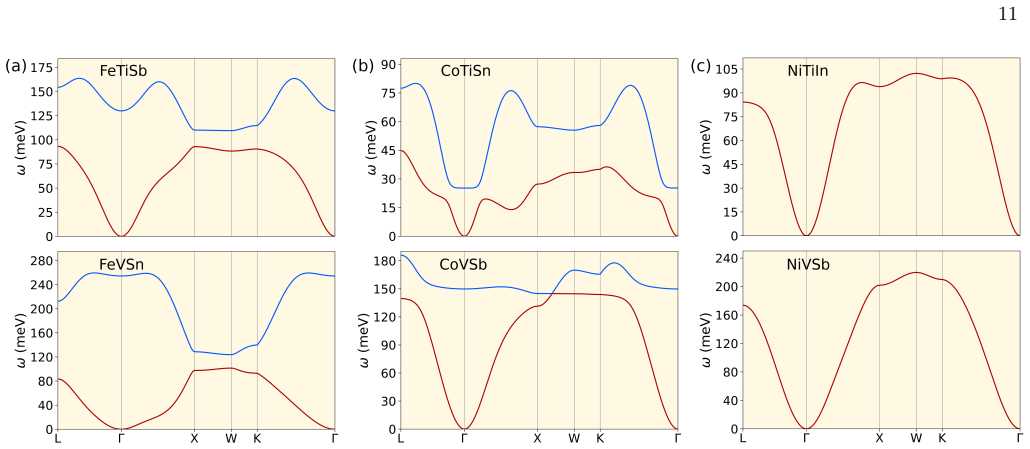
On the paper's own terms, the central finding is that the Stoner criterion, applied separately to the two transition-metal sublattices of each half-Heusler, correctly separates the magnetic from the nonmagnetic members of the spin-gapped-metal family. The authors estimate I from cRPA values of U and J via I=(U+6J)/5, evaluate N(E_F) in the non-spin-polarized state, and find that compounds with I·N(E_F)>1 on at least one sublattice develop moments, while compounds with the product below unity on both sublattices—NiHfIn, CoNbSb, CoTaSb, NiTiSb, NiZrSb, NiHfSb, NiNbSn, NiTaSn—remain nonmagnetic. They also show that the stability of the moment when switching from ferromagnetic to antiferromagnetic alignment, together with real-space spin-density isosurfaces, distinguishes itinerant from localized behavior, and that for the magnetic members Heisenberg exchange parameters yield Curie temperatures and magnon dispersions with stiffnesses between 165 and 936 meV Ų.
Load-bearing premise
The Fermi level of these gapped metals sits at or near the edge of a narrow gap, so the nonmagnetic density of states used in the Stoner product is very sensitive to the accuracy of the PBE band structure, and the paper does not quantify how GGA gap errors shift the products.
Editorial extensions
If this is right
- A DFT plus cRPA screen using only the nonmagnetic density of states and on-site U, J can label a candidate half-Heusler as magnetic or nonmagnetic before any spin-polarized or Heisenberg calculation is run.
- The eight compounds with the Stoner product below unity on both sublattices are predicted to stay nonmagnetic, making them candidate nonmagnetic electrodes for spin-gapped-metal transistors.
- FeVSn, CoVSb, and NiVSb have estimated Curie temperatures of 532 K, 419 K, and 684 K, respectively, putting them above room temperature and in range for spintronic and magnonic use.
- Magnon spectra of the two-sublattice magnets contain an acoustic branch and an optical branch, with spin-wave stiffnesses from 165 to 936 meV Ų, giving quantitative input for magnon-transport modeling.
- Above T_C, compounds whose spin channels share the same p- or n-type gapped character may remain gapped metals in the paramagnetic state rather than becoming ordinary metals.
Reading between the lines
- This criterion should transfer to other gapped-metal families, such as 18-electron half-Heusler semiconductors doped by one electron or hole; the same nonmagnetic-DOS plus cRPA calculation would predict where magnetism appears, which the paper does not test.
- A useful stress test would be to compute N(E_F) with a hybrid functional or GW corrections for the borderline compounds; because the Fermi level hugs a gap edge, small band shifts could move a compound across the I·N(E_F)=1 line, and knowing which compounds are near the boundary would show how robust the classification is.
- The α=0.6 renormalized criterion, taken literally, would call NiZrIn nonmagnetic even though the DFT ground state has a small moment; deciding whether the renormalization factor should be material-dependent is a concrete question the paper leaves open.
- If the gapped character survives above T_C as argued, the same compounds could serve as spin-filtering electrodes in both ordered and paramagnetic regimes, which is an experimentally testable transport prediction.
Editorial analysis
A structured set of objections, weighed in public.
Referee Report
Summary. The manuscript reports a systematic density-functional-theory (DFT) study of magnetism in 24 spin gapped metallic half-Heusler compounds. For each compound the authors compute magnetic moments in ferromagnetic/ferrimagnetic and antiferromagnetic configurations, identify itinerant versus localized moment character using moment collapse and spin-density isosurfaces, and obtain cRPA-based Hubbard U and Hund's exchange J parameters. From U and J they construct the Stoner parameter I=(U+6J)/5 and evaluate a sublattice-resolved Stoner criterion I·N(E_F) against nonmagnetic projected densities of states. They further compute Heisenberg exchange parameters via the LKAG formalism, estimate mean-field Curie temperatures, and report magnon dispersions and spin-wave stiffness constants. The central claim is that the cRPA-based Stoner criterion, with a renormalization factor α=0.6, distinguishes compounds that remain nonmagnetic gapped metals from those that order magnetically, and that the magnetic compounds with high Curie temperatures are promising for spintronic applications.
Significance. If the Stoner-based classification were reliable, the paper would provide a computationally inexpensive, material-specific predictor for magnetism in an underexplored family of half-Heusler compounds, and the reported Curie temperatures and spin-wave stiffnesses would constitute useful design inputs. The study has commendable breadth: 24 compounds, two independent DFT codes cross-validated, cRPA interaction parameters, LKAG exchange, magnon spectra, and a clear presentation of structural and electronic data. The authors are also appropriately cautious about the limitations of the Heisenberg mapping for itinerant magnets and about the neglect of Landau damping. However, the key predictive claim is undermined by an internal inconsistency in the Stoner analysis (see Major Comment 1), and the robustness of the criterion with respect to the DFT gap problem is not demonstrated. Because the classification is the paper's central new message, the manuscript needs substantive revision.
major comments (3)
- [§IV C, Table II] The text states that for the eight compounds classified as gapped metals, 'both the unrenormalized and renormalized Stoner products, I·N(E_F) and α·I·N(E_F), remain below the critical threshold of unity.' Table II directly contradicts this for four of the eight compounds: CoNbSb has bare products 1.39 (Co) and 1.16 (Nb), CoTaSb 1.11 (Co), NiTiSb 1.50 (Ti), and NiNbSn 1.40 (Ni) and 1.29 (Nb). For these compounds it is only after multiplying by the ad hoc α=0.6 that the products fall below 1. Thus the classification as nonmagnetic depends entirely on this renormalization factor, which is imported from a generic 40% correlation reduction cited from Ref. 51 without any material-specific justification or sensitivity analysis. This is load-bearing because the abstract and conclusions present the Stoner criterion as the framework that 'successfully accounts for the absence of magnetic order' in these compounds.
- [§IV C, Table II] The decision rule is not applied consistently to the magnetic members. FeVSn is listed as satisfying the Stoner condition on both sublattices, but its renormalized products are 1.32 (Fe) and 0.80 (V), with V carrying a 1.03 μB moment. If α·I·N(E_F) is the relevant criterion, V does not satisfy it, contradicting the text; if the unrenormalized product is used for magnetic compounds, then the criterion is applied differently to magnetic and nonmagnetic compounds, and the classification is post hoc. The manuscript must state explicitly whether the bare or renormalized Stoner product is the predictor, apply it uniformly to all 24 compounds, and discuss the resulting misclassifications (including FeVSn, and also NiTiIn where the renormaized Ti product 1.56 exceeds 1 yet the compound is classified in the 'only one sublattice satisfies' group without comment).
- [§III, §IV C] The projected N(E_F) values used in the Stoner product are obtained from PBE non-spin-polarized band structures, but in these gapped metals the Fermi level sits at or very near the edge of a narrow gap, so the projected DOS at E_F is extremely sensitive to the accuracy of the band structure. The authors do not quantify this sensitivity; a band-edge shift of order 0.1 eV—well within PBE's expected gap error—could push several of the borderline products (e.g., CoNbSb Ni 1.16, NiTiSb Ti 1.50) across the I·N(E_F)=1 threshold, or pull magnetic cases below it. Since the central claim is a predictive threshold criterion, the manuscript should include an explicit sensitivity test, for example a rigid scissor shift applied to the conduction or valence band edges, or results from a hybrid functional for a representative subset, to show that the separation between magnetic and nonmagnetic compounds is robust.
minor comments (4)
- [Abstract and §V] The abstract and conclusion describe the Stoner analysis as establishing a 'predictive framework,' but the analysis is applied post hoc to a dataset already known to contain magnetic and nonmagnetic members, and the α=0.6 factor is not fixed a priori. The wording should be softened unless the authors provide a genuinely predictive validation (e.g., leave-one-out or a test on compounds not used to set α).
- [§III] There is a typographical error in the opening sentence: 'spin gapped metsllic' should read 'spin gapped metallic.'
- [Table I] The column headings 'FM (001)' and 'AFM (111)' are not defined in the table caption; the reader must infer the magnetic ordering from the text and Fig. 2. Please define the FM and AFM configurations explicitly in the caption and state that the AFM column gives moments in the doubled [111] cell; otherwise the meaning of 'mtotal' in the AFM case is ambiguous.
- [Fig. 5(b)] The caption describes CoTiSn as ferromagnetic and FeVSb as ferrimagnetic, but the text in §IV D says FeVSn and CoVSb are ferrimagnets; the label 'FeVSb' in Fig. 5(b) appears to be a typo for 'FeVSn', and the caption should be checked for consistent compound names.
Circularity Check
No circularity: Stoner products are built from cRPA-derived U/J and nonmagnetic DFT DOS, independent of the magnetic moments they classify; the paper's internal inconsistencies are soundness flaws, not circular reductions.
full rationale
The paper's central derivation is not circular. The Stoner parameter I is computed from cRPA-obtained U and J via I = (U + 6J)/5, and N(E_F) is taken from non-spin-polarized DFT; neither input contains the FM/AFM magnetic moments or the magnetic/nonmagnetic labels with which the criterion is compared. The renormalization factor alpha = 0.6 is imported from Stollhoff et al. (Ref. 51), a published estimate of correlation suppression, rather than fitted to the 24 compounds in Table I. Exchange parameters, Curie temperatures, and spin-wave stiffnesses are obtained from LKAG/Heisenberg calculations based on independent spin-polarized DFT. Self-citations (e.g., Ref. 26) supply the compound list and the spin-gapped-metal classification, but the Stoner analysis and magnetic-interaction results are computed in the present paper. Applying the criterion after computing the moments is post hoc, which limits predictive force, but post hoc consistency checking is not circularity. The main caveats are instead internal-consistency problems: Sec. IV C states that for the gapped metals both I·N(E_F) and alpha·I·N(E_F) remain below unity, but Table II lists bare products above unity (e.g., CoNbSb 1.39/1.16, NiTiSb 1.50 on Ti, NiNbSn 1.40/1.29), and FeVSn's V sublattice has renormalized product 0.80 yet carries a 1.03 mu_B moment. These flaws weaken the claimed criterion but do not reduce the outputs to the inputs.
Assumptions & free parameters
free parameters (1)
- alpha correlation renormalization =
0.6
assumptions (4)
- domain assumption PBE-GGA exchange-correlation functional gives accurate band structure for these half-Heuslers, including the position of near-Fermi energy gaps.
- domain assumption cRPA-computed U and J for the d orbitals are reliable inputs for the Stoner parameter in these compounds.
- domain assumption A sublattice-resolved Stoner criterion with I*N(E_F)>1 predicts spontaneous magnetization in multi-sublattice itinerant magnets.
- domain assumption LKAG exchange parameters mapped onto a classical Heisenberg Hamiltonian describe the thermodynamics and spin waves of these compounds.
Cite this review
Pith. "Pith review of Itinerant versus localized magnetism in spin gapped metallic half-Heusler compounds: Stoner criterion and magnetic interactions." pith.science (2026). https://pith.science/paper/N2PIXA22
@misc{pith2026250603416,
  author       = {Pith},
  title        = {Pith review of: Itinerant versus localized magnetism in spin gapped metallic half-Heusler compounds: Stoner criterion and magnetic interactions},
  year         = {2026},
  howpublished = {\url{https://pith.science/paper/N2PIXA22}},
  note         = {Machine review of arXiv:2506.03416}
}
read the original abstract
Spin gapped metals have recently emerged as promising candidates for spintronic and nanoelectronic applications, enabling functionalities such as sub-60mV/dec switching, negative differential resistance, and non-local spin-valve effects in field-effect transistors. Realizing these functionalities, however, requires a deeper understanding of their magnetic behavior, which is governed by a subtle interplay between localized and itinerant magnetism. This interplay is particularly complex in spin gapped metallic half-Heusler compounds, whose magnetic properties remain largely unexplored despite previous studies of their electronic structure. In this work, we systematically investigate the magnetic behavior of spin gapped metallic half-Heusler compounds XYZ (X = Fe, Co, Ni, Rh, Ir, Pd, Pt; Y = Ti, V, Zr, Hf, Nb, Ta; Z = In, Sn, Sb), revealing clear trends. Co- and Ni-based compounds predominantly exhibit itinerant magnetism, whereas Ti-, V-, and Fe-based systems may host localized moments, itinerant moments, or a coexistence of both. To uncover the origin of magnetism, we apply the Stoner model, with the Stoner parameter I estimated from Coulomb interaction parameters (Hubbard U and Hund's exchange J) computed using the constrained random phase approximation (cRPA). Our analysis shows that compounds not satisfying the Stoner criterion tend to remain non-magnetic. On the contrary compounds, which satisfy the Stoner criterion, generally exhibit magnetic ordering highlighting the crucial role of electronic correlations and band structure effects in the emergence of magnetism. For compounds with magnetic ground states, we compute Heisenberg exchange parameters, estimate Curie temperatures (T_C), and analyze spin-wave properties, including magnon dispersions and stiffness constants.
Figures


Figures from the paper (2 more)

Reference graph
Works this paper leans on
-
[1]
A. Hirohata, K. Yamada, Y. Nakatani, I.-L. Prejbeanu, B. Di´ eny, P. Pirro, and B. Hillebrands, Review on spin- tronics: Principles and device applications, J. Magn. Magn. Mater. 509, 166711 (2020). 13
work page 2020
-
[2]
S. Tavares, K. Yang, and M. A. Meyers, Heusler alloys: Past, properties, new alloys, and prospects, Progr. Mat. Sci. 132, 101017 (2023)
work page 2023
-
[3]
S. Chatterjee, S. Chatterjee, S. Giri, and S. Majumdar, Transport properties of Heusler compounds and alloys, J. Phys.: Condens. Matter 34, 013001 (2022)
work page 2022
-
[4]
T. Graf, C. Felser, and S. S. P. Parkin, Simple rules for the understanding of heusler compounds, Progr. Sol. St. Chem. 39, 1 (2011)
work page 2011
-
[5]
S. V. Faleev, Y. Ferrante, J. Jeong, M. G. Samant, B. Jones, and S. S. P. Parkin, Heusler compounds with perpendicular magnetic anisotropy and large tunneling magnetoresistance, Phys. Rev. Mater. 1, 024402 (2017)
work page 2017
-
[6]
Q. Gao, I. Opahle, and H. Zhang, High-throughput screening for spin-gapless semiconductors in quaternary heusler compounds, Phys. Rev. Mater. 3, 024410 (2019)
work page 2019
-
[7]
J. Ma, V. I. Hegde, K. Munira, Y. Xie, S. Keshavarz, D. T. Mildebrath, C. Wolverton, A. W. Ghosh, and W. H. Butler, Computational investigation of half-Heusler com- pounds for spintronics applications, Phys. Rev. B 95, 024411 (2017)
work page 2017
-
[8]
Marathe and H
M. Marathe and H. C. Herper, Exploration of all-3d Heusler alloys for permanent magnets: An ab initio based high-throughput study, Phys. Rev. B107, 174402 (2023)
2023
Show all 79 references
-
[9]
Sanvito, J
S. Sanvito, J. Xue, A. Tiwari, M. Zic, T. Archer, P. Toz- man, M. Venkatesan, M. Coey, and S. Curtarolo, Ac- celerated discovery of new magnets in the Heusler alloy family, Sci. Adv. 3, e1602241 (2017)
2017
-
[10]
Ouardi, G
S. Ouardi, G. H. Fecher, C. Felser, and J. K¨ ubler, Real- ization of spin gapless semiconductors: The Heusler com- pound Mn 2CoAl, Phys. Rev. Lett. 110, 100401 (2013)
2013
-
[11]
Galanakis, K
I. Galanakis, K. ¨Ozdo˜ gan, and E. S ¸a¸ sıo˘ glu, A pro- posal for an alternative class of spin filter materials: Hybridization-induced high-T c ferromagnetic semicon- ductors CoVXAl (X=Ti, Zr, Hf), Appl. Phys. Lett. 103, 142404 (2013)
2013
-
[12]
Galanakis, K
I. Galanakis, K. ¨Ozdo˜ gan, and E. S ¸a¸ sıo˘ glu, High-Tc fully compensated ferrimagnetic semiconductors as spin- filter materials: the case of CrVXAl (X = Ti, Zr, Hf) Heusler compounds, J. Phys.: Condens. Matter 26, 086003 (2014)
2014
-
[13]
S.-Y. Lin, M. Chen, X.-B. Yang, Y.-J. Zhao, S.-C. Wu, C. Felser, and B. Yan, Theoretical search for half-Heusler topological insulators, Phys. Rev. B 91, 094107 (2015)
2015
-
[14]
Z. Wang, M. G. Vergniory, S. Kushwaha, M. Hirschberger, E. V. Chulkov, A. Ernst, N. P. Ong, R. J. Cava, and B. A. Bernevig, Time-reversal- breaking Weyl fermions in magnetic Heusler alloys, Phys. Rev. Lett. 117, 236401 (2016)
2016
-
[15]
Manna, Y
K. Manna, Y. Sun, L. Muechler, J. K¨ ubler, and C. Felser, Heusler, WEYL and BERRY, Nat. Rev. Mater. 3, 244 (2018)
2018
-
[16]
H. Liu, J. Liang, T. Sun, and L. Wang, Recent progress in topological semimetal and its realization in Heusler compounds, Mater. Tod. Phys. 41, 101343 (2024)
2024
-
[17]
Chadov, S.-C
S. Chadov, S.-C. Wu, C. Felser, and I. Galanakis, Sta- bility of Weyl points in magnetic half-metallic Heusler compounds, Phys. Rev. B 96, 024435 (2017)
2017
-
[18]
Jung, H.-J
D. Jung, H.-J. Koo, and M.-H. Whangbo, Study of the 18-electron band gap and ferromagnetism in semi-Heusler compounds by non-spin-polarized electronic band struc- ture calculations, J. Mol. Struct.:THEOCHEM 527, 113 (2000)
2000
-
[19]
Pierre, R
J. Pierre, R. V. Skolozdra, Y. K. Gorelenko, and M. Kouacou, From nonmagnetic semiconductor to itin- erant ferromagnet in the TiNiSn-TiCoSn series, J. Magn. Magn. Mater. 134, 95 (1994)
1994
-
[20]
Tobola and J
J. Tobola and J. Pierre, Electronic phase diagram of the XTZ (X=Fe, Co, Ni; T=Ti, V, Zr, Nb, Mn; Z=Sn, Sb) semi-Heusler compounds, J. All. Comp. 296, 243 (2000)
2000
-
[21]
Ouardi, G
S. Ouardi, G. H. Fecher, C. Felser, M. Schwall, S. S. Naghavi, A. Gloskovskii, B. Balke, J. Hamrle, K. Postava, J. Piˇ stora, S. Ueda, and K. Kobayashi, Elec- tronic structure and optical, mechanical, and transport properties of the pure, electron-doped, and hole-doped Heusler...
2012
-
[22]
Mokhtari, F
M. Mokhtari, F. Dahmane, G. Benabdellah, L. Zekri, S. Benalia, and N. Zekri, Theoretical study of the struc- tural stability, electronic and magnetic properties of XVSb (X = Fe, Co, and Ni) half-Heusler compounds, Condens. Matter Phys. 11, 43705 (2018)
2018
-
[23]
G¨ urb¨ uz, S
E. G¨ urb¨ uz, S. Ghosh, E. S ¸a¸ sıo˘ glu, I. Galanakis, I. Mer- tig, and B. Sanyal, Spin-polarized two-dimensional elec- tron/hole gas at the interface of nonmagnetic semi- conducting half-Heusler compounds: Modified Slater- Pauling rule for half-metallicity at the interface...
2023
-
[24]
G¨ urb¨ uz, M
E. G¨ urb¨ uz, M. Tas, E. S ¸a¸ sıo˘ glu, I. Mertig, B. Sanyal, and I. Galanakis, First-principles prediction of energy bandgaps in 18-valence electron semiconducting half- Heusler compounds: Exploring the role of exchange and correlation, J. Appl. Phys. 134, 205703 (2023)
2023
-
[25]
G. Xu, E. K. Liu, Y. Du, G. J. Li, G. D. Liu, W. H. Wang, and G. H. Wu, New spin gapless semiconductors family: Quaternary heusler compounds, Europhys. Lett. 102, 17007 (2013)
2013
-
[26]
S ¸a¸ sıo˘ glu, M
E. S ¸a¸ sıo˘ glu, M. Tas, S. Ghosh, W. Beida, B. Sanyal, S. Bl¨ ugel, I. Mertig, and I. Galanakis, Spin gapped metals: A novel class of materials for multifunctional spintronic devices, J. Magn. Magn. Mater. 615, 172792 (2025)
2025
-
[27]
K. Sato, L. Bergqvist, J. Kudrnovsk´ y, P. H. Ded- erichs, O. Eriksson, I. Turek, B. Sanyal, G. Bouzerar, H. Katayama-Yoshida, V. A. Dinh, T. Fukushima, H. Kizaki, and R. Zeller, First-principles theory of di- lute magnetic semiconductors, Rev. Mod. Phys. 82, 1633 (2010)
2010
-
[28]
Lei and D
B.-H. Lei and D. J. Singh, Computational search for itin- erant n-type and p-type magnetic semiconductors: Ar- senopyrites as bipolar magnetic semiconductors, Phys. Rev. B 105, L121201 (2022)
2022
-
[29]
N. T. Tu, P. N. Hai, L. D. Anh, and M. Tanaka, (Ga,Fe)Sb: A p-type ferromagnetic semiconductor, Appl. Phys. Lett. 105, 132402 (2014)
2014
-
[30]
Kroth, B
K. Kroth, B. Balke, G. H. Fecher, V. Ksenofontov, C. Felser, and H.-J. Lin, Diluted magnetic semiconduc- tors with high curie temperature based on C1(b) com- pounds: CoTi 1−xFexSb, Appl. Phys. Lett. 89, 202509 (2006)
2006
-
[31]
S ¸a¸ sıo˘ glu, P
E. S ¸a¸ sıo˘ glu, P. Bodewei, N. F. Hinsche, and I. Mertig, Multifunctional spintronic transistors: Sub-60 mv/dec switching, non-local gmr, and ndr in spin gapless semi- conductor and/or spin gapped metal fets, arXiv preprint arXiv:2411.07216 (2024)
2024 arXiv
-
[32]
https://oqmd.org/ . 14
-
[33]
J. Saal, S. Kirklin, M. Aykol, B. Meredig, and C. Wolverton, Materials Design and Discovery with High-Throughput Density Functional Theory: The Open Quantum Materials Database (OQMD), JOM 65, 1501 (2013)
2013
-
[34]
Kirklin, J
S. Kirklin, J. Saal, B. Meredig, A. Thompson, J. Doak, M. Aykol, S. R¨ uhl, and C. Wolverton, The Open Quan- tum Materials Database (OQMD): assessing the accuracy of DFT formation energies, npj Computational Materials 1, 15010 (2015)
2015
-
[35]
Lejaeghere and et al., Reproducibility in density func- tional theory calculations of solids, Science 351, 1394 (2016)
K. Lejaeghere and et al., Reproducibility in density func- tional theory calculations of solids, Science 351, 1394 (2016)
2016
-
[36]
J. P. Perdew, K. Burke, and M. Ernzerhof, Generalized gradient approximation made simple, Phys. Rev. Lett. 77, 3865 (1996)
1996
-
[37]
Meinert, Modified Becke-Johnson potential investiga- tion of half-metallic Heusler compounds, Phys
M. Meinert, Modified Becke-Johnson potential investiga- tion of half-metallic Heusler compounds, Phys. Rev. B 87, 045103 (2013)
2013
-
[38]
Smidstrup, D
S. Smidstrup, D. Stradi, J. Wellendorff, P. A. Khomyakov, U. G. Vej-Hansen, M.-E. Lee, T. Ghosh, E. J´ onsson, H. J´ onsson, and K. Stokbro, First-principles Green’s-function method for surface calculations: A pseudopotential localized basis set approach, Phys. Rev. B 96, 1953...
2017
-
[39]
Smidstrup, T
S. Smidstrup, T. Markussen, P. Vancraeyveld, J. Wellen- dorff, J. Schneider, T. Gunst, B. Verstichel, D. Stradi, P. A. Khomyakov, U. G. Vej-Hansen, M.-E. Lee, S. T. Chill, F. Rasmussen, G. Penazzi, F. Corsetti, A. Ojan- pera, K. Jensen, M. L. N. Palsgaard, U. Martinez, A. Blom...
2020
-
[40]
2022-06725
partially funded by the Swedish Research Council through grant agreement No. 2022-06725. DA T A A V AILABILITY ST A TEMENT Data available on request from the authors
2022
-
[41]
M. J. van Setten, M. Giantomassi, E. Bousquet, M. J. Verstraete, D. R. Hamann, X. Gonze, and G. M. Rig- nanese, The PSEUDODOJO: Training and grading a 85 element optimized norm-conserving pseudopotential ta- ble, Comp. Phys. Commun. 226, 39 (2018)
2018
-
[42]
H. J. Monkhorst and J. D. Pack, Special points for Brillouin-zone integrations, Phys. Rev. B 13, 5188 (1976)
1976
-
[43]
A. I. Liechtenstein, M. I. Katsnelson, V. P. Antropov, and V. A. Gubanov, Local spin density functional approach to the theory of exchange interactions in ferromagnetic metals and alloys, J. Magn. Magn. Mater. 67, 65 (1987)
1987
-
[44]
X. He, N. Helbig, M. J. Verstraete, and E. Bousquet, TB2J: A python package for computing magnetic inter- action parameters, Comp. Phys. Commun. 264, 107938 (2021)
2021
-
[45]
Pajda, J
M. Pajda, J. Kudrnovsk´ y, I. Turek, V. Drchal, and P. Bruno, Ab initio calculations of exchange interactions, spin-wave stiffness constants, and Curie temperatures of fe, co, and ni, Phys. Rev. B 64, 174402 (2001)
2001
-
[46]
Wortmann, G
D. Wortmann, G. Michalicek, N. Baadji, M. Bet- zinger, G. Bihlmayer, J. Br¨ oder, T. Burnus, J. Enko- vaara, F. Freimuth, C. Friedrich, C.-R. Gerhorst, S. Granberg Cauchi, U. Grytsiuk, A. Hanke, J.-P. Hanke, M. Heide, S. Heinze, R. Hilgers, H. Janssen, D. A. Kl¨ uppelberg, R. ...
2023
-
[47]
https://www.flapw.de/MaX-7.0/
-
[48]
Friedrich, S
C. Friedrich, S. Bl¨ ugel, and A. Schindlmayr, Efficient implementation of the GW approximation within the all-electron FLAPW method, Phys. Rev. B 81, 125102 (2010)
2010
-
[49]
Friedrich, M
C. Friedrich, M. C. T. D. M¨ uller, J. Kirchmair, R. Sakuma, E. Sasioglu, M. Niesert, and S. Bl¨ ugel, Spex code (2024)
2024
-
[50]
S ¸a¸ sıo˘ glu, I
E. S ¸a¸ sıo˘ glu, I. Galanakis, F. Friedrich, and S. Bl¨ ugel, Ab initio calculation of the effective on-site Coulomb inter- action parameters for half-metallic magnets, Phys. Rev. B 88, 134402 (2013)
2013
-
[51]
M. Tas, E. S ¸a¸ sıo˘ glu, , Bl¨ ugel, I. Mertic, and I. Galanakis, Ab initio calculation of the Hubbard U and Hund ex- change J in local moment magnets: The case of Mn-based full Heusler compounds, Phys. Rev. Mater. 6, 114401 (2022)
2022
-
[52]
Stollhoff and V
G. Stollhoff and V. Oles, A. M.and Heine, Stoner ex- change interaction in transition metals, Phys. Rev. B 41, 7028 (1990)
1990
-
[53]
Koepernik and H
K. Koepernik and H. Eschrig, Full-potential nonorthog- onal local-orbital minimum-basis band-structure scheme, Phys. Rev. B 59, 1743 (1999)
1999
-
[54]
https://www.fplo.de/
-
[55]
Minar, Correlation effects in transition metals and their alloys studied using the fully self-consistent KKR- based LSDA + DMFT scheme, J
J. Minar, Correlation effects in transition metals and their alloys studied using the fully self-consistent KKR- based LSDA + DMFT scheme, J. Phys.: Condens. Mat- ter 23, 253201 (2011)
2011
-
[56]
I. V. Solovyev, Combining dft and many-body methods to understand correlated materials, J. Phys.: Condens. Matter 20, 293201 (2008)
2008
-
[57]
Karlsson, F
K. Karlsson, F. Aryasetiawan, and O. Jepsen, Method for calculating the electronic structure of correlated materi- als from a truly first-principles LDA+U scheme, Phys. Rev. B 81, 245113 (2010)
2010
-
[58]
Lechermann, A
F. Lechermann, A. Georges, A. Poteryaev, S. Bier- mann, M. Posternak, A. Yamasaki, and O. K. Andersen, Dynamical mean-field theory using Wannier functions: A flexible route to electronic structure calculations of strongly correlated materials, Phys. Rev. B 74, 125120 (2006)
2006
-
[59]
E. H. Shourov, P. J. Strohbeen, D. Du, A. Sharan, F. C. de Lima, F. Rodolakis, J. L. McChesney, V. Yannello, A. Janotti, T. Birol, and J. K. Kawasaki, Electronic cor- relations in the semiconducting half-Heusler compound FeVSb, Phys. Rev. B 103, 045134 (2021)
2021
-
[60]
Fischer, X
G. Fischer, X. Zubizarreta, A. Marmodoro, M. Hoff- mann, P. Buczek, N. Buczek, M. D¨ ane, W. Herg- ert, E. S ¸a¸ sıo˘ glu, I. Galanakis, and A. Ernst, Effect of correlation and disorder on the spin-wave spectra of Pd 2MnSn, Nd 2MnSn, and Cu 2MnAl Heusler alloys: A first-princi...
2020
-
[61]
S ¸a¸ sıo˘ glu, C
E. S ¸a¸ sıo˘ glu, C. Friedrich, and S. Bl¨ ugel, Effective Coulomb interaction in transition metals from con- strained Random-Phase Approximation, Phys. Rev. B 83, 121101 (2011)
2011
-
[62]
Lichtenstein, Magnetism: From Stoner to Hubbard, in Emergent Phenomena in Correlated Matter - Lecture Notes of the Autumn School Correlated Electrons 2013, edited by E
A. Lichtenstein, Magnetism: From Stoner to Hubbard, in Emergent Phenomena in Correlated Matter - Lecture Notes of the Autumn School Correlated Electrons 2013, edited by E. Pavarini, E. Koch, and U. Schollw¨ ock (For- shungzentrum J¨ ulich, J¨ ulich, Germany, 2013) pp. 151– 185
2013
-
[63]
Sandratskii, Noncollinear magnetism in itinerant- electron systems: theory and applications, Advances in 15 Physics 47, 91 (1998)
L. Sandratskii, Noncollinear magnetism in itinerant- electron systems: theory and applications, Advances in 15 Physics 47, 91 (1998)
1998
-
[64]
Nordstr¨ om and D
L. Nordstr¨ om and D. J. Singh, Noncollinear intra-atomic magnetism, Phys. Rev. Lett. 76, 4420 (1996)
1996
-
[65]
Halilov, H
S. Halilov, H. Eschrig, A. Y. Perlov, and P. Oppeneer, Adiabatic spin dynamics from spin-density-functional theory: Application to Fe, Co, and Ni, Phys. Rev. B 58, 293 (1998)
1998
-
[66]
Van Schilfgaarde and V
M. Van Schilfgaarde and V. P. Antropov, First-principles exchange interactions in Fe, Ni, and Co, J. Appl. Phys. 85, 4827 (1999)
1999
-
[67]
Grotheer, C
O. Grotheer, C. Ederer, and M. F¨ ahnle, Fast ab initio methods for the calculation of adiabatic spin wave spec- tra in complex systems, Phys. Rev. B 63, 100401 (2001)
2001
-
[68]
S ¸a¸ sıo˘ glu, L
E. S ¸a¸ sıo˘ glu, L. M. Sandratskii, P. Bruno, and I. Galanakis, Exchange interactions and temperature de- pendence of magnetization in half-metallic Heusler alloys, Phys. Rev. B 72, 184415 (2005)
2005
-
[69]
J. Rusz, L. Bergqvist, J. Kudrnovsk´ y, and I. Turek, Exchange interactions and Curie temperatures in Ni2−xMnSb alloys: First-principles study, Phys. Rev. B 73, 214412 (2006)
2006
-
[70]
K¨ ubler, G
J. K¨ ubler, G. H. Fecher, and C. Felser, Understanding the trend in the Curie temperatures of Co 2-based Heusler compounds: Ab initio calculations, Phys. Rev. B 76, 024414 (2007)
2007
-
[71]
S. Y. Savrasov, Linear response calculations of spin fluc- tuations, Phys. Rev. Lett. 81, 2570 (1998)
1998
-
[72]
Buczek, A
P. Buczek, A. Ernst, P. Bruno, and L. M. Sandratskii, Energies and lifetimes of magnons in complex ferromag- nets: A first-principle study of Heusler alloys, Phys. Rev. Lett. 102, 247206 (2009)
2009
-
[73]
S ¸a¸ sıo˘ glu, A
E. S ¸a¸ sıo˘ glu, A. Schindlmayr, C. Friedrich, F. Freimuth, and S. Bl¨ ugel, Wannier-function approach to spin exci- tations in solids, Phys. Rev. B 81, 054434 (2010)
2010
-
[74]
Karlsson and F
K. Karlsson and F. Aryasetiawan, Spin-wave excitation spectra of nickel and iron, Phys. Rev. B 62, 3006 (2000)
2000
-
[75]
Friedrich, E
C. Friedrich, E. S ¸a¸ sıo˘ glu, M. M¨ uller, A. Schindlmayr, and S. Bl¨ ugel, Spin excitations in solids from many-body perturbation theory, in First Principles Approaches to Spectroscopic Properties of Complex Materials, edited by C. Di Valentin, S. Botti, and M. Cococcioni ...
2014
-
[76]
Costa Jr, R
A. Costa Jr, R. Muniz, and D. Mills, Theory of spin waves in ultrathin ferromagnetic films: The case of Co on Cu (100), Phys. Rev. B 69, 064413 (2004)
2004
-
[77]
Lounis, A
S. Lounis, A. Costa, R. Muniz, and D. Mills, Dynamical magnetic excitations of nanostructures from first princi- ples, Phys. Rev. Lett. 105, 187205 (2010)
2010
-
[78]
Jakobsson, P
A. Jakobsson, P. Mavropoulos, E. S ¸a¸ sıo˘ glu, S. Bl¨ ugel, M. Leˇ zai´ c, B. Sanyal, and I. Galanakis, First-principles calculations of exchange interactions, spin waves, and temperature dependence of magnetization in inverse- Heusler-based spin gapless semiconductors, Phys...
2015
-
[79]
A. I. Liechtenstein, V. I. Anisimov, and J. Zaanen, Density-functional theory and strong interactions: Or- bital ordering in Mott-Hubbard insulators, Phys. Rev. B 52, R5467 (1995)
1995
Reviewed August 7, 2026 · model on record in the stance chip above.
Discussion (0). Sign in to comment.