REVIEW 3 major objections 5 minor 56 references
Germanium Atomic Compton Scattering Measurements and ${ab}$ ${initio}$ Many-Body Calculations: Implications for Electronic recoil Dark Matter Detection
T0 review · 3 major / 5 minor · reviewed 2026-08-07 · deepseek-v4-flash
Pith's one-line read A 2.3% measurement of atomic Compton scattering in germanium distinguishes between Geant4's Compton models and raises the predicted low-energy dark-matter background by 10–50%.
desk verdict A careful Compton-scattering measurement that convincingly kills the Geant4 Monash model, but the scattering-function and dark-matter background claims rest on simulation-dependent normalization and extrapolation beyond the measured range. read the letter →
The pith
A machine-rendered reading of the paper's core claim, the machinery that carries it, and where it could break.
The reading
What carries the argument
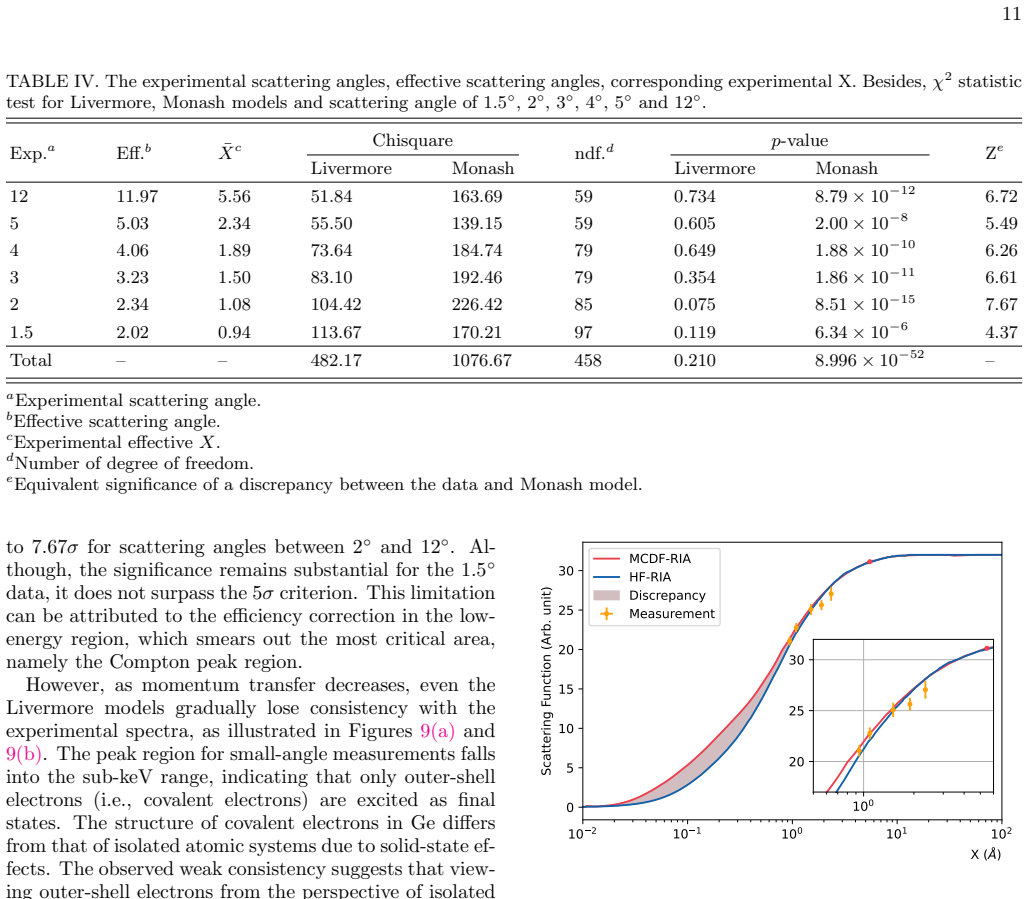
The central object is the incoherent scattering function $S(X)$ in the relativistic impulse approximation, which factorizes the Compton doubly differential cross section into a free-electron term times $S(X)$. The paper computes $S(X)$ from first principles using multi-configuration Dirac-Fock wavefunctions (MCDF-RIA) and compares it with the Hartree-Fock-based function (HF-RIA) used by Geant4. A second load-bearing mechanism is the soft-wall effect: the experimental scattering angle is not a delta function but a simulated distribution, so the effective scattering angle exceeds the nominal one (1.5 degrees maps to 2.02 degrees), which limits how low in momentum transfer the measurement can reach.
What would settle it
Repeat the small-angle measurement with a well-collimated source and a lower detector threshold so the soft-wall smearing is reduced; if the extracted scattering-function values move toward the HF-RIA curve rather than the MCDF-RIA curve as the soft-wall is removed, the claimed preference would be directly contradicted. Alternatively, a band-structure calculation of germanium's valence Compton profile could be compared with the sub-keV region of the measured spectra to test whether the mild overestimation seen for the Livermore model comes from the isolated-atom assumption.
Extended reading notes
Core claim
The paper establishes that the Livermore and Penelope Compton models in Geant4 reproduce the measured energy spectra of 662 keV photons Compton-scattered in a 10 g germanium crystal at angles from 1.5 to 12 degrees, whereas the Monash model fails decisively, with discrepancies equivalent to 4.4–7.7 sigma. It also establishes, from the same spectra, an experimental incoherent scattering function that at low momentum transfer tracks the MCDF-RIA calculation more closely than the HF-RIA function adopted in Geant4. Because the scattering function multiplies the free-electron cross section, this changes the predicted low-energy Compton background in germanium: the MCDF-RIA function gives steps in the spectrum about 10–50% higher than HF-RIA at 239 keV, with the largest difference below the L-shell ionization edge.
Load-bearing premise
The extraction of the scattering function assumes that the simulated effective-angle distribution, including the soft-wall shift, correctly models the source dispersion and geometry; if that simulation is wrong, the X-coordinates of the measured scattering-function points shift and the apparent preference for MCDF-RIA over HF-RIA could change.
Editorial extensions
If this is right
- The Livermore and Penelope models can be used with confidence for angle-dependent Compton simulations in germanium, while the Monash model should not be used for such small-angle work.
- Compton backgrounds in germanium detectors computed with the MCDF-RIA scattering function are 10–50% higher than the default Geant4 values at low gamma energies such as 239 keV, with the difference concentrated below the L-shell ionization edge.
- Detector mass strongly affects the shape of the Compton background spectrum, with small detectors showing non-flat structures from electron escape and larger detectors approaching a flatter spectrum, independent of gamma source position.
- For electronic-recoil dark-matter searches, the step-like structures in the expected ALP, dark-photon, and Migdal signals remain distinguishable from the step-like Compton and photon-coherent-scattering background, despite sharing the same sub-shell ionization energies.
- The soft-wall effect sets a practical floor on how low in momentum transfer the present generation of small-angle scattering experiments can reach with a 662 keV source and a 10 g germanium detector.
Reading between the lines
- The paper's isolated-atom caveat suggests that a band-structure treatment of germanium's valence electrons could reduce the mild overestimation seen for the Livermore model below 500 eV; if so, the sub-keV Compton background in dark-matter detectors would be slightly lower than the MCDF-RIA isolated-atom prediction.
- The same measurement strategy can be extended to other detector materials: applying MCDF-RIA calculations to silicon or germanium at different photon energies would give a direct, model-independent way to calibrate low-energy Compton backgrounds before designing next-generation ionization detectors.
- Because the MCDF-RIA difference grows as gamma energy decreases, the largest background-correction impact will be for low-energy environmental lines around 200–350 keV, which are common in underground laboratories; this could matter for experiments searching for dark matter with masses near the sub-GeV range.
Editorial analysis
A structured set of objections, weighed in public.
Referee Report
Summary. The paper reports a coincidence measurement of Compton doubly differential cross sections (DDCS) from a 10-g HPGe detector irradiated by a collimated 662 keV 137Cs source, at nominal scattering angles of 1.5°, 2°, 3°, 4°, 5°, and 12°, with scattered photons detected by a NaI[Tl] detector. The measured spectra are compared with Geant4 implementations of three low-energy Compton models (Livermore, Monash, Penelope), and the Monash model is reported to be rejected at 4.4σ–7.7σ while Livermore/Penelope are consistent with data. Using the ratio of measured to simulated spectra, the authors extract experimental scattering functions S(X) and compare them with two theoretical scattering functions: the HF-RIA one adopted in Geant4 and their own MCDF-RIA calculation, concluding that the data favor MCDF-RIA at low momentum transfer. The paper then uses Geant4 simulations to estimate the impact of the MCDF-RIA versus HF-RIA scattering functions, detector mass, and source position on Compton backgrounds relevant to electronic-recoil dark matter searches, and presents a combined background analysis for several dark matter models. The abstract additionally claims a "2.3% measurement" of atomic Compton scattering in the momentum-transfer range 180 eV/c to 25 keV/c, but no 2.3% figure appears in the body of the manuscript.
Significance. If the central claims hold, the paper would provide a useful experimental test of low-energy Compton models in Geant4, a new ab initio MCDF-RIA calculation of the germanium scattering function, and a concrete quantification of how the choice of scattering function affects sub-keV dark matter backgrounds. The DDCS comparison that rejects the Monash model is substantially independent of the scattering-function normalization and is valuable for validating Monte Carlo transport codes in the low-energy regime. The machine-readable style of the analysis, with explicit tables of efficiencies, systematic errors, and chi-square statistics, is a strength. However, the scattering-function extraction is not a direct measurement of S(X) in the region where MCDF-RIA and HF-RIA differ most, and the headline precision claim is not substantiated in the text; these issues materially weaken the parts of the paper that motivate the dark matter implications.
major comments (3)
- [Abstract and Section V] The abstract claims a "2.3% measurement of atomic Compton scattering", but no 2.3% uncertainty appears anywhere in Sections IV E, V, or the tables. Table III lists total systematic errors of 0.46%–0.77%, and the normalization procedure in Section V A fixes the overall scale at 12 degrees by construction. The abstract should either be revised to quote the actual systematic errors (which are the ones quantified in the paper) or a derivation of the 2.3% number must be supplied; as written, the headline claim is unsupported and internally inconsistent with the body text.
- [Section V B, Eq. (8), Table IV] The measured scattering function is defined as S_exp = (dσ/dΩ_exp / dσ/dΩ_sim) × S_sim, and the 12 degree point is pinned to the theoretical scattering function by the normalization described in Section V A. The only information that can discriminate MCDF-RIA from HF-RIA therefore comes from the low-angle points, whose effective angles are 2.02° and 2.34° for nominal 1.5° and 2°, i.e., shifts of 0.52° and 0.34° relative to the nominal angles. These shifts far exceed the 0.03° angular calibration precision and are derived entirely from the Geant4 simulation of source dispersion, geometry, and the sub-keV PSD efficiency. If that simulated angle distribution is wrong at the 0.3–0.5° level, the X-coordinates of the decisive points shift by an amount comparable to the separation between the MCDF-RIA and HF-RIA curves, changing the conclusion that the data favor MCDF-RIA. The paper should quantify this sensitivity explicitly, for example by varying the simulated source divergence or PSD efficiency within their uncertainties and recomputing the effective angles and the resulting χ² values.
- [Section VI A, Fig. 10, Fig. 11] The 10–50% background enhancement at 239 keV is stated to arise in the sub-keV region, which corresponds to momentum transfers at or below the lowest measured point in Fig. 10 (X ≈ 0.94 Å^-1 at the effective angle of 2.02°). No measured scattering-function point lies in this region, so the experimental data do not directly test the MCDF-RIA versus HF-RIA difference that drives the background claim. The conclusion in Section VI A rests on the MCDF-RIA calculation itself plus the fragile low-angle extraction discussed in the previous comment. The manuscript should explicitly state that the background comparison is a prediction from the ab initio calculation, not a tested consequence of the measured scattering function, and should provide a quantitative estimate of how the systematic uncertainty in the effective-angle shifts propagates to the 10–50% claim.
minor comments (5)
- [Throughout] There are frequent typographical and grammatical errors (e.g., "defination", "discrypancy", "bule", "corsses", "diviations", "choosen", "background" for background) that should be corrected in a thorough language edit.
- [Reference list] Reference [43] reads "And still have three models in version (11.03)" and is not a proper bibliographic entry; it should be replaced with a complete citation or removed.
- [Section IV E, Table III] The table columns labeled "(a) (b) (c) (d)" and "(a) (b) (c)" are not self-explanatory; the captions should explicitly map each column letter to the corresponding systematic-error item described in the text.
- [Section V A] The sentence "The equivalent significance of the discrepancy between the data and Monash model ranges from 5.49σ to 7.67σ" is immediately followed by an exception for the 1.5° point (4.4σ); the text should be rephrased to present the 4.4σ value together with the range, since the current wording creates an apparent contradiction.
- [Section III B and Section V B] The terms "effective scattering angle" and "soft wall" are introduced in Section V B without a formal definition at first use; a short definition or a reference to Table IV would help the reader follow the subsequent argument.
Circularity Check
The measured scattering-function points are partly self-referential (Eq. 8 uses S_sim and a 12° calibration), but the main Livermore-vs-Monash DDCS test and the MCDF ab initio calculation are independent; overall circularity is low.
-
self definitional
[Section V B, Eq. (8); Section V A normalization; Section II B]
"The defination of the measured scattering function is given by S( ¯X) exp. = [ (dσ/dΩ) exp. / (dσ/dΩ) sim. ] · S( ¯X) sim., (8) ... As mentioned in Section V A, the normalization from the simulated spectra to measurements is established through calibration at 12◦, indicating that the SF at 12◦ aligns precisely with the theoretical SFs."
Eq. (8) defines S_exp by multiplying the simulation's scattering function S_sim by the measured DDCS ratio, and the normalization at 12° forces S_exp to equal the theoretical SF at that angle by construction. Since Section II B states that Geant4's scattering functions were replaced with MCDF-RIA results, S_sim is the MCDF-RIA value. Thus the absolute scale of the 'measured' SF is pinned to MCDF-RIA rather than independently determined; only the shape of the ratio can discriminate models. The DDCS-based Livermore/Monash comparison is unaffected, but the SF-based statement that the data 'favor the MCDF-RIA scattering function' is partly a consistency check with the simulation's input SF rather than a fully independent measurement.
full rationale
The paper's central model comparison—rejecting the Monash Compton model at 4.4–7.7σ while finding Livermore/Penelope consistent—uses measured DDCS spectral shapes and is independent of the SF normalization; it does not reduce to a fitted parameter or to a self-citation chain. The MCDF-RIA calculation is an ab initio atomic-structure computation with externally benchmarked ionization energies, not an empirical fit to the present data. The one genuinely self-referential element is the scattering-function extraction in Eq. (8), where S_exp is defined multiplicatively through S_sim and the 12° point is explicitly treated as a calibration point. The authors disclose this, and the remaining low-angle points still carry shape information, so the circularity is partial rather than total. The 'soft wall' effective-angle correction (1.5°→2.02°) is an important model-dependent caveat for the X-coordinates of the decisive low-angle SF points, but it is an assumption about geometry and source dispersion rather than a circular reduction. No load-bearing self-citation or imported-uniqueness argument was found; the previous measurement is cited for comparison, not as the source of the central result. Overall, the paper is largely self-contained and the main claims have independent content, with only the secondary SF-favoring statement partially constructed from its own simulation input.
Assumptions & free parameters
free parameters (2)
- Global normalization factor N =
not reported numerically, derived from count rate 1-60 keV at 12 degrees
- Lindhard quenching parameter k =
0.162
assumptions (5)
- domain assumption The RIA factorization dσ/dΩ = (dσ/dΩ)_FEA · S(X) (Eq. 1) is valid in the measured momentum transfer range (180 eV/c to 25 keV/c).
- domain assumption MCDF wavefunctions provide accurate binding energies and Compton profiles for germanium.
- domain assumption The Geant4 Livermore model is representative of the RIA with HF wavefunctions (HF-RIA) for normalization.
- domain assumption The isolated-atom model applies to germanium outer-shell (covalent) electrons.
- domain assumption Lindhard model with k=0.162 describes PCS ionization quenching.
Cite this review
Pith. "Pith review of Germanium Atomic Compton Scattering Measurements and ${ab}$ ${initio}$ Many-Body Calculations: Implications for Electronic recoil Dark Matter Detection." pith.science (2026). https://pith.science/paper/5FUCIYOI
@misc{pith2026250603539,
  author       = {Pith},
  title        = {Pith review of: Germanium Atomic Compton Scattering Measurements and $ab$ $initio$ Many-Body Calculations: Implications for Electronic recoil Dark Matter Detection},
  year         = {2026},
  howpublished = {\url{https://pith.science/paper/5FUCIYOI}},
  note         = {Machine review of arXiv:2506.03539}
}
abstract
Diverse searches for direct dark matter (DM) in effective electromagnetic and leptophilic interactions resulting from new physics, as well as Weakly Interacting Massive Particles (WIMPs) with unconventional electronic recoils, are intensively pursued. Low-energy backgrounds from radioactive $\gamma$ rays via Compton scattering and photon coherent scattering are unavoidable in terrestrial detectors. The interpretation of dark matter experimental data is dependent on a better knowledge of the background in the low-energy region. We provide a 2.3% measurement of atomic Compton scattering in the low momentum transfer range of 180 eV/c to 25 keV/c, using a 10-g germanium detector bombarded by a $^{137}\mathrm{Cs}$ source with a 7.2 m-Curie radioactivity and the scatter photon collected by a cylindrical NaI[Tl] detector. The ability to detect Compton scattering's doubly differential cross section (DDCS) gives a special test for clearly identifying the kinematic restraints in atomic many-body systems, notably the Livermore model. Additionally, a low-energy-background comparison is made between coherent photon scattering and Compton scattering replacing the scattering function of ${GEANT4}$@software, which uses a completely relativistic impulse approximation (RIA) together with Multi-Configuration Dirac-Fock (MCDF) wavefunctions. For the purpose of investigating sub-GeV mass and electronic-recoil dark matter theories, signatures including low energy backgrounds via high energy $\gamma$ rays in germanium targets are discussed.
Figures


Figures from the paper (9 more)




Reference graph
Works this paper leans on
-
[1]
M. W. Goodman and E. Witten, Phys. Rev. D31, 3059 (1985)
1985
- [2]
- [3]
-
[4]
J. Aalbers, D. S. Akerib, C. W. Akerlof,et al., Phys. Rev. Lett.131, 041002 (2023)
work page 2023
-
[5]
Y. Meng, Z. Wang, Y. Tao,et al., Phys. Rev. Lett.127, 261802 (2021)
work page 2021
-
[6]
J. Tiffenberg, M. Sofo-Haro, A. Drlica-Wagner,et al., Phys. Rev. Lett.119, 131802 (2017)
work page 2017
-
[7]
R. Ren, C. Bathurst, Y. Y. Chang,et al., Phys. Rev. D 104, 032010 (2021)
work page 2021
-
[8]
I. Arnquist, N. Avalos, D. Baxter,et al., Phys. Rev. Lett. 130, 171003 (2023)
work page 2023
Show all 56 references
-
[9]
Collaboration, P
SENSEI. Collaboration, P. Adari, I. M. Bloch,et al., SENSEI: First Direct-Detection Results on sub-GeV Dark Matter from SENSEI at SNOLAB (2023), arXiv:2312.13342 [astro-ph]
2023 arXiv
-
[10]
Arnaud, E
Q. Arnaud, E. Armengaud, C. Augier,et al., Phys. Rev. Lett.125, 141301 (2020)
2020
-
[11]
Cheng, K.-J
J.-P. Cheng, K.-J. Kang, J.-M. Li,et al., Annu. Rev. Nucl. Part. Sci.67, 231 (2017)
2017
-
[12]
Barker, ArXiv161105792 Astro-Ph Physicsphysics (2016), arXiv:1611.05792 [astro-ph, physics:physics]
D. Barker, ArXiv161105792 Astro-Ph Physicsphysics (2016), arXiv:1611.05792 [astro-ph, physics:physics]
2016 arXiv
-
[13]
J. Hu, L. Yang, Q. Yue,et al., J. Inst.18, P04011 (2023)
2023
-
[14]
Norcini, N
D. Norcini, N. Castell´ o-Mor, D. Baxter,et al., Phys. Rev. D106, 092001 (2022)
2022
-
[15]
A. E. Robinson, Phys. Rev. D95, 021301 (2017)
2017
-
[16]
P. Du, D. Egana-Ugrinovic, R. Essig,et al., Phys. Rev. X12, 011009 (2022)
2022
-
[17]
K. V. Berghaus, R. Essig, Y. Hochberg,et al., Phys. Rev. D106, 023026 (2022)
2022
-
[18]
Ribberfors, Phys
R. Ribberfors, Phys. Rev. B12, 2067 (1975)
1975
-
[19]
Ribberfors, Phys
R. Ribberfors, Phys. Rev. B12, 3136 (1975)
1975
-
[20]
Ribberfors and K
R. Ribberfors and K. F. Berggren, Phys. Rev. A26, 3325 (1982)
1982
-
[21]
Klein and Y
O. Klein and Y. Nishina, Z. Physik52, 853 (1929)
1929
-
[22]
Bergstrom and R
P. Bergstrom and R. Pratt, Radiation Physics and Chem- istry50, 3 (1997)
1997
-
[23]
Brown, M
J. Brown, M. Dimmock, J. Gillam,et al., Nuclear Instru- 16 ments and Methods in Physics Research Section B: Beam Interactions with Materials and Atoms338, 77 (2014)
2014
-
[24]
D. E. Cullen, Nuclear Instruments and Methods in Physics Research Section B: Beam Interactions with Ma- terials and Atoms101, 499 (1995)
1995
-
[25]
W. R. Nelson, H. Hirayama, and D. W. O. Rogers, (1985)
1985
-
[26]
Brusa, G
D. Brusa, G. Stutz, J. Riveros,et al., Nuclear Instru- ments and Methods in Physics Research Section A: Accelerators, Spectrometers, Detectors and Associated Equipment379, 167 (1996)
1996
-
[27]
Agostinelli, J
S. Agostinelli, J. Allison, K. Amako,et al., Nuclear In- struments and Methods in Physics Research Section A: Accelerators, Spectrometers, Detectors and Associated Equipment506, 250 (2003)
2003
-
[28]
Essig, Y
R. Essig, Y. Hochberg, Y. Shoji,et al., Phys. Rev. D 109, 116011 (2024)
2024
-
[29]
Qiao, H.-C
C.-K. Qiao, H.-C. Chi, L. Zhang,et al., J. Phys. B: At. Mol. Opt. Phys.53, 075002 (2020)
2020
-
[30]
Qiao, H.-C
C.-K. Qiao, H.-C. Chi, S.-T. Lin,et al., J. Phys. G: Nucl. Part. Phys.47, 045202 (2020)
2020
-
[31]
Jia, S.-T
H.-T. Jia, S.-T. Lin, S.-K. Liu,et al., NUCL SCI TECH 33, 157 (2022)
2022
-
[32]
Ribberfors, Phys
R. Ribberfors, Phys. Rev. A27, 3061 (1983)
1983
-
[33]
J. H. Hubbell, Wm. J. Veigele, E. A. Briggs,et al., Journal of Physical and Chemical Reference Data4, 471 (1975)
1975
-
[34]
Kahane, Atomic Data and Nuclear Data Tables68, 323 (1998)
S. Kahane, Atomic Data and Nuclear Data Tables68, 323 (1998)
1998
-
[35]
B. J. Bloch and L. B. Mendelsohn, Phys. Rev. A9, 129 (1974)
1974
-
[36]
Desclaux, Computer Physics Communications9, 31 (1975)
J. Desclaux, Computer Physics Communications9, 31 (1975)
1975
-
[37]
Cullen, J
D. Cullen, J. Hubbell, and L. Kissel,EPDL97: The Evaluated Photo Data Library ‘97 Version, Tech. Rep. UCRL–50400-Vol.6-Rev.5, 295438 (1997)
1997
-
[38]
Henke, E
B. Henke, E. Gullikson, and J. Davis, Atomic Data and Nuclear Data Tables54, 181 (1993)
1993
-
[39]
R. D. Deslattes, E. G. Kessler, P. Indelicato,et al., Rev. Mod. Phys.75, 35 (2003)
2003
-
[40]
Biggs, L
F. Biggs, L. Mendelsohn, and J. Mann, Atomic Data and Nuclear Data Tables16, 201 (1975)
1975
-
[41]
Apostolakis, S
J. Apostolakis, S. Giani, M. Maire,et al. 10.15161/OAR.IT/1448986129.49 (1999)
1999
-
[42]
Salvat Gavald` a, J
F. Salvat Gavald` a, J. M. Fern´ andez Varea, and J. Sem- pau Roma,PENELOPE 2008: A Code System for Monte Carlo Simulation of Electron and Photon Transport : Workshop Proceedings, Barcelona, Spain 30 June-3 July 2008(OECD, Paris, 2009)
2008
-
[43]
And still have three models in version (11.03)
-
[44]
A. E. Robinson, Phys. Rev. D95, 069907 (2017)
2017
-
[45]
S. Roy, L. Kissel, and R. Pratt, Radiation Physics and Chemistry56, 3 (1999)
1999
-
[46]
P. Kane, L. Kissel, R. Pratt,et al., Physics Reports140, 75 (1986)
1986
-
[47]
Schaupp, M
D. Schaupp, M. Schumacher, F. Smend,et al., Journal of Physical and Chemical Reference Data12, 467 (1983)
1983
-
[48]
Falkenberg, A
H. Falkenberg, A. H¨ unger, P. Rullhusen,et al., Atomic Data and Nuclear Data Tables50, 1 (1992)
1992
-
[49]
B. K. Chatterjee and S. C. Roy, Journal of Physical and Chemical Reference Data27, 1011 (1998)
1998
-
[50]
Lindhard, V
J. Lindhard, V. Nielsen, M. Scharff,et al., Mat. Fys. Medd. Dan. Vid. Selsk33, 1 (1963)
1963
-
[51]
Bonhomme, H
A. Bonhomme, H. Bonet, C. Buck,et al., Eur. Phys. J. C82, 815 (2022)
2022
-
[52]
Y. Wang, Q. Yue, S. K. Liu,et al., Phys. Rev. D101, 052003 (2020)
2020
-
[53]
Z. She, L. P. Jia, Q. Yue,et al., Phys. Rev. Lett.124, 111301 (2020)
2020
-
[54]
Z. Y. Zhang, L. T. Yang, Q. Yue,et al., Phys. Rev. Lett. 129, 221301 (2022)
2022
-
[55]
Z. Z. Liu, Q. Yue, L. T. Yang,et al., Phys. Rev. Lett. 123, 161301 (2019)
2019
-
[56]
M. Ibe, W. Nakano, Y. Shoji,et al., J. High Energ. Phys. 2018(3), 194
2018
Reviewed August 7, 2026 · model on record in the stance chip above.
Discussion (0). Sign in to comment.