REVIEW 4 major objections 5 minor 2 cited by
WIFE-Fusion:Wavelet-aware Intra-inter Frequency Enhancement for Multi-model Image Fusion
T0 review · 4 major / 5 minor · reviewed 2026-08-07 · deepseek-v4-flash
Pith's one-line read Multimodal image fusion improves when features are split into wavelet frequency bands and those bands are exchanged across modalities, outperforming 14 published methods on five datasets.
desk verdict Solid, broadly benchmarked fusion paper; the real issue is a Q/K/V swap in Eq. 6 that the authors can fix in revision. read the letter →
The pith
A machine-rendered reading of the paper's core claim, the machinery that carries it, and where it could break.
The reading
What carries the argument
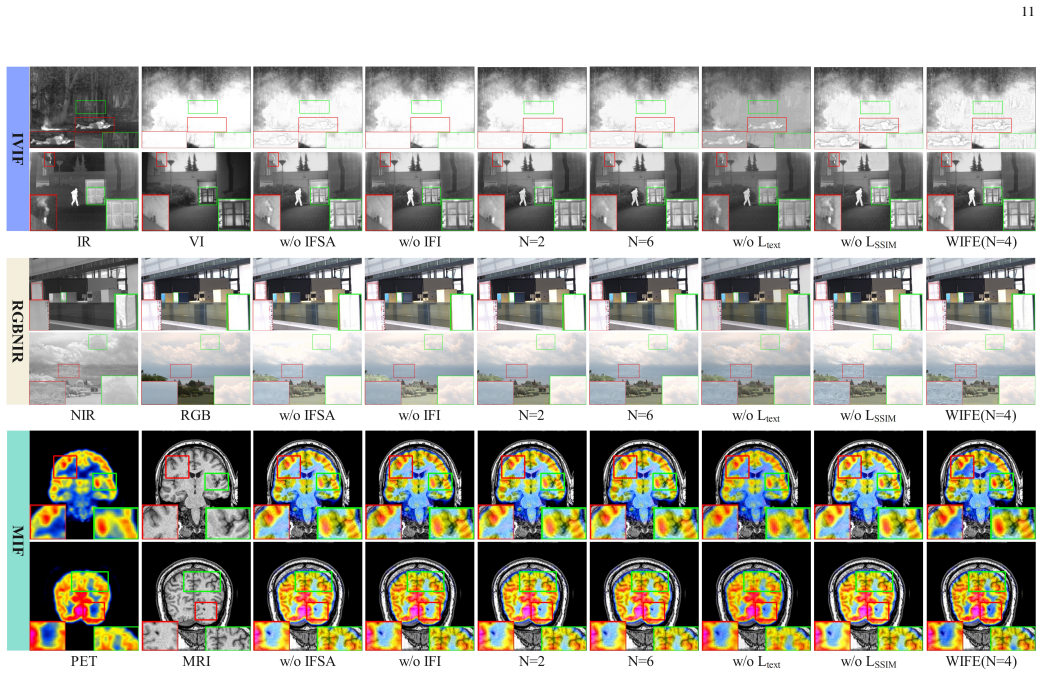
The load-bearing object is the WIFE module (Wavelet-aware Intra-inter Frequency Enhancement), a transformer-style block that operates in the wavelet domain. It contains two named mechanisms: IFSA (Intra-Frequency Self-Attention), where for each frequency band the queries and values come from one modality while the keys come from the same band of the other modality, so attention aligns cross-modal same-frequency content; and IFI (Inter-Frequency Interaction), defined by Eq. (7), which concatenates the channel-attended low-frequency band of one modality with the spatial-attended high-frequency band of the other, and vice versa. The discrete wavelet transform supplies the structure/detail decomposition that makes the exchange meaningful: the LL band carries brightness and structure, while the LH, HL, and HH bands carry oriented detail. The module is stacked four times, with layer normalization, MLP, and residual connections, and is followed by a three-convolution reconstruction head; the loss combines L1 intensity, gradient-max texture, and SSIM terms.
What would settle it
Retrain WIFE-Fusion with the IFI pairing reversed (low-from-modal-1 with low-from-modal-2, high with high) or with a learned stochastic pairing, on the same five datasets: if the fusion metrics stay statistically indistinguishable, the specific cross-frequency mechanism is not carrying the gains. Also compute the cross-frequency SSIM correlations from Fig. 1 over the full datasets rather than two cropped regions; if the fused image's high-frequency component does not correlate with the sources' low-frequency components wherever the method wins, the motivating discovery would not hold.
Extended reading notes
Core claim
The paper's central claim is that a fusion network built on wavelet-domain frequency decomposition and explicit cross-modal, cross-frequency interaction can extract and aggregate features better than networks that operate on spatial features alone. Concretely, WIFE-Fusion first runs both source images through a light CNN, then applies a discrete wavelet transform to the resulting feature maps, producing low-frequency (LL) and high-frequency (LH, HL, HH) subbands. In each subband, Intra-Frequency Self-Attention (IFSA) computes multi-head self-attention using queries and values from one modality and keys from the same-frequency subband of the other modality, so that complementary structure and detail are highlighted within matching frequency bands. Inter-Frequency Interaction (IFI) then combines modality 1's low-frequency features with modality 2's high-frequency features, and symmetrically modality 2's low-frequency features with modality 1's high-frequency features, after channel and spatial attention, and concatenates the results along the batch dimension. An inverse wavelet transform and residual connections return the features to the spatial domain, and a simple CNN reconstructs the fused image under an intensity, texture-gradient, and SSIM loss. The paper reports that this arrangement yields the best or near-best scores on six fusion-quality metrics on the TNO, MSRS, LLVIP, RGB-NIR, and Harvard medical datasets, and improves mean average precision in a downstream object-detection task.
Load-bearing premise
The load-bearing premise is that the wavelet low-frequency band cleanly carries structure and brightness while the high-frequency bands cleanly carry detail, and that pairing modality 1's low-frequency band with modality 2's high-frequency band (and vice versa) is the right exchange for all three fusion tasks; if that pairing is wrong or task-dependent, the reported gains would come from the loss terms or from generic attention rather than from the frequency-interaction design.
Editorial extensions
If this is right
- If the central claim holds, a single architecture can serve infrared-visible, RGB-NIR, and medical fusion without task-specific frequency rules, since the same wavelet-domain interaction is used throughout.
- The MSRS object-detection experiment suggests that this style of frequency-domain fusion carries over to downstream vision: fused outputs preserve the target and texture information detectors rely on better than spatial-only fusions do.
- Because removing either IFSA or IFI degrades results, the paper implies that the same-frequency cross-modal pathway and the cross-frequency exchange pathway each contribute independently to the reported gains.
- The transfer of IVIF-trained weights to RGB-NIR implies that the learned frequency-interaction behavior generalizes across modality pairs, making the method a plausible pretrained backbone for other two-input fusion tasks.
Reading between the lines
- The fixed IFI pairing in Eq. (7) is one of many possible rules; a natural extension the paper does not test is learning the pairing per task, which would reveal whether the low-high exchange is universally right or just one workable configuration.
- Because the wavelet transform is applied to CNN features rather than to raw images, and nonlinear features do not preserve pixel-level frequency semantics, a direct comparison against DWT-on-input variants would show whether the claimed structure-detail decoupling still holds after feature extraction.
- Comparing methods with their official pretrained weights while training WIFE-Fusion on the target dataset means some gains could reflect training data and hyperparameters; equal-budget retraining of all methods would separate architecture effects from training effects.
- The motivating SSIM measurement in Fig. 1 is computed on only two boxed regions; a dataset-wide analysis of cross-frequency correlations between sources and fused outputs could turn that anecdotal motivation into a falsifiable property.
Editorial analysis
A structured set of objections, weighed in public.
Referee Report
Summary. This paper proposes WIFE-Fusion, a multimodal image fusion framework built around wavelet decomposition of learned features. The network extracts shallow features, applies N cascaded WIFE modules (each containing Intra-Frequency Self-Attention (IFSA) and Inter-Frequency Interaction (IFI)), and reconstructs the fused image with a small CNN. IFSA is described as a cross-modal, same-frequency attention mechanism operating on DWT subbands, and IFI combines low-frequency features of one modality with high-frequency features of the other. The method is evaluated on infrared-visible (TNO, MSRS, LLVIP), RGB-NIR, and medical (Harvard CT-MRI, PET-MRI) fusion tasks, with six quantitative metrics, qualitative comparisons, ablations, and a downstream detection experiment. The authors report top-ranked performance on most metrics and provide code.
Significance. If the results are reproducible, the paper offers a useful new architecture that explicitly models cross-modal and cross-frequency interactions in the wavelet domain, with empirical support across three tasks and five datasets. The manuscript includes a public code link, ablations over architecture components and loss terms, and a downstream detection evaluation, which are all strengths. The central technical claim, however, rests on the IFSA/IFI design whose specification is internally inconsistent (Eq. 6), so the contribution cannot be fully assessed as written.
major comments (4)
- [III-B, Eq. (6)] The IFSA equation reverses the query/key/value roles described in the text. The text states that attention is computed 'between the queries Q and values V corresponding to the frequency-domain components and the keys K from cross-modal same-frequency components,' which for the L1 output implies Q and V from L1 and K from L2, i.e., MHSA(Q_L1, K_L2, V_L1). Eq. (6) instead defines X'_L1 = MHSA(Q_L2, K_L1, V_L2) and X'_L2 = MHSA(Q_L1, K_L2, V_L1), swapping the roles. Because IFSA is the first named contribution and the mechanism claimed to bring cross-modal correlations into the fusion, this is a load-bearing inconsistency: a reader implementing from the paper cannot determine which variant was actually evaluated, and the reported gains cannot be attributed to the intended mechanism on the basis of the manuscript. The high-frequency branch is said to use 'the same process' but no explicit equations are provided, compounding the ambiguity. Please correct either the prose or Eq. (6), give the high-frequency equations, and state which variant is implemented in the released code.
- [IV-A, Tables II-IV] The quantitative comparisons report single-run scores with no error bars, confidence intervals, or significance tests, despite test sets of only 24-50 pairs in several cases. Many of the claimed improvements are small: for example, Q_cb on MSRS (Ours 0.5430 vs. SwinFusion 0.5537), Q_w on RGB-NIR (Ours 0.8595 vs. SwinFusion 0.8678), and FMI on CT-MRI (Ours 0.8801 vs. PMGI 0.8890 and SwinFusion 0.8804). Without repeated runs or a statistical test, the assertion that WIFE-Fusion 'outperforms' all baselines is not yet supported. Please add standard deviations over multiple seeds (or equivalent) and report whether the differences are significant, at least for the main comparisons.
- [III-C, Eq. (9)] The overall loss uses weights α=2, β=10, γ=1, but no sensitivity analysis is provided. The ablation study removes entire loss terms but never varies the weights. Since the core claim is that the frequency-interaction modules (IFSA/IFI) drive the gains, a reader cannot exclude the possibility that the loss weighting is the main contributor. Please add a small sweep over (α, β, γ) or a justification for the chosen values.
- [III-B, Eq. (7)] The IFI module fixes the pairing as modality 1's low-frequency component with modality 2's high-frequency components and vice versa. This is a strong design assumption: the motivating analysis in Fig. 1 shows that inter-frequency transfer occurs in some regions, but it does not establish that this particular pairing is beneficial across all tasks. The ablations do not test alternative pairings (e.g., same-frequency cross-modal concat, or symmetric bidirectional pairing). Given that the paper attributes its gains to this interaction design, please provide an ablation over pairing choices or empirical justification for the fixed pairing.
minor comments (5)
- [IV.F] The section heading appears as 'F . Downstream Application' with a stray space; also the subsection is labeled F after E, which is fine, but the formatting should be cleaned.
- [Acknowledgments] The funding statement contains placeholders 'National Natural Science Foundation of China (xxxxx)' and the corresponding-author line is 'xxxxxx'; these must be completed before publication.
- [Title/Abstract] The title and abstract use 'Multi-model Image Fusion'; the standard term in the field is 'multimodal image fusion.' Please update for consistency.
- [Eq. (7)] In Eq. (7), the second concat has an extra closing parenthesis: 'concat(CA(f_IFSA_L1), SA(f_IFSA_H2)))' appears to have two closing parentheses after the argument. Please fix the typo.
- [Fig. 1] The text describing Fig. 1 says 'selected red boxed and green boxed' and the figure itself is not referenced in the caption clearly; please clarify which boxes correspond to which subfigures and make the caption self-contained.
Circularity Check
No circular derivation: WIFE-Fusion proposes an architecture whose components are motivated from wavelet-domain observations and validated against external baselines; the only self-citations are comparison/related-work entries and are not load-bearing.
full rationale
WIFE-Fusion does not claim to derive a result from first principles; it presents a network design (IFSA/IFI) and supports it empirically. The IFSA mechanism is defined by explicit equations (Eq. 6) and the IFI by Eq. 7 using standard attention/CBAM blocks; these are architectural choices, not fitted quantities masquerading as predictions. Evaluation is against 14 external methods on five public datasets with official pretrained weights, including the authors' own W-Mamba [58] used solely as a baseline. No parameter is fitted to the test metrics and then reported as a prediction, and no uniqueness theorem or cited prior result is invoked to make the architecture forced. The self-citations (W-Mamba [58] and DAAF [15]) appear in the comparison table and related-work discussion, not as evidence for the core mechanism; removing them would not change the derivation or the empirical claim. The manuscript's internal inconsistency between the prose description of IFSA and Eq. 6 (Q/V vs. K source swap) is a reproducibility/correctness concern, but it is not a circular reduction: the reported gains are not shown to be identical to the inputs by construction. Therefore no significant circularity is present.
Assumptions & free parameters
free parameters (2)
- Loss balance weights alpha, beta, gamma =
alpha=2, beta=10, gamma=1
- Number of cascaded WIFE modules N =
4
assumptions (3)
- domain assumption Wavelet decomposition separates structural/brightness information (LL) from detail information (LH, HL, HH) in a way that is meaningful for fusion.
- ad hoc to paper DWT and IWT are valid on learned feature maps, not just images, and concatenation along the batch dimension preserves the subband alignment required for IWT.
- ad hoc to paper The fixed IFI pairing, modality 1's low-frequency component with modality 2's high-frequency components, is beneficial across all tasks.
Cite this review
Pith. "Pith review of WIFE-Fusion:Wavelet-aware Intra-inter Frequency Enhancement for Multi-model Image Fusion." pith.science (2026). https://pith.science/paper/I4QFUDWJ
@misc{pith2026250603555,
  author       = {Pith},
  title        = {Pith review of: WIFE-Fusion:Wavelet-aware Intra-inter Frequency Enhancement for Multi-model Image Fusion},
  year         = {2026},
  howpublished = {\url{https://pith.science/paper/I4QFUDWJ}},
  note         = {Machine review of arXiv:2506.03555}
}
read the original abstract
Multimodal image fusion effectively aggregates information from diverse modalities, with fused images playing a crucial role in vision systems. However, existing methods often neglect frequency-domain feature exploration and interactive relationships. In this paper, we propose wavelet-aware Intra-inter Frequency Enhancement Fusion (WIFE-Fusion), a multimodal image fusion framework based on frequency-domain components interactions. Its core innovations include: Intra-Frequency Self-Attention (IFSA) that leverages inherent cross-modal correlations and complementarity through interactive self-attention mechanisms to extract enriched frequency-domain features, and Inter-Frequency Interaction (IFI) that enhances enriched features and filters latent features via combinatorial interactions between heterogeneous frequency-domain components across modalities. These processes achieve precise source feature extraction and unified modeling of feature extraction-aggregation. Extensive experiments on five datasets across three multimodal fusion tasks demonstrate WIFE-Fusion's superiority over current specialized and unified fusion methods. Our code is available at https://github.com/Lmmh058/WIFE-Fusion.
Figures


Figures from the paper (7 more)






Forward citations
Cited by 2 Pith papers
-
STGBD-Net: Spatio-temporal Gradient Basis Decomposition Network for Infrared Small Target Detection
A U-Net variant using dynamic projection onto normalized difference features achieves state-of-the-art mIoU on NUDT-SIRST (95.13%) and IRSTD-1K (69.40%) with 0.27M parameters.
-
SWAN: Synergistic Wavelet-Attention Network for Infrared Small Target Detection
A new network, SWAN, combines Haar wavelet convolution with two attention modules to improve infrared small target detection.
Reference graph
Works this paper leans on
-
[58]
T. Zhang, Y . Zhu, J. Zhao, G. Cui, and Y . Zheng, “Ex- ploring state space model in wavelet domain: An infrared and visible image fusion network via wavelet transform and state space model,”arXiv preprint arXiv:2503.18378, 2025
arXiv 2025
-
[1]
Infrared and visible image fusion methods and applications: A survey,
J. Ma, Y . Ma, and C. Li, “Infrared and visible image fusion methods and applications: A survey,”Information fusion, vol. 45, pp. 153–178, 2019. 13
work page 2019
-
[2]
Mct-net: Multi-hierarchical cross transformer for hy- perspectral and multispectral image fusion,
X. Wang, X. Wang, R. Song, X. Zhao, and K. Zhao, “Mct-net: Multi-hierarchical cross transformer for hy- perspectral and multispectral image fusion,”Knowledge- Based Systems, vol. 264, p. 110362, 2023
work page 2023
-
[3]
Multi-focus im- age fusion based on dynamic threshold neural p systems and surfacelet transform,
B. Li, H. Peng, J. Wang, and X. Huang, “Multi-focus im- age fusion based on dynamic threshold neural p systems and surfacelet transform,”Knowledge-Based Systems, vol. 196, p. 105794, 2020
work page 2020
-
[4]
Toward accurate infrared small target detection via edge-aware gated transformer,
Y . Zhu, Y . Ma, F. Fan, J. Huang, K. Wu, and G. Wang, “Toward accurate infrared small target detection via edge-aware gated transformer,”IEEE Journal of Selected Topics in Applied Earth Observations and Remote Sens- ing, vol. 17, pp. 8779–8793, 2024
work page 2024
-
[5]
D. Feng, C. Haase-Sch ¨utz, L. Rosenbaum, H. Hertlein, C. Glaeser, F. Timm, W. Wiesbeck, and K. Dietmayer, “Deep multi-modal object detection and semantic seg- mentation for autonomous driving: Datasets, methods, and challenges,”IEEE Transactions on Intelligent Trans- portation Systems, vol. 22, no. 3, pp. 1341–1360, 2020
work page 2020
-
[6]
B. Goyal, A. Dogra, D. C. Lepcha, D. Koundal, A. Al- hudhaif, F. Alenezi, and S. A. Althubiti, “Multi-modality image fusion for medical assistive technology manage- ment based on hybrid domain filtering,”Expert Systems with Applications, vol. 209, p. 118283, 2022
work page 2022
-
[7]
Infrared and visible image fusion using multi-scale nsct and rolling-guidance filter,
A. Selvaraj and P. Ganesan, “Infrared and visible image fusion using multi-scale nsct and rolling-guidance filter,” IET Image Processing, vol. 14, no. 16, pp. 4210–4219, 2020
work page 2020
Show all 75 references
-
[8]
Infrared and visible image fusion using visual saliency sparse representation and detail injection model,
Y . Yang, Y . Zhang, S. Huang, Y . Zuo, and J. Sun, “Infrared and visible image fusion using visual saliency sparse representation and detail injection model,”IEEE Transactions on Instrumentation and Measurement, vol. 70, pp. 1–15, 2020
2020
-
[9]
Novel infrared and visible image fusion method based on independent component analysis,
Y . Lu, F. Wang, X. Luo, and F. Liu, “Novel infrared and visible image fusion method based on independent component analysis,”Frontiers of Computer Science, vol. 8, pp. 243–254, 2014
2014
-
[10]
Infrared and visible image fusion based on visual saliency map and weighted least square optimization,
J. Ma, Z. Zhou, B. Wang, and H. Zong, “Infrared and visible image fusion based on visual saliency map and weighted least square optimization,”Infrared Physics & Technology, vol. 82, pp. 8–17, 2017
2017
-
[11]
Rfn-nest: An end-to-end residual fusion network for infrared and visible images,
H. Li, X.-J. Wu, and J. Kittler, “Rfn-nest: An end-to-end residual fusion network for infrared and visible images,” Information Fusion, vol. 73, pp. 72–86, 2021
2021
-
[12]
Scdfuse: A semantic complementary distillation framework for joint infrared and visible image fusion and denoising,
S. Xie, H. Li, Y . Zang, J. Cao, D. Zhou, M. Tan, Z. Ding, and G. Wang, “Scdfuse: A semantic complementary distillation framework for joint infrared and visible image fusion and denoising,”Knowledge-Based Systems, vol. 315, p. 113262, 2025
2025
-
[13]
Gtmfuse: Group- attention transformer-driven multiscale dense feature- enhanced network for infrared and visible image fusion,
L. Mei, X. Hu, Z. Ye, L. Tang, Y . Wang, D. Li, Y . Liu, X. Hao, C. Lei, C. Xuet al., “Gtmfuse: Group- attention transformer-driven multiscale dense feature- enhanced network for infrared and visible image fusion,” Knowledge-Based Systems, vol. 293, p. 111658, 2024
2024
-
[14]
U2fusion: A unified unsupervised image fusion network,
H. Xu, J. Ma, J. Jiang, X. Guo, and H. Ling, “U2fusion: A unified unsupervised image fusion network,”IEEE Transactions on Pattern Analysis and Machine Intelli- gence, vol. 44, no. 1, pp. 502–518, 2020
2020
-
[15]
Daaf: Degradation-aware adaptive fusion framework for robust infrared and visible images fusion,
T. Zhang, J. Zhao, Y . Zhu, G. Cui, Y . Jing, and Y . Lyu, “Daaf: Degradation-aware adaptive fusion framework for robust infrared and visible images fusion,”arXiv preprint arXiv:2504.10871, 2025
2025
-
[16]
Fusiongan: A generative adversarial network for infrared and visible image fusion,
J. Ma, W. Yu, P. Liang, C. Li, and J. Jiang, “Fusiongan: A generative adversarial network for infrared and visible image fusion,”Information fusion, vol. 48, pp. 11–26, 2019
2019
-
[17]
Un- fusion: A unified multi-scale densely connected network for infrared and visible image fusion,
Z. Wang, J. Wang, Y . Wu, J. Xu, and X. Zhang, “Un- fusion: A unified multi-scale densely connected network for infrared and visible image fusion,”IEEE Transactions on Circuits and Systems for Video Technology, vol. 32, no. 6, pp. 3360–3374, 2021
2021
-
[18]
Datfuse: Infrared and visible image fusion via dual attention transformer,
W. Tang, F. He, Y . Liu, Y . Duan, and T. Si, “Datfuse: Infrared and visible image fusion via dual attention transformer,”IEEE Transactions on Circuits and Systems for Video Technology, vol. 33, no. 7, pp. 3159–3172, 2023
2023
-
[19]
Swinfuse: A residual swin transformer fusion network for infrared and visible images,
Z. Wang, Y . Chen, W. Shao, H. Li, and L. Zhang, “Swinfuse: A residual swin transformer fusion network for infrared and visible images,”IEEE Transactions on Instrumentation and Measurement, vol. 71, pp. 1–12, 2022
2022
-
[20]
Datransnet: dynamic attention transformer network for infrared small target detection,
C. Hu, Y . Huang, K. Li, L. Zhang, C. Long, Y . Zhu, T. Pu, and Z. Peng, “Datransnet: dynamic attention transformer network for infrared small target detection,” IEEE Geoscience and Remote Sensing Letters, 2025
2025
-
[21]
Aitfuse: Infrared and visible image fusion via adaptive interactive transformer learning,
Z. Wang, F. Yang, J. Sun, J. Xu, F. Yang, and X. Yan, “Aitfuse: Infrared and visible image fusion via adaptive interactive transformer learning,”Knowledge-Based Sys- tems, vol. 299, p. 111949, 2024
2024
-
[22]
Swinfusion: Cross-domain long-range learning for gen- eral image fusion via swin transformer,
J. Ma, L. Tang, F. Fan, J. Huang, X. Mei, and Y . Ma, “Swinfusion: Cross-domain long-range learning for gen- eral image fusion via swin transformer,”IEEE/CAA Jour- nal of Automatica Sinica, vol. 9, no. 7, pp. 1200–1217, 2022
2022
-
[23]
A general spatial-frequency learning framework for multimodal image fusion,
M. Zhou, J. Huang, K. Yan, D. Hong, X. Jia, J. Chanus- sot, and C. Li, “A general spatial-frequency learning framework for multimodal image fusion,”IEEE Trans- actions on Pattern Analysis and Machine Intelligence, 2024
2024
-
[24]
The laplacian pyramid as a compact image code,
P. J. Burt and E. H. Adelson, “The laplacian pyramid as a compact image code,” inReadings in computer vision. Elsevier, 1987, pp. 671–679
1987
-
[25]
Infrared and visible images fusion method based on discrete wavelet trans- form,
L. Zhan, Y . Zhuang, and L. Huang, “Infrared and visible images fusion method based on discrete wavelet trans- form,”Journal of Computers, vol. 28, no. 2, pp. 57–71, 2017
2017
-
[26]
Infrared and visible image fusion scheme based on nsct and low-level visual features,
H. Li, H. Qiu, Z. Yu, and Y . Zhang, “Infrared and visible image fusion scheme based on nsct and low-level visual features,”Infrared Physics & Technology, vol. 76, pp. 174–184, 2016
2016
-
[27]
Re- mote sensing image fusion using the curvelet transform,
F. Nencini, A. Garzelli, S. Baronti, and L. Alparone, “Re- mote sensing image fusion using the curvelet transform,” Information fusion, vol. 8, no. 2, pp. 143–156, 2007
2007
-
[28]
A curvelet transform approach for the fusion of mr and ct images,
F. E. Ali, I. El-Dokany, A. Saad, and F. Abd El-Samie, “A curvelet transform approach for the fusion of mr and ct images,”Journal of Modern Optics, vol. 57, no. 4, pp. 14 273–286, 2010
2010
-
[29]
A fusion algorithm for in- frared and visible images based on adaptive dual-channel unit-linking pcnn in nsct domain,
T. Xiang, L. Yan, and R. Gao, “A fusion algorithm for in- frared and visible images based on adaptive dual-channel unit-linking pcnn in nsct domain,”Infrared Physics & Technology, vol. 69, pp. 53–61, 2015
2015
-
[30]
A phase congruency and local laplacian energy based multi- modality medical image fusion method in nsct domain,
Z. Zhu, M. Zheng, G. Qi, D. Wang, and Y . Xiang, “A phase congruency and local laplacian energy based multi- modality medical image fusion method in nsct domain,” Ieee Access, vol. 7, pp. 20 811–20 824, 2019
2019
-
[31]
Multi-modality medical image fusion using discrete wavelet transform,
V . Bhavana and H. Krishnappa, “Multi-modality medical image fusion using discrete wavelet transform,”Procedia Computer Science, vol. 70, pp. 625–631, 2015
2015
-
[32]
Perceptual image fusion using wavelets,
P. Hill, M. E. Al-Mualla, and D. Bull, “Perceptual image fusion using wavelets,”IEEE transactions on image processing, vol. 26, no. 3, pp. 1076–1088, 2016
2016
-
[33]
A fast image fusion with dis- crete cosine transform,
M. Wang and X. Shang, “A fast image fusion with dis- crete cosine transform,”IEEE Signal Processing Letters, vol. 27, pp. 990–994, 2020
2020
-
[34]
Medical image fusion and denoising algorithm based on a decom- position model of hybrid variation-sparse representation,
G. Wang, W. Li, J. Du, B. Xiao, and X. Gao, “Medical image fusion and denoising algorithm based on a decom- position model of hybrid variation-sparse representation,” IEEE Journal of Biomedical and Health Informatics, vol. 26, no. 11, pp. 5584–5595, 2022
2022
-
[35]
Fusion method for infrared and visible images by using non- negative sparse representation,
J. Wang, J. Peng, X. Feng, G. He, and J. Fan, “Fusion method for infrared and visible images by using non- negative sparse representation,”Infrared Physics & Tech- nology, vol. 67, pp. 477–489, 2014
2014
-
[36]
The infrared and visible image fusion algorithm based on target separation and sparse representation,
X. Lu, B. Zhang, Y . Zhao, H. Liu, and H. Pei, “The infrared and visible image fusion algorithm based on target separation and sparse representation,”Infrared Physics & Technology, vol. 67, pp. 397–407, 2014
2014
-
[37]
Infrared and visible image fusion method based on principal component anal- ysis network and multi-scale morphological gradient,
S. Li, Y . Zou, G. Wang, and C. Lin, “Infrared and visible image fusion method based on principal component anal- ysis network and multi-scale morphological gradient,” Infrared Physics & Technology, vol. 133, p. 104810, 2023
2023
-
[38]
Multi-focus image fusion based on non-negative matrix factorization and difference images,
Y . Zhang, L. Chen, J. Jia, and Z. Zhao, “Multi-focus image fusion based on non-negative matrix factorization and difference images,”Signal Processing, vol. 105, pp. 84–97, 2014
2014
-
[39]
Fast saliency- aware multi-modality image fusion,
J. Han, E. J. Pauwels, and P. De Zeeuw, “Fast saliency- aware multi-modality image fusion,”Neurocomputing, vol. 111, pp. 70–80, 2013
2013
-
[40]
De- tail preserved fusion of visible and infrared images using regional saliency extraction and multi-scale image decomposition,
G. Cui, H. Feng, Z. Xu, Q. Li, and Y . Chen, “De- tail preserved fusion of visible and infrared images using regional saliency extraction and multi-scale image decomposition,”Optics Communications, vol. 341, pp. 199–209, 2015
2015
-
[41]
Infrared and visible image fusion via salient object extraction and low-light region enhancement,
Y . Liu, L. Dong, and W. Xu, “Infrared and visible image fusion via salient object extraction and low-light region enhancement,”Infrared Physics & Technology, vol. 124, p. 104223, 2022
2022
-
[42]
Anatomical-functional image fusion by information of interest in local laplacian filter- ing domain,
J. Du, W. Li, and B. Xiao, “Anatomical-functional image fusion by information of interest in local laplacian filter- ing domain,”IEEE Transactions on Image Processing, vol. 26, no. 12, pp. 5855–5866, 2017
2017
-
[43]
Joint patch clustering- based dictionary learning for multimodal image fusion,
M. Kim, D. K. Han, and H. Ko, “Joint patch clustering- based dictionary learning for multimodal image fusion,” Information fusion, vol. 27, pp. 198–214, 2016
2016
-
[44]
Sgfusion: A saliency guided deep-learning framework for pixel-level image fusion,
J. Liu, R. Dian, S. Li, and H. Liu, “Sgfusion: A saliency guided deep-learning framework for pixel-level image fusion,”Information Fusion, vol. 91, pp. 205–214, 2023
2023
-
[45]
An image is worth 16x16 words: Transformers for image recognition at scale,
A. Dosovitskiy, L. Beyer, A. Kolesnikov, D. Weis- senborn, X. Zhai, T. Unterthiner, M. Dehghani, M. Min- derer, G. Heigold, S. Gellyet al., “An image is worth 16x16 words: Transformers for image recognition at scale,”arXiv preprint arXiv:2010.11929, 2020
2010 arXiv
-
[46]
A medical image fusion method based on convolutional neural networks,
Y . Liu, X. Chen, J. Cheng, and H. Peng, “A medical image fusion method based on convolutional neural networks,” in2017 20th international conference on information fusion (Fusion). IEEE, 2017, pp. 1–7
2017
-
[47]
Sdnet: A versatile squeeze-and- decomposition network for real-time image fusion,
H. Zhang and J. Ma, “Sdnet: A versatile squeeze-and- decomposition network for real-time image fusion,”In- ternational Journal of Computer Vision, vol. 129, no. 10, pp. 2761–2785, 2021
2021
-
[48]
Emfusion: An unsupervised enhanced medical image fusion network,
H. Xu and J. Ma, “Emfusion: An unsupervised enhanced medical image fusion network,”Information Fusion, vol. 76, pp. 177–186, 2021
2021
-
[49]
Ddcgan: A dual-discriminator conditional generative adversarial network for multi-resolution image fusion,
J. Ma, H. Xu, J. Jiang, X. Mei, and X.-P. Zhang, “Ddcgan: A dual-discriminator conditional generative adversarial network for multi-resolution image fusion,” IEEE Transactions on Image Processing, vol. 29, pp. 4980–4995, 2020
2020
-
[50]
Fusion- mamba: Dynamic feature enhancement for multimodal image fusion with mamba,
X. Xie, Y . Cui, T. Tan, X. Zheng, and Z. Yu, “Fusion- mamba: Dynamic feature enhancement for multimodal image fusion with mamba,”Visual Intelligence, vol. 2, no. 1, p. 37, 2024
2024
-
[51]
Mamba: Linear-time sequence modeling with selective state spaces,
A. Gu and T. Dao, “Mamba: Linear-time sequence modeling with selective state spaces,”arXiv preprint arXiv:2312.00752, 2023
2023 arXiv
-
[52]
Wavelet- based self-supervised learning for multi-scene image fusion,
S. Liu, L. Qu, Q. Qiao, M. Wang, and Z. Song, “Wavelet- based self-supervised learning for multi-scene image fusion,”Neural Computing and Applications, vol. 34, no. 18, pp. 15 689–15 704, 2022
2022
-
[53]
Mfif-dwt- cnn: Multi-focus ımage fusion based on discrete wavelet transform with deep convolutional neural network,
D. Avcı, E. Sert, F. ¨Ozyurt, and E. Avcı, “Mfif-dwt- cnn: Multi-focus ımage fusion based on discrete wavelet transform with deep convolutional neural network,”Mul- timedia Tools and Applications, vol. 83, no. 4, pp. 10 951–10 968, 2024
2024
-
[54]
Dcfnet: Infrared and visible image fusion network based on discrete wavelet transform and convolutional neural network,
D. Wu, Y . Wang, H. Wang, F. Wang, and G. Gao, “Dcfnet: Infrared and visible image fusion network based on discrete wavelet transform and convolutional neural network,”Sensors, vol. 24, no. 13, p. 4065, 2024
2024
-
[55]
Attention is all you need,
A. Vaswani, N. Shazeer, N. Parmar, J. Uszkoreit, L. Jones, A. N. Gomez, Ł. Kaiser, and I. Polosukhin, “Attention is all you need,”Advances in neural informa- tion processing systems, vol. 30, 2017
2017
-
[56]
Cbam: Convolutional block attention module,
S. Woo, J. Park, J.-Y . Lee, and I. S. Kweon, “Cbam: Convolutional block attention module,” inProceedings of the European conference on computer vision (ECCV), 2018, pp. 3–19
2018
-
[57]
Ganmcc: A generative adversarial network with multiclassifica- tion constraints for infrared and visible image fusion,
J. Ma, H. Zhang, Z. Shao, P. Liang, and H. Xu, “Ganmcc: A generative adversarial network with multiclassifica- tion constraints for infrared and visible image fusion,” IEEE Transactions on Instrumentation and Measurement, vol. 70, pp. 1–14, 2020. 15
2020
-
[59]
Gesenet: A general semantic-guided network with cou- ple mask ensemble for medical image fusion,
J. Li, J. Liu, S. Zhou, Q. Zhang, and N. K. Kasabov, “Gesenet: A general semantic-guided network with cou- ple mask ensemble for medical image fusion,”IEEE Transactions on Neural Networks and Learning Systems, 2023
2023
-
[60]
Mmif- inet: Multimodal medical image fusion by invertible network,
D. He, W. Li, G. Wang, Y . Huang, and S. Liu, “Mmif- inet: Multimodal medical image fusion by invertible network,”Information Fusion, vol. 114, p. 102666, 2025
2025
-
[61]
Ifcnn: A general image fusion framework based on con- volutional neural network,
Y . Zhang, Y . Liu, P. Sun, H. Yan, X. Zhao, and L. Zhang, “Ifcnn: A general image fusion framework based on con- volutional neural network,”Information Fusion, vol. 54, pp. 99–118, 2020
2020
-
[62]
Re- thinking the image fusion: A fast unified image fusion network based on proportional maintenance of gradient and intensity,
H. Zhang, H. Xu, Y . Xiao, X. Guo, and J. Ma, “Re- thinking the image fusion: A fast unified image fusion network based on proportional maintenance of gradient and intensity,” inProceedings of the AAAI conference on artificial intelligence, vol. 34, no. 07, 2020, pp. 12 797– 12 804
2020
-
[63]
Cddfuse: Correlation- driven dual-branch feature decomposition for multi- modality image fusion,
Z. Zhao, H. Bai, J. Zhang, Y . Zhang, S. Xu, Z. Lin, R. Timofte, and L. Van Gool, “Cddfuse: Correlation- driven dual-branch feature decomposition for multi- modality image fusion,” inProceedings of the IEEE/CVF conference on computer vision and pattern recognition, 2023, pp. 5906–5916
2023
-
[64]
Equivariant multi-modality image fusion,
Z. Zhao, H. Bai, J. Zhang, Y . Zhang, K. Zhang, S. Xu, D. Chen, R. Timofte, and L. Van Gool, “Equivariant multi-modality image fusion,” inProceedings of the IEEE/CVF conference on computer vision and pattern recognition, 2024, pp. 25 912–25 921
2024
-
[65]
Llvip: A visible-infrared paired dataset for low-light vision,
X. Jia, C. Zhu, M. Li, W. Tang, and W. Zhou, “Llvip: A visible-infrared paired dataset for low-light vision,” in Proceedings of the IEEE/CVF international conference on computer vision, 2021, pp. 3496–3504
2021
-
[66]
The tno multiband image data collection,
A. Toet, “The tno multiband image data collection,”Data in brief, vol. 15, pp. 249–251, 2017
2017
-
[67]
Piafusion: A progressive infrared and visible image fu- sion network based on illumination aware,
L. Tang, J. Yuan, H. Zhang, X. Jiang, and J. Ma, “Piafusion: A progressive infrared and visible image fu- sion network based on illumination aware,”Information Fusion, vol. 83, pp. 79–92, 2022
2022
-
[68]
Multi-spectral sift for scene category recognition,
M. Brown and S. S ¨usstrunk, “Multi-spectral sift for scene category recognition,” inCVPR 2011. IEEE, 2011, pp. 177–184
2011
-
[69]
A non-reference image fusion metric based on mutual information of image features,
M. B. A. Haghighat, A. Aghagolzadeh, and H. Seyedarabi, “A non-reference image fusion metric based on mutual information of image features,” Computers & Electrical Engineering, vol. 37, no. 5, pp. 744–756, 2011
2011
-
[70]
Information measure for performance of image fusion,
G. Qu, D. Zhang, and P. Yan, “Information measure for performance of image fusion,”Electronics letters, vol. 38, no. 7, p. 1, 2002
2002
-
[71]
A new automated quality as- sessment algorithm for image fusion,
Y . Chen and R. S. Blum, “A new automated quality as- sessment algorithm for image fusion,”Image and vision computing, vol. 27, no. 10, pp. 1421–1432, 2009
2009
-
[72]
A new image fusion performance metric based on visual information fidelity,
Y . Han, Y . Cai, Y . Cao, and X. Xu, “A new image fusion performance metric based on visual information fidelity,” Information fusion, vol. 14, no. 2, pp. 127–135, 2013
2013
-
[73]
A new quality metric for image fusion,
G. Piella and H. Heijmans, “A new quality metric for image fusion,” inProceedings 2003 international confer- ence on image processing (Cat. No. 03CH37429), vol. 3. IEEE, 2003, pp. III–173
2003
-
[74]
Objective image fusion performance measure,
C. S. Xydeas, V . Petrovicet al., “Objective image fusion performance measure,”Electronics letters, vol. 36, no. 4, pp. 308–309, 2000
2000
-
[75]
Performance assess- ment of combinative pixel-level image fusion based on an absolute feature measurement,
J. Zhao, R. Laganiere, and Z. Liu, “Performance assess- ment of combinative pixel-level image fusion based on an absolute feature measurement,”Int. J. Innov. Comput. Inf. Control, vol. 3, no. 6, pp. 1433–1447, 2007
2007
Reviewed August 7, 2026 · model on record in the stance chip above.
Discussion (0). Sign in to comment.