REVIEW 2 major objections 4 minor 61 references
Cantor spectrum for multidimensional quasi-periodic Schr\"odinger operators
T0 review · 2 major / 4 minor · reviewed 2026-08-07 · deepseek-v4-flash
Pith's one-line read Multidimensional quasiperiodic Schrödinger spectrum is Cantor
desk verdict Important result, likely true, but the proof of the key semiclassical extension in Appendix C is a sketch, not a complete argument; the paper deserves peer review but needs revision. read the letter →
The pith
A machine-rendered reading of the paper's core claim, the machinery that carries it, and where it could break.
The reading
What carries the argument
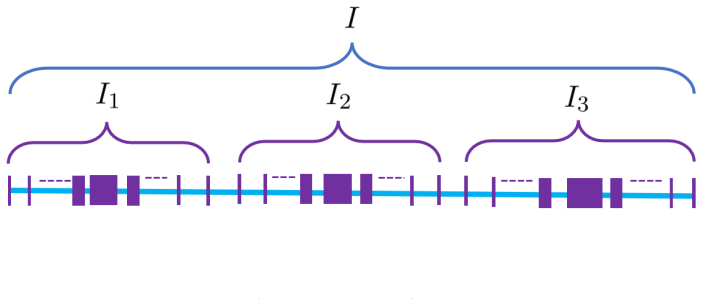
The load-bearing object is an abstract nested covering structure, indexed by a language of words, in which each parent interval $I_w$ is divided into child bands whose lengths and gaps obey the metrical bounds of a standard $(\varsigma,\epsilon,M,C,h)$-configuration: a central black-box band of size comparable to $h$, inner bands of size about $h/\log h$, exponentially small outer bands $e^{-C/h}$, and multiscale intermediate bands with lengths $e^{-|c_i|/h}h^{-C\log|c_i|}$. The central estimate is the ratio-sum bound (14): for any $\delta\in(0,1)$, once $h$ is small enough, $\sum_{J\in\mathcal{J}}(|J|/|I|)^\delta\le 1$. Iterating this bound controls the $\delta$-dimensional Hausdorff measure of the limit set, and adding a lower bound on $h$ controls the interval-counting function that gives the upper box dimension. The paper matches the critical one-dimensional almost Mathieu spectrum to this structure through Theorem 5.2, which extracts the full family of upgraded coverings from the semiclassical analysis of the Harper operator.
What would settle it
Find one frequency $\alpha$ satisfying the hypotheses of Theorem 5.2, with bounded continued-fraction prefix and odd $q_{\hat m}(\alpha)$, for which the first black-box interval, once opened, contains sub-bands whose number or length ratios violate Definition 3.2(vi); such a violation would break the covering structure on which Proposition 5.4 and Theorem 1.1 rest.
Extended reading notes
Core claim
The paper claims that for a dense and positive Hausdorff dimension set of frequency vectors $\vec\alpha\in\mathbb{T}^d$, the spectrum of the multidimensional almost Mathieu operator $M_{\cos,\vec\alpha}$ is a Cantor set of zero Lebesgue measure. The route is fractal rather than spectral-gap-theoretic: Theorem 1.4 shows that for any $\delta>0$, the sets of frequencies for which the critical one-dimensional almost Mathieu spectrum has upper box dimension at most $\delta$ are dense in $\mathbb{R}$ and have positive Hausdorff dimension. Taking $\delta=1/(d+1)$, the spectrum of the $d$-dimensional separable operator is the Minkowski sum of $d$ such one-dimensional spectra, so its upper box dimension is strictly less than one and its Lebesgue measure is zero. Theorem 1.3 additionally asserts that for any $\delta\in(0,1)$ there is a dense, positive-Hausdorff-dimensional set of $\alpha\in\mathbb{R}\setminus\mathbb{Q}$ with $\beta(\alpha)=0$ such that $0<\dim_H\Sigma_\alpha\le\overline{\dim}_B\Sigma_\alpha\le\delta$.
Load-bearing premise
The argument assumes that the detailed band-structure description known for frequencies very close to zero continues to hold for frequencies whose continued fractions begin with an arbitrary bounded block, an extension the appendix sketches but does not fully prove.
Editorial extensions
If this is right
- Theorem 1.1 supplies the first example of a multidimensional discrete quasiperiodic Schrödinger operator whose spectrum is a Cantor set of zero Lebesgue measure, answering the question quoted from [19].
- At the critical coupling $\lambda=1$, a dense positive-dimensional family of frequency vectors has Cantor spectrum, whereas for $\lambda\neq 1$ the spectrum has positive measure; the dense interior thus disappears exactly as the coupling reaches the critical value.
- Bourgain's positive-measure gap result for multidimensional almost Mathieu operators is strengthened for a dense set of frequencies at $\lambda=1$: the spectral gaps become dense as well.
- For the critical one-dimensional almost Mathieu operator, the upper box dimension can be made arbitrarily small while the Hausdorff dimension remains positive, for a dense positive-Hausdorff-dimensional set of $\alpha$ with $\beta(\alpha)=0$; this sits in sharp contrast with the case $\beta(\alpha)>0$, where the upper box dimension equals one.
- The abstract dimension theorem gives a template: any nested covering whose band-length sums satisfy (14) has a limit set of Hausdorff dimension below $\delta$, so other operators admitting such coverings inherit the same dimension control.
Reading between the lines
- The Minkowski-sum mechanism is dimension-agnostic: any one-dimensional spectral family whose upper box dimension can be made smaller than $\delta/d$ will yield a $d$-dimensional zero-measure Cantor spectrum, so the construction should transfer to other separable quasiperiodic potentials provided the covering estimates survive.
- If the Appendix C extension is completed, the same method would likely give arbitrarily small upper box dimension for frequencies whose continued fractions are eventually large but have a bounded prefix, with the parity condition $q_{\hat m}(\alpha)$ odd potentially removable using the touching-band analysis.
- A concrete numerical check: for $\alpha=[1,2,L,L,\dots]$ with $L$ large, box-counting on finite approximants of the critical almost Mathieu spectrum should show upper box dimension below a prescribed $\delta$; this is an observable prediction of Theorem 1.4 rather than a statement proved in the paper.
Editorial analysis
A structured set of objections, weighed in public.
Referee Report
Summary. The paper studies the spectrum of the multidimensional critical almost Mathieu operator M_{cos,α} on ℓ²(Z^d). The main results are Theorem 1.1, asserting that for a dense, positive-Hausdorff-dimensional set of frequencies α∈T^d the spectrum is a Cantor set of zero Lebesgue measure, and Theorems 1.3–1.4, asserting that for a dense positive-dimensional set of frequencies with β(α)=0 the Hausdorff and upper box dimensions of the critical one-dimensional AMO spectrum can be made arbitrarily small while remaining positive. The proof strategy is to extract a nested covering structure from the semiclassical analyses of Helffer–Sjöstrand, formalize it in an abstract language of configurations (Sections 3–4), and then apply it to the AMO in Section 5. The abstract machinery in Sections 3–4 is developed rigorously and yields dimension bounds for the limit set of such coverings. The application, however, rests on Theorem 5.2, which generalizes the Helffer–Sjöstrand covering analysis to frequencies whose continued fraction coefficients are arbitrary (bounded) in the first m positions. The proof of this generalization is only sketched in Appendix C, with key steps explicitly deferred.
Significance. If the results are correct, Theorem 1.1 resolves a question of Damanik–Fillman–Gorodetski by giving the first example of a multidimensional discrete quasiperiodic Schrödinger operator with zero-measure Cantor spectrum. Theorems 1.3–1.4 also provide new, quantitatively sharp information on the fractal dimensions of the critical almost Mathieu spectrum. Strengths of the paper include the fully rigorous abstract covering framework in Sections 3–4 (Definitions 3.2–3.5, Lemma 3.7, Theorem 4.2), the clear derivation of Theorem 1.1 from the box-dimension bound via Minkowski-sum arguments, and the transparent reduction of Theorem 1.3 to Theorem 1.4 plus previously published lower bounds. The main caveat is that the connecting step Theorem 5.2 is not proved in full in the manuscript: the m>0 case is deferred to an appendix that itself says 'Once this is proven, the proof is identical' and 'we show in this appendix how one should proceed' without completing the promised proof. Consequently, the major theorems are conditional on an unproved assertion.
major comments (2)
- [Section 5.1, Theorem 5.2; Appendix C] Theorem 5.2 is the load-bearing bridge between the abstract covering theory of Sections 3–4 and the spectral application to the critical AMO. For the case m̂>0, the proof as written is a summary rather than a derivation: the text says that the analysis of [36] leads to a (k,ρ;...;h)-configuration with k=q_{m̂}(α) and that one can iterate, while Appendix C explicitly contains the phrases 'we show in this appendix how one should proceed' and 'Once this is proven, the proof is identical'. The promised variant of [37, Prop. 4.4] — constructing the Grushin reduction near each saddle point of the q×q matrix symbol M_{p,q}(x,hD_x), diagonalizing via Chambers' formula, and proving uniform bounds on ε(Q) and C(Q) for the effective operator at every scale — is not carried out. Without a complete proof of this step, Proposition 5.4, and hence Theorems 1.1, 1.3, and 1.4, are not established. Please provide a full proof or a precise reference to a published theorem that covers the m̂>0 case with the uniformity needed for the iteration.
- [Section 2, proof of Theorem 1.1] Theorem 1.1 calls the spectrum a Cantor set, but the proof in Section 2 establishes only zero Lebesgue measure via the upper box-dimension bound (Lemma 2.1 and the inclusion FB(δ)^d ⊂ F). Zero measure plus compactness does not imply that the spectrum is a Cantor set; one also needs perfectness (no isolated points). The nested covering structure from Theorem 5.2 may imply this, but no argument is given in the text. Please either prove perfectness of Sp(M_{cos,α}) for the constructed frequencies or rephrase Theorem 1.1 to state only the zero-measure property and add a separate statement for Cantor structure if it follows from deeper input.
minor comments (4)
- [Title] The title contains a typo, 'MUL TIDIMENSIONAL' should be 'MULTIDIMENSIONAL'.
- [Remark 1.2(2)] The statement about Steinhaus's theorem is imprecise: Steinhaus's theorem implies that the difference set of a positive-measure set contains a neighborhood of 0, not directly that the spectrum has a 'dense interior'. Please clarify the intended argument.
- [Section 3, Lemma 3.7] In the proof of Lemma 3.7(1), the notation J_min and J_max for the family J is used before being defined in Definition 3.1; this is harmless but would be clearer if the definition were referenced at the point of use.
- [Appendix C] The phrase 'we believe that the techniques in the present paper rather automatically lead to a more complete Cantor structure result' is a conjecture-like statement; if it is intended as a claim, it should be proved or explicitly labeled as heuristic.
Circularity Check
No circularity: the argument derives new results from previously published, parameter-free covering theorems and a prior lower-bound theorem; no fitted quantity is relabeled as a prediction.
full rationale
The main reductions are not circular. Theorem 1.1 is a direct corollary of Theorem 1.4 via a standard Minkowski-sum/box-dimension argument (Lemma 2.1), with no spectral quantity fitted to data. Theorem 1.4 follows from Proposition 5.4, which applies the abstract dimension estimate of Theorem 4.2 to the covering structure stated in Theorem 5.2. Theorem 5.2 is quoted from the published memoirs of Helffer and Sjöstrand [35,36,37]; although one of the present authors is also an author of those memoirs, the cited results are parameter-free theorems with explicit hypotheses (type 1f/type 2f operators, continued-fraction conditions) and are not equivalent to the conclusions being proved here, so citing them is legitimate independent support rather than circular dependence. The lower bound dim_H Σα > 0 in Theorem 1.3 is imported from the authors' earlier [34], a standalone published result with its own proof; its hypotheses do not include the upper-bound or dimension conclusions of the present paper. No parameter in this paper is fitted to spectral data and then called a prediction. The one caveat is a completeness gap, not circularity: Appendix C explicitly defers the proof of the m-hat > 0 variant of [37, Prop. 4.4], stating 'Once this is proven, the proof is identical', so Theorem 5.2 rests on an unproved assertion for the rational-approximation case. That is a missing proof, not an equation reduced to its input or a fitted parameter renamed as a prediction, so it does not raise the circularity score.
Assumptions & free parameters
assumptions (4)
- domain assumption Theorem 5.2: the Helffer-Sjöstrand covering structure extends to frequencies with arbitrary bounded initial continued fraction coefficients, yielding the standardized configurations of Section 3.
- domain assumption Sp(M_{cos,alpha}) = Σ_{alpha1} + ... + Σ_{alphad} for separable potentials.
- domain assumption For the constructed frequencies with β(alpha)=0, dim_H Σ_alpha > 0.
- standard math Rational Harper spectra have touching bands only when the denominator is even; odd q_m avoids touching.
Cite this review
Pith. "Pith review of Cantor spectrum for multidimensional quasi-periodic Schr\"odinger operators." pith.science (2026). https://pith.science/paper/VKUJANMB
@misc{pith2026250603577,
  author       = {Pith},
  title        = {Pith review of: Cantor spectrum for multidimensional quasi-periodic Schr\"odinger operators},
  year         = {2026},
  howpublished = {\url{https://pith.science/paper/VKUJANMB}},
  note         = {Machine review of arXiv:2506.03577}
}
read the original abstract
In this paper, we investigate the spectrum of a class of multidimensional quasi-periodic Schr\"odinger operators that exhibit a Cantor spectrum, which provides a resolution to a question posed by Damanik, Fillman, and Gorodetski \cite{DFG}. Additionally, we prove that for a dense set of irrational frequencies with positive Hausdorff dimension, the Hausdorff (and upper box) dimension of the spectrum of the critical almost Mathieu operator is positive, yet can be made arbitrarily small.
Figures


Figures from the paper (5 more)


Reference graph
Works this paper leans on
-
[37]
B. Helffer and J. Sj¨ ostrand, Semi-classical analysis for the Harper’s equation III: Cantor structure of the spectrum. M´ em. Soc. Math. France, No. 39. 1–124 (1989)
work page 1989
-
[36]
B. Helffer and J. Sj¨ ostrand, Analyse semi-classique pour l’´ equation de Harper II: Comportement semi-classique pr` es d’un rationnel. M´ em. Soc. Math. France, No. 40, 1–139. (1990)
work page 1990
-
[1]
Assel, Semiclassical study of the spectrum of the sum of two Harper’s operators
R. Assel, Semiclassical study of the spectrum of the sum of two Harper’s operators. C. R. Acad. Sci. Paris S´ er. I Math. 326.7 (1998): 809–813
work page 1998
-
[2]
S. Aubry and G. Andr´ e, Analyticity breaking and Anderson localization in incommensurate lattices. In: Group Theoretical Methods in Physics (Proc. Eighth Internat. Colloq. Kiryat Anavim, 1979), Hilger, Bristol, 133-164 (1980)
work page 1980
-
[3]
Avila, Global theory of one-frequency Schr¨ odinger operators, Acta Math
A. Avila, Global theory of one-frequency Schr¨ odinger operators, Acta Math. 215 (2015), no. 1, 1–54
work page 2015
- [4]
-
[5]
A. Avila and S. Jitomirskaya, The ten Martini problem. Ann. Math. (2), 170(1): 303–342, 2009
work page 2009
-
[6]
A. Avila and R. Krikorian, Reducibility or non-uniform hyperbolicity for quasi-periodic Schr¨ odinger cocycles. Ann. Math. 164, 911-940 (2006)
work page 2006
Show all 61 references
-
[7]
Avila, Y
A. Avila, Y. Last, M. Shamis, and Q. Zhou, On the abominable properties of the Almost Mathieu operator with well approximated frequencies, Duke Math. J. 173 (4), 603–672 (2024)
2024
-
[8]
Avila, J
A. Avila, J. You, and Q. Zhou, Dry ten martini problem for noncritical almost Mathieu operator. arXiv:2306.16254
-
[9]
Avron, D
J. Avron, D. Osadchy, and R. Seiler, A topological look at the quantum Hall effect, Physics Today 56 (8), 38-42 (2003)
2003
-
[10]
Avron, P
J. Avron, P. van Mouche, and B. Simon, On the measure of the spectrum for the almost Mathieu operator. Commun. Math. Phys. 132, 103–118 (1990)
1990
-
[11]
Bell and R
J. Bell and R. B. Stinchcombe, Hierarchical band clustering and fractal spectra in incommensurate systems. J. Phys. A 20, 739–744 (1987). 32
1987
-
[12]
Bellissard and B
J. Bellissard and B. Simon, Cantor spectrum for the almost Mathieu equation. J. Funct. Anal.,48 (1982), 408–419
1982
-
[13]
Bordia, H
P. Bordia, H. P L¨ uschen, S. S. Hodgman, M. Schreiber, I. Bloch, and U. Schneider, Coupling identical one-dimensional many-body localized systems. Physical review letters, 116, 140401 (2016)
2016
-
[14]
Bourgain, On the spectrum of lattice Schr¨ odinger operators with deterministic potential
J. Bourgain, On the spectrum of lattice Schr¨ odinger operators with deterministic potential. J. Anal. Math. 87, 37-75 (2002)
2002
-
[15]
Chambers, Linear-network model for magnetic breakdown in two dimensions
W.G. Chambers, Linear-network model for magnetic breakdown in two dimensions. Phys. Review 140 (1965), 135–143
1965
-
[16]
M. D. Choi, G. A. Elliott, and N. Yui, Gauss polynomials and the rotation algebra. Invent. Math., 99 (1990), 225–246
1990
-
[17]
Damanik and A
D. Damanik and A. Gorodetski, Spectral and quantum dynamical properties of the weakly coupled Fibonacci Hamiltonian. Comm. Math. Phys. 305 (2011), no. 1, 221–277
2011
-
[18]
Damanik and J
D. Damanik and J. Fillman, One-dimensional ergodic Schr¨ odinger operators II. Special classes, volume 249 of Graduate Studies in Mathematics. American Mathematical Society, Providence, RI, 2025
2025
-
[19]
Damanik, J
D. Damanik, J. Fillman, and A. Gorodetski, Multidimensional almost-periodic Schr¨ odinger operators with Cantor spectrum. Ann. Henri Poincar´ e 20, 1393–1402 (2019)
2019
-
[20]
Eliasson, Floquet solutions for the 1-dimensional quasi-periodic Schr¨ odinger equation.Commun
L.H. Eliasson, Floquet solutions for the 1-dimensional quasi-periodic Schr¨ odinger equation.Commun. Math. Phys., 146:447–482, 1992
1992
-
[21]
Embree and J
M. Embree and J. Fillman, Spectra of discrete two-dimensional periodic Schr¨ odinger operators with small potentials. J. Spectr. Theory 9 (2019), no. 3, 1063–1087
2019
-
[22]
Falconer, Fractal geometry–Mathematical foundations and applications
K. Falconer, Fractal geometry–Mathematical foundations and applications. John Wiley & Sons, Ltd., Chichester, 1990
1990
-
[23]
D. Feng, Z. Wen, and J. Wu, Some dimensional results for homogeneous Moran sets. Sci. China Ser. A 40 (1997), no. 5, 475–482
1997
-
[24]
L. Ge, S. Jitomirskaya and J. You, Kotani theory, Puig’s argument, and stability of The Ten Martini Problem, arXiv:2308.09321 (2023)
2023 arXiv
-
[25]
L. Ge, S. Jitomirskaya and J. You, In preparation
-
[26]
L. Ge, S. Jitomirskaya, J. You and Q. Zhou, Multiplicative Jensen’s formula and quantitative global theory of one-frequency Schr¨ odinger operators, arXiv:2306.16387 (2023)
2023 arXiv
-
[27]
Geisel, R
T. Geisel, R. Ketzmerick and G. Petshel, New class of level statistics in quantum systems with unbounded diffusion. Phys. Rev. Lett. 66, 1651–1654 (1991)
1991
-
[28]
Goldstein and W
M. Goldstein and W. Schlag, On resonances and the formation of gaps in the spectrum of quasi- periodic Schr¨ odinger equations.Ann. Math. (2),173(1):337–475, 2011
2011
-
[29]
Goldstein, W
M. Goldstein, W. Schlag and M. Voda, On the spectrum of multi-frequency quasiperiodic Schr¨ odinger operators with large coupling. Invent. Math. 217, 603–701 (2019)
2019
-
[30]
Good, The fractional dimensional theory of continued fractions
I.J. Good, The fractional dimensional theory of continued fractions. Proc. Cambridge Philos. Soc. 37, (1941). 199–228
1941
-
[31]
R. Han, S. Jitomirskaya, Discrete Bethe-Sommerfeld conjecture. Commun. Math. Phys. 361, 205–216 (2018)
2018
-
[32]
Harper, Single band motion of conduction electrons in a uniform magnetic field
P.G. Harper, Single band motion of conduction electrons in a uniform magnetic field. Proc. Phys. Soc. London A. 68, 874–892 (1955)
1955
-
[33]
Helffer and P
B. Helffer and P. Kerdelhue, On the total bandwidth for the rational Harper’s equation. Commun. Math. Phys. 173, 335–356 (1995)
1995
-
[34]
Helffer, Q
B. Helffer, Q. Liu, Y. Qu, and Q. Zhou, Positive Hausdorff dimensional spectrum for the critical almost Mathieu operator. Commun. Math. Phys. 368, 369–382 (2019)
2019
-
[35]
Helffer and J
B. Helffer and J. Sj¨ ostrand, Analyse semi-classique pour l’´ equation de Harper (avec application ` a l’´ equation de Schr¨ odinger avec champ magn´ etique). M´ em. Soc. Math. France, No. 34, 1–113 (1988)
1988
-
[38]
Helffer and J
B. Helffer and J. Sj¨ ostrand, Structure cantorienne du spectre de l’op´ erateur de Harper. S´ eminaire EDP (Polytechnique) 1987-1988, expos´ e No 12
1987
-
[39]
Hitrik and J
M. Hitrik and J. Sj¨ ostrand, Two minicourses on analytic microlocal analysis. Arxiv 1508.00649. url: https://arxiv.org/ abs/1508.00649 (2015). 33
2015 arXiv
-
[40]
D. R. Hofstadter, Energy levels and wave functions of Bloch electrons in rational and irrational magnetic fields. Phys Rev B 14, 2239–2249 (1976)
1976
-
[41]
Jitomirskaya and I
S. Jitomirskaya and I. Krasovsky, Critical almost Mathieu operator: hidden singularity, gap continuity, and the Hausdorff dimension of the spectrum. arXiv:1909.04429
1909 arXiv
-
[42]
Jitomirskaya and S
S. Jitomirskaya and S. Zhang, Quantitative continuity of singular continuous spectral measures and arithmetic criteria for quasiperiodic Schr¨ odinger operators. J. Eur. Math. Soc. 24 (2022), no. 5, 1723– 1767
2022
-
[43]
Johnstone, P
D. Johnstone, P. ¨Ohberg, and C. W. Duncan, The mean-field Bose glass in quasicrystalline systems. Journal of Physics A: Mathematical and Theoretical, 54, 395001 (2021)
2021
-
[44]
Kac, public commun
M. Kac, public commun. at 1981 AMS Annual Meeting
1981
-
[45]
Karpeshina, L
Yu. Karpeshina, L. Parnovski, and R. Shterenberg, Bethe-Sommerfeld conjecture and absolutely con- tinuous spectrum of multi-dimensional quasi-periodic Schr¨ odinger operators. Ann of Math, to appear
-
[46]
Karpeshina and R
Y. Karpeshina and R. Shterenberg, Extended states for the Schr¨ odinger operator with quasi-periodic potential in dimension two. Mem. Am. Math. Soc. Volume: 258; (2019)
2019
-
[47]
Kuchment, An overview of periodic elliptic operators
P. Kuchment, An overview of periodic elliptic operators. Bull. Am. Math. Soc. 53, 343-414 (2016)
2016
-
[48]
Last, Zero measure spectrum for the almost Mathieu Operator
Y. Last, Zero measure spectrum for the almost Mathieu Operator. Commun. Math. Phys.164, 421-432 (1994)
1994
-
[49]
Last and M
Y. Last and M. Shamis, Zero Hausdorff dimension spectrum for the almost Mathieu operator. Com- mun. Math. Phys. 348, 729-750 (2016)
2016
-
[50]
Parnovski, Bethe–Sommerfeld conjecture
L. Parnovski, Bethe–Sommerfeld conjecture. Ann. Henri Poincar´ e 9, 457–508 (2008)
2008
-
[51]
Peierls, Zur Theorie des Diamagnetismus von Leitungselektronen
R. Peierls, Zur Theorie des Diamagnetismus von Leitungselektronen. Z. Phys. 80, 763–791 (1933)
1933
-
[52]
Puig, Cantor spectrum for the almost Mathieu operator
J. Puig, Cantor spectrum for the almost Mathieu operator. Comm.Math.Phys., 244 (2004), 297-309
2004
-
[53]
Rauh, Degeneracy of Landau levels in crystals, Phys
A. Rauh, Degeneracy of Landau levels in crystals, Phys. Status Solidi B 65, 131-135 (1974)
1974
-
[54]
Simon, Almost periodic Schr¨ odinger operators: a review
B. Simon, Almost periodic Schr¨ odinger operators: a review. Adv. in Appl. Math. 3(4): 463–490, (1982)
1982
-
[55]
Simon, Fifty years of the spectral theory of Schr¨ odinger operators
B. Simon, Fifty years of the spectral theory of Schr¨ odinger operators. Linde Hall Inaugural Math Symposium, Caltech, Feb. 2019
2019
-
[56]
Schneider, Mixed spectra and partially extended states in a two-dimensional quasiperi- odic model
A.Szab´ o and U. Schneider, Mixed spectra and partially extended states in a two-dimensional quasiperi- odic model. Phys Rev B. 101, 014205 (2020)
2020
-
[57]
Takase, On the spectra of separable 2D almost Mathieu operators
A. Takase, On the spectra of separable 2D almost Mathieu operators. Ann. Henri Poincar´ e. 22, 3747– 3761 (2021)
2021
-
[58]
Tang and M
C. Tang and M. Kohmoto, Global scaling properties of the spectrum for a quasiperiodic Schr¨ odinger equation. Phys. Rev. B 34, 2041–2044 (1986)
1986
-
[59]
van Mouche, The coexistence problem for the discrete Mathieu operator
P. van Mouche, The coexistence problem for the discrete Mathieu operator. Comm. Math. Phys. 122 (1989), no. 1, 23–33
1989
-
[60]
J. Wang, Q. Zhou and T. J¨ ager, Genericity of mode-locking for quasiperiodically forced circle maps. Advances in Mathematics 348 (2019) 353–377
2019
-
[61]
Wilkinson and E.J
M. Wilkinson and E.J. Austin, Spectral dimension and dynamics for Harper’s equation. Phys. Rev. B 50, 1420–1430 (1994). Laboratoire de Math´ematiques Jean Leray, Nantes Universit ´e and CNRS, 44 000 Nantes Cedex (France). Email address: Bernard.Helffer@univ-nantes.fr Departmen...
1994
Reviewed August 7, 2026 · model on record in the stance chip above.
Discussion (0). Sign in to comment.