REVIEW 2 major objections 5 minor 1 cited by
Peering through the veil: Investigating protoplanetary disk outer edges using backside visibility
T0 review · 2 major / 5 minor · reviewed 2026-08-07 · deepseek-v4-flash
Pith's one-line read Using radiative transfer simulations, this paper argues that a protoplanetary disk's backside is visible in scattered light only when the outer edge is sharp: exponential tapers hide the far side, so a detected backside at low inclination…
desk verdict Useful new diagnostic — low-inclination backside visibility implies a truncated outer disk — but the claim needs a wider stellar-parameter scan before applying it to T Tauri stars. read the letter →
The pith
A machine-rendered reading of the paper's core claim, the machinery that carries it, and where it could break.
The reading
What carries the argument
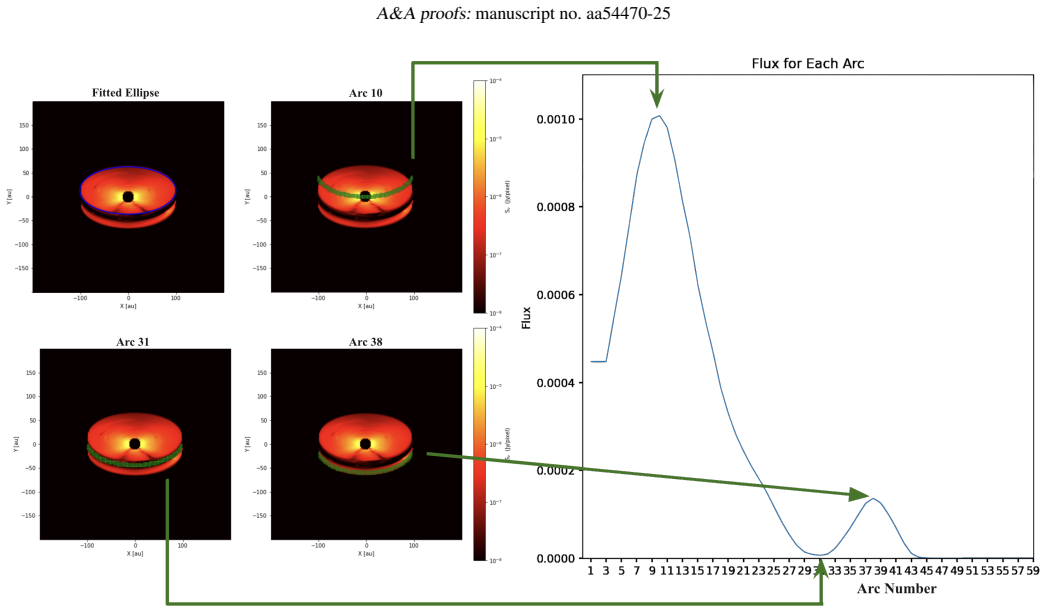
Three outer-edge prescriptions carry the argument: a cut-off disk whose surface density stops abruptly at $R_\mathrm{out}$, a tapered disk following the Lynden-Bell--Pringle exponential decay $\Sigma(R)\propto R^{-\gamma}\exp[-(R/R_c)^{2-\gamma}]$, and an extended disk that adds a low-density outer component to a cut-off profile. Backside flux is quantified with a crescent-scan method in which an arc fitted to the front side is stepped through the image while the integrated flux is recorded; the backside appears as a secondary peak after a dark midplane dip. The physical quantity that decides visibility is the line-of-sight optical depth $\tau_{AB}=\kappa\,\Sigma_d(R')\,/\,\cos\theta$ through the outer disk toward the backside, which is zero for cut-off disks, below about 0.1 for tapered backsides that are detectable, and above roughly 1 when the backside is hidden. Model detection limits are calibrated against 1-$\sigma$ and 3-$\sigma$ noise levels measured from real $U_\phi$ polarimetric frames.
What would settle it
Rerun the tapered-disk parameter sequence with a cooler, less luminous T Tauri star (roughly $0.5\,M_\odot$, $4{,}000$ K) at inclinations of $30^\circ$--$60^\circ$: if any low-inclination tapered model shows a backside above the 3-$\sigma$ noise threshold, the claim that low-inclination backsides diagnose truncation would be weakened, since most observed disks host T Tauri stars. Observationally, take a low-inclination disk with a clearly detected backside and measure its outer-edge surface-density profile: a smooth exponential taper with no steepening beyond the scattering edge would contradict the diagnostic.
Extended reading notes
Core claim
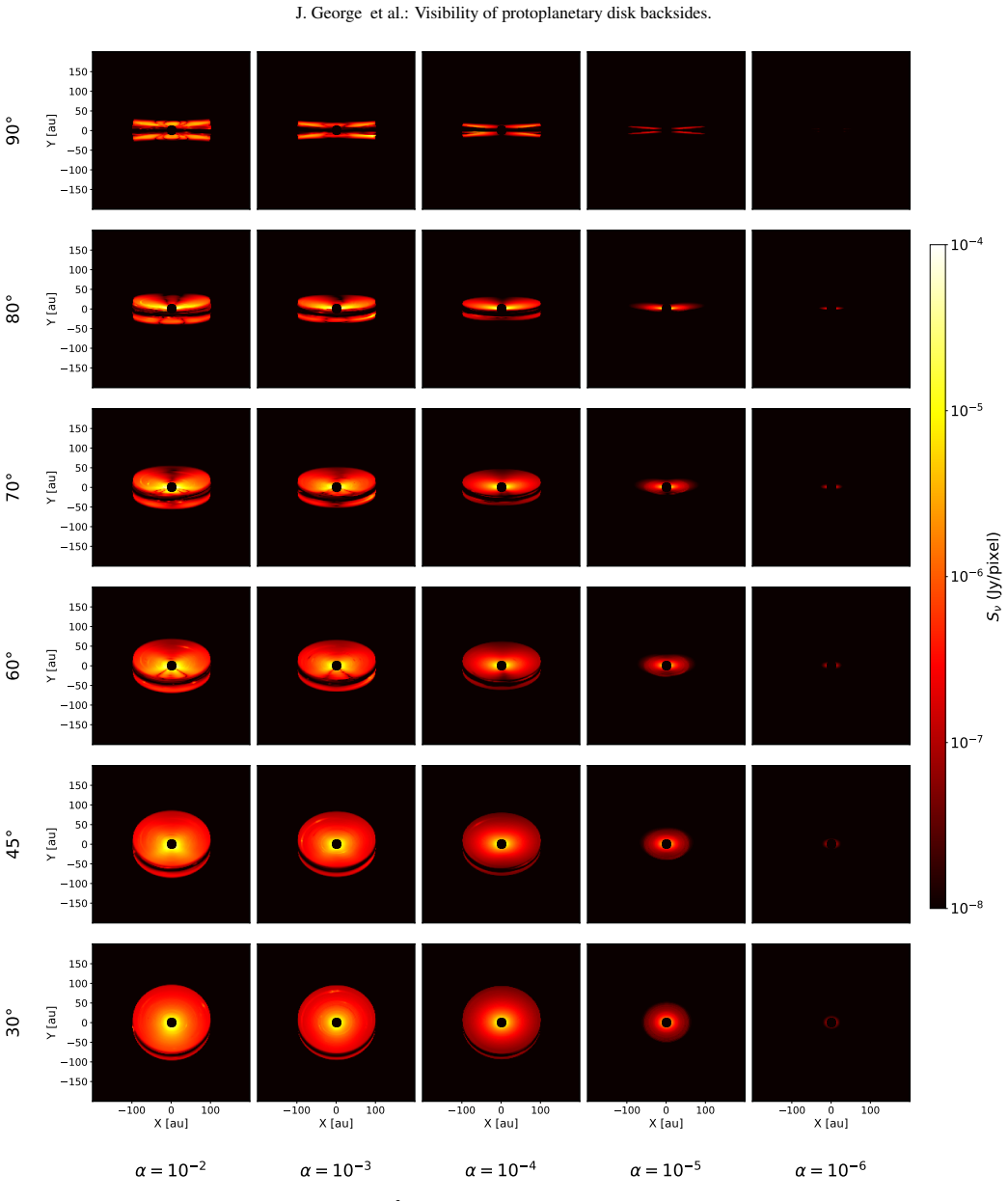
The central claim is that the visibility of a protoplanetary disk's backside in H-band polarized scattered light is set primarily by the outer-disk surface-density profile. In the tapered (Lynden-Bell--Pringle viscous) models, the exponential decay of $\Sigma(R)$ leaves enough dust along the inclined line of sight to attenuate backside-scattered light while remaining too tenuous to scatter it toward the observer, so the backside is obscured; in cut-off models the optical depth beyond the edge is zero, and the backside flux exceeds the tapered case by one to two orders of magnitude. Measured against noise thresholds derived from real polarimetric observations, backsides of tapered disks fall below the 3-$\sigma$ level at inclinations of $45^\circ$ and $30^\circ$, whereas cut-off backsides remain detectable. The paper concludes that disks with visible backsides at low inclinations could indeed be cut-off, that is, truncated disks, with genuine truncation attributable to close encounters, dynamical interactions, or external photoevaporation.
Load-bearing premise
The load-bearing premise is that the star's properties can be fixed at one value ($2.4\,M_\odot$, $2.4\,R_\odot$, $10{,}000$ K) because stellar luminosity changes only the overall signal-to-noise ratio, not the relative visibility of the front and back sides; since the disk's vertical thickness and flaring angle depend on the temperature of stellar irradiation, the conclusions are carried over to cooler T Tauri stars without running those models.
Editorial extensions
If this is right
- A secure backside detection in a disk inclined below about $60^\circ$ becomes a truncation candidate, motivating searches for flybys, companions, or external photoevaporation as the cause.
- Viscous, exponentially tapered disks should rarely show backsides, which matches the observed rarity of backside features in roughly 18 of about 200 scattered-light disks.
- The one to two order-of-magnitude gap in backside flux between cut-off and tapered models gives observers a quantitative expectation for how bright a backside should be when the edge is sharp.
- A tenuous outer extension with only half the inner disk's surface density can entirely hide the backside, so an undetected backside does not by itself prove that a disk is smoothly tapered.
- Observed low-inclination backside disks such as IM Lup and PDS 111 are, under this interpretation, likely truncated, with external photoevaporation favored for IM Lup and a dynamical perturber for PDS 111.
Reading between the lines
- The stellar-parameter assumption is the point most worth testing: because the disk's scale height and flaring angle are set by the irradiation temperature of the star, the taper-hides-backside result was computed only for a $2.4\,M_\odot$, $10{,}000$ K star and may shift for the cooler T Tauri stars that host most observed disks.
- Backside visibility could be used as a cheap screening diagnostic on existing archival scattered-light images: a census of low-inclination backsides would yield a list of truncation candidates to verify with high-resolution ALMA continuum and gas observations.
- The optical-depth threshold ($\tau\approx0.1$--$1$) ties backside visibility to a measurable column density, suggesting that outer-disk mass estimates from CO or millimeter continuum could predict which disks should show backsides.
- If the diagnostic holds, it sharpens the solar-system comparison: the Kuiper Cliff would no longer be an isolated curiosity but one example of a class of truncated outer edges, distinguishable from the smooth viscous fade-out that characterizes most disks.
Editorial analysis
A structured set of objections, weighed in public.
Referee Report
Summary. The paper uses RADMC-3D radiative transfer simulations to investigate when the far side (backside) of an inclined protoplanetary disk is visible in scattered light, with the aim of using backside visibility as a diagnostic of the outer-edge structure. Three outer-density prescriptions are compared: sharp cut-off disks, exponentially tapered (Lynden-Bell–Pringle) disks, and cut-off disks surrounded by a low-density extended outer disk. The parameter study varies inclination, dust surface density, turbulence parameter α, surface-density power-law index γ, characteristic radius Rc, and outer-disk reduction factor, and it quantifies backside flux with a crescent-aperture method. The main conclusions are that tapered disks usually hide the backside, that visible backsides at low inclinations therefore favor truncated (cut-off) disks, and that outer-disk dust mass, settling, and stratification control the attenuation. The paper also adds realistic Uphi noise from IM Lup, MY Lup, and PDS 453 to estimate 1σ and 3σ detection thresholds and applies the diagnostic to IM Lup and PDS 111.
Significance. If the central diagnostic holds, it offers an observationally accessible way to identify outer-edge truncation in protoplanetary disks, with implications for spotting dynamical encounters and external photoevaporation. The study is a transparent forward-modeling parameter survey rather than an inversion, and it has the strength of comparing three clearly specified outer-edge prescriptions on a common grid, using a quantitative crescent-integration measurement and real observational noise files to set detection thresholds. The comparative statement that tapered disks obscure backsides more than cut-off disks is well supported by the simulation grid. However, the generalization of the low-inclination backside diagnostic to low-mass T Tauri stars rests on an unverified invariance assumption about stellar parameters, which limits the domain of validity of the headline conclusion until that assumption is tested.
major comments (2)
- [Section 4 (p. 6), Eqs. (14)–(15) and §5.2] The claim that 'the visibility of the backside is related to the stellar luminosity only insofar as the overall S/N of the image depends on it, but not the relative visibility of front and backsides' is not a consequence of the model equations. In Eq. (15), T_disk ∝ (L*/r^2)^(1/4), and Eq. (3) sets h_p = c_s/Ω, so h_p/r depends on L* and M* separately through both the temperature and the Keplerian frequency. The settling profile in Eq. (11) also depends on h_p. The entire parameter study uses M* = 2.4 M_sun, R* = 2.4 R_sun, T* = 10,000 K, yet the conclusions are applied in §5.2 to T Tauri stars (IM Lup at 48°, GM Aur at 55°, DG Tau at 31°). A cooler, smaller star changes the flaring geometry and the optical depth along the backside line of sight (Eq. (29)), and with α_irr fixed at 0.05 this could plausibly move a tapered disk across the detection threshold shown in Fig. 10. I ask the authors to either rerun the key low-inclination cases for representative T Tauri parameters (e.g., M* ~ 1 M_sun, R* ~ 1-2 R_sun, T* ~ 4000 K) or explicitly restrict the conclusion to intermediate-mass stars.
- [§5.1 and Figs. 5–8] The detectability criterion is not applied consistently. The heat maps in Figs. 5 and 6 classify a backside as detected or not based on the 'absence of secondary peak' in the crescent integrated-flux plot (Fig. 3), which is a visual criterion. In §5.1 the authors quantify detection by comparing integrated backside flux against a 3σ threshold derived from real Uphi noise. These two criteria need not agree: a secondary peak can be present even when the integrated flux falls below the 3σ threshold, and noise can create spurious peaks. Since the central conclusion that tapered disks hide backsides at low inclination is based on the black cells in the heat maps, the manuscript should state explicitly which criterion defines those cells and should show that the qualitative conclusions are robust to using the quantitative 3σ criterion instead.
minor comments (5)
- [Throughout] The unit 'Janksy' appears repeatedly (e.g., §5.1 and Fig. 8); this should be 'Jansky'.
- [Introduction] There is a typo: 'coronaraphy' should be 'coronagraphy'.
- [§5.1, Eq. (22)] The conversion from Jy/arcsec² to Jy/pixel using σ_total = σ√N is not self-evident; converting surface brightness to flux per pixel normally requires multiplying by the pixel solid angle. Please clarify the definition of σ, N, and how σ_total is used in Fig. 8.
- [Figs. 5 and 6] Several heat-map cells are empty (e.g., Fig. 5 left panel at 30° for α = 10^-2 and 10^-3; Fig. 6 left panel at 45° and 60° for some γ). Please state whether these are cases without a detected backside that were omitted from the numerics or cases that were not simulated.
- [§5.3] The discussion of IM Lup cites CO extending beyond the millimeter continuum as evidence of external photoevaporation, but the relationship between gas extension and a sharp dust edge would benefit from an explicit statement of how the dust surface-density profile is inferred to be truncated.
Circularity Check
No significant circularity: this is a forward-modeling parameter study whose diagnostic conclusion is inferred from independently constructed model families and external noise measurements, not from fitted inputs.
full rationale
The paper does not fit any parameter to the observed backside detections it interprets. It constructs three physically motivated outer-disk density structures (cut-off, tapered, extended), solves the radiative transfer with RADMC-3D, and compares the resulting backside integrated flux against detection thresholds derived from real U_phi noise files (Sec. 5.1, Eq. 22). The central claim that low-inclination backside detections favor truncated disks is an inference from the relative fluxes of the model families (Figs. 5, 6, 8), not a quantity that equals its inputs by construction. The temperature and scale-height relations in Secs. 2.1-2.4 are standard radiative-equilibrium physics with external citations; the presence of a co-author citation (Dullemond & Dominik 2004) for the dust-settling equation is not load-bearing for the paper's diagnostic claim. The only notable limitation is the explicit assumption in Sec. 4 that stellar luminosity affects only overall S/N and not the relative visibility of front and backsides; this is an untested generalization to T Tauri stars, but it is a domain-of-validity assumption rather than a circular reduction. Accordingly, the derivation chain is self-contained and non-circular.
Assumptions & free parameters
free parameters (10)
- Stellar mass, radius, effective temperature =
M*=2.4 Msun, R*=2.4 Rsun, T*=10000 K
- Flaring irradiation incidence angle alpha_irr =
0.05 rad
- Dust surface density normalization =
Sigma0 = 1 or 10 g/cm^2 at Rc = 1 AU (cut-off); Sigma_c = 1 g/cm^2 at Rc (tapered)
- Surface density power-law index gamma =
gamma = 0.25 to 1.25 (tapered), 1.0 (cut-off)
- Characteristic radius Rc =
25 and 50 AU (tapered)
- Turbulence parameter alpha (Shakura-Sunyaev) =
10^-2 to 10^-6
- Dust size distribution =
MRN: n(a) ~ a^-3.5, a = 0.05 to 2000 micron, 15 discrete sizes
- Outer radii and extended-disk reduction factor =
R_out = 100 AU (cut-off), 500 AU (extended); outer disk surface density reduced by factors 1/2 to 1/20
- Coronagraph radius =
92.5 mas (12.95 AU)
- Crescent measurement aperture thickness =
4 pixels (8 AU)
assumptions (6)
- domain assumption Axisymmetric, vertically isothermal disk in hydrostatic equilibrium with Gaussian density profile (Eqs. 1-4).
- domain assumption Dust vertical settling balanced by turbulent diffusion with constant diffusion coefficient and Schmidt number of order unity (Eqs. 9-11).
- domain assumption Dust scattering treated with MRN size distribution and DIANA amorphous pyroxene + carbon opacities (Section 3.2).
- ad hoc to paper Backside visibility is independent of stellar parameters except overall signal-to-noise (Section 4, page 6).
- domain assumption PDI noise can be represented by averaged Uphi noise from three disks (IM Lup, MY Lup, PDS453) with sqrt(N) scaling to per-pixel values (Eq. 22).
- standard math Stokes-Mueller scattering formalism and radiative transfer as implemented in RADMC-3D (Section 3.1).
Cite this review
Pith. "Pith review of Peering through the veil: Investigating protoplanetary disk outer edges using backside visibility." pith.science (2026). https://pith.science/paper/GHLXGLDV
@misc{pith2026250603624,
  author       = {Pith},
  title        = {Pith review of: Peering through the veil: Investigating protoplanetary disk outer edges using backside visibility},
  year         = {2026},
  howpublished = {\url{https://pith.science/paper/GHLXGLDV}},
  note         = {Machine review of arXiv:2506.03624}
}
read the original abstract
Protoplanetary disks observed in scattered light reveal essential insights into the disk's three-dimensional architecture and dust properties. These disks, which play a crucial role in planet formation, have complex structures where the visibility of the disk's backside can vary significantly based on several parameters. This study aims to explore the factors impacting backside visibility in protoplanetary disks, particularly under variations in inclination, dust distribution, grain characteristics, and outer disk morphology. Using RADMC-3D radiative transfer simulations, we investigate how these variables influence the appearance of the backside in scattered light images. Tapered disk models with exponential tapers, frequently obscure the backside, which supports the rarity of observed backside features. In cases where backside features are visible at lower inclinations, they likely indicate cut-off disks, as backside detection is challenging in standard tapered models at these inclinations. Additionally, factors like dust mass, grain distribution, and disk material stratification play crucial roles in backside observability, affecting its potential detection in real observations. This study contributes to understanding the detectability of the backside in protoplanetary disks, with implications for refining observational strategies and interpreting backside features in scattered light images. These findings help frame backside visibility as a critical aspect of assessing disk structure and evolution.
Figures


Figures from the paper (7 more)


Forward citations
Cited by 1 Pith paper
-
WIde Separation Planets In Time (WISPIT): A Gap-clearing Planet in a Multi-ringed Disk around the Young Solar-type Star WISPIT 2
Direct imaging of the young star WISPIT 2 reveals a 380-au multi-ringed disk and a co-moving, gap-embedded companion consistent with a 4.9-MJup planet in Keplerian motion.
Reference graph
Works this paper leans on
-
[1]
Andrews, S. M. 2020, ARA&A, 58, 483
2020
-
[2]
Andrews, S. M., Wilner, D. J., Espaillat, C., et al. 2011, ApJ, 732, 42
work page 2011
-
[3]
M., Wilner, D
Andrews, S. M., Wilner, D. J., Hughes, A. M., Qi, C., & Dullemond, C. P. 2009, ApJ, 700, 1502
2009
-
[4]
P., Garufi, A., et al
Avenhaus, H., Quanz, S. P., Garufi, A., et al. 2018, ApJ, 863, 44
2018
-
[5]
2022, Optical and Near-infrared View of Planet-forming Disks and Protoplanets
Benisty, M., Dominik, C., Follette, K., et al. 2022, Optical and Near-infrared View of Planet-forming Disks and Protoplanets
work page 2022
-
[6]
2023, in Astronomical Society of the Pacific Conference Series, V ol
Benisty, M., Dominik, C., Follette, K., et al. 2023, in Astronomical Society of the Pacific Conference Series, V ol. 534, Protostars and Planets VII, ed. S. In- utsuka, Y . Aikawa, T. Muto, K. Tomida, & M. Tamura, 605
work page 2023
-
[7]
2015, A&A, 578, L6
Benisty, M., Juhasz, A., Boccaletti, A., et al. 2015, A&A, 578, L6
2015
-
[8]
Bernstein, G. M., Trilling, D. E., Allen, R. L., et al. 2004, AJ, 128, 1364
work page 2004
Show all 53 references
-
[9]
2016, A&A, 594, A53
Bhandare, A., Breslau, A., & Pfalzner, S. 2016, A&A, 594, A53
2016
-
[10]
2024, ARA&A, 62, 157
Birnstiel, T. 2024, ARA&A, 62, 157
2024
-
[11]
Brown, A. G. A., Vallenari, A., Prusti, T., et al. 2018, Astronomy and Astro- physics, 616, A1
2018
-
[12]
2011, Experimental Astronomy, 30, 39
Carbillet, M., Bendjoya, P., Abe, L., et al. 2011, Experimental Astronomy, 30, 39
2011
-
[13]
1960, Radiative transfer
Chandrasekhar, S. 1960, Radiative transfer
1960
-
[14]
Chiang, E. I. & Goldreich, P. 1997, The Astrophysical Journal, 490, 368–376
1997
-
[15]
I., Öberg, K
Cleeves, L. I., Öberg, K. I., Wilner, D. J., et al. 2016, ApJ, 832, 110
2016
-
[16]
Coleman, G. A. L. & Haworth, T. J. 2022, MNRAS, 514, 2315
2022
-
[17]
2018, Monthly Notices of the Royal Astronomical Society, 483, 4114–4139
Cuello, N., Dipierro, G., Mentiplay, D., et al. 2018, Monthly Notices of the Royal Astronomical Society, 483, 4114–4139
2018
-
[18]
2020, MNRAS, 491, 504 de Boer, J., Ginski, C., Chauvin, G., et al
Cuello, N., Louvet, F., Mentiplay, D., et al. 2020, MNRAS, 491, 504 de Boer, J., Ginski, C., Chauvin, G., et al. 2021, A&A, 649, A25 de Boer, J., Salter, G., Benisty, M., et al. 2016, A&A, 595, A114 de Regt, S., Ginski, C., Kenworthy, M. A., et al. 2024, A&A, 684, A73
2020
-
[19]
2024, A&A, 688, A149
Derkink, A., Ginski, C., Pinilla, P., et al. 2024, A&A, 688, A149
2024
-
[20]
2021, OpTool: Command-line driven tool for creating complex dust opacities, Astrophysics Source Code Library, record ascl:2104.010
Dominik, C., Min, M., & Tazaki, R. 2021, OpTool: Command-line driven tool for creating complex dust opacities, Astrophysics Source Code Library, record ascl:2104.010
2021
-
[21]
Dullemond, C. P. & Dominik, C. 2004, A&A, 421, 1075
2004
-
[22]
P., Dominik, C., & Natta, A
Dullemond, C. P., Dominik, C., & Natta, A. 2001, ApJ, 560, 957
2001
-
[23]
& Nelson, R
Fromang, S. & Nelson, R. P. 2009, A&A, 496, 597 Gárate, M., Pinilla, P., Haworth, T. J., & Facchini, S. 2024, A&A, 681, A84
2009
-
[24]
2020, A&A, 633, A82
Garufi, A., Avenhaus, H., Pérez, S., et al. 2020, A&A, 633, A82
2020
-
[25]
2018, A&A, 620, A94
Garufi, A., Benisty, M., Pinilla, P., et al. 2018, A&A, 620, A94
2018
-
[26]
G., et al
Garufi, A., Ginski, C., van Holstein, R. G., et al. 2024, A&A, 685, A53
2024
-
[27]
2024, A&A, 685, A52
Ginski, C., Garufi, A., Benisty, M., et al. 2024, A&A, 685, A52
2024
-
[28]
2016, A&A, 595, A112
Ginski, C., Stolker, T., Pinilla, P., et al. 2016, A&A, 595, A112
2016
-
[29]
M., van der Marel, N., Williams, J
Guerra-Alvarado, O. M., van der Marel, N., Williams, J. P., et al. 2025, A&A, 696, A232
2025
-
[30]
2011, Experimental Astron- omy, 30, 59
Guerri, G., Daban, J.-B., Robbe-Dubois, S., et al. 2011, Experimental Astron- omy, 30, 59
2011
-
[31]
1998, ApJ, 495, 385
Hartmann, L., Calvet, N., Gullbring, E., & D’Alessio, P. 1998, ApJ, 495, 385
1998
-
[32]
J., Facchini, S., Clarke, C
Haworth, T. J., Facchini, S., Clarke, C. J., & Cleeves, L. I. 2017, MNRAS, 468, L108
2017
-
[33]
& Nelson, R
Ilgner, M. & Nelson, R. P. 2008, A&A, 483, 815
2008
-
[34]
M., & Sargent, A
Isella, A., Carpenter, J. M., & Sargent, A. I. 2010, ApJ, 714, 1746
2010
-
[35]
& Klahr, H
Johansen, A. & Klahr, H. 2005, ApJ, 634, 1353
2005
-
[36]
J., Harsono, D., et al
Long, F., Herczeg, G. J., Harsono, D., et al. 2019, ApJ, 882, 49
2019
-
[37]
& Pringle, J
Lynden-Bell, D. & Pringle, J. E. 1974, MNRAS, 168, 603
1974
-
[38]
2006, ApJ, 641, 556
Marois, C., Lafrenière, D., Doyon, R., Macintosh, B., & Nadeau, D. 2006, ApJ, 641, 556
2006
-
[39]
S., Rumpl, W., & Nordsieck, K
Mathis, J. S., Rumpl, W., & Nordsieck, K. H. 1977, ApJ, 217, 425
1977
-
[40]
C., & Kataoka, A
Miotello, A., Kamp, I., Birnstiel, T., Cleeves, L. C., & Kataoka, A. 2023, in As- tronomical Society of the Pacific Conference Series, V ol. 534, Protostars and Planets VII, ed. S. Inutsuka, Y . Aikawa, T. Muto, K. Tomida, & M. Tamura, 501
2023
-
[41]
A., Benisty, M., Ginski, C., et al
Muro-Arena, G. A., Benisty, M., Ginski, C., et al. 2020, A&A, 635, A121
2020
-
[42]
A., Hashimoto, J., et al
Muto, T., Grady, C. A., Hashimoto, J., et al. 2012, ApJ, 748, L22
2012
-
[43]
A., Monnier, J
Rich, E. A., Monnier, J. D., Aarnio, A., et al. 2022, AJ, 164, 109
2022
-
[44]
2023, A&A, 671, A82 Schräpler, R
Rigliaco, E., Gratton, R., Ceppi, S., et al. 2023, A&A, 671, A82 Schräpler, R. & Henning, T. 2004, ApJ, 614, 960
2023
-
[45]
Shakura, N. I. & Sunyaev, R. A. 1973, A&A, 24, 337
1973
-
[46]
2023, ApJ, 944, L43 Valegård, P
Tazaki, R., Ginski, C., & Dominik, C. 2023, ApJ, 944, L43 Valegård, P. G., Ginski, C., Derkink, A., et al. 2024, A&A, 685, A54 Valegård, P. G., Ginski, C., Dominik, C., et al. 2022, A&A, 668, A25
2023
-
[47]
Villenave, M., Benisty, M., Dent, W. R. F., et al. 2019, A&A, 624, A7
2019
-
[48]
2021, A&A, 648, A26
Wahhaj, Z., Milli, J., Romero, C., et al. 2021, A&A, 648, A26
2021
-
[49]
Weidenschilling, S. J. 1977, MNRAS, 180, 57
1977
-
[50]
J., Clarke, C
Winter, A. J., Clarke, C. J., Rosotti, G., et al. 2018, MNRAS, 478, 2700
2018
-
[51]
2016, A&A, 586, A103
Woitke, P., Min, M., Pinte, C., et al. 2016, A&A, 586, A103
2016
-
[52]
G., Perrin, M
Wolff, S. G., Perrin, M. D., Stapelfeldt, K., et al. 2017, ApJ, 851, 56
2017
-
[53]
S., Schlafly, E
Zucker, C., Speagle, J. S., Schlafly, E. F., et al. 2020, A&A, 633, A51 Appendix A: Model images from parameter studies This appendix contains the images of additional parameter stud- ies executed for the paper. For a discussion of the figures, see the main text of this paper....
2020
Reviewed August 7, 2026 · model on record in the stance chip above.
Discussion (0). Sign in to comment.